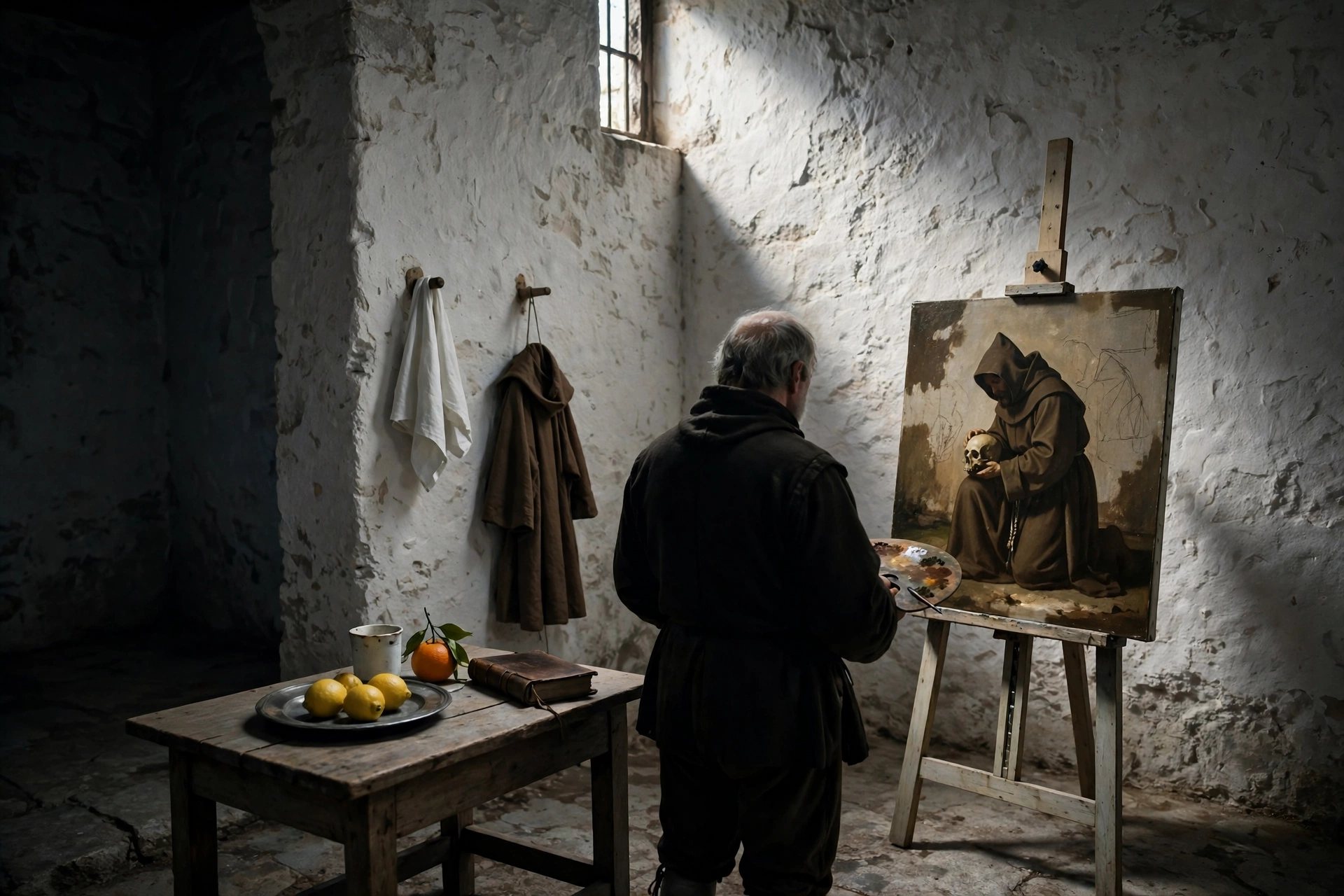
The painter of monks and silence: from a workshop in Seville, Zurbarán sent his severe, luminous saints to monasteries across Spain and the Americas. His cloth has the weight of carved wood, his light the clarity of a cell in the morning — and his still lifes make a lemon into an act of devotion.
Zurbarán built drapery the way a sculptor builds a statue: he studied real garments — monks' habits, linen, brocade — arranged over figures and lay models until the folds held their own architecture, then painted them fold by fold, plane by plane. A Zurbarán habit does not flow; it stands. You could carve his cloth in wood and it would keep its shape.
Earth pigments, black, and above all lead white: his colour is rationed like speech in a cloister. Whole canvases live on browns, greys and whites — and then a single red skirt, a basket of oranges, lands like a spoken word in a silent refectory. The restraint is not poverty of means; it is the discipline that makes the small colour burn.
His patrons were orders: Mercedarians, Franciscans, Carthusians, Dominicans, Hieronymites — contracts survive, specifying subjects, sizes, deadlines and prices for whole series of saints and founders to hang in refectories, sacristies and chapter houses. He ran Seville's most businesslike sacred workshop, and its crates also sailed for the monasteries of Spanish America.
No painter of the century paints white like Zurbarán: the Mercedarian habits of Saint Serapion, the Carthusians' robes, Veronica's cloth — lead white modulated with ochre, grey and black until white itself has shadow, weight and temperature. It is a technique of infinite patience: the brightest thing in the picture is built almost entirely from near-whites laid side by side.
His bodegones set a few objects on a shelf against total darkness and give each the attention of a portrait: a lemon's peel is a landscape, a cup holds the light like a small altar vessel. In a painter formed by monasteries, the still life became a discipline of looking — nothing in it is filler, everything is contemplated.
Zurbarán never crossed to Italy; the Caravaggist darkness reached him second-hand, through prints and the tenebrist canvases hanging in Seville and Madrid — and he made of it something more austere than the original: no drama of gesture, no theatrical diagonals, only a figure, a light, and a silence you can hear. The provinces, in his hands, out-prayed the capital.
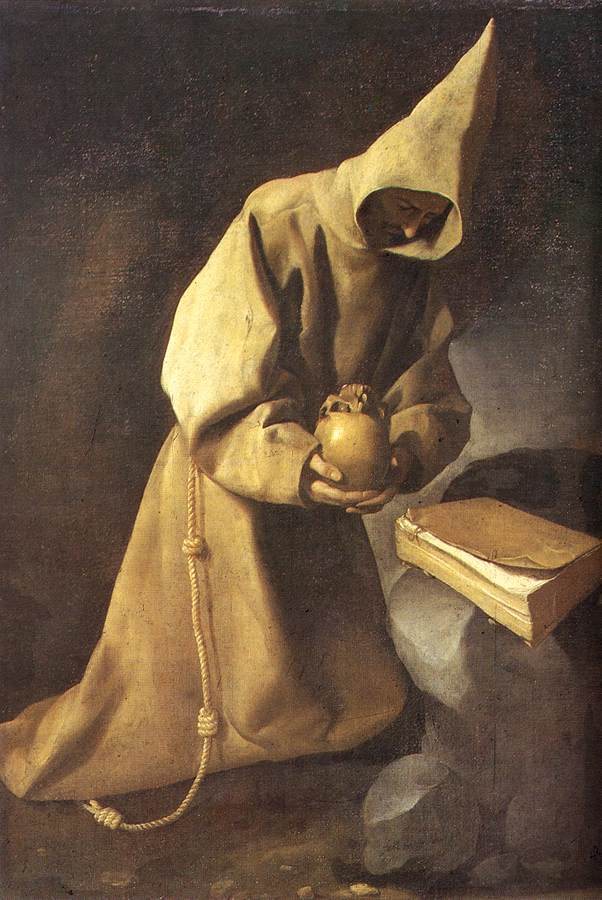
The saint kneels in the dark in his pointed hood, both hands clutching a skull to his breast, a book and a rock beside him. The habit is a tent of sculptured cloth and the face is lost in its shadow — Zurbarán paints prayer as something done by the whole body, in hiding, at night.
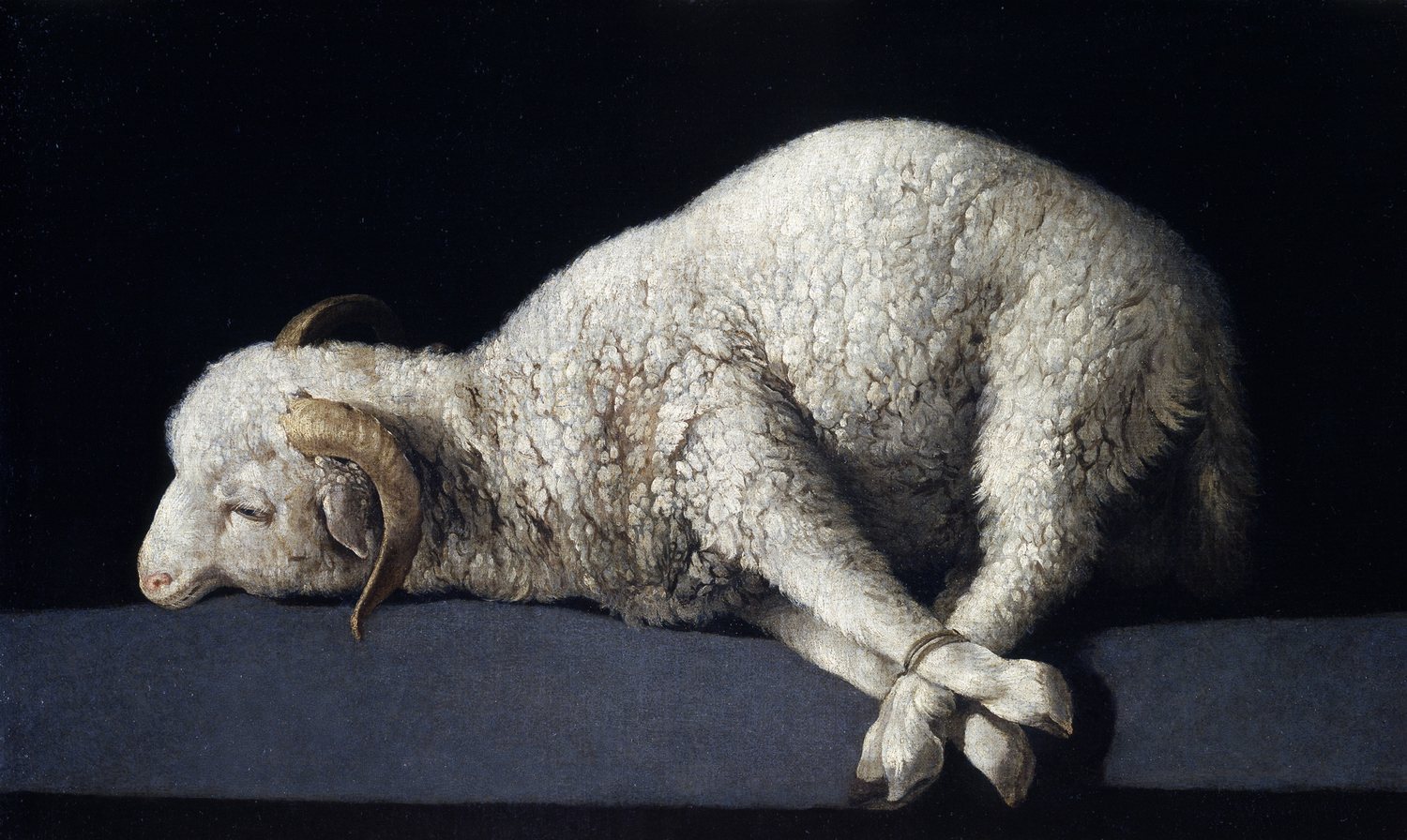
A young ram lies bound on a stone slab, its legs tied, its head lowered in an obedience the picture makes unbearable and beautiful at once. Painted with a naturalist's patience — every curl of the fleece is counted — it is a still life that is also a Passion: the Lamb of God, waiting.
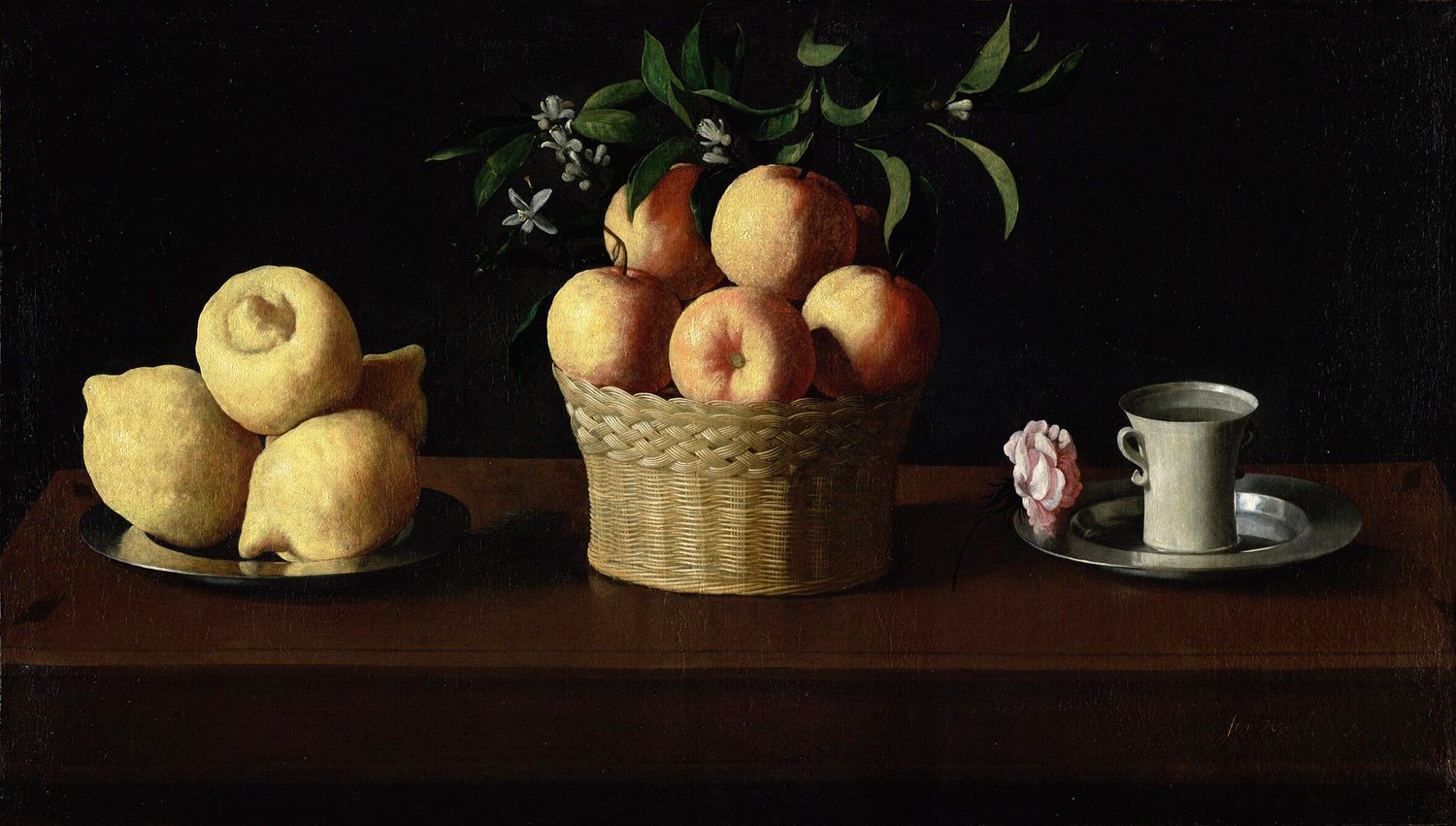
Lemons on a pewter plate, oranges in a basket with their blossom still on, a white cup with a single rose — arranged on a dark shelf like vessels on an altar. It is the only still life Zurbarán signed and dated, and it behaves like a religious picture that has dismissed its figures and kept the devotion.
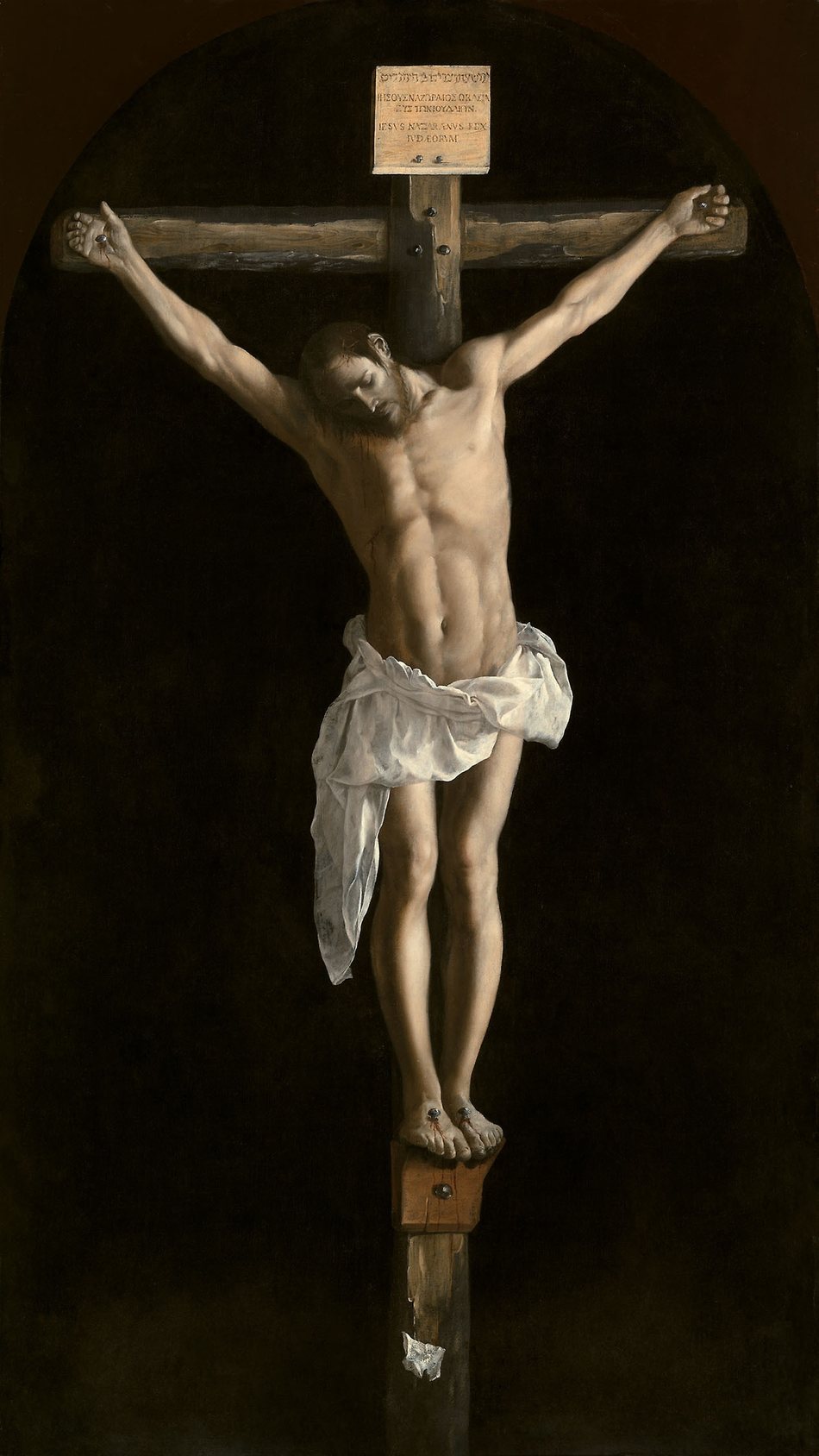
Painted when he was twenty-nine for a Dominican convent in Seville, it made his reputation overnight: the body rises out of total blackness lit like carved ivory, the feet set on the little step Spanish crucifixes required. Nothing moves, nothing pleads — the stillness itself is the theology.
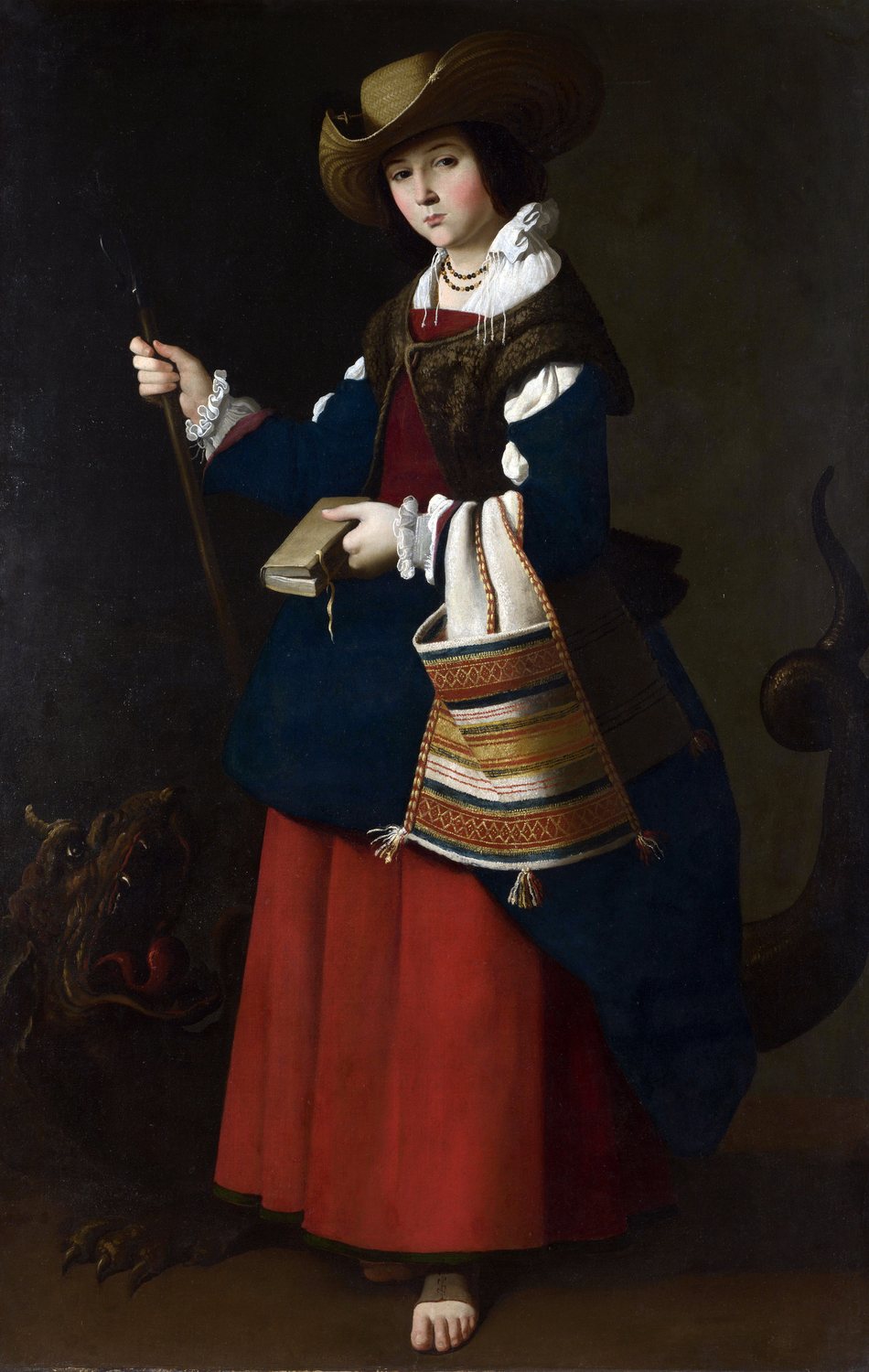
The saint comes dressed as a shepherdess of his own countryside — broad hat, staff, book in a woven bag, her little dragon waiting behind her skirts. Zurbarán's holy girls are village models in festival dress, and Margaret's calm, direct look makes the costume irrelevant: she is not dressed up as a saint, the saint is dressed as her.
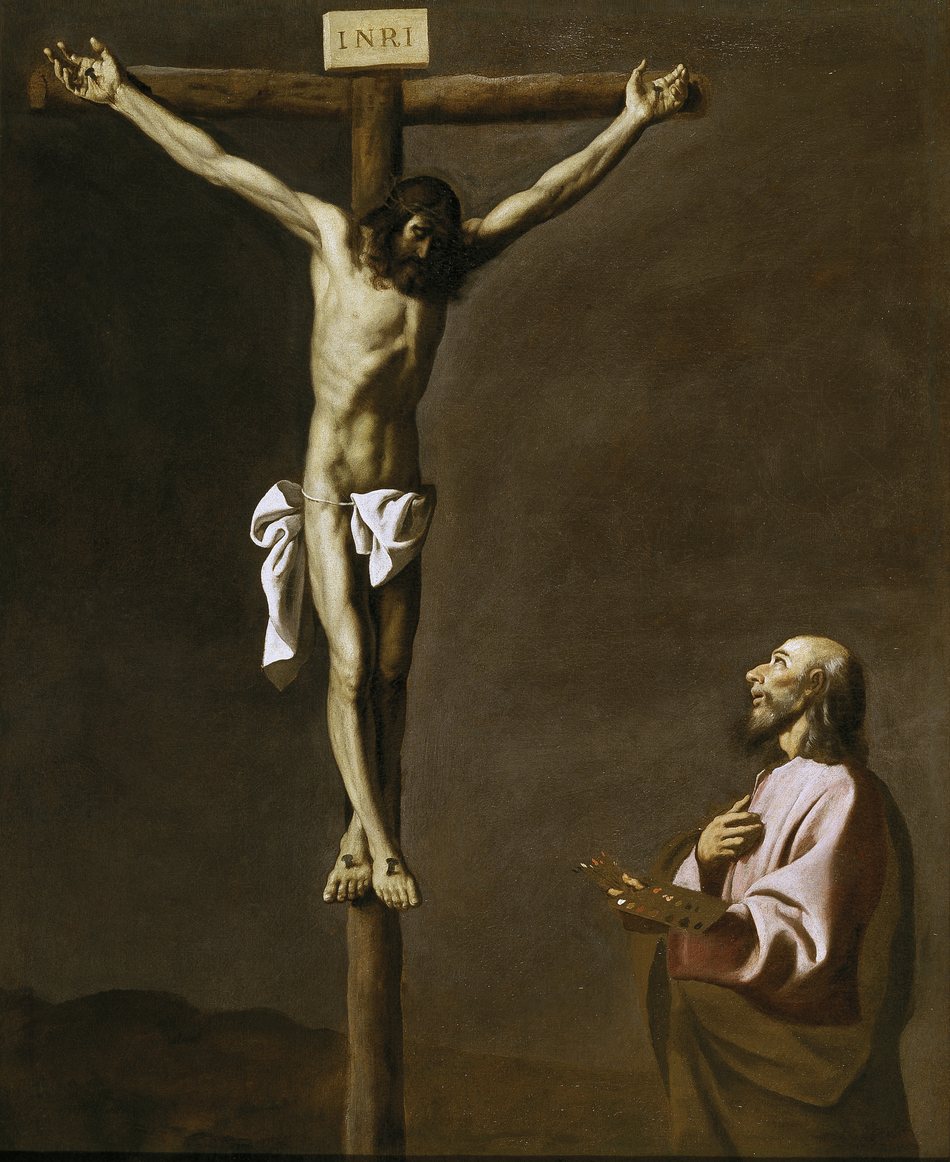
The evangelist, patron saint of painters, kneels with his palette before the crucifix he is painting — and the face under the raised hands is Zurbarán's own. It is the quietest self-portrait of the century: the artist not at his easel in glory, but at work on his knees, inside the picture's prayer.
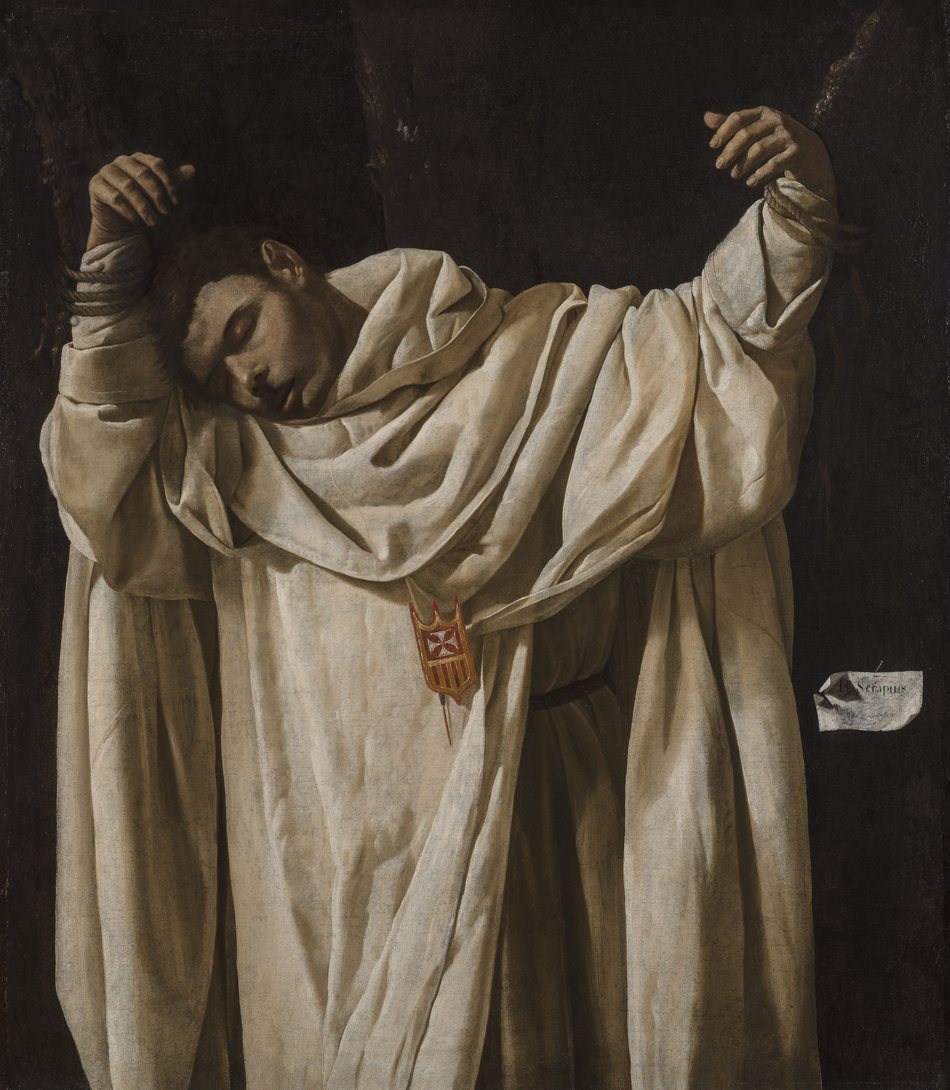
The martyred Mercedarian hangs by his bound wrists, his head fallen forward, and the white habit fills the canvas like a sail — the most famous white in Spanish painting. On the small paper pinned at the right, Zurbarán signed his name, as if pinning a note to the edge of grief.
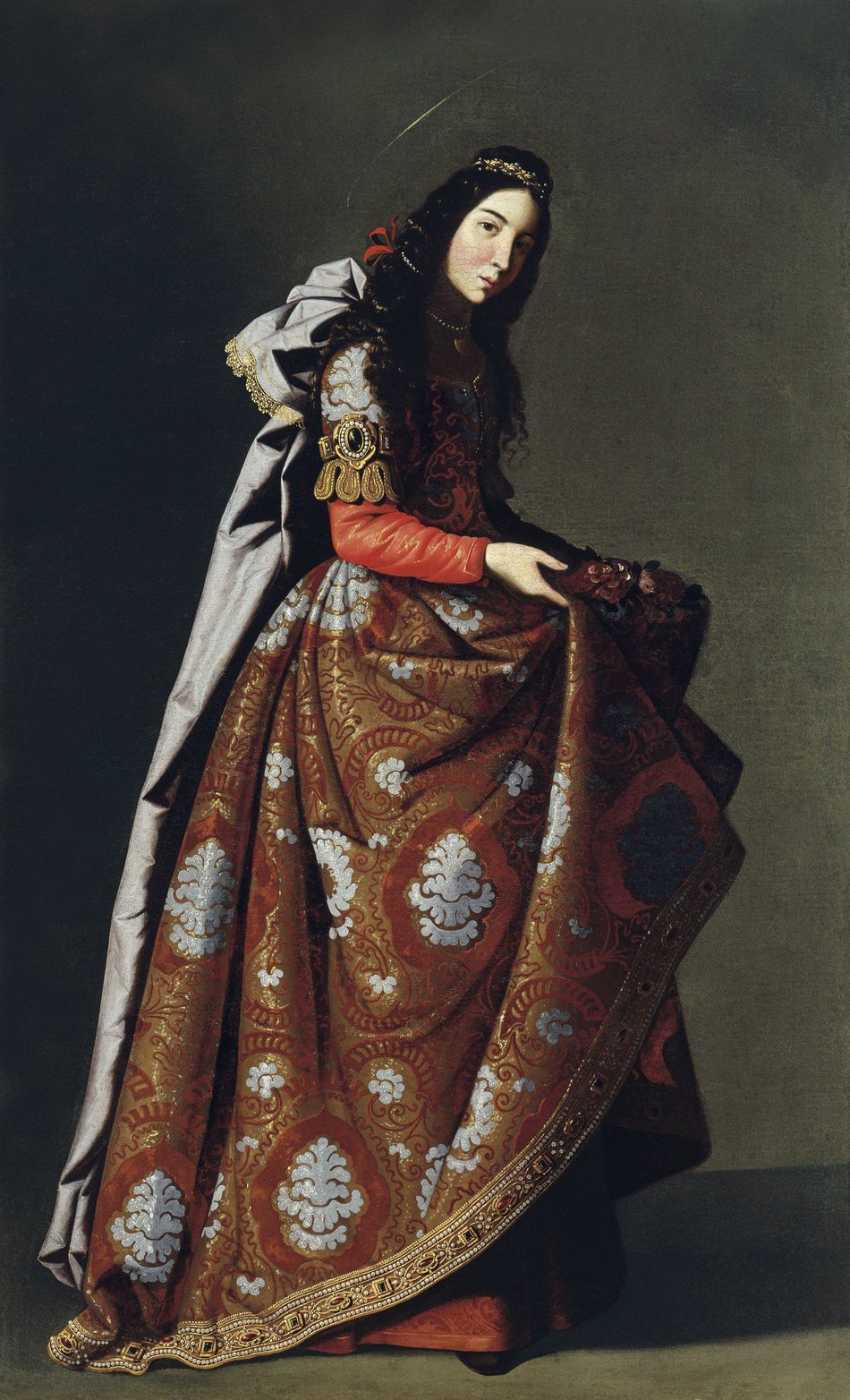
She lifts her brocade skirt to show the miracle: the bread she was carrying to Christian prisoners has turned into roses. The dress is the painting's second miracle — gold thread, silk and pattern rendered stitch by stitch, a whole treasury of cloth carried by a girl looking modestly down.
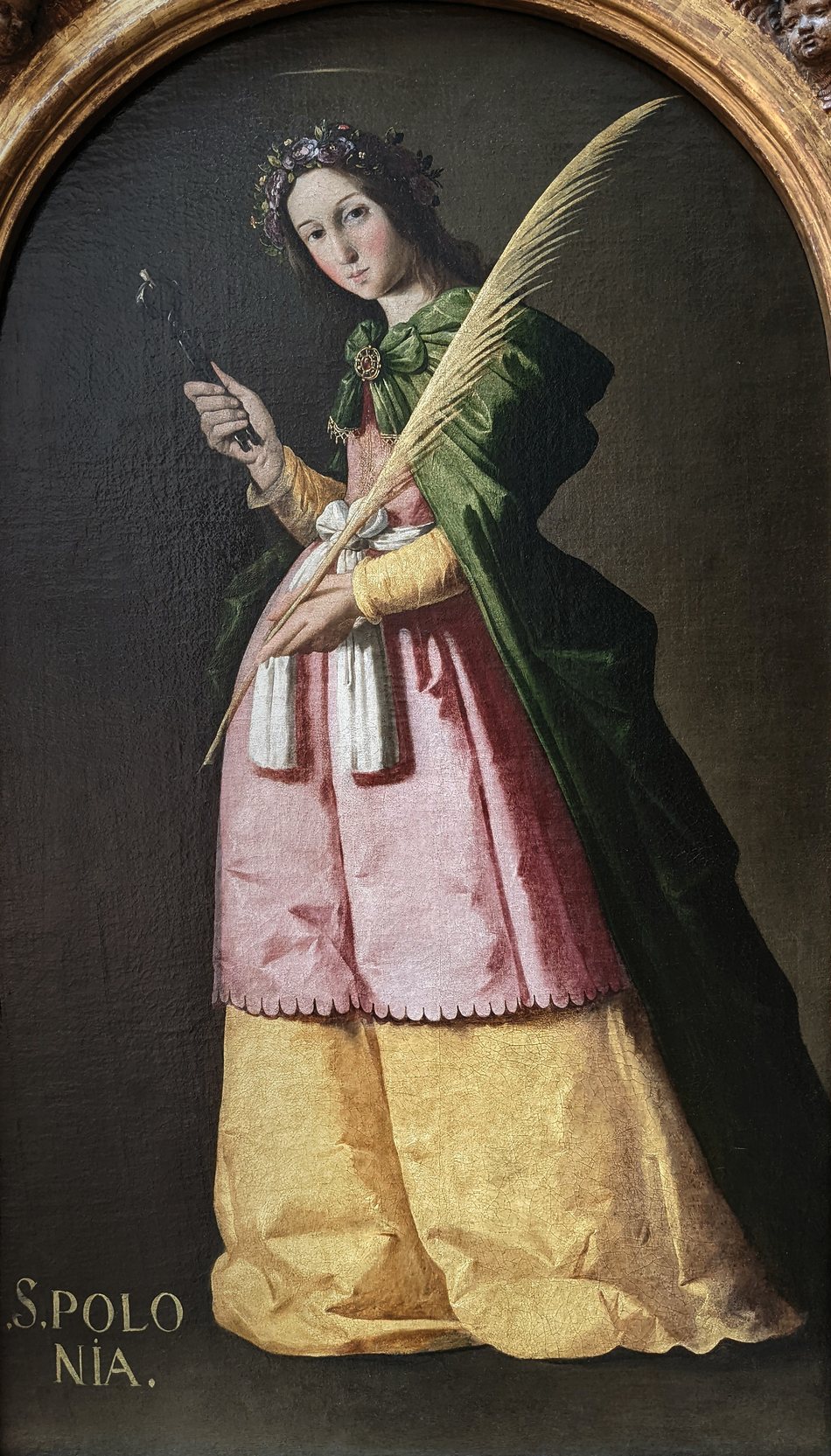
She stands in her arched niche like a statue that has decided to live — palm of martyrdom in one hand, the pincers that tore out her teeth in the other, her name inscribed beneath her feet. Zurbarán painted whole processions of these sainted girls; Apollonia, in green and rose, is among the most serene.
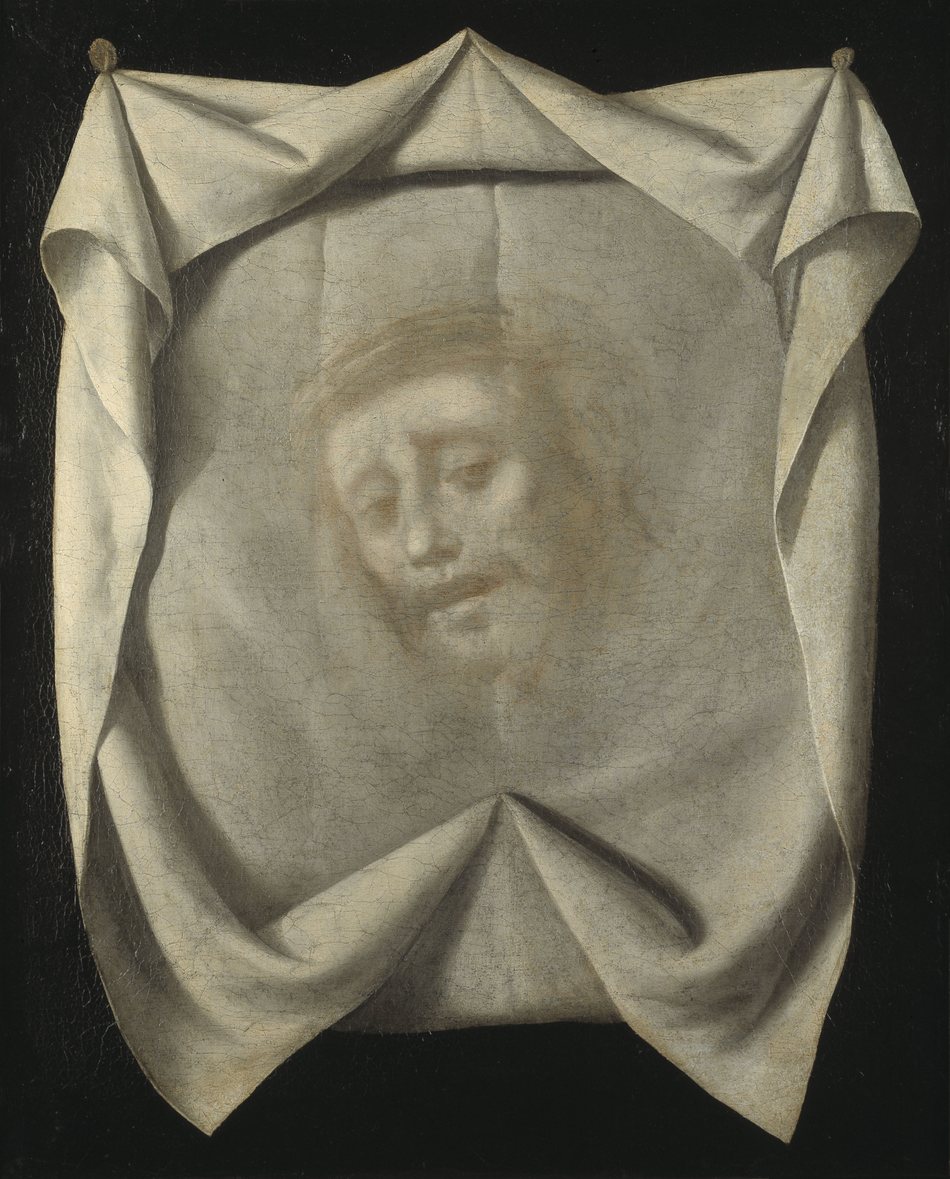
Nothing but a cloth, pinned at its corners against the dark, and on the cloth the faintest face — Christ's features left on Veronica's veil, painted so thinly the image seems to breathe through the linen. It is the boldest picture in this room: a painting of a picture, made of almost nothing.