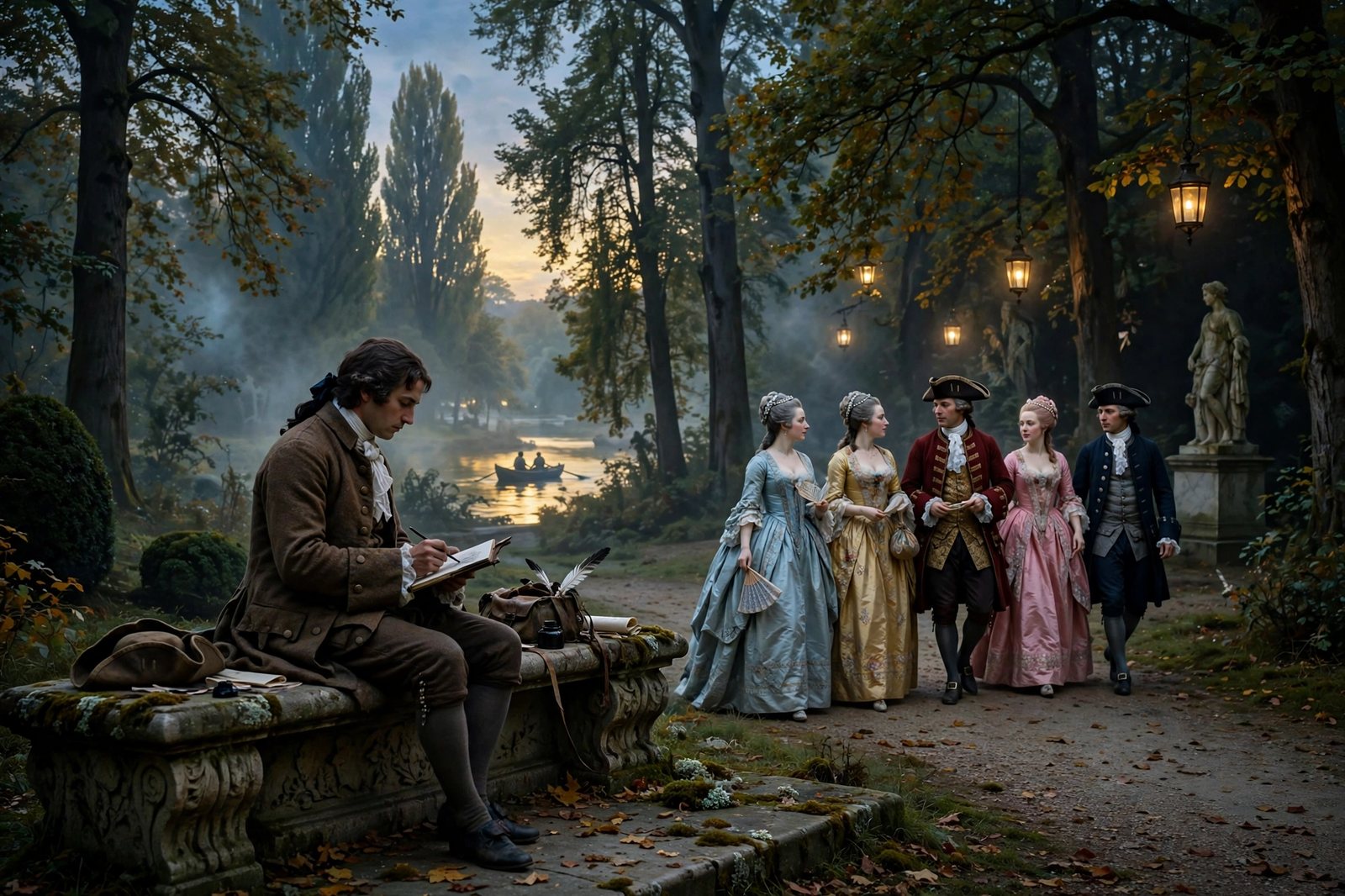
He arrived in Paris from Valenciennes with a draughtsman's hand and a theatre usher's knowledge of actors, and in barely fifteen years of painting — before consumption killed him at thirty-six — he invented a world: elegant people in parks at dusk, loving, hesitating, departing, in pictures where nothing happens and everything is felt.
His foundation was the trois crayons: red chalk, black stone and white chalk worked together on buff paper. With them he drew from life for years — models in the studio, actors, street musicians, soldiers — building albums of studies of heads, hands, draperies and whole figures that he treated as capital: a pose drawn once could be spent in three different paintings.
A Watteau canvas is cast, not found. Figures studied separately — sometimes years apart, sometimes from different models — are assembled on a stage of parkland and joined by glances, gestures and music rather than by action. The eye must choreograph them, which is why his scenes feel both arranged and utterly spontaneous: the drawing was alive before the composition was decided.
He kept his oil paint thin, mobile, almost dry — rubbed, scumbled and feathered over a warm ground so that silk shimmers without heavy impasto and foliage dissolves into trembling touches. The hand stays a draughtsman's: contours are breathed rather than drawn, and colours are 'broken' — pearl grey, silvery green, shot pink and blue — the palette of dusk rather than noon.
He learned figures in the workshop of Claude Gillot, designer for the Paris Opéra and obsessive draughtsman of the commedia dell'arte — hence the Harlequins, Mezzetins and Gilles who people his work — and in the Luxembourg Palace, copying Rubens' Medici cycle under Claude Audran III. Theatre gave him the poses; Rubens gave him the colour; the park was his own.
When the Academy received him in 1717 with the Cythera picture, it could not classify what he had brought: not history, not genre, not portrait. It invented a category for one man — the fête galante, the elegant outdoor entertainment. His recipe: real contemporary dress instead of costume, myth reduced to a golden statue and a boat, and emotion carried by posture — a turned head, a couple already walking away.
Tuberculosis made him fast and unsentimental. The Gersaint shop sign — a masterpiece nearly two metres wide — was painted in about a week, working mornings only, as a practical advertisement for his dealer friend; the canvas was later cut down from its original arched shop-front shape. He destroyed quantities of his drawings near the end, judging them as coldly as he had made them: the albums that survive are the ones friends rescued.
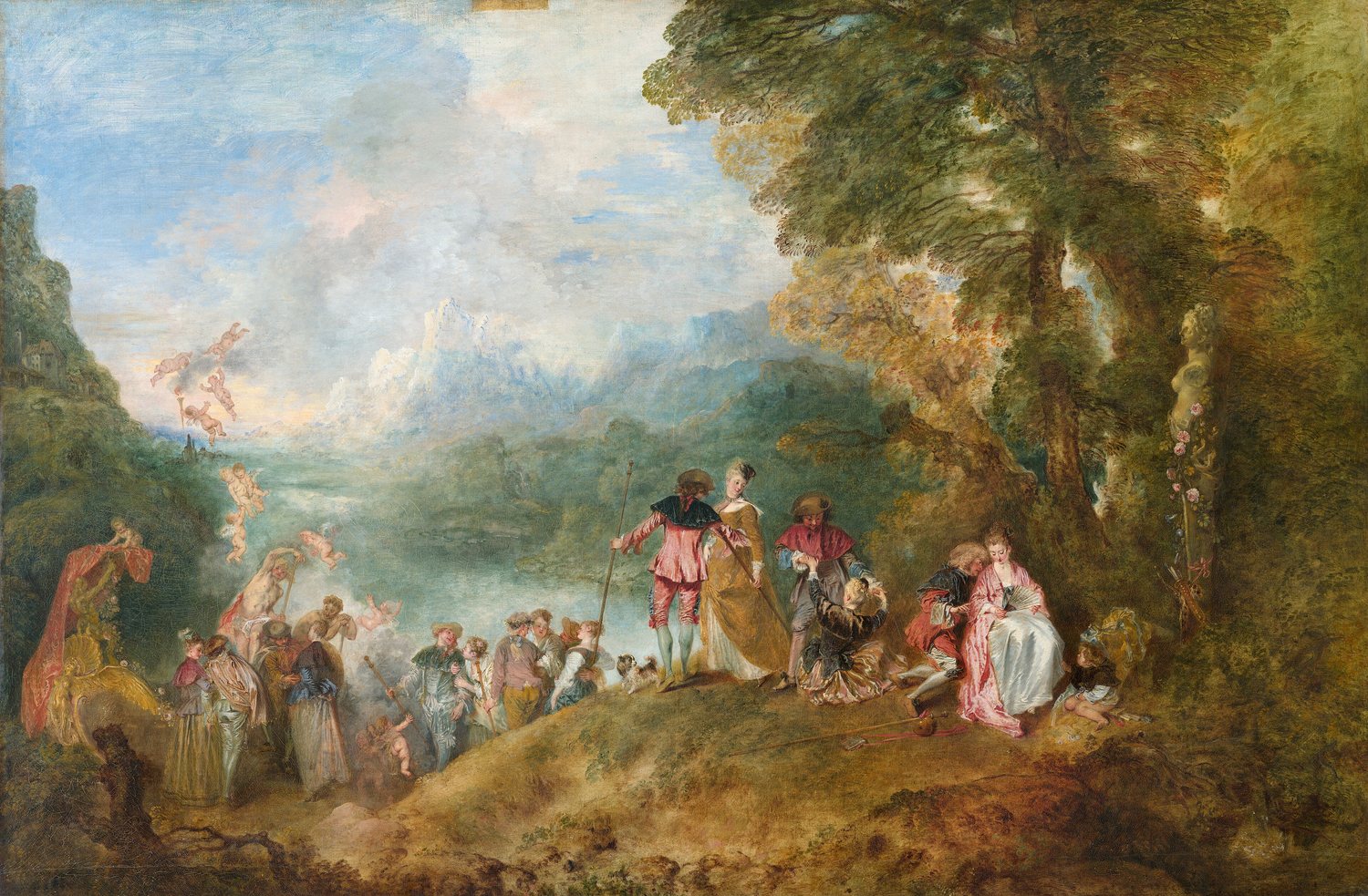
Couples who have paid their respects at the shrine of Venus drift down to the boat that will take them from the island of love — or bring them to it; Watteau leaves the direction deliciously undecided. His reception piece at the Academy, it forced the invention of a new genre, the fête galante, because nothing like it had existed before.
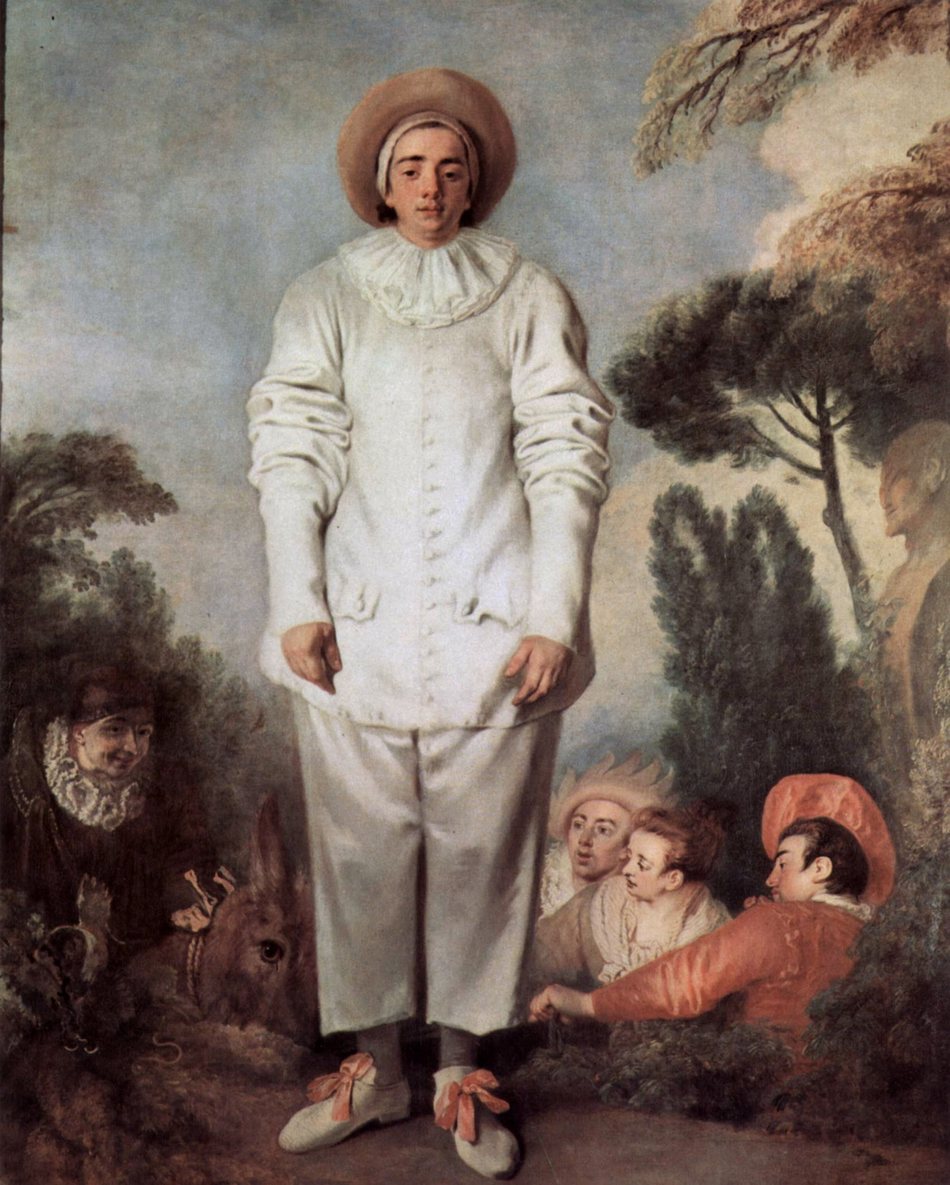
The white clown stands full-length at the front of the stage, arms hanging, donkey and fellow actors half-hidden behind him, and looks at us with an unreadable, slightly lost expression. Almost life-size and nearly monochrome, it may have served as a sign for a theatrical troupe — the saddest advertisement in art.
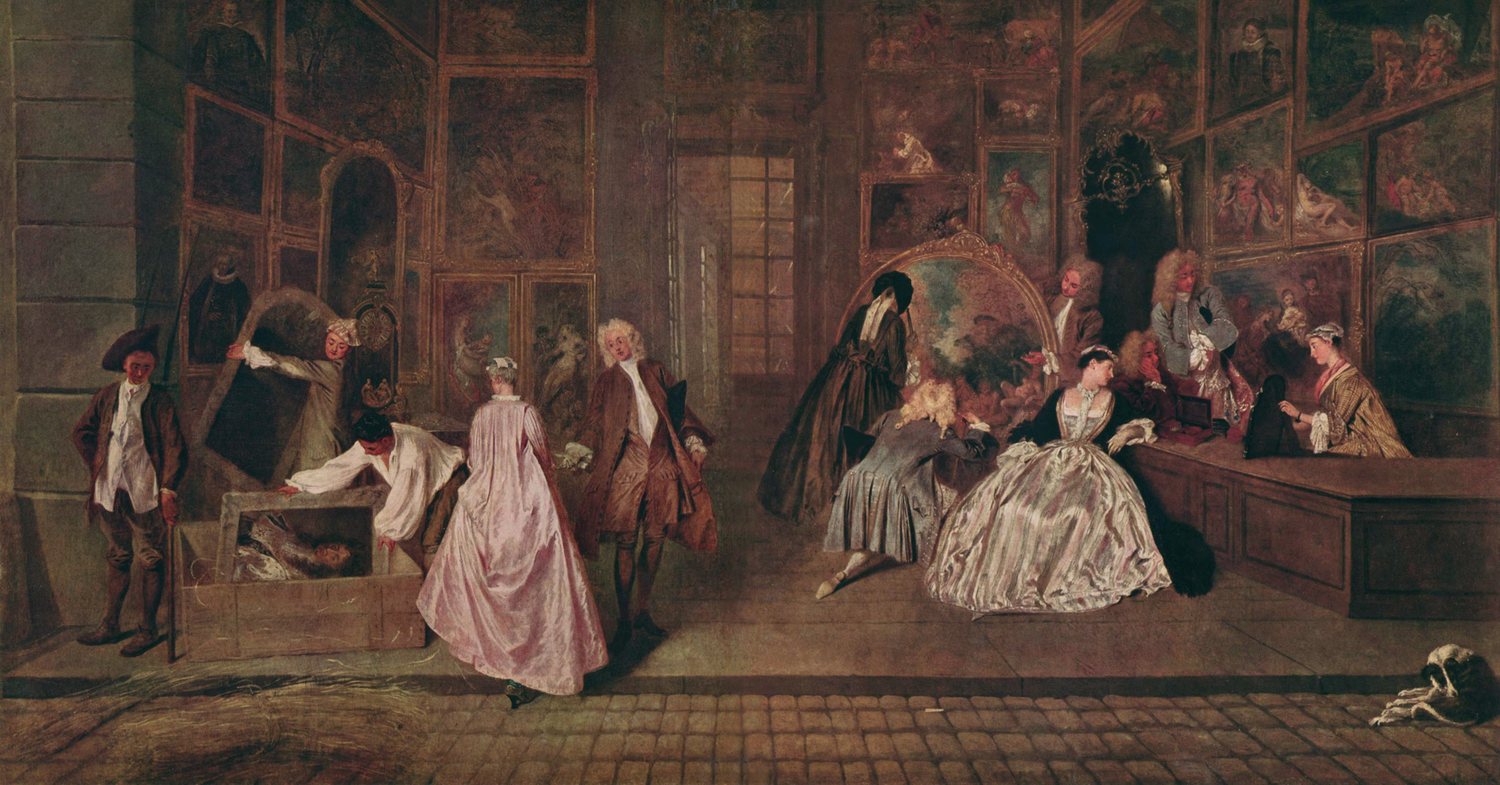
Inside a fashionable art shop, connoisseurs examine paintings while a portrait of Louis XIV is packed away into a crate — an era being stored. Painted in a handful of mornings as the actual sign of the dealer Gersaint, it was Watteau's last major work: a whole world of art, commerce and elegance folded into one calm interior.
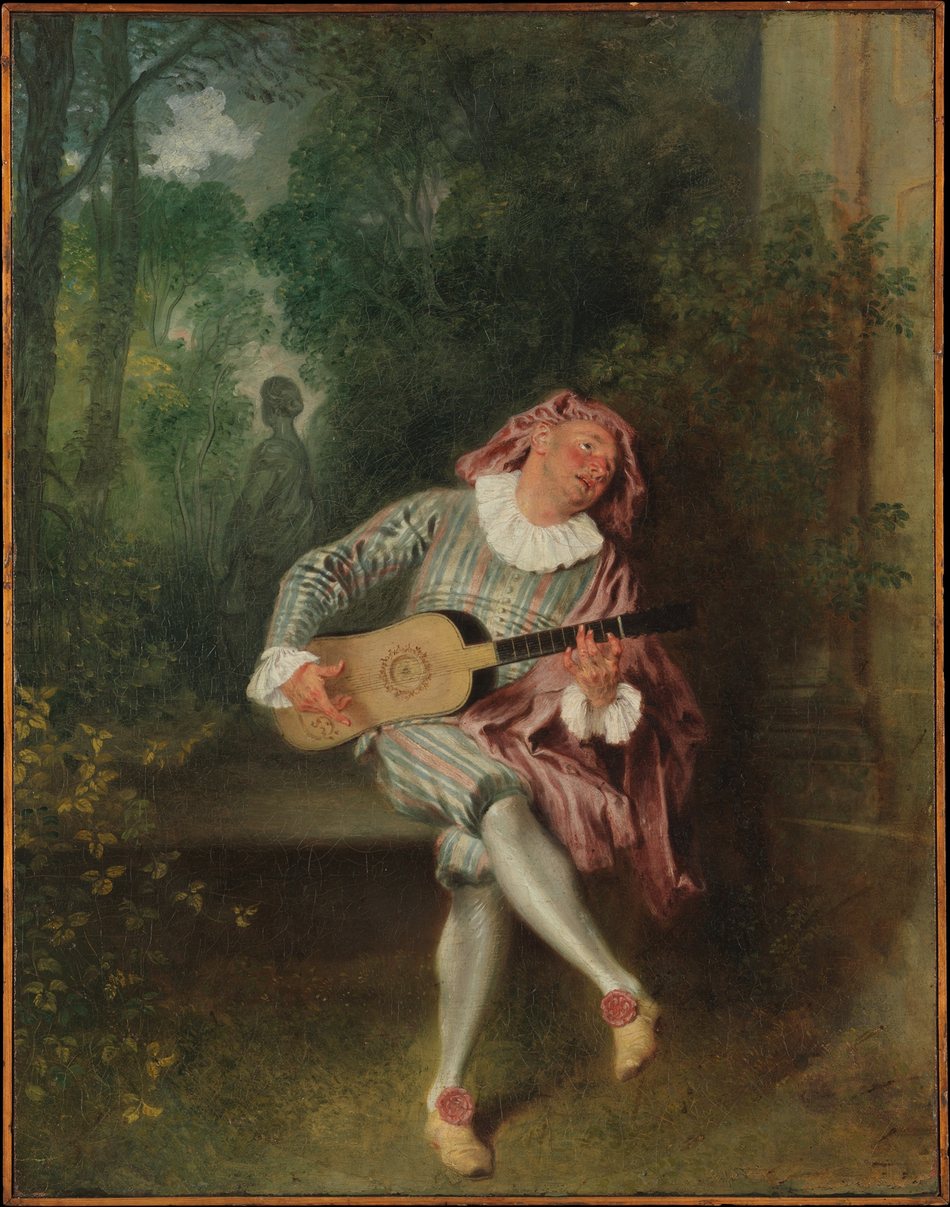
The commedia dell'arte musician sits alone on a garden bench, guitar in hand, head tilted to a song nobody else hears; a marble statue turns its back in the trees. One of Watteau's most concentrated pictures — a single figure, a bench, a garden — and the whole theatre of longing is in it.
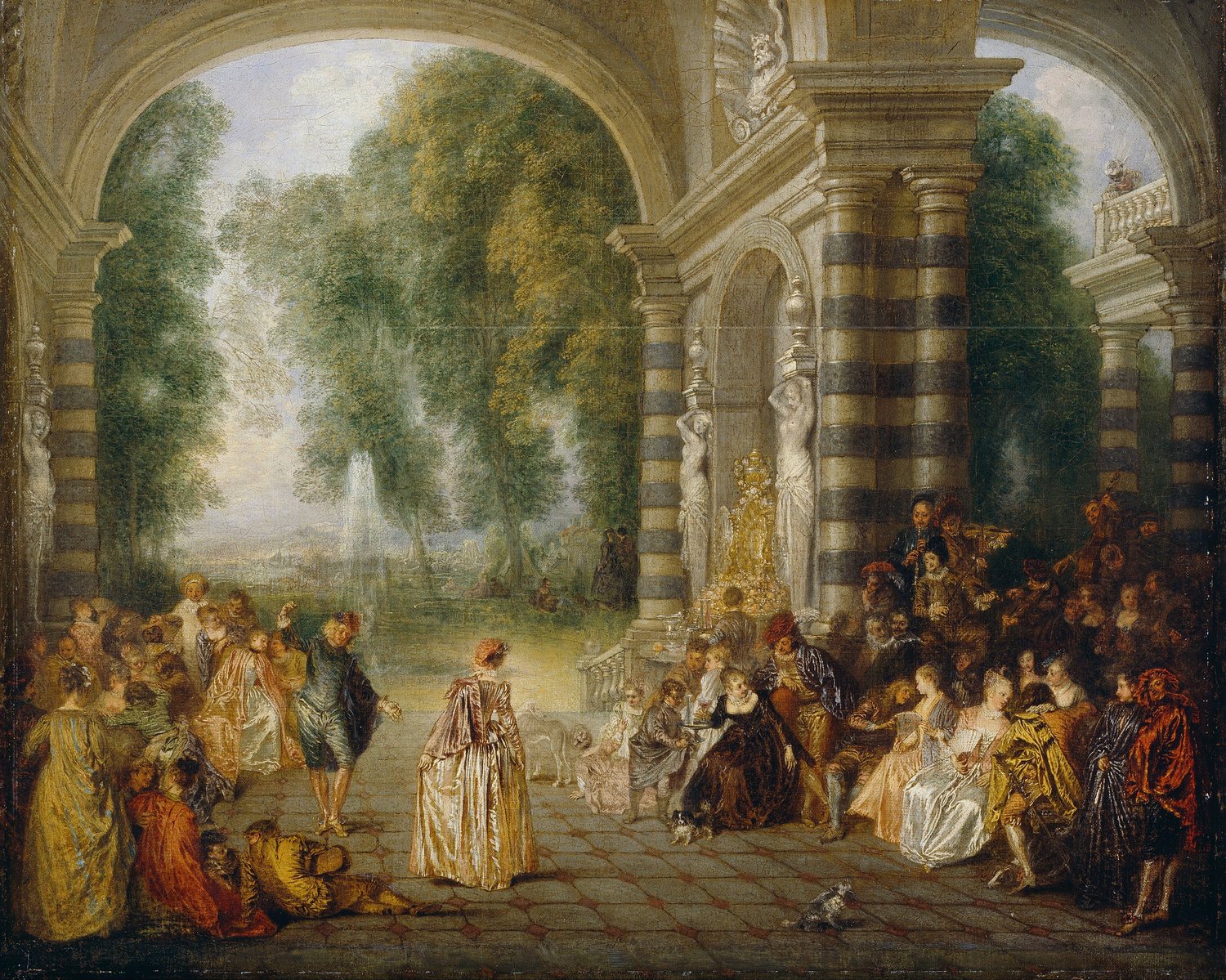
Under a great domed portico opening onto parkland, couples dance, flirt, play music and watch each other doing all three. It is the fête galante at its most sociable — dozens of small negotiations of desire, painted with a touch so light the whole crowd seems to breathe.
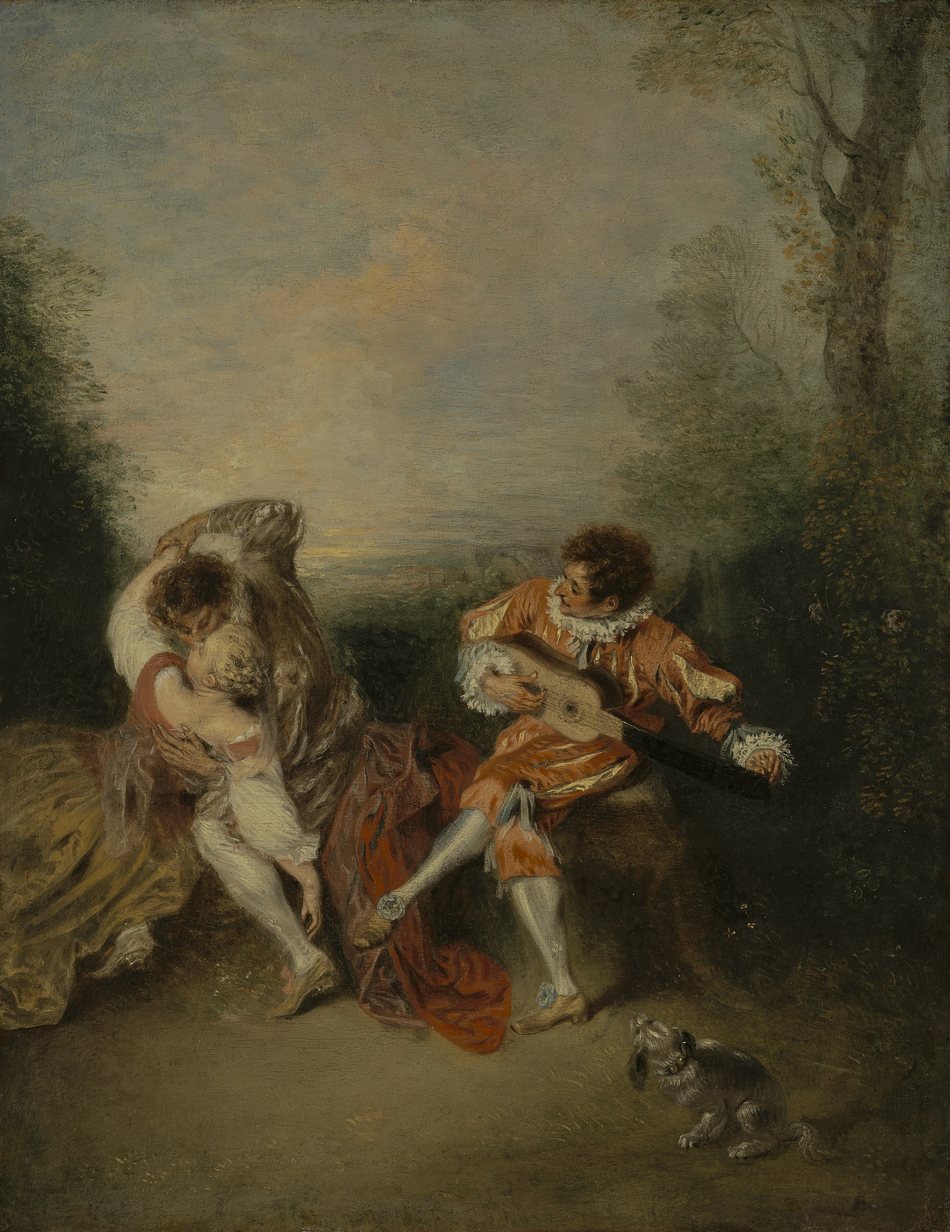
In a garden at the blue hour, Mezzetin with his guitar comes upon a pair of lovers embracing on the grass — and freezes, as do we. A tiny panel with the structure of a held breath: the picture makes voyeurs of its viewers and then forgives them with its beauty.
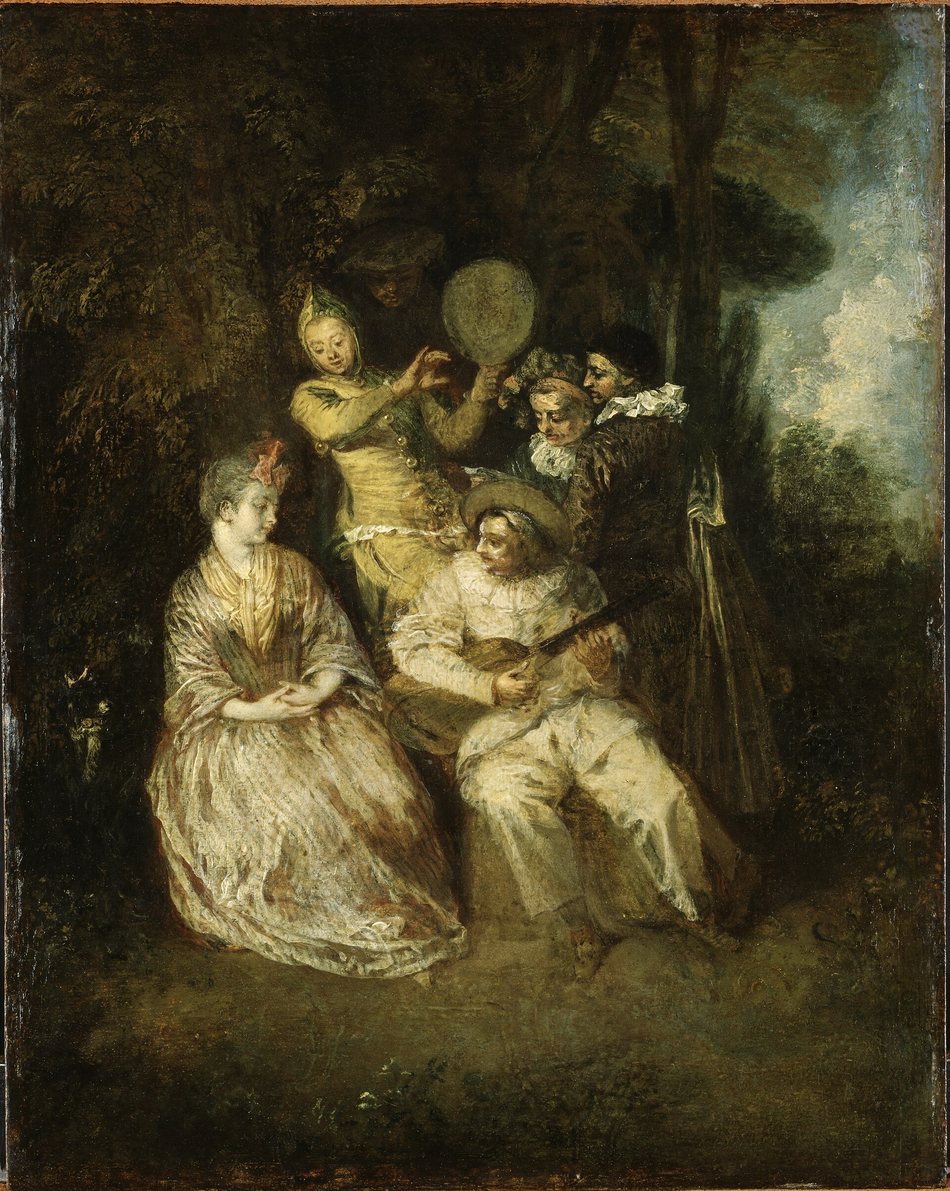
On a terrace between house and garden, a little company makes music in the dusk — a theorbist, singers, listeners already half in shadow. Watteau painted the moment after the concert has dissolved into conversation and before the evening has decided what it is about.
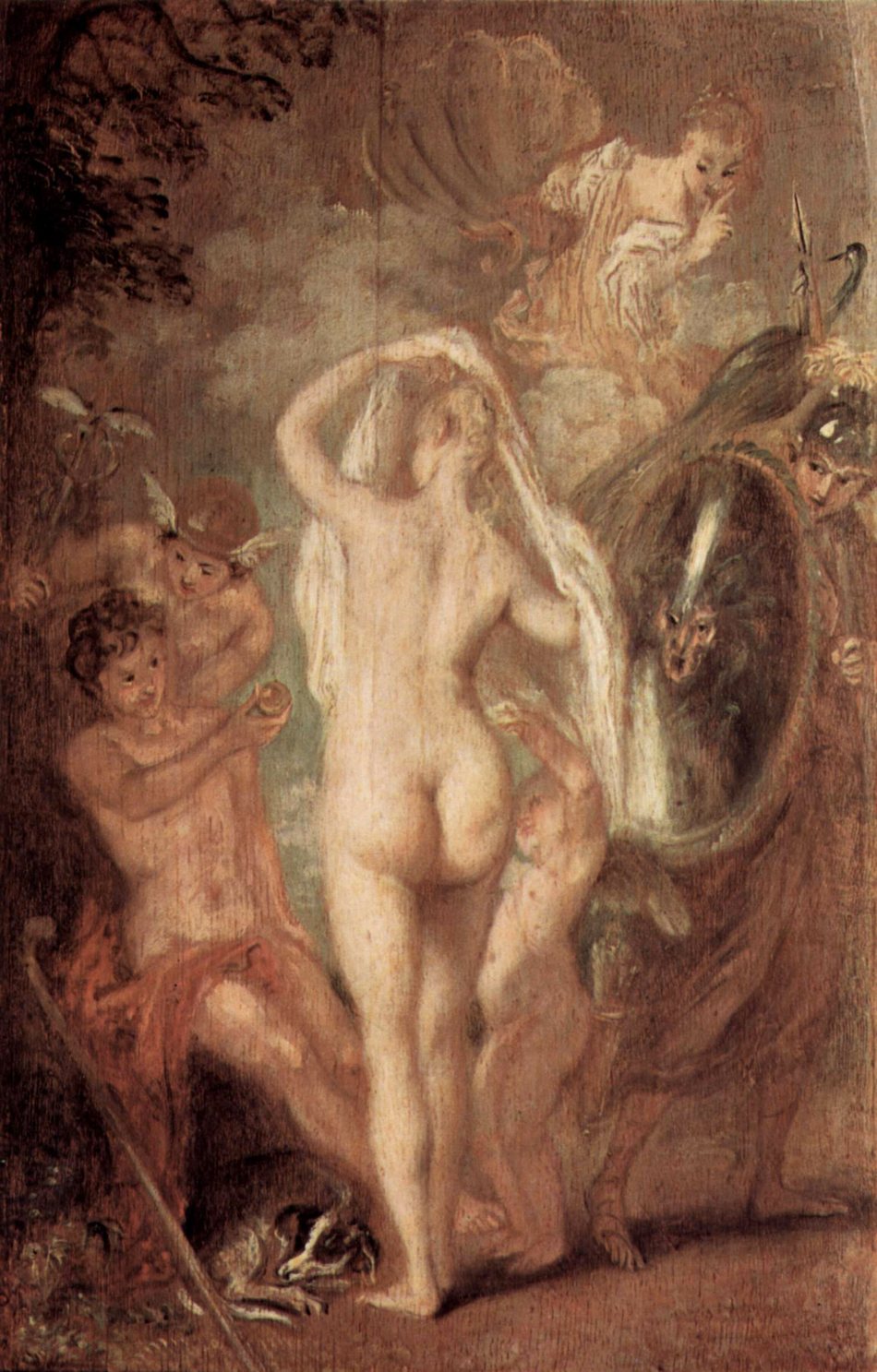
His only mythological nude, painted in the last year of his life: Paris, seen from behind in shepherd's dress, hands the apple to a Venus who turns with unhurried confidence. Watteau avoided the nude for a career; here he proves, almost as a farewell, that he had never needed to.
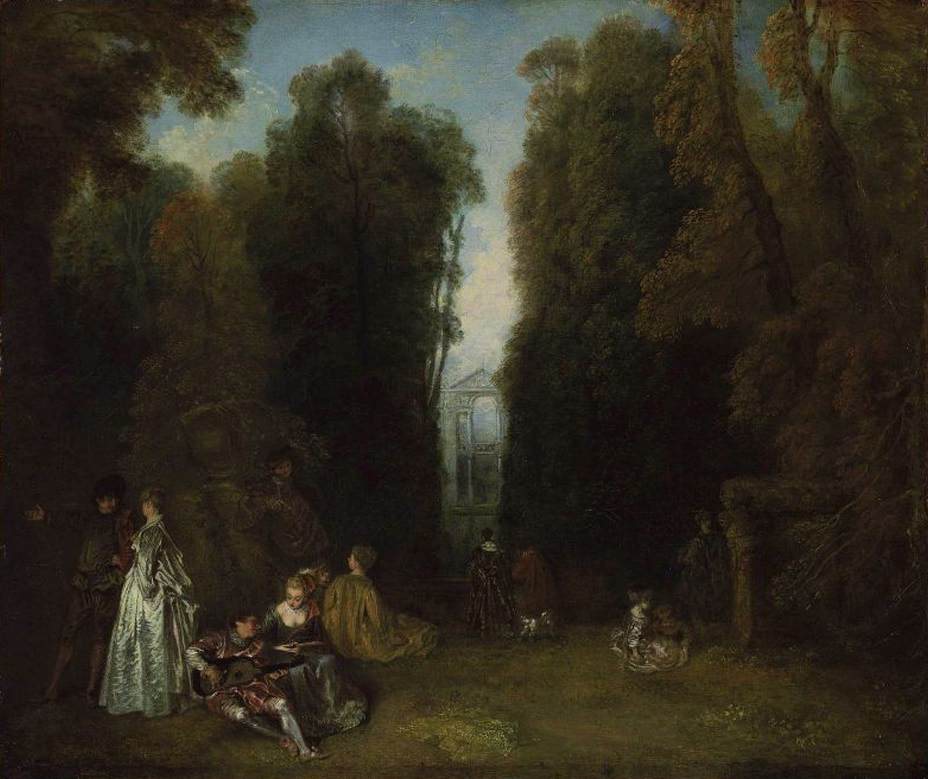
Down the tree-lined avenue of his patron Pierre Crozat's park at Montmorency, tiny strollers move toward a distant, sunlit house. It is one of his most purely painterly works — a study of green depths and evening air in which the figures are almost an excuse for the atmosphere.
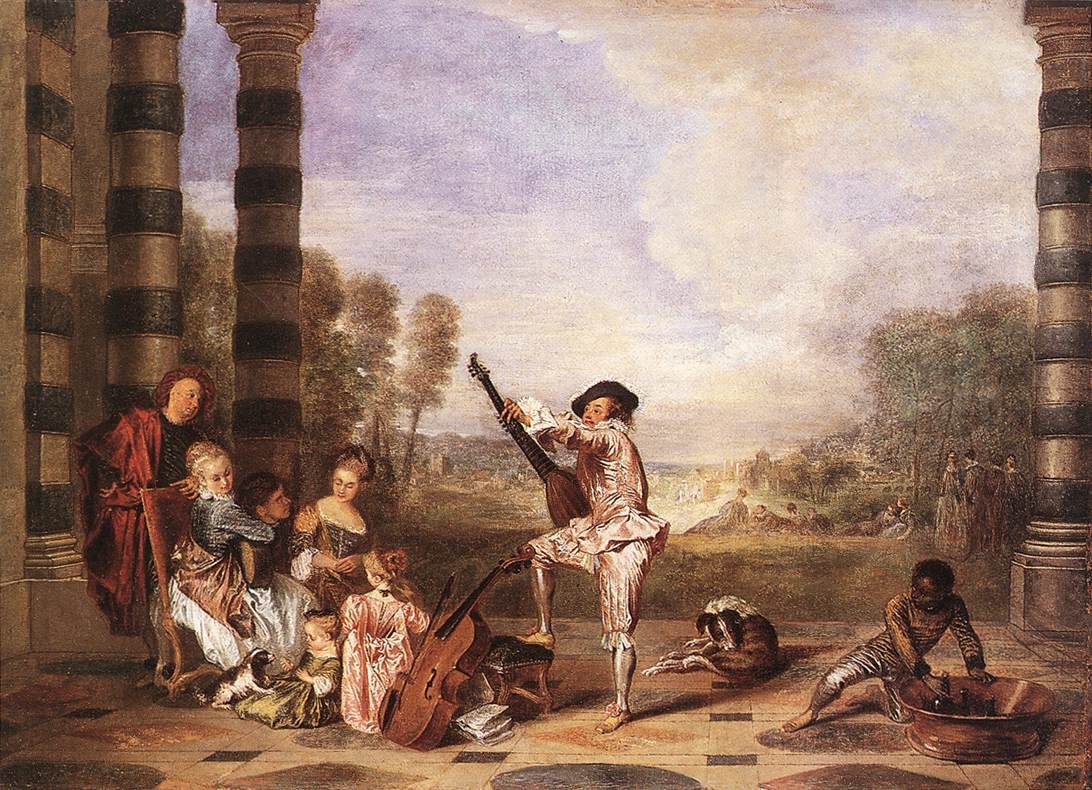
On a terrace above a garden, a party gathers round a theorbist — dancing master, listeners, a servant with refreshments, a dog keeping its own counsel. Also called The Music Party, it is Watteau's art of society distilled: every figure placed like a note, the whole tuned to a key of elegant melancholy.