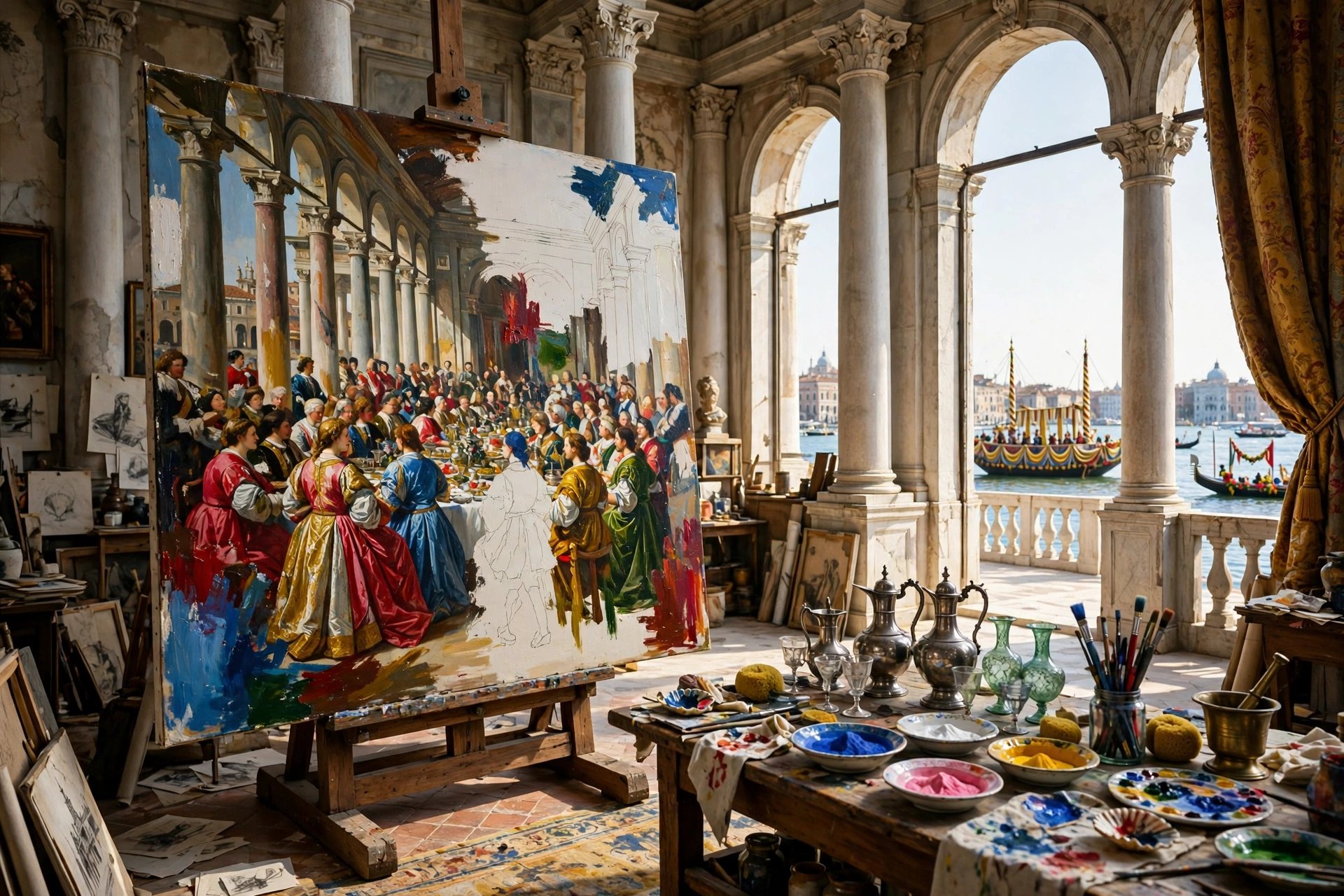
Veronese painted Venice's dream of itself: feasts that never end, in marble halls that never existed, lit by a silvery daylight all his own. The Inquisition once summoned him to explain his Last Supper — he simply renamed it, and the dogs, dwarfs and drunkards stayed.
Veronese builds his banquets like Palladio built villas: colonnades, balustrades and staircases first, the sacred story fitted into the architecture like guests at a long table. The marble is painted with the same care as the faces — in his world, a column is a character.
His trademark fabric is shot silk — cloth that changes colour as it turns, crimson shot with gold, blue with green. He paints it with split highlights and glazed shadows, so a sleeve carries two colours at once. Venetian looms made the stuff; Venetian sumptuary laws tried to ban it; Veronese made it immortal.
In 1573 the Inquisition hauled him in over this room's Feast: why were there buffoons, drunk Germans, a man with a toothpick, a dog — at the Last Supper? His defence is famous: painters take the licence poets and madmen take. Ordered to repaint, he changed only the title — the Feast in the House of Levi. The transcript survives; it is the best interview any Renaissance painter ever gave.
Paolo ran a family firm with his brother Benedetto and, later, his sons — the workshop signed canvases as the 'heirs of Paolo' long after his death. The huge output was a division of labour: architecture, figures, draperies, each hand to its trade, the master designing and finishing. A Veronese feast was catered by a household.
His light is neither Titian's gold nor Tintoretto's storm: it is a cool, silvery daylight, as if every feast were held outdoors at noon under a high Venetian sky. Shadows go blue-grey, whites stay luminous, and even a martyrdom keeps the weather of a festival. Nobody else in the century paints noon like this.
Paolo Caliari came from Verona — the city gave him his name, as it had given him his first masters and his feeling for frescoed architecture. Venice made him rich and famous, but the clarity of his spaces is a mainland virtue: Verona's Roman stones, remembered in every painted colonnade.
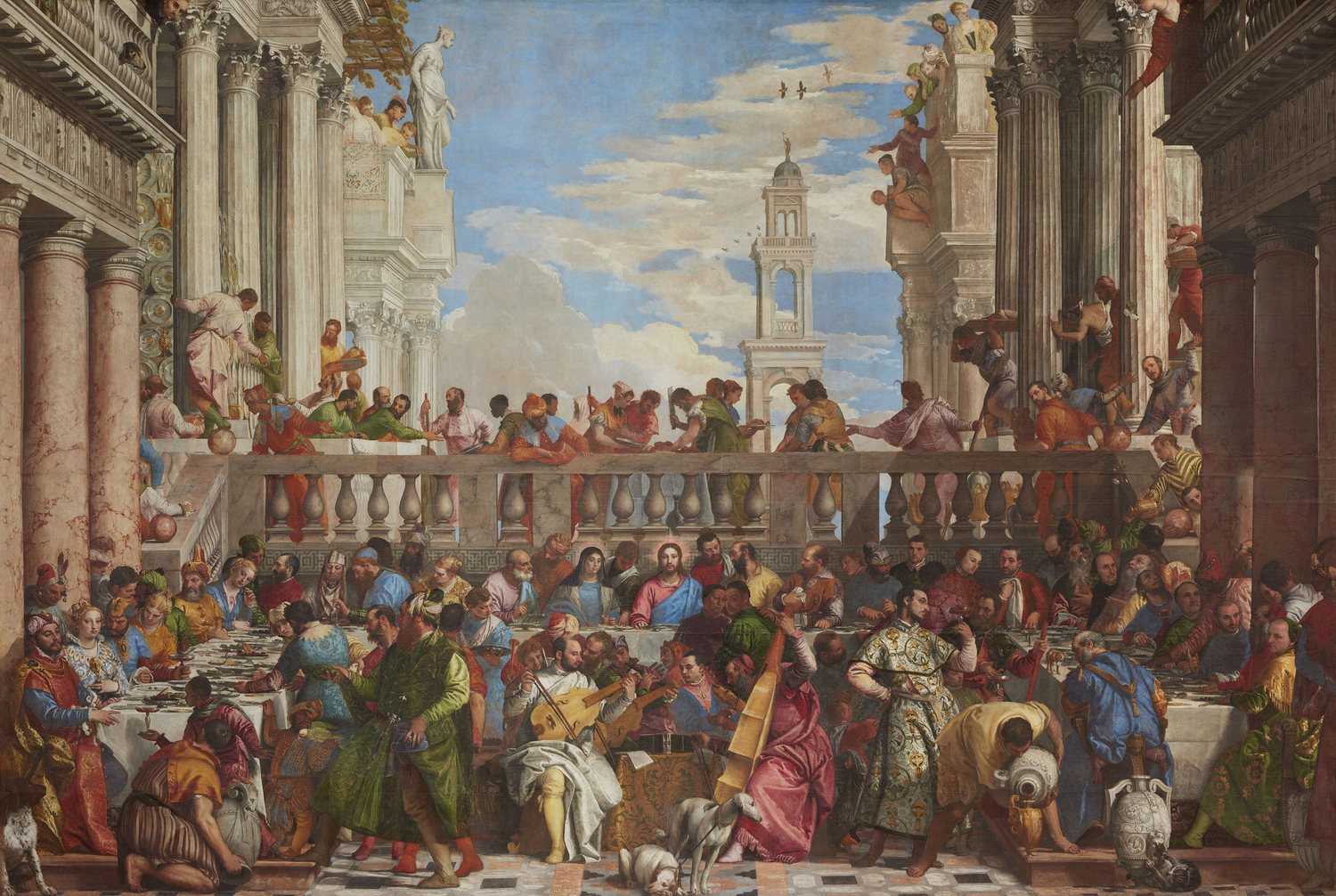
The largest painting in the Louvre — over six by nine metres, a hundred and thirty feasters in contemporary Venetian silk at Christ's first miracle, with the painters themselves among the musicians in the middle: Titian, Tintoretto, Bassano, and Veronese in white, playing the viola. The water turned to wine is almost an excuse; the subject is Venice, dressed for dinner.
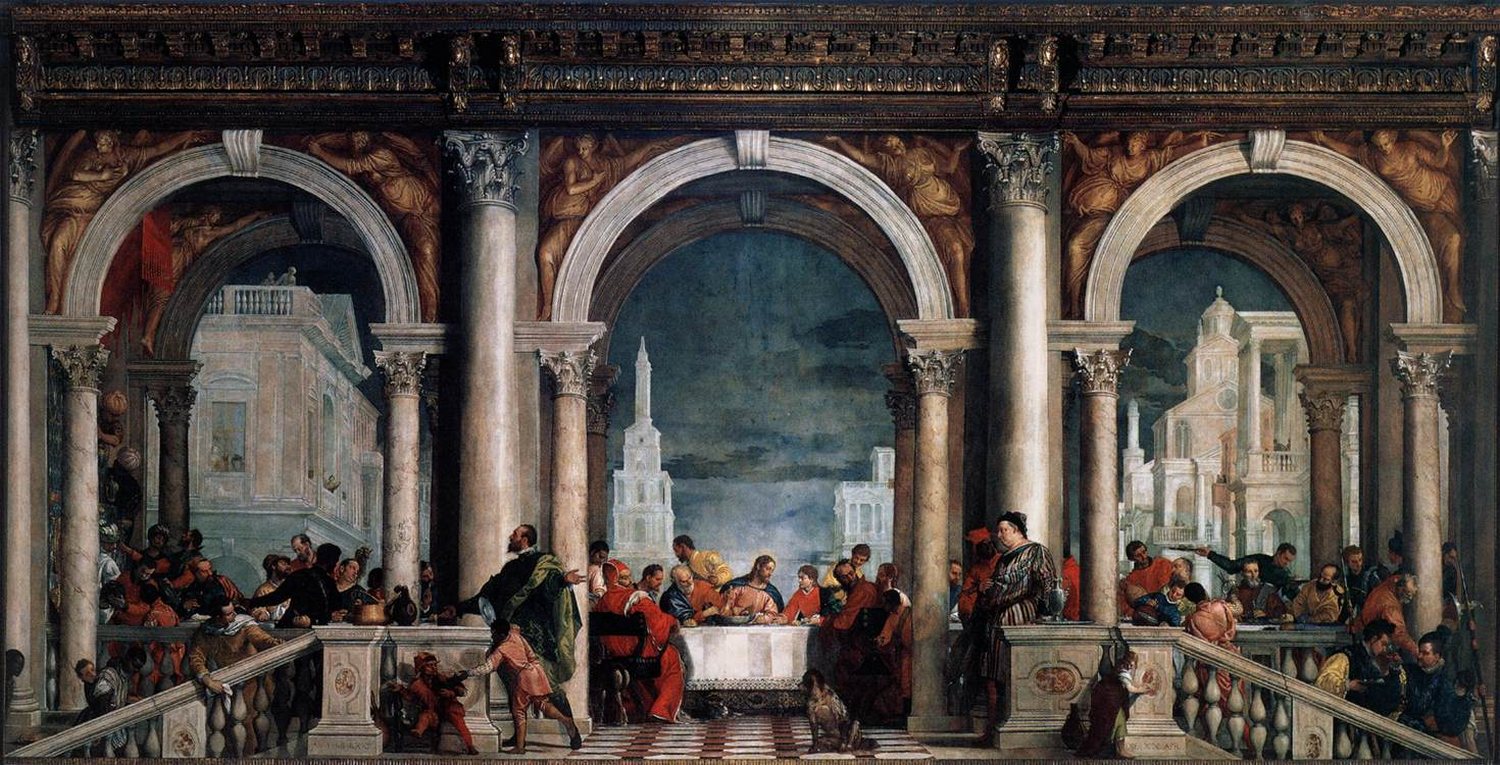
Painted as a Last Supper, defended before the Inquisition, and saved by a new title: Christ dines at the centre of a triple-arched loggia while around him swirls everything the tribunal objected to — servants, soldiers, a jester with a parrot, the famous dog. The sacred event, staged as the greatest dinner party in Venice.
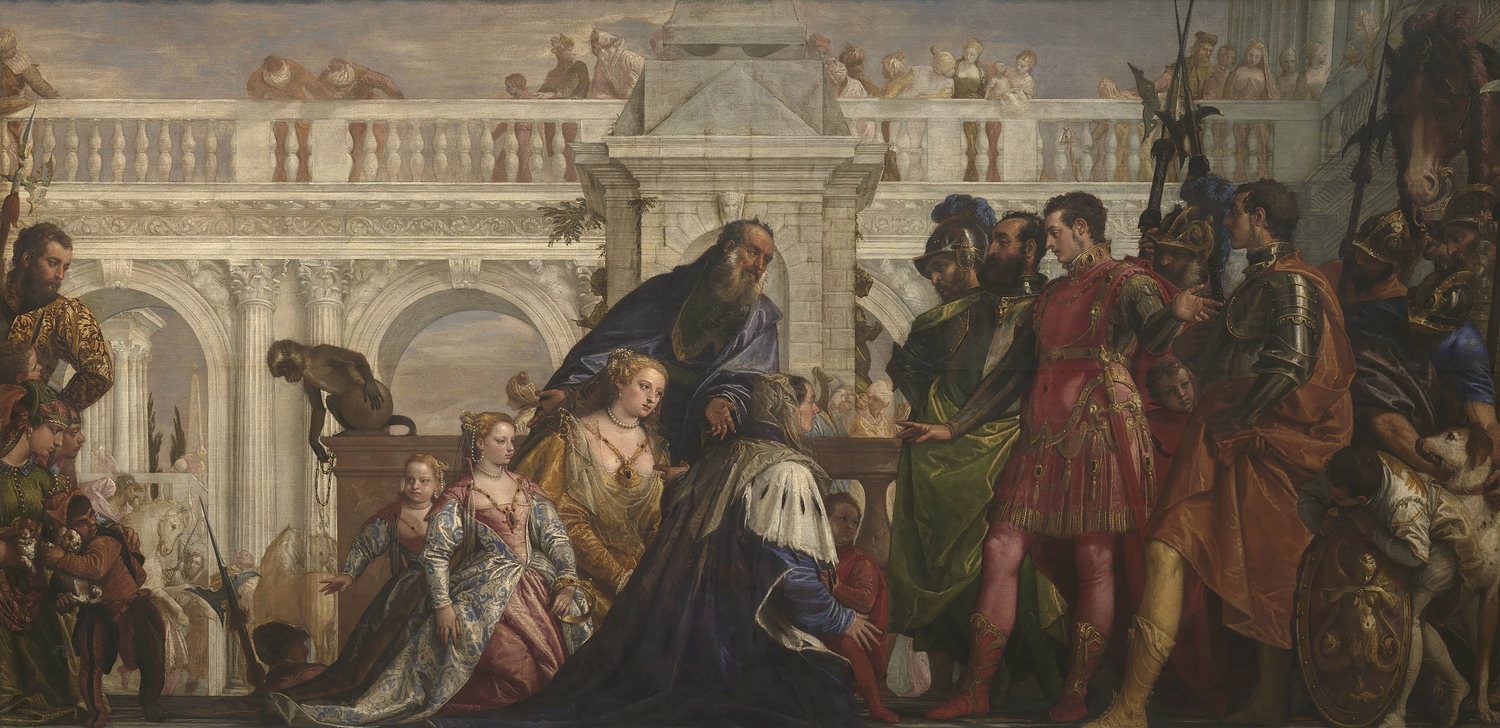
The Persian king's mother kneels to the wrong conqueror — to Alexander's friend Hephaestion, mistaking the taller man for the king — and Alexander forgives the error with a gesture. Veronese stages the antique story as Venetian state ceremony: brocade, dwarfs, monkeys, and architecture like a triumphal arch.
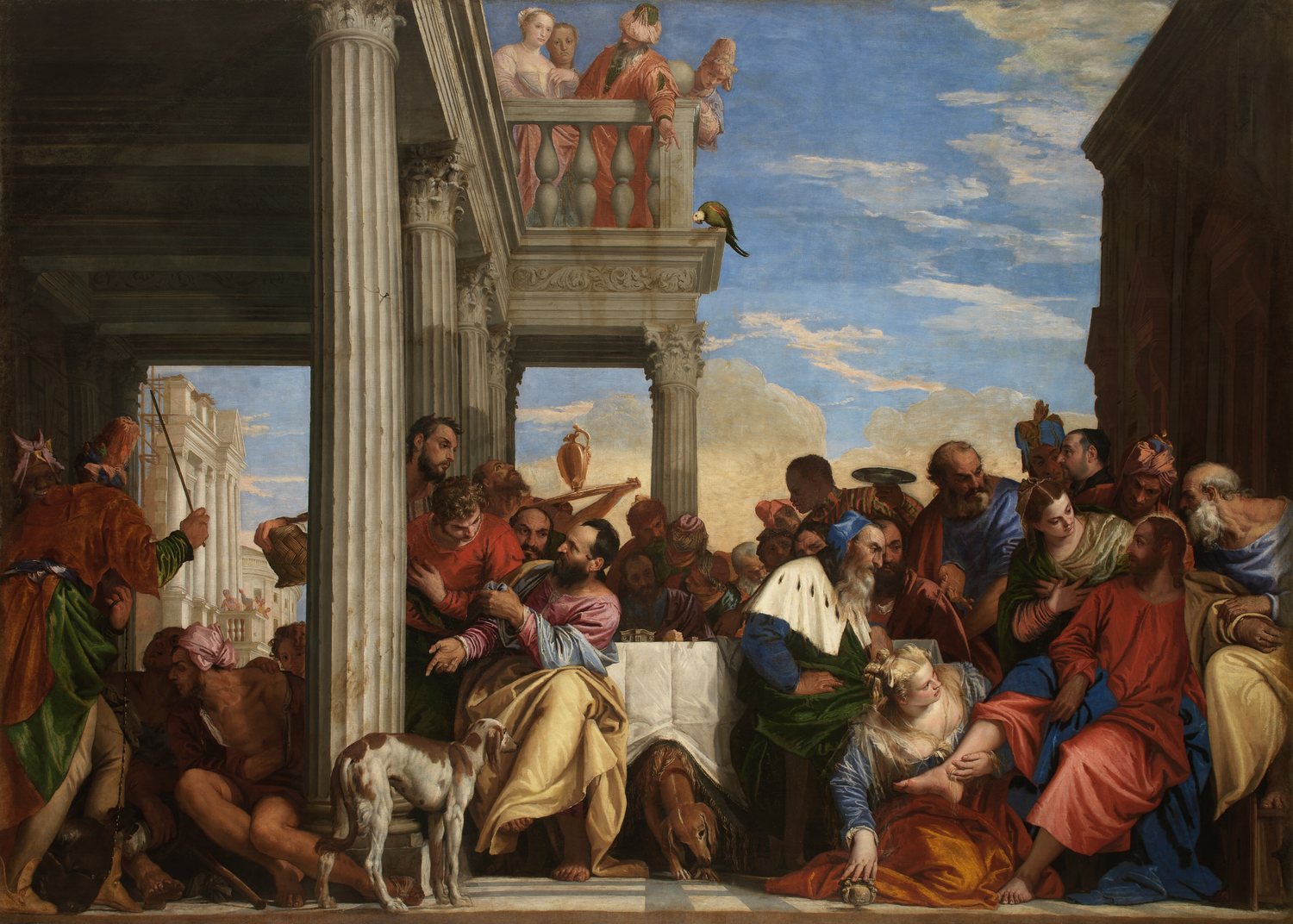
An early feast, already fully Veronese: Christ at Simon's table, Mary Magdalene anointing his feet in the foreground, and around them a whole loggia of servants, dogs and onlookers under a bright sky. The gospel scene is an occasion for what he loved — a great room, a long table, and daylight.
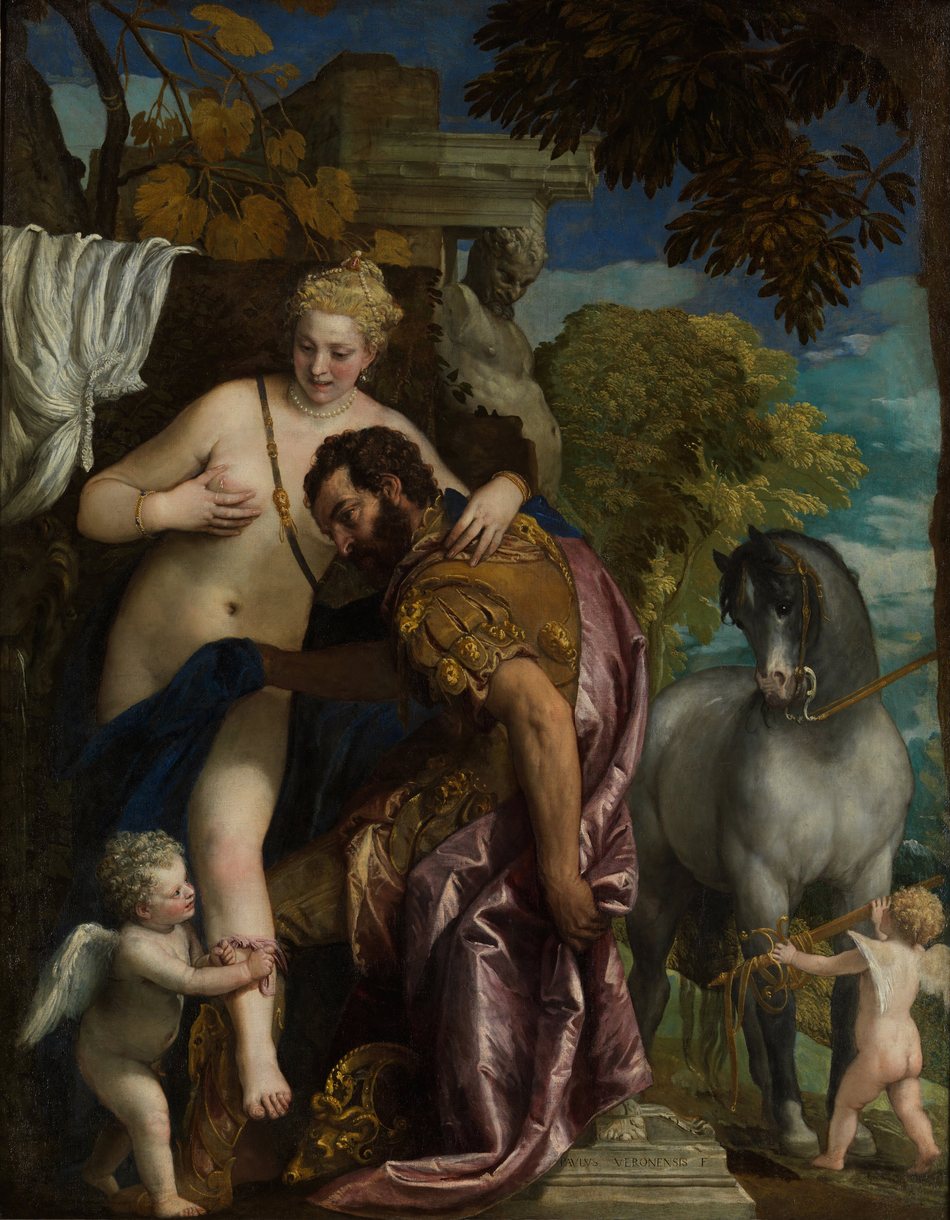
Love ties the war god's sash while Venus offers her breast and a cupid steadies Mars's horse: an allegory of love disarming war, painted in flesh and silk of extraordinary softness. The satyr peeking from behind the pillar is the painting's wink — desire, watching itself behave.
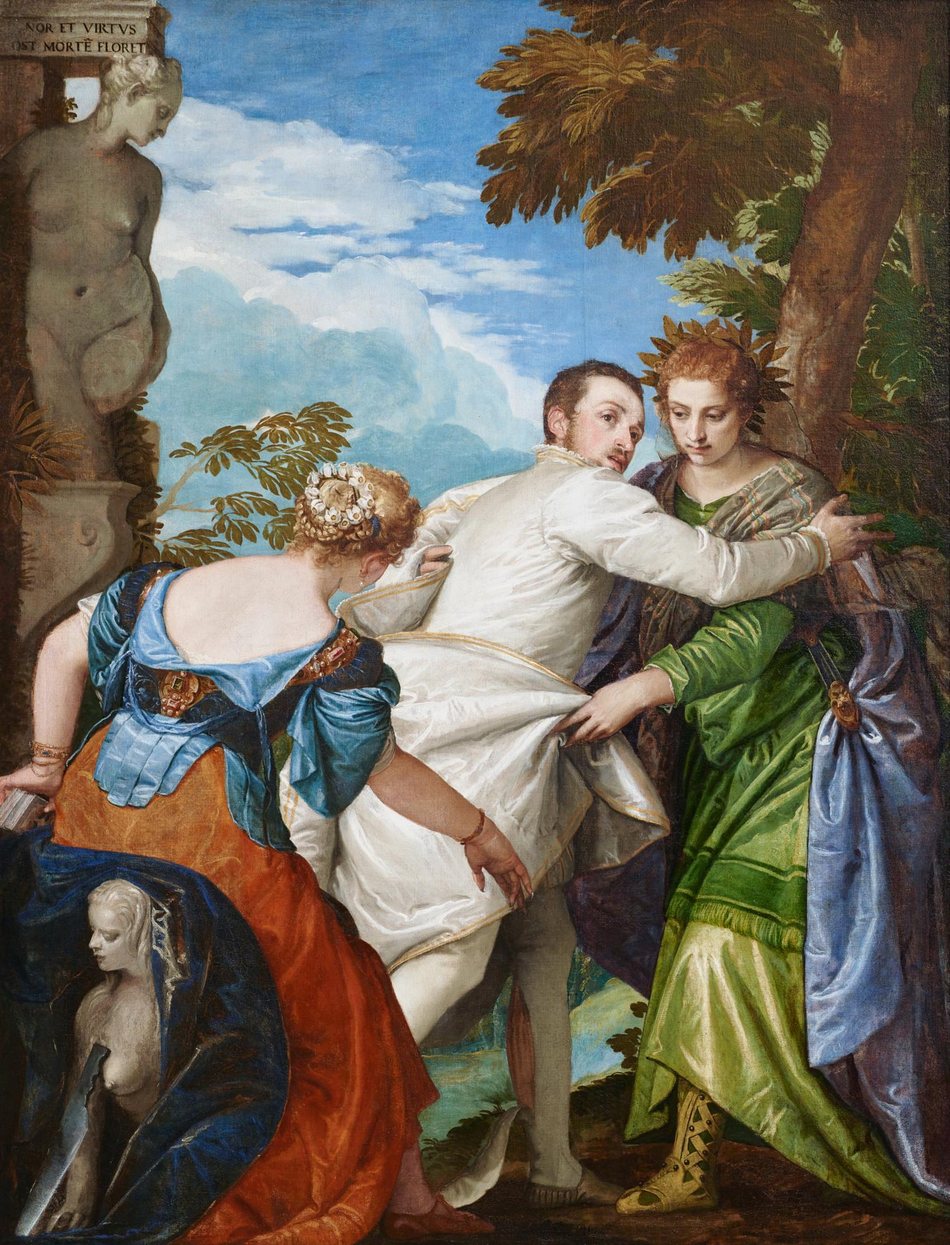
A young man in white silk is pulled two ways at once: Vice, in gorgeous shot silk, tugs him toward her ruined garden, while Virtue — no less beautiful, rather sterner — holds his arm toward the steep path up. He looks back at Vice. Veronese does not pretend the choice is easy; he makes both women worth choosing.
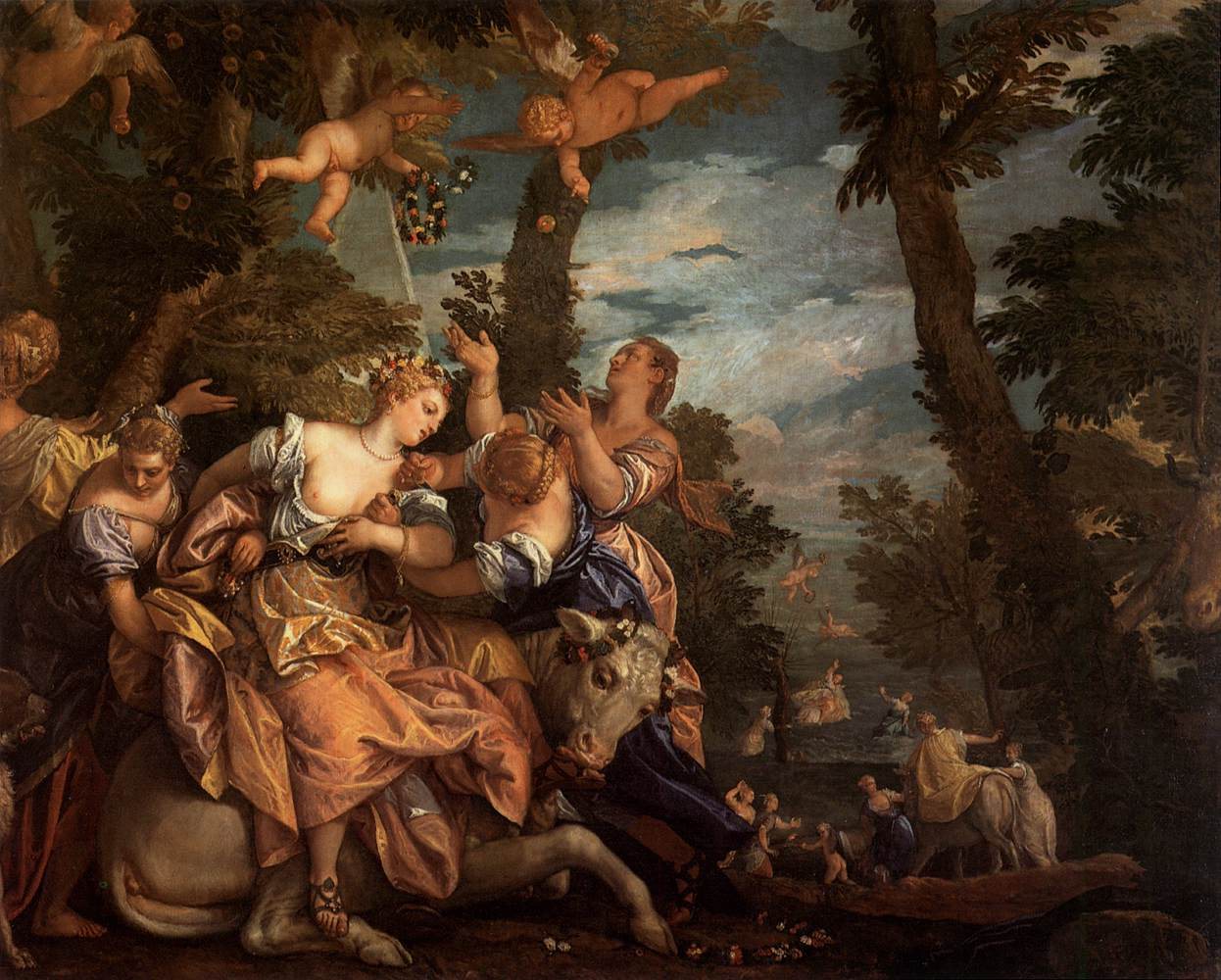
Europa, garlanded and half-undressed by her attendants, is settled onto the white bull's back under a rain of putti — more coronation than abduction, with the sea and the distant shore already waiting at the right. Even a kidnapping, in Veronese, is staged as a pageant in silk.
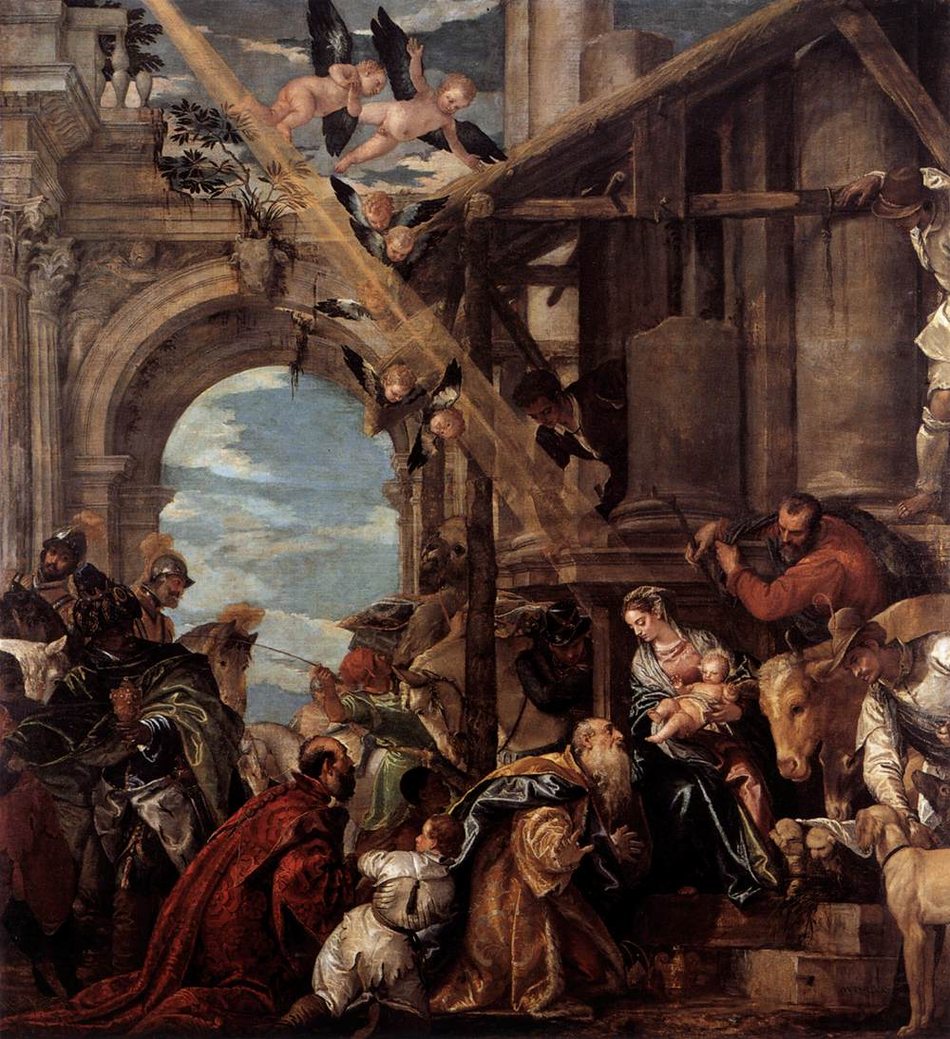
Painted for a Venetian church in the same year as the Feast: the kings arrive like a state procession through a ruined classical stable, all brocade and horses, while the Virgin sits in a shaft of calm at the centre of the splendour. Epiphany as Venice understood it — heaven, received with full ceremony.
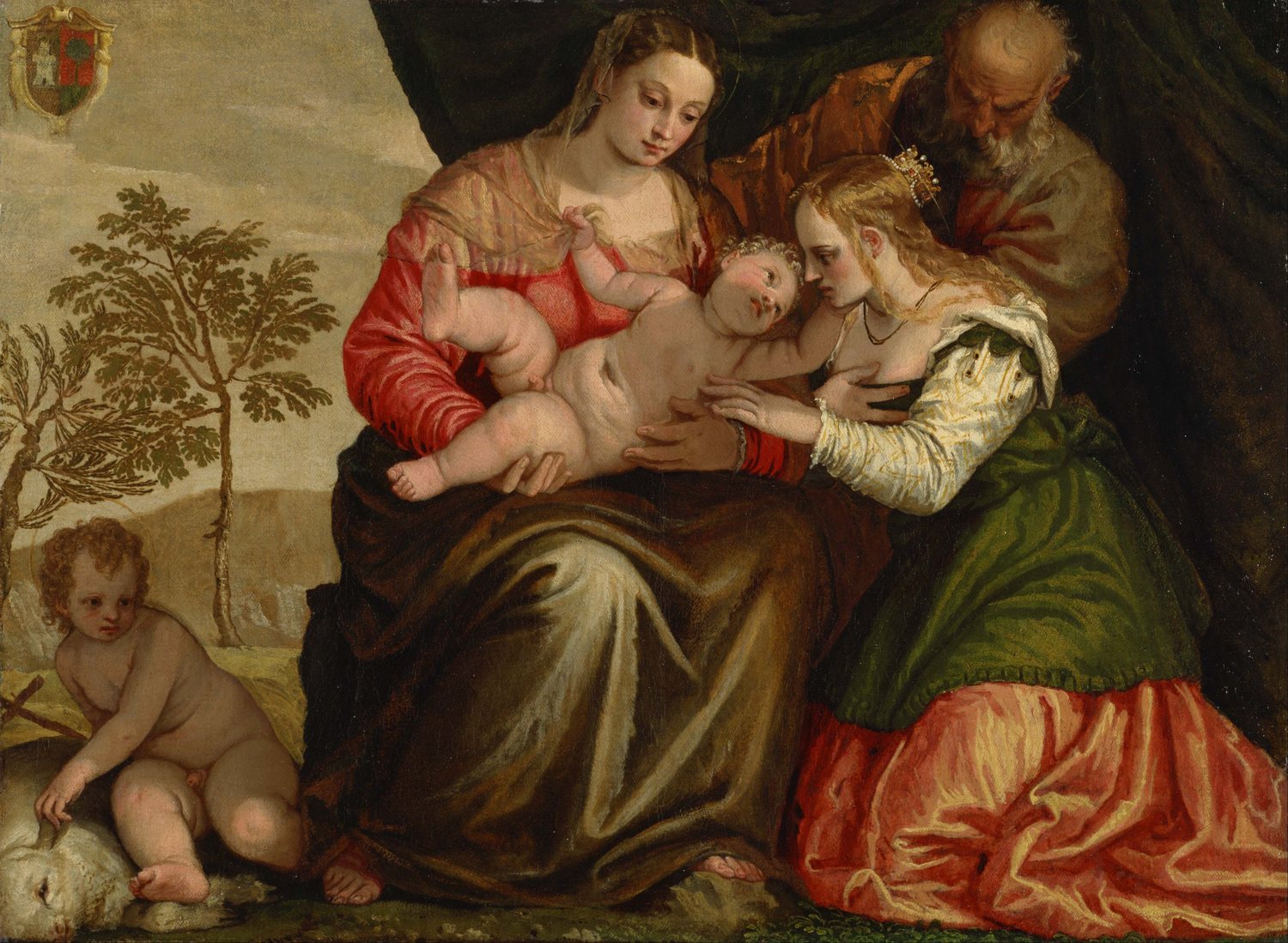
The infant Christ slips the ring onto Catherine's finger while the Virgin holds him and Joseph looks on — a wedding performed by a baby, attended by angels, in colours like enamel. One of his most beloved altarpieces, and among the most tender: the ceremony is small, the silk is not.
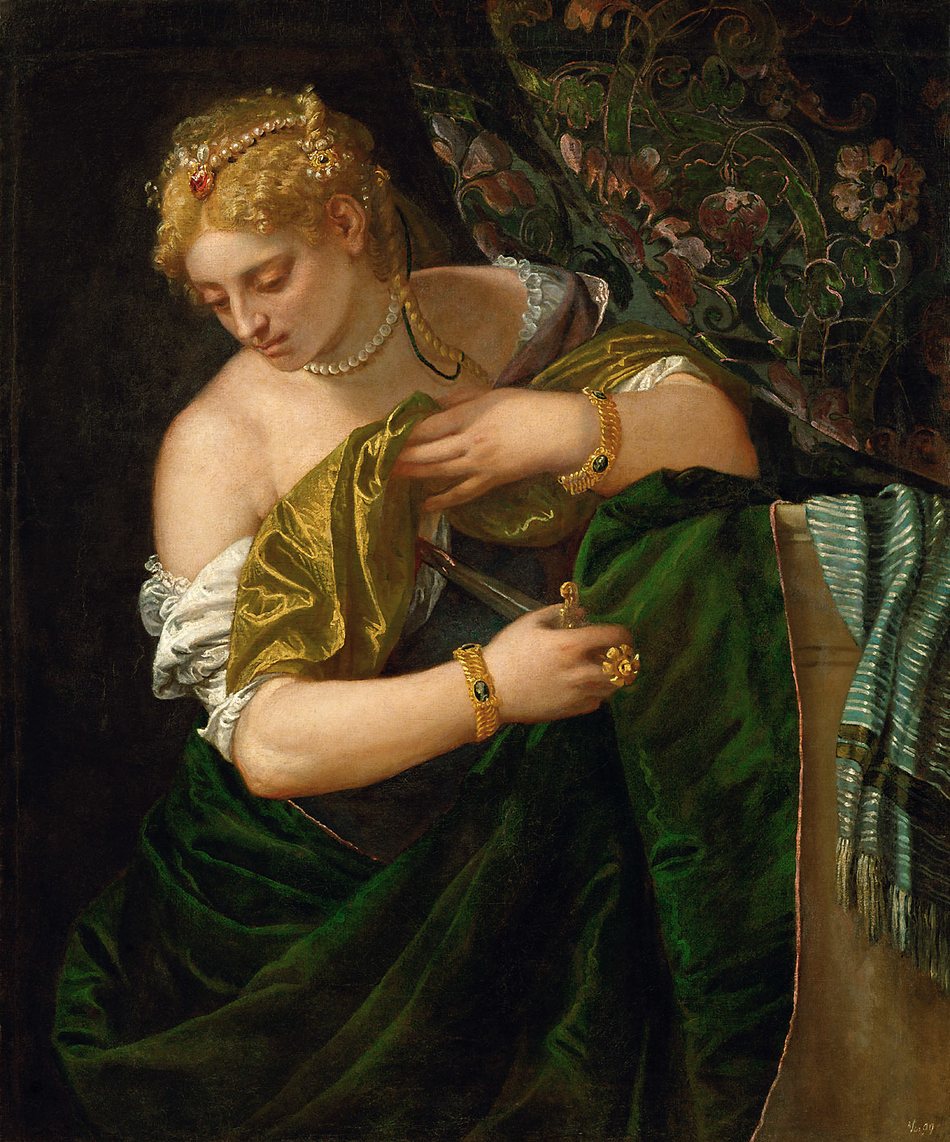
Lucretia at the moment of decision, the dagger at her breast, dressed — as only Veronese would dress a suicide — in green velvet and pearls, her face turned away into shadow. The splendour is the point and the discomfort: Roman virtue performed in Venetian luxury.