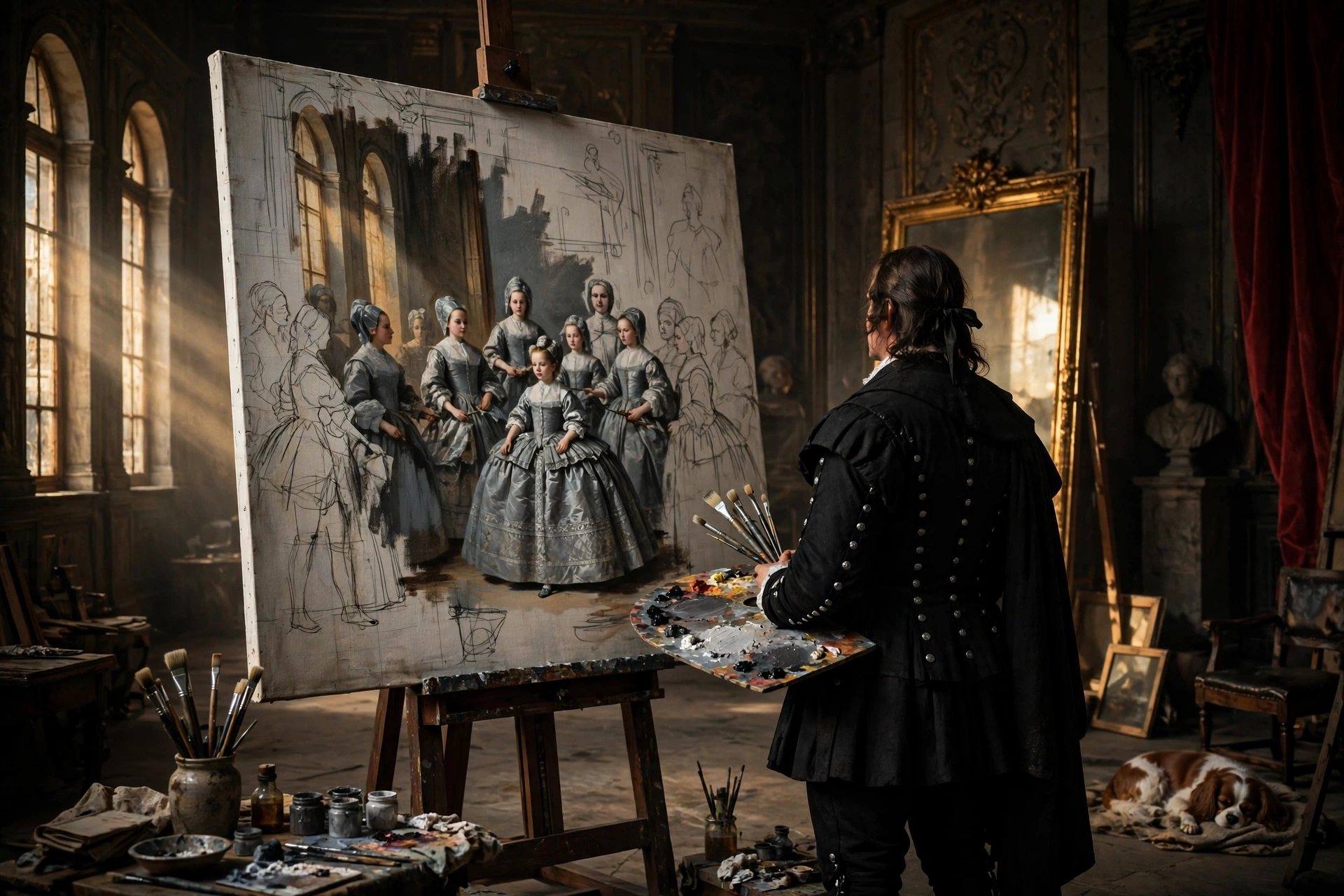
A tavern painter from Seville who became the king's chamberlain and the greatest portraitist of the Spanish Golden Age. Velázquez painted power the way others paint weather — from life, at arm's length, in strokes that fall apart when you come close and fuse into silk, silver and living faces when you step back. Manet called him the painter of painters; Las Meninas alone would justify it.
His teacher and father-in-law Pacheco recorded the method: Velázquez worked with very long brushes, standing well back from the canvas. Come close to a late picture and it dissolves — a sleeve is three grey strokes, a face a handful of dabs. Step back to the distance he stood at, and the strokes fuse into silk, silver thread, living skin. It is the most economical painting in Europe: nothing is described, everything is seen.
In Seville, before the court, he painted bodegones — kitchen and tavern scenes: an old woman frying eggs, a waterseller, three men at a table — in an earthy palette with a hard, sculptural light learned from Caravaggio's followers. Everything in them is from life and slightly larger than life. The courtier of the silver dresses began as the most truthful painter of pots, eggs and working men in Spain.
The Spanish court dressed in black, and Velázquez made black the richest colour in painting — satin black, iron black, the black of a mastiff's coat and a mourning dress. Around it he built the mature palette: silvery greys, pearl, bone white, one note of red. The Infanta's dress in Las Meninas is not white at all; it is grey, blue-grey and pink-grey, and it shines like silver brocade from across the room.
Almost nothing on paper survives from his hand — no certain drawings, no oil sketches. He composed on the canvas itself, painting directly from the model and changing his mind in paint: X-rays of Las Meninas show figures moved, heads repainted, the whole room adjusted like a thought still forming. The risk is visible in the surface. What looks effortless was decided at full size, at full speed, in the wet paint.
He spent his life climbing the court he painted: painter to the king, then usher, chamberlain, and finally — the ambition of his life — a knight of the Order of Santiago, whose red cross he wears in Las Meninas. The cross was added after the picture was finished; tradition says at the king's own command. The office work devoured his time, and the late pictures are few. Each one is a summit.
Twice the king sent him to Italy to buy pictures — Titians, Tintorettos, Veroneses for the palace — and twice he came back more himself. In Rome in 1650 he painted the enslaved assistant who travelled with him, Juan de Pareja, as a free man in a lace collar; the portrait stunned Rome. The same year he painted Pope Innocent X, who is said to have looked at it and muttered: troppo vero — too true. Pareja was freed four years later.
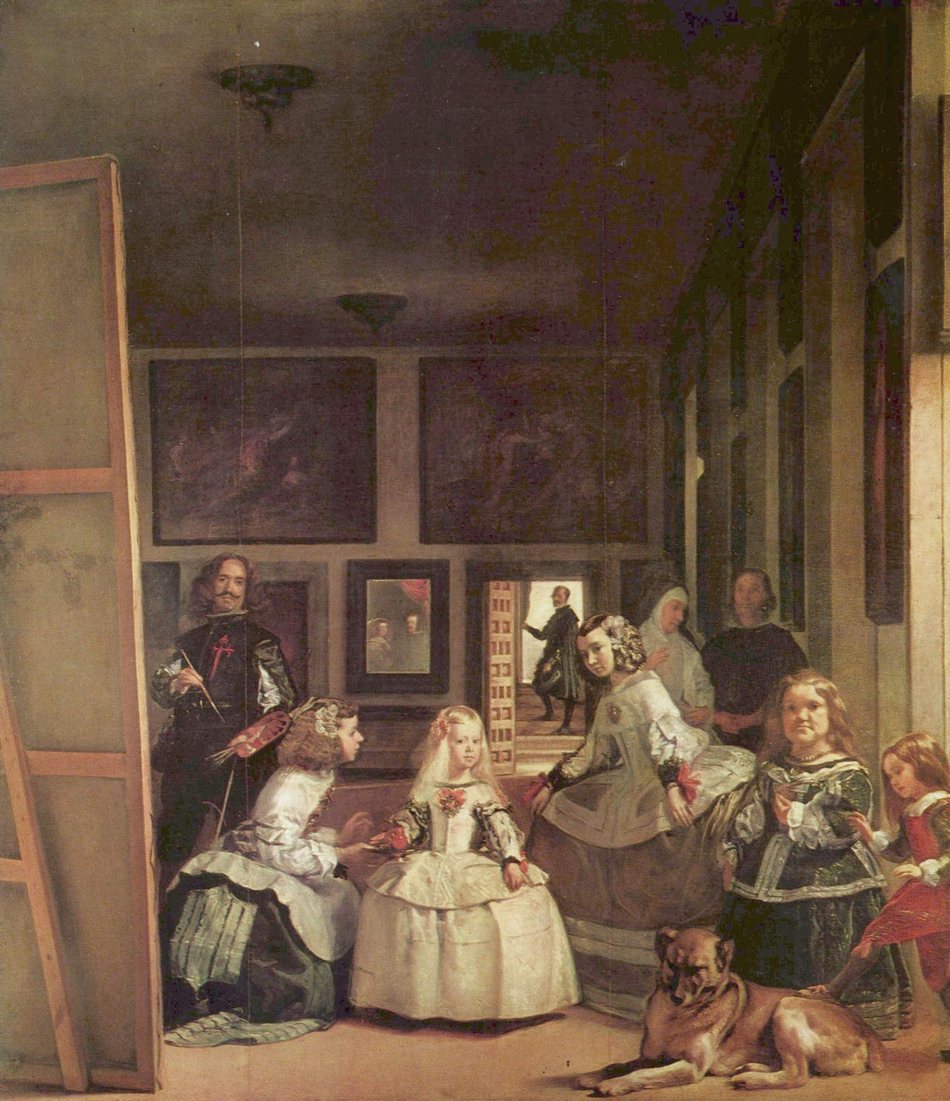
The most analysed painting in Western art: the little Infanta Margarita among her maids of honour in the painter's studio in the palace, the king and queen visible only as reflections in the mirror — or as the people standing where we stand. Velázquez himself works at the great canvas, looking out at us. Nothing in it is settled: it is a picture about painting, about looking, and about who in the room is real.
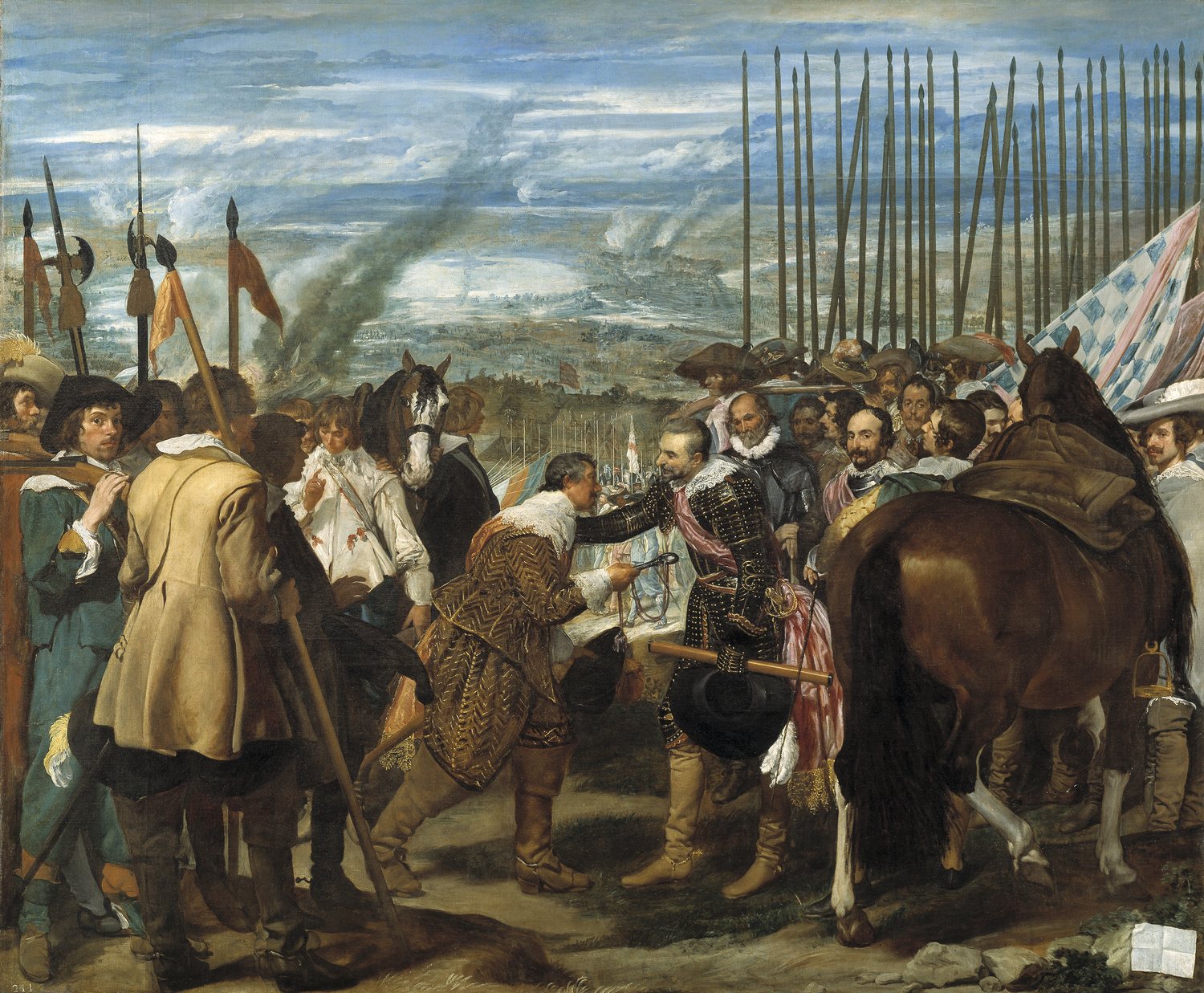
The Dutch commander Justin of Nassau hands the key of Breda to the Spanish general Spinola, who receives it with a hand on the loser's shoulder — a victory painted without a single act of humiliation. Behind them the forest of Spanish lances rises in perfect order; before them, two gentlemen talk. It hung in the Hall of Realms of the Buen Retiro palace, the great gallery of Spanish victories.
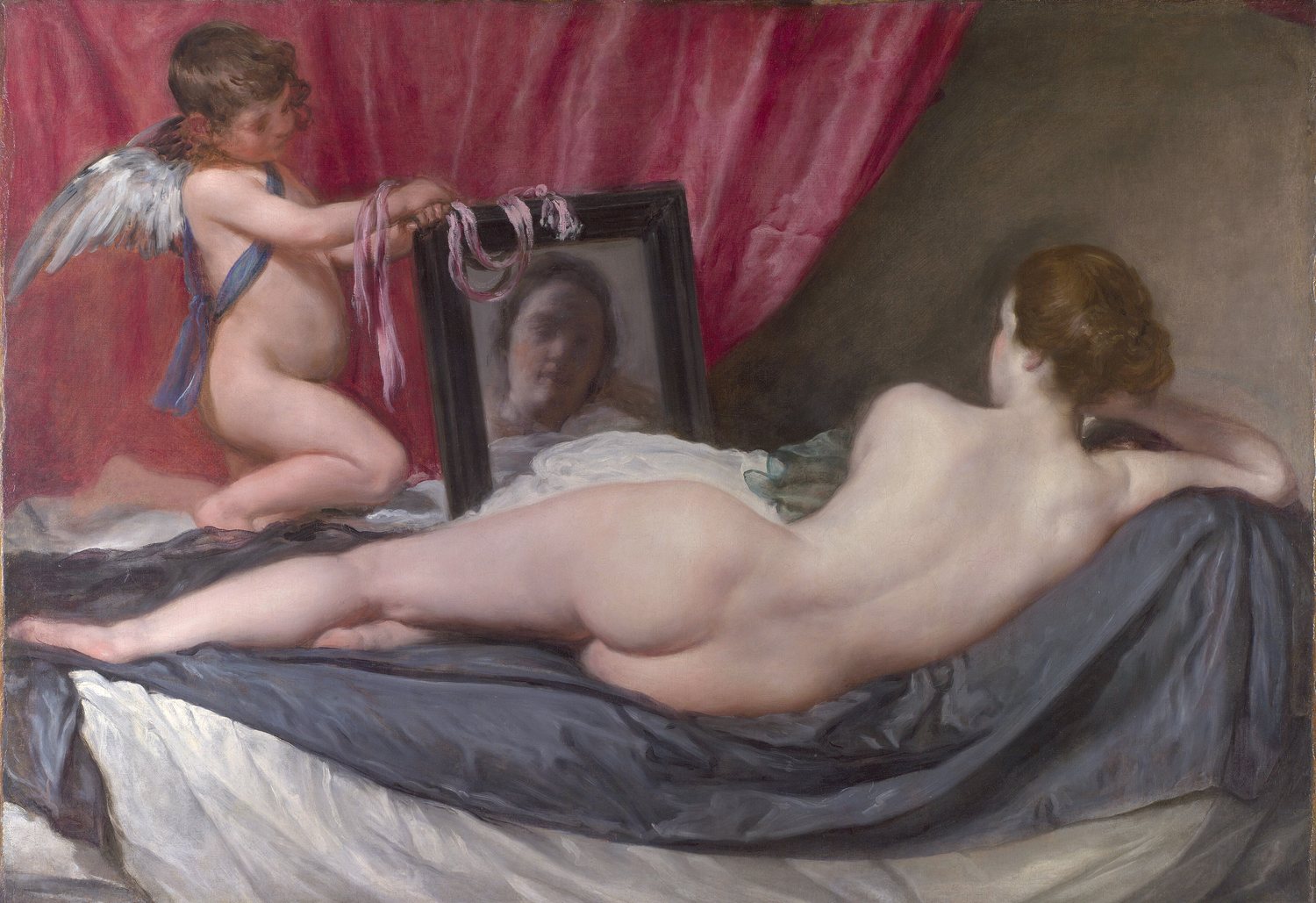
The only female nude of Spanish Golden Age painting, painted in Italy or just after: Venus lies with her back to us, watching our watching in a mirror held by Cupid — and her face in the glass is blurred, as if beauty would not sit still for its own portrait. In 1914 a suffragette attacked it with a meat cleaver; the slashes were repaired, and the picture's fame only grew.
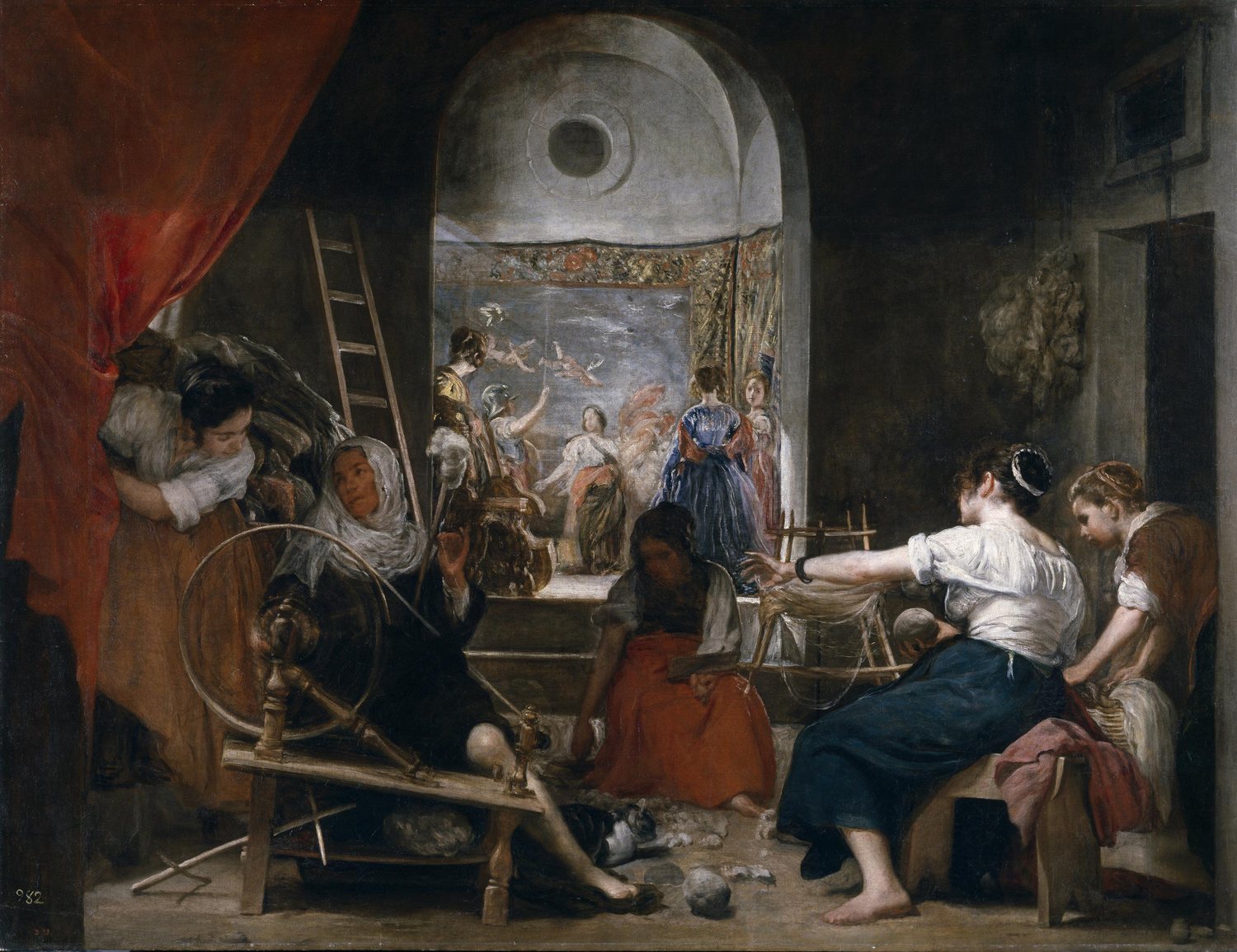
In the foreground, women spin wool in a Madrid tapestry workshop, one at a spinning wheel that blurs with speed; through a raised doorway behind them, lit like a stage, the myth itself unfolds — Athena confronting the weaver Arachne, with a tapestry of the Rape of Europa copied from Titian. A factory floor and a fable about art's pride, in a single breath of light.
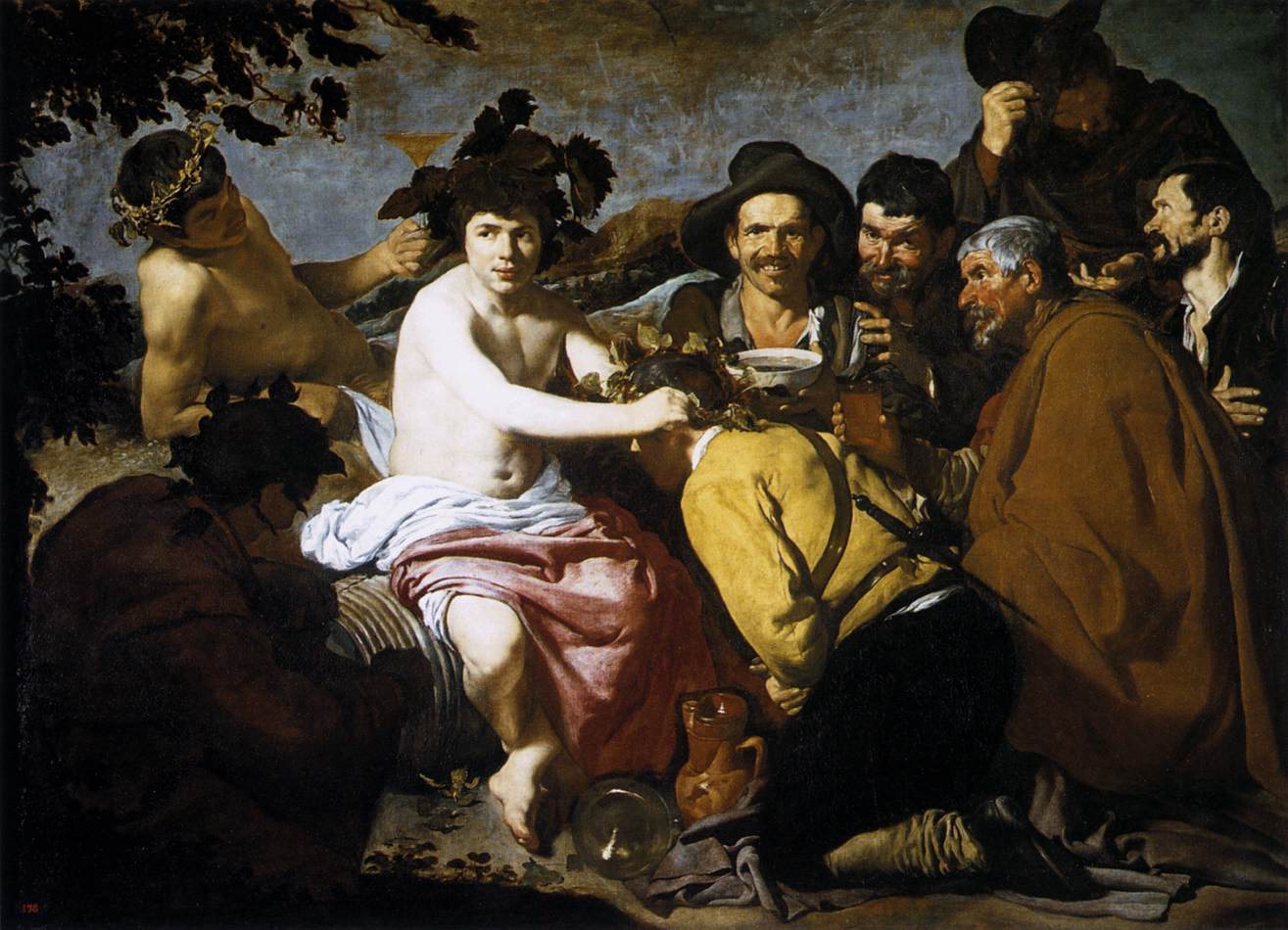
A half-naked god of wine, pale as a statue, crowns a kneeling peasant in a tavern full of real, sunburnt, grinning men — one of them looks straight out at us, delighted to be caught mid-drink. Velázquez's first picture for the king joins mythology to the bodegón without a seam: the god is painted, the drunks are alive.
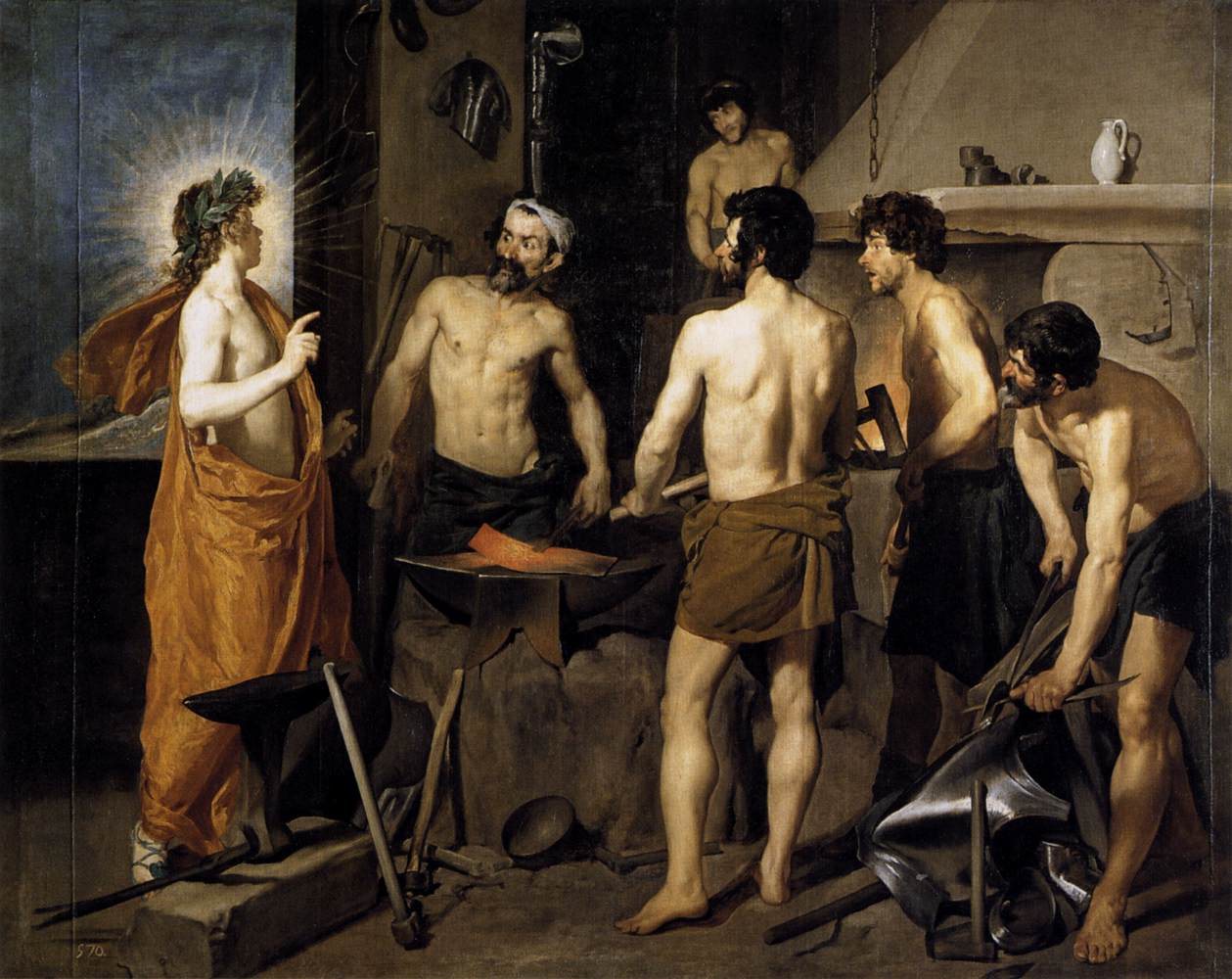
Painted in Rome: Apollo, crowned with laurel and glowing like a struck match, enters Vulcan's forge to report Venus's adultery — and five blacksmiths freeze mid-blow, mouths open, around their anvils. The god is a classical statue; the smiths are Roman workmen painted from life, their bodies still warm from the fire. Mythology told as workshop gossip.
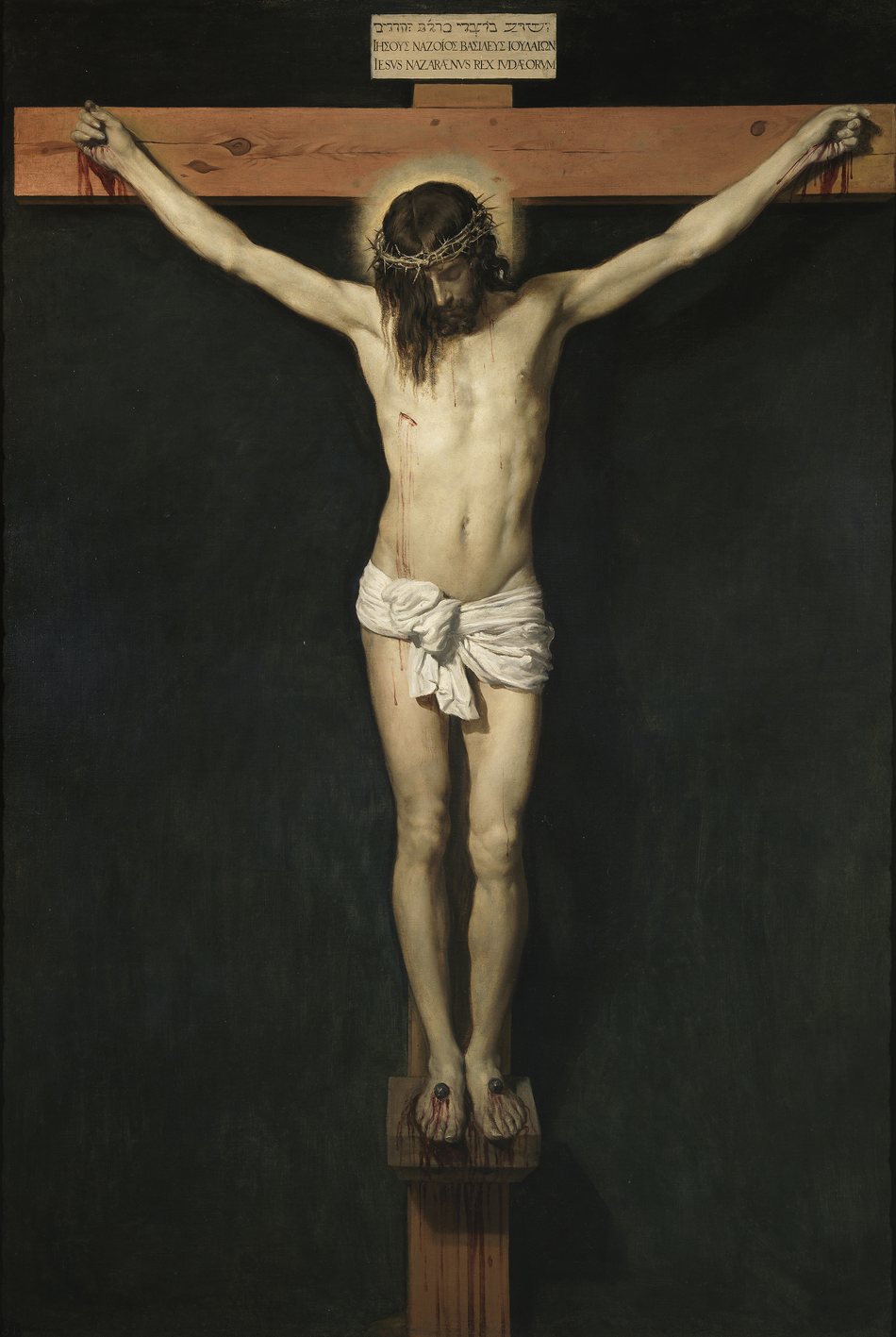
Christ alone against a darkness without horizon, the body painted with an almost classical calm, the head fallen forward into a curtain of hair that hides half the face. There is no landscape, no crowd, no drama — only the greenish light on the flesh and the absolute quiet. Painted for the convent of San Plácido in Madrid, it is the still point of Spanish religious painting.
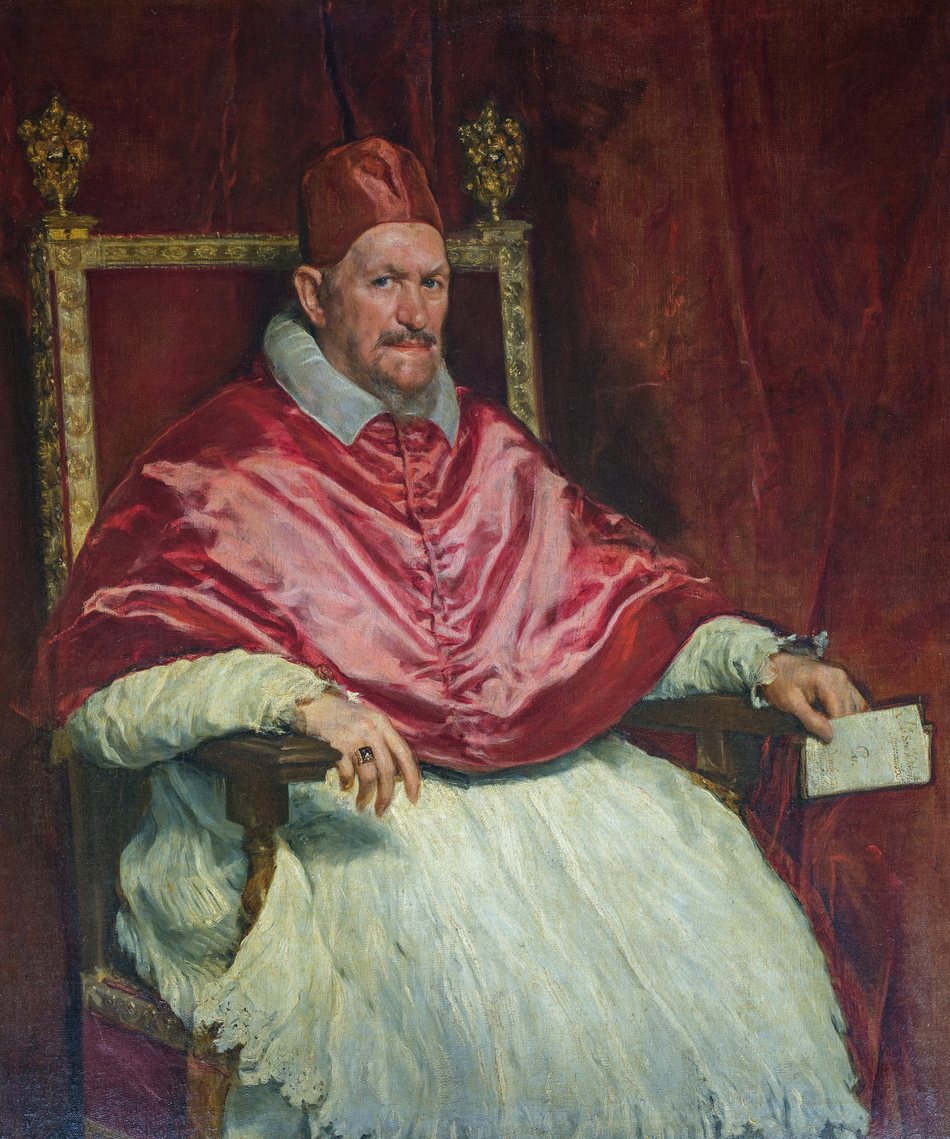
The Pope in crimson and white, on a throne of gold, holding the painter's signed petition in one hand — and looking out with the shrewd, suspicious, utterly unflattered gaze that made him mutter troppo vero, too true. Velázquez painted it in Rome in 1650 as his visiting card; it has hung in the Palazzo Doria Pamphilj ever since, the most penetrating portrait of power in European art.
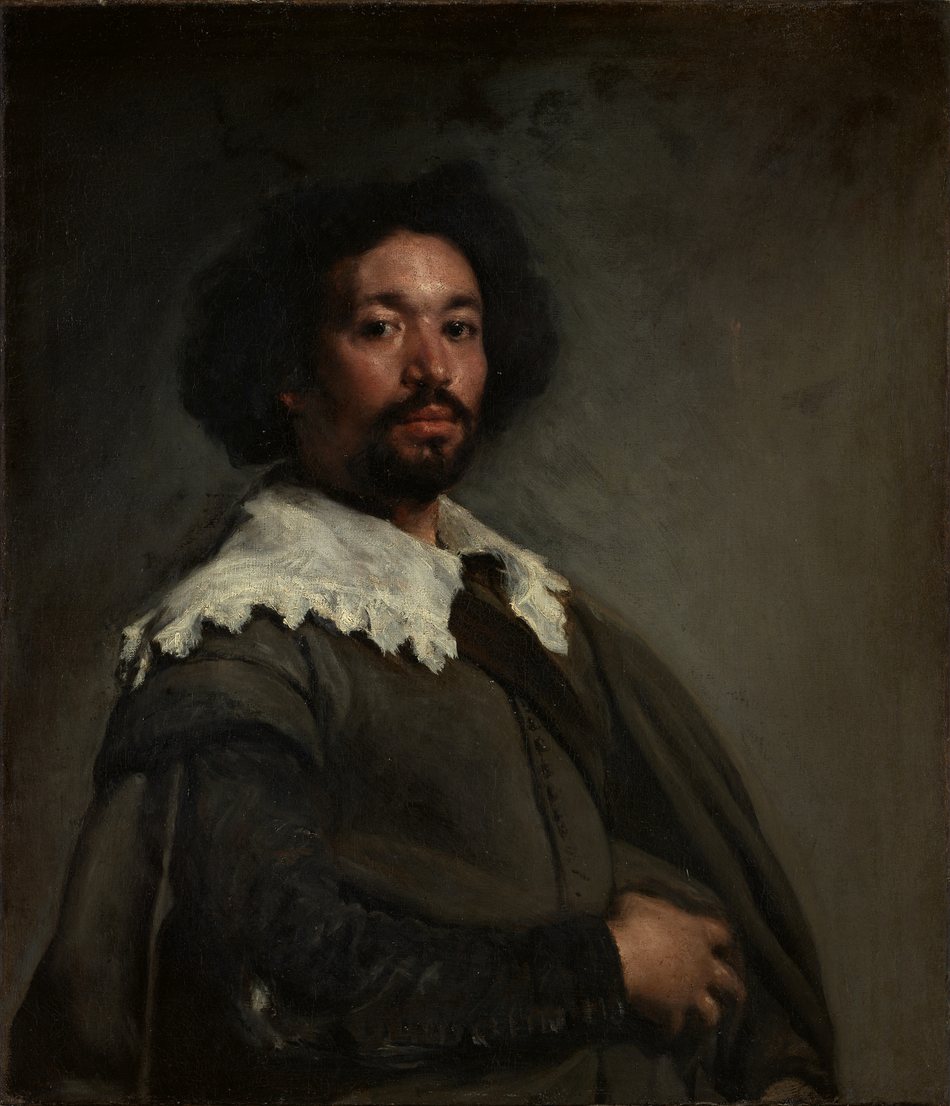
Painted in Rome and exhibited to astonished crowds: the painter's enslaved assistant, dressed as a gentleman in a lace collar, returns our gaze with grave, undeceived dignity. Velázquez is said to have painted it as a study before the Pope's portrait; it became the greater manifesto. Four years later he signed Pareja's freedom. The portrait had already declared it.
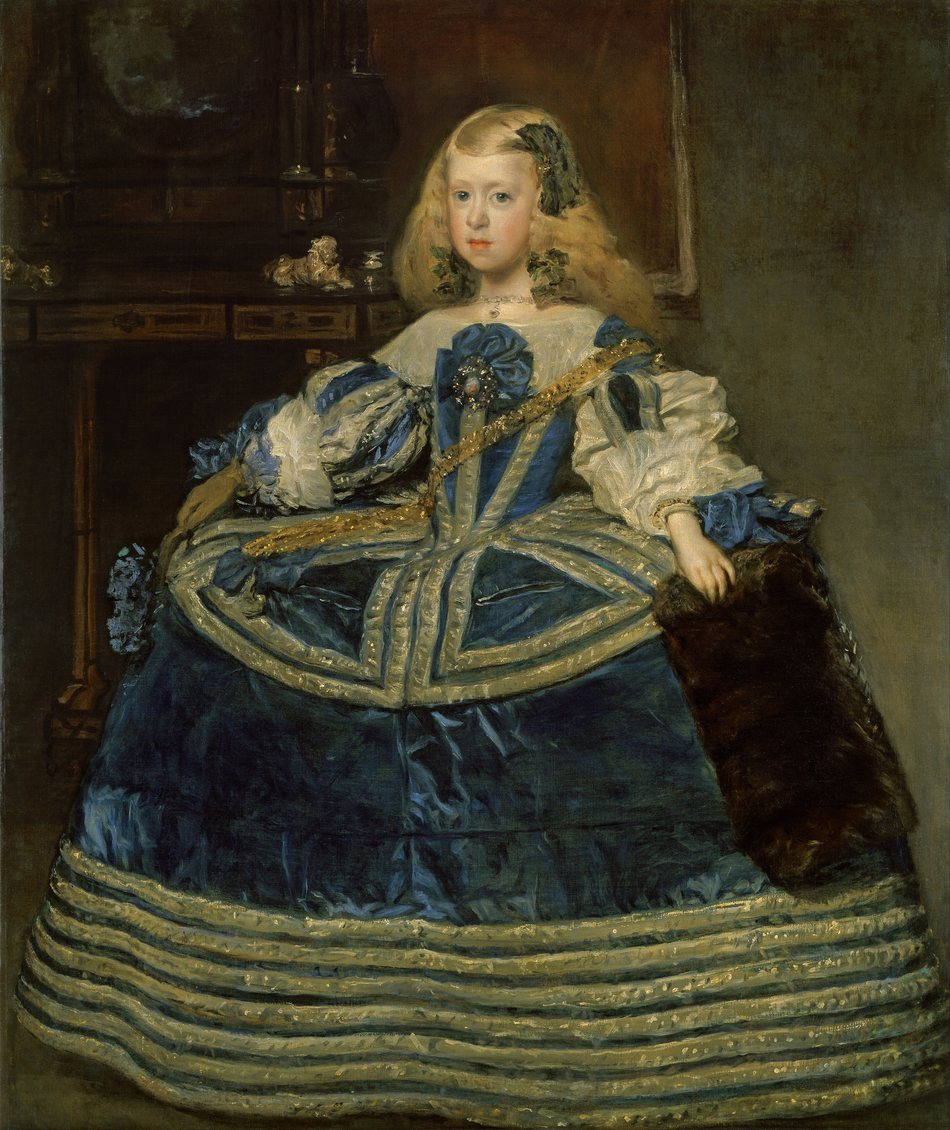
The little Infanta of Las Meninas, three years older, in a blue dress of impossible width, painted in the last year of Velázquez's life to be sent to her uncle and future husband, the Emperor in Vienna. The brocade is built from loose, flickering strokes that only become silk at a distance — the whole technique of the late style, worn by an eight-year-old.
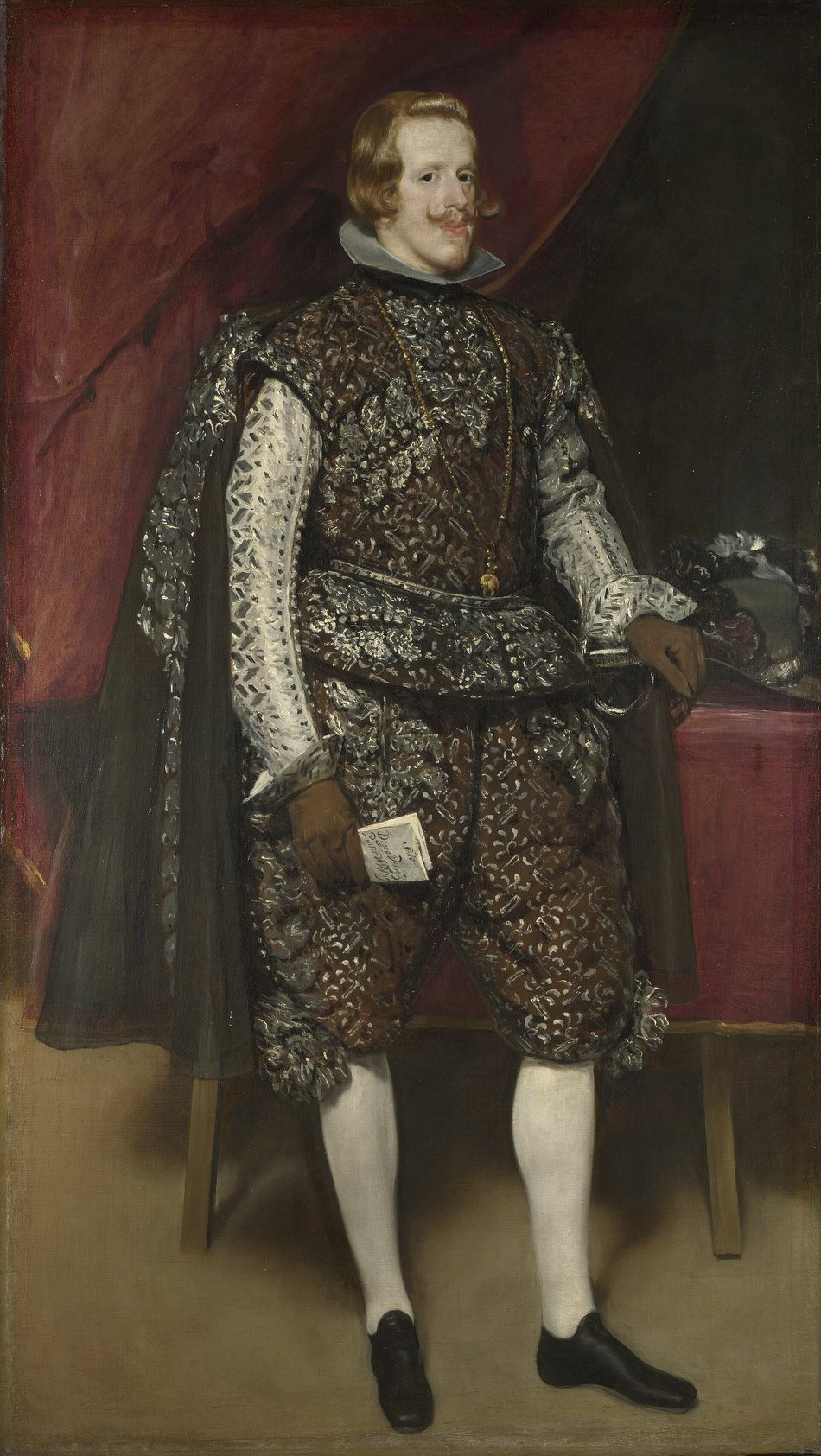
The king full-length in a suit embroidered with silver, a letter — a petition, signed by the painter — in his hand, a red curtain and table behind. He is in his twenties, already practising the immobility that power required. Velázquez painted Philip IV for forty years, ageing with him portrait by portrait; this is the young god at the beginning of the long reign.
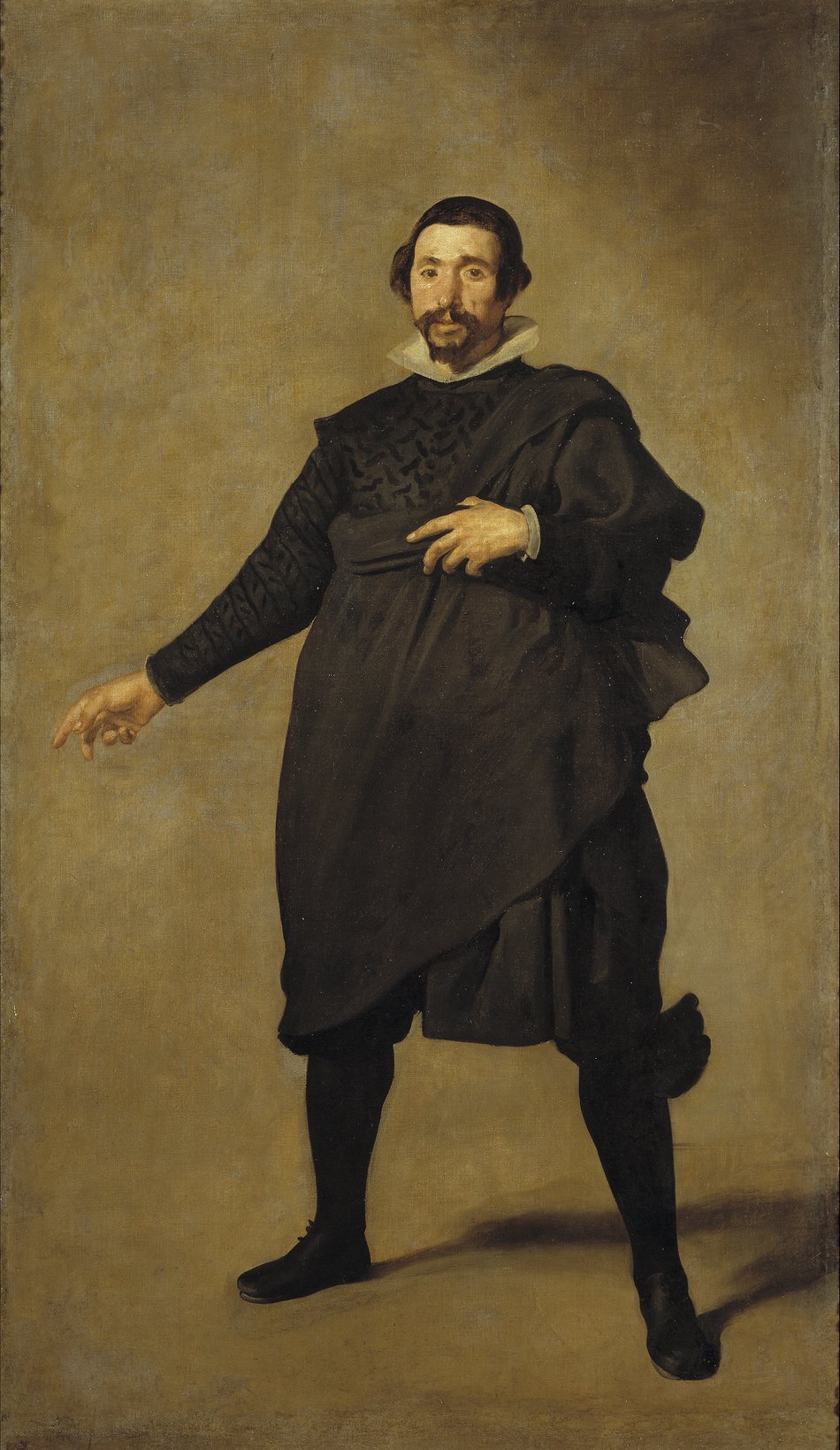
A court jester and actor, declaiming — standing on nothing. There is no floor, no wall, no horizon: only a warm brown emptiness out of which the black figure casts a small shadow, the most radical portrait ground of the seventeenth century. Manet, seeing it in Madrid in 1865, wrote home that the background disappears and it is air itself that surrounds the man.
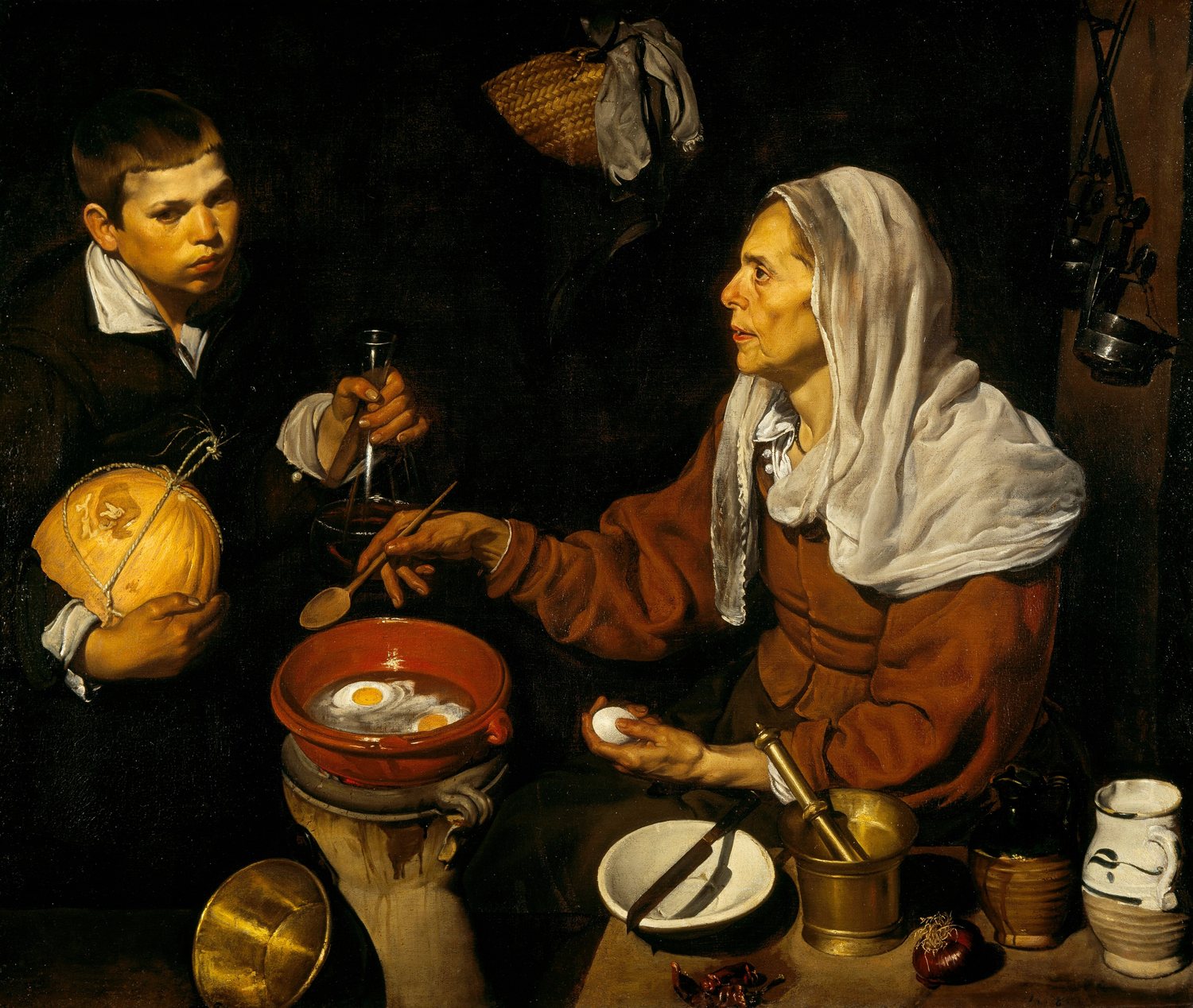
Painted at nineteen: an old woman poaching eggs in an earthenware bowl over a brazier, a boy arriving with a melon and a flask, and every object — brass, glass, ceramic, eggshell — rendered with a concentration that borders on devotion. The Seville bodegón at its most perfect, painted by a teenager who already saw more in a kitchen than most painters see in a cathedral.
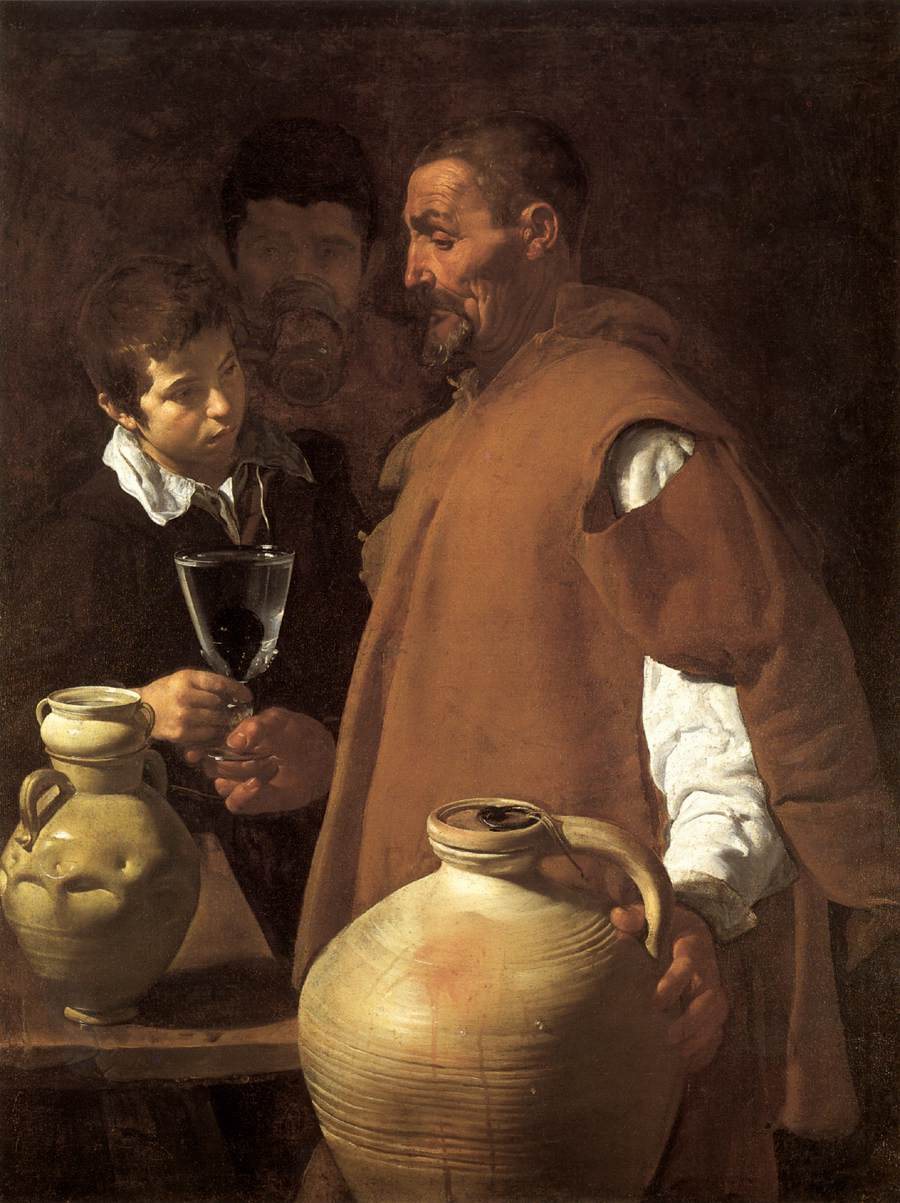
The waterseller of Seville, monumental as a philosopher, hands a tall glass of water — with a fig in it, to sweeten it — to a boy. The great earthenware jar in the foreground, scarred and sweating drops, is painted like a portrait in its own right. Wellington took the picture from Joseph Bonaparte's baggage after Vitoria; it hangs in his London house still.
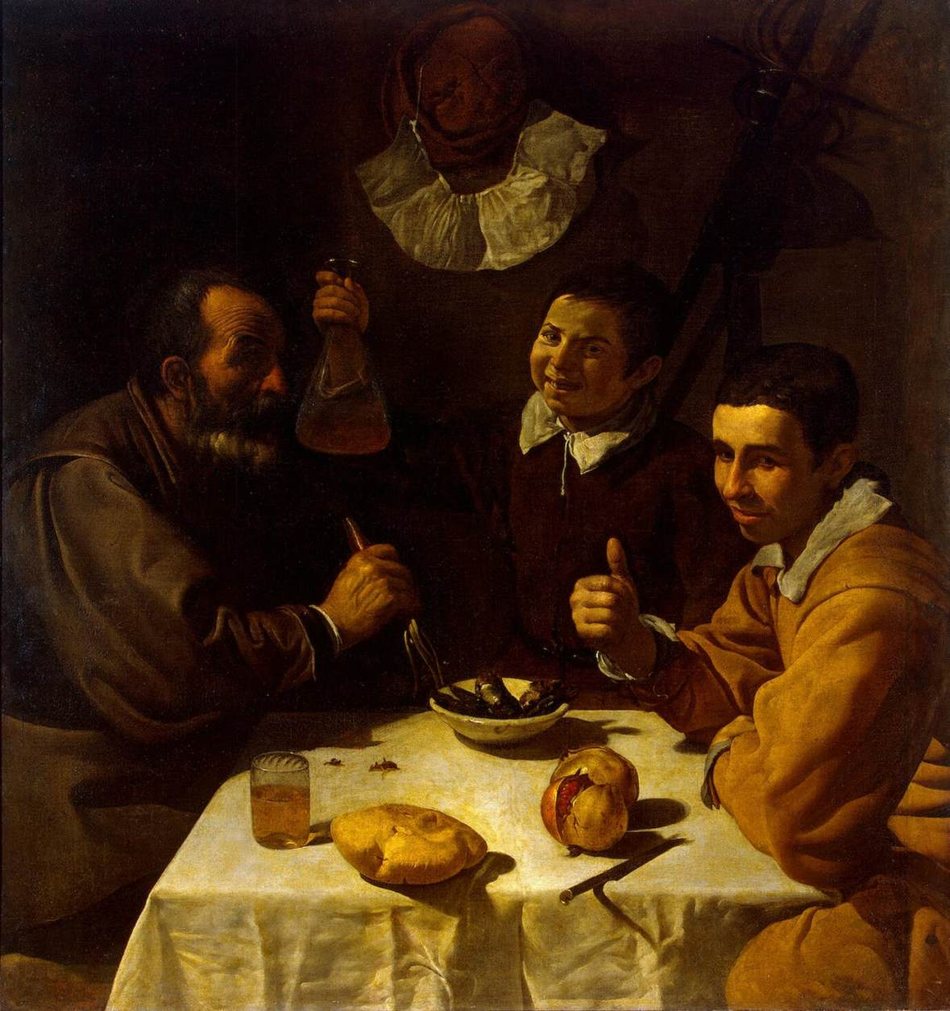
Three men of three ages at a tavern table — bread, pomegranate, a glass raised — painted when Velázquez was about eighteen, already with the bodegón's whole grammar: the white cloth, the raking light, the faces that do not perform for us. An old man, a young man laughing, a boy serving: the ages of man, seated at lunch.
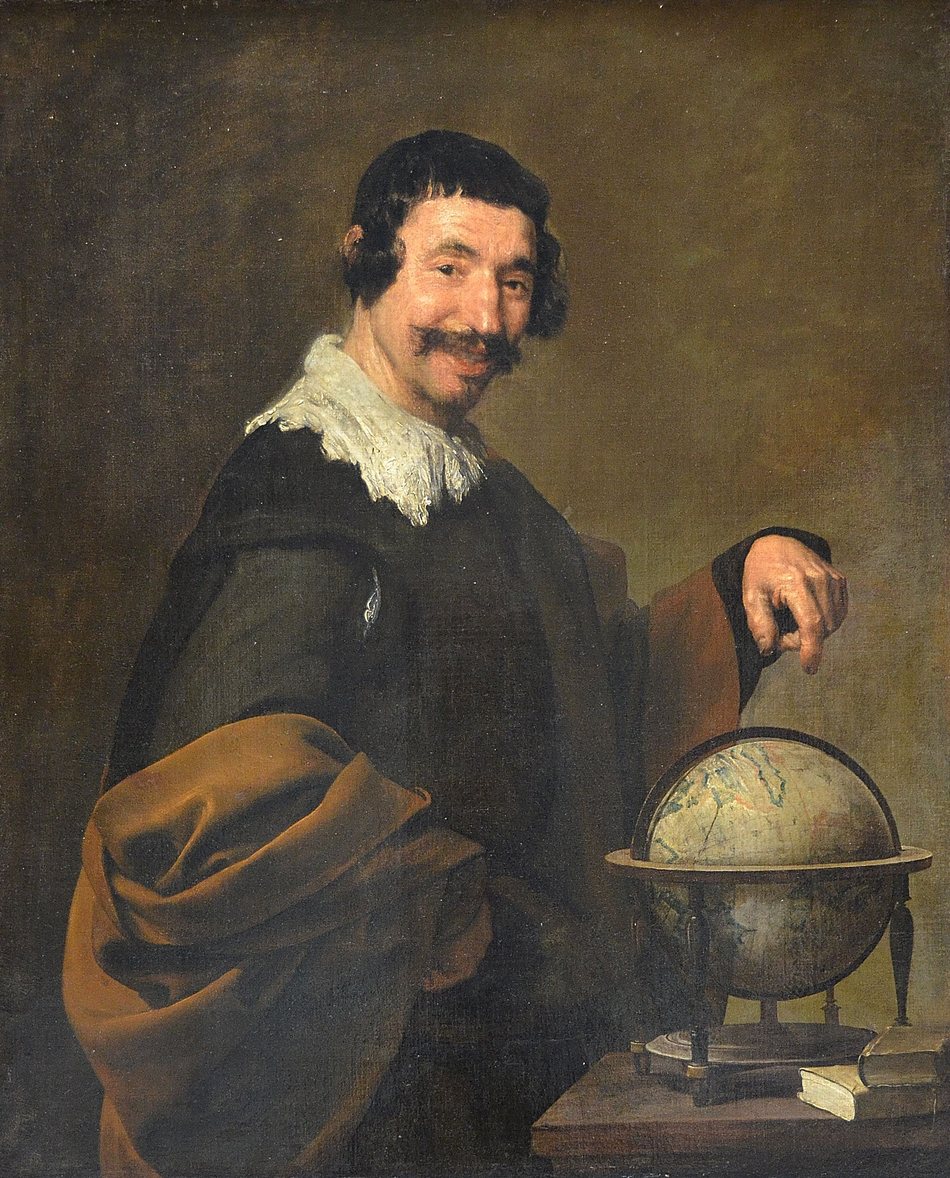
The laughing philosopher, a globe at his hand, grins out at the folly of the world — a tavern model in a lace collar, painted with the bodegón's earthy truth and raised into philosophy by a title. Velázquez returned to the canvas years later and repainted the head and hand into the final, freer handling; the laugh survived every revision.
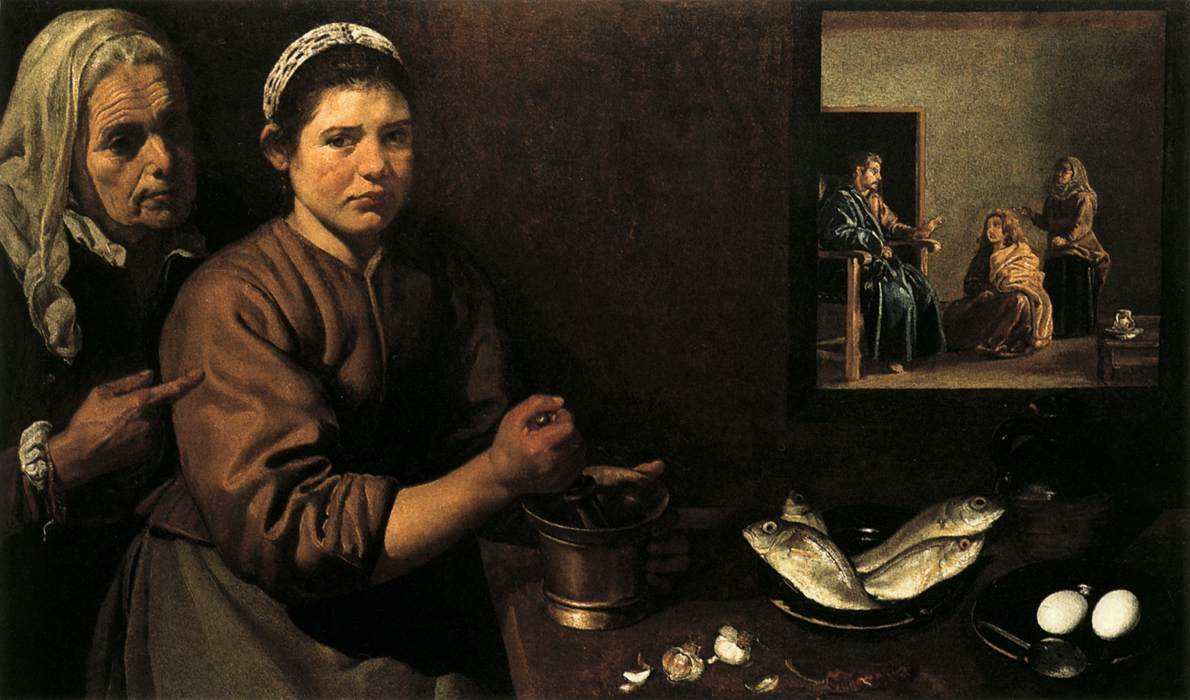
In the foreground a kitchen maid pounds garlic, sulking, while an old woman points her toward the small scene glimpsed through an opening in the wall behind: Christ reproving Martha in the house at Bethany. A picture within the picture, a sermon inside a kitchen — the young Velázquez inventing the bodegón a lo divino, the sacred smuggled into the everyday.
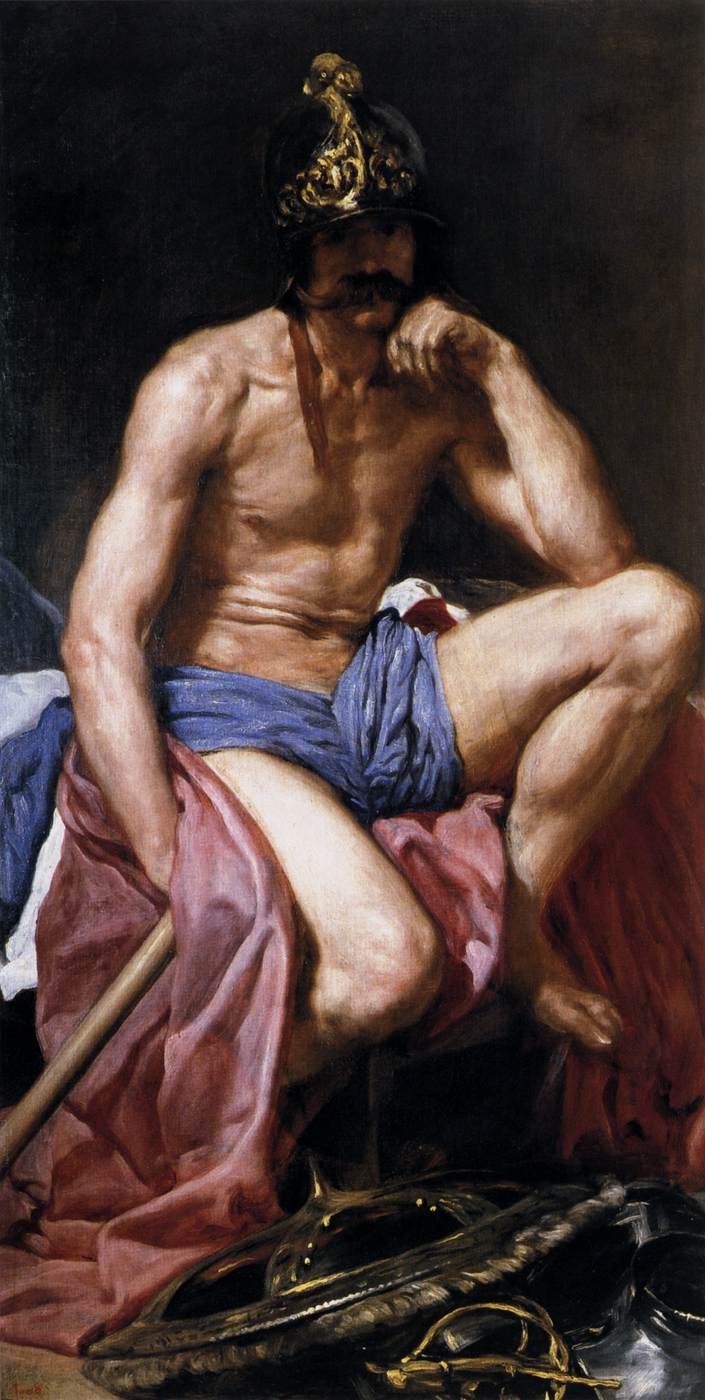
The god of war as a tired, middle-aged man in a moustache and a helmet too grand for him, sitting slumped on a camp bed with his armour discarded at his feet. Painted for the king's hunting lodge, the Torre de la Parada, it is mythology without a drop of glory — the gentlest satire ever painted of the god Spain worshipped most.
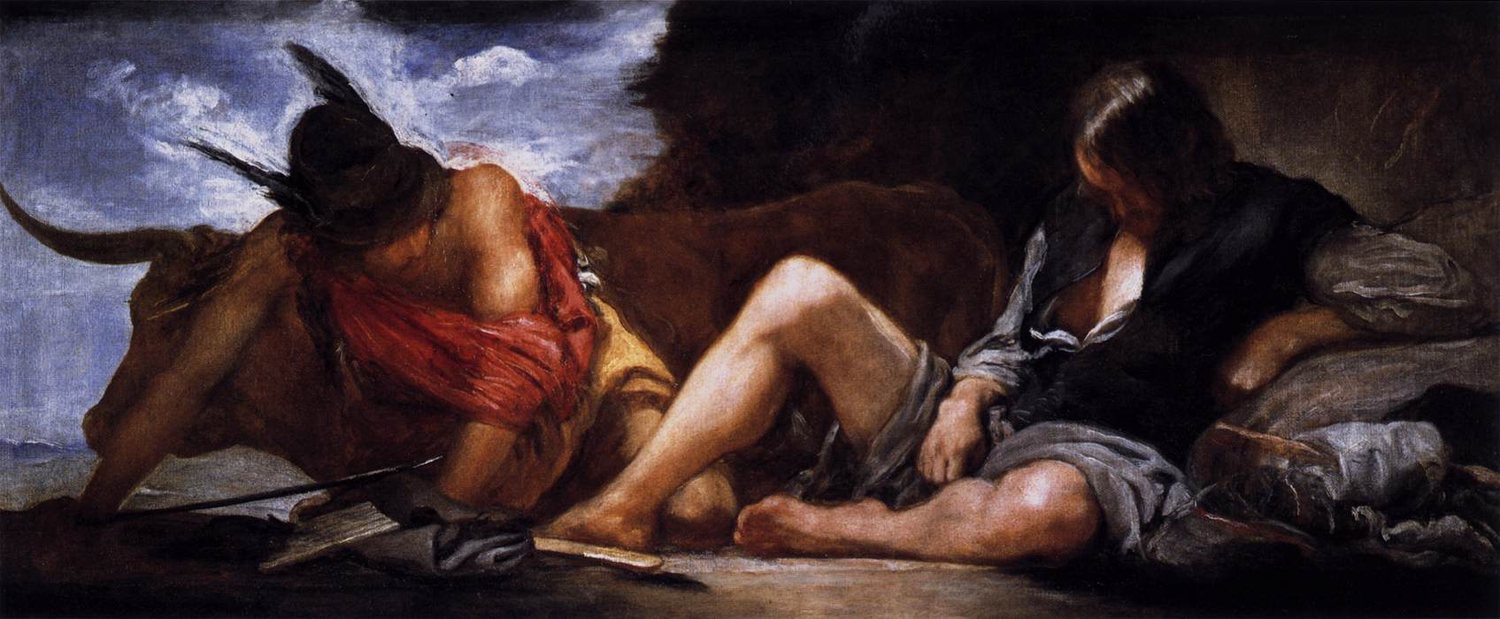
From the last year of his life, painted for the Hall of Mirrors in the Alcázar: Mercury, having lulled the hundred-eyed Argus to sleep with his music, reaches for his sword in a dusk of blue and brown so loosely painted it is nearly abstract. The story is murder; the mood is a lullaby. The late style could go no further — and did not have to.
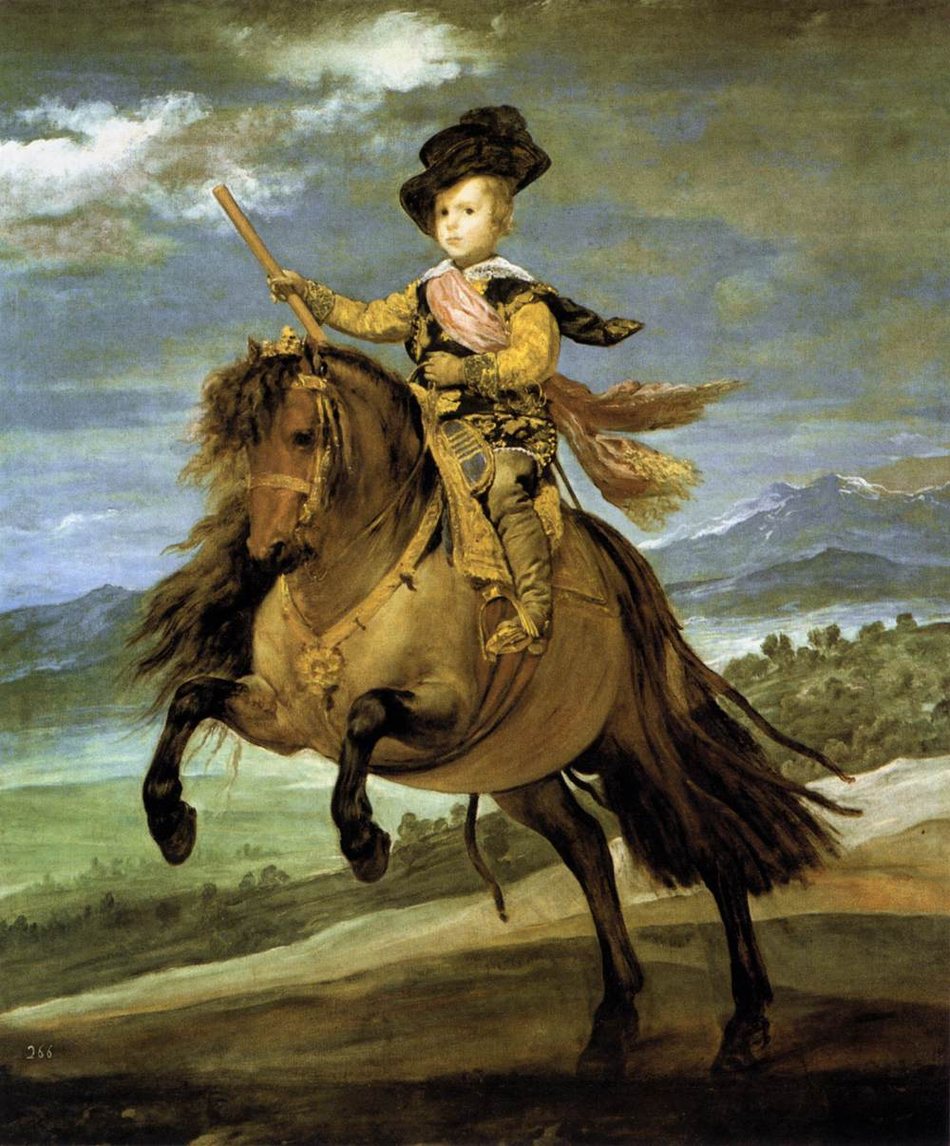
The six-year-old heir to the throne on a rearing pony, baton in hand, plumed hat, the Sierra de Guadarrama dissolving into silver-blue behind him — the whole future of Spain, painted with total confidence. Baltasar Carlos died at sixteen; the picture, which hung in the Hall of Realms among the victories, became the dynasty's most beautiful memorial to what did not happen.