For fifty years Adriaen van Ostade painted one room: a barn-like tavern in Haarlem, low beams, one window, and the same company of peasants drinking, smoking, dancing and quarrelling inside the shaft of light. He painted it broadly as a young man in Frans Hals's orbit and enamel-smooth as an old one, etched it, sold it across Europe — and never tired of it, because the room was never the same twice.
Tradition makes Van Ostade a pupil of Frans Hals, and his early taverns show it: broad, sketchy brushwork, figures caught mid-gesture, paint laid with a swagger. His younger brother Isaac learned in the same shop and took the family manner out of doors, to inn-yards and frozen canals. Adriaen stayed inside, and made the interior his kingdom.
His mature interiors are built on a single decision: one window, high and small, throwing a shaft of light diagonally into a brown room. Everything is arranged by that shaft — the table it strikes, the faces it catches, the smoke it makes visible. The rest is glazed shadow, in which a jug, a cat or a sleeping dog is allowed to glimmer at the edge.
Across fifty years his handling changed completely: the rough, Hals-like impasto of the 1630s gives way, under Rembrandt's example, to modelled chiaroscuro, and by the 1660s to an almost porcelain smoothness, colours brightening, peasants tidying themselves. It is the whole history of Dutch painting, enacted inside one tavern.
Van Ostade etched some fifty plates — taverns, fairs, the senses, the family at table — printing and selling them widely at prices a painting could never reach. The etchings carried his compositions into cottages and collections across Europe, and they taught printmakers what a peasant interior could be: his lines are as smoky and warm as his glazes.
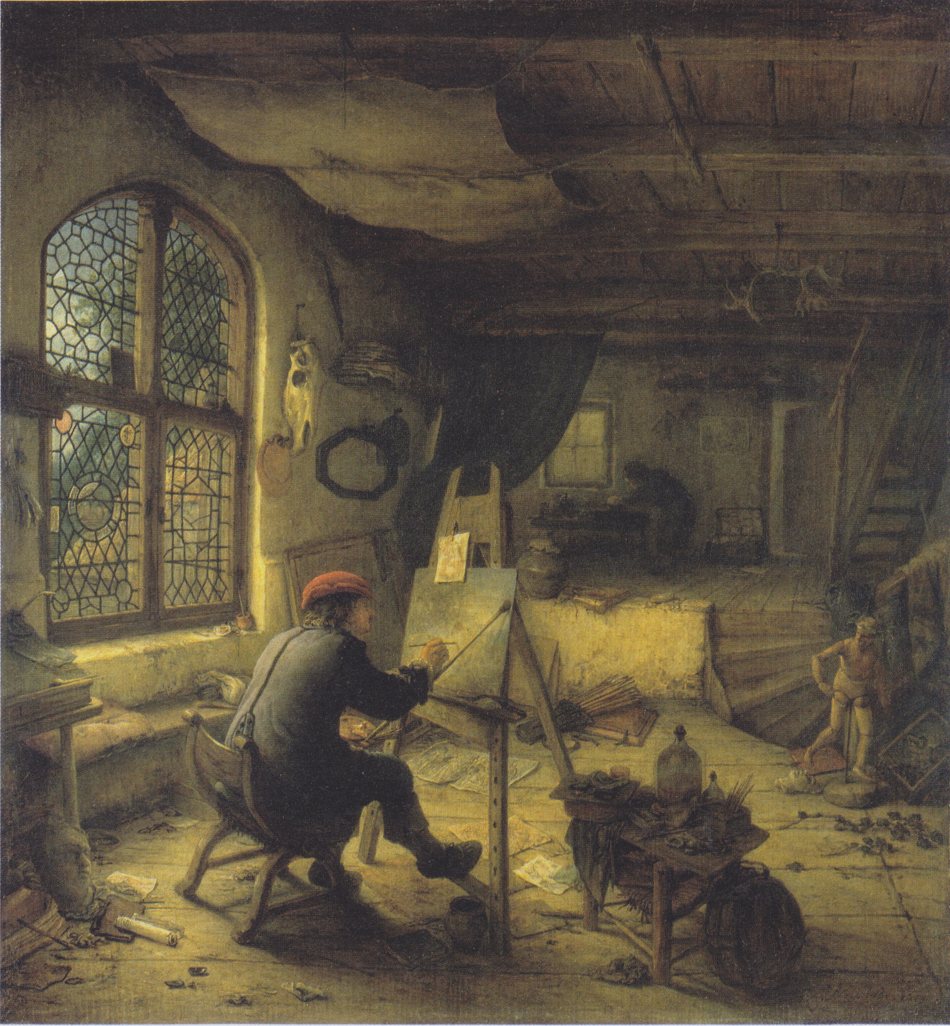
In 1663 he painted himself at work, and the picture is a document: the easel by the window, a lay figure for posing peasants who could not be had, portfolios of drawings, pictures in progress on the wall. The tavern that looks like life caught unawares was, like all such rooms, built — prop by prop, study by study.
The Ostades were a dynasty: Adriaen at the easel for over fifty years, Isaac dead young in 1649 with a brilliant manner of his own, pupils like Cornelis Dusart carrying the tavern into the next century. Adriaen lived to sixty-seven, dean of the Haarlem guild, prosperous and respected — the painter of drunkards who himself kept excellent order.
Ostade paints his own trade without vanity: a painter at his easel by a tall window, grinding colours on the floor beside him, canvases and prints pinned and stacked around a room that is half workshop, half attic. He was fifty-three, the most successful painter in Haarlem — and this is how he chose to show the work: as a craft, done sitting down, in good light.
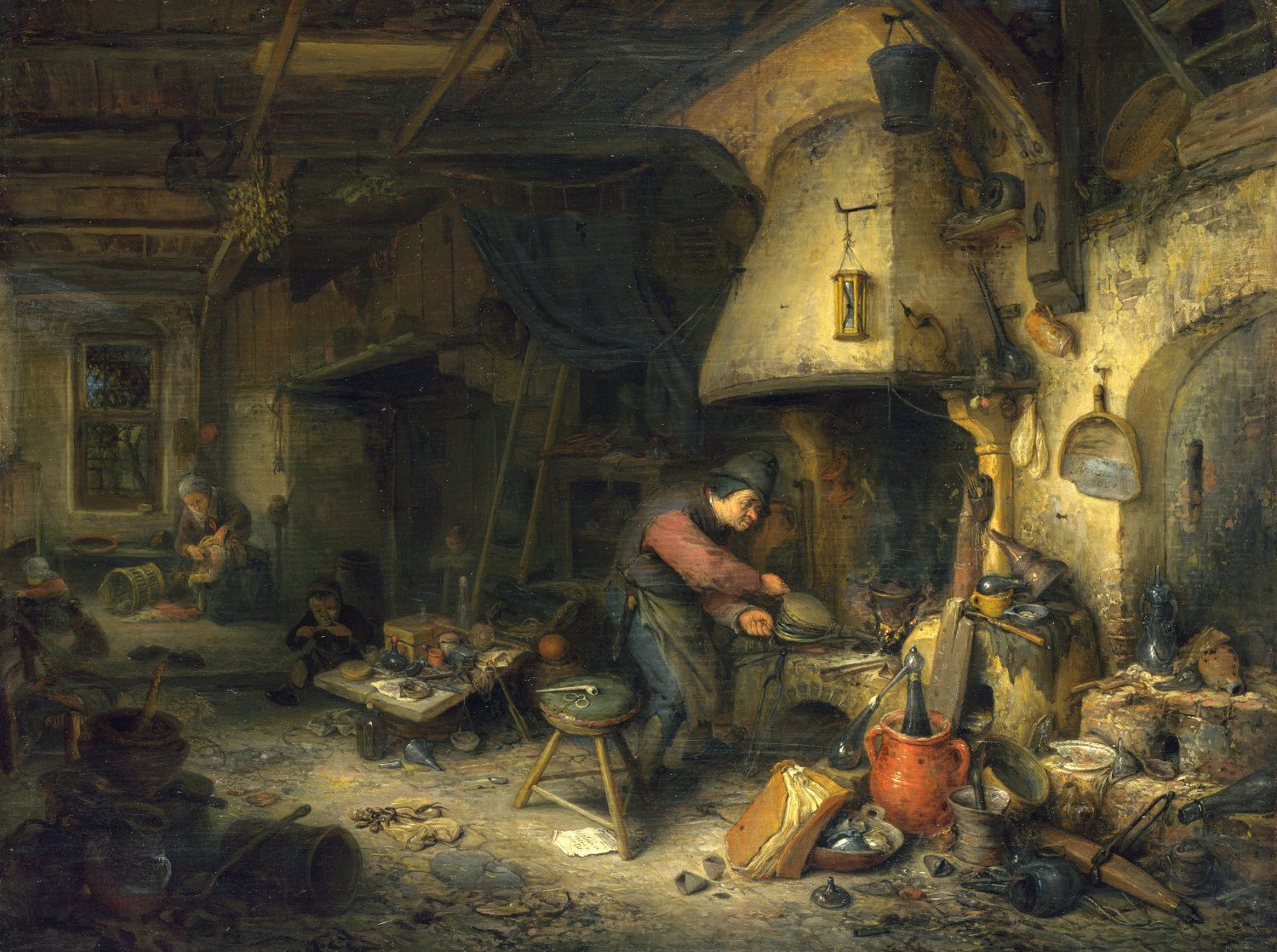
The alchemist stirs his vessel in a laboratory that is also a kitchen, a storehouse and a junk room: bellows, retorts, books and crocks piled to the rafters, a child at the bellows, everything lit by one window. Ostade does not mock him — he paints the beautiful clutter of a man who believes the next hour will pay for all the years.
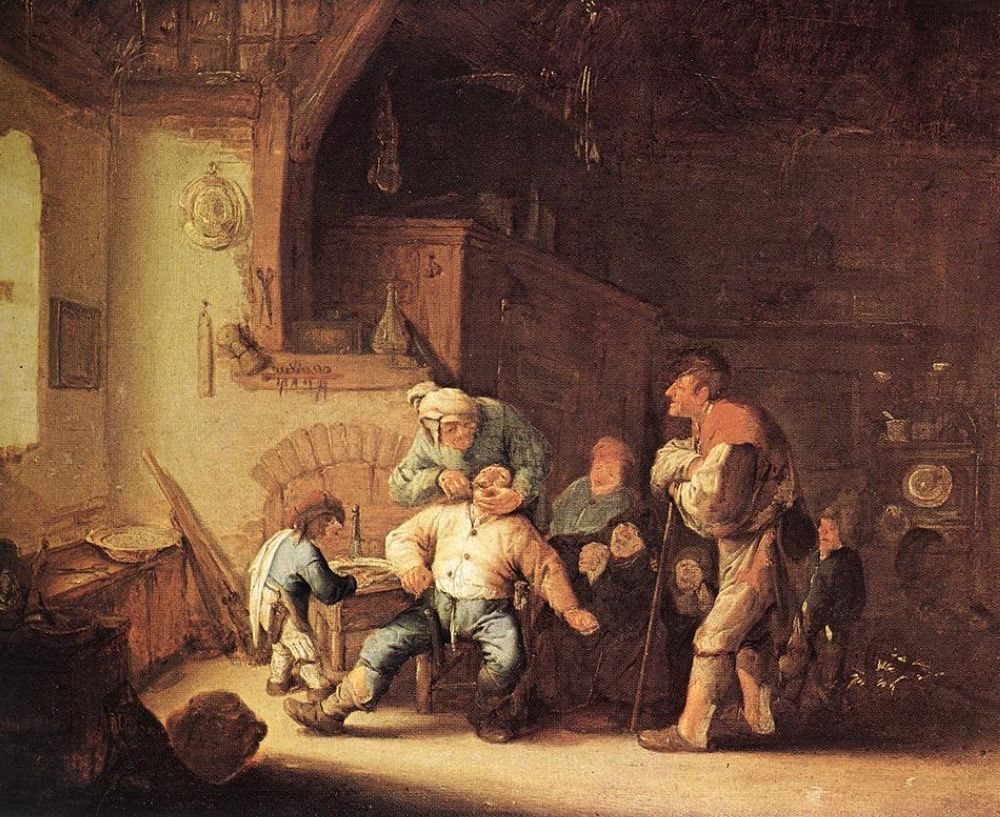
The village barber-surgeon at work: the patient thrown back in the chair, mouth open, hands clutching, while the whole inn turns to watch. Dentistry before anaesthesia was a public spectacle and a test of grip; Ostade paints the exact second of the pull, with the onlookers' faces doing the screaming for the man in the chair.
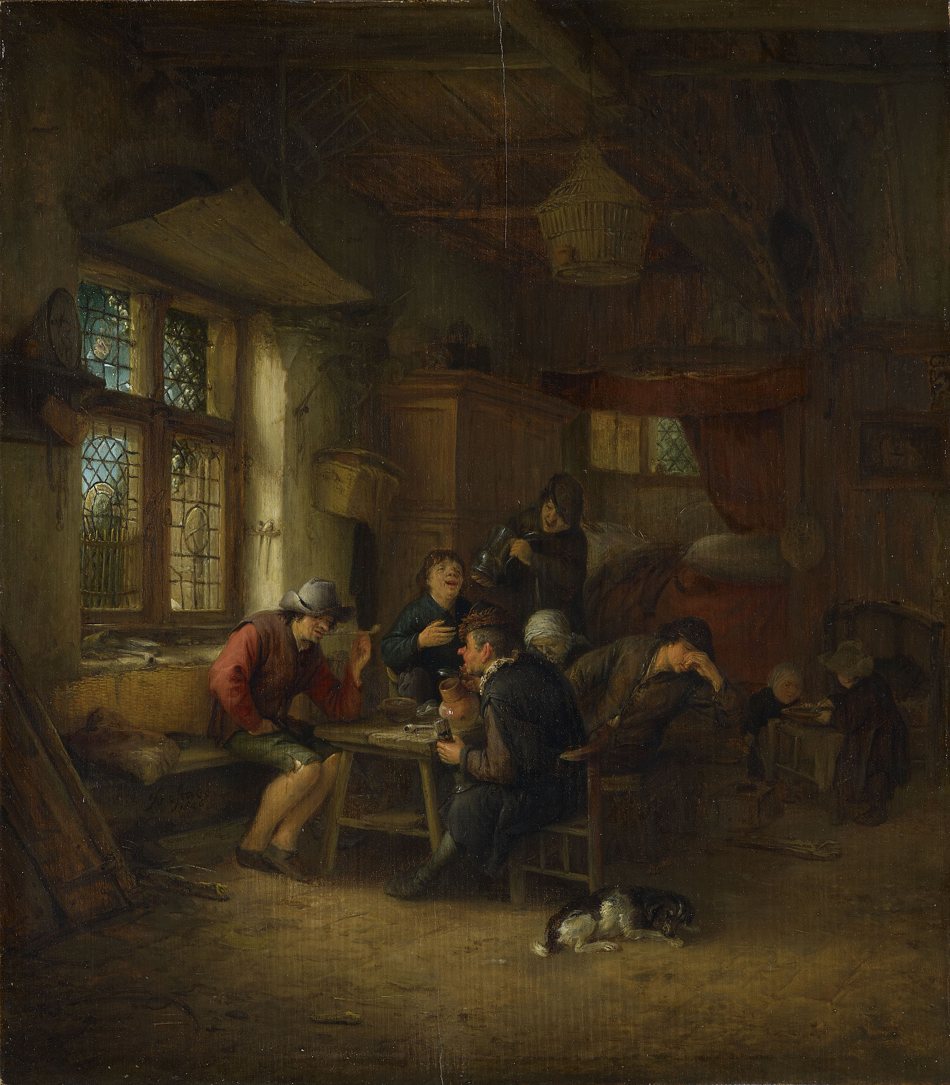
The mature Ostade interior: companies at their tables under a high window, the light falling like poured ale, every group complete in itself — drinkers, card-players, a man warming his hands at the back. Nothing happens and everything is going on; this is the tavern as a small republic, each table its own state.
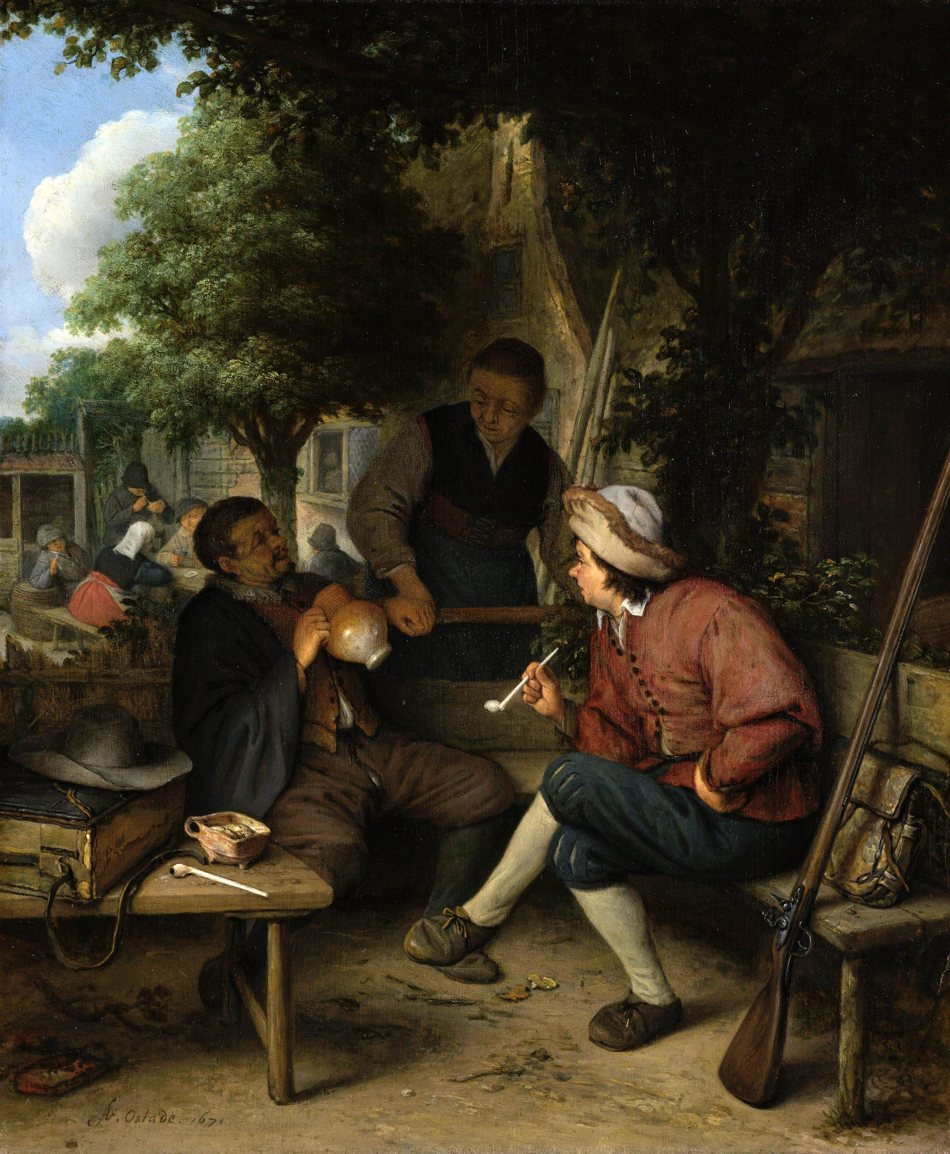
Summer moves the tavern outdoors: a company under the tree at the inn door, pipes lit, a jug going round, one man already asleep against the bench. Ostade gives the scene the full daylight he usually saves for the window — green shade, blue sky, and the whole village taking its ease in the open.
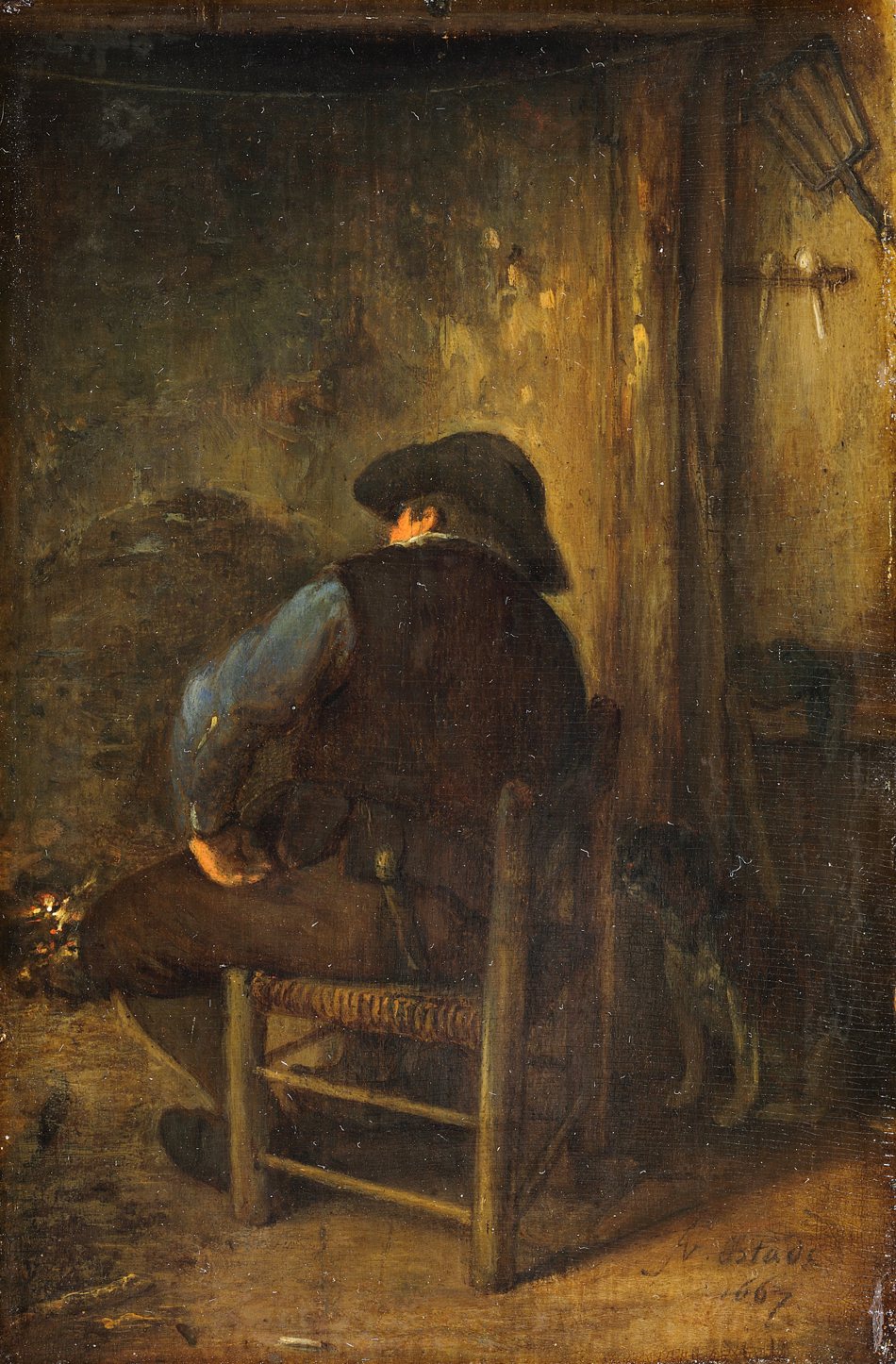
A man seen from behind, alone on his chair by a door, smoking into the light. It is the quietest picture in this room and perhaps the boldest: no face, no story, only a back, a pipe, and the brown dark of an interior breathing around him. Ostade, the painter of crowds, could also paint one man being alone.
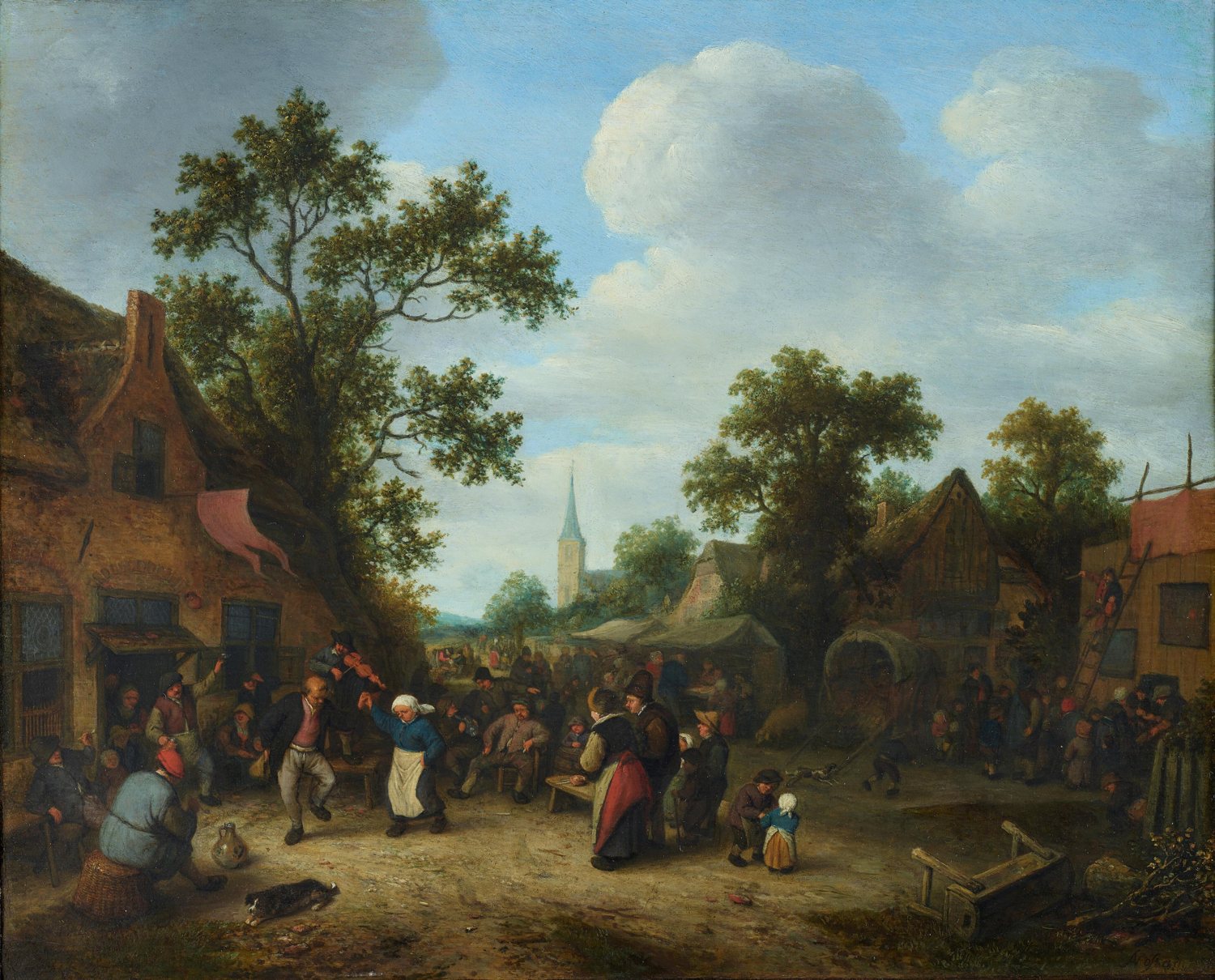
The kermesse fills the village square: a couple dancing at the centre, children tumbling, booths and barrels, the church spire keeping time in the distance. Painted in the bright, high-keyed colour of his later years, it is the tavern turned inside out — the whole parish in the street at once.
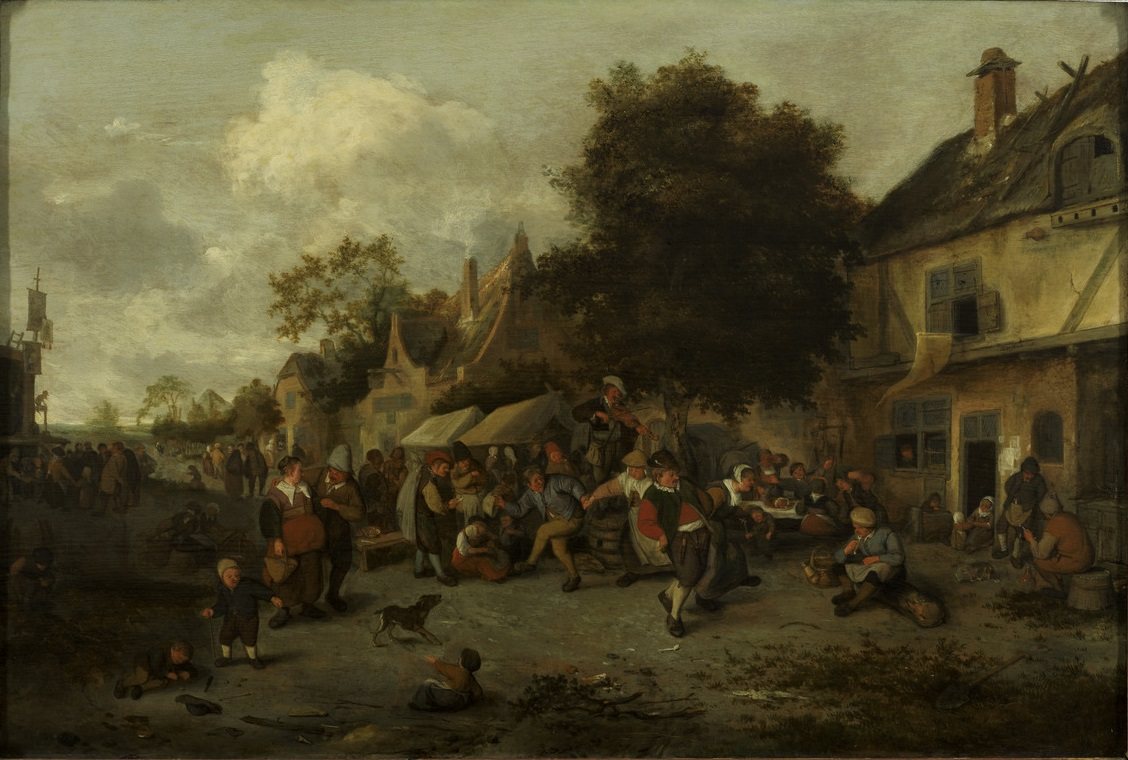
Another square, another feast day, seen in the softer light of afternoon: dancers, drinkers, children and dogs distributed across the cobbles like figures on a board. Ostade painted the village feast all his life; each version is the same holiday and a different crowd, the way the feast itself must have been.
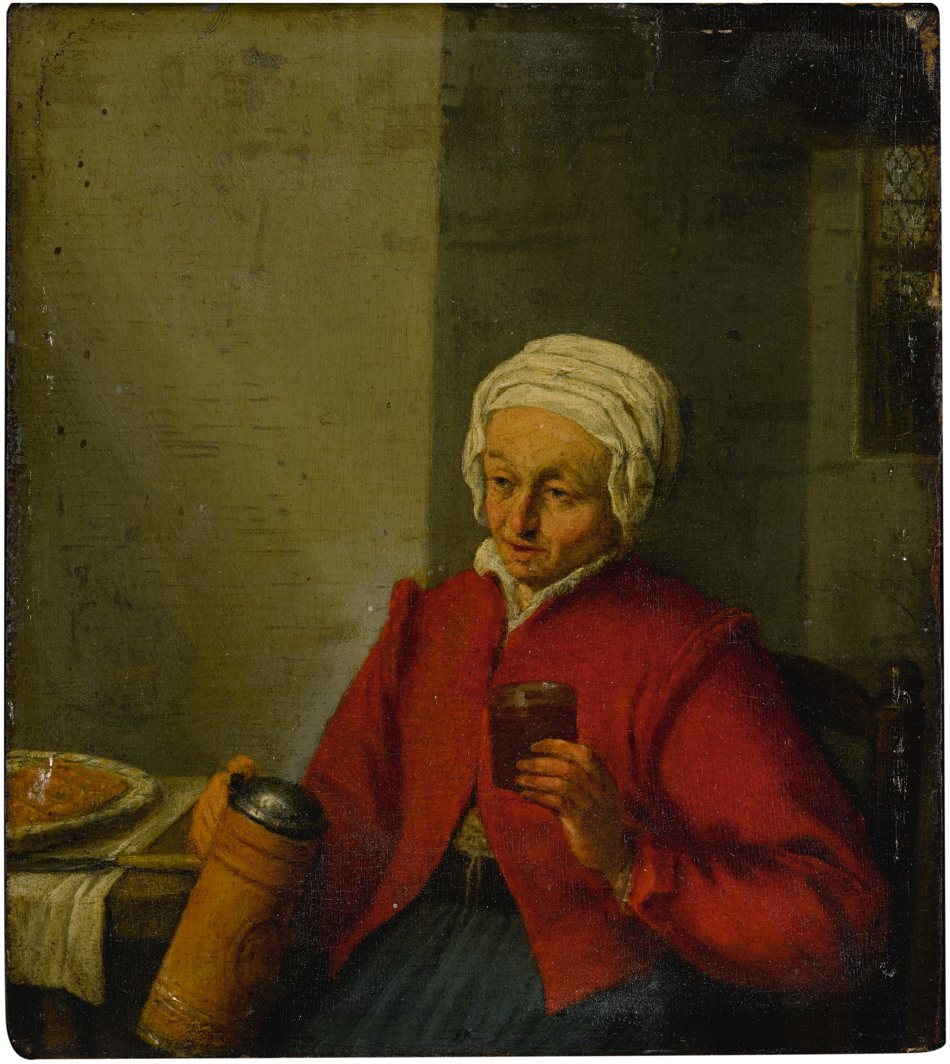
A half-length figure in a red jacket and white cap, a stoneware jug in one hand and a filled glass in the other, looking out at us with the calm of a woman who runs the house. Ostade's single figures have the weight of portraits: this is the landlady of every tavern in this room, caught between one round and the next.
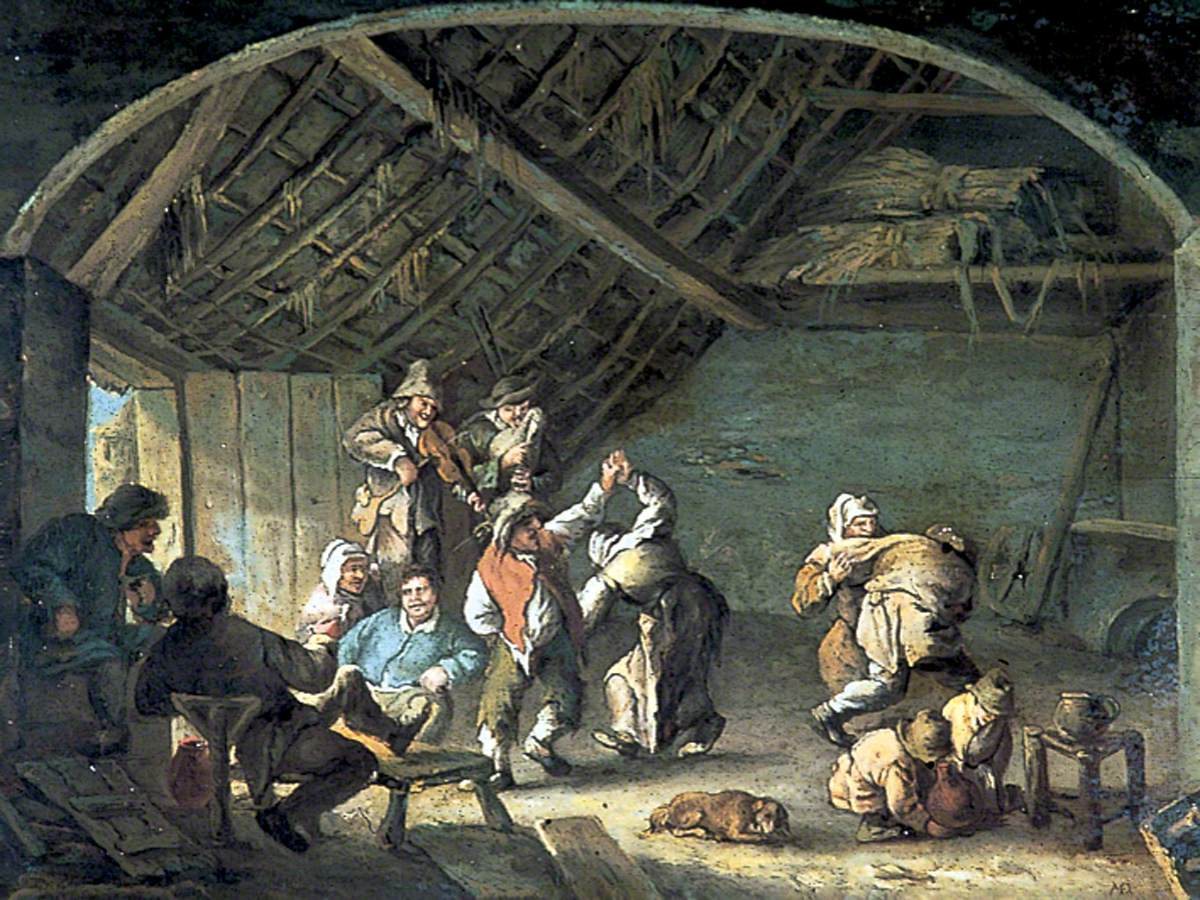
The barn becomes a ballroom: the fiddler perched on a stool, couples turning in the straw-light under the great arched roof, a dog asleep through all of it. The panel itself is arched, like the barn — Ostade lets the picture take the shape of the room it shows, and the dance fills it to the beams.