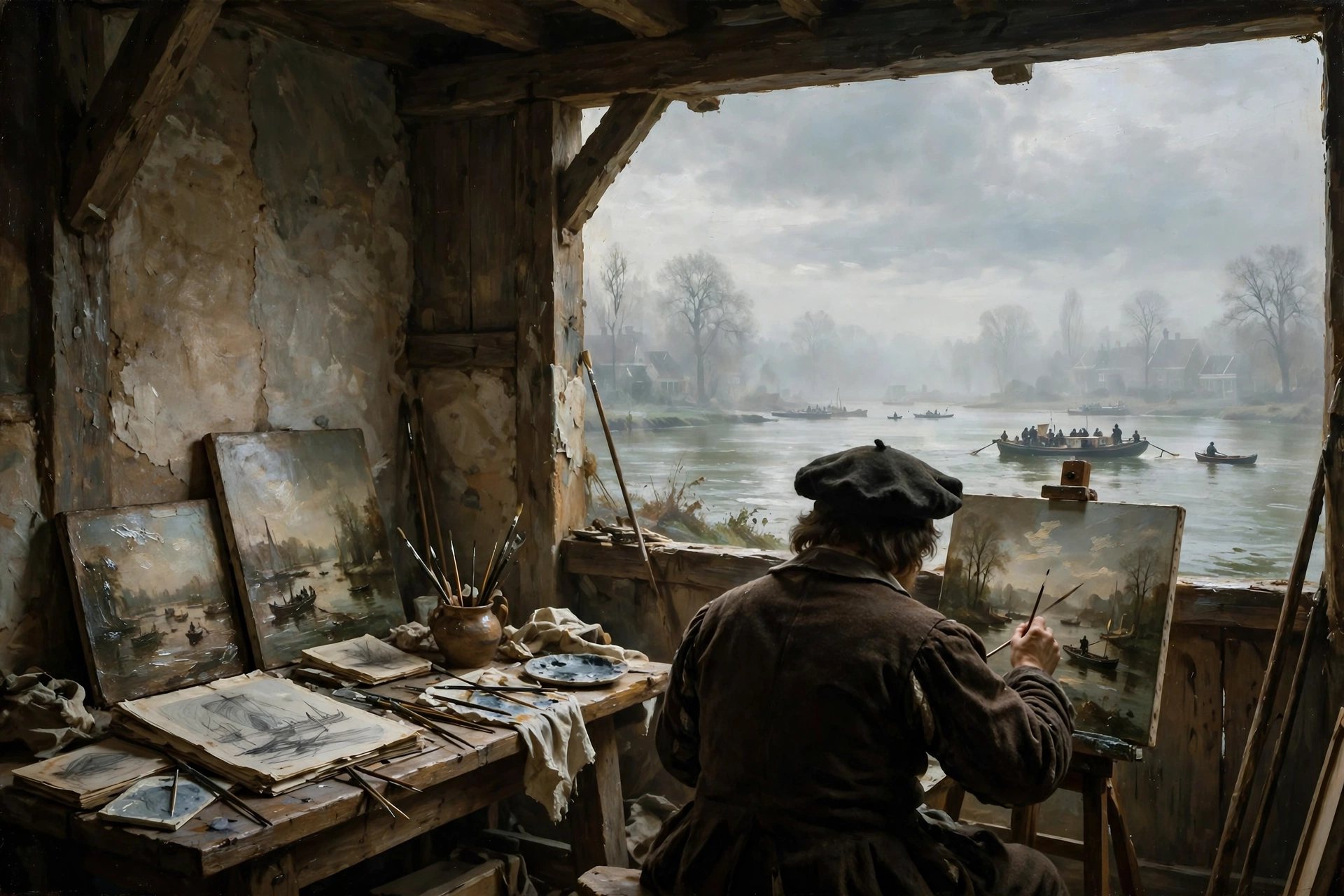
No Dutch painter worked faster, and few worked better. Van Goyen built a landscape out of three tones and a sky, drew it in brown paint as other men draw in chalk, and could finish a river view while the ferry was still crossing. He left more than a thousand paintings and a mountain of chalk drawings made from boats — and died in debt anyway, undone by tulips, houses and dealing. The rivers, at least, never lost money.
Around 1626, with his teacher Esaias van de Velde and Pieter de Molijn, Van Goyen launched the tonal phase of Dutch landscape: a restricted chord of greys, yellow-greens and browns, the sky taking two-thirds of the panel, the land reduced to a dark strip of bank, water and a few trees. Against the bright, coloured landscapes before it, this was painting in the key of Dutch weather.
Contemporaries marvelled at his speed: a whole landscape laid in within the hour, the composition drawn directly in thin brown paint on the grounded panel, the sky swept in with a broad brush while the foreground was still wet. Dealers told of pictures begun and finished during a single conversation. The speed was not carelessness — it was a method, and an economy.
He travelled the rivers by boat and filled sketchbooks with black-chalk drawings — banks, ferries, church towers, farm gables — hundreds of which survive, dated like diary entries. Back in the studio these pages were his capital: a tower from one journey, a ferry from another, a sky from a third, composed into views that feel remembered rather than invented.
His construction can be drawn in three lines: a low horizon, a bank cutting diagonally from a near corner, a wedge of water answering it. Onto this armature everything else is hung — boats, figures, a windmill, a town in the mist. The diagonal is the engine: it pulls the eye across the water exactly as the ferry pulls its passengers.
Painting was only one of his businesses. Van Goyen dealt in pictures, ran auctions, bought houses, and speculated in the great tulip trade of 1636–37 — and lost. He painted faster and faster to feed the debts, which is why the oeuvre runs past a thousand pictures and why so many are small, quick and brilliant. He died in The Hague in 1656 owing money, leaving the rivers to pay his reputation's arrears.
Under the paint, a Van Goyen begins as a drawing: the whole scene sketched in brown on the pale ground, so thin that in worn passages you can still read the first thoughts. Colour was then glazed and scumbled over it in a few broad campaigns — grey for the sky, green-brown for the banks — keeping the drawing alive inside the finished picture like a pulse.
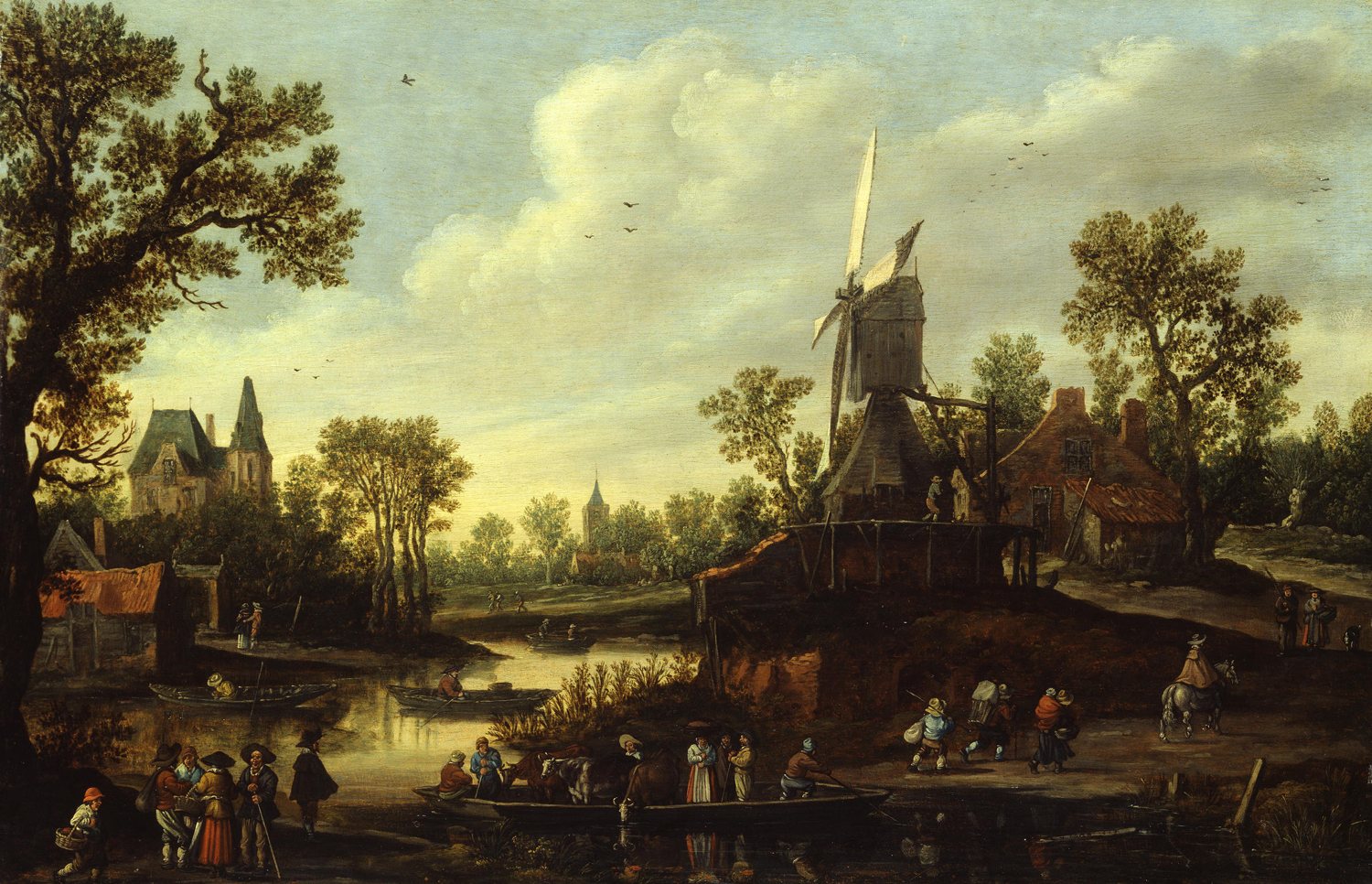
A windmill, a church, a village landing, and the ferry doing its slow shuttle in front of them: the whole Dutch river economy in one glance. Van Goyen paints it the way the ferryman rows — steadily, without flourish, trusting the crossing to make the picture.
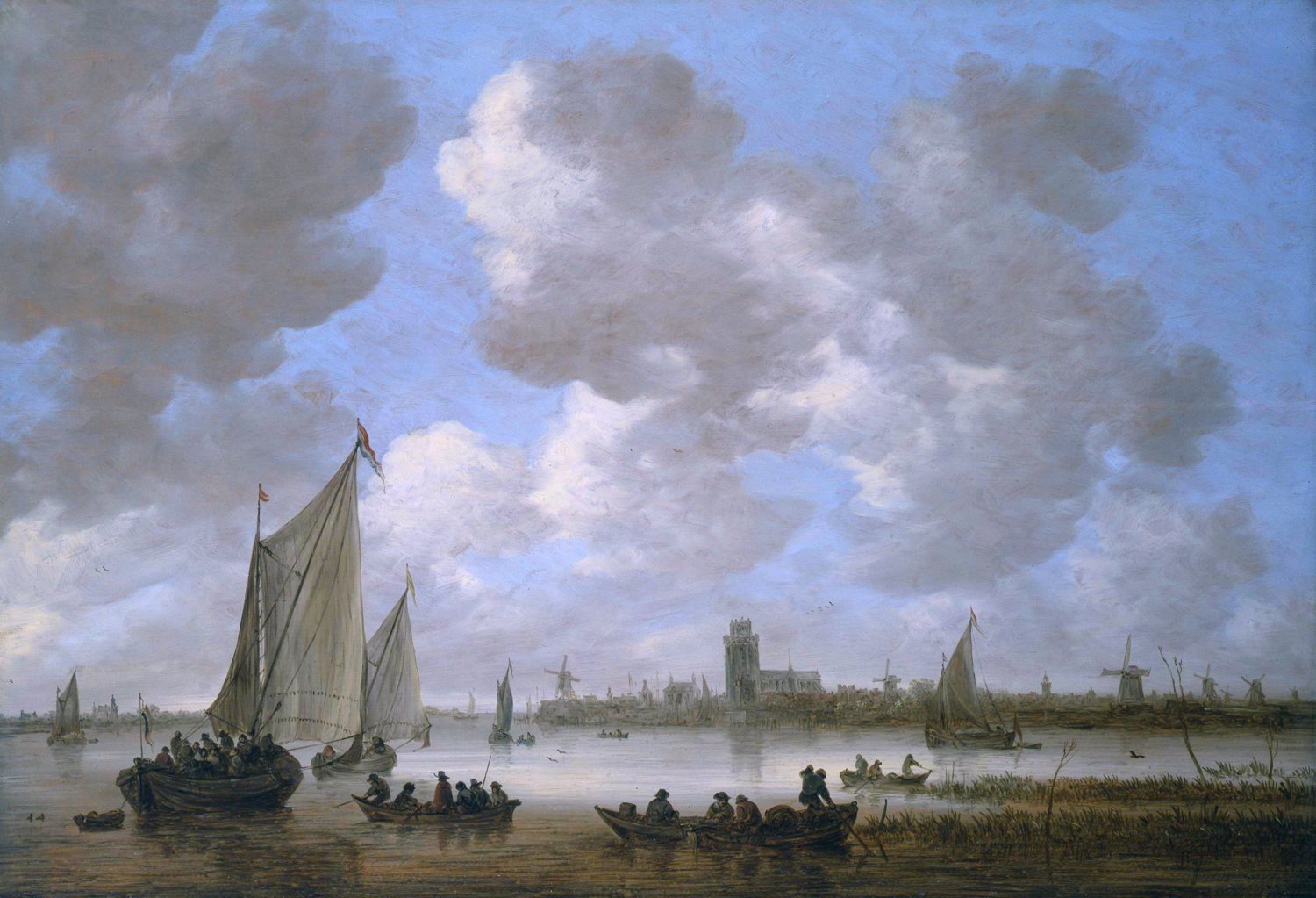
Dordrecht from the water: the great church on the horizon, sailing barges and rowing ferries crossing in front, two-thirds of the panel given to a sky that keeps changing its mind. He painted the town again and again across thirty years; this late version is the calmest — a portrait of a place he knew like a ferry route.
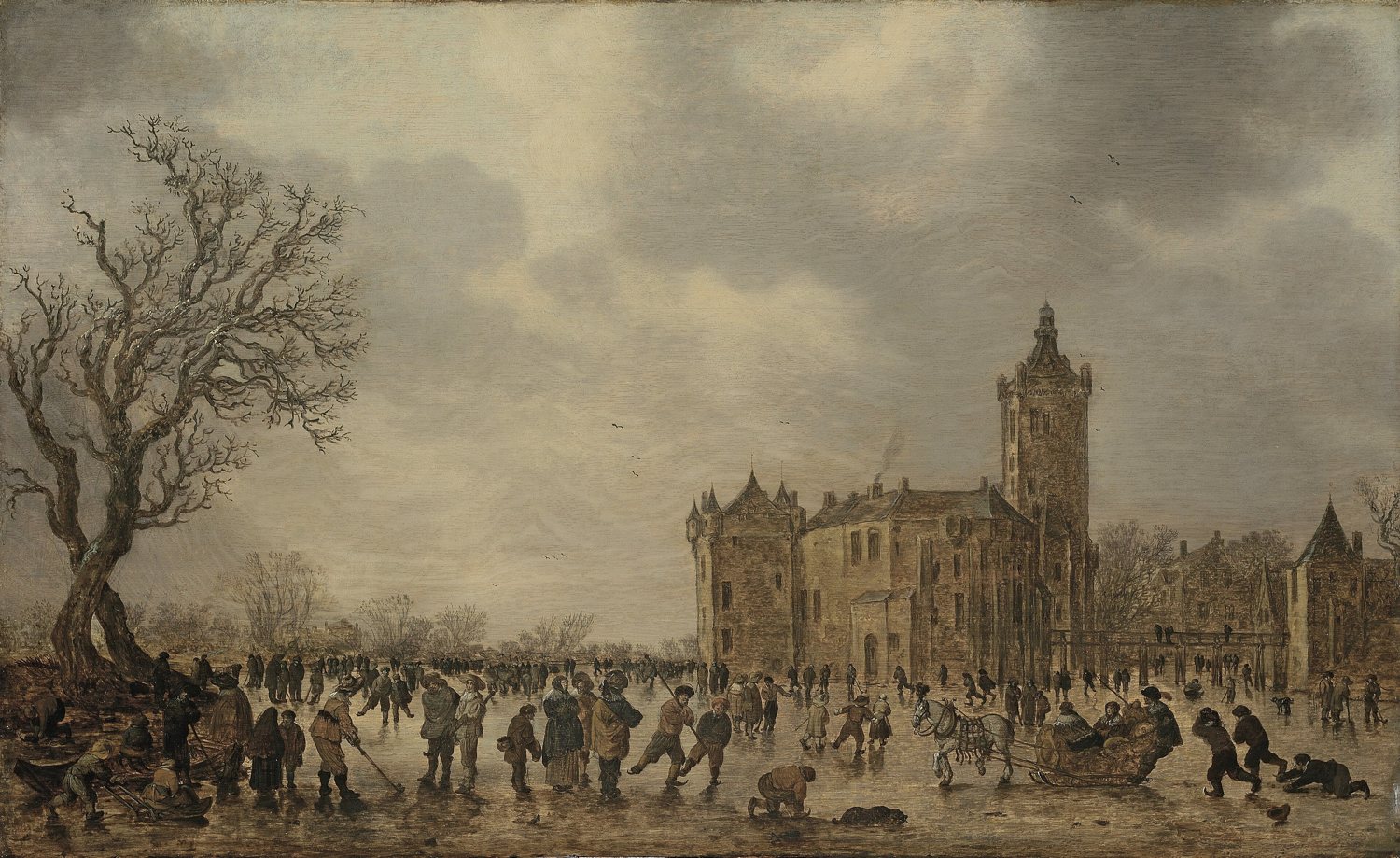
A frozen river before a castle: skaters, sledges, a crowd at the eel-hole, one bare tree writing the season across the sky. Winter was the tonal manner's home ground — a world already painted in grey and brown before the artist opened his box.
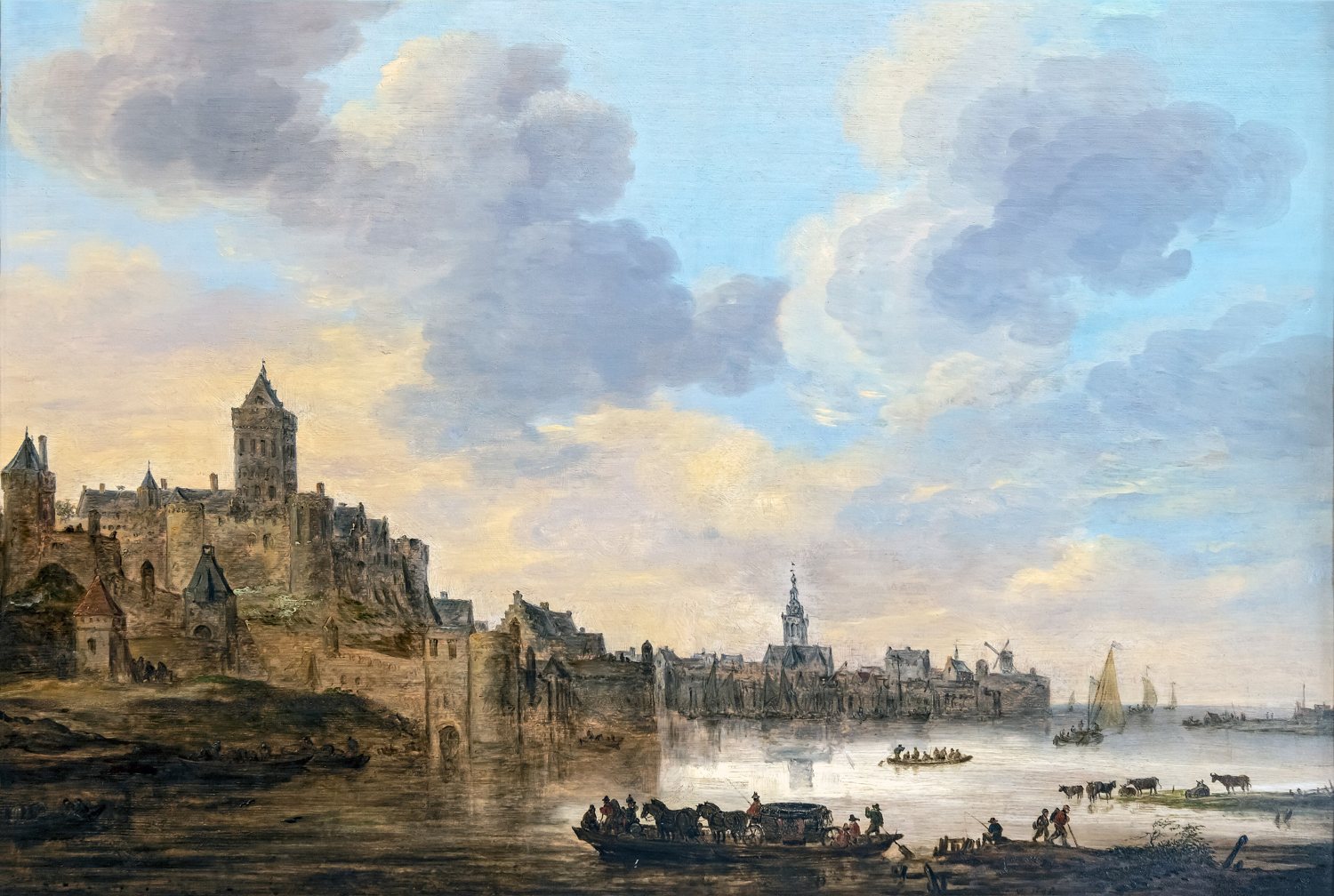
The Valkhof at Nijmegen rides above the Waal like a ship: the old imperial castle, the Belvedere tower, boats unloading below. Van Goyen travelled the great rivers with his chalk book in the 1640s and brought home town profiles by the dozen — this is among the grandest, a city seen the way a skipper sees it.
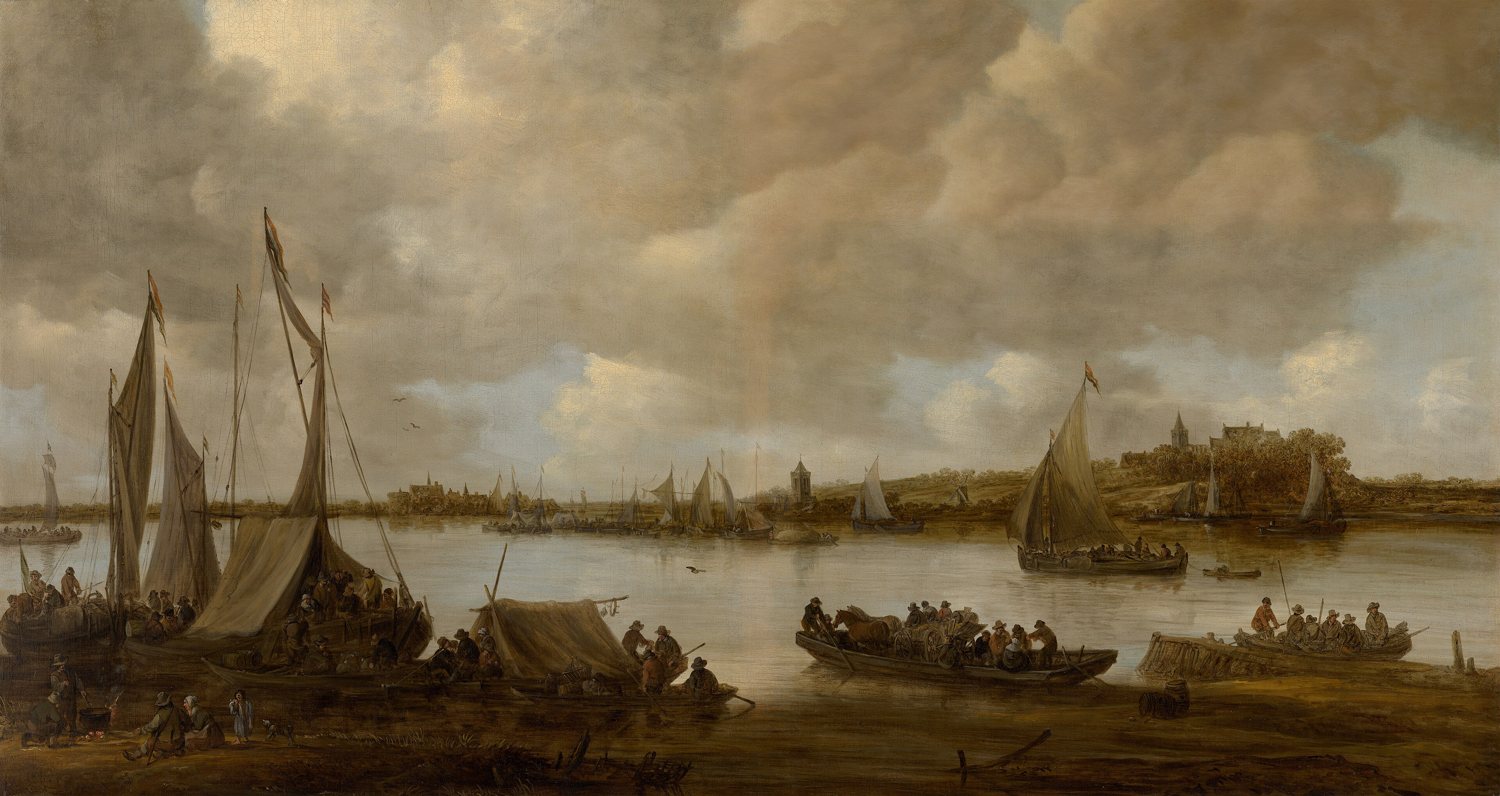
On the Rhine journey of the 1640s the land itself rises: the wooded hill of Elten on the far bank, ferries and barges working the current below. Van Goyen keeps his low horizon and grey-green chord even here, where Holland has ended and Germany has begun — the river, he shows, does not change its habits at the border.
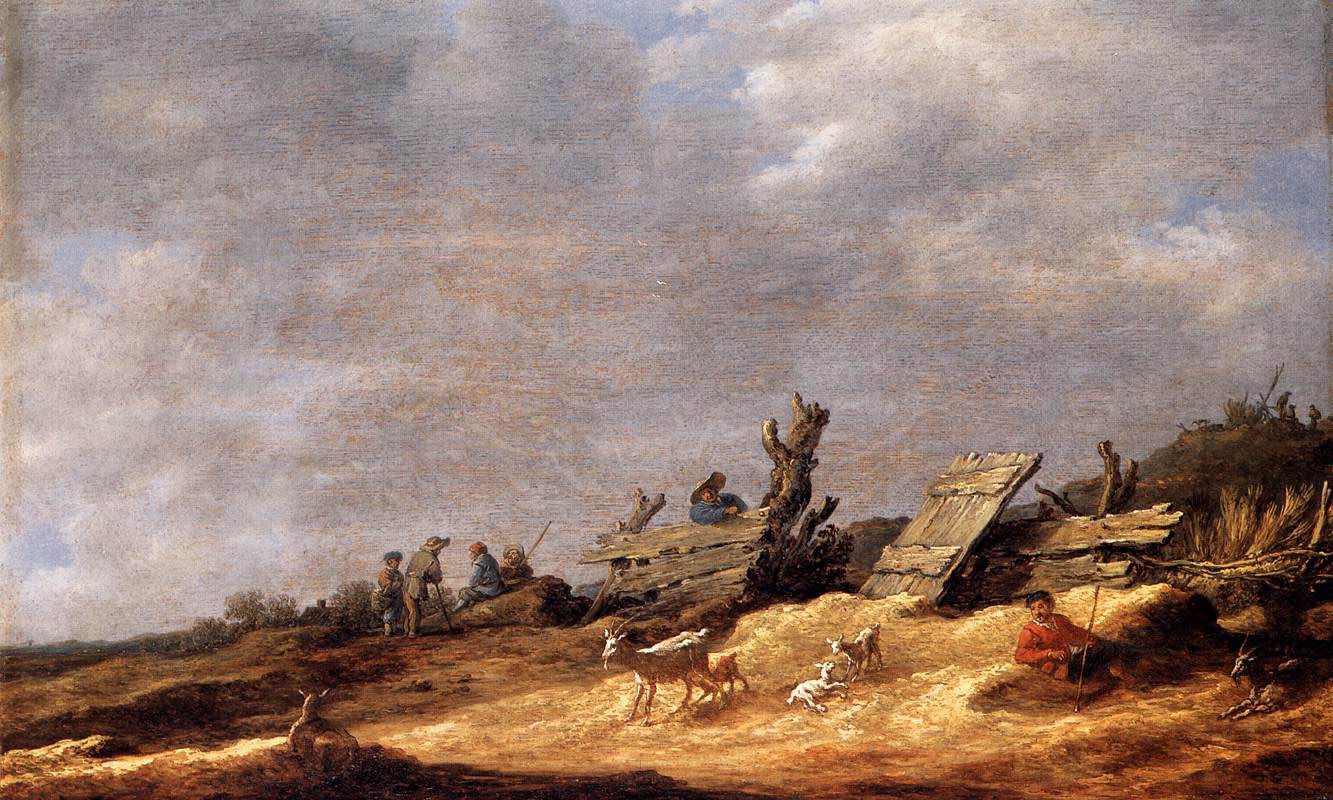
From the years when the tonal manner was new: a sandy dune track, a broken fence, travellers resting, the land built of three browns under a sky of wet grey. Nothing is described and everything is present — this economy is the invention itself, dated the year he turned thirty-five.
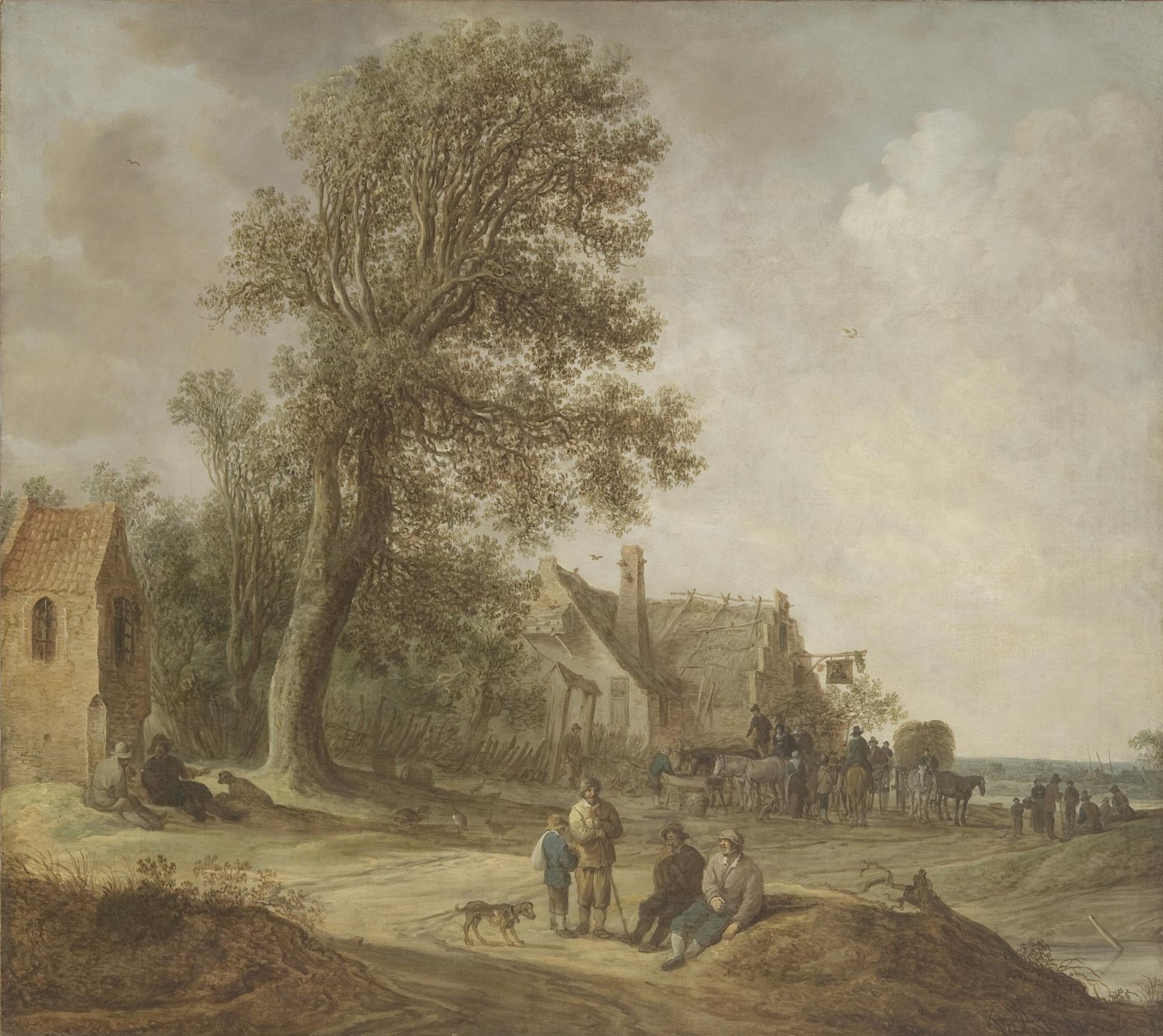
The inn under the great tree is the river journey's punctuation mark: horses unhitched, travellers at the bench, the village church behind. Van Goyen paints the stop the way he painted the road — quickly, warmly, and with the tree doing the work of a cathedral.
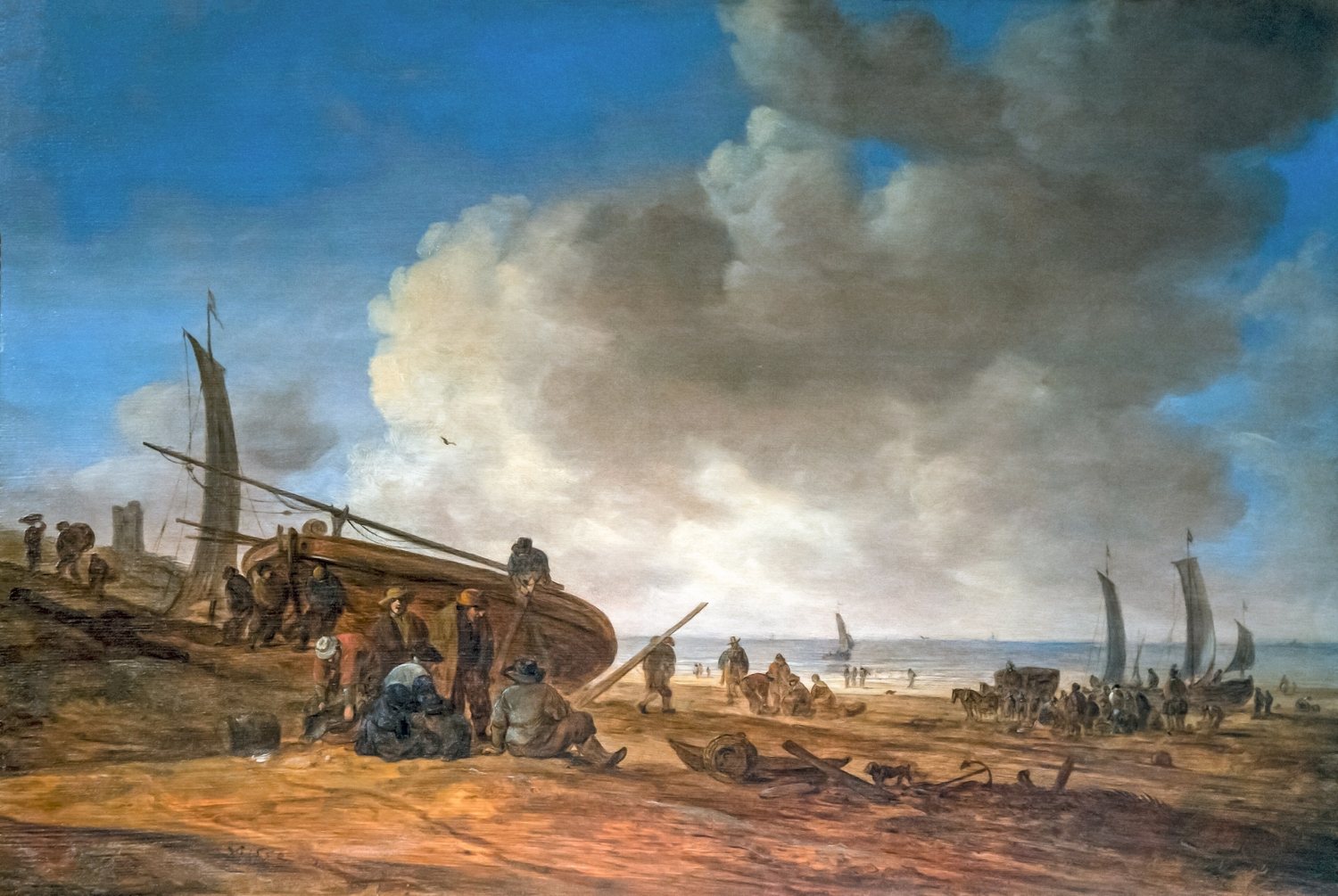
A fishing boat hauled out on the sand, the crew and buyers around it, the sea flat behind and the sky enormous above. The beach pictures are the river pictures turned outward: the same low horizon, the same working crowd, but the water now goes to the edge of the world.
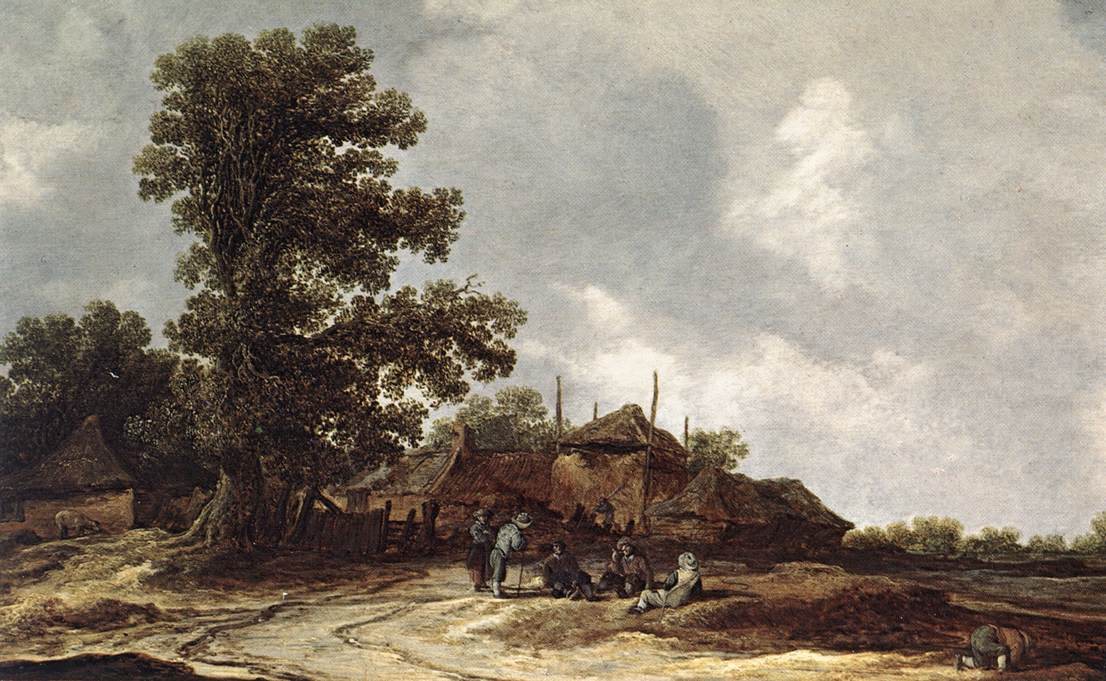
A great tree, a farm roof, figures at their chores in the yard: the smallest of his subjects, painted with the same three tones as the great rivers. In Van Goyen the farmyard and the estuary are one country, and the haystack gets the same sky as Dordrecht.
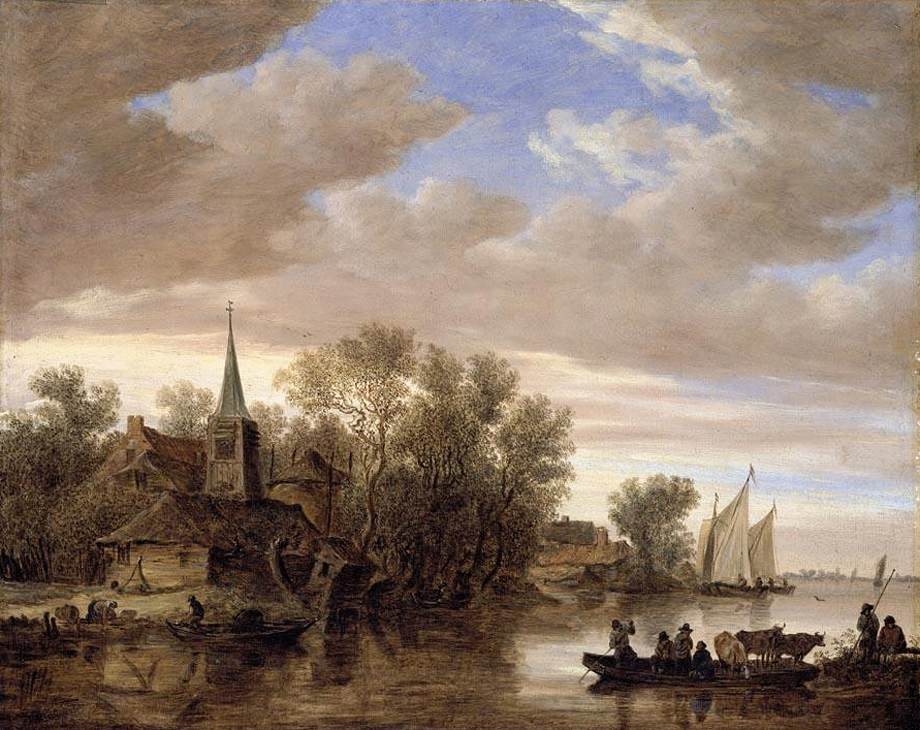
A village with its church spire reflected in still water, the ferry crossing with its load, sail barges waiting at the bank. It is the complete Van Goyen sentence — bank, water, sky, boat — written so often that it became a signature, and so well that it never became a formula.