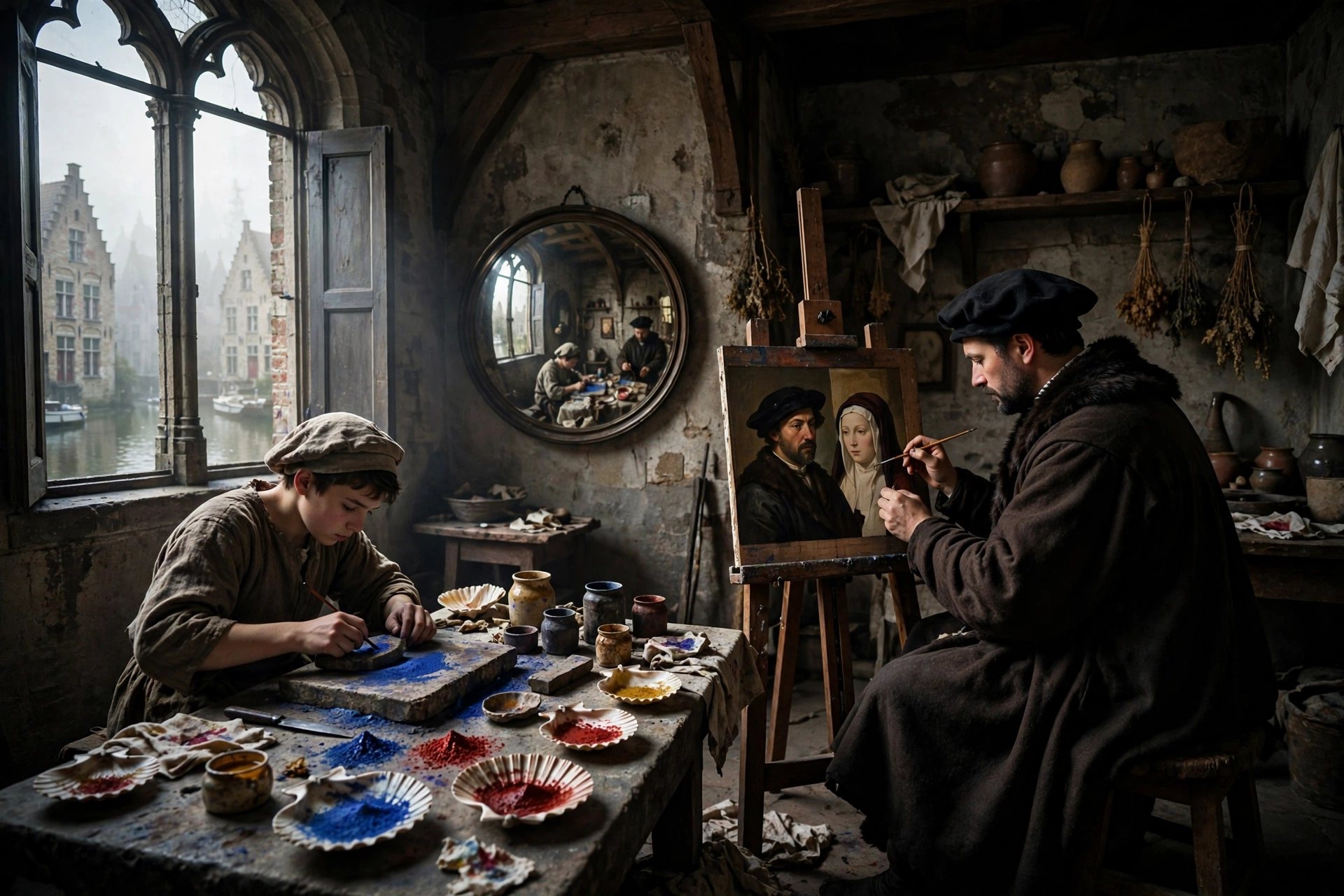
The painter who taught Europe what oil paint could do: Jan van Eyck built his pictures layer upon translucent layer, until fur, brass, glass and skin each caught the light in their own way. A courtier of Philip the Good and a citizen of Bruges, he signed his most famous panel not with a flourish but as a witness: Jan van Eyck was here.
Van Eyck's colour is not mixed on the palette but built in the picture: a light underpainting, then thin translucent glazes of oil — red lake over vermilion, blue over grey — each layer lit from beneath. That is why his jewels glow instead of shining, and why a fur collar can hold a hundred separate hairs, laid with a brush of a few sable strands.
His panels are Baltic oak, coated with chalk ground polished smooth as ivory and drawn on in a dark liquid medium — the underdrawing infrared cameras read today. The white ground is the picture's hidden lamp: light passes through the glazes, strikes it, and returns to the eye carrying the colour with it.
His motto — Als Ich Can, 'as I can' — puns on his own name, Eyck, and he painted it on frames like a craftsman's mark. On the Arnolfini panel the signature is not on the frame at all but on the wall inside the picture, in legal calligraphy: Johannes de Eyck fuit hic — Jan van Eyck was here. The painting presents itself as a witnessed document.
The convex mirror on the Arnolfini wall reflects the whole room from behind — including two men entering who stand where the viewer stands. To paint a curved reflection truly, with every object bent correctly, is a feat of optics no contemporary attempted: the mirror is Van Eyck's quiet proof that his eye misses nothing.
Behind his Virgins and donors, windows and loggias open onto landscapes painted with microscopic patience — river towns, bridges crowded with figures, hills dissolving into blue haze. This aerial perspective, depth made of thinning colour and light, is a Flemish gift to European painting, and Van Eyck is its first master.
Vasari's tale that Van Eyck invented oil painting is a myth: oils are older than he is. What he did was harder — he systematised the medium, glaze by glaze, until panel painting could hold light itself. The Ghent Altarpiece inscription credits his brother Hubert as the greater painter who began the work; Jan, 'second in art', finished it in 1432.
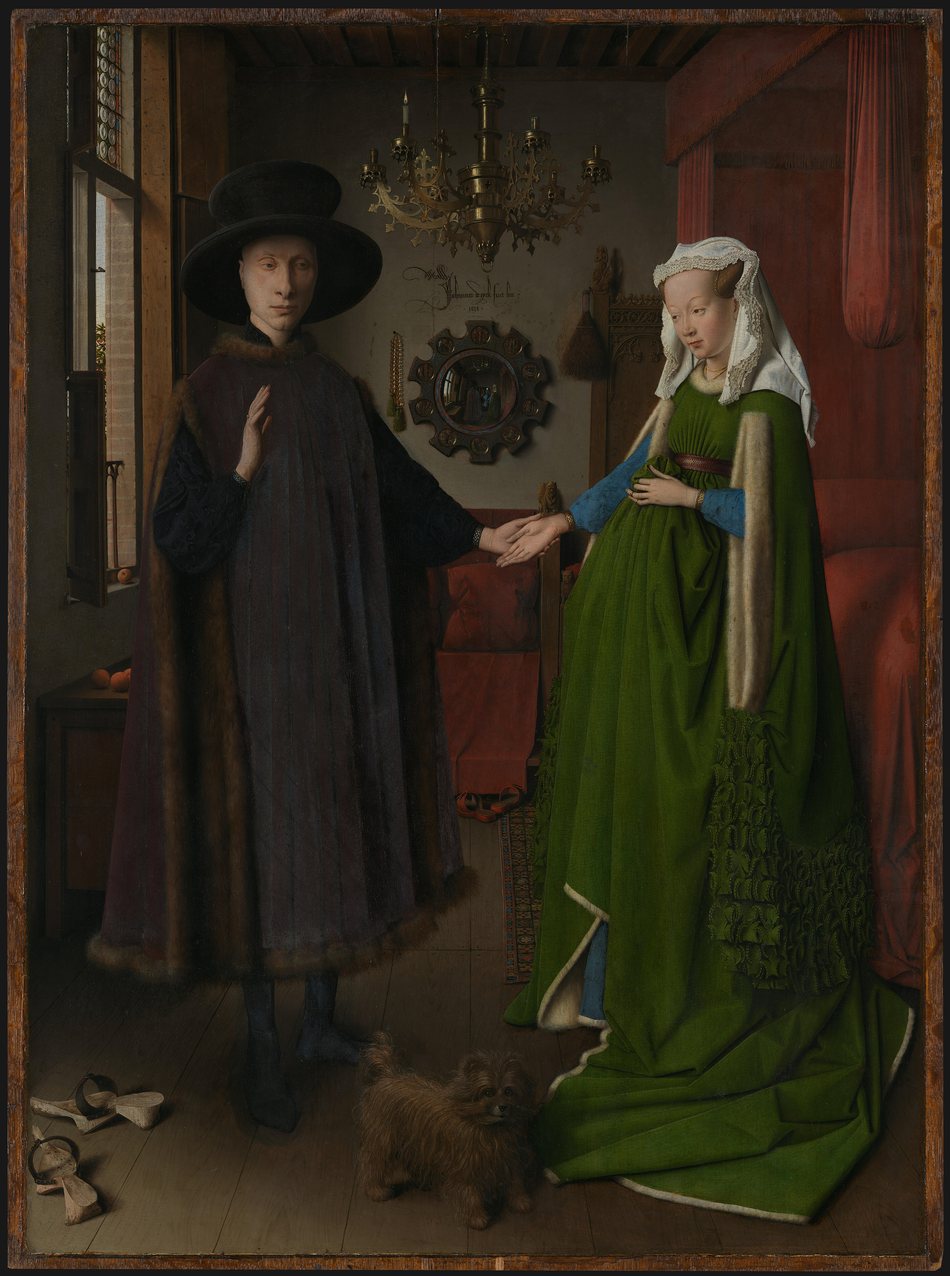
A Florentine merchant and his wife in a Bruges bedroom, every object — the little dog, the oranges, the discarded clogs, the beads by the mirror — painted with a jeweller's patience. In the convex mirror two men enter the room, and above it Van Eyck signs like a witness to a contract: Jan van Eyck was here, 1434.
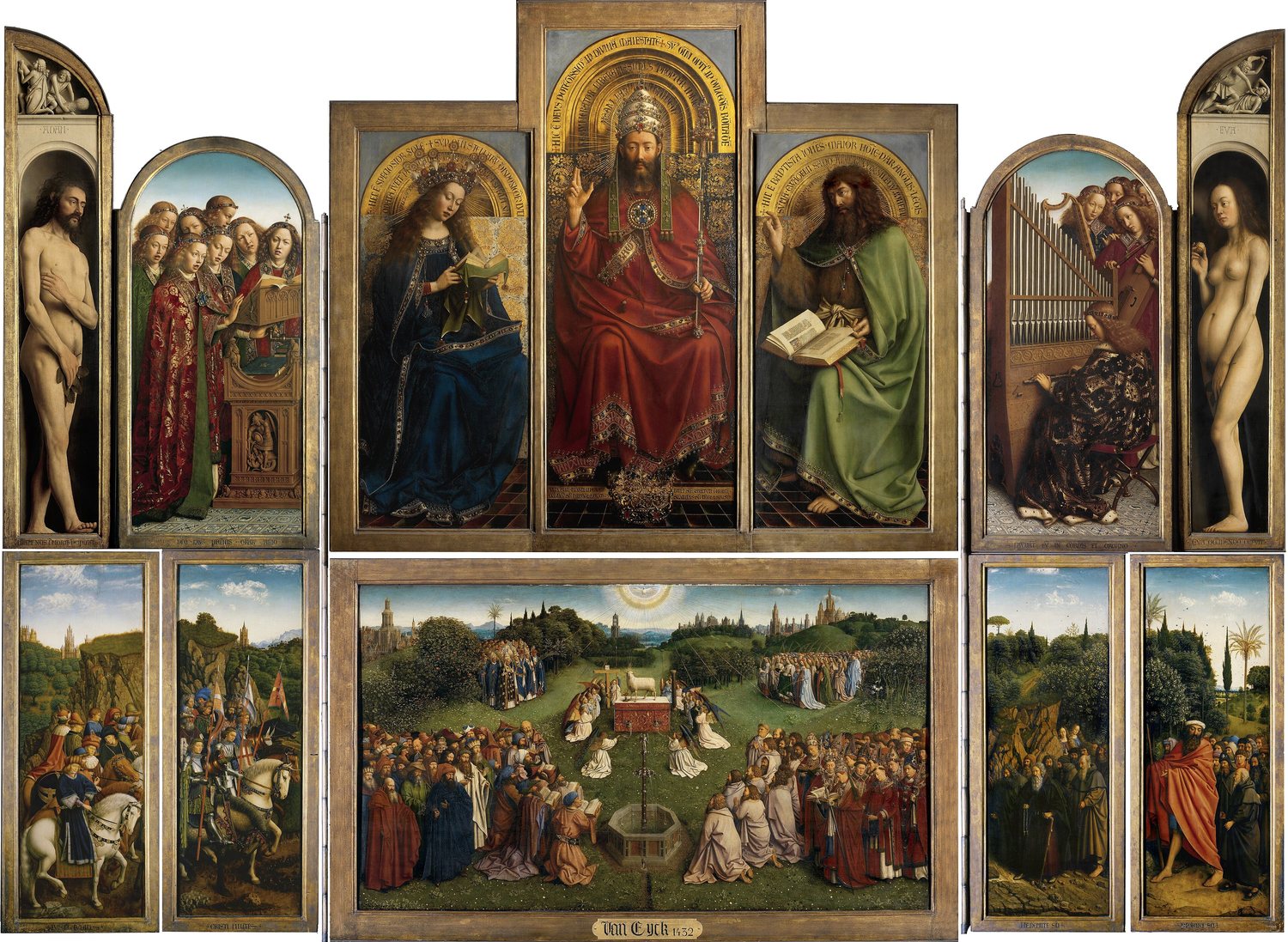
The open altarpiece, shown here in full: singing and music-making angels around the enthroned Deity above, and below, the Lamb on the altar while prophets, martyrs and knights stream across a spring landscape to adore it. Begun by Hubert van Eyck and finished by Jan, it has been stolen so often that it is called the most stolen artwork in history.
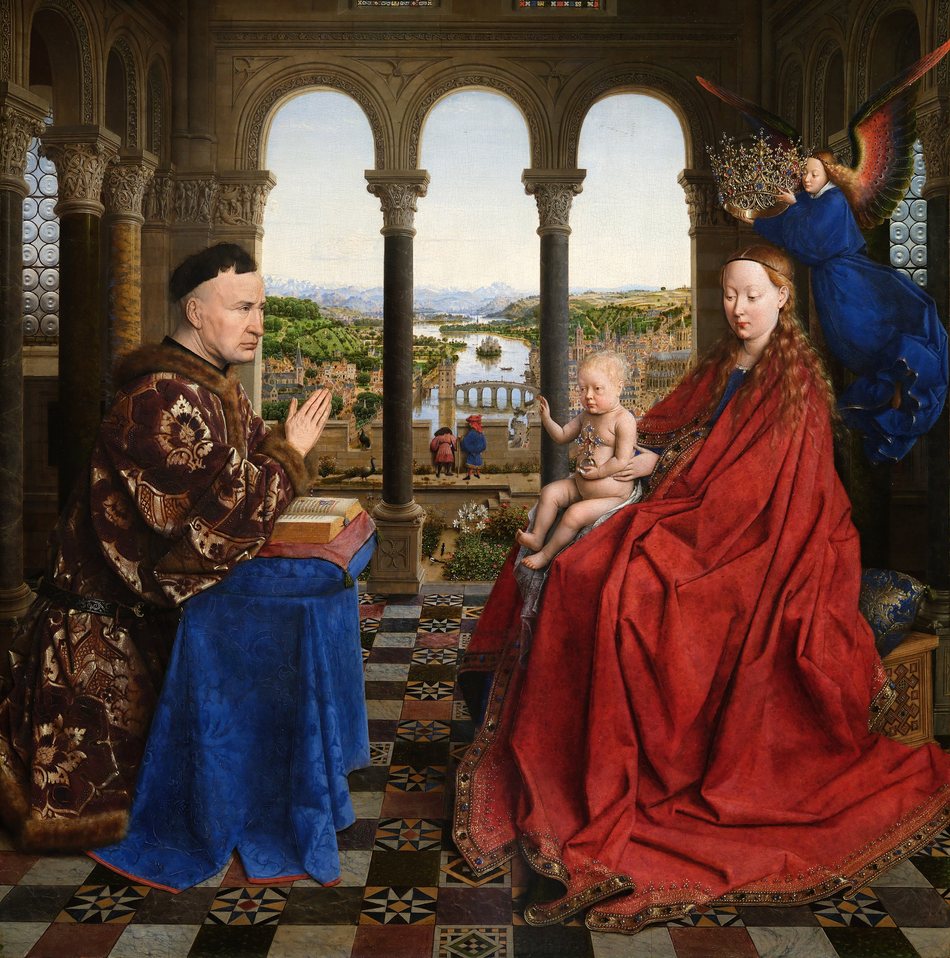
The most powerful layman in Burgundy kneels at his prayers as close to the Virgin as paint allows, while an angel descends with her crown. Through the triple arch behind them lies a whole river city — hundreds of tiny figures on a bridge, gardens, churches, and hills dissolving into blue distance.
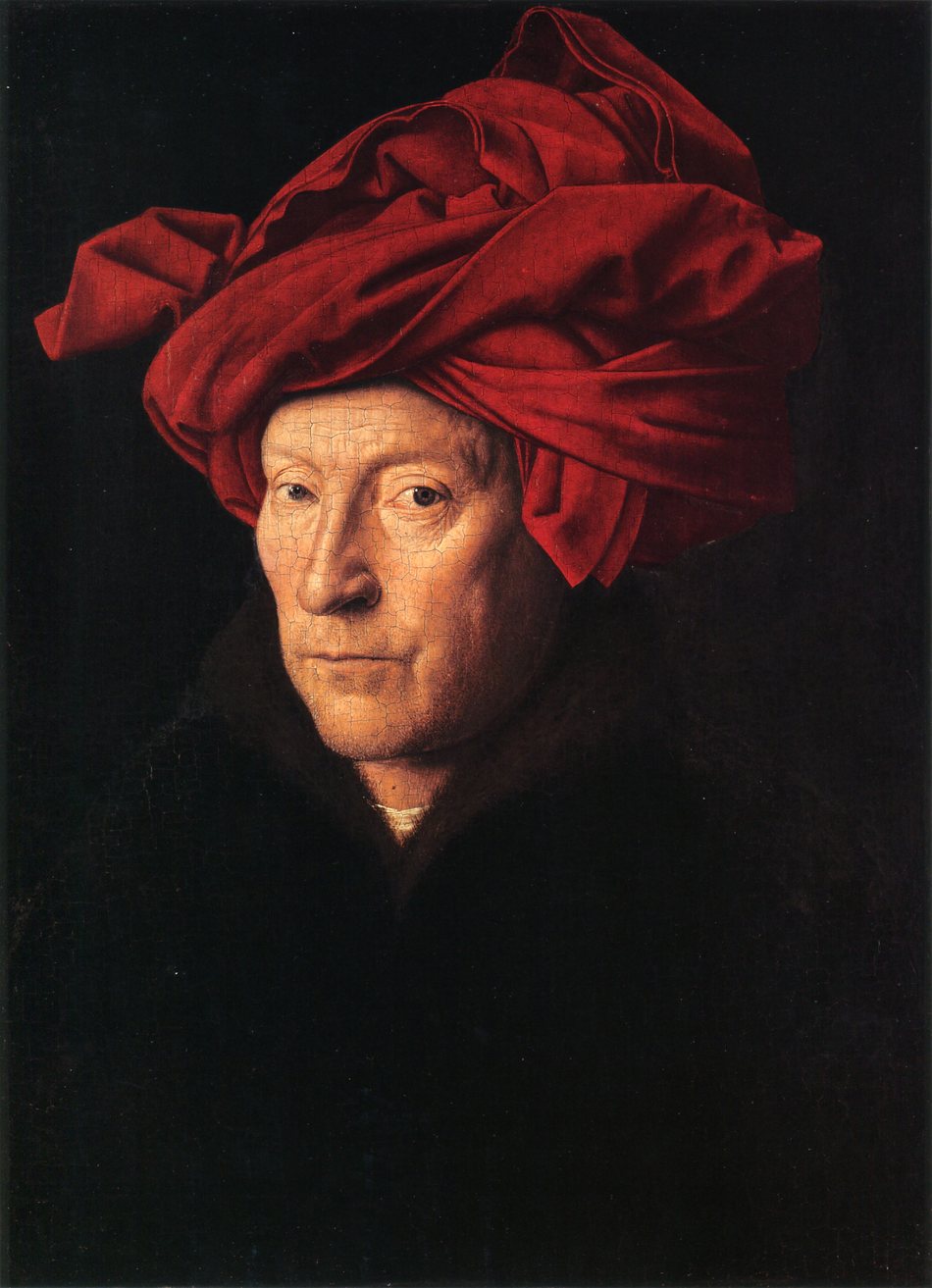
Long taken for the painter's self-portrait — the steady, appraising gaze is a man looking into a mirror. The original frame carries his motto, Als Ich Can, and the great red chaperon is built from folds of red glaze over red: a demonstration of the medium disguised as a portrait.
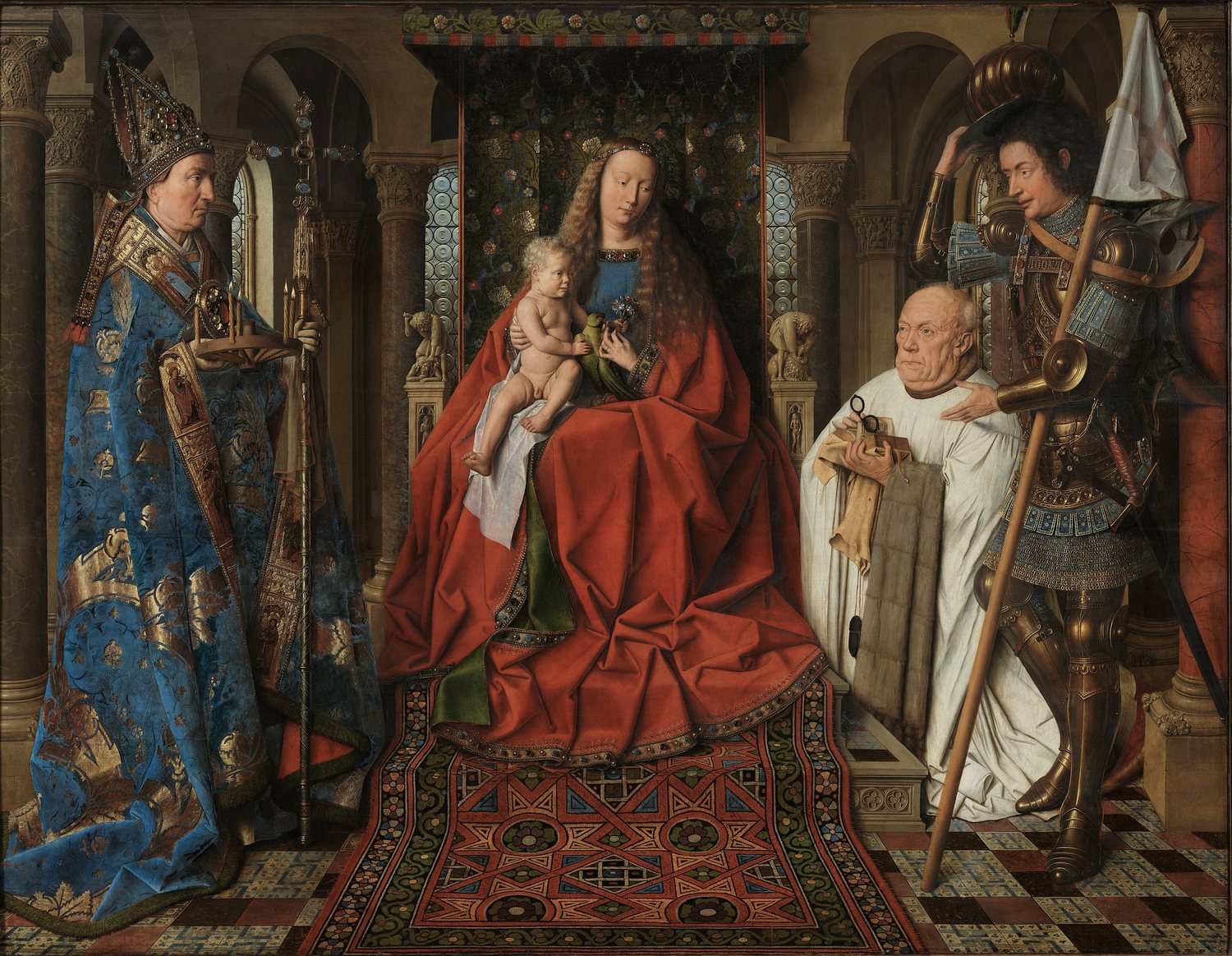
The old canon, spectacles and prayer book in hand, is presented to the Virgin by his name-saint George, whose polished armour reflects the room he stands in. Oriental carpet, brocade, a parrot pulling at the Child's hand — Van Eyck arranges a still life of treasures around a dying man's prayer.
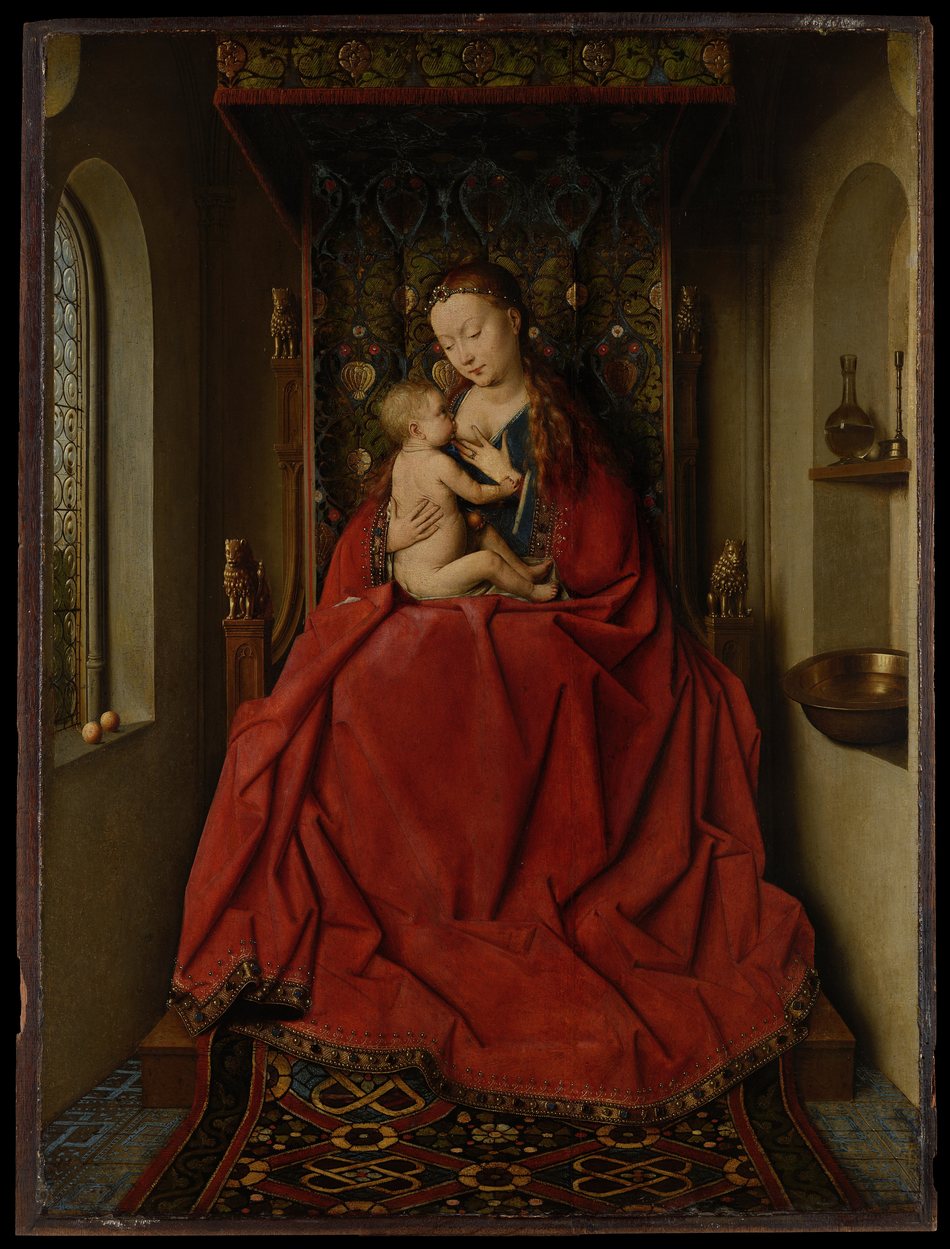
The Virgin nurses the Child on a throne whose arms end in little lions, an eastern carpet under her feet and a carafe catching the window light behind her. Small and intimate, its great red robe is the lesson of the room in one passage: lake glaze laid over lake glaze until the colour has depth like wine.
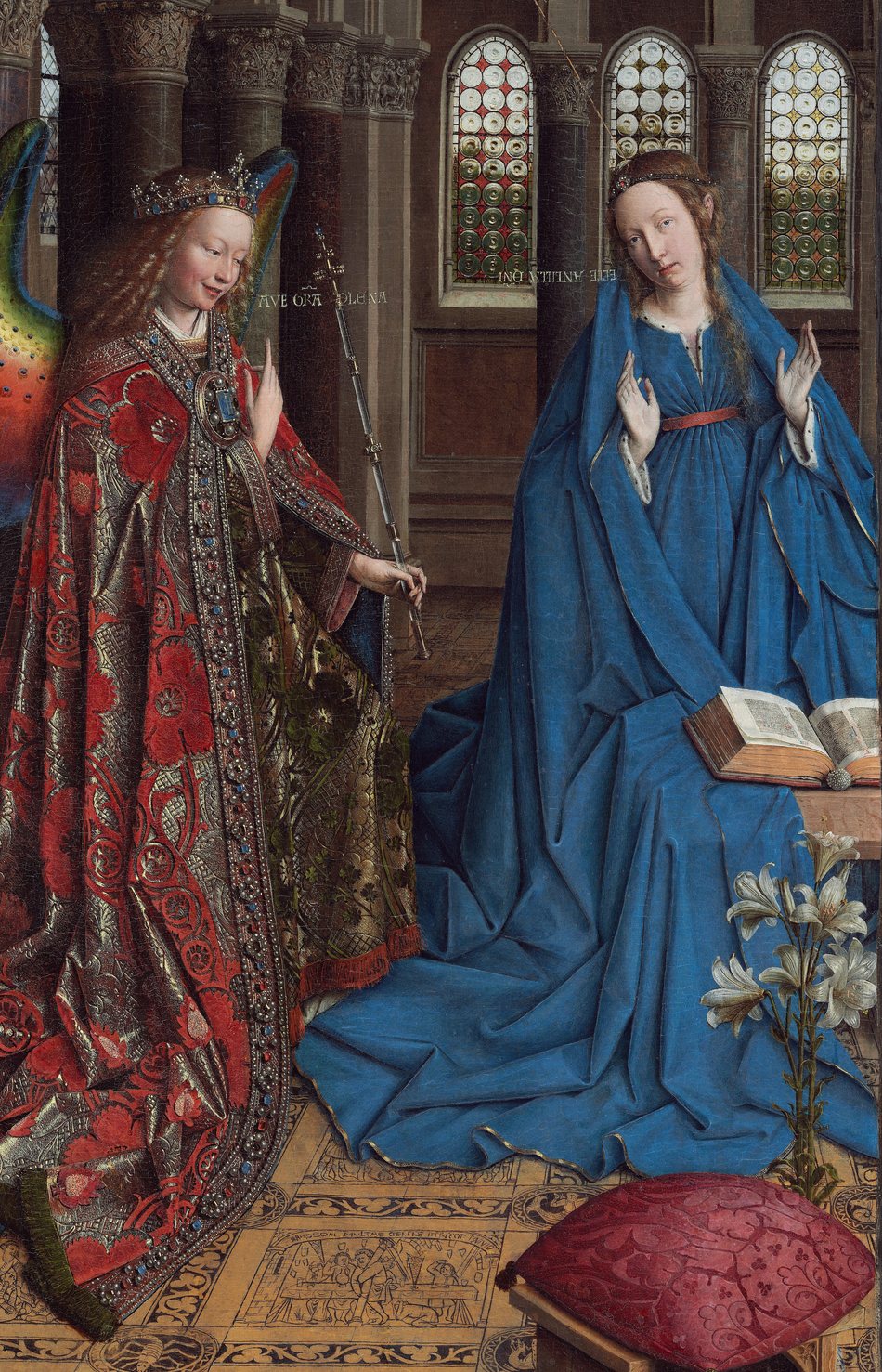
Gabriel's brocade is worked like real gold embroidery, and the words of his greeting leave his mouth in gold letters that turn in the air to meet the Virgin's answer. The church around them is painted stone by stone, tile by tile — heaven's message delivered in a building you could measure.
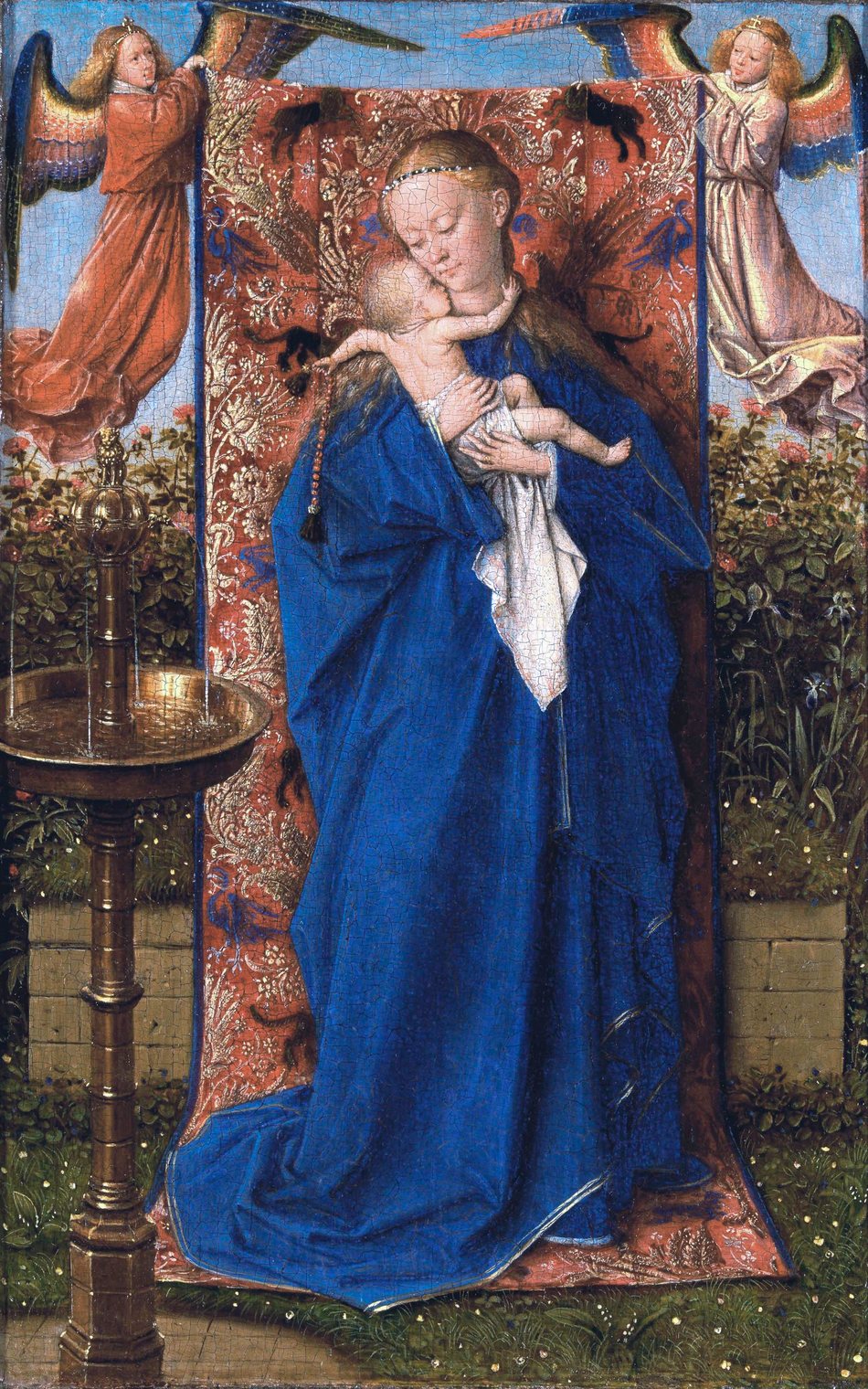
His last dated painting, and his smallest — barely nineteen centimetres high. Two angels hold a brocade cloth of honour behind the Virgin, a fountain of life plays beside her in a walled garden, and the whole jewel of a picture is signed and dated on its frame by the painter himself.
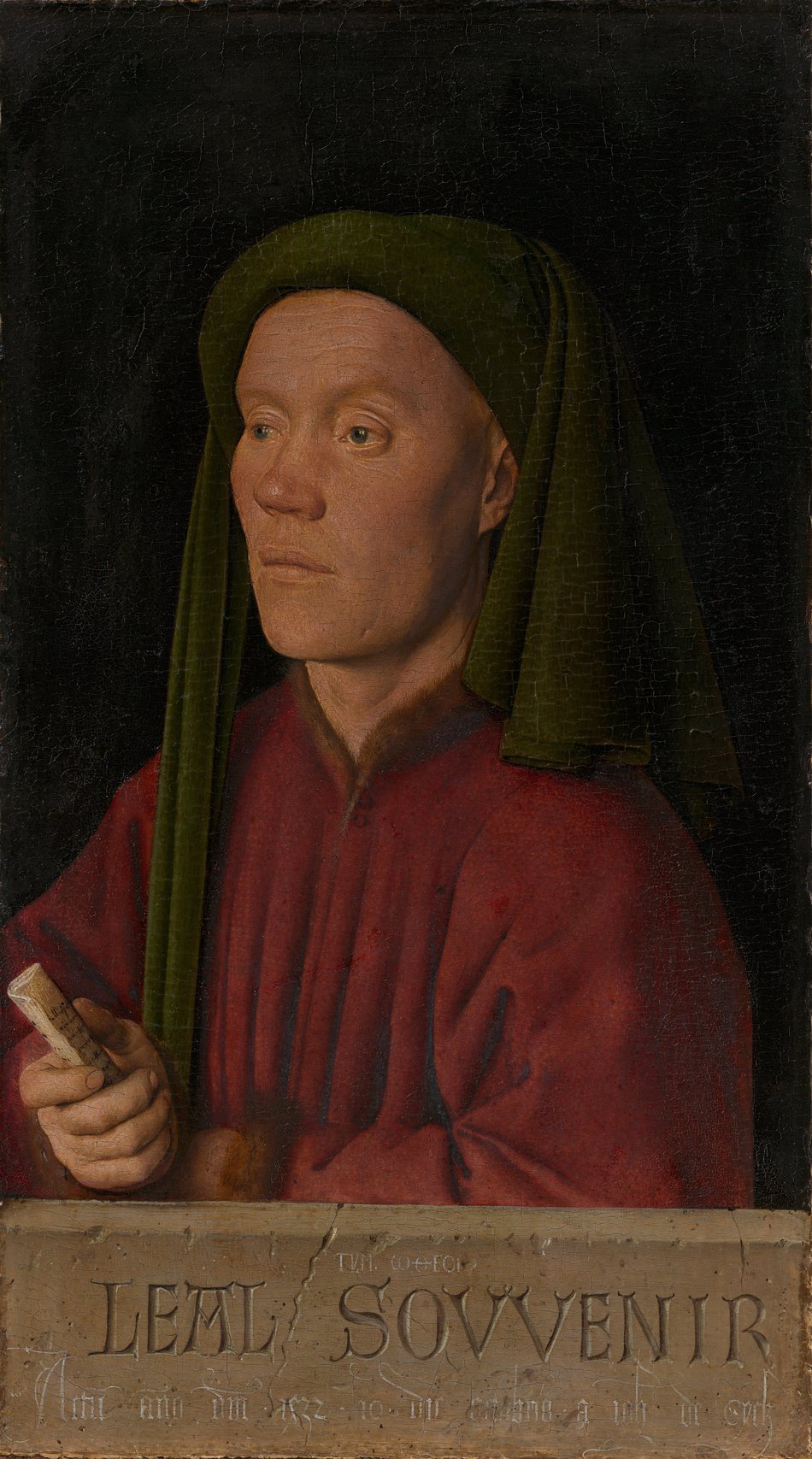
The sitter leans on a stone parapet, a scroll in his hand, and the parapet itself is the picture's puzzle: carved with three inscriptions, Greek, Latin and the French words LEAL SOVVENIR — loyal remembrance. Portrait, epitaph and riddle in one small panel, painted the year the Ghent Altarpiece was unveiled.
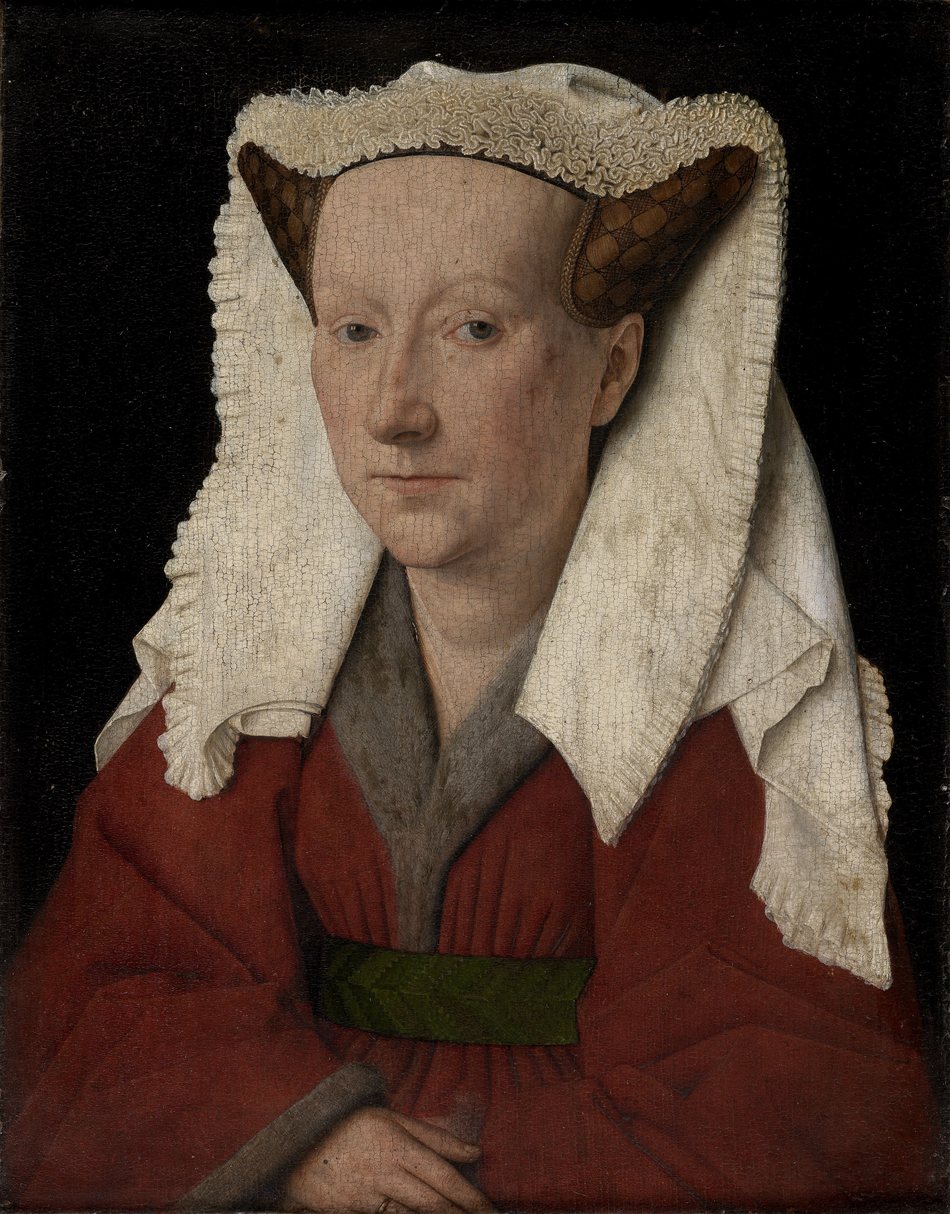
The painter's wife in a red dress and a horned headdress lined with fur, painted in the last years of his life. The inscription on the frame gives her age — thirty-three — and signs off with a husband's formality: my husband Johannes completed me on 17 June 1439.
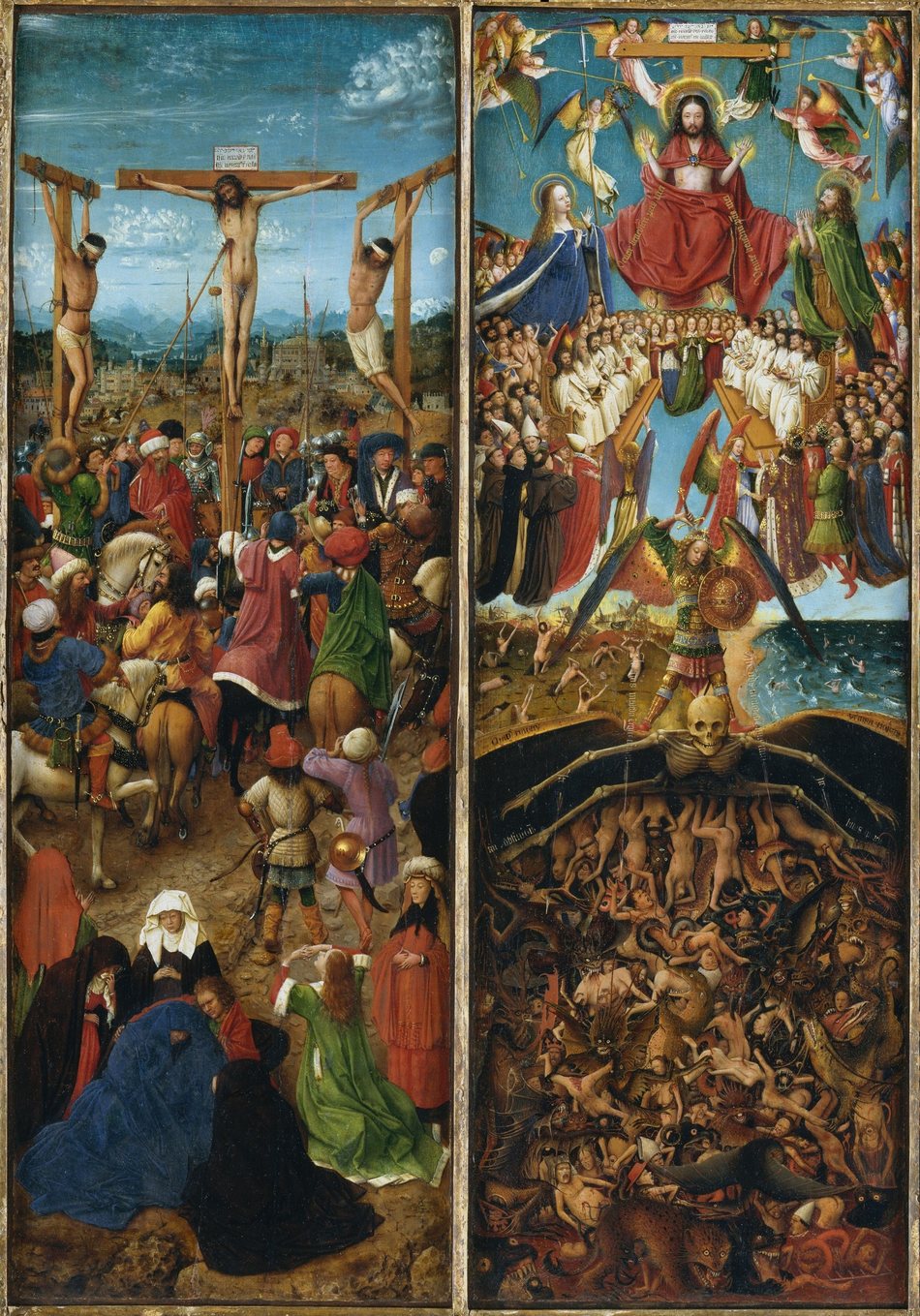
A diptych of two worlds hinged together: on the left, Jerusalem crowded beneath a vast blue distance at the hour of the Crucifixion; on the right, the dead rising out of a painted sea at the Judgement, with Death spreading bat wings over the damned. The frames themselves carry the texts, in Latin and in Greek.
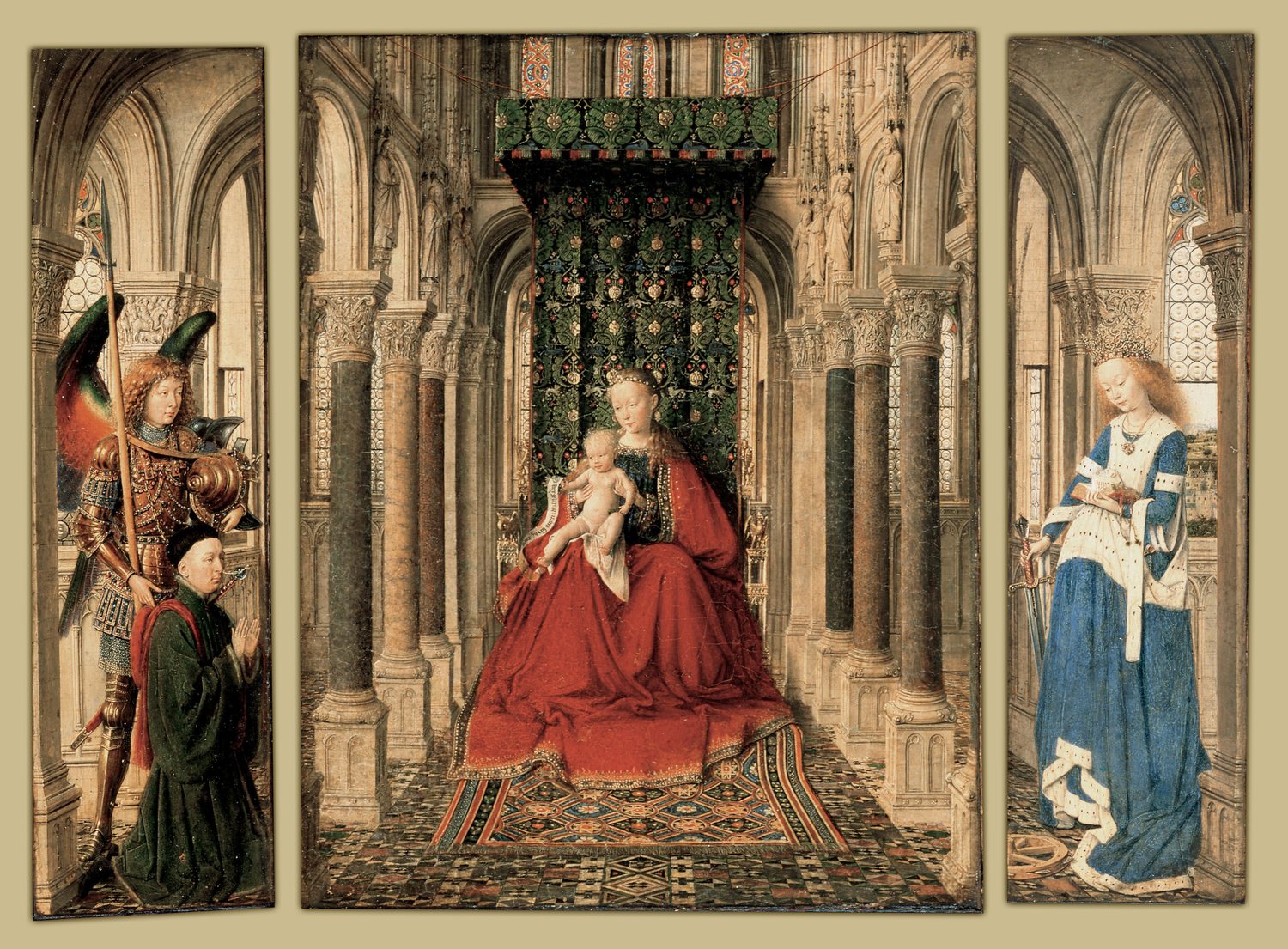
A travelling altar barely thirty-three centimetres high: the Virgin enthroned in the choir of a church, St Michael presenting the kneeling donor on one wing, St Catherine reading on the other. The church interior — columns, tiles, light through clerestory windows — is painted with a goldsmith's patience at the scale of a jewel.
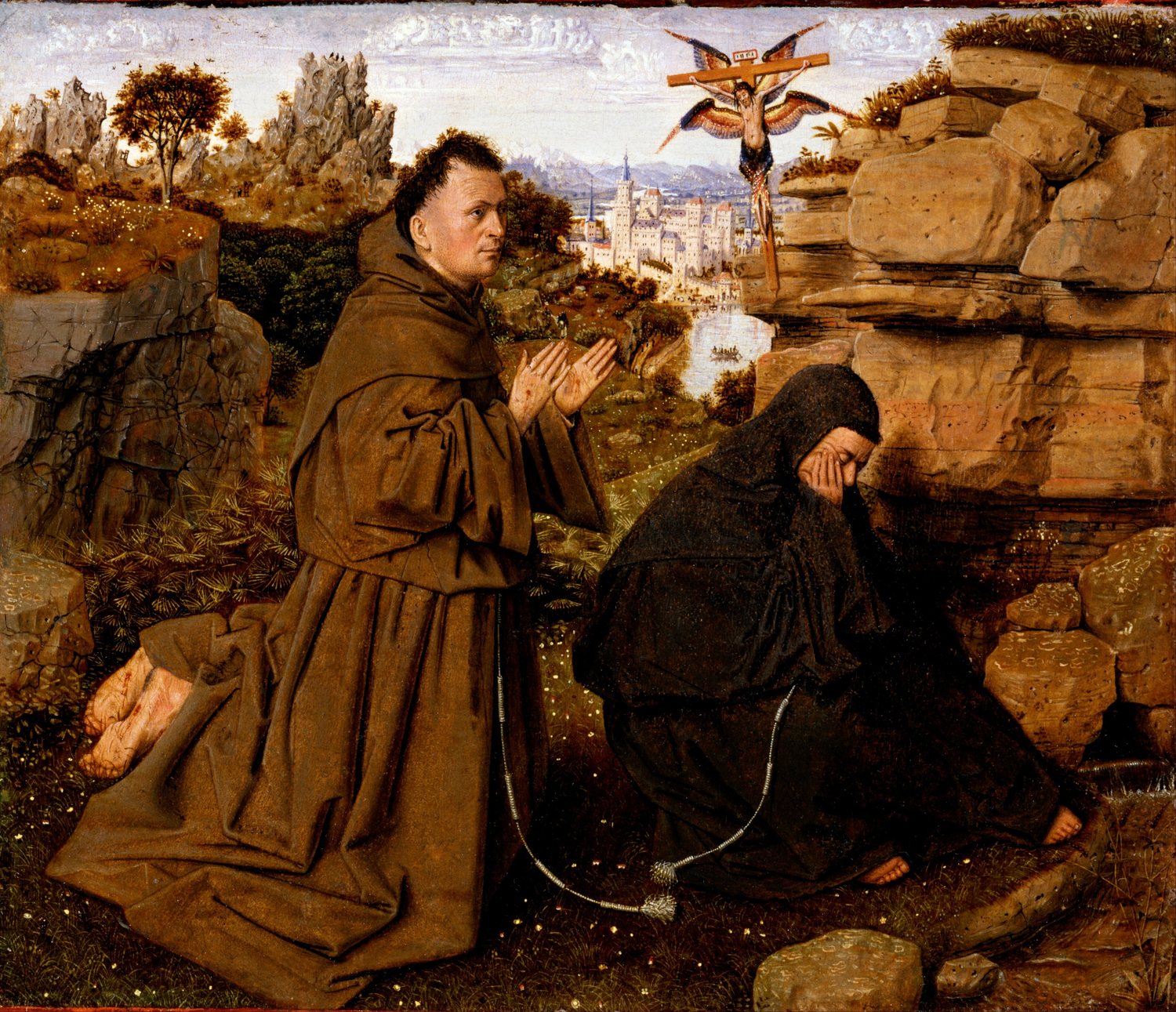
A picture the size of two hands containing a whole world: the saint kneels before the seraph in a rocky landscape, Brother Leo sleeps beside him, and behind them a river winds past a town filled with tiny travellers. A second, nearly identical version hangs in Turin; both are given to Van Eyck's own hand or his closest circle.
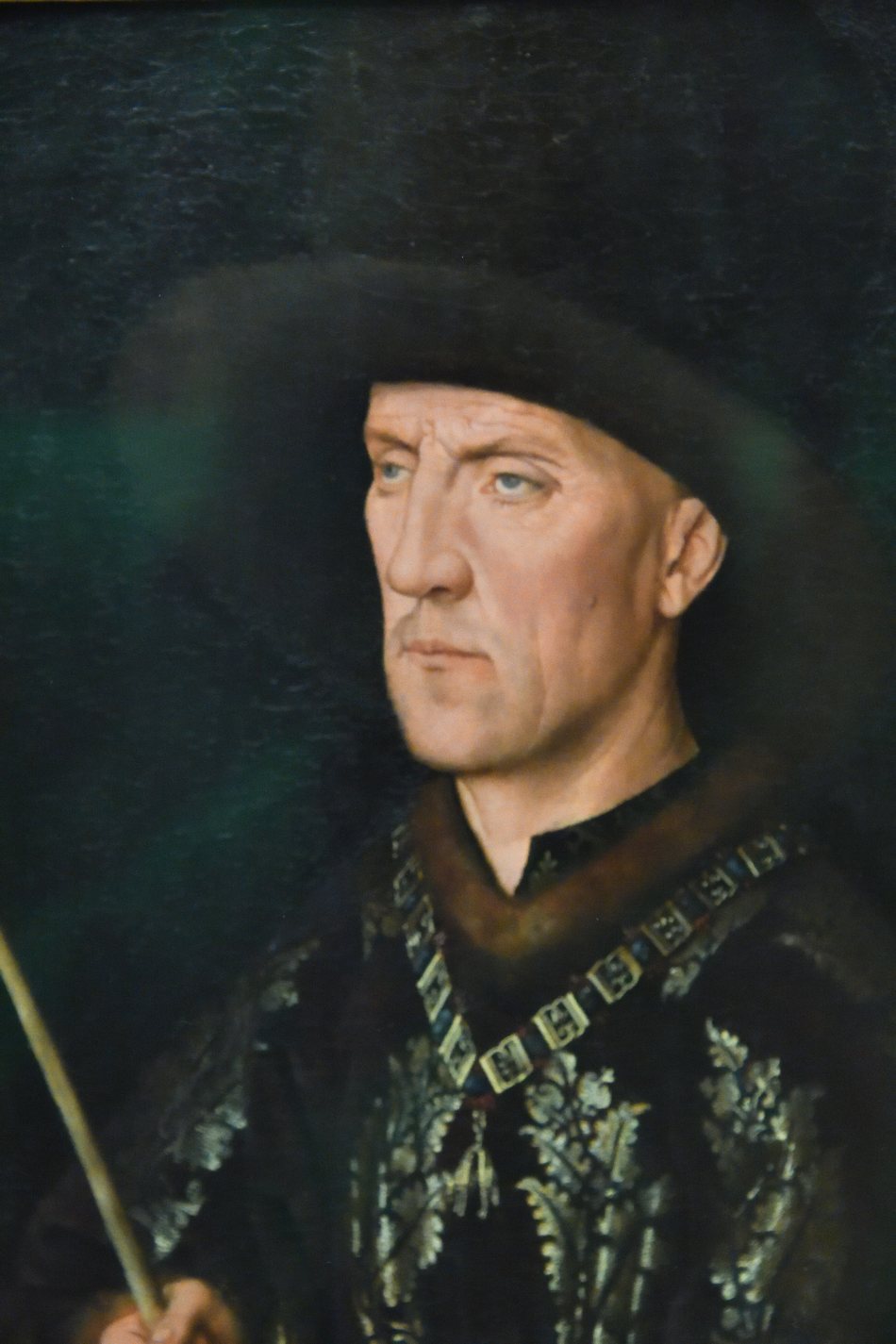
A chamberlain of Philip the Good, wearing the collar of the Order of the Golden Fleece and holding his white staff of office. Nothing in the face is softened — the heavy eyelids, the lined skin, the set mouth are recorded with the same fidelity Van Eyck gives to silk and fur.
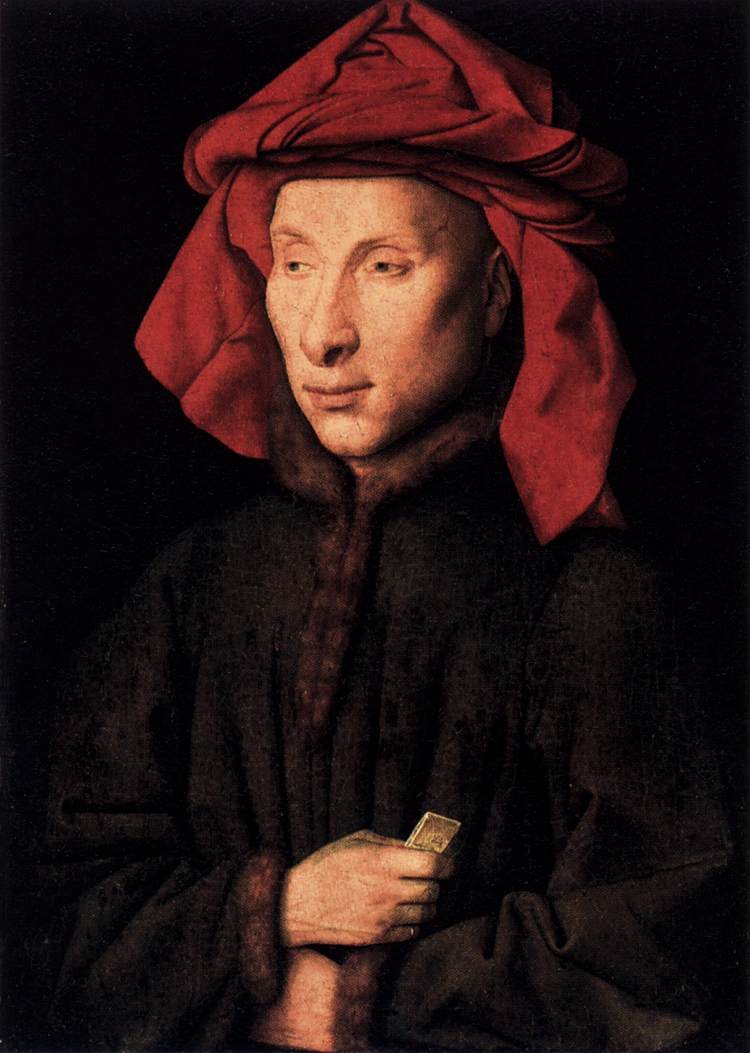
The merchant of the great double portrait, painted again a few years on: the same long face beneath a red chaperon, one hand raised in greeting or oath. The two Arnolfini panels, read together, are the nearest thing the fifteenth century has to a portrait album of one man.
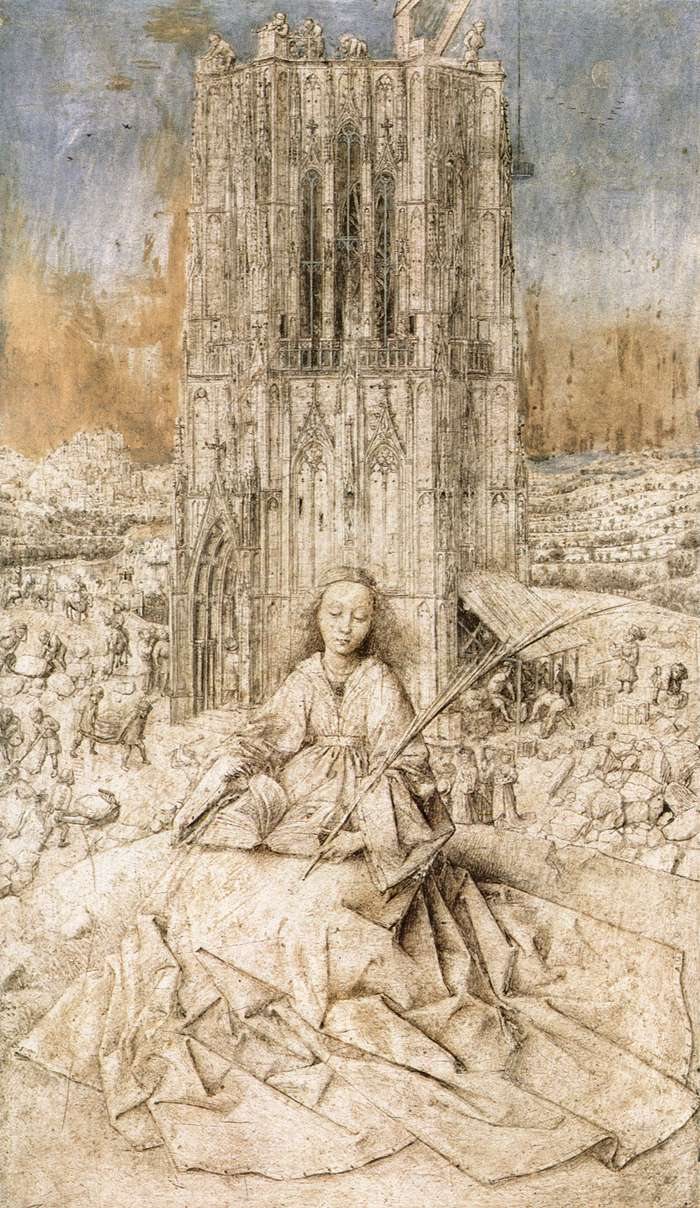
Neither a drawing nor a finished painting: a first laying-in in grey and brown, which Van Eyck nevertheless signed and dated as if it were complete. The saint sits reading before her tower — and behind her the tower is still being built, stone by stone, by dozens of tiny workmen.
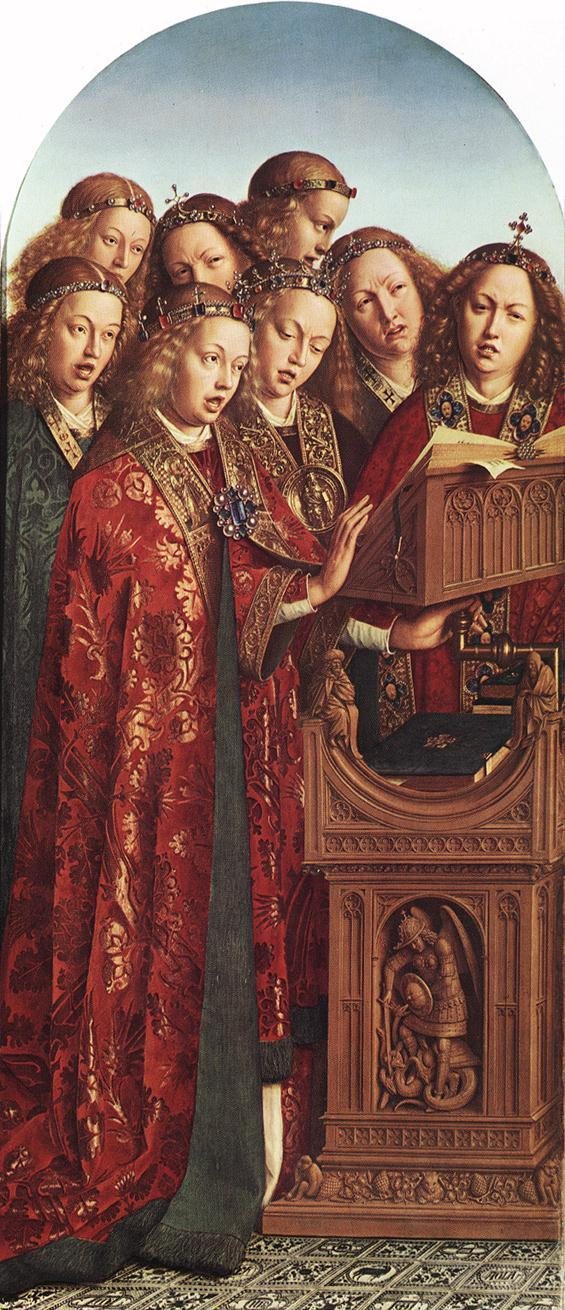
A choir at a lectern on the upper tier of the altarpiece: each angel sings a different note, mouths open in different shapes, brocades stiff with gold thread. No sound has ever been painted more carefully — singers have studied these faces to learn how a choir actually breathes.
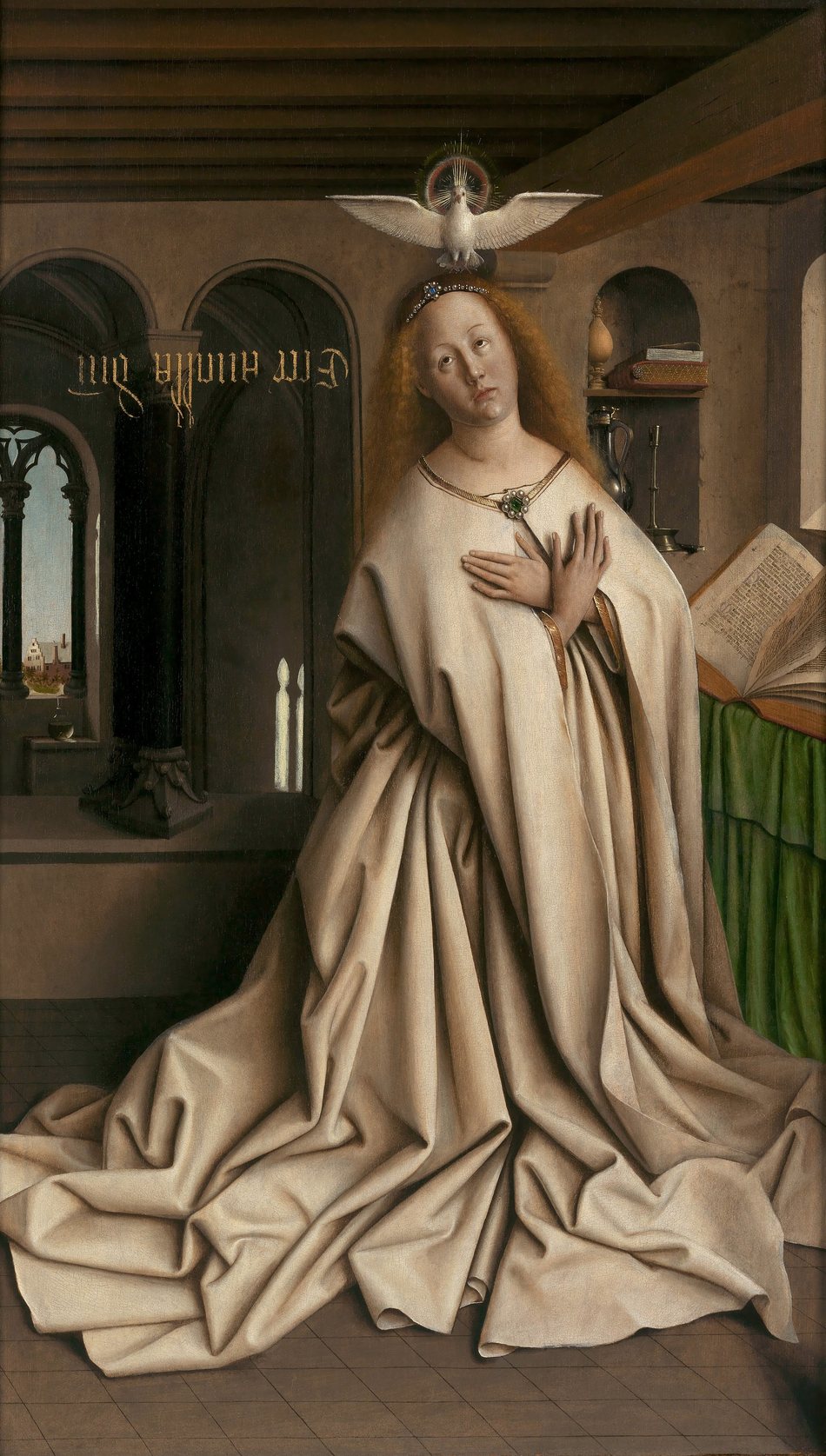
From the closed view of the altarpiece: the Virgin alone in a plain room, the dove descending over her, and through the window behind her the rooftops of Ghent. The outside of the altarpiece is painted in near-grisaille — all its colour saved for the feast days, when the wings were thrown open.
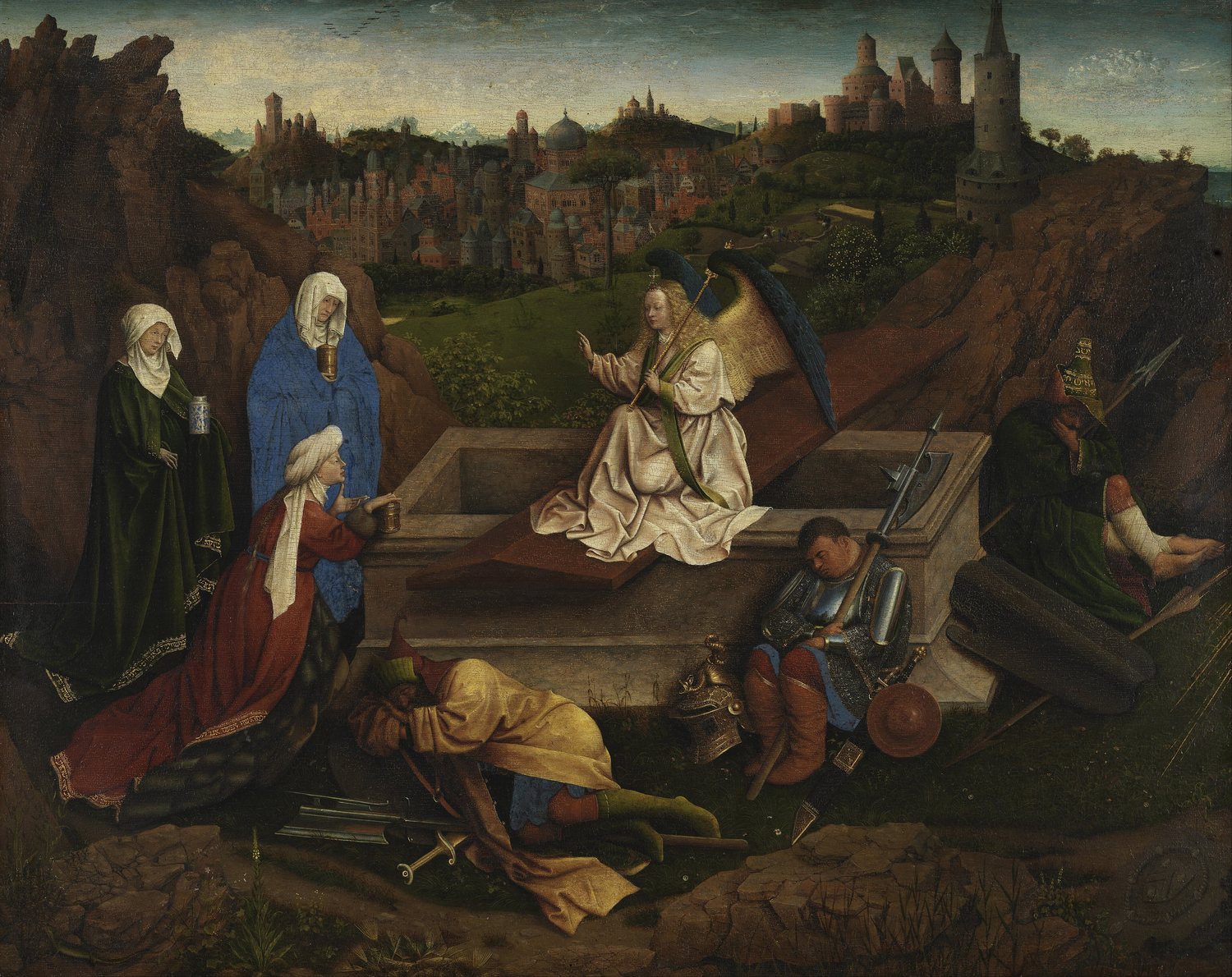
The soldiers sleep around the empty tomb in their armour while the three Marys arrive with their ointment jars and Jerusalem wakes behind them in morning light. The panel has been given to Hubert, to Jan, and to both brothers together — the same open question the Ghent inscription leaves behind.
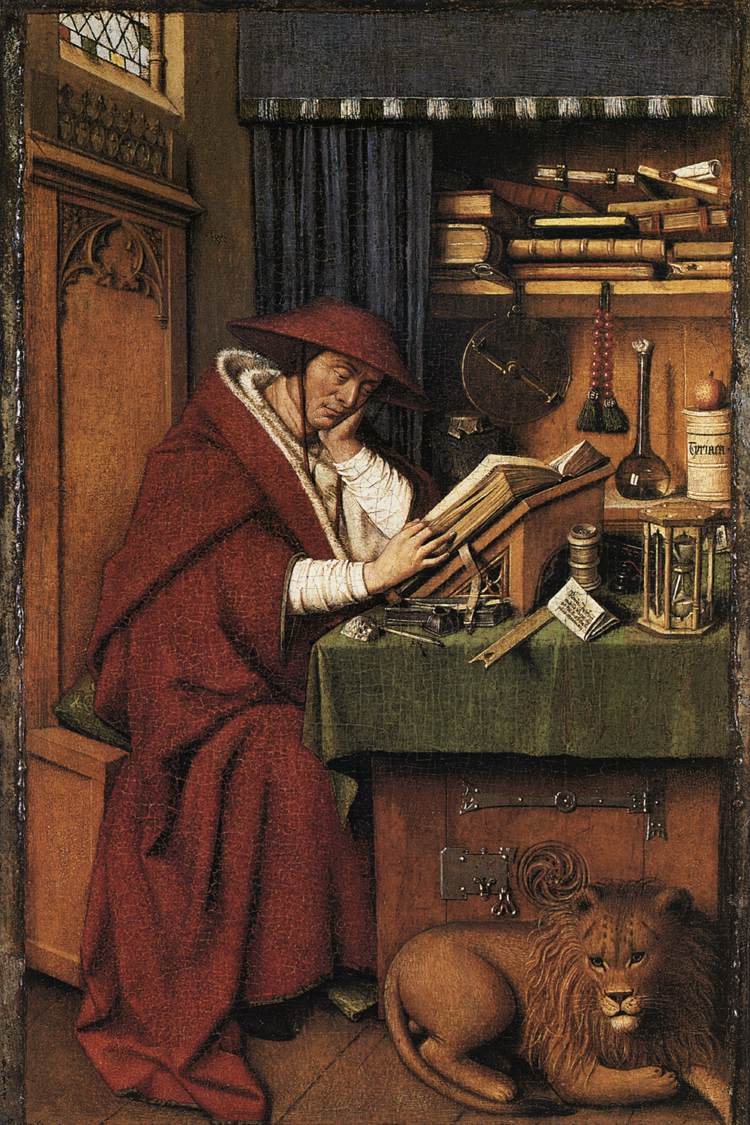
The cardinal-scholar reads at his desk in a study lined with books, an astrolabe and hourglasses, his lion asleep at his feet like a great cat. The picture comes from Van Eyck's workshop and was finished, scholars believe, by hands trained in his own — the master's design carried out at his level of finish.