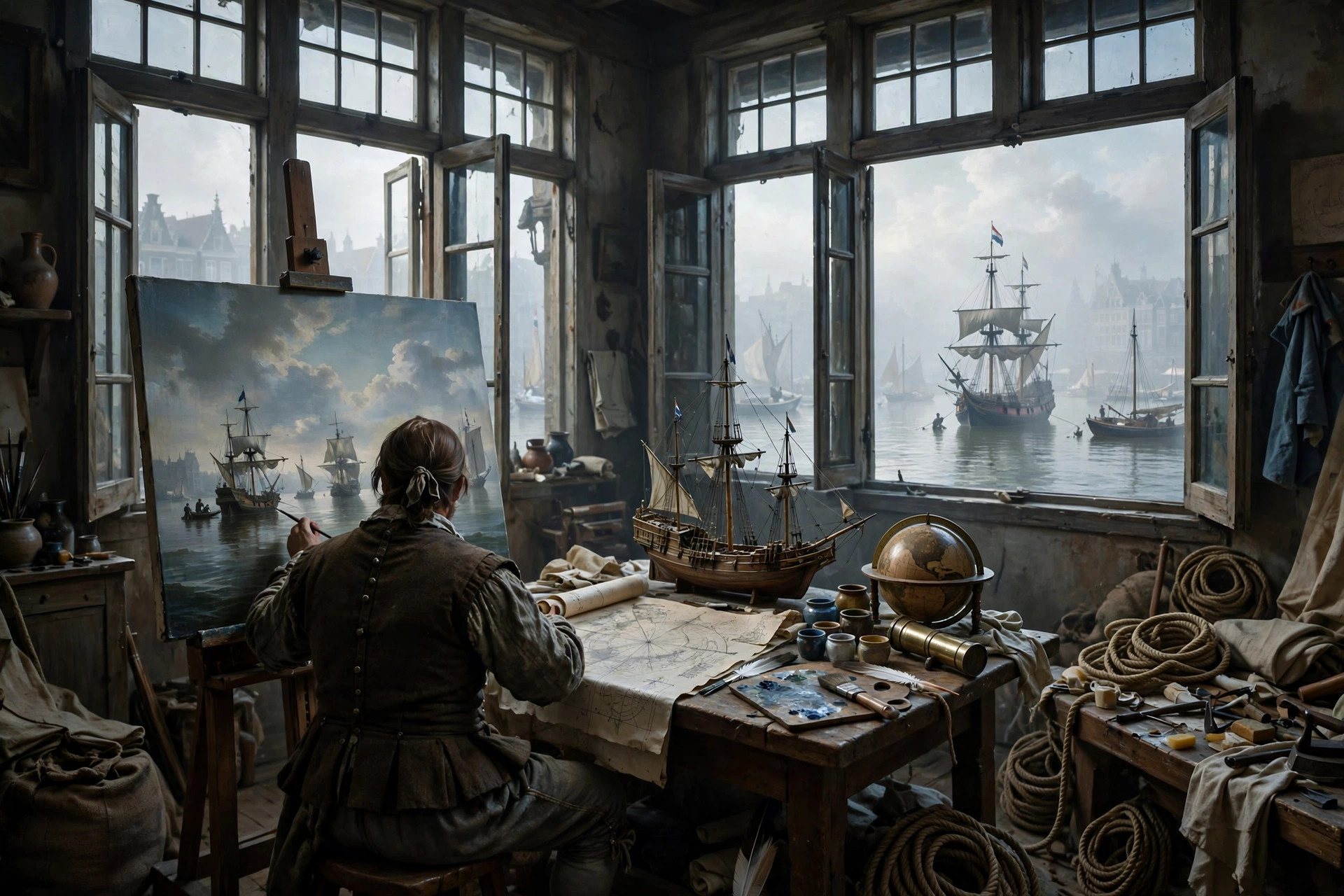
He learned the sea in his father's studio and in the middle of battles, drawing Dutch fleets while the guns fired. No one has ever painted ships better: every rope in its place, every sail understood — and over the exactitude, the silvery light of a calm morning or the black wall of a squall. Admirals queued for his portraits of their ships as courtiers queued for portraits of themselves.
Willem the Elder invented the pen painting — ship portraits drawn in ink on a white prepared panel, exact as engravings. The son grew up inside that precision: thousands of drawings of hulls, rigging and sails, made from life in harbours and at sea. His oil paintings keep the draughtsman's conscience — a van de Velde ship could be rebuilt from the picture.
In the Anglo-Dutch Wars both van de Veldes sailed with the fleet in a small galliot, sketching the action as it happened — the Four Days' Battle, the St James's Day fight, Solebay. Their drawings were the Republic's official record, worked up afterwards into paintings for admirals and councils. The younger Willem's battle pieces are history painted by a man who was there, smelling the powder.
His signature weather is no weather: a fleet at anchor on glass, sails slatting, the water doubling every hull in a silvery mirror. Painting still water is the hardest marine problem — there is nothing to hide behind — and van de Velde solves it with tone alone, a symphony of greys and pearl in which a single white sail carries the whole picture.
The opposite pole: the squall arriving like a wall, a ship heeling under shortened sail, the sea whipped into white. He painted The Gust in 1707, the year of his death, at seventy-three — the most violent of all his pictures, a lifetime of watching weather compressed into one black minute on the water.
In the winter of 1672–73, as the Dutch wars turned, father and son crossed to London. Charles II gave them a studio in the Queen's House at Greenwich and a salary — the father to draw, the son to paint 'sea fights'. The younger van de Velde stayed thirty-five years, became the founding father of English marine painting, and is buried in St James's, Piccadilly.
The studio's capital was paper: some eight thousand drawings of ships, battles, harbours and coasts, hoarded across two lifetimes and plundered for compositions for fifty years. A sketch made off Texel in 1673 could surface in a London painting of 1700. The archive survives, mostly at Greenwich and Rotterdam — the memory of the Dutch sea, in pencil and ink.
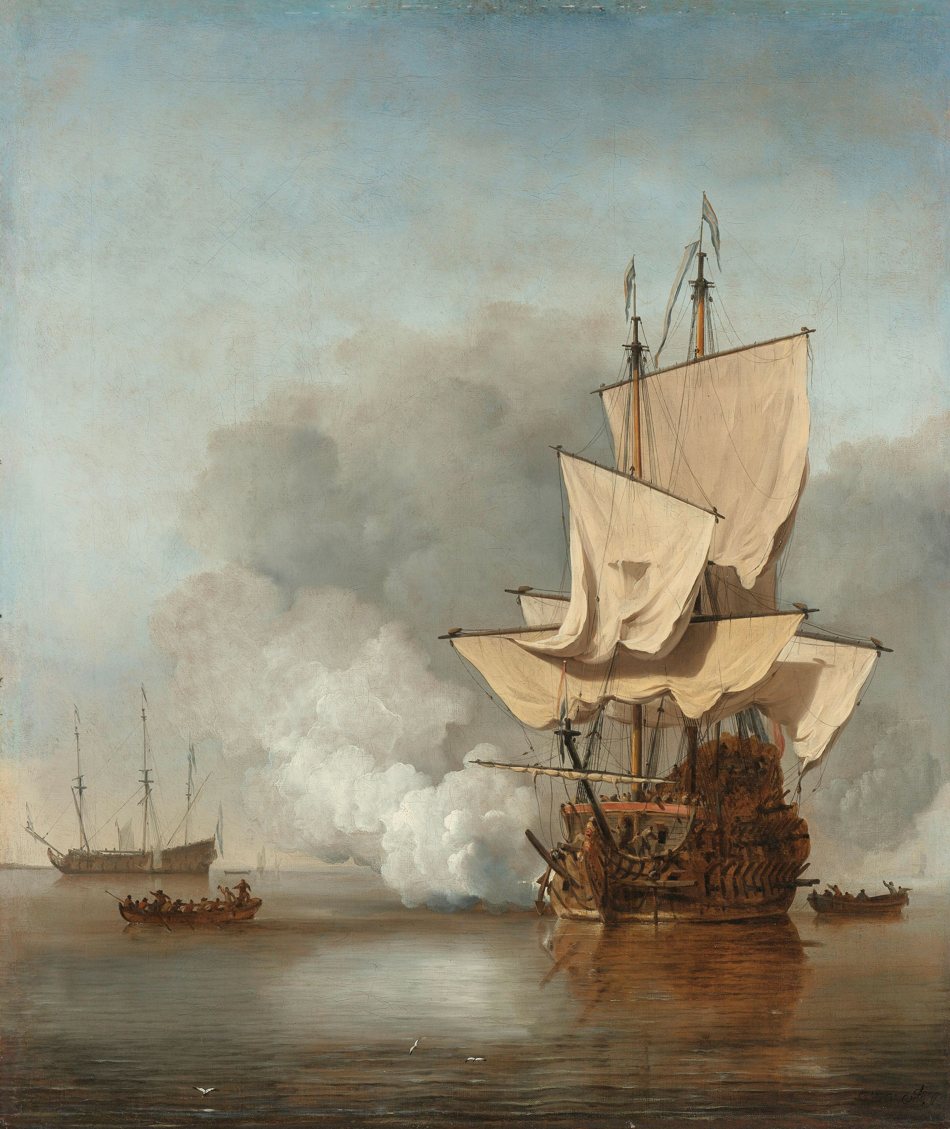
A Dutch man-of-war fires a salute, her stern to us, the smoke rolling across a sea like glass while small craft row out to her. It is a portrait of one ship at her most ceremonial — every gun, rope and carving correct — wrapped in a cloud of her own making. Van de Velde painted it in his twenties; the whole of Dutch sea power salutes with her.
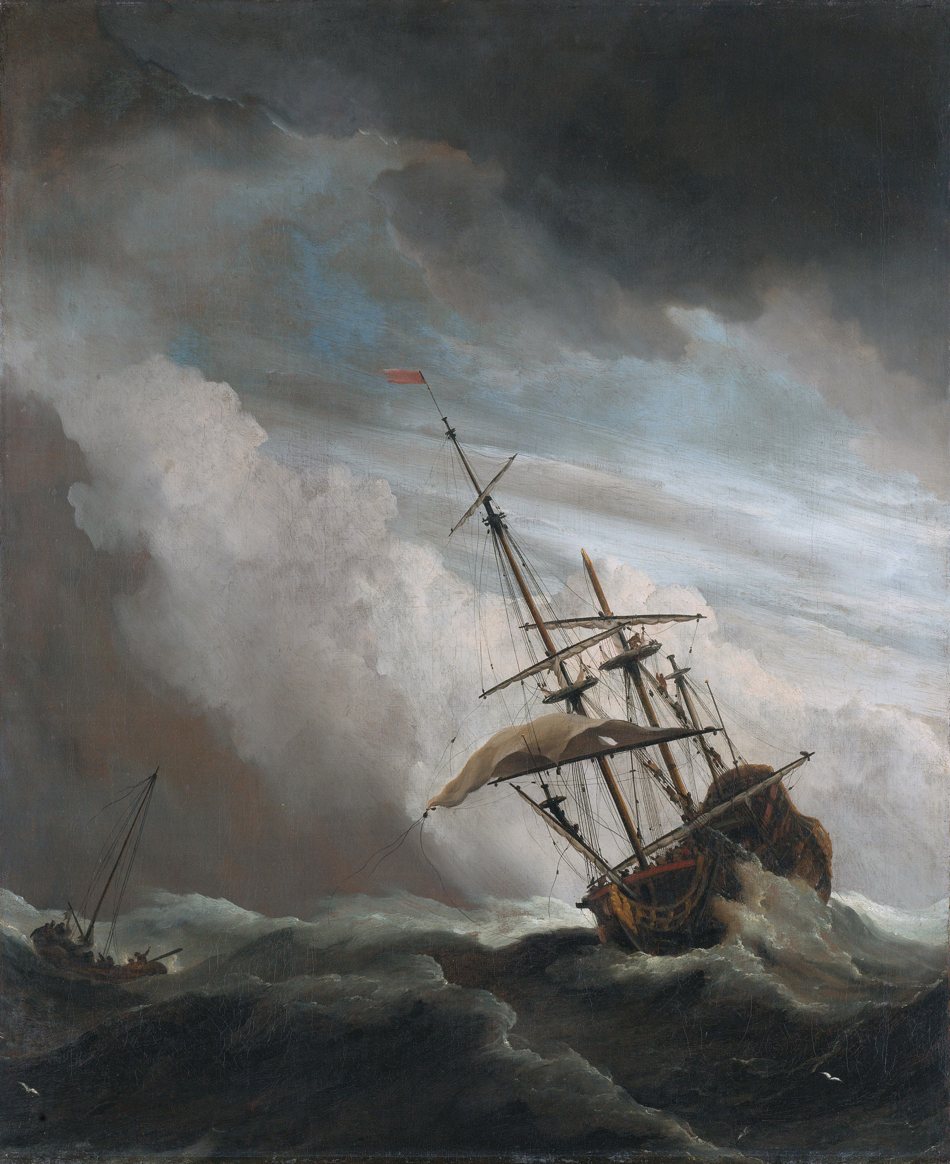
His last picture, painted in the year of his death: a ship caught by a squall, heeling hard under a rag of sail, the sea standing up around her and the sky black as a wall. Seventy-three years of watching weather are in it. The young man who painted glassy calms ends as the painter of the worst minute at sea.
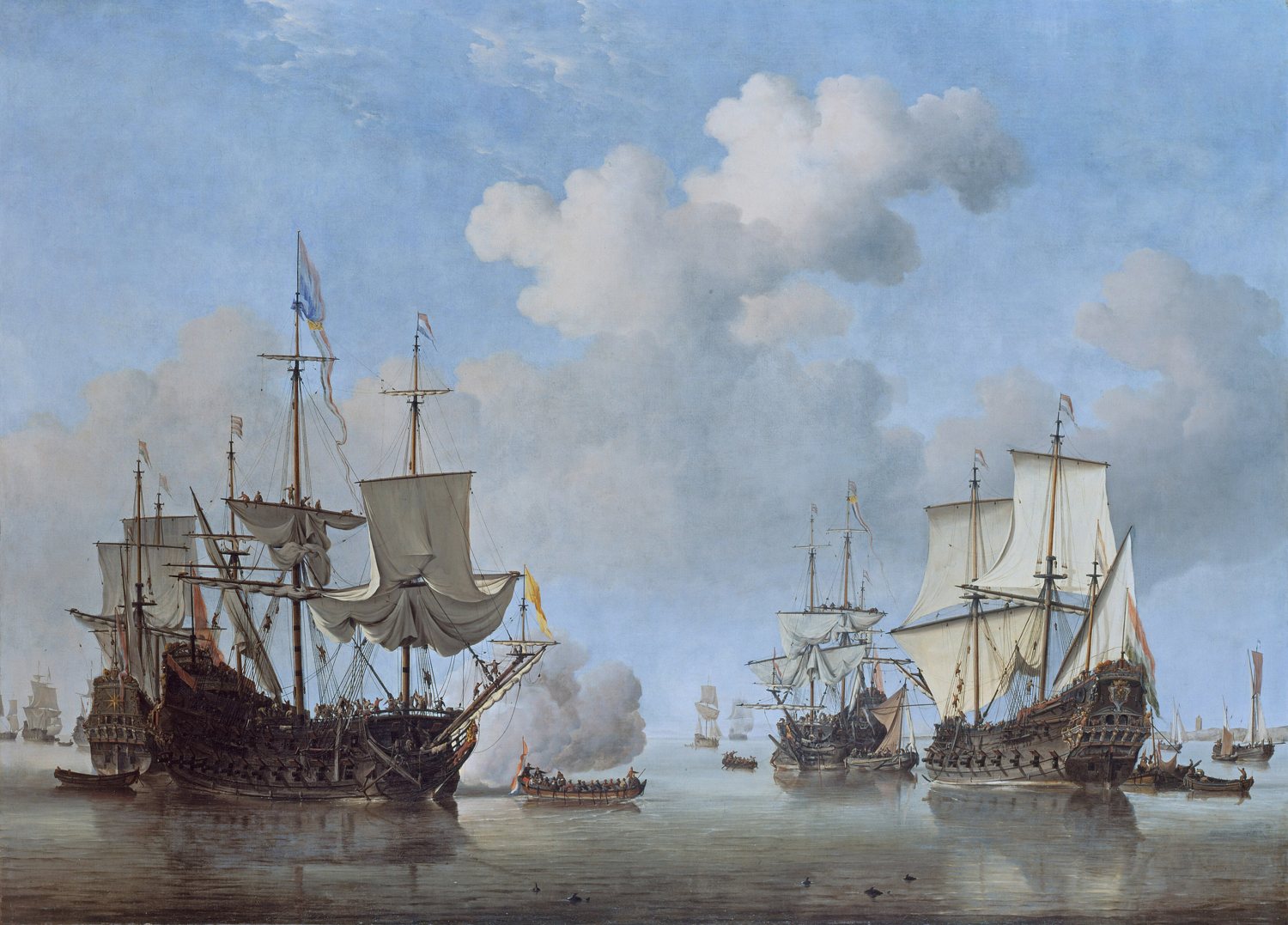
Morning on a roadstead: great ships settling to anchor, sails being handed, boats rowing between them, every hull doubled in the water. This is the van de Velde calm at its most complete — no wind, no drama, nothing but light, air and exact knowledge, arranged like music for an orchestra at rest.
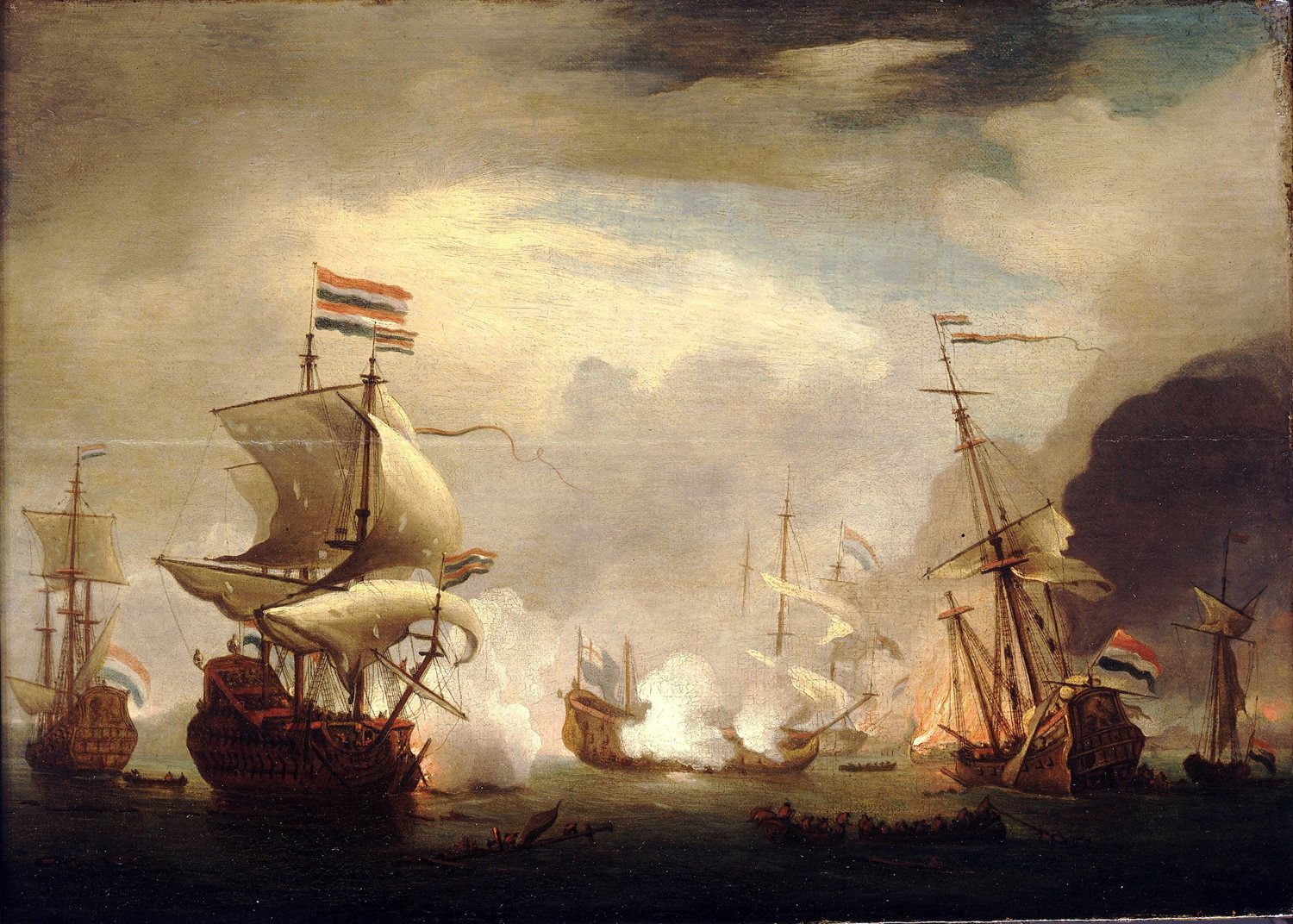
The last great sea fight of the Dutch wars, August 1673: De Ruyter's fleet against the English and French, painted from the drawings the van de Veldes made on the spot. Smoke, fire and flags fill the canvas, but the order of battle is a historian's document — the painter had watched these very ships manoeuvre from his galliot.
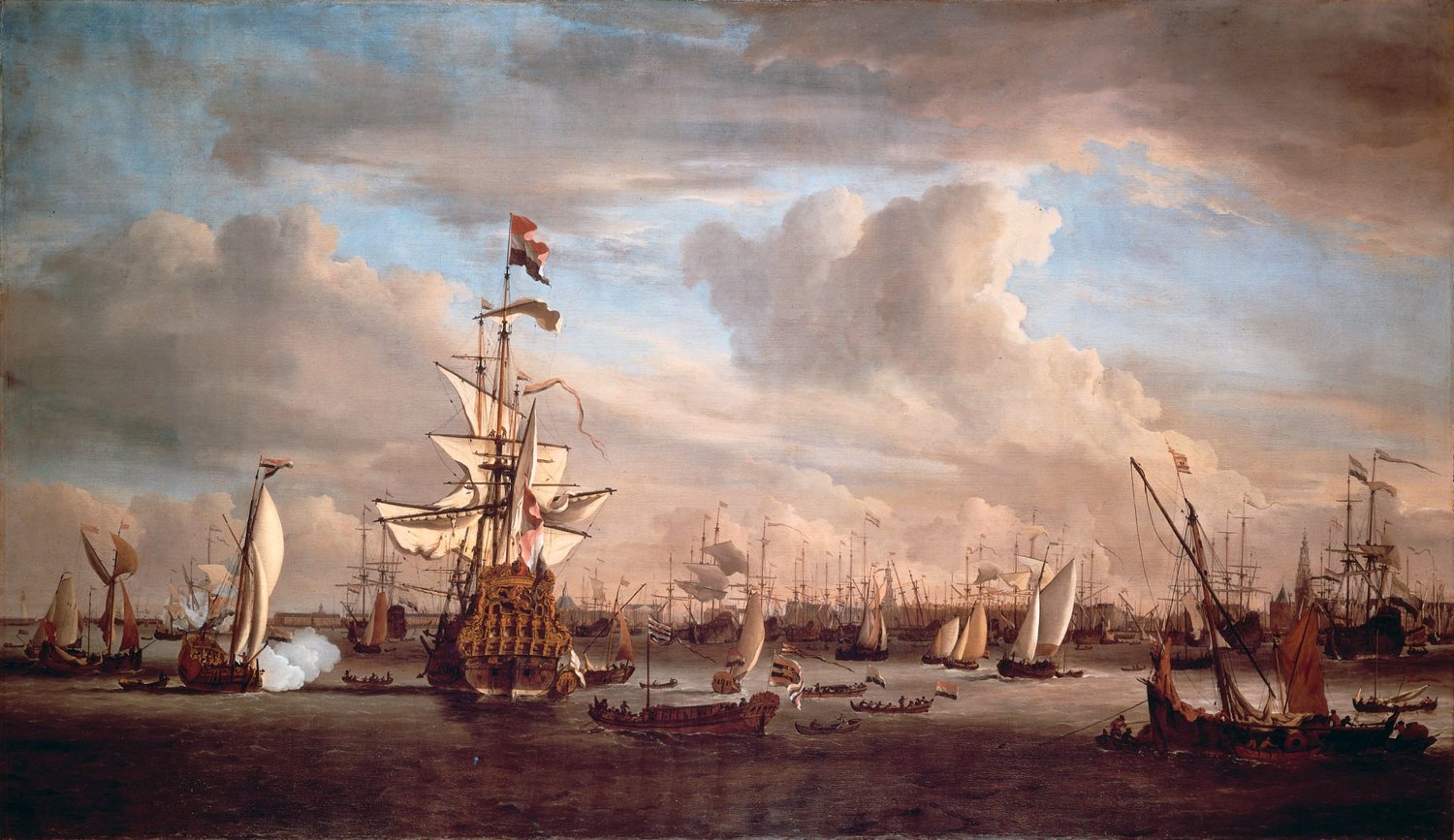
The IJ crowded with shipping, and at its heart the Gouden Leeuw — the Golden Lion, once Tromp's flagship — riding at anchor before the city. A panorama of Amsterdam's sea-gate in its golden decades: yachts, flutes, men-of-war and harbour boats, each one drawn like a portrait, the whole fleet held in a single silvery light.
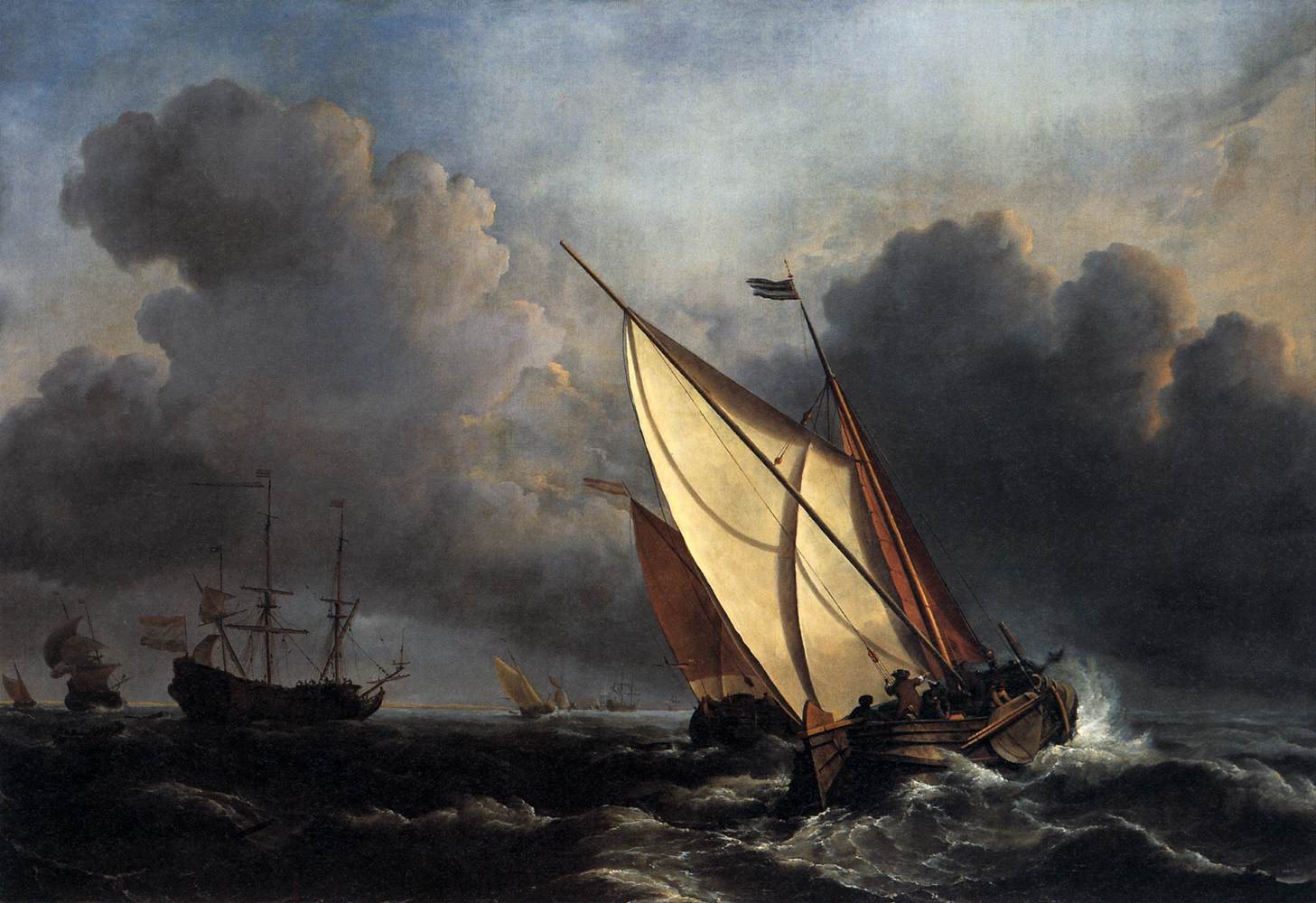
A small Dutch vessel heels under a press of sail as the squall hits, warships labouring behind her under a sky of rolling black cloud. Painted around the year he left for England — the Dutch sea saying goodbye in its roughest voice, and the painter answering with everything he had learned in forty years of watching it.
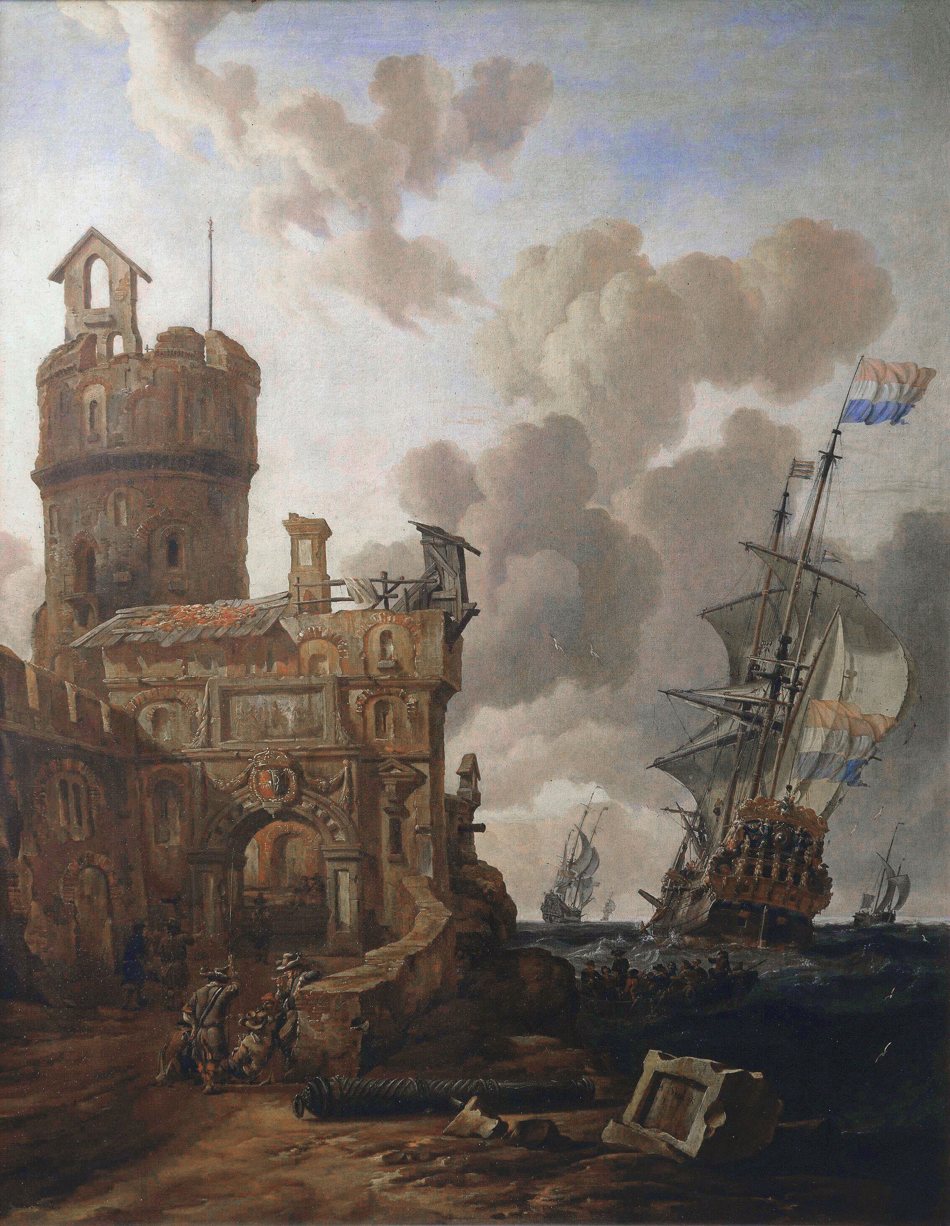
A ship salutes as she passes a great stone fort on a rocky shore — part real coast, part invention, the tower rising like a stage set against a sky of piled cloud. Van de Velde's coastal pieces let him play architect: masonry, surf and shipping composed into one vertical ceremony of arrival.
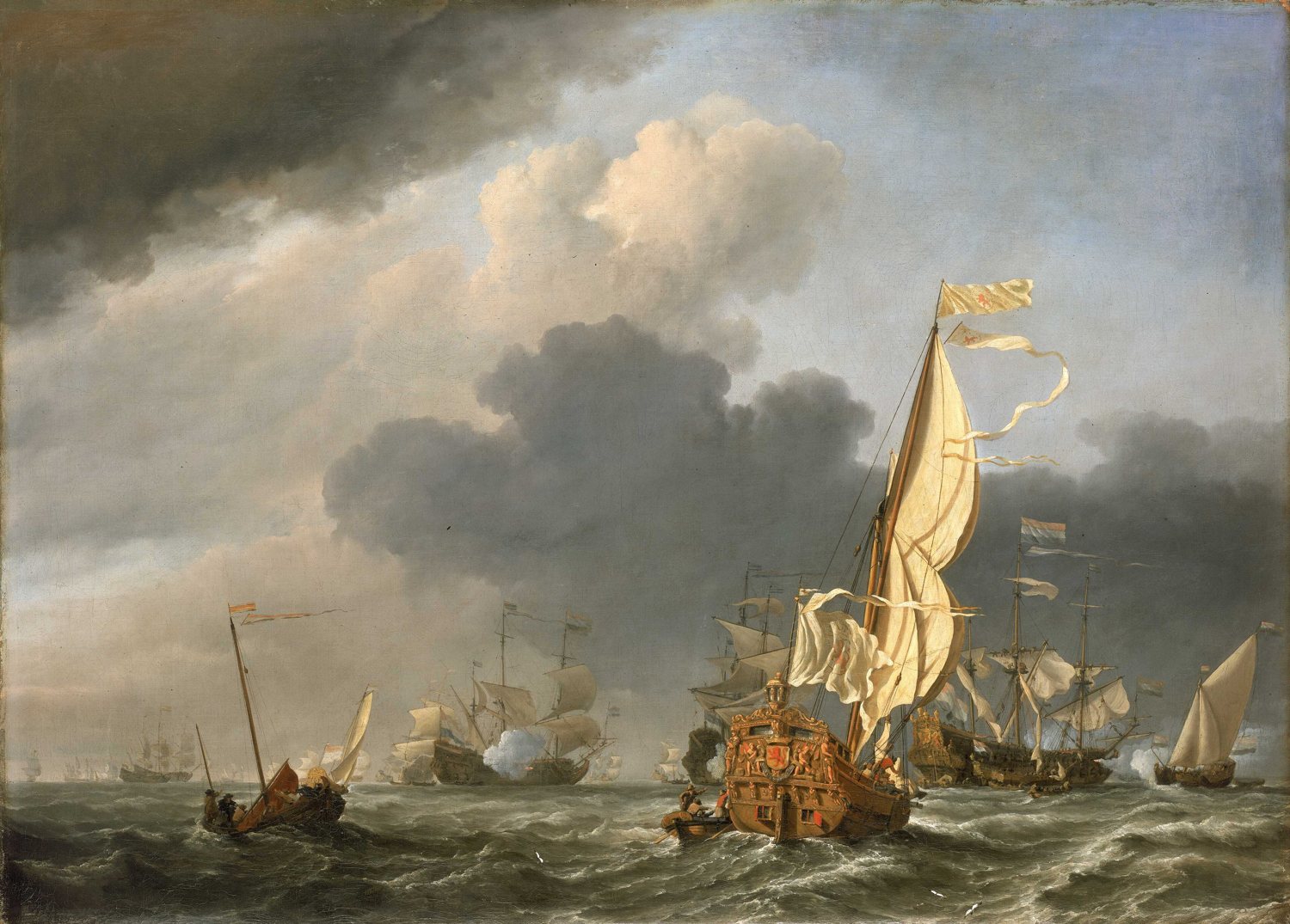
A States yacht — the ceremonial barge of the Dutch government — runs before a fresh breeze toward a group of men-of-war, her great sail bellied, spray at her bow. The yacht was the sports car of the Republic, and van de Velde paints her the way she felt: fast, gilded and entirely sure of herself.
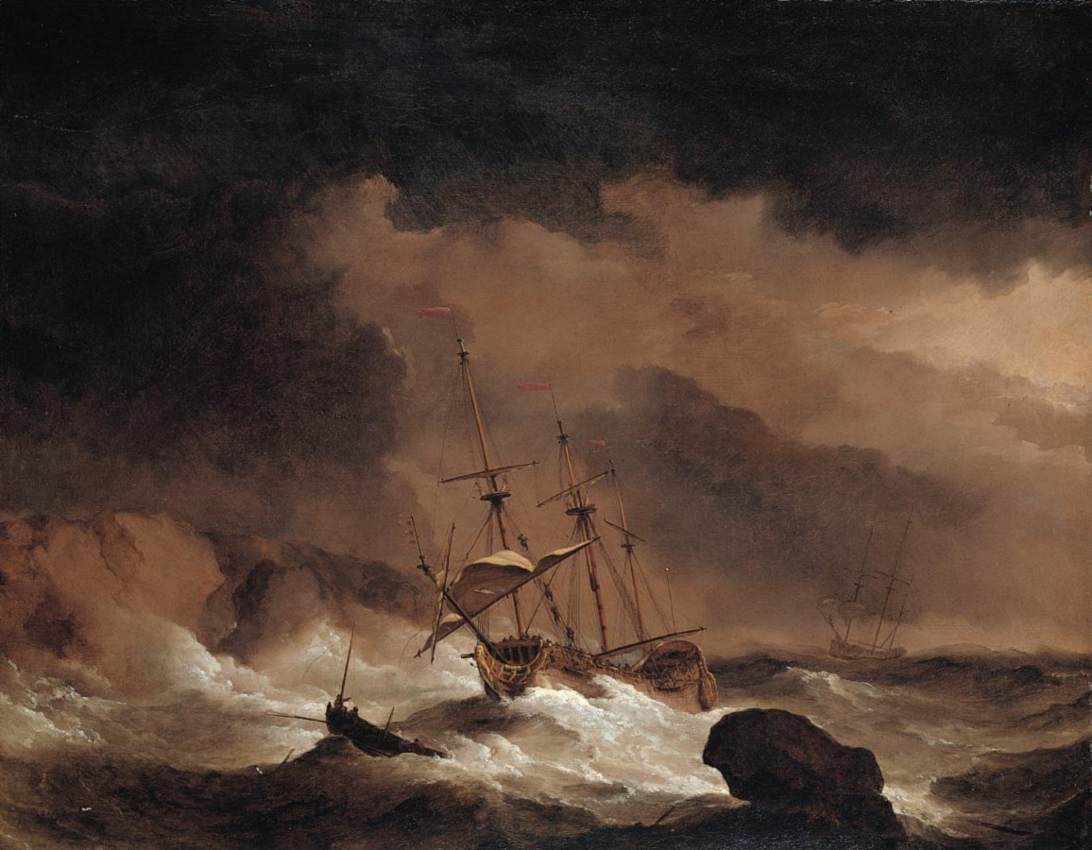
An East Indiaman — the treasure ship of the Dutch empire — fights a gale on a lee shore, rocks under her stern, the sea breaking white in the dark. It is the nightmare inside every calm he painted: the same ship, the same sea, the weather turned murderer. No painter has made canvas and water argue more convincingly.
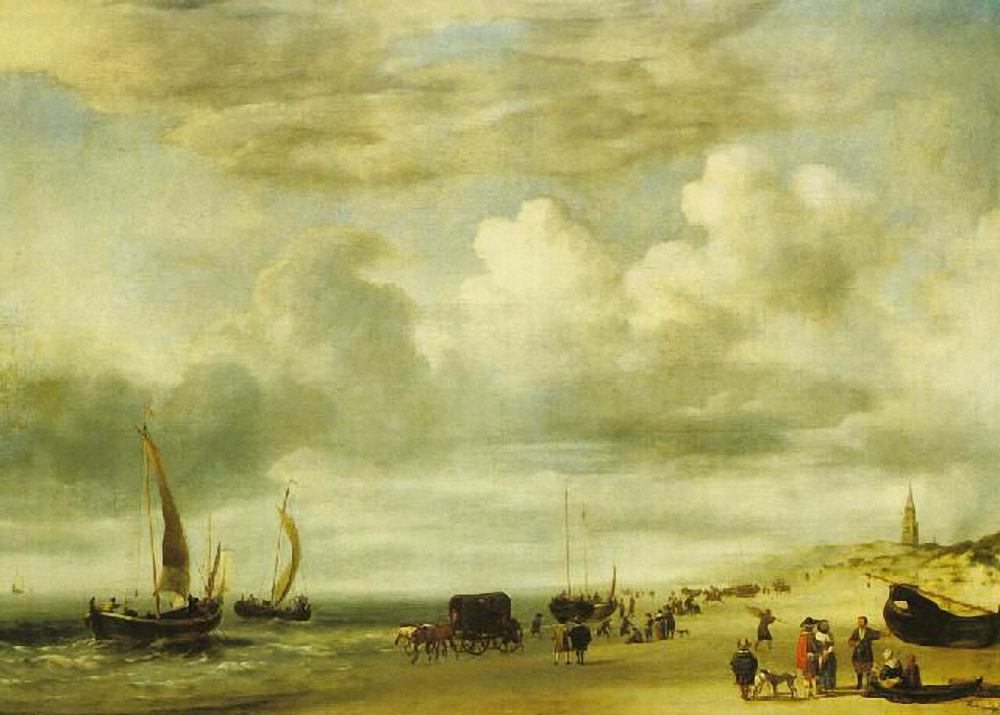
The fishing fleet beached at Scheveningen, carts and crowds on the sand — a family picture: Willem painted the ships and the sea, his younger brother Adriaen, the landscape painter, the figures on the shore. Two van de Veldes in one small panel, each doing the half of the world he did best.