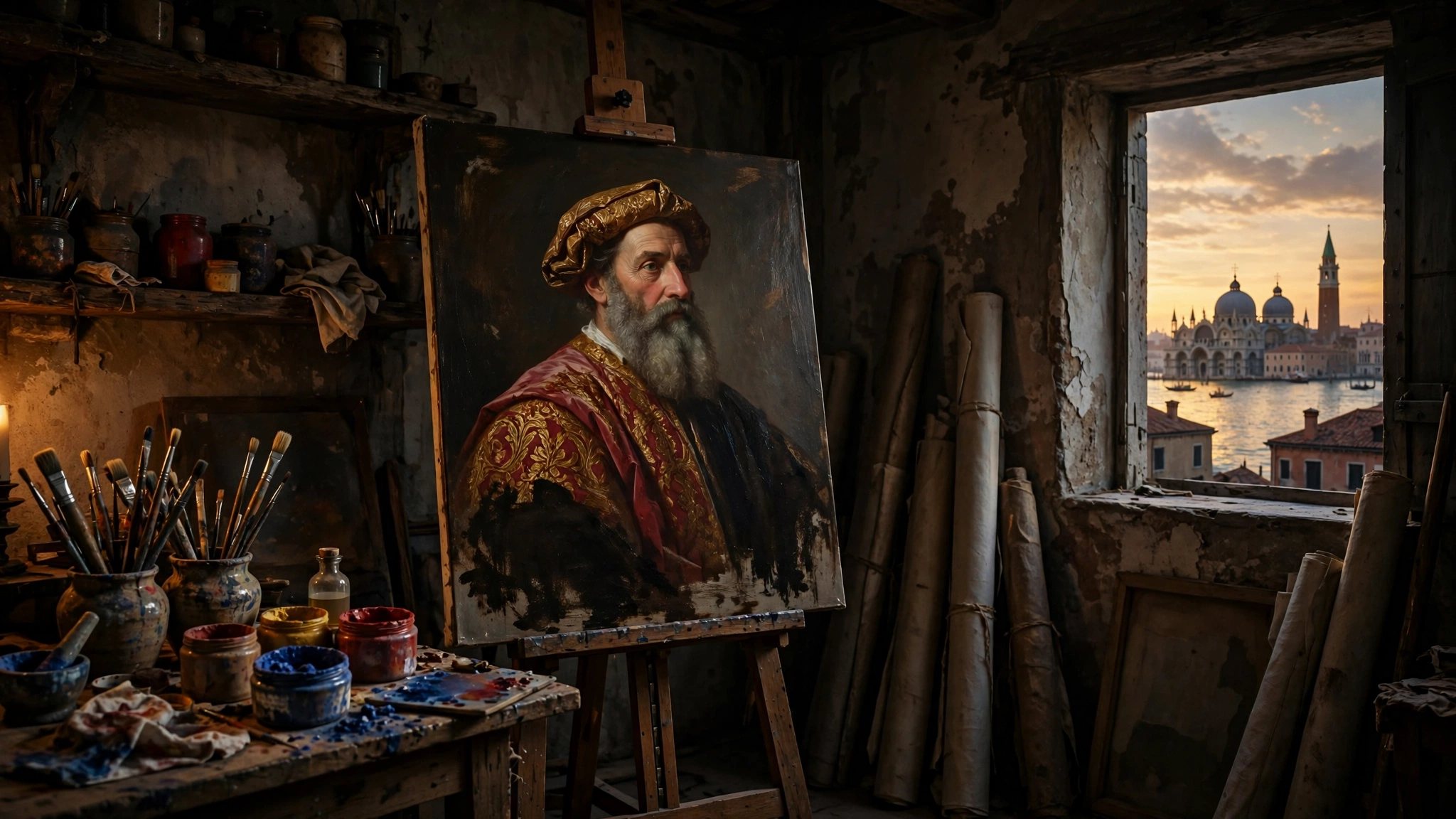
Titian painted for nearly seventy years and reinvented himself in every decade: the young colourist of the Assunta, the portraitist of emperors, and at the end an old man painting with his fingers in paint so loose it dissolves into light and flesh. Venice gave painting its colour; Titian gave colour its freedom.
Florence worshipped drawing; Venice answered with colour. Titian built forms not with outline but with patches of pigment — warm against cool, light against dark — adjusted until the flesh breathed. Seen up close, his surfaces are almost abstract; step back, and they become skin, silk and storm.
Titian kept canvases in his studio for years, turning them to the wall and returning months later to repaint whole passages. The Danaë and the Venus and Adonis for Philip II were worked, rested and reworked like wine maturing — he called the results poesie, poems, and treated delivery dates accordingly.
Palma Giovane, who watched the old Titian work, described the method: masses of colour laid with big brushes, then modelled with fingers, smearing the lights and shadows into one another, a final touch of red 'like a drop of blood'. The last paintings are half sculpture, half apparition.
Venice was Europe's pigment market, and Titian bought the best: lapis lazuli ultramarine from Afghanistan, red lake, lead-tin yellow. Contracts sometimes specified how much ultramarine a picture must contain — patrons were literally buying blue by weight, and Titian's skies and robes show where the money went.
Charles V made Titian a Count Palatine and knight, and legend says the emperor once stooped to pick up the painter's dropped brush. True or not, the portraits explain the honour: no one else could make power look this quiet. Titian painted three generations of Habsburgs and outlived most of them.
The late works — the Death of Actaeon, the Flaying of Marsyas — were never delivered and perhaps never meant to be: kept in the studio, reworked endlessly, their paint dragged and flickered until form emerges from chaos like something remembered. Modern painting begins in that looseness.
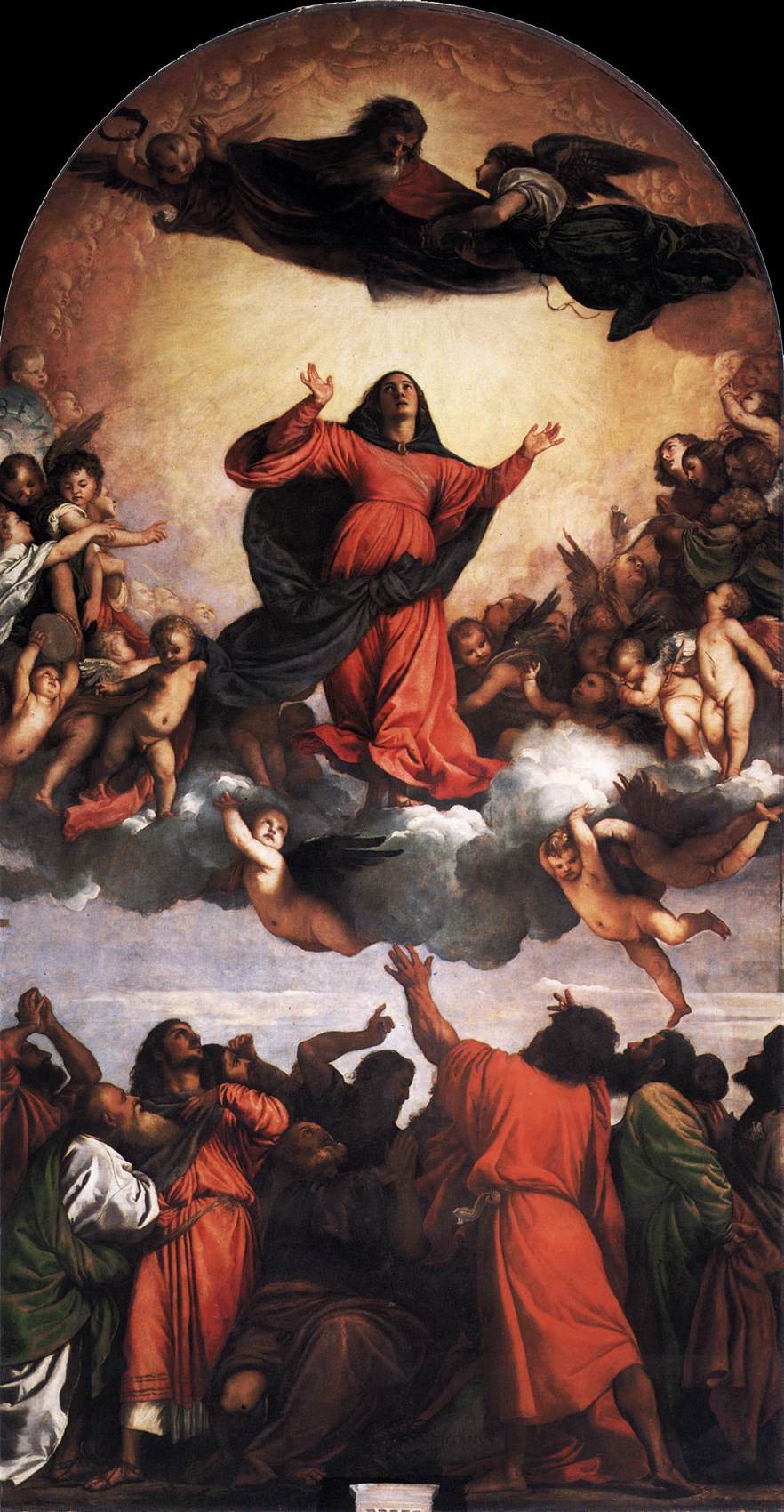
Nearly seven metres of ascending joy over the Frari altar: the apostles surge below, the Virgin rises on a cloud of angels, God the Father bends toward her from the gold. When it was unveiled, Venice understood at once that its young painter had outrun everyone — including, some said, Raphael.
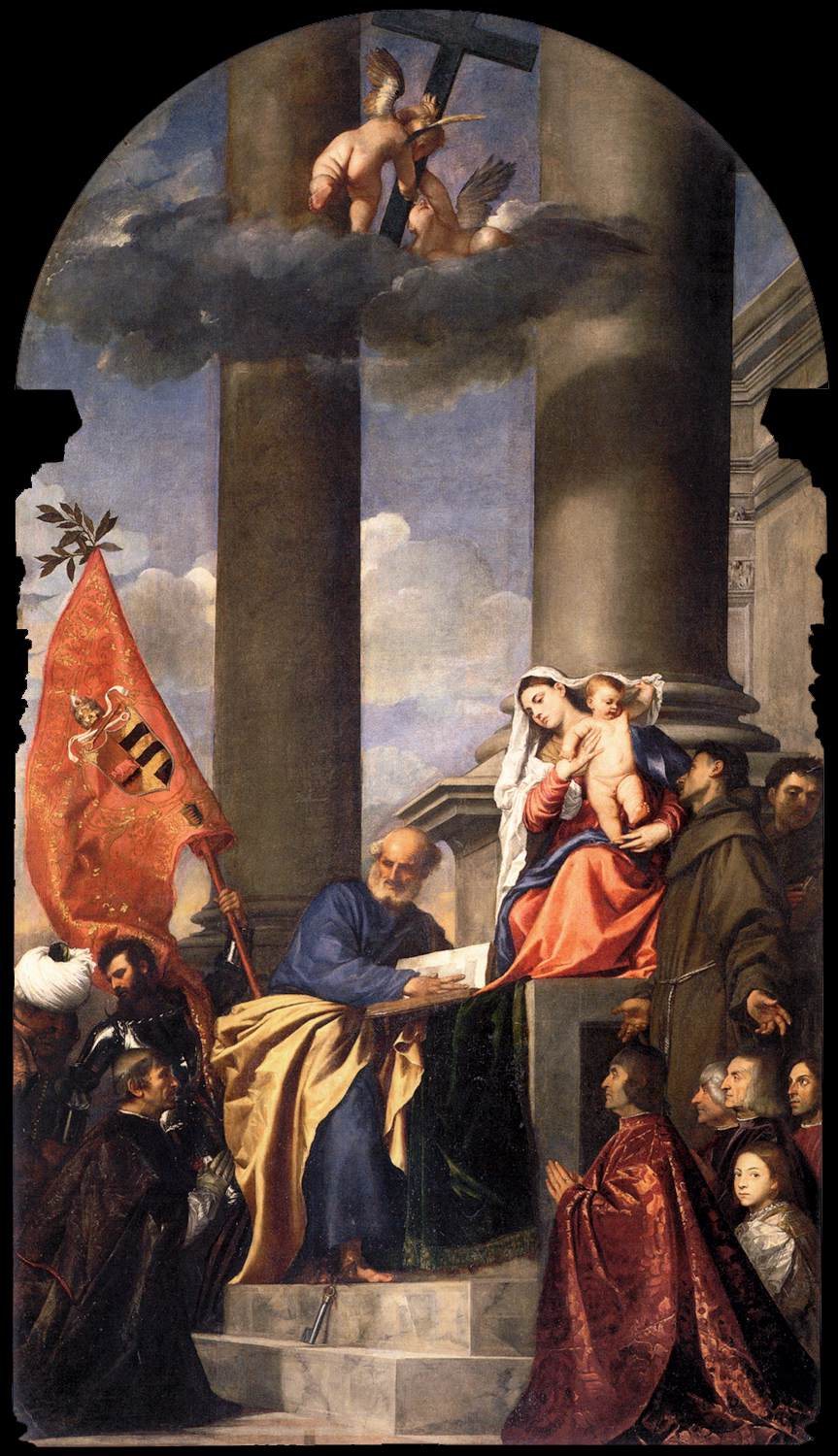
A Madonna composition tipped boldly off-centre: the Virgin sits high to the right under vast columns, the Pesaro family kneels in a diagonal below, a standard-bearer drags a Moorish prisoner into the scene. Nothing this asymmetrical and this calm had been hung over an altar before.
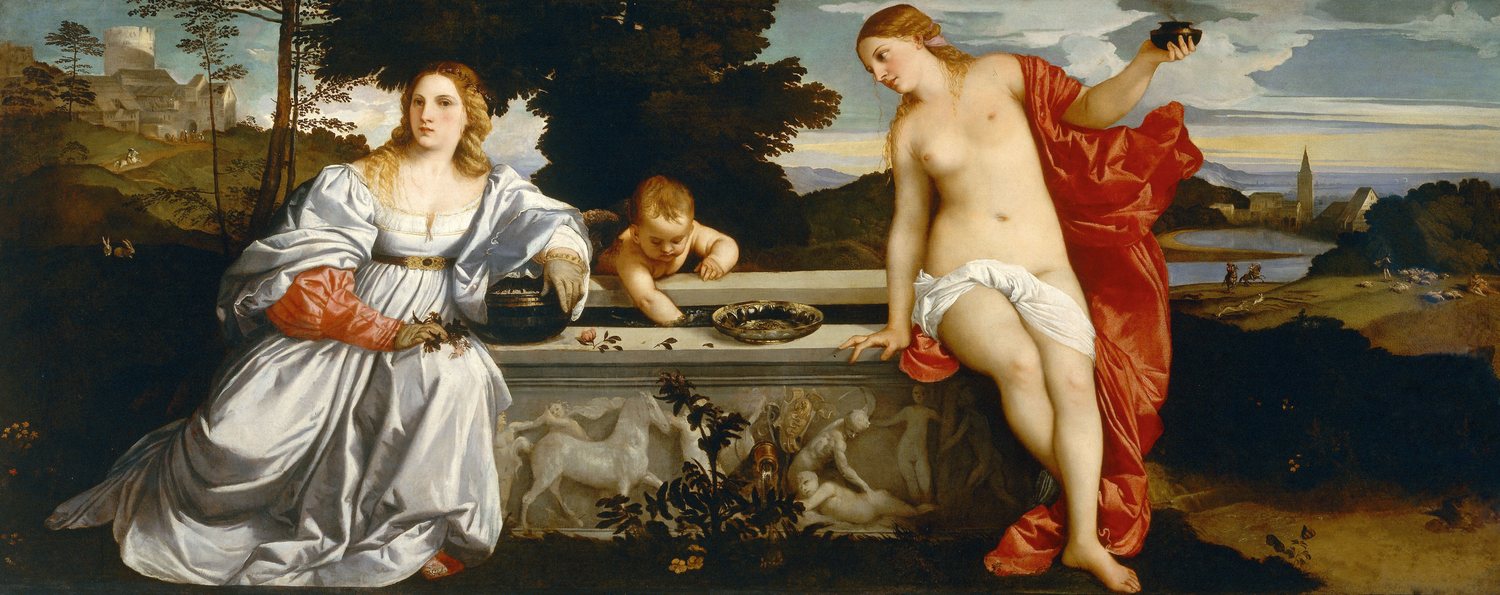
Two women at a fountain in a golden landscape — one clothed in white, one nude — and five centuries of scholars arguing about who they are. A wedding picture, an allegory, a meditation on two kinds of love: the painting keeps its secret and gives only its light, which may be the point.
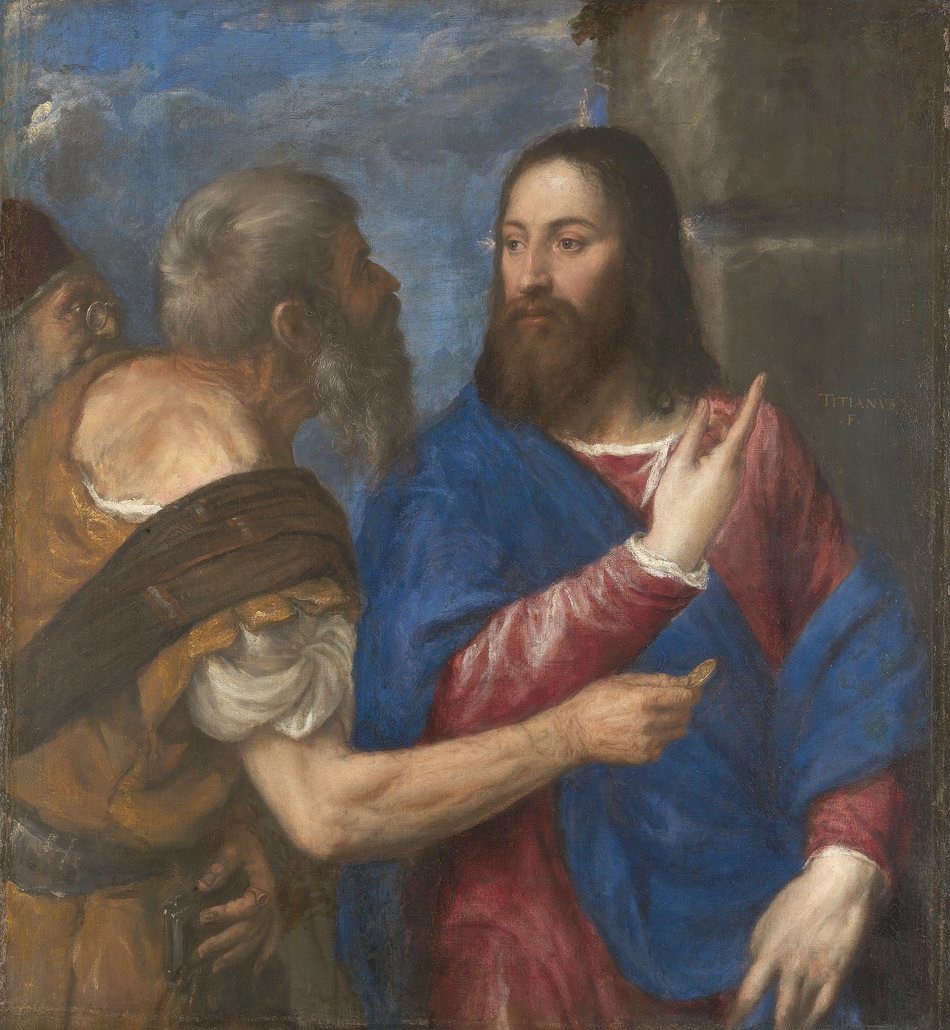
Christ turns from the Pharisee's trap with the coin held up: 'Render unto Caesar…' Painted for the Duke of Ferrara, the heads are carved like sculpture and the light is already pure Titian — the picture that announced Venice had a second giant beside Giorgione.
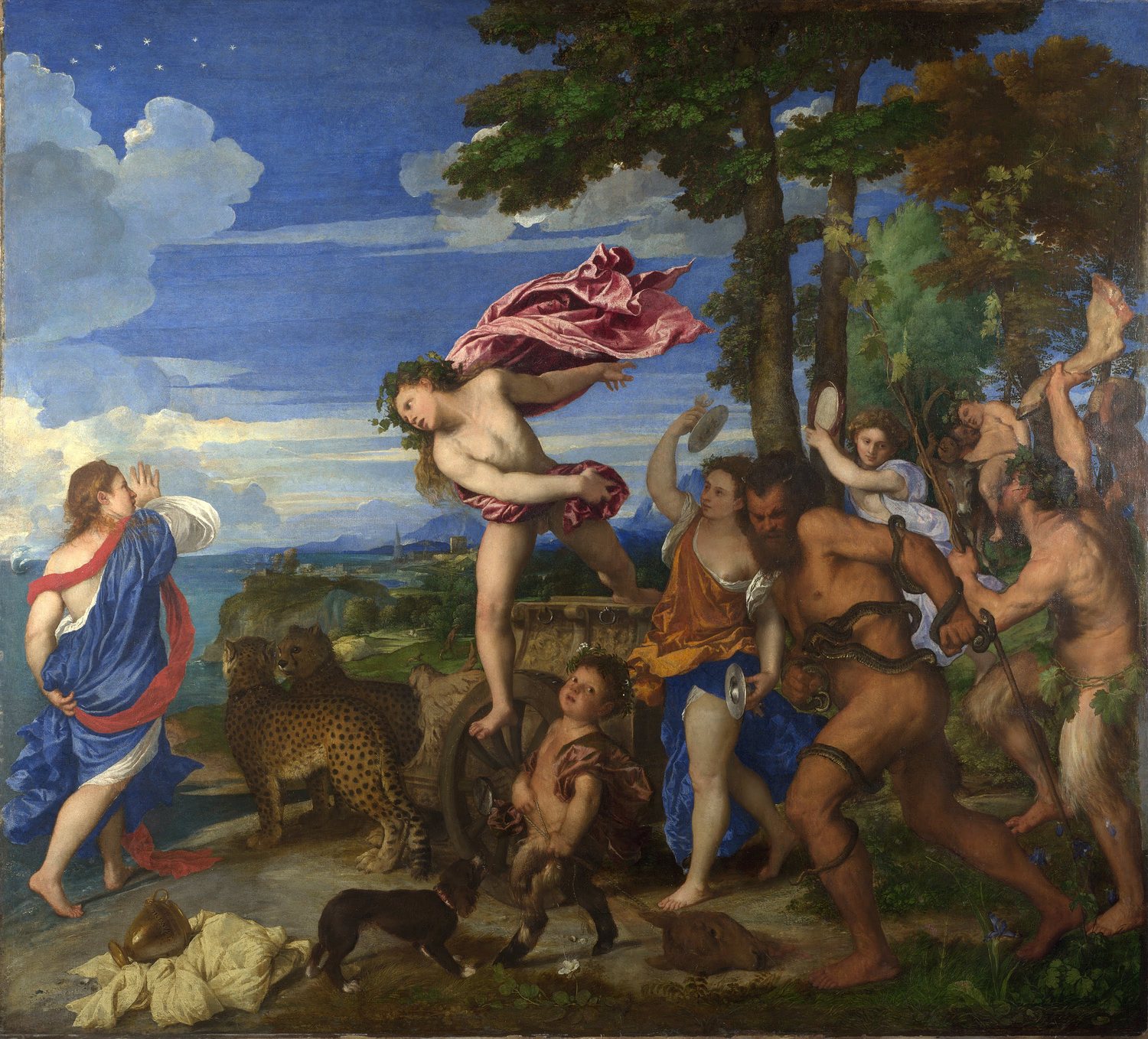
Bacchus leaps from his chariot toward Ariadne, his cloak still flying, her crown already becoming stars in the blue above. The ultramarine sky was the most expensive patch of paint in Europe — the patron, Alfonso d'Este, was buying lapis by the kilo and Titian spent it gloriously.
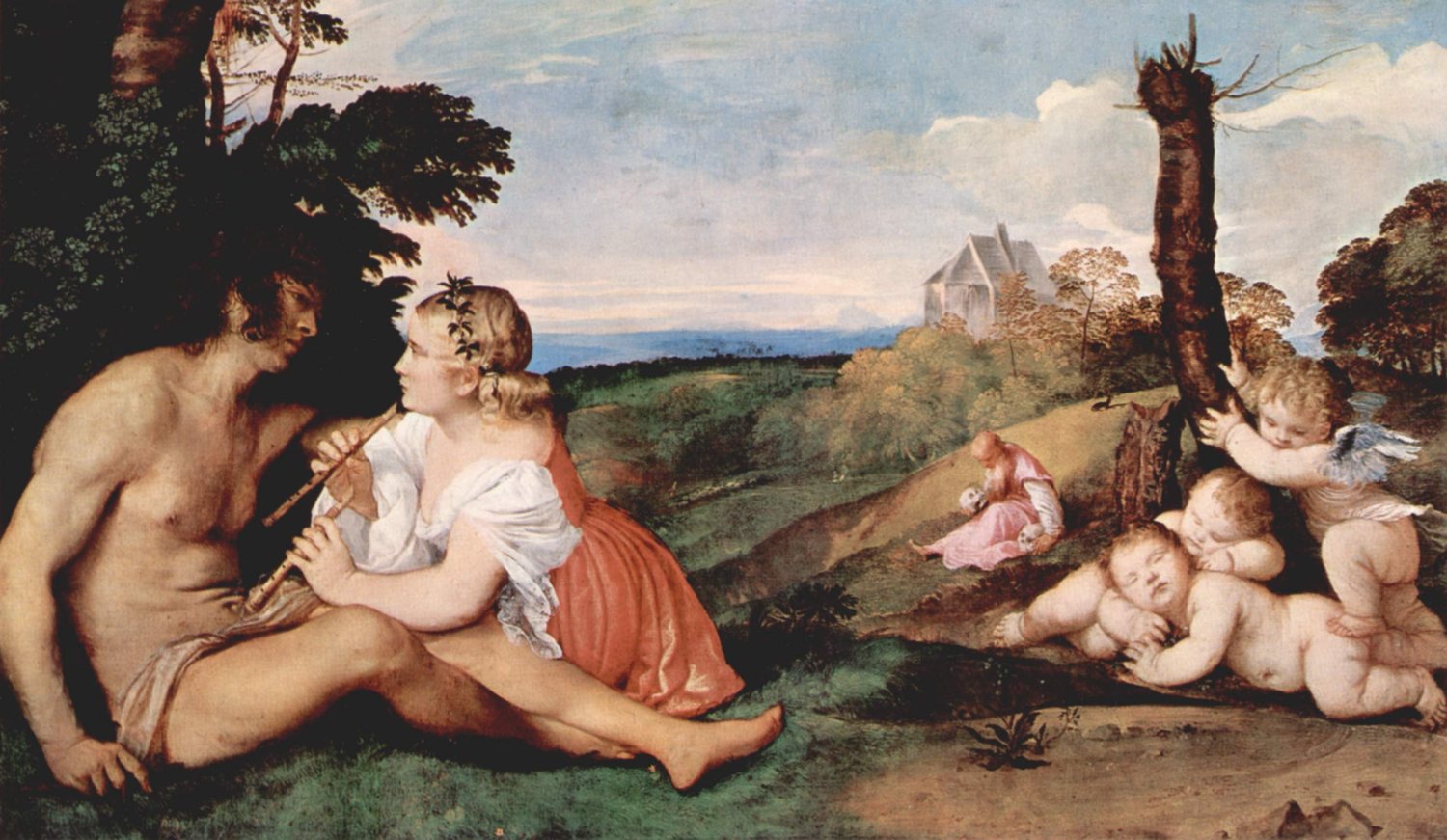
Childhood sleeps in the grass watched by an angel, youth dallies in love at the left, and age — an old man with two skulls — waits in the trees at the right. A whole life in one meadow, painted when Titian himself was barely out of the first age.
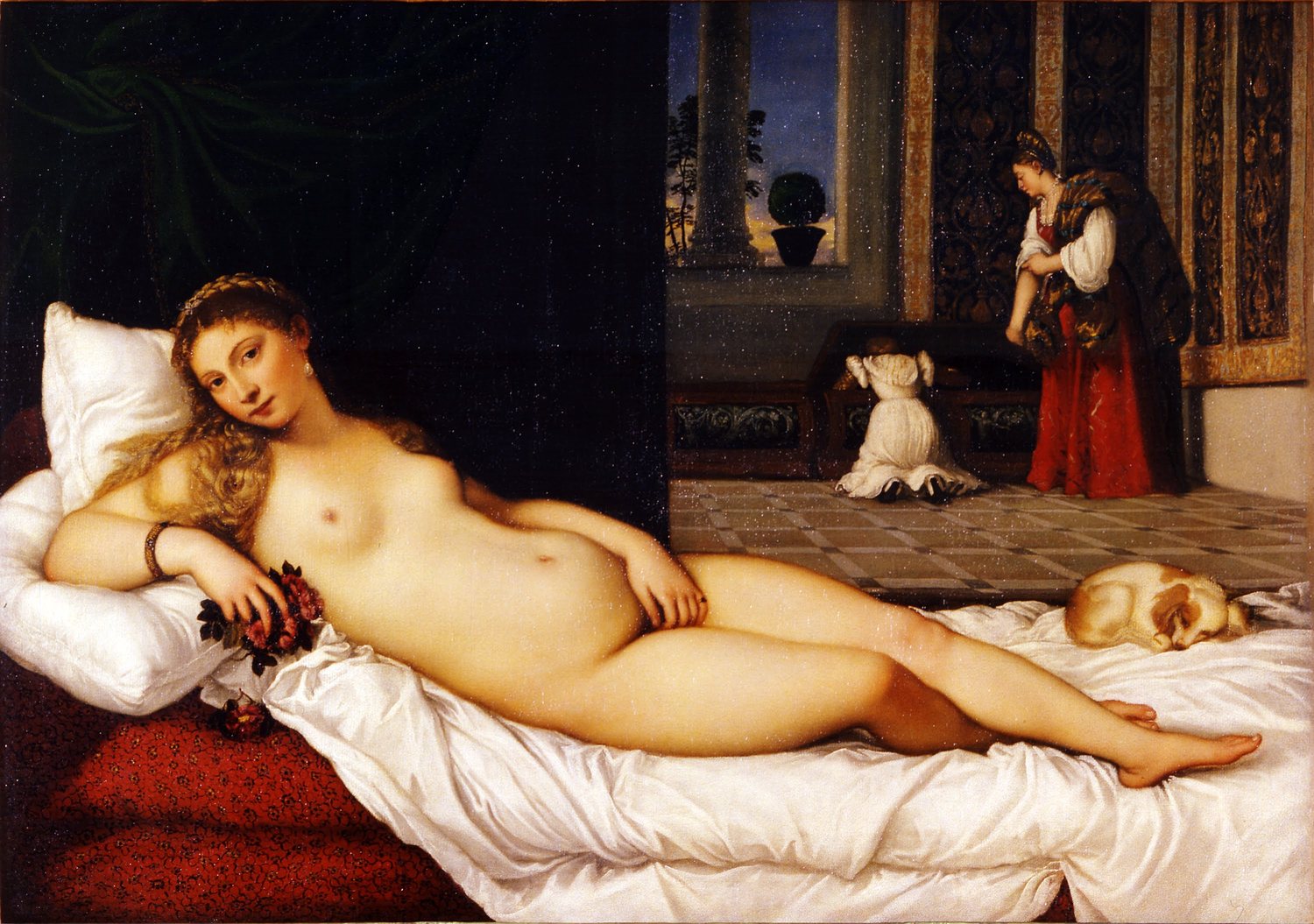
She lies on a disordered bed in a Venetian palace, a little dog asleep, maids hunting through a clothes chest behind — and she looks straight at us, awake and entirely unembarrassed. Bought by the young Duke of Urbino, it became the most imitated reclining nude in Western art.
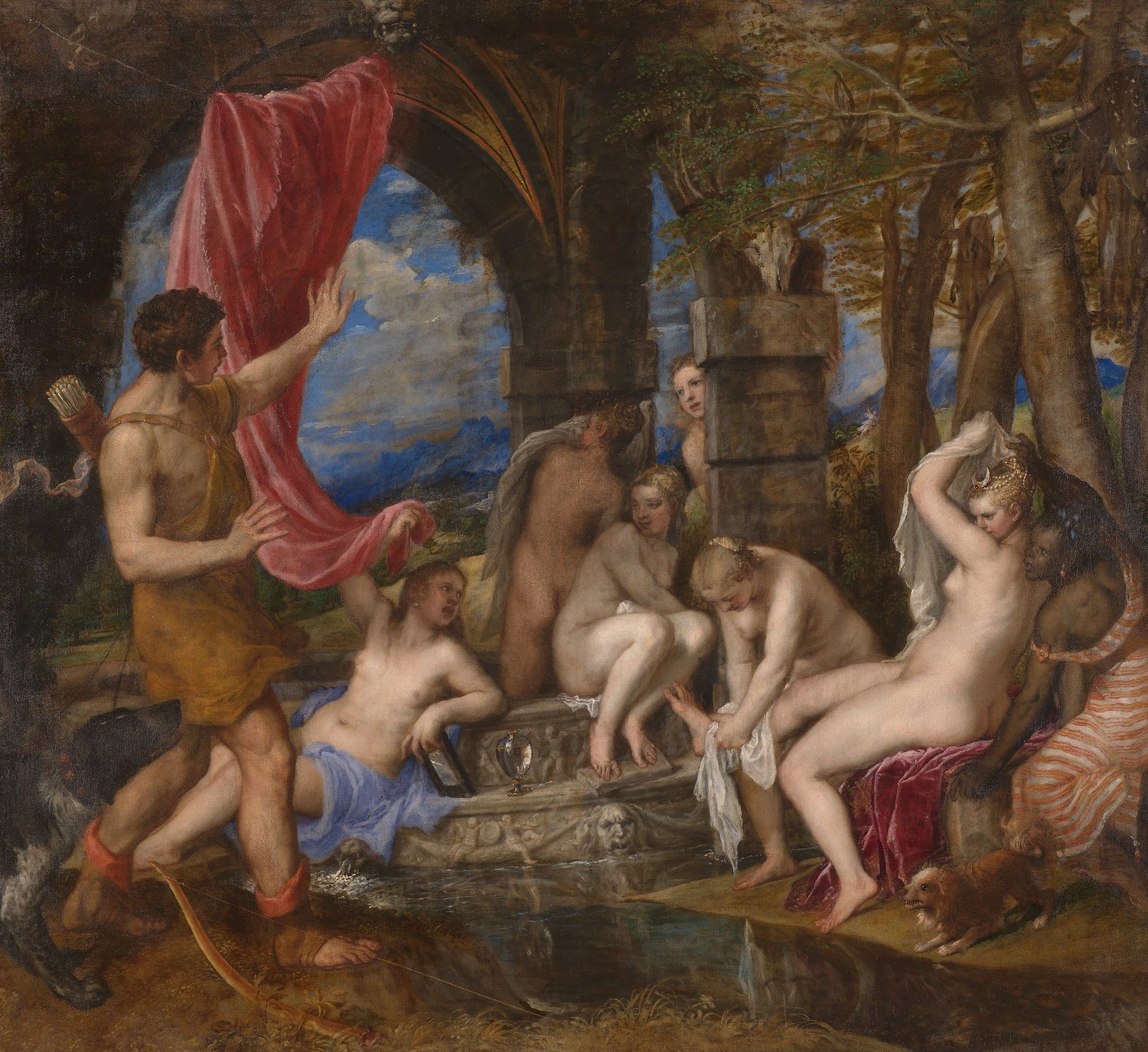
Actaeon bursts through the curtain and sees the goddess bathing; Diana's gesture — half shielding, half cursing — already contains his death. One of the poesie painted for Philip II of Spain, kept in the studio for years and released like a vintage wine.
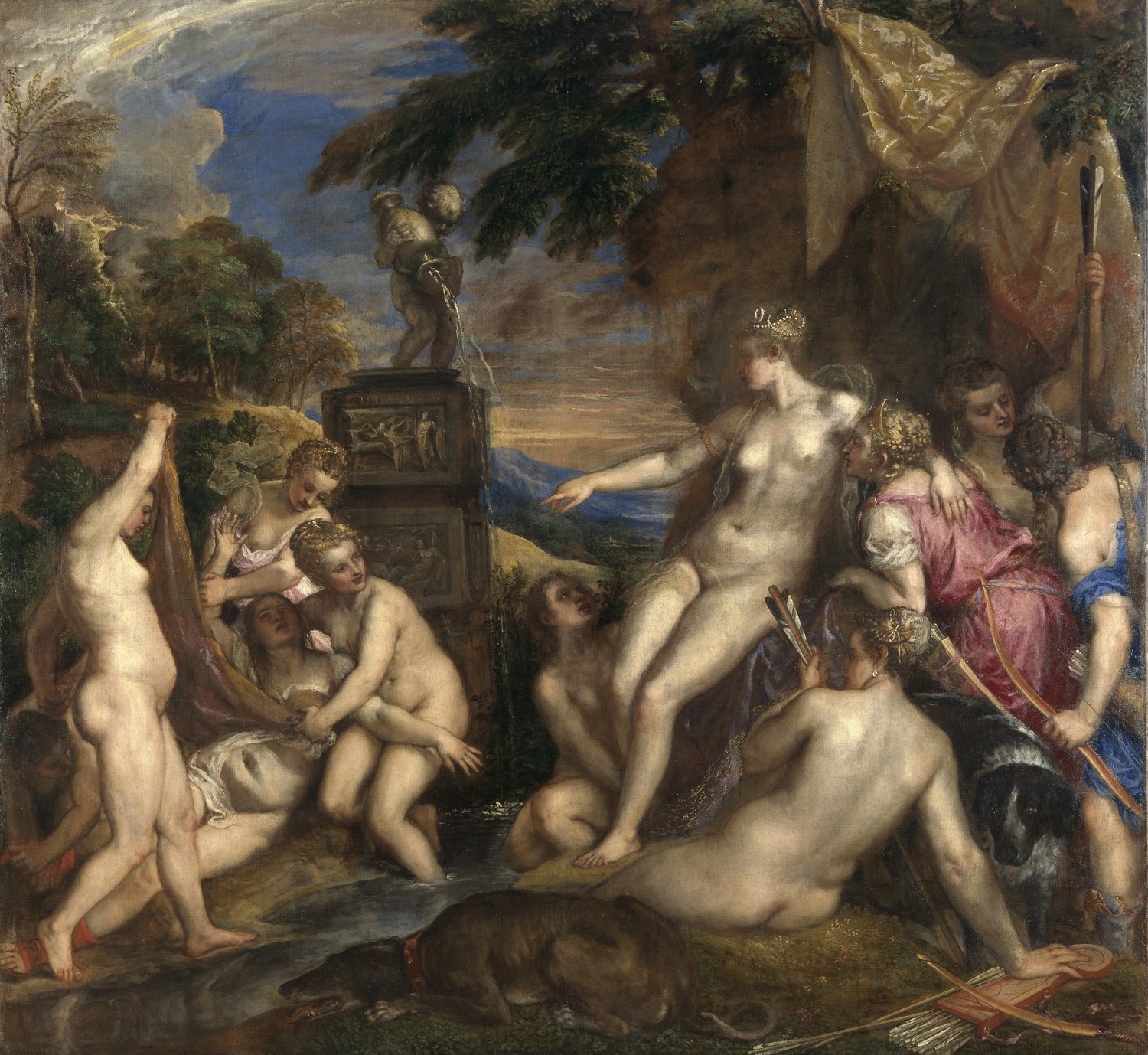
The companion piece: Callisto, pregnant by Jupiter, is stripped by her own companions as Diana banishes her — cruelty staged in the same golden woods as its pair. The two canvases have hung together, apart and together again across four centuries and two kingdoms.
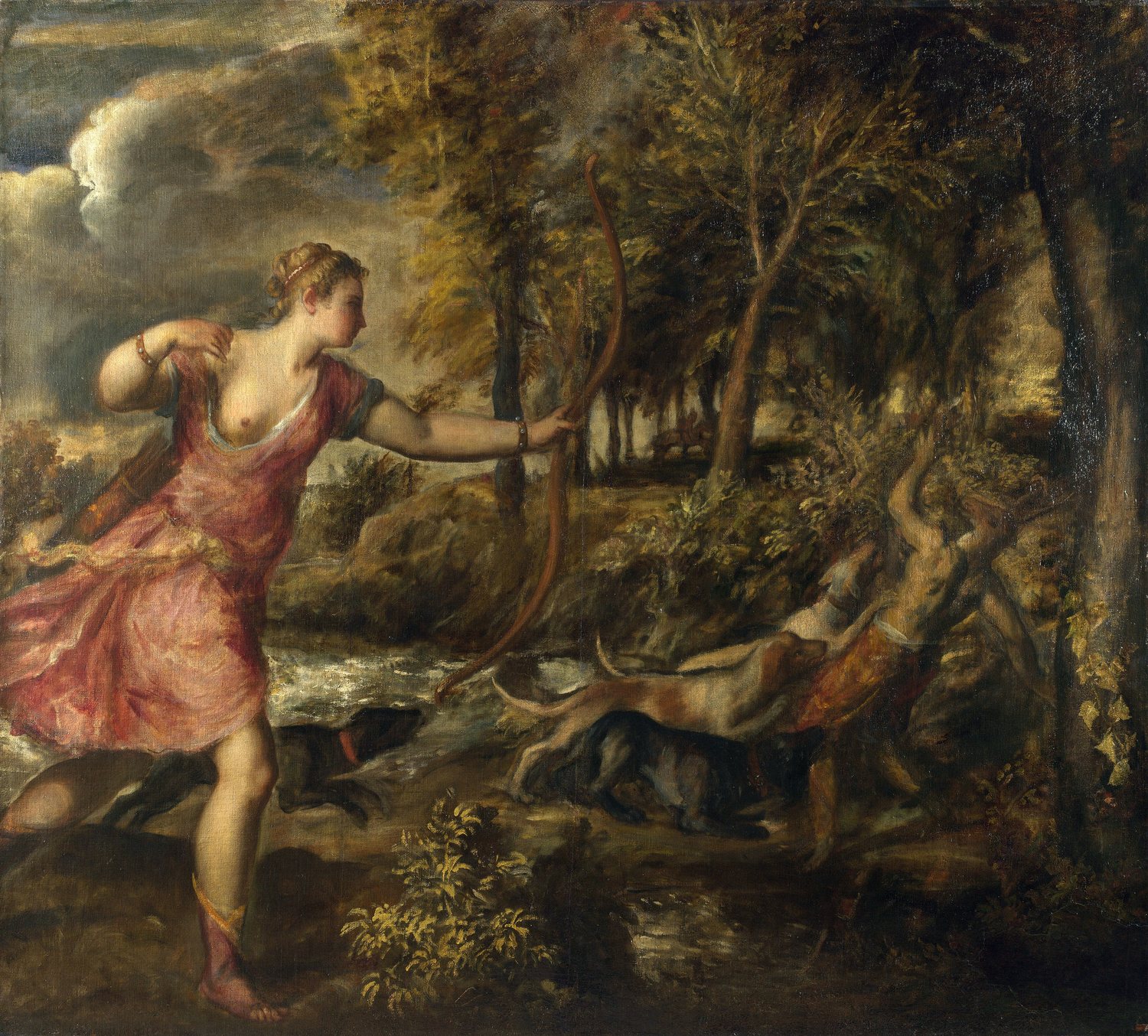
The sequel Titian never delivered: Actaeon, half stag already, goes down under his own hounds while Diana strides in with her bow. The paint is dragged, flickered, almost dissolved — an old man's vision of a young man's story, kept in the studio until his death.
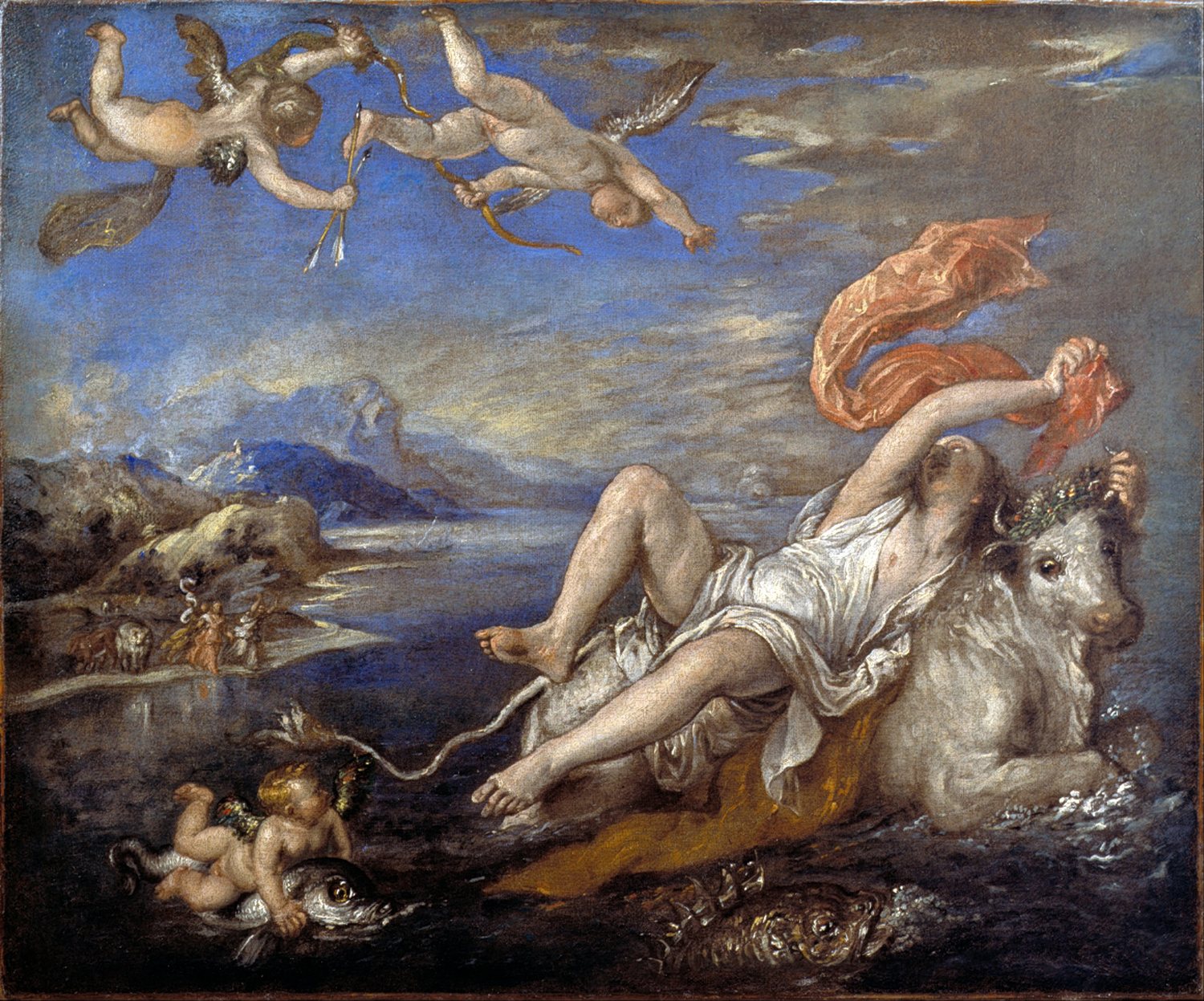
The bull swims for Crete with Europa clinging to his horn, her scarf flying like a flag of alarm, cupids riding dolphins in her wake. Rubens copied it, princes coveted it — the most violent of the poesie and the most tenderly painted.
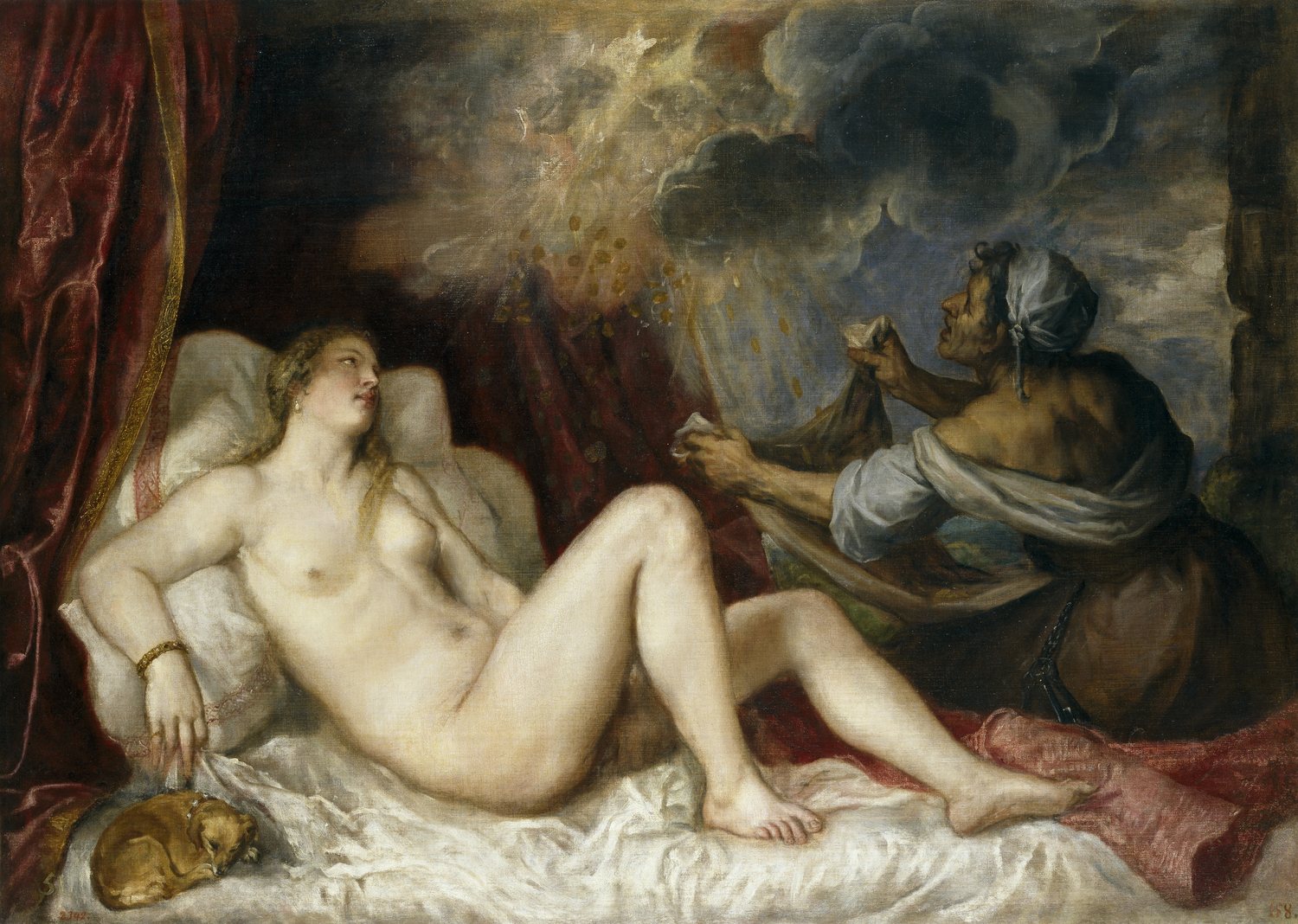
Jupiter arrives as a shower of gold coins, caught in the apron of the old nurse while Danaë receives him in a blaze of flesh and crimson. Philip II hung the poesie in a private room; the picture's warmth is deliberate — paint doing what gold does to light.
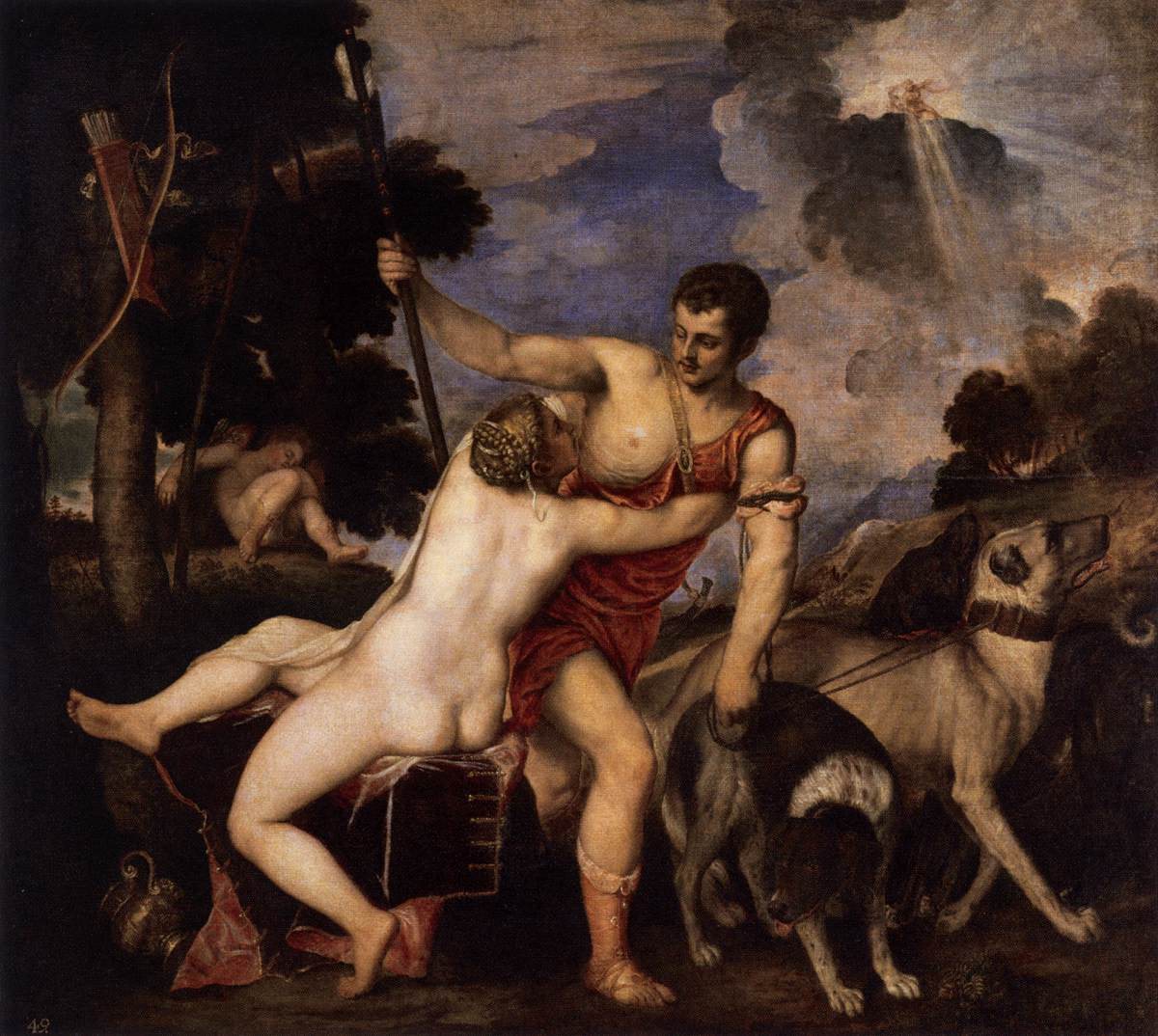
Venus clings to Adonis as he pulls away to the hunt that will kill him, his dogs already straining at the leash. Titian invented the composition — antiquity never showed her holding him back — and Europe copied his invention for two hundred years.
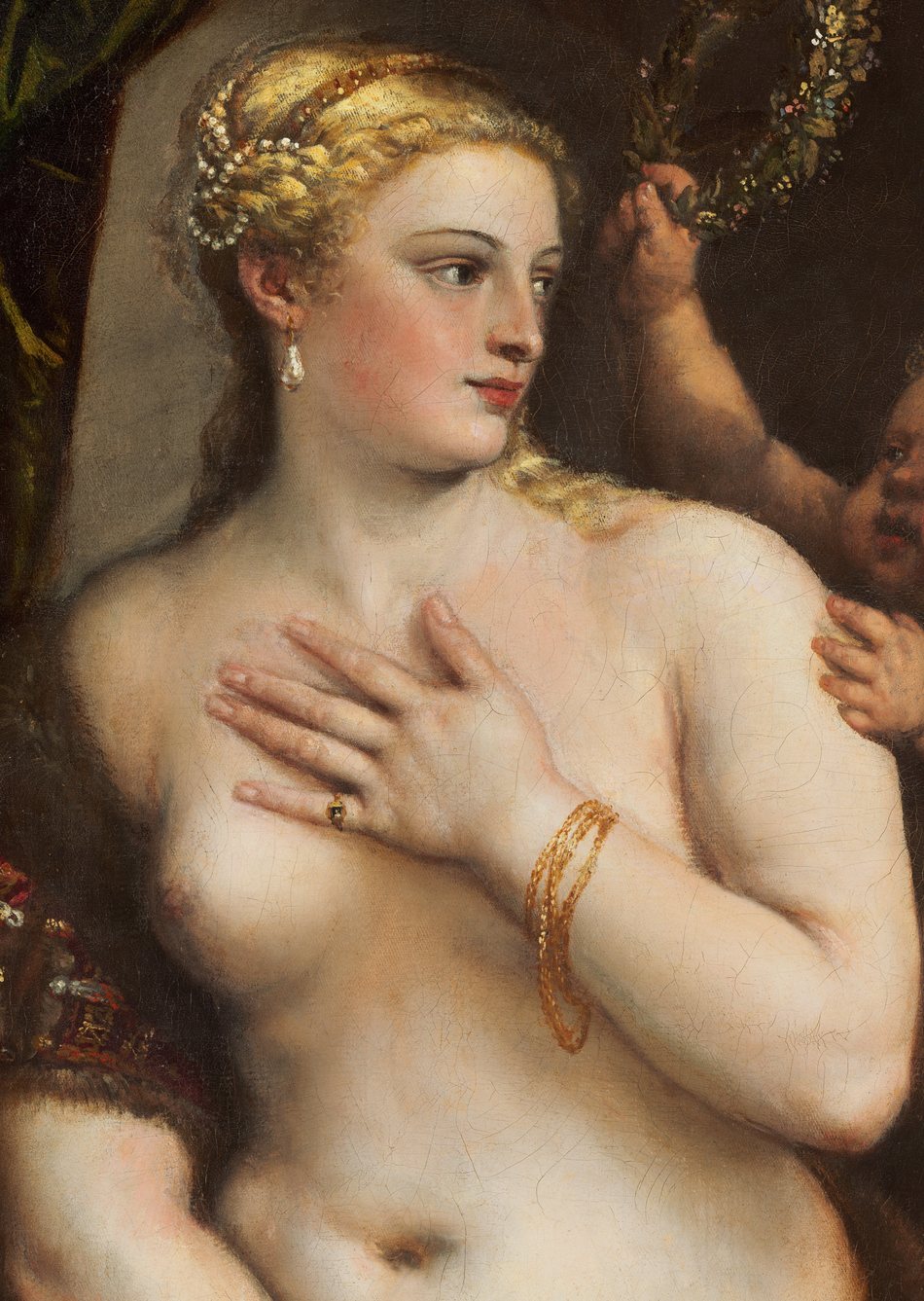
Venus checks her beauty in a mirror held by Cupid, half-draped in a fur-trimmed crimson wrap — the goddess as a Venetian lady at her toilet. X-rays show Titian first painted another composition underneath and turned the canvas to reuse it: thrift and genius in one gesture.
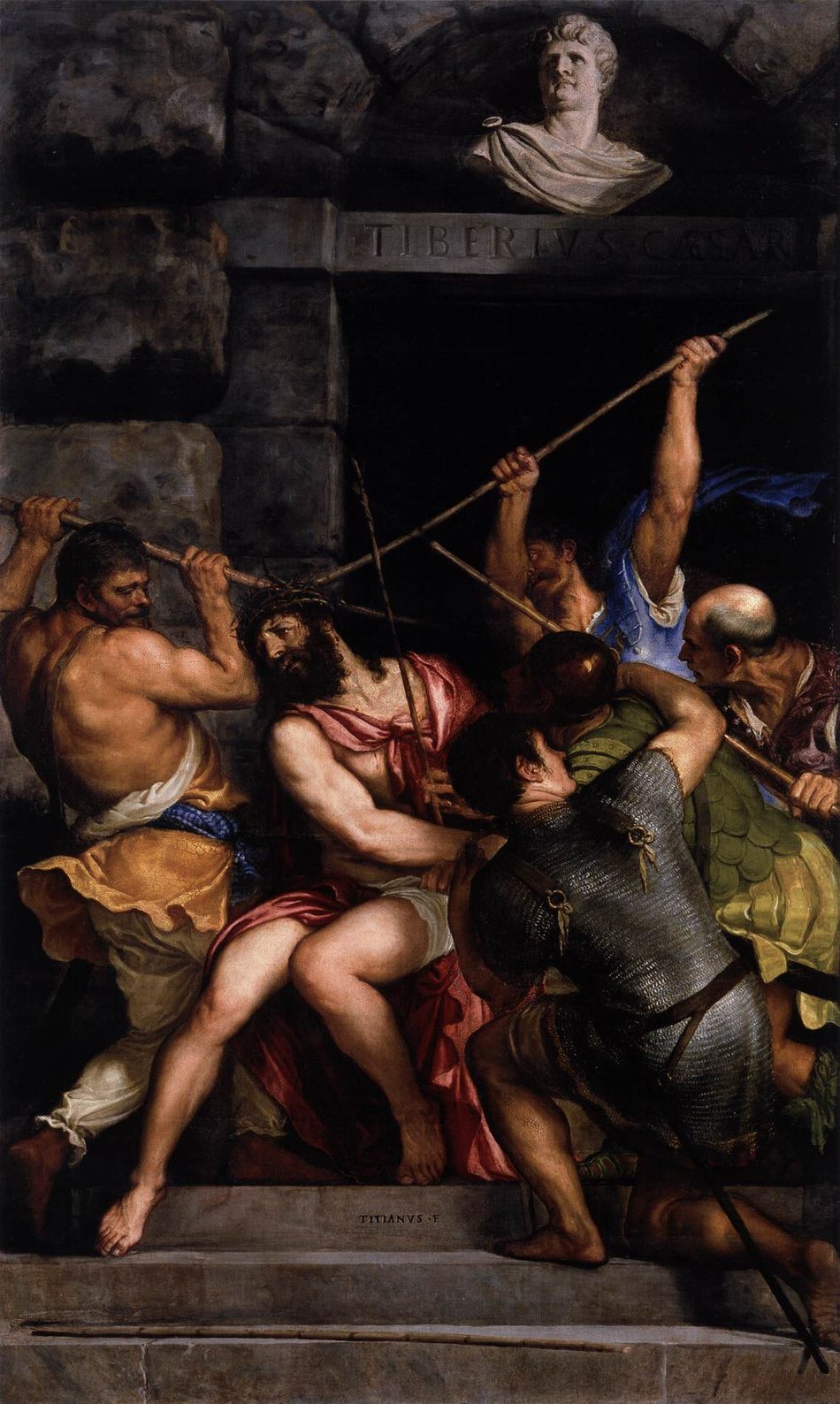
Tormentors force the crown down with crossed sticks, their bodies twisting like a machine of cruelty under a cold stone arch. Titian returned to this subject at the very end of his life in a version of pure flame and shadow — this earlier one is already merciless enough.
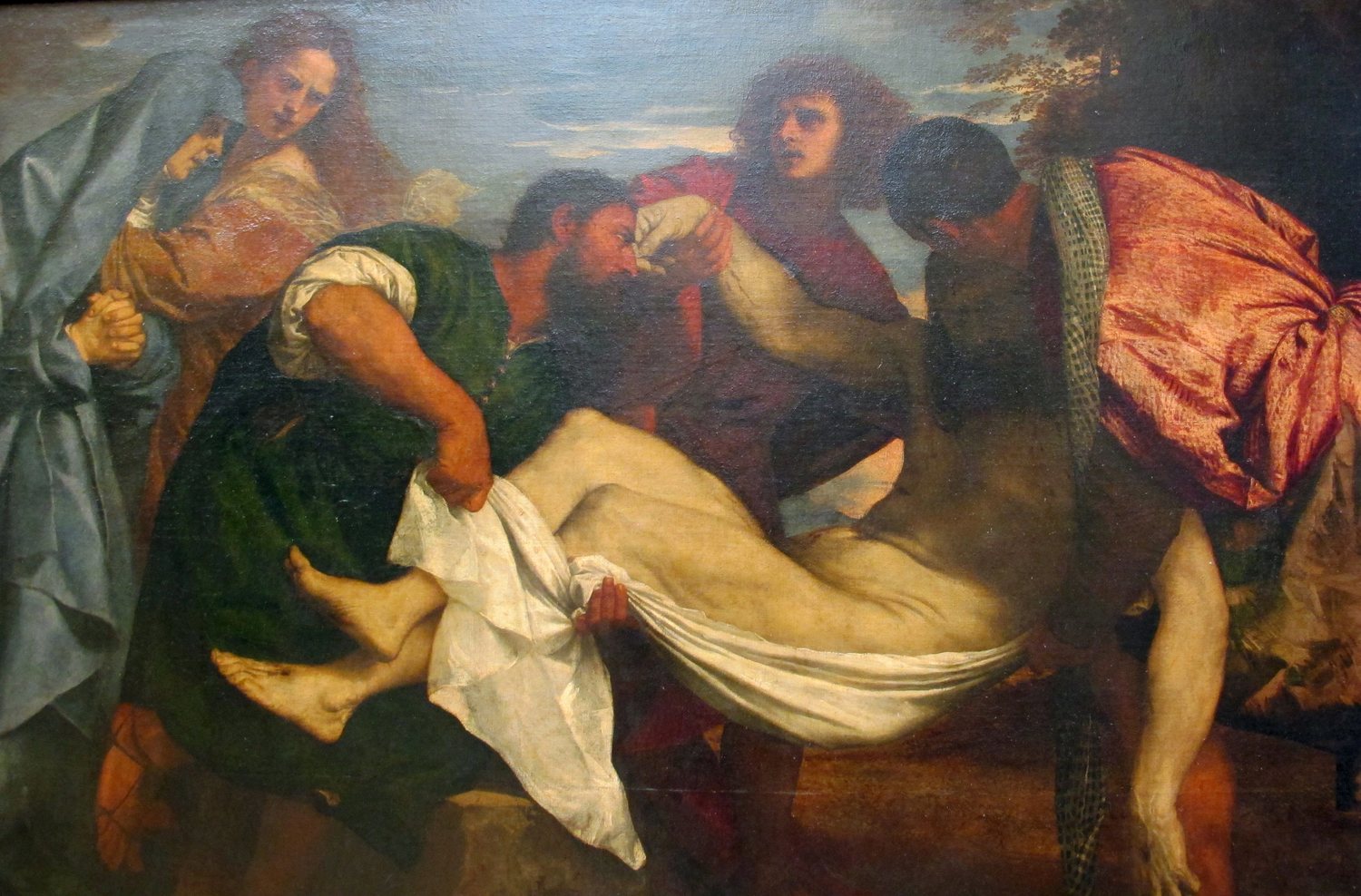
Christ's body, heavy as a sleeping man, is carried through a darkening landscape by bearers who strain under the weight of grief itself. An early work, but the evening light and the green pallor of the flesh are the inventions of a master already complete.
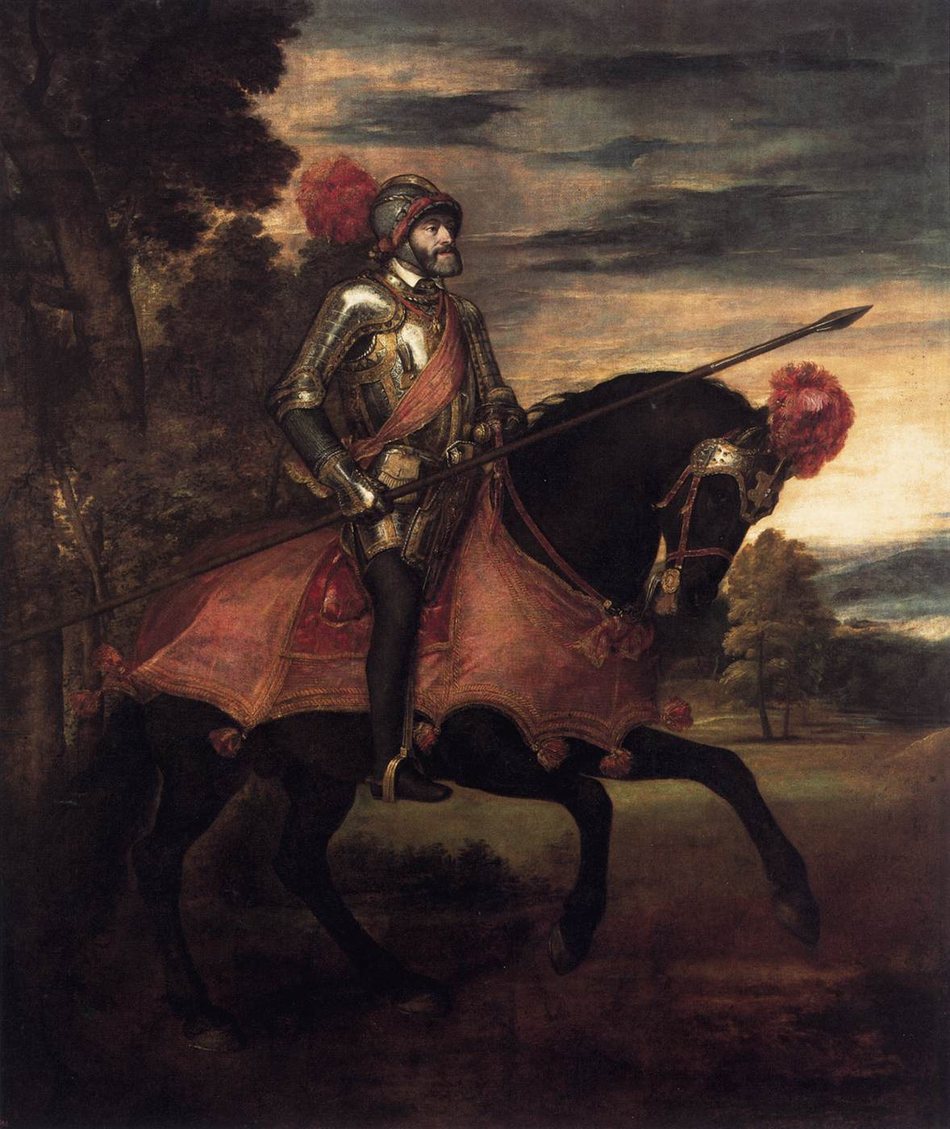
The emperor rides out of a dawn wood in parade armour, alone, quiet, absolute — the most famous equestrian portrait ever painted, and the least triumphant: victory rendered as stillness. Every royal portrait on horseback since is a footnote to this one.
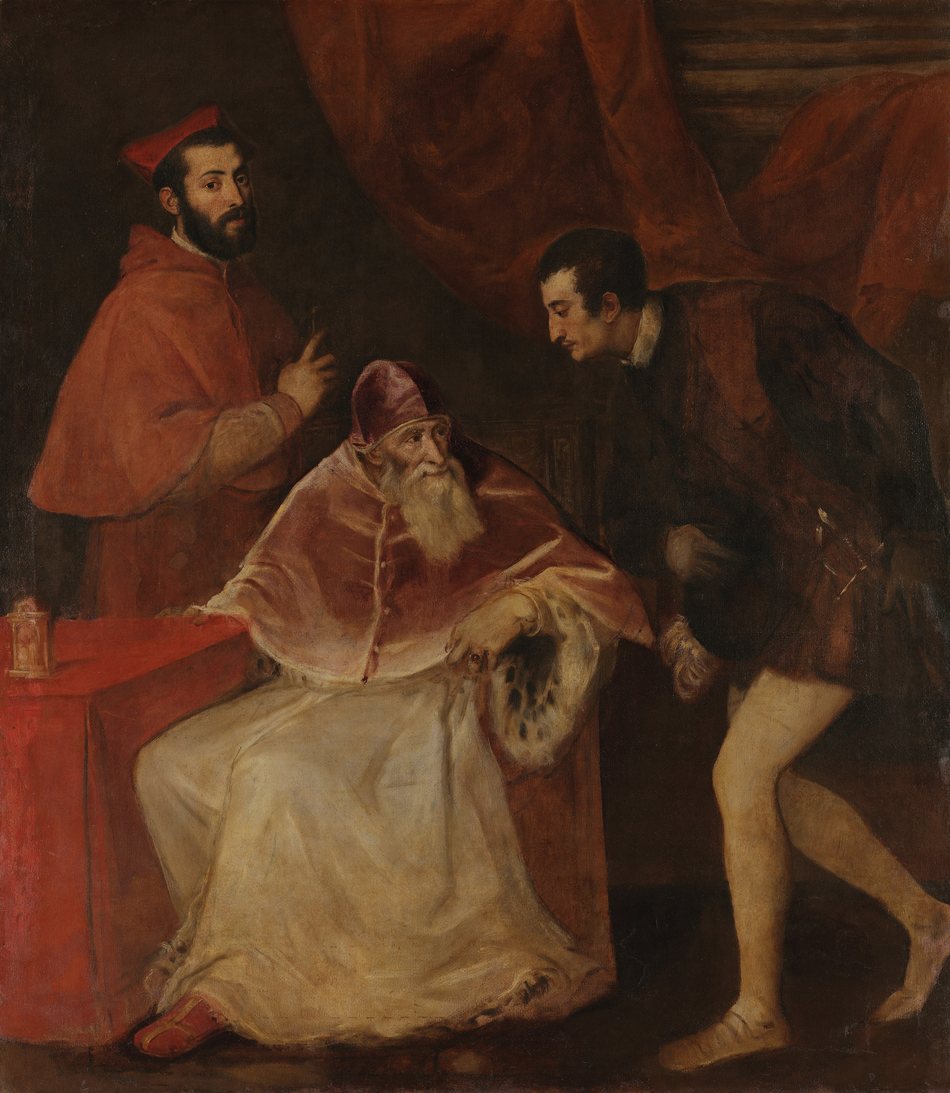
The old pope hunches forward, one grandson bows with a courtier's smile, the other stands stiff as a soldier — a whole court of ambition in three figures and a red curtain. The pope, displeased or merely tired, never had it finished; the canvas keeps its sketchy passages like an open file.
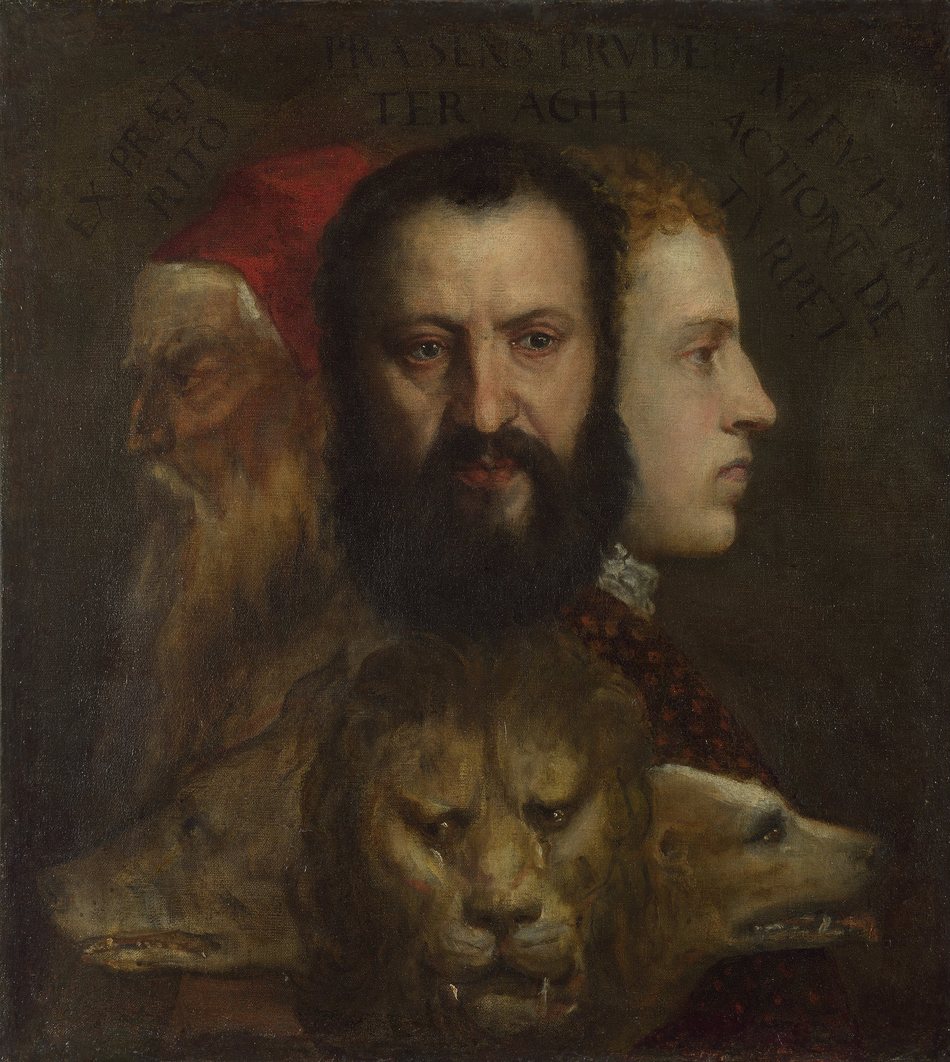
Three heads — an old man, Titian himself, a youth — over a wolf, a lion and a dog: past, present and future governing one another, with a Latin motto above: 'From the past, the present acts prudently, lest it spoil future action.' His own face is the present, looking straight out at us.
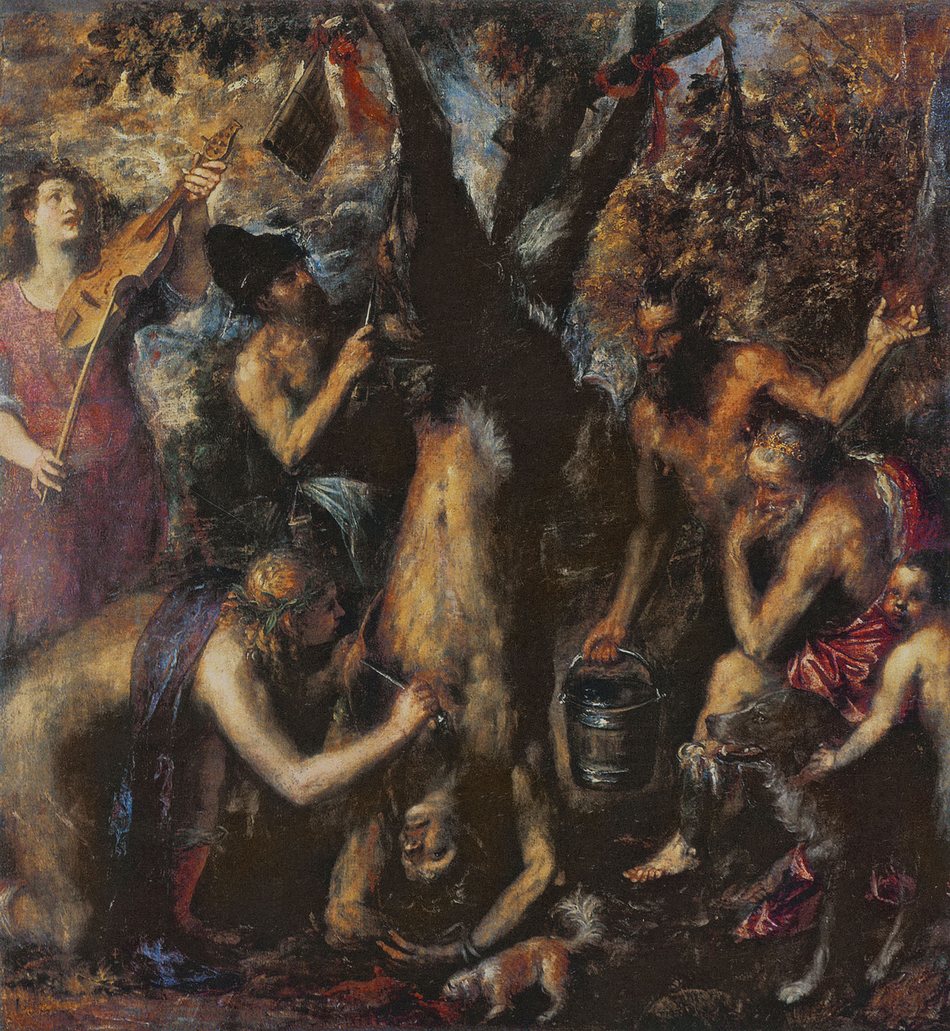
His last painting, and the most terrible: Marsyas hangs upside down like a carcass while Apollo works with a knife, a little dog lapping the blood, King Midas — with Titian's own features, some say — watching in gloom. Painted in his late eighties, in paint like embers. He signed it, poignantly, 'Titianus f.' — Titian made this.