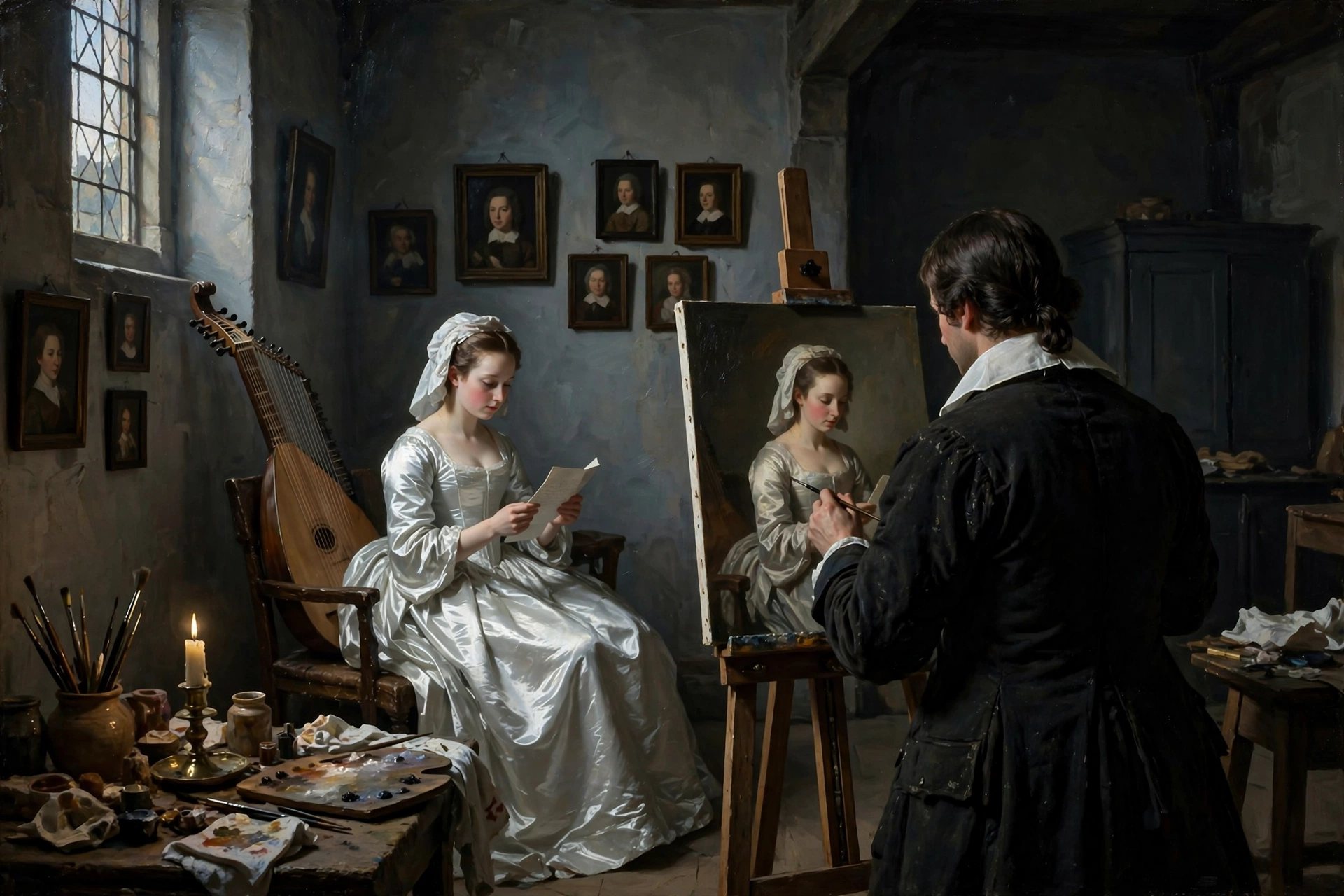
He painted the quietest pictures in Holland: a woman reading a letter, an officer dictating one, a suitor standing with his hat in his hand — and in the middle of the quiet, a dress of white satin that took the whole art of painting to render. Ter Borch came from Zwolle, drew the peacemakers of Europe at Münster when he was thirty, and spent the rest of his life in Deventer, making small canvases in which almost nothing happens and everything is felt.
White satin is the hardest test in painting: a fabric that is nowhere white, built entirely of reflections. Ter Borch lays it over a cool grey undermodelling, then works the folds in half-tones — blue-grey in the shadows, warm cream where the window strikes, edges lost and found again. In The Father's Admonition one dress carries the whole picture, and three centuries of painters have studied it like a textbook.
He worked small — panels and canvases you could carry under one arm — with fine sable brushes and an enamel-smooth finish. The discipline came from home: his father, Gerard the Elder, was a draughtsman of fanatical neatness who kept the children's drawings in albums. The family archive survives; you can watch the boy's hand being trained page by page.
In 1646 Ter Borch travelled to Münster, where Europe was negotiating the peace that would end the Thirty Years' War. He drew the envoys in dozens of small portraits on copper and, in 1648, painted the swearing of the oath itself — scores of identifiable men in a panel you can cover with two hands. It is a history painting painted from life, by the only great artist who was actually in the room.
His interiors are built like stage boxes: one high window at the left, a curtain drawn across the top, a tiled or boarded floor running back to a plain wall. Into this emptiness he sets two or three figures like chess pieces — and leaves the foreground vacant, so the viewer steps into the room before the actors notice. The drama is all in the spacing.
Letters run through his work like a pulse: read in silence, written at a table, dictated by an officer to a waiting clerk. The letter is a machine for painting attention — a face bent over paper, a listener, a pause in the day. What the letter says is never shown. Ter Borch paints the reading, and leaves the words to us.
His most loved compositions exist in several autograph versions — The Father's Admonition in Amsterdam and in Berlin, the concerts and letter-readers repeated with variations for different buyers. The woman in the satin was often his half-sister Gesina, the family's own artist, who modelled for the letter-readers and kept the album in which the whole gifted family drew itself.
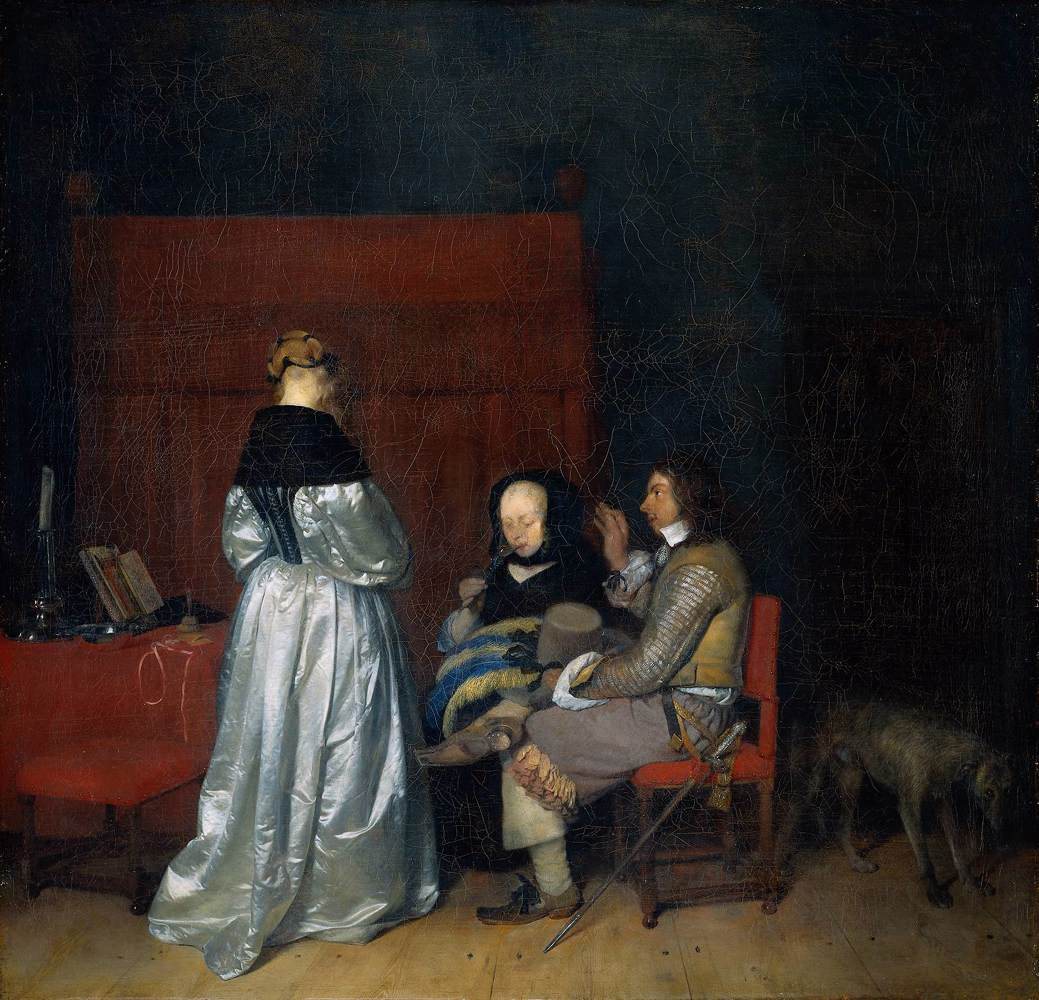
A young woman in white satin stands with her back to us, head bowed, while her father — so the old title says — admonishes her and her mother sits by with a glass of wine. Modern eyes see something less certain: a suitor's visit, a negotiation, a pause. What is certain is the dress, the most famous piece of satin in Dutch painting.
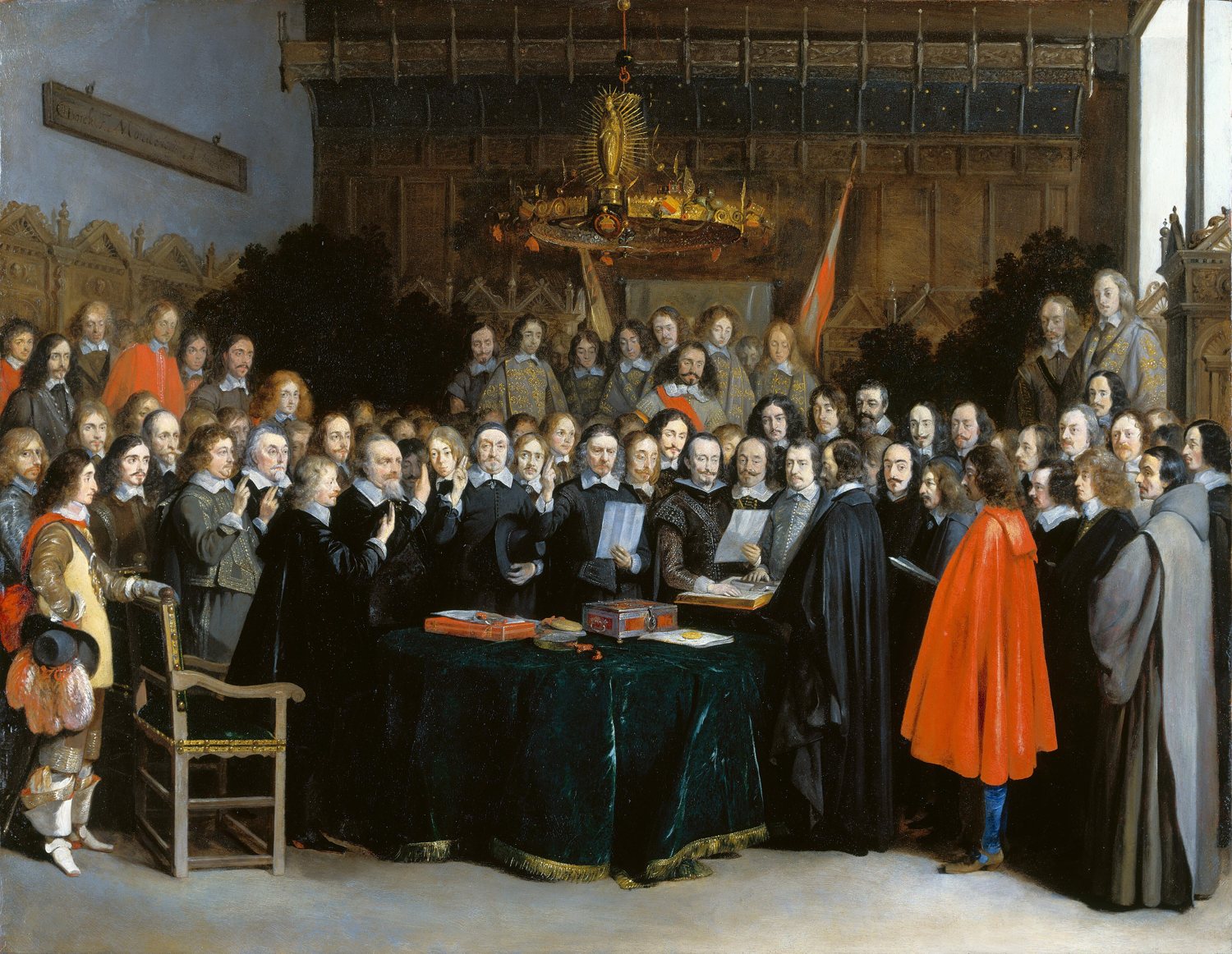
On 15 May 1648, in the council chamber at Münster, the Spanish and Dutch envoys swore the peace that ended eighty years of war — and Ter Borch, thirty years old and present on the spot, painted them all, some seventy identifiable men on a copper plate smaller than a sheet of paper. The Dutch stand with raised hands; the Spanish, graver, swear on the cross.
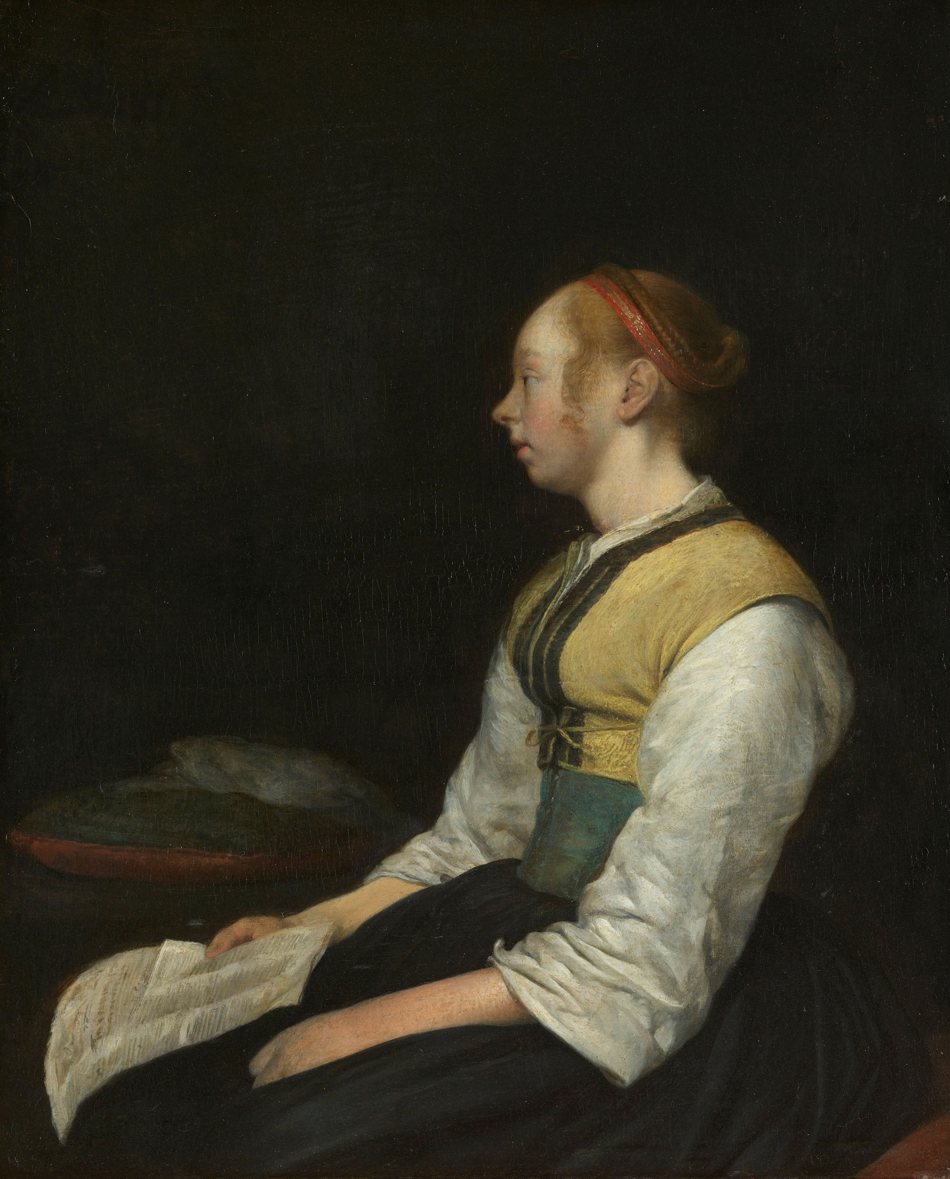
A serving girl sits sideways on her chair, apron over her dress, reading a letter with her whole attention. Nobody poses in Ter Borch; people are caught. The dark behind her is not emptiness but a held breath — the whole picture is the small distance between her eyes and the page.
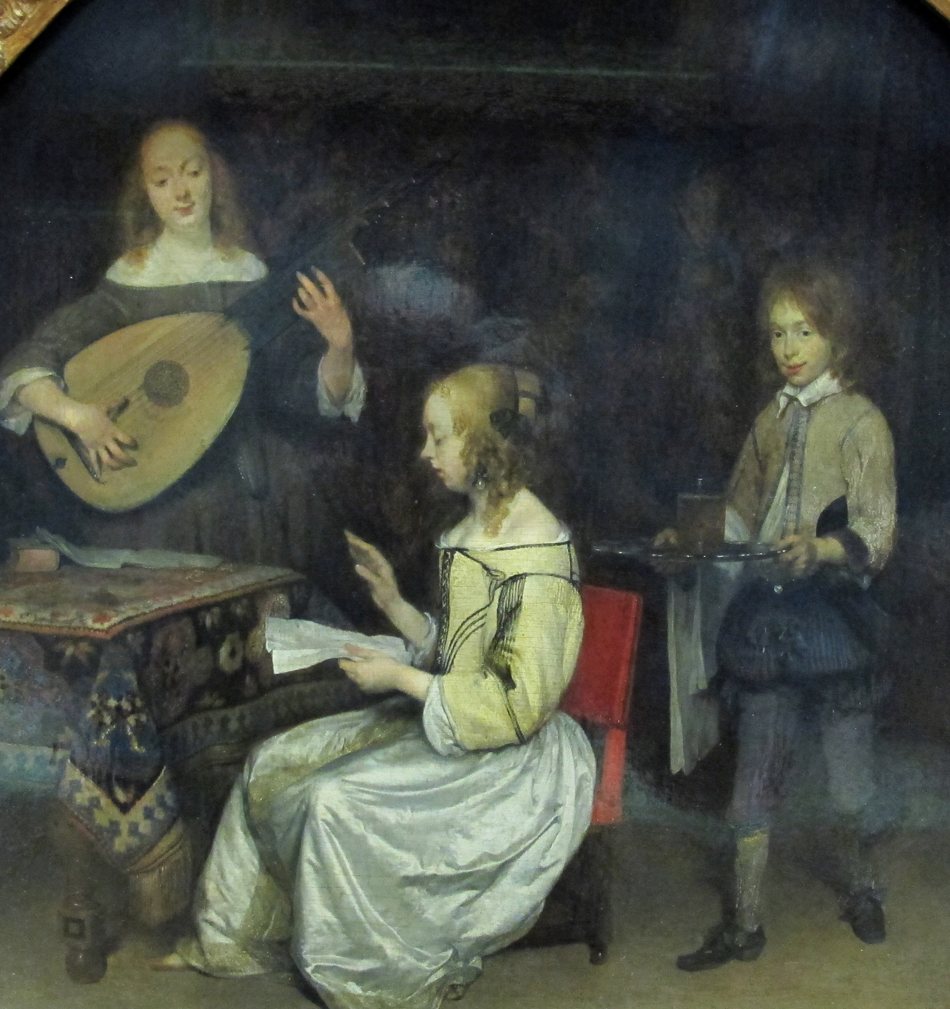
A woman sings from a sheet, another plays the lute, a boy with a violin waits for his entry: a family concert in a dark room, painted under an arched top like a chapel of music. Ter Borch, whose own family made music together all their lives, paints the moment just before the sound.
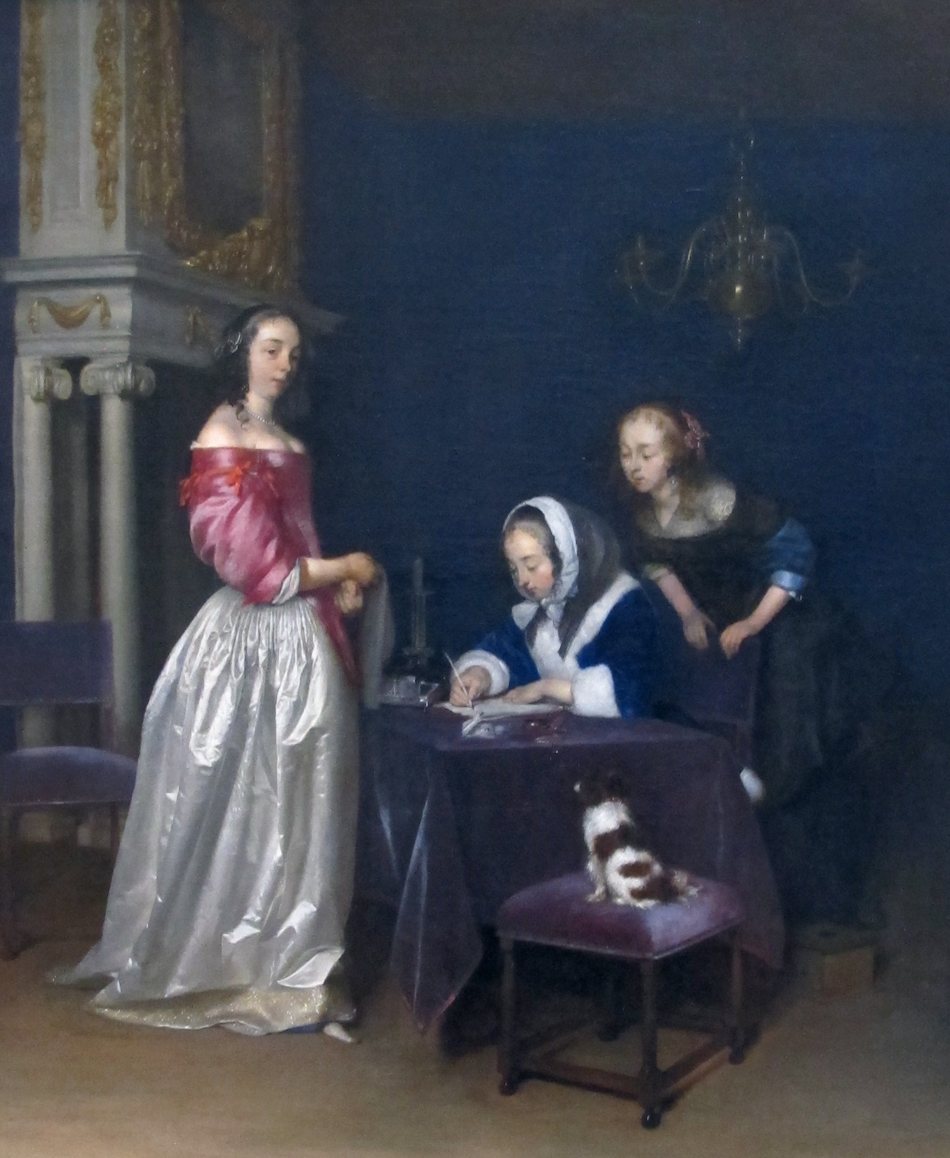
Three women of three ages around a table: the youngest standing in rose and silver satin, an older woman bent over a letter, a third looking on — and a little dog on the stool, the only one who looks at us. Whatever news the letter holds, the picture holds longer: it is curiosity itself, arranged by generations.
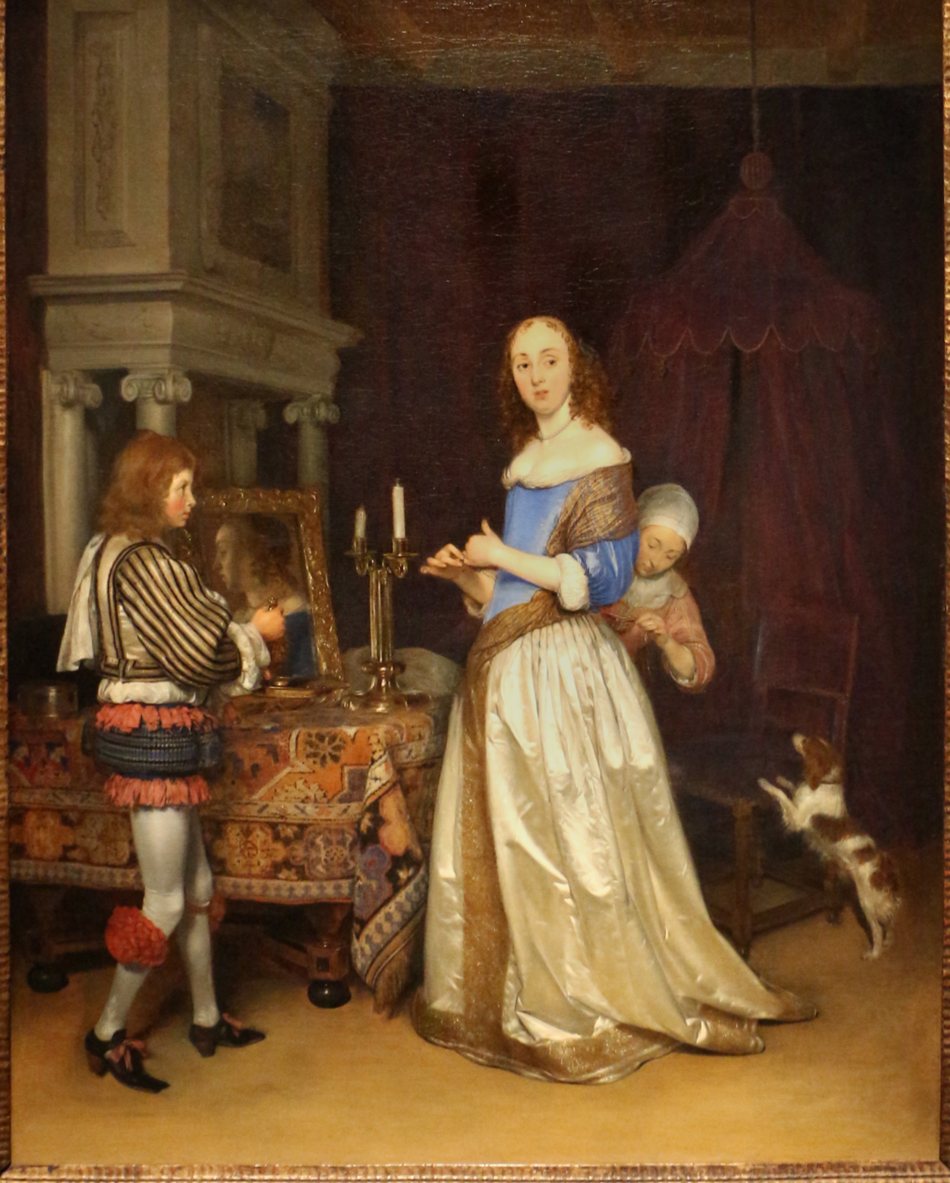
A lady stands at her dressing table in a blue bodice and a skirt of pale satin, a page lighting the candles, a child peeping from behind her, a dog dancing at her feet. The toilet was the theatre of a seventeenth-century morning, and Ter Borch paints its ceremony with a straight face and a jeweller's hand.
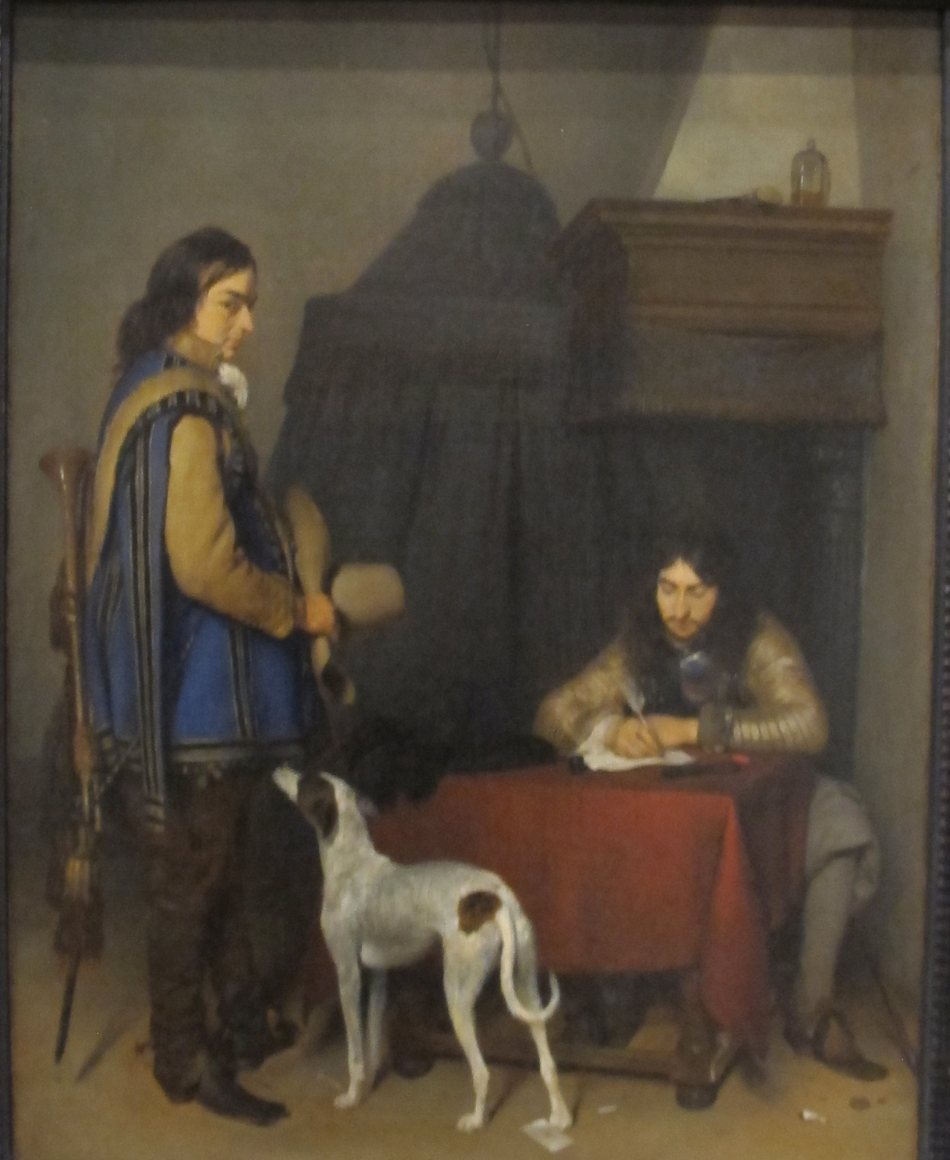
In a guardroom, an officer sits writing at a table covered in red, his trumpeter standing by with the instrument of announcements at his hip, a dog waiting between them. War, in Ter Borch, is mostly this: paperwork, waiting, and a man choosing his words while the campaign holds its breath outside the door.
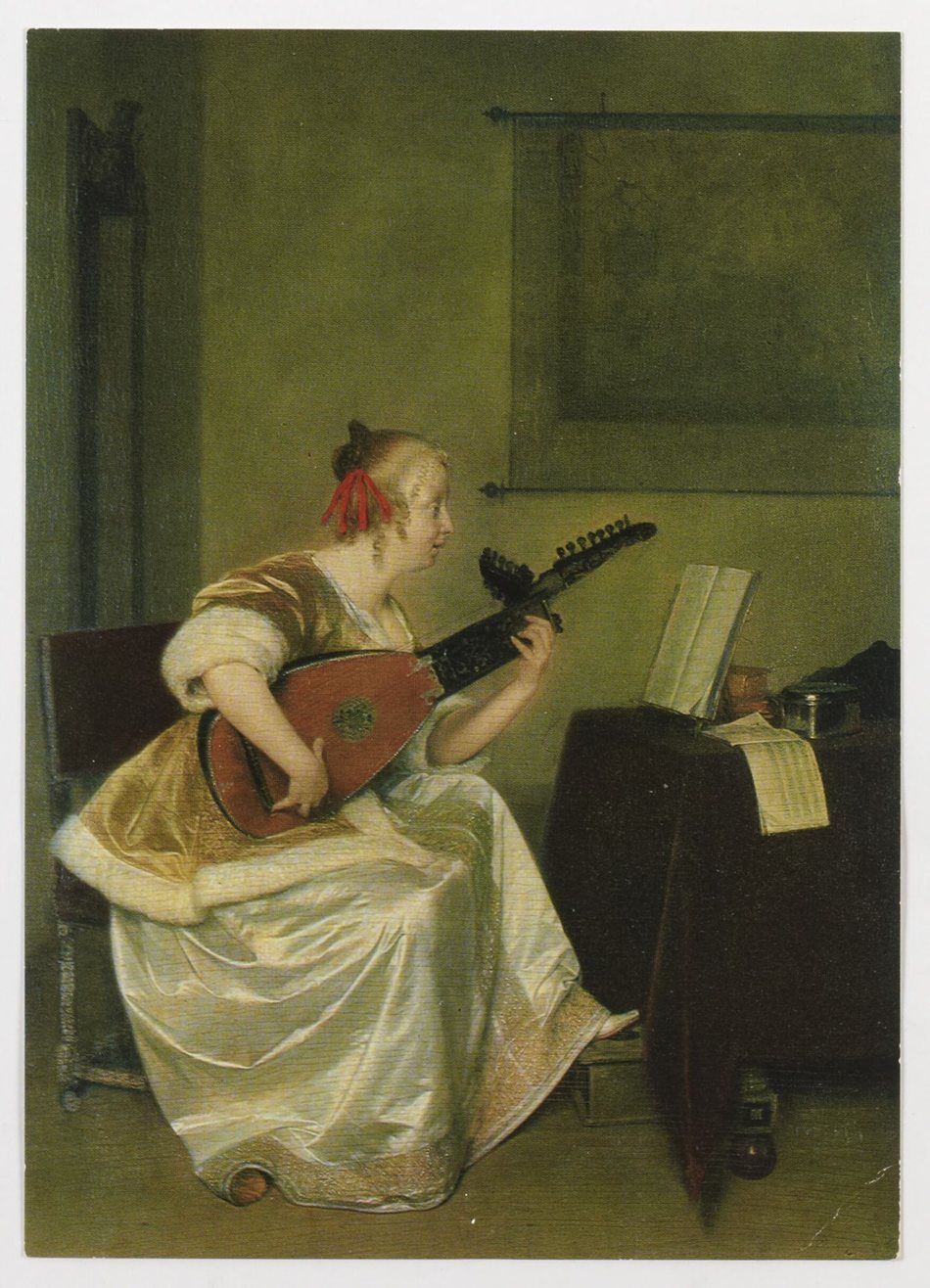
A woman in white satin, alone with a great theorbo, her music on the stand, her face turned half away. It is the satin again — but quieter than in the Admonition, a single figure in a grey room, and the picture hums at the pitch of a string about to be plucked.
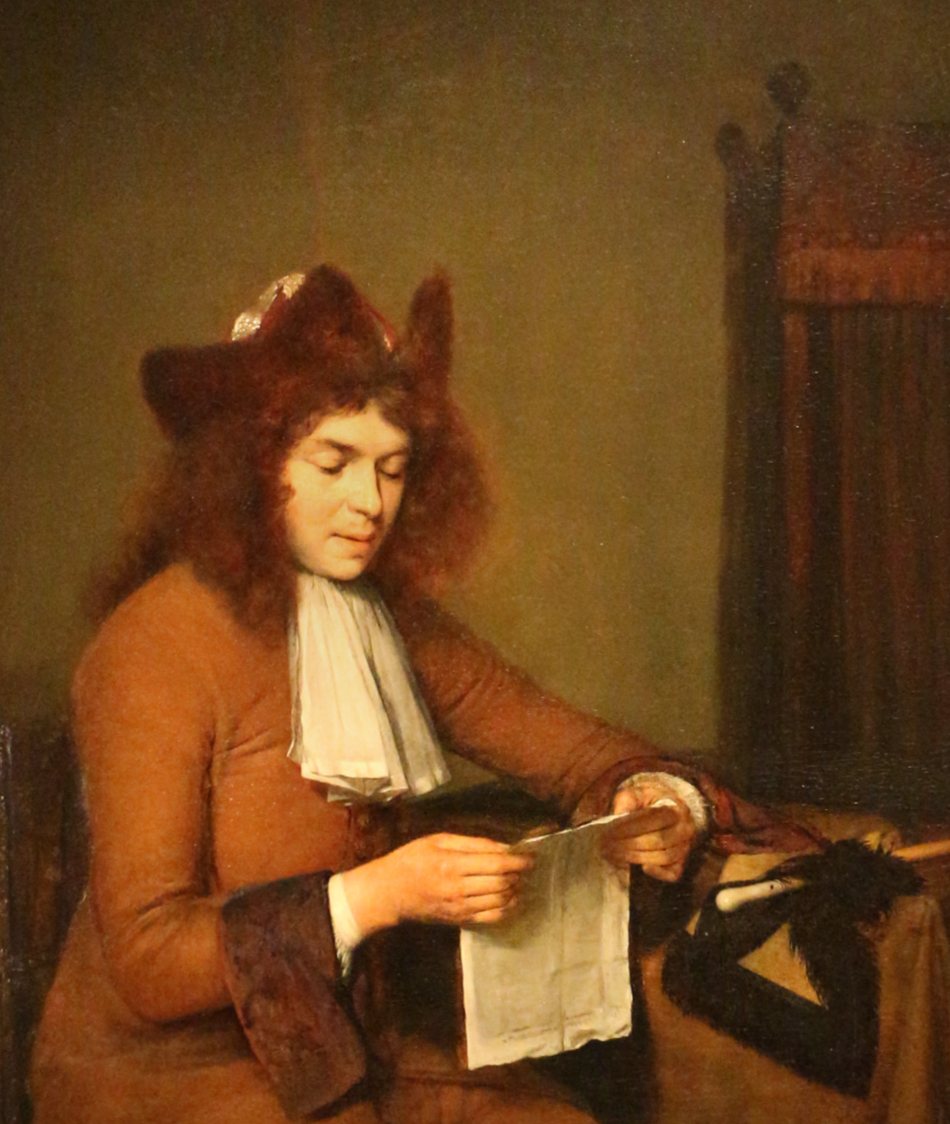
One of the last pictures: a young officer in a russet coat and a plumed hat, reading a letter by plain daylight, his sword-belt in his other hand. Ter Borch was over sixty and the brush had lost nothing — the face is all concentration, the letter all consequence, and the room keeps its counsel as it always did.
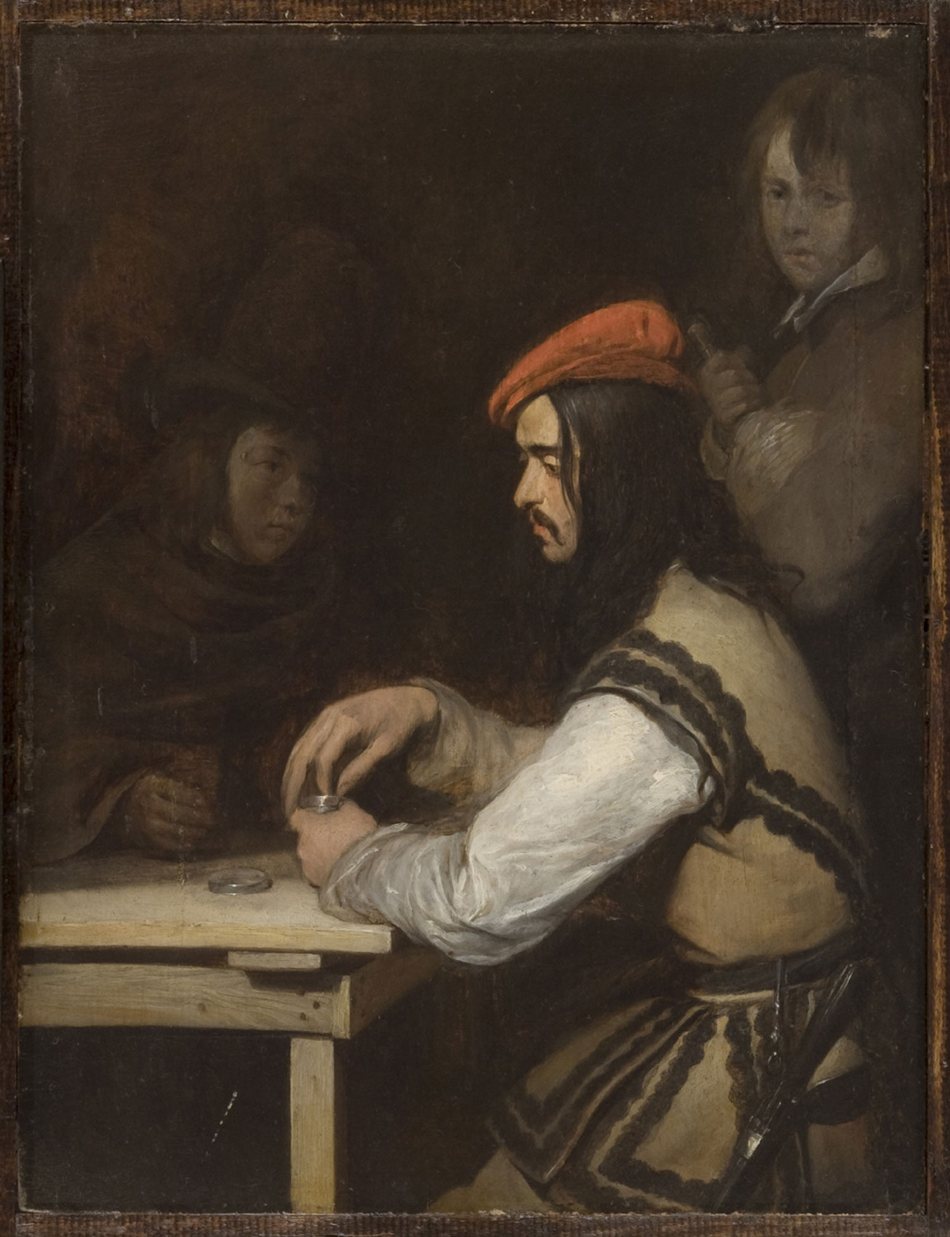
The young Ter Borch, before the satin: a card-player in a red cap leans over the table in a smoky inn, his companions looming out of the brown dark. He learned these rooms from the Haarlem guardroom painters, and spent the rest of his life trading their noise for his silence — but the eye for a face in half-light is already here.