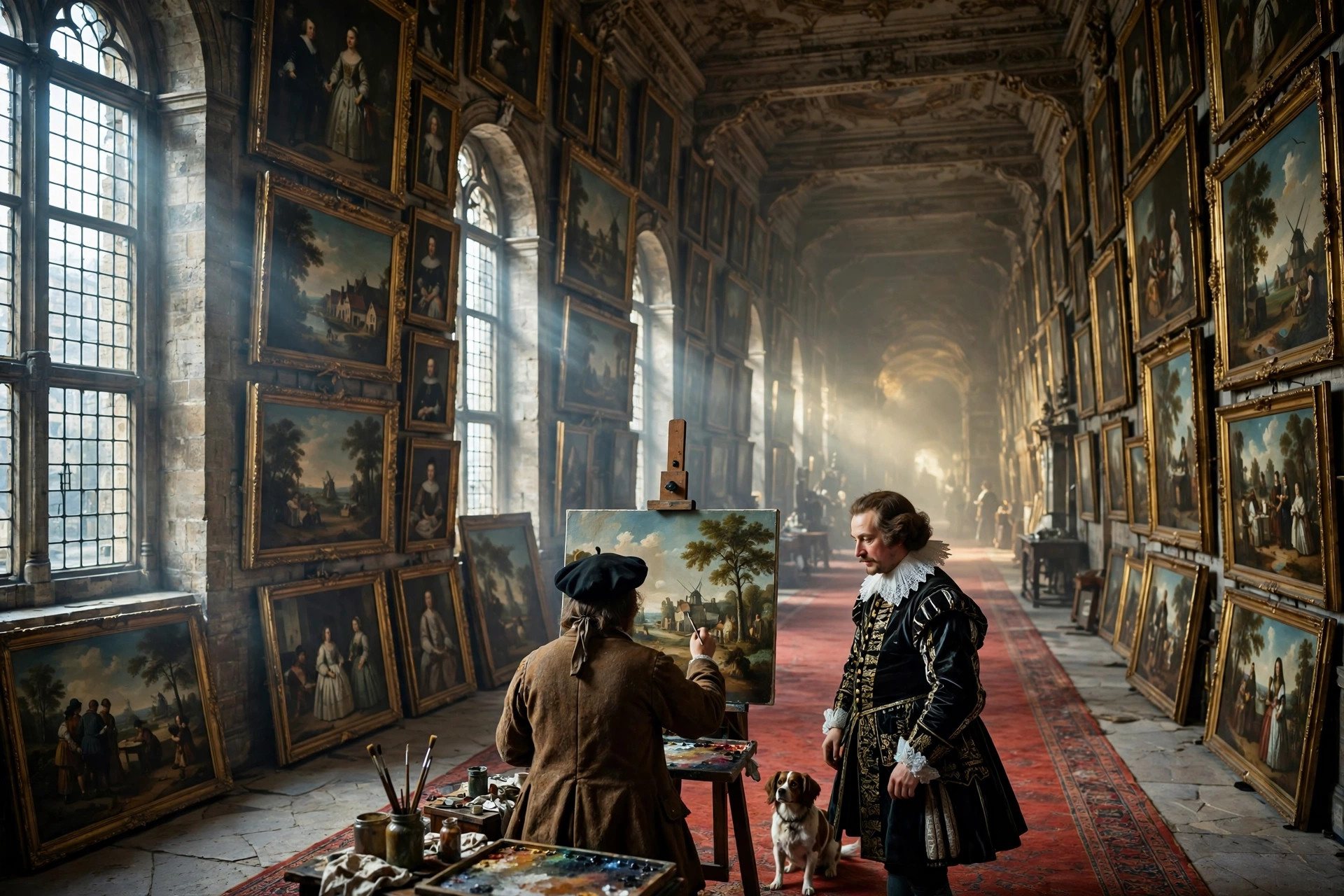
Two painters in one skin: at court in Brussels he catalogued the Archduke's Raphaels and Titians in miniature; at home in Antwerp he painted peasants dancing, drinking and bowling outside every inn in Flanders. Over two thousand pictures came off his easel — galleries, kermesses, alchemists, guardrooms, and monkeys doing all of it again in fur.
As keeper of Archduke Leopold Wilhelm's collection, Teniers painted hundreds of small oil copies of its Italian masterpieces — Titian, Giorgione, Veronese — as models for engravers. The engravings were published in 1660 as the Theatrum Pictorium, the first printed, illustrated catalogue of a great collection. Before photography, this is how Europe learned what the pictures in Brussels looked like.
His gallery pictures show the Archduke among his treasures, walls tiled with real, recognisable paintings — each one a miniature Teniers copy of a Titian or a Raphael, brushwork scaled down but never simplified. A single gallery piece could hold fifty pictures-within-the-picture, a whole collection carried in one panel.
Teniers was famously fast: a feathery, loaded brush, figures struck in with a few strokes, whole kermesses assembled from a stock of studied poses. The speed was a business model — his peasants hung in every great house in Europe, and his workshop, sons and followers multiplied them further. Counting workshop and copies, the name Teniers covers thousands of panels.
The early taverns are painted in the brown-grey tonal manner of Brouwer; the pictures of the 1640s turn silvery and pearly, the light like a Flemish morning; the late work opens into clear, bright colour under blue skies. Watch the skies across this room and you can date the pictures by their weather.
The singeries — monkeys shaving cats, cooking, smoking, playing cards — were satire with a straight face: every human folly of the tavern and the barber's shop, performed in fur with perfect gravity. Teniers painted them all his life; collectors who would not hang a peasant brawl hung the same brawl in monkeys, and laughed at themselves without knowing it.
He married Jan Brueghel the Elder's daughter, bought a country house, founded the Antwerp Academy in 1663, and served two governors of the Spanish Netherlands as court painter and curator. The peasant scenes that made him rich were painted by a man who dined with archdukes — perhaps that is why the peasants are never mocked: he painted the village from the manor, but with the manor's respect.
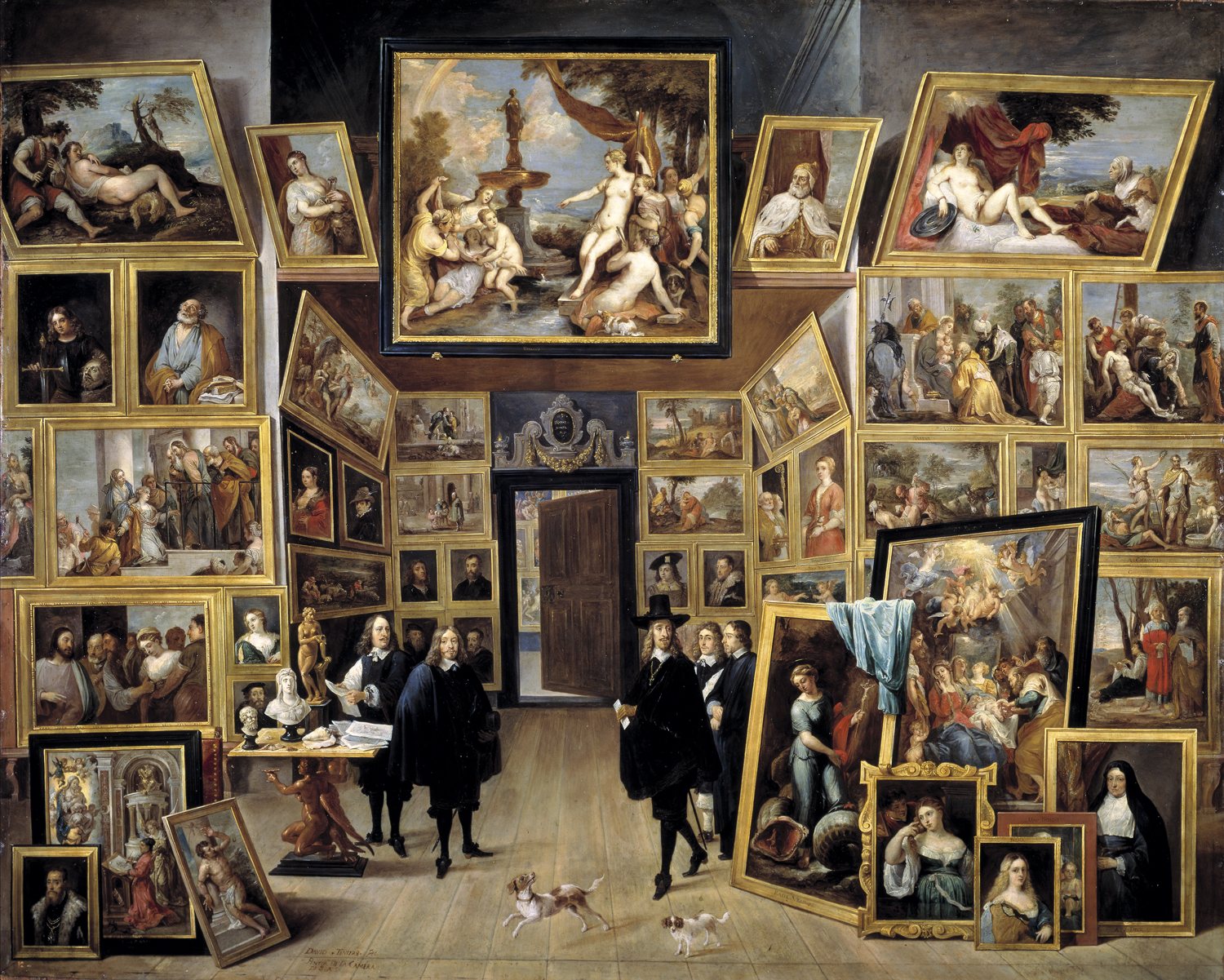
The most famous picture of a picture collection: Archduke Leopold Wilhelm, governor of the Spanish Netherlands, walks his Brussels gallery with Teniers himself in attendance, the walls tiled with Titians, Raphaels and Veroneses — every one identifiable, every one a miniature masterpiece of copying. Two small dogs trot between the frames. It is a catalogue you can walk into.
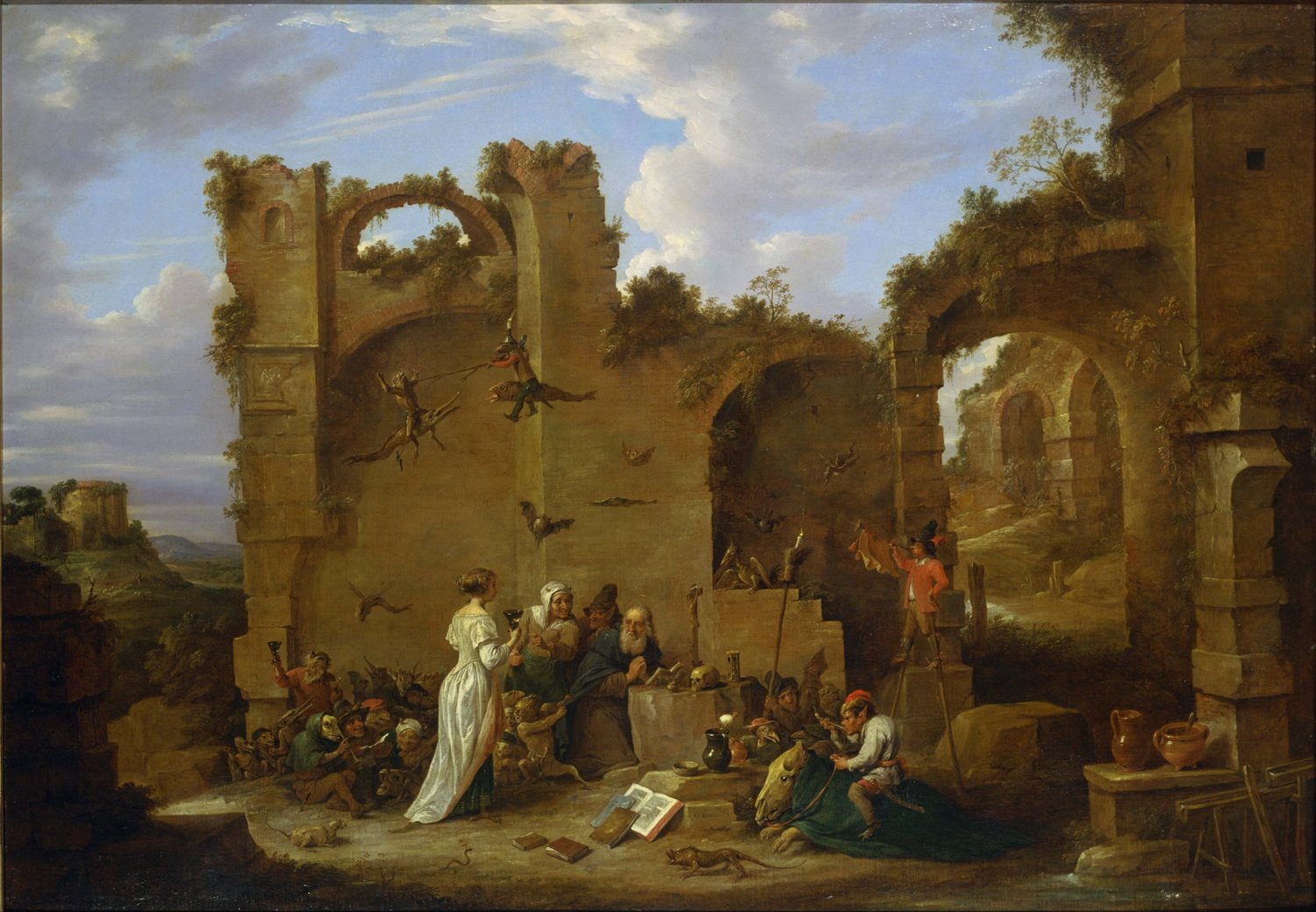
In a ruined abbey the old hermit reads on, while the temptation performs around him: a beautiful woman offering a goblet, demons riding through the air on dragons, imps in every arch. Teniers painted the subject dozens of times — it licensed everything he loved: ruins, monsters, peasants, and one still figure at the centre refusing to look up.
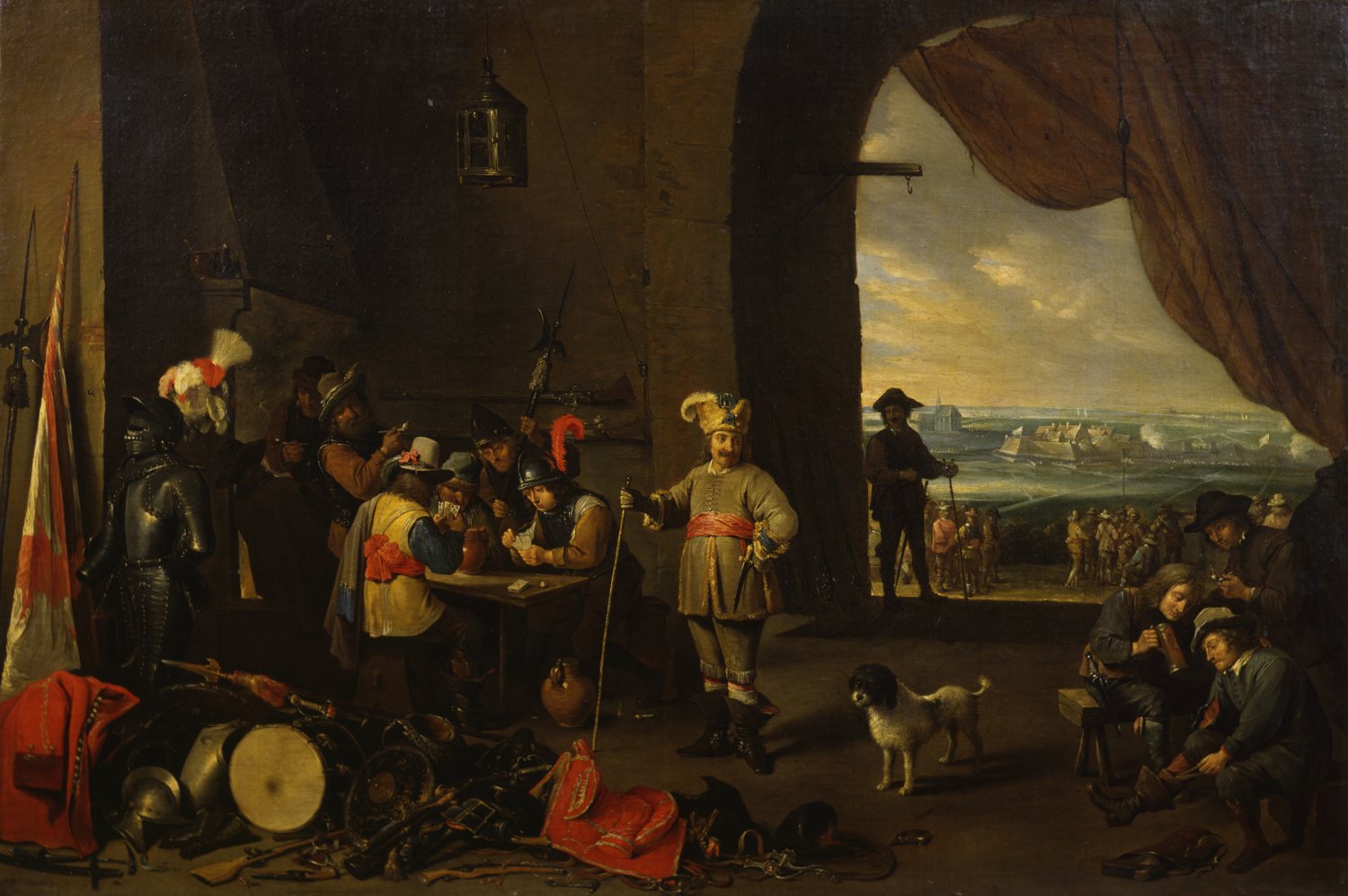
Soldiers off duty in a vaulted guardroom: cards and dice at the table, armour, drums and a banner heaped in the foreground like a still life of war, a dog asleep, and through the great arch a landscape with troops on the march. The guardroom was Teniers' peacetime answer to battle painting — war at rest, painted cushion by cushion.
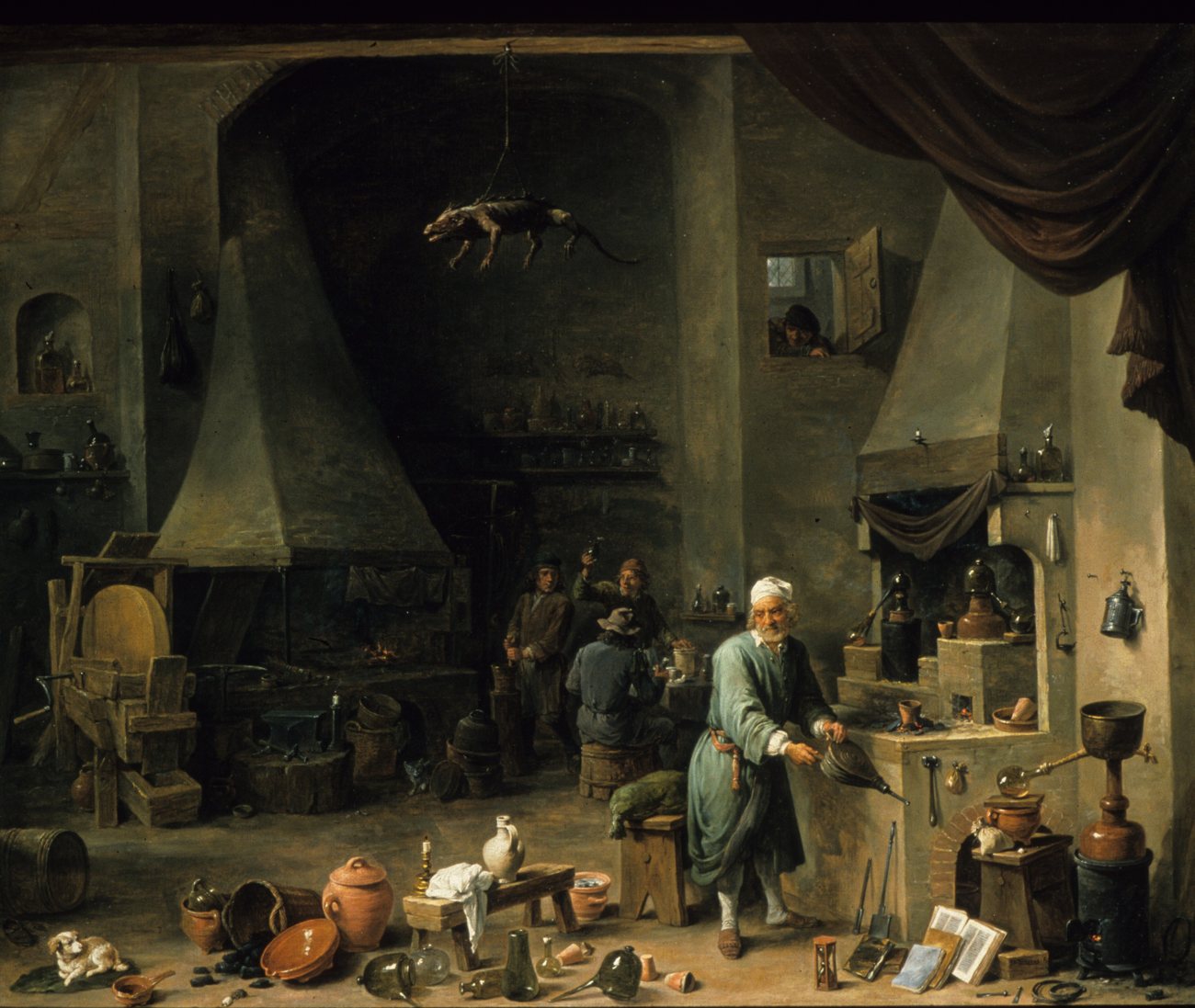
A great vaulted laboratory with two furnaces, assistants at the bellows, vessels on every surface and a crocodile hanging from the ceiling — the alchemist himself standing apart, watching a retort. Teniers painted alchemists as he painted peasants: without mockery, delighted by the clutter of a trade, every pot and pipe in its painted place.
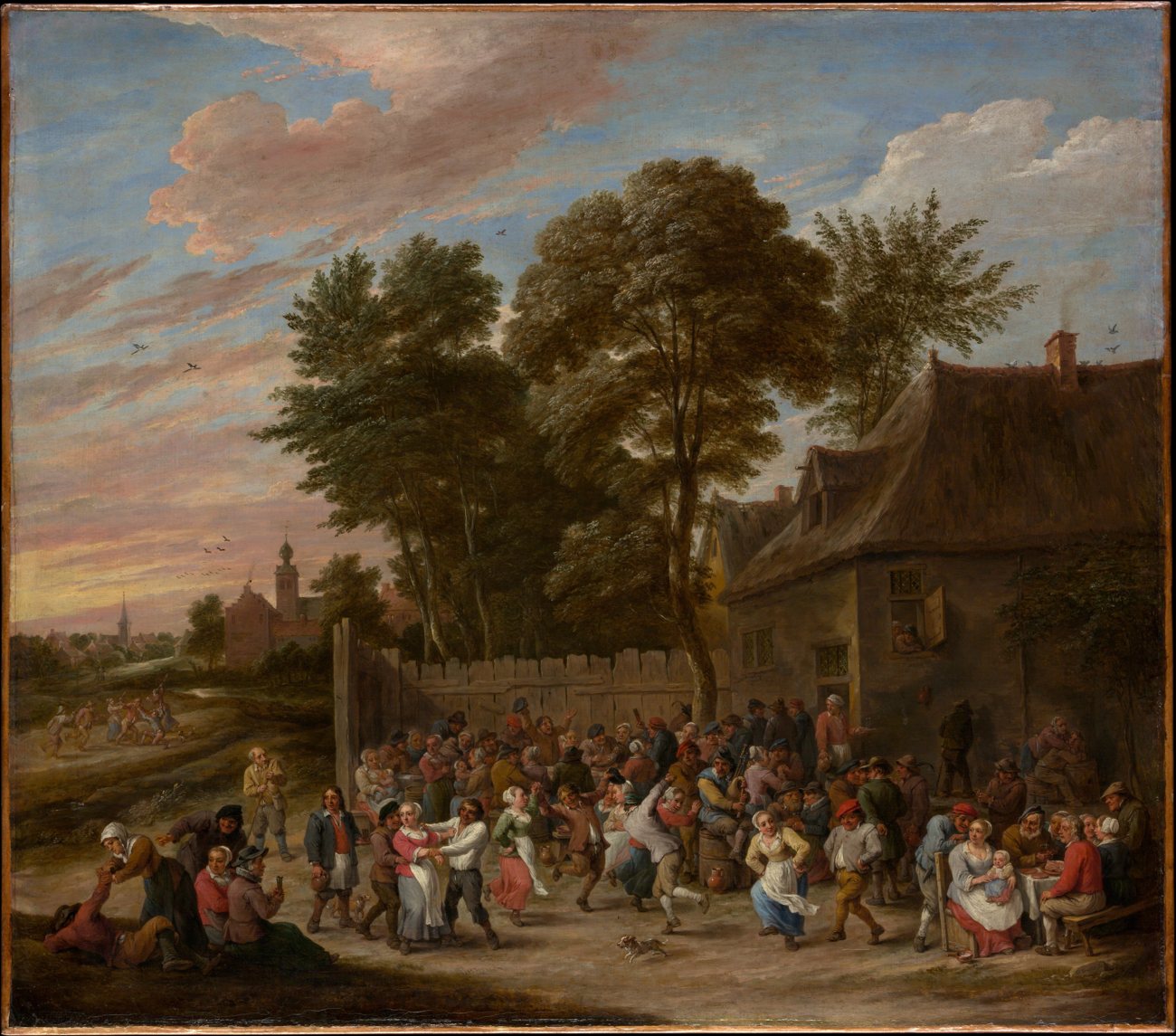
Evening at the village inn: a whole parish dancing, eating and drinking under a rose-streaked sky, the fiddler on his bench, couples turning in the yard. This is the kermesse in Teniers' silvery middle manner — fifty figures, none of them still, all of them placed like notes in a tune he could play by heart.
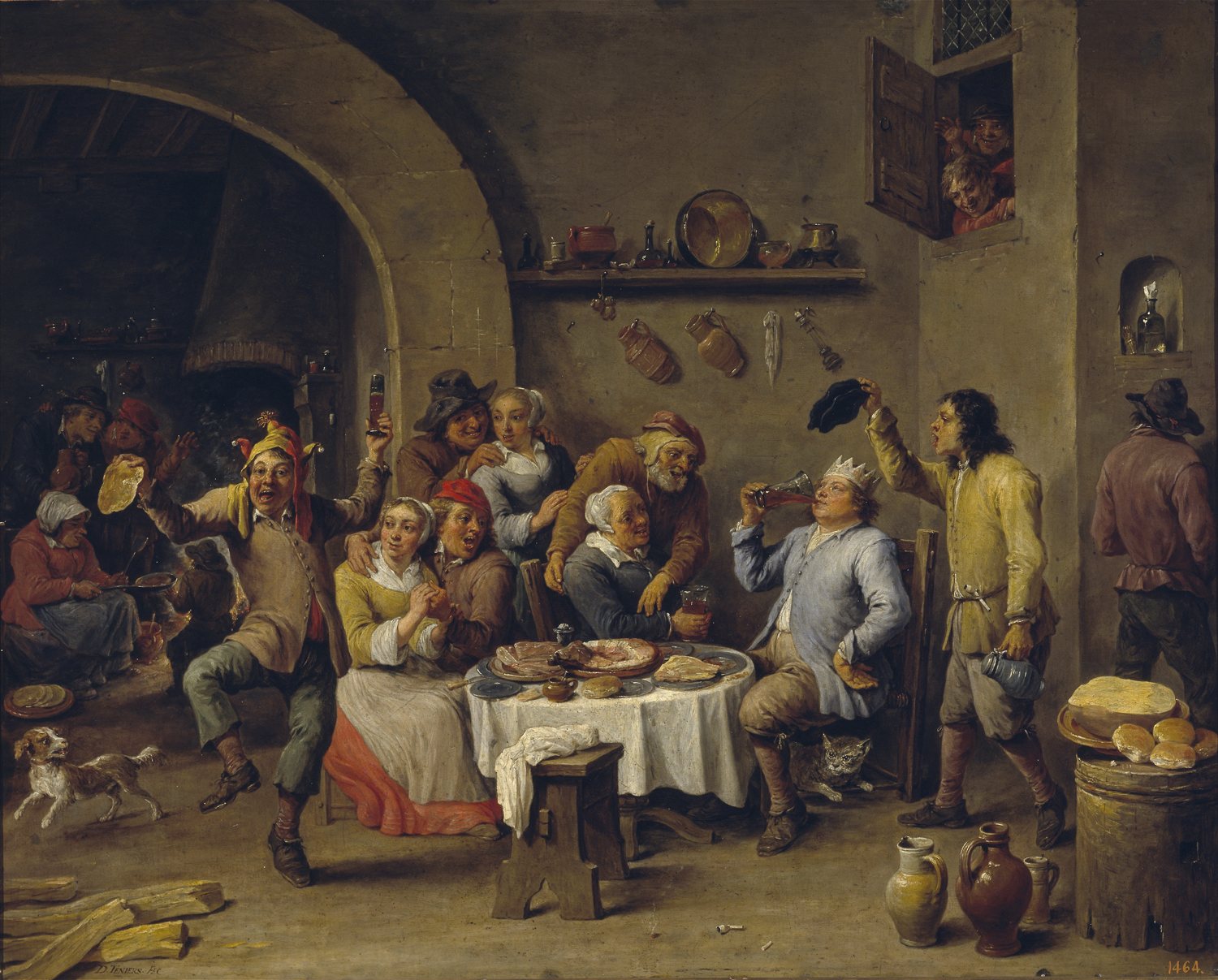
On Twelfth Night the bean-king of the feast, paper crown and all, raises his glass while the company roars the toast. A fool dances in with the pancakes, a dog steals the moment at the left. Teniers paints the loudest second of the Flemish year at the volume of a held breath.
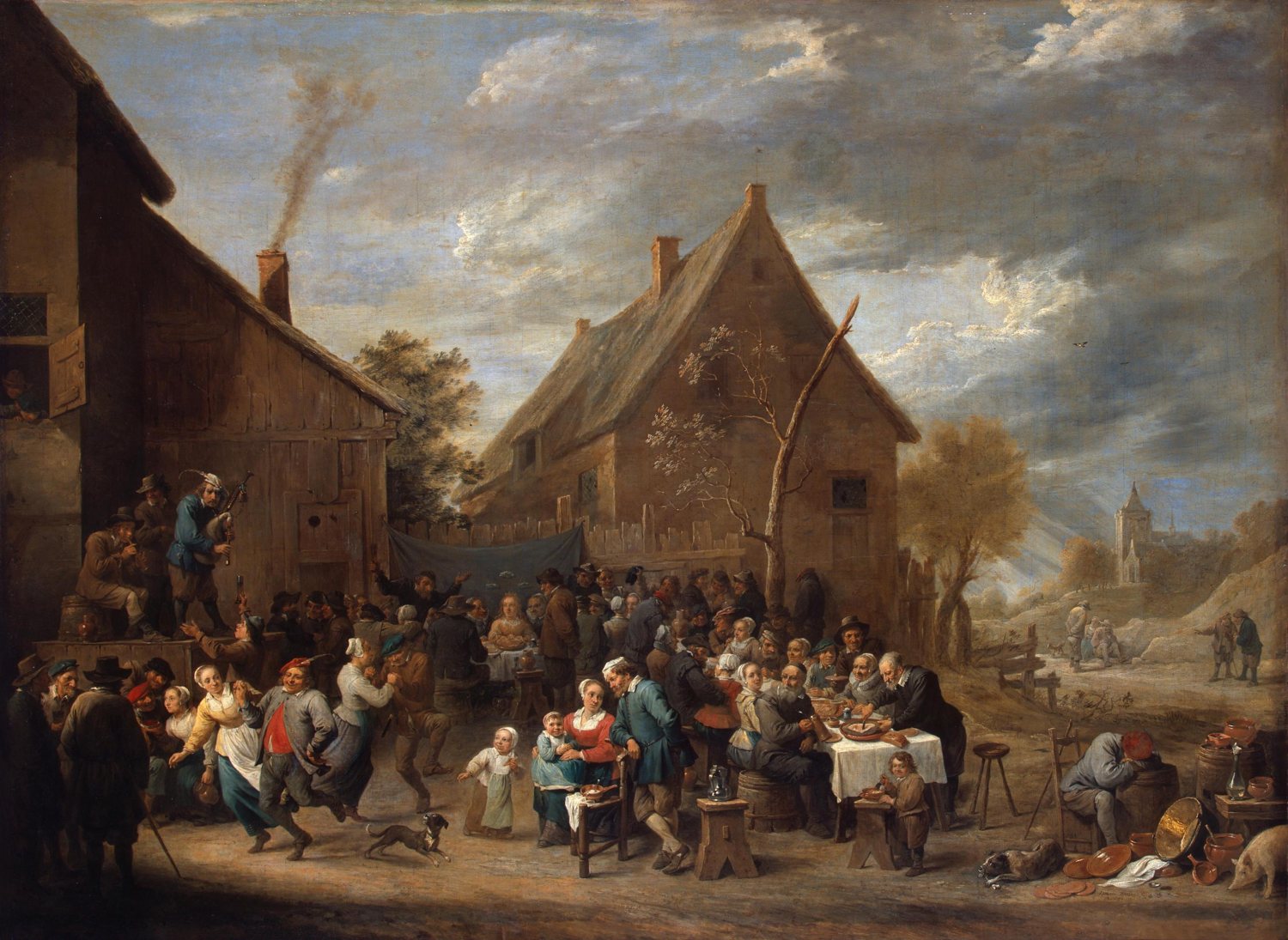
The wedding feast fills the farmyard: the bride at the table of honour, dancers already turning, children under everyone's feet, the whole village in its Sunday best under a working sky. Teniers painted weddings as he painted kermesses — as the village's portrait of itself on its happiest day, taken from a slight, affectionate distance.
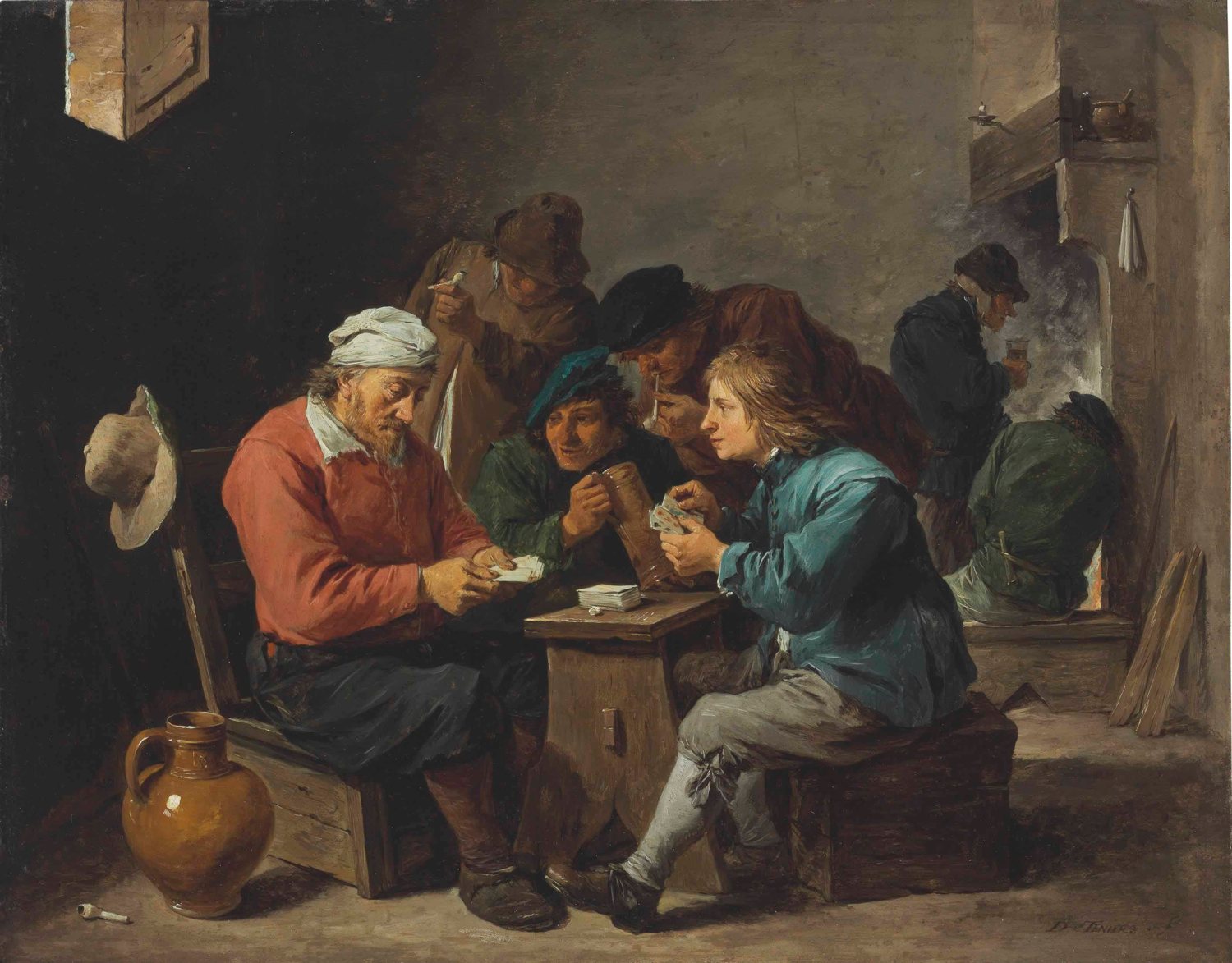
A tavern corner in close-up: an old player in a red jacket studies his hand while the table leans in — the smoker behind, the boy watching, the whole economy of the game written on four faces. Teniers' small interiors are his most concentrated work: a square foot of panel holding a complete short story.
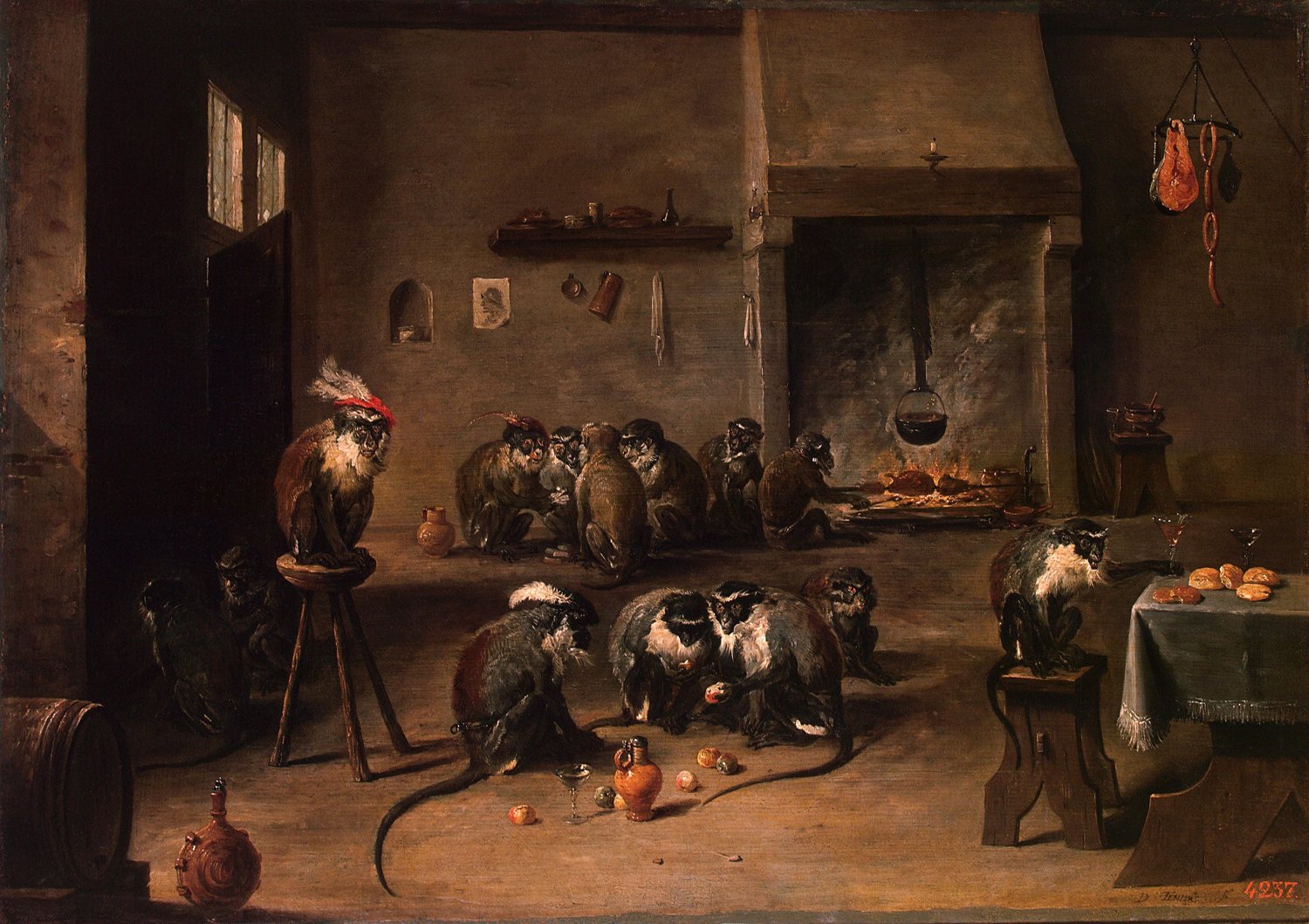
The singerie at its best: a kitchen full of monkeys in collars and sleeves, tending the fire, tasting from the pot, one seated in state on a stool like the master of the house. Every gesture is copied from the human tavern scenes — which is the joke, and the mirror. Teniers signs the satire with a perfectly straight face.
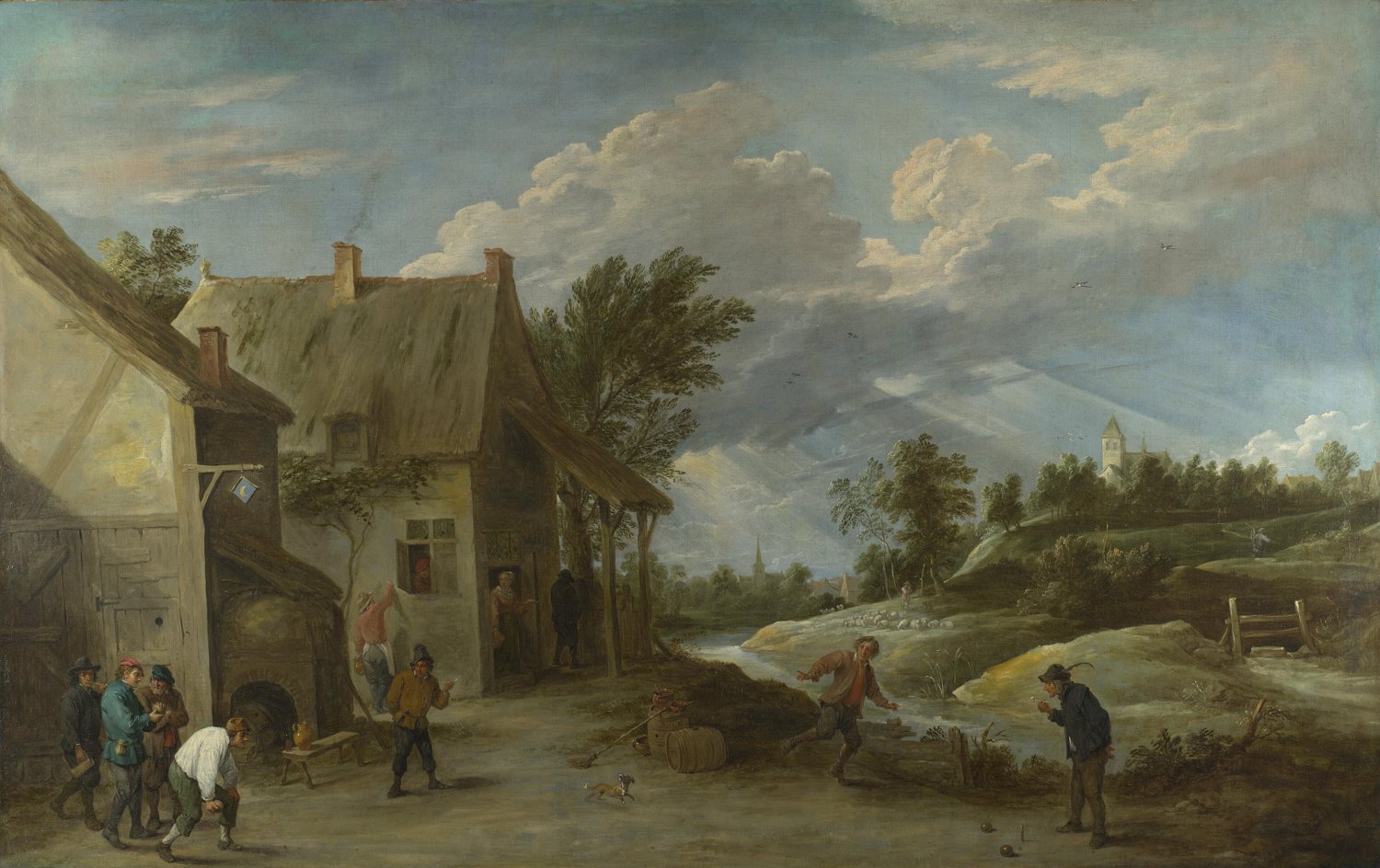
A game of bowls on the inn green, the bowler caught mid-delivery, his opponent measuring the lie of the wood, the inn and a river landscape opening behind. The outdoor scenes are Teniers' holiday pictures — the village at play, in daylight, with the horizon let in like fresh air.