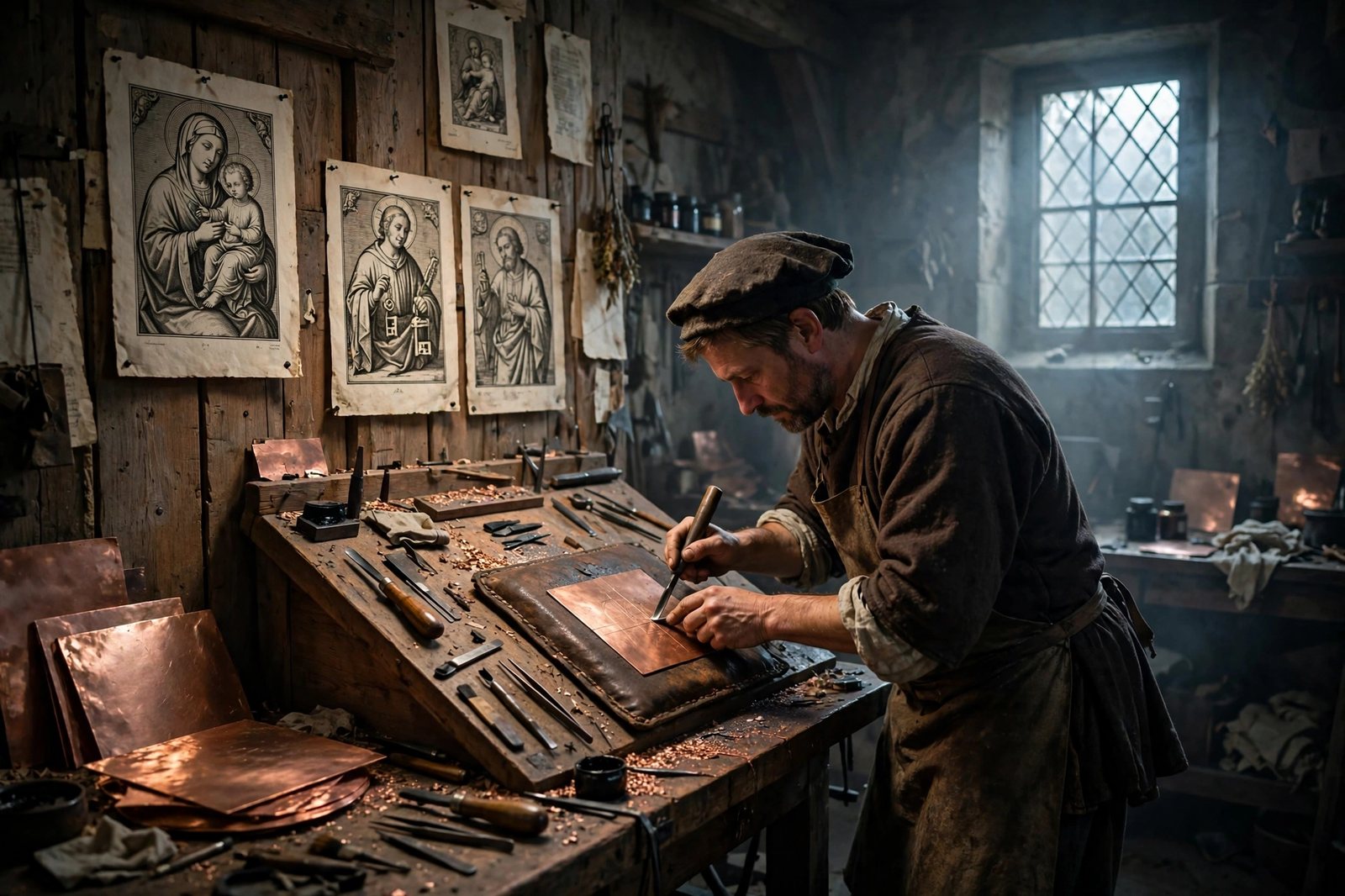
Before Dürer, there was Schongauer. A goldsmith's son from Colmar who cut copper the way his father cut gold, he turned the young art of engraving into the first European fame carried by paper: over a hundred signed plates, copied from Italy to Spain, studied by the boy Michelangelo, and mourned by Dürer, who travelled to meet him and arrived a year too late.
Engraving was born in the goldsmith's shop, where designs were cut into metal for niello and ornament, and Schongauer's father Caspar ran such a shop in Colmar. The son's advantage was a childhood at the bench: when he turned the burin from gold plate to copper printing plate, he brought a jeweller's control that no painter-engraver of his generation could match.
His burin stroke swells as it cuts and tapers as the tool is lifted and turned — a single line that can thicken into shadow and vanish into light. With it he built a complete modelling system: parallel hatching for half-tones, cross-hatching for depth, stippled flicks for texture, all as disciplined as handwriting. This grammar of the burin is the one Dürer inherited and the one printmaking used for three centuries.
Schongauer signed his plates with a consistent monogram — M+S — among the first printmakers to do so systematically. The mark turned anonymous impressions into authored works: collectors across Europe asked for 'the beautiful Martin' ('Hübsch Martin', as the Germans called him — schongauer means 'beautiful to look at') by name. Over 115 of his plates survive, every one a small, signed world.
His workshop issued impressions in quantity, and his brothers — goldsmiths and painters themselves — helped carry the prints across Europe: to the Netherlands, Italy, Spain, France. Copies after his plates multiplied the reach further, some flattering, some pirated. It was the first distribution network of images in European art, and its hub was a workshop in Colmar.
Silverpoint and brush studies precede the plates: heads, hands, drapery systems worried fold by fold until they could be translated into hatchings. His compositions are built like goldsmith relief — every form closed, every surface accounted for — which is why the engravings hold together at any scale, from a saint two inches high to the largest plate of the century.
Few panels survive, but the Madonna of the Rose Bower shows the painter equal to the engraver: oil glazes over an underdrawing as exact as a plate, drapery folded with hatched logic, goldfinches and roses observed like specimens. Dürer, arriving in Colmar in 1492 to study with him, found him a year dead — and was given his drawings by his brother, the closest thing to the apprenticeship that never happened.
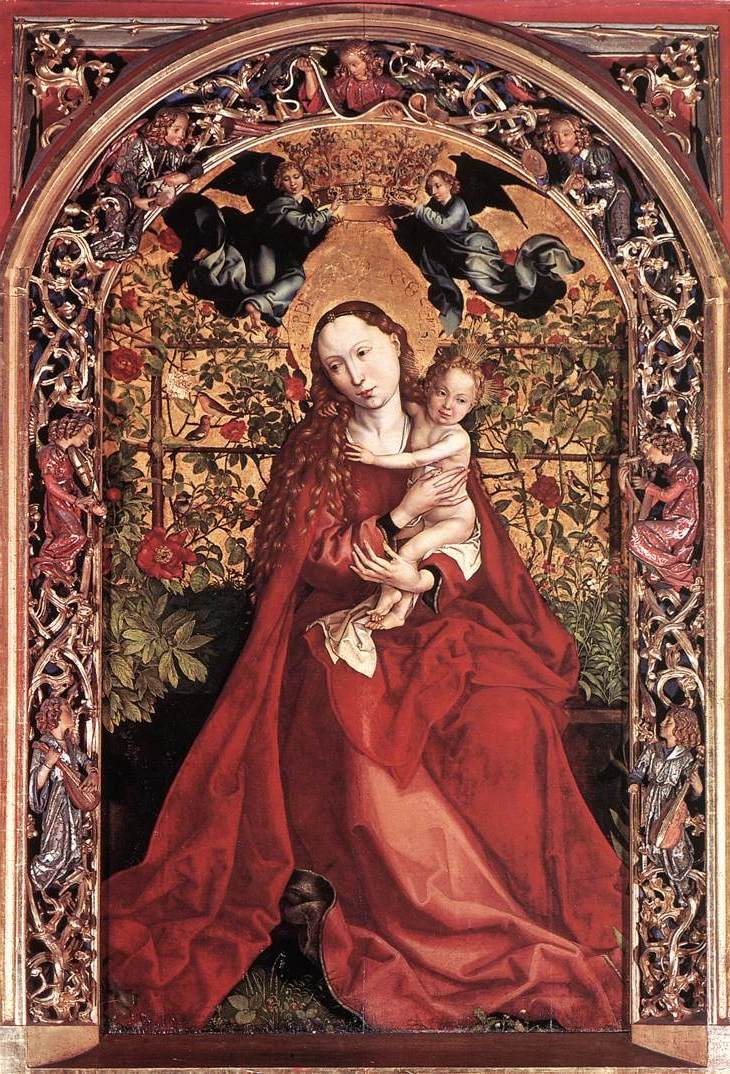
Mary sits in a garden before a trellis of red roses, two angels holding a great crown above her, goldfinches picking among the leaves — the largest German panel painting of its time, signed and dated 1473. Every petal and feather is described with an engraver's patience, yet the whole breathes: the painter and the printmaker are one hand.
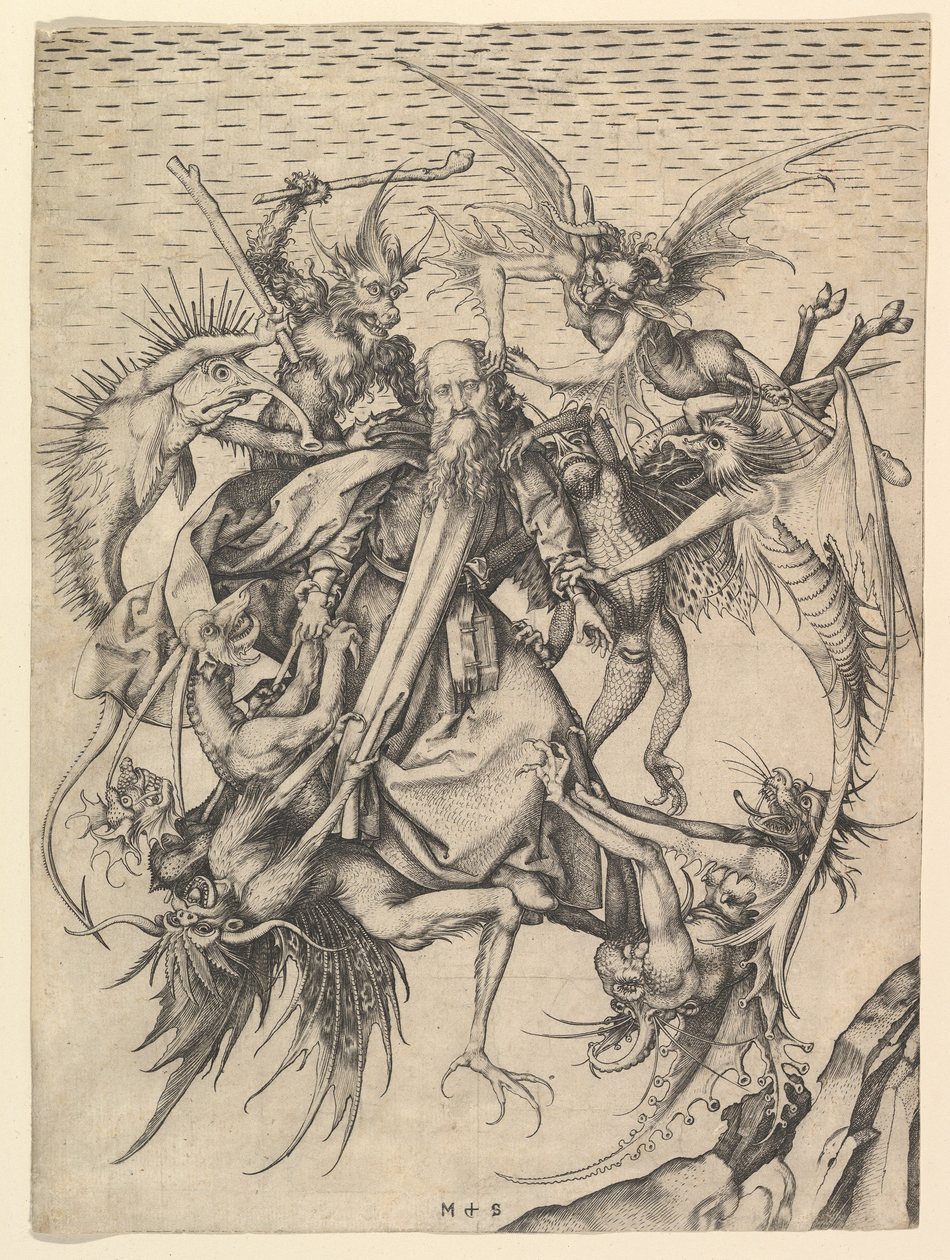
Saint Anthony, calm as a man at prayer, is hauled into the air by a swarm of invented demons — spined, beaked, bat-winged, each one a small masterpiece of the burin. The print travelled to Florence, where the young Michelangelo copied it in paint: his earliest known painting is a tribute to this sheet of paper from Colmar.
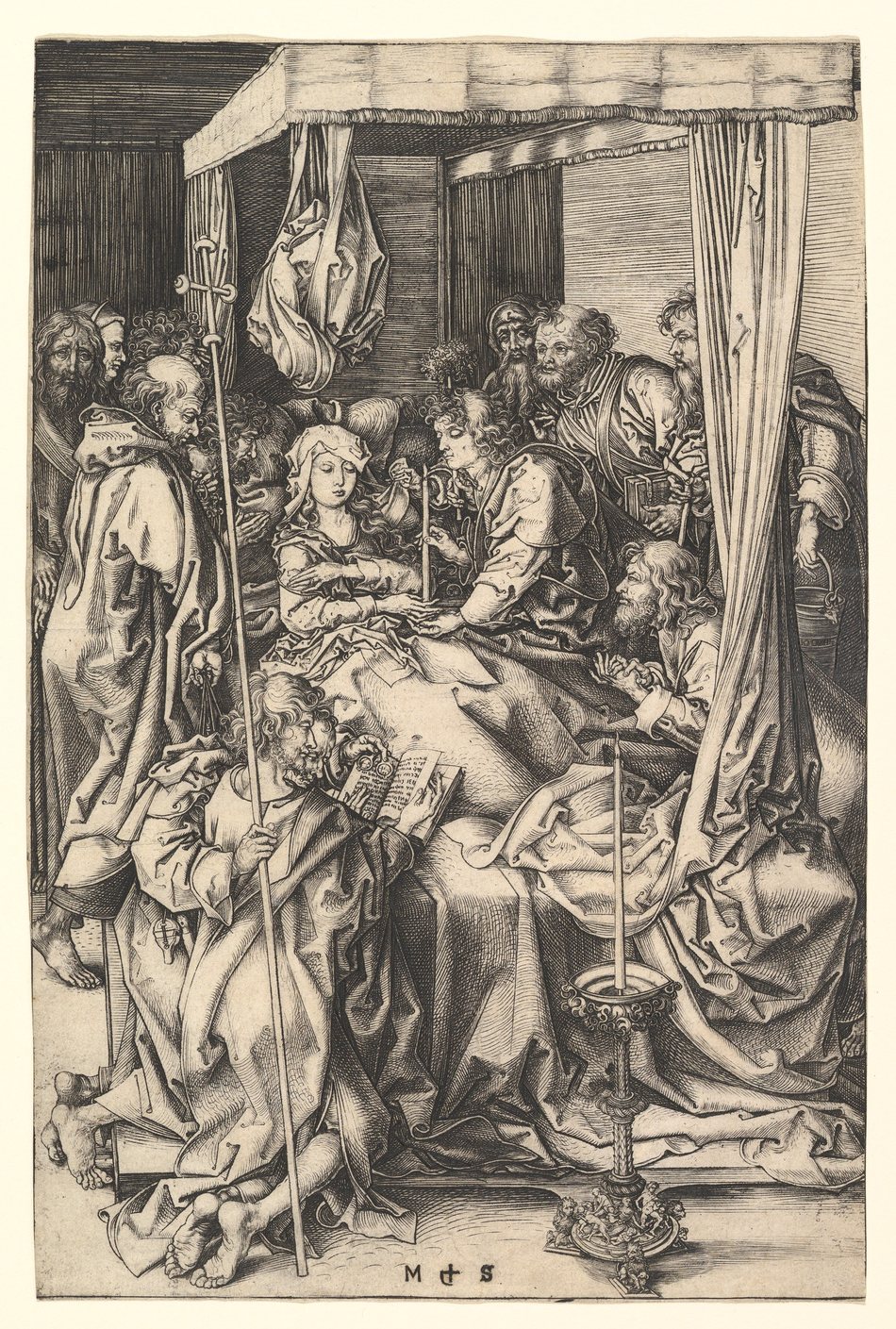
Around Mary's bed the twelve apostles gather in a ring of grief, one reading, one swinging the censer, the dying Virgin at the still centre. It is among the largest and most composed of his plates — a whole chapel of emotion built from nothing but burin lines on copper, and copied by painters for a hundred years.
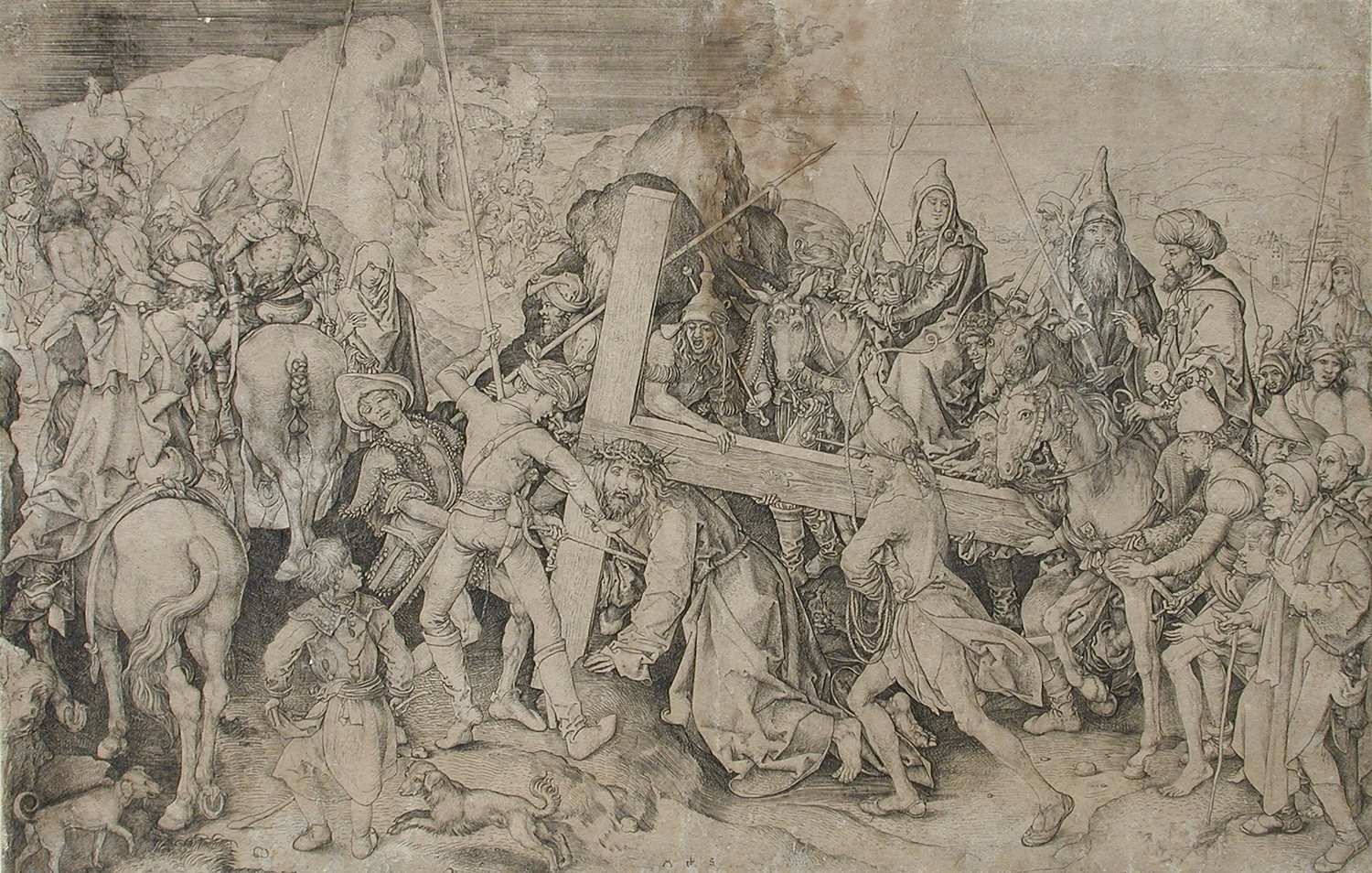
The largest engraving of the fifteenth century: a river of soldiers, tormentors and mourners pours out of the city gate, Christ sunk under the cross at its centre, the two thieves driven ahead. Hundreds of figures, every one of them cut with the same unhurried burin — a crowd scene no painter of the time attempted at this scale.
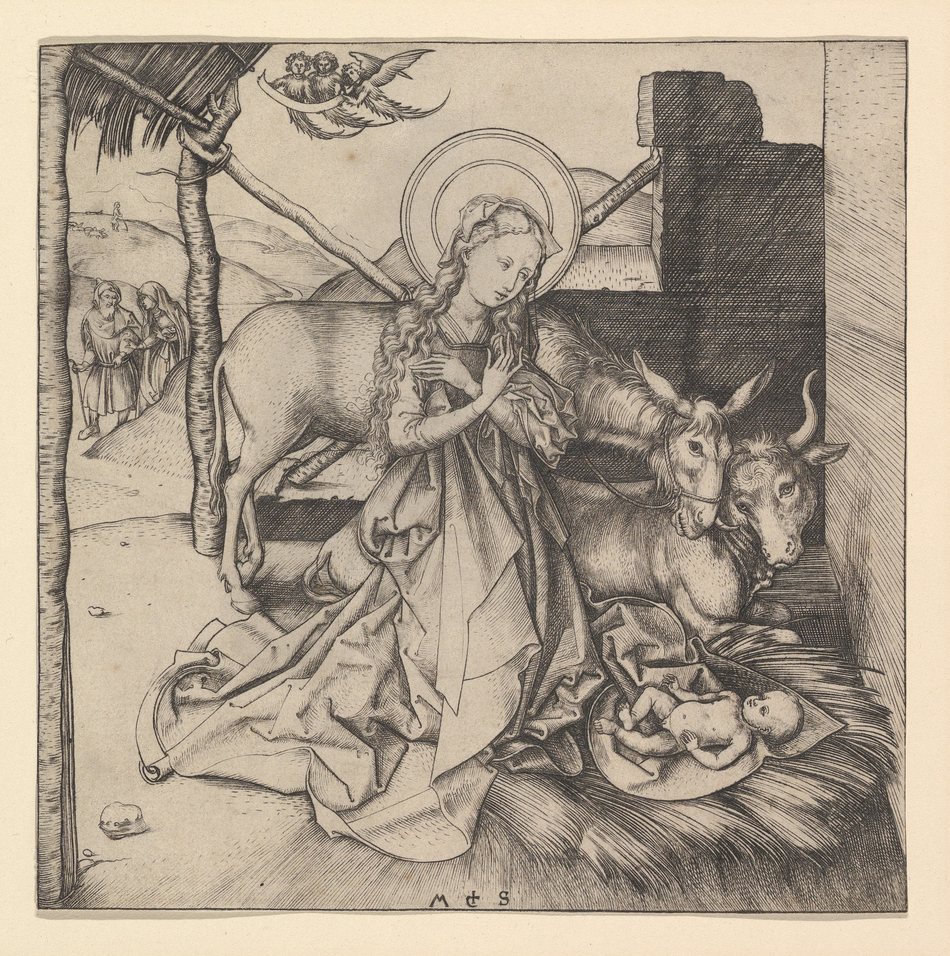
In a ruined stable open to a landscape, Mary kneels in adoration over the Child while Joseph warms his hands at a small fire and the ox and ass look on. The plate is a lesson in his system: brick, thatch, fur and flesh each given its own dialect of hatching, all of it legible at a glance.
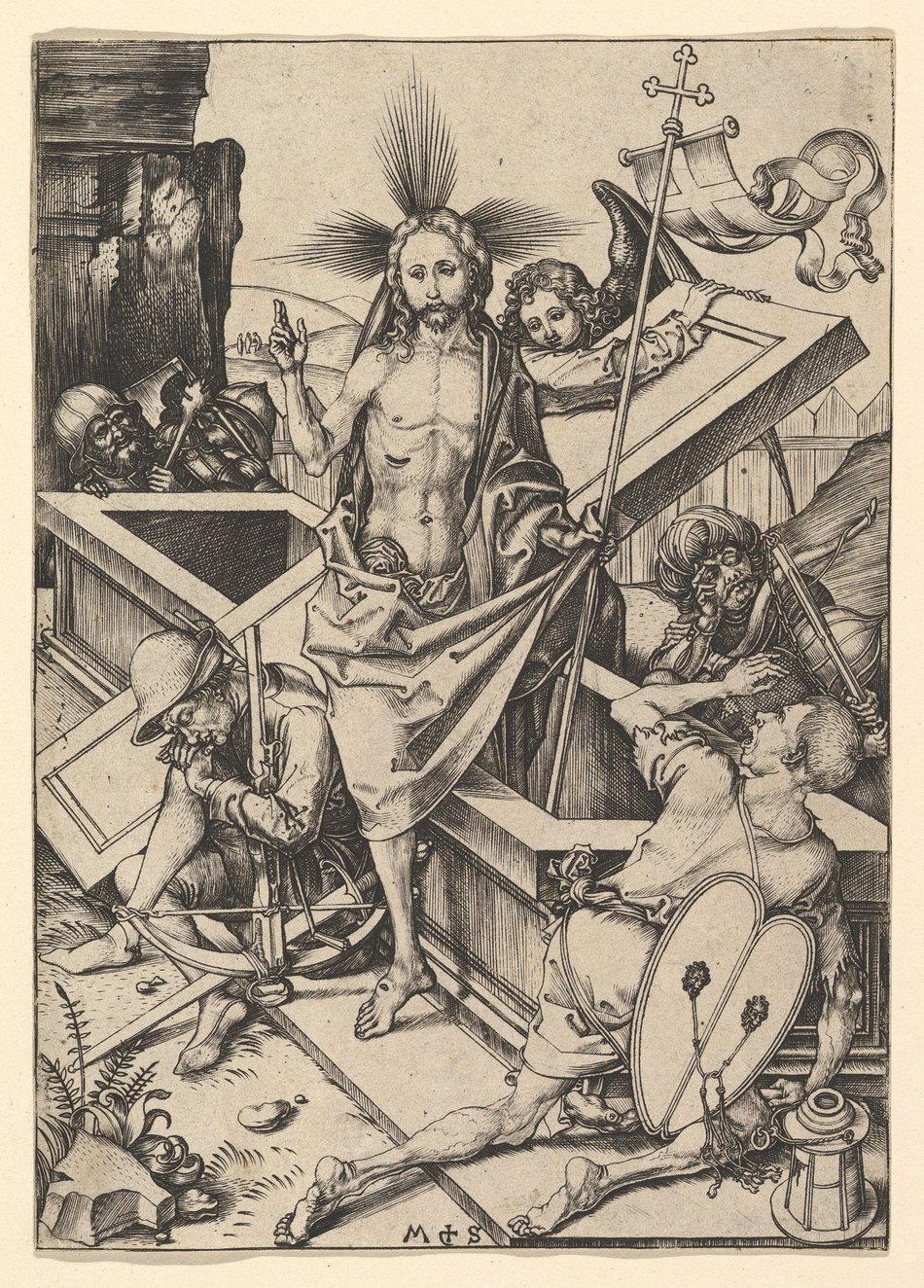
Christ steps from the tomb in a blaze of hatched rays, banner in hand, while the guards tumble in sleep below — one plate from the Passion series that made his name in every workshop in Europe. The series was copied so widely that Schongauer's Passion became, in effect, the standard visual text of the story.
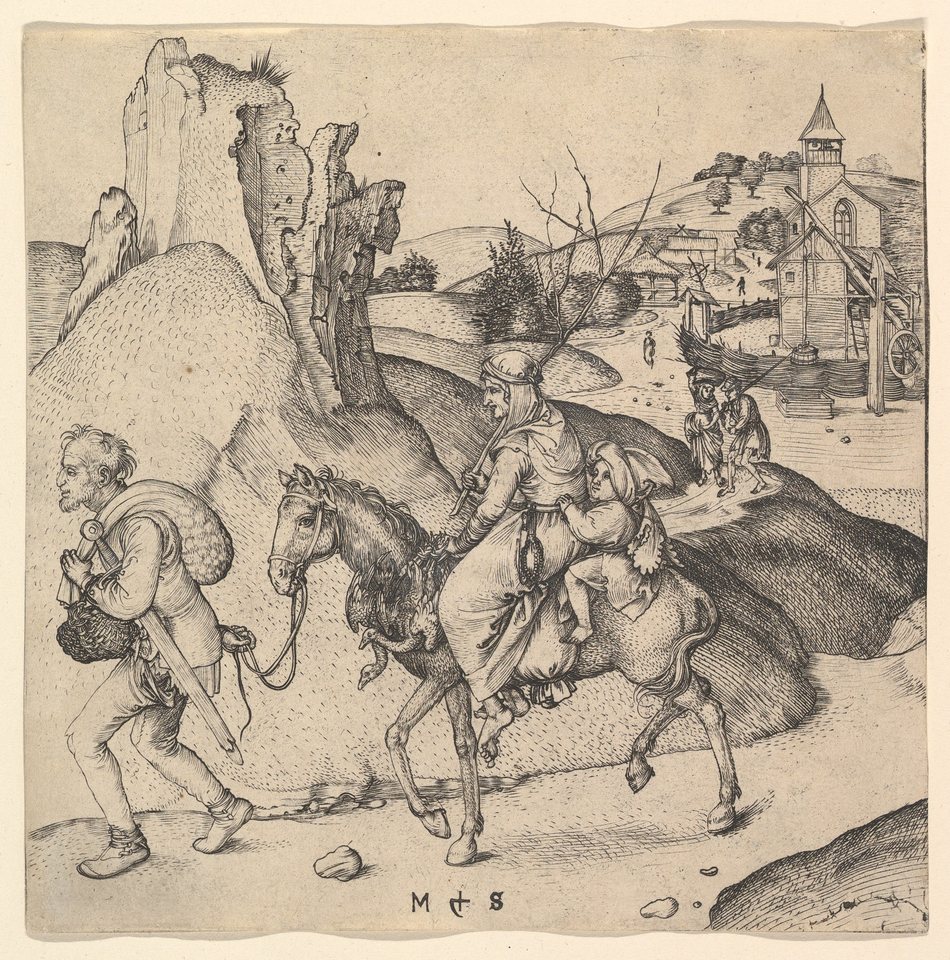
A peasant leads a loaded horse to market, his wife beside him carrying a basket and a child, the whole family rendered with the same serious burin he gave to apostles. Genre scenes like this — ordinary people, exactly observed — are among the first in printmaking, and among the most tender things he cut.
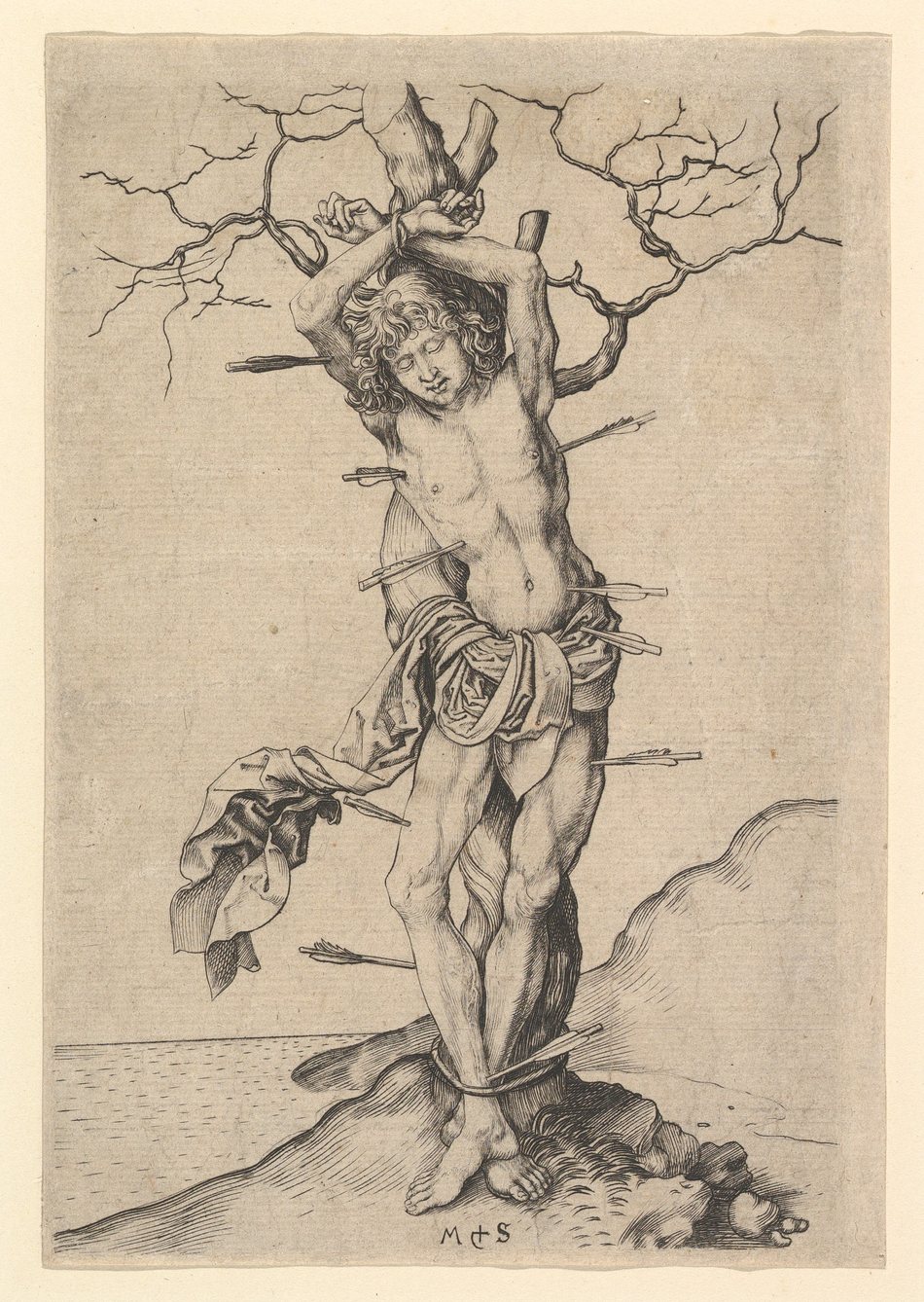
Sebastian stands bound to his tree, body arched, arrows placed with a jeweller's precision, his face turned up in a patience that the burin renders as pure light on the skin. The plate shows his late manner at its most refined — fewer lines, each one doing more, the flesh built from the swelling stroke alone.
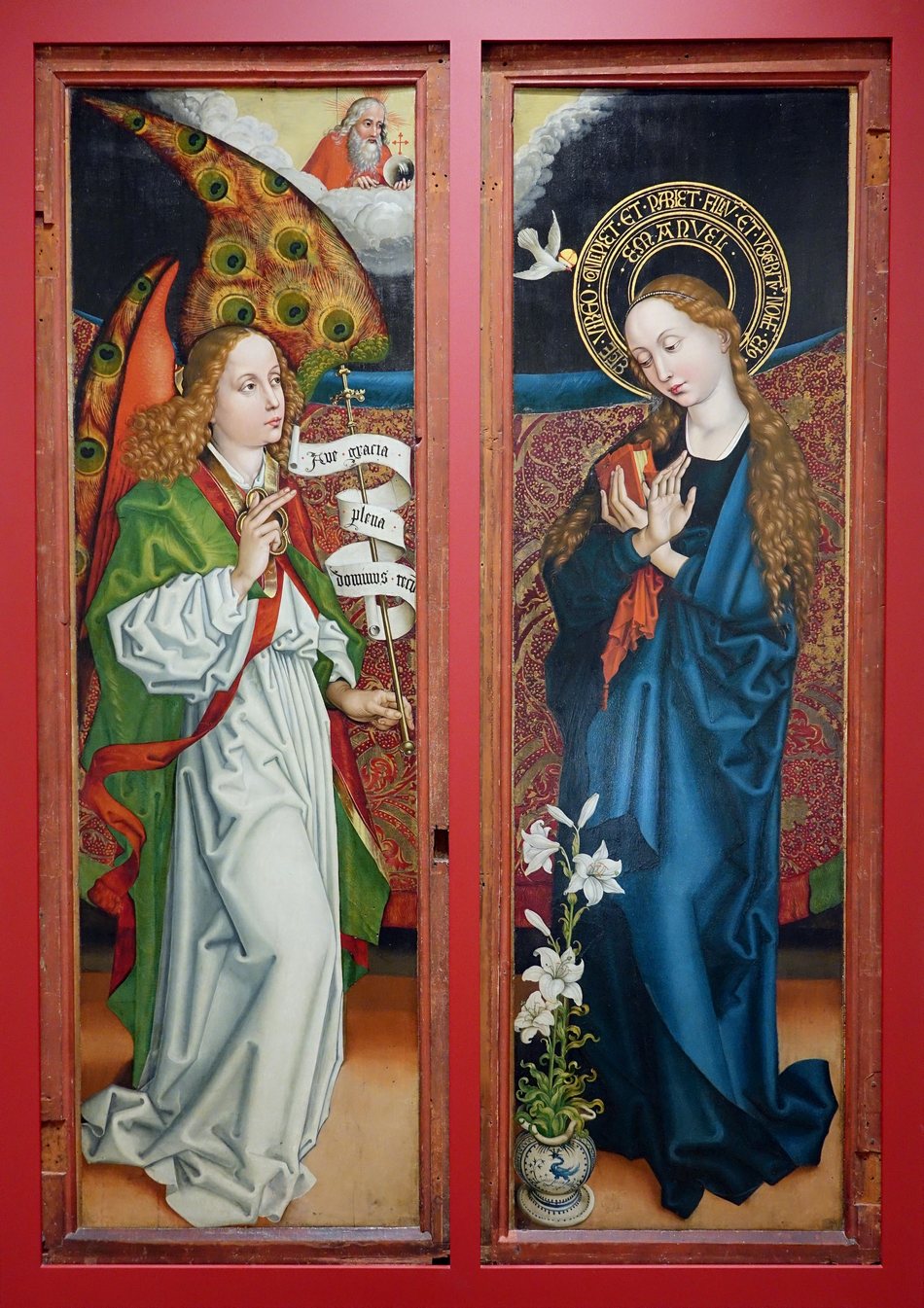
The two wings of the Orlier Altarpiece open like a book: Gabriel sweeping in with his scroll on one panel, Mary at her reading desk on the other, the lilies between them. Painted for a Colmar patron at the same moment as the Rose Bower Madonna, they prove the engraver's drapery systems worked in colour exactly as they worked in line.
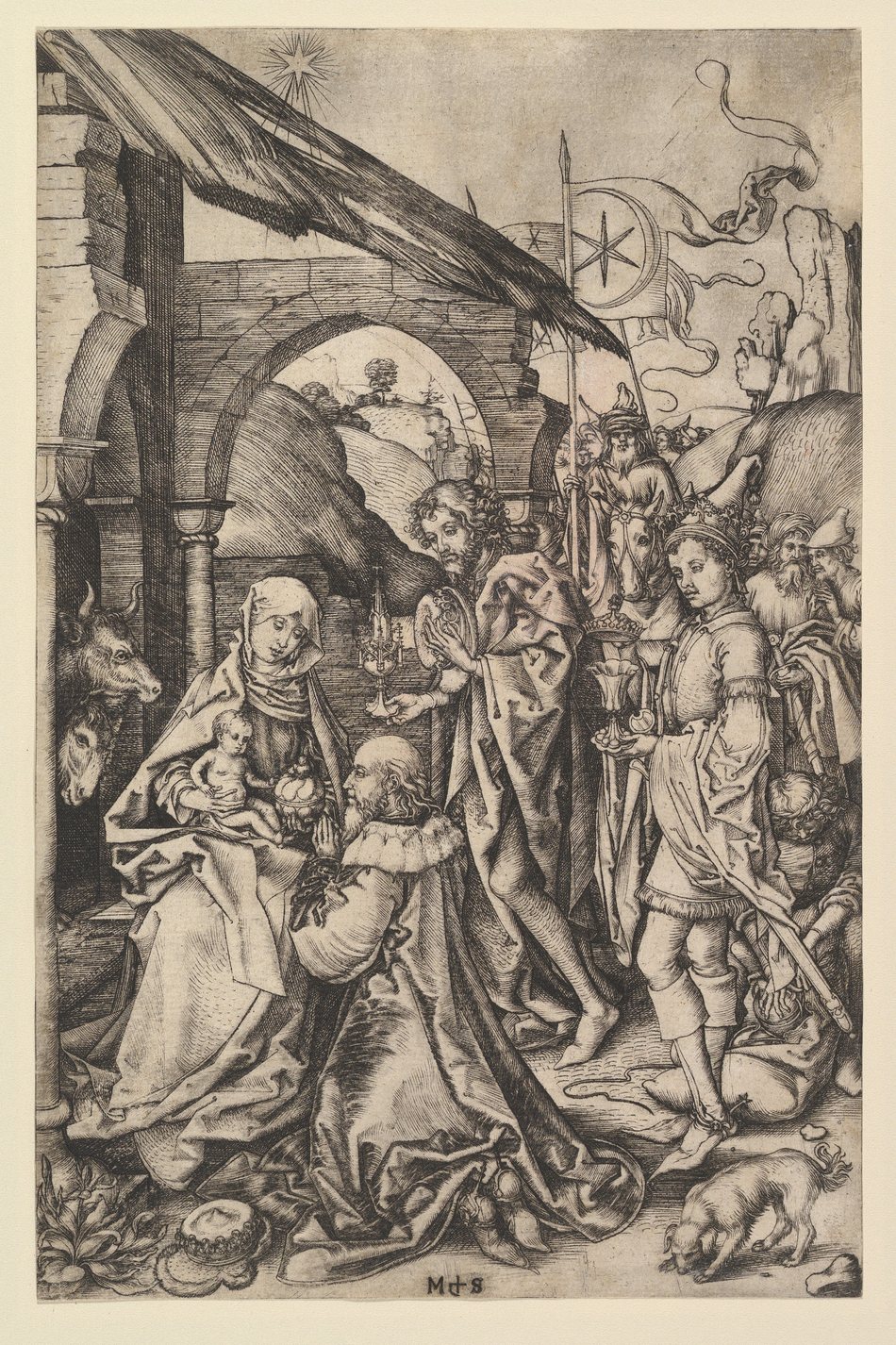
The three kings arrive with a retinue of horses, gifts and gorgeous headgear, crowding the ruined stable in a festival of textures — fur, brocade, armour, horseflesh — each given its own hatching. It is Schongauer the goldsmith at play: a plate that is also a treasury, meant to be looked at for an hour.