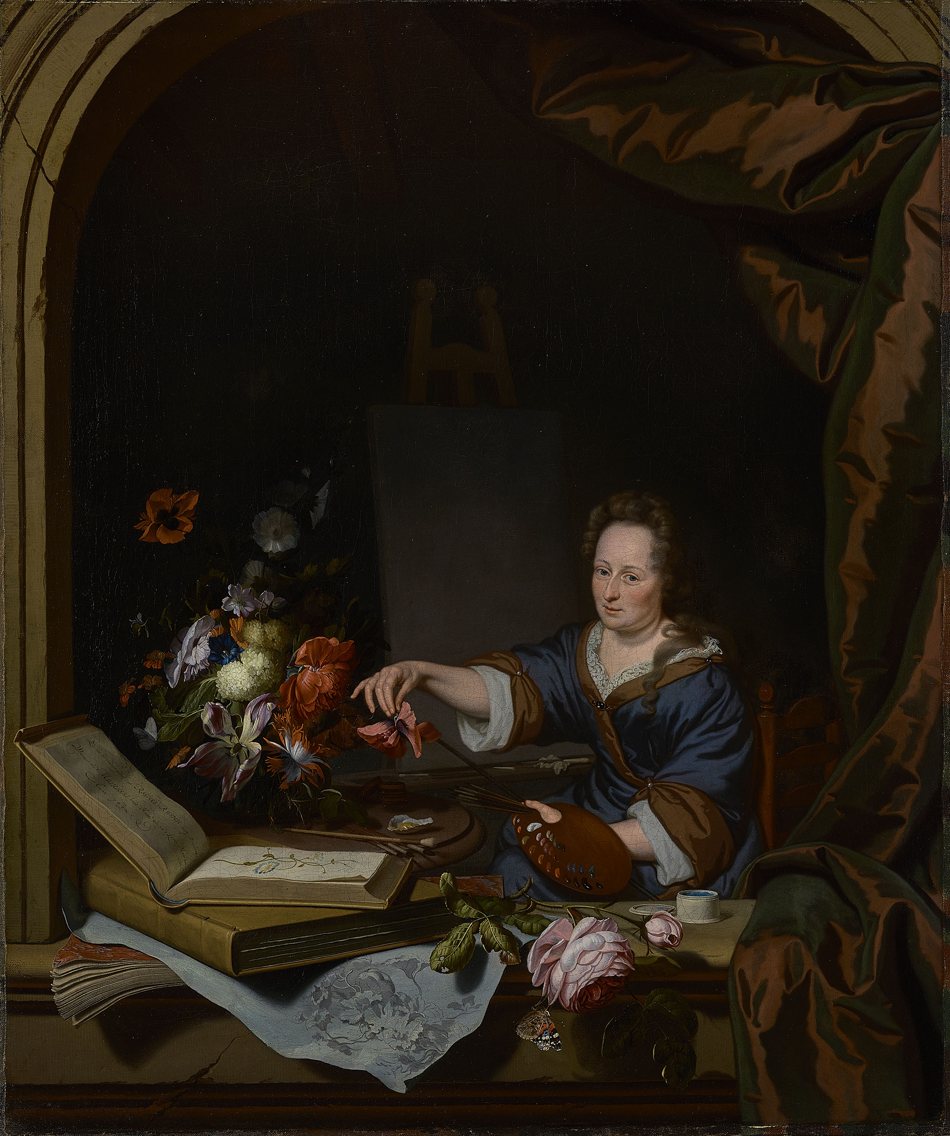
She painted flowers for seventy years and was still signing canvases in her eighties — the most celebrated flower painter in Europe, paid like a history painter. Her bouquets never existed: spring tulips stand with autumn grapes, insects crawl over both, and every petal is botanically true. A bouquet, for Ruysch, was not a moment. It was an ideal, assembled petal by petal.
Her father, Frederik Ruysch, was Amsterdam's celebrated professor of anatomy and botany, with a famous cabinet of preserved specimens — flowers, insects, shells — kept in spirits in glass jars. Rachel grew up arranging and drawing that collection. Her paintings keep the scientist's habits: every species identifiable, every insect placed like a specimen, beauty and evidence in the same vase.
No vase ever held her bouquets: tulips of April stand with grapes of October, poppies with roses, blooms from three seasons wired into one arrangement. She painted from studies — drawings and painted flower pieces made when each species flowered — and composed the bouquet in the studio like a piece of music from remembered themes. The still life is a fiction built entirely of facts.
Her mature bouquets do not sit still: they sweep. A great S-curve of stems and blooms drives diagonally across a black ground, light striking the arrangement like a stage beam, one flower escaping over the table's edge toward the viewer. The energy is baroque, almost violent for so gentle a subject — a bouquet in motion, caught at its brightest second.
Butterflies, dragonflies, grasshoppers, a lizard waiting under the leaves: her creatures are not decoration. In the still-life language of the time they speak of brevity — the butterfly's week against the flower's day — and of nature's indifference, the lizard about to take the butterfly mid-picture. Ruysch, the scientist's daughter, paints the food chain inside the bouquet.
In 1708 she and her husband, the portraitist Juriaen Pool, were appointed court painters to Johann Wilhelm, Elector Palatine, at Düsseldorf — the first woman to hold such a post at a German court. The great flower pieces travelled to the Elector's gallery; her prices matched those of history painters, and collectors across Europe ordered bouquets years in advance.
She raised ten children and painted through all of it, signing and dating canvases into the 1740s — a flower piece of 1747, made at eighty-three, hangs as proof that the hand never lost its patience. When she died in 1750, aged eighty-six, the Dutch Golden Age of painting effectively died with her: she was its last great flower painter, and its longest career.
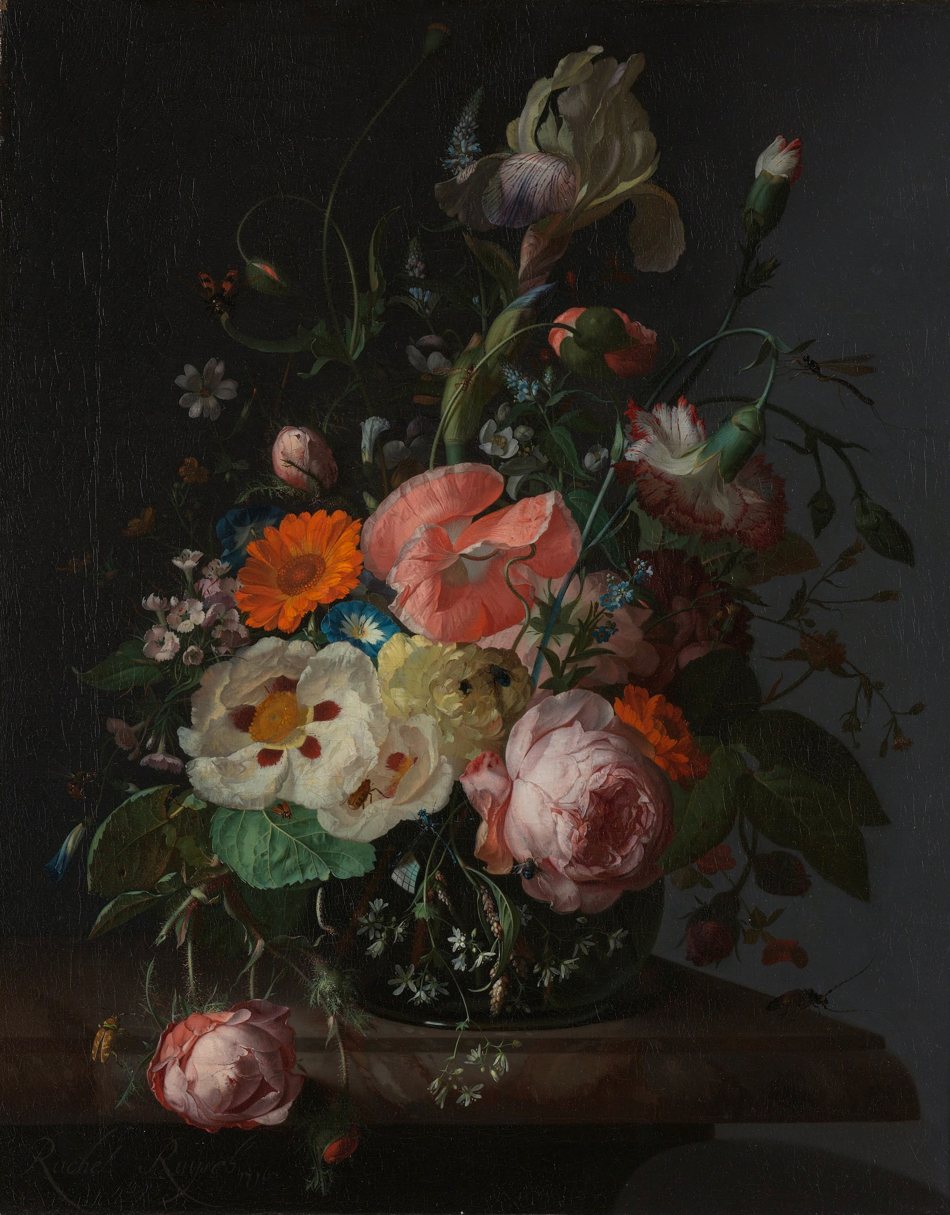
Her most famous arrangement: roses, peonies, an iris and poppies rising from a dark vase on a veined marble slab, a butterfly at the top, a rose dropped on the stone in front. Painted in her fifties, at the height of her fame — every bloom at its single perfect hour, assembled from a year's worth of mornings into one that never happened.
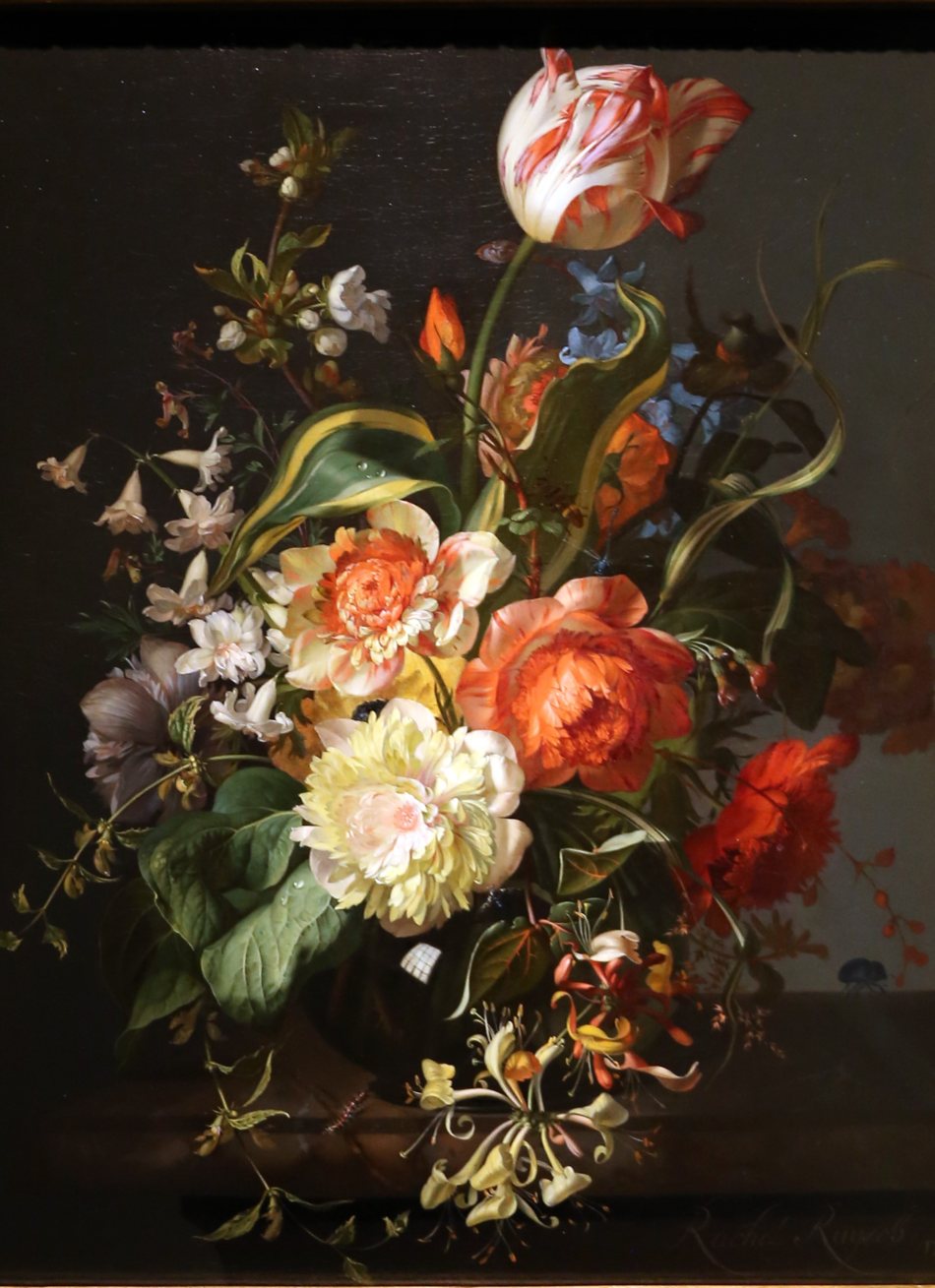
A broken tulip — red flames on white — rises above peonies and roses like a flag over a festival. The striped tulips, freaks of a virus, had been the treasure of the mania eighty years before; Ruysch paints the most valuable flower in Dutch history as simply the tallest in the vase, and lets the peonies steal the light.
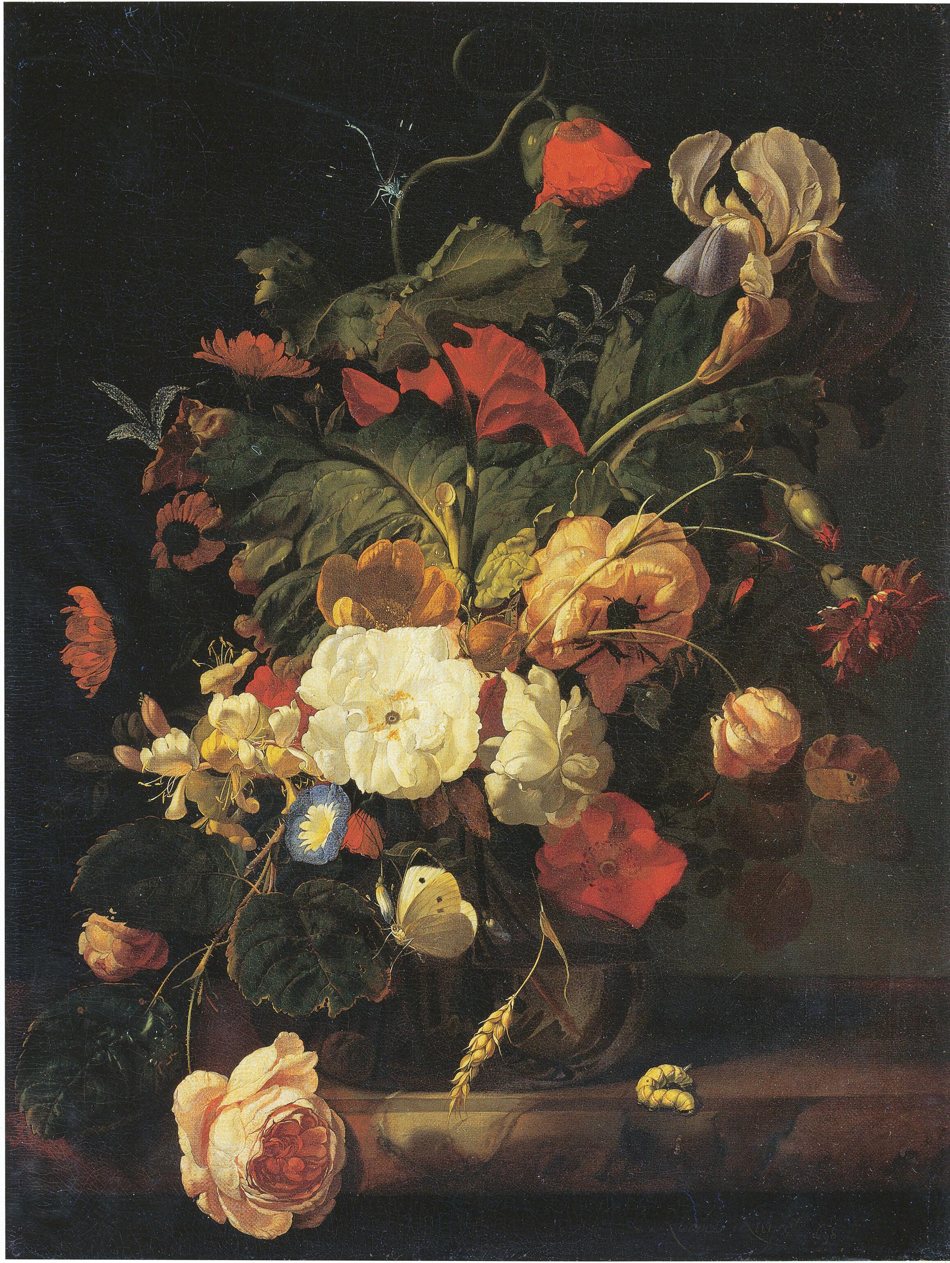
The glass vase itself is painted like a jewel — a breath of highlight on curved glass, the stems ghosting through the water. Around it the bouquet performs its sweep: iris and poppy at the summit, roses tumbling down the diagonal, one bloom fallen to the ledge where a butterfly has claimed it.
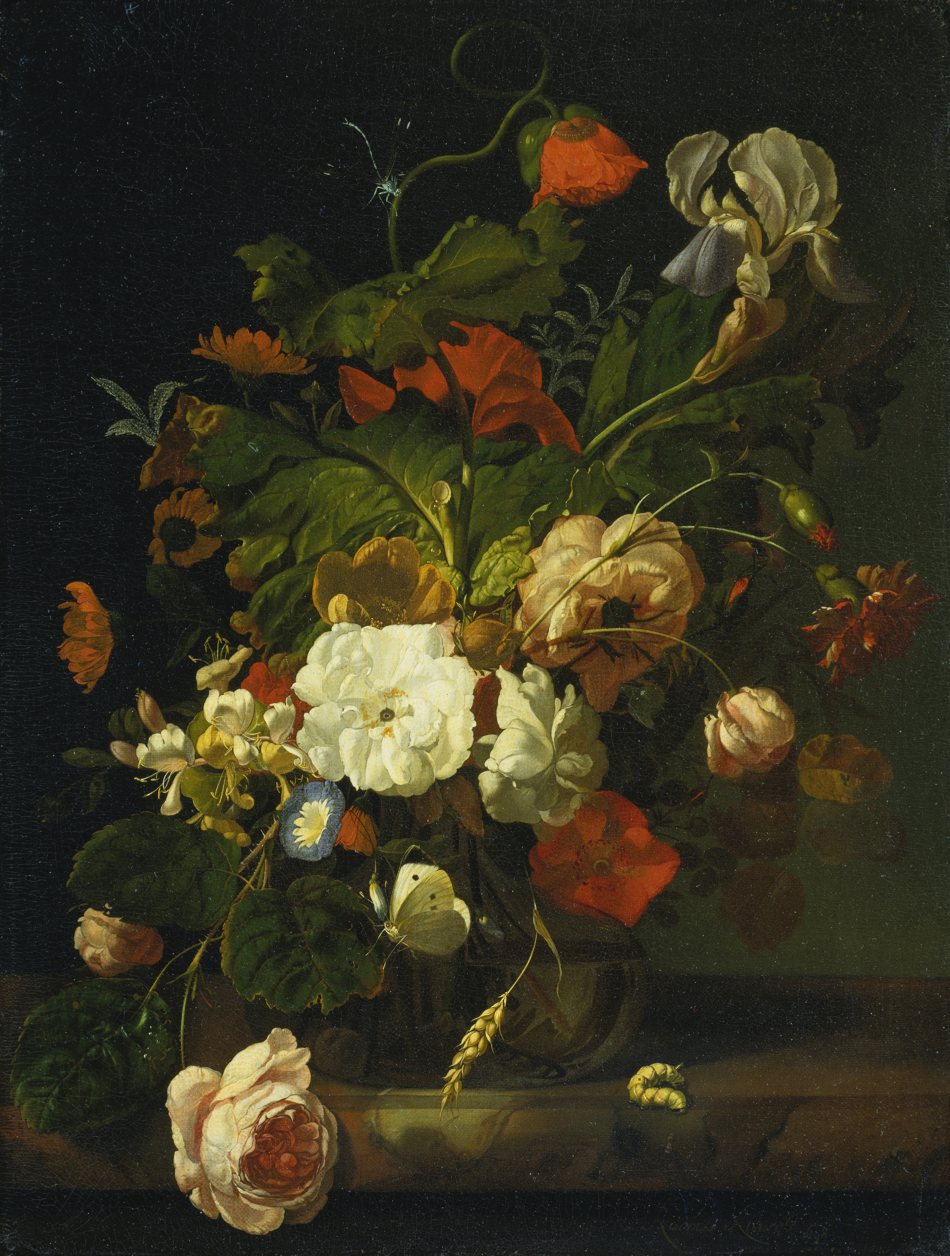
The bouquet at its most theatrical: great white and blush blooms at the centre of the light, darker flowers retreating into the black ground at the edges, stems crossing like the rigging of a ship. Ruysch's late arrangements are architecture — every flower a placed stone in an arch that stands only in paint.
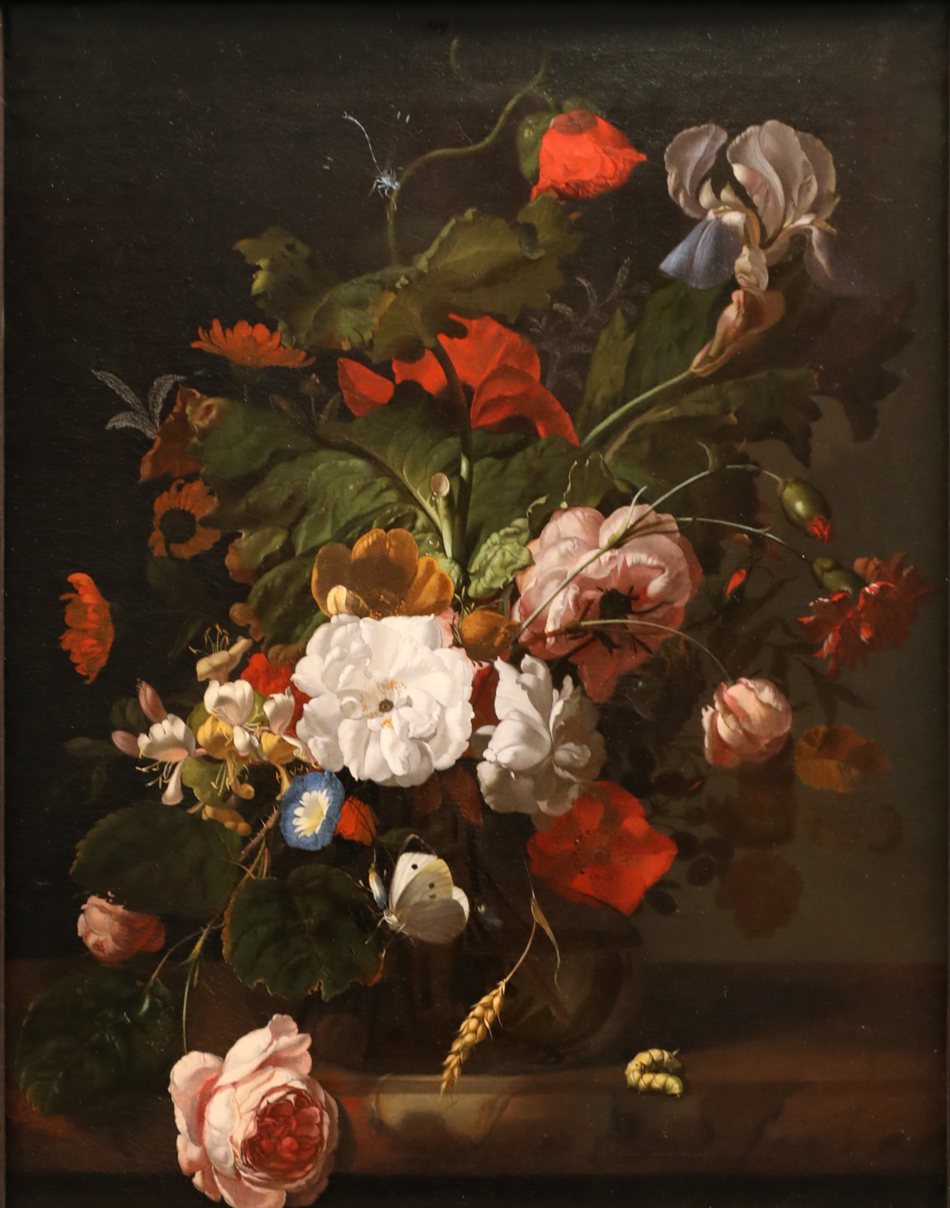
An early bouquet, painted in her thirties: poppies, an iris, white roses and a single rose laid on the table beside a caterpillar — the whole cycle of the picture in one small green footnote. The darkness is already hers, and the light already knows exactly which petal to touch first.
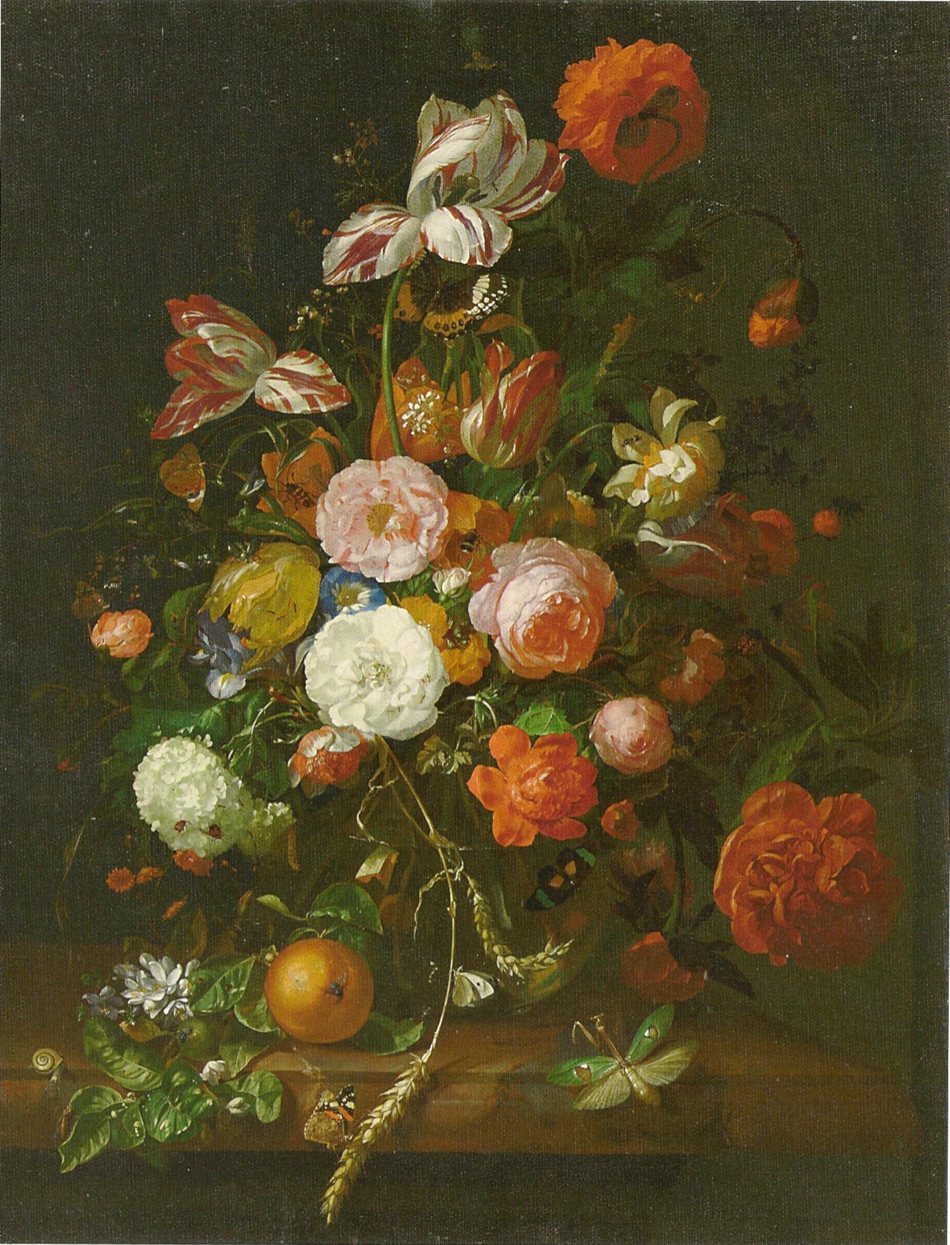
From the year of her Düsseldorf appointment: a tall, festive arrangement — tulips, peonies, roses and an orange resting at the foot of the vase, the court's fruit among the flowers. It has the confidence of a painter who has just been given a palace to supply: nothing here is modest, and everything is exact.
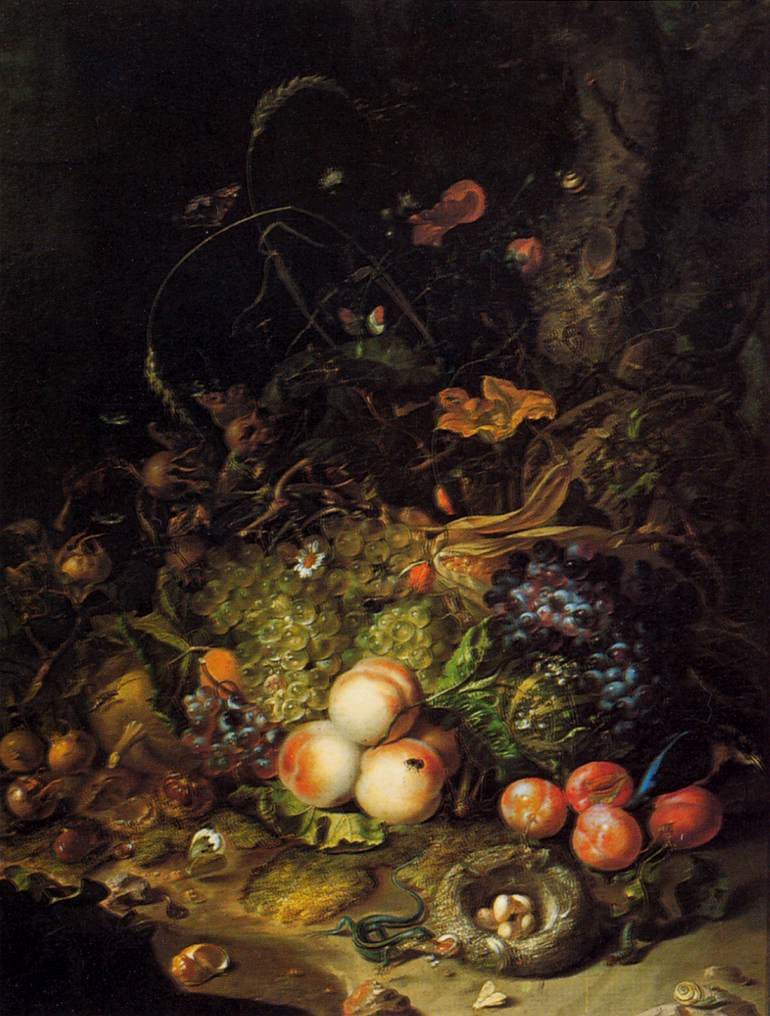
On the forest floor at the foot of a tree: peaches, grapes and plums ripening among leaves, a bird's nest with eggs below, insects over everything. These woodland pieces, learned from the forest still lifes of Otto Marseus van Schrieck, are Ruysch's wild side — the bouquet let loose in the undergrowth, where fruit falls and nests wait their season.
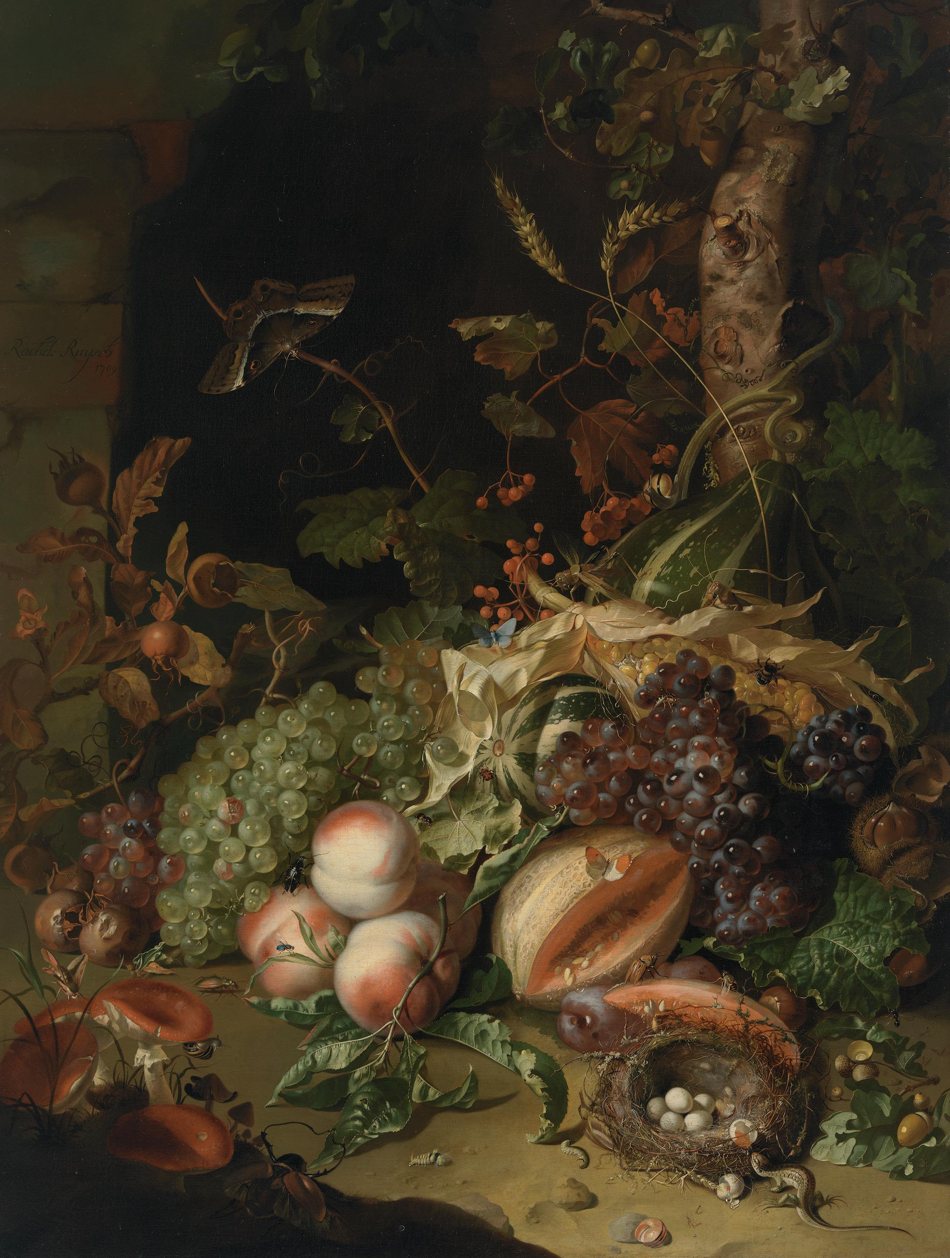
A companion woodland piece: grapes, peaches and a cut melon spilling its seeds beside a nest of eggs, lizards and insects in attendance. Painted for a German collection, it is the forest floor as a banquet — nature serving itself, course by course, to whatever passes by.
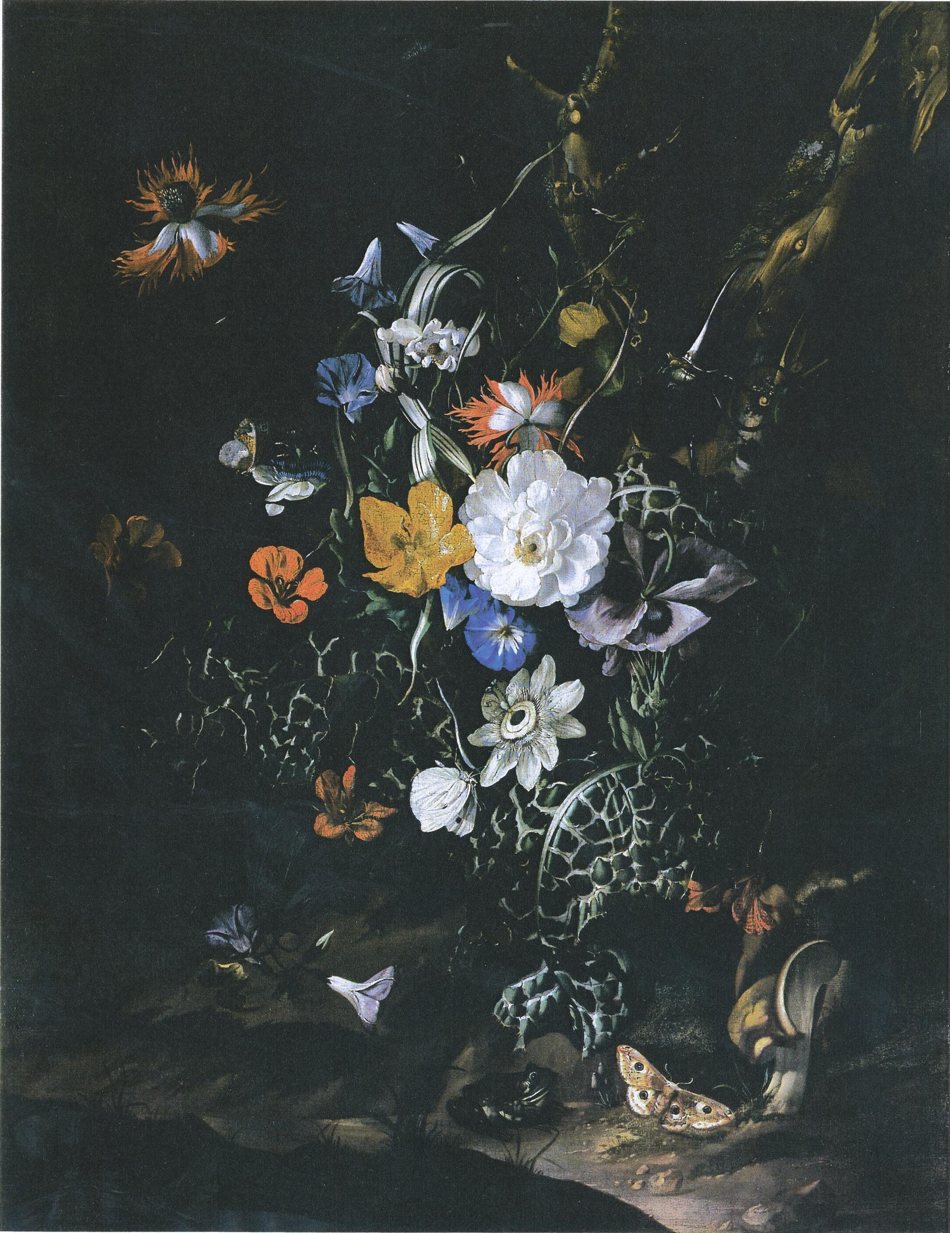
The darkest picture in this room: a spray of wild flowers rising out of blackness at a wood's edge, a butterfly above, and at the bottom — if you look — a lizard and a snail going about their business. Ruysch paints the border where the garden ends and the wildwood begins, and stocks it with her father's specimens, alive.
The room ends with its maker: Michiel van Musscher's portrait of Ruysch at twenty-eight, seated in her studio arranging flowers, her paintings and a great book around her, an easel behind. She is not shown painting but choosing — the hand among the blooms, deciding what the bouquet will be. It is the truest likeness of her art there is.