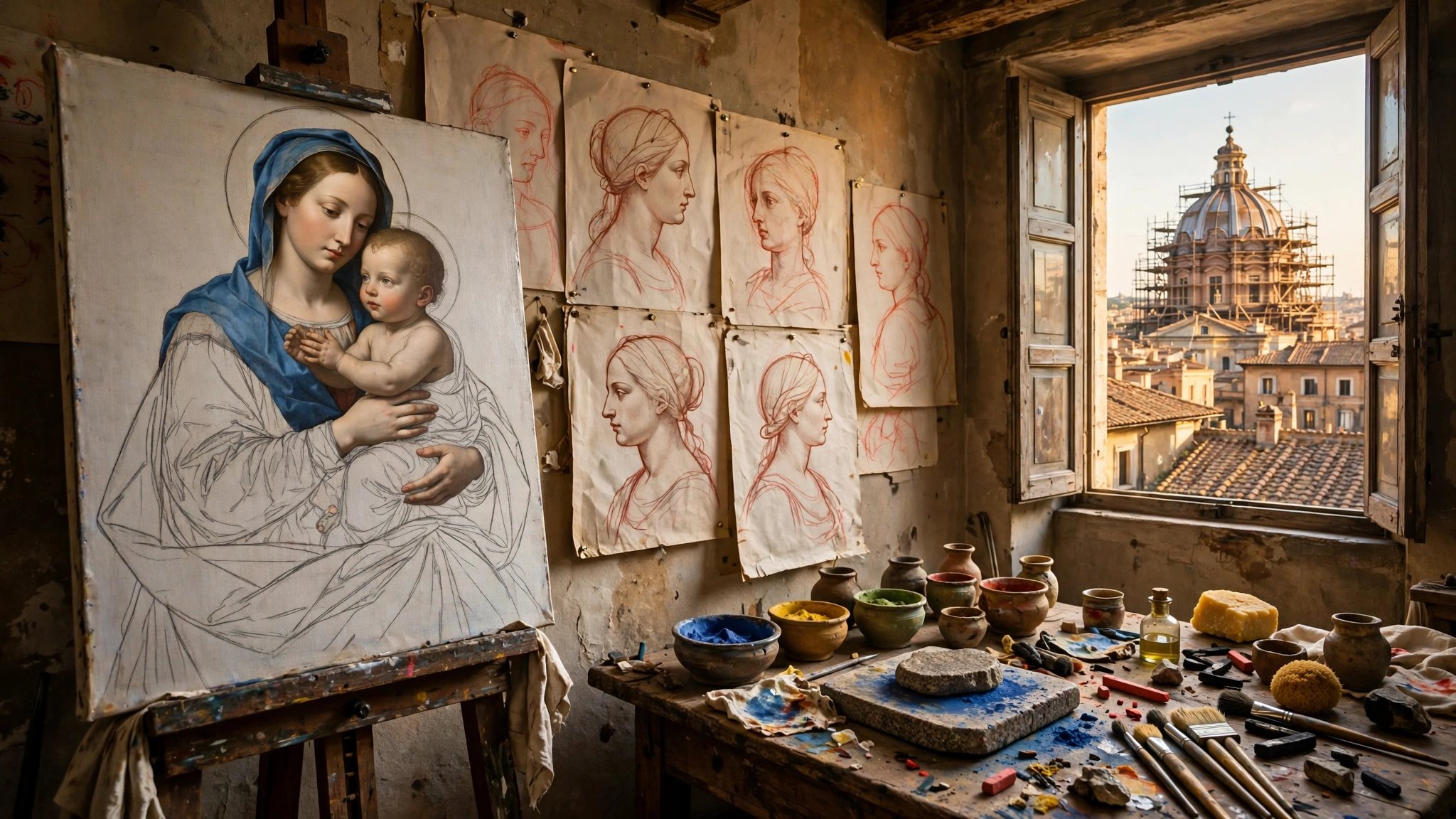
Grace, in Raphael, is not a gift but a technique: behind every effortless Madonna stand cartoons, studies and a workshop run like a small state. He died at thirty-seven with Rome at his feet, leaving paintings so balanced that for three centuries they were the definition of perfection — and a production line that taught Europe how a master's studio could work.
Raphael's frescoes began as full-size paper cartoons, transferred to the wet plaster by pricking and charcoal dust. Hundreds of his drawings survive — studies of heads, hands, whole compositions reworked until the final arrangement looks inevitable. The ease on the wall is the end of a long paper road.
Vasari says Raphael studied everyone's strengths — Leonardo's modelling, Michelangelo's anatomy, Fra Bartolomeo's colour — and fused them into his own manner. The famous grazia was assembled, deliberately, from the best parts of his rivals. Genius, here, looks a lot like editing.
By the 1510s Raphael ran the largest painting operation in Rome: Giulio Romano, Giovanni da Udine, Perino del Vaga and dozens more executing his designs across fresco, panel, tapestry and print. Signing the design, not every brushstroke, was the master's job — an idea that built modern studio practice.
His panels keep fresco's clarity: forms drawn with a sculptor's contour, colour laid in smooth, enamel-like layers over a light ground, no dark murk anywhere. Even his most dramatic late works — the Transfiguration above all — keep that luminous order, as if the wall's discipline had moved into the panel.
Raphael's favourite drawing tool was natural red chalk — sanguine — soft enough for flesh, precise enough for a profile. His head studies in red chalk, drawn from living models in the workshop, are where the Madonnas' faces were invented: the same features return, refined, across a dozen paintings.
Raphael understood reproduction: he worked with the engraver Marcantonio Raimondi, whose prints after his designs carried Raphael's compositions across Europe — the first time a painter's inventions were mass-distributed in his lifetime. The fame that reached Dürer in Venice arrived on paper.
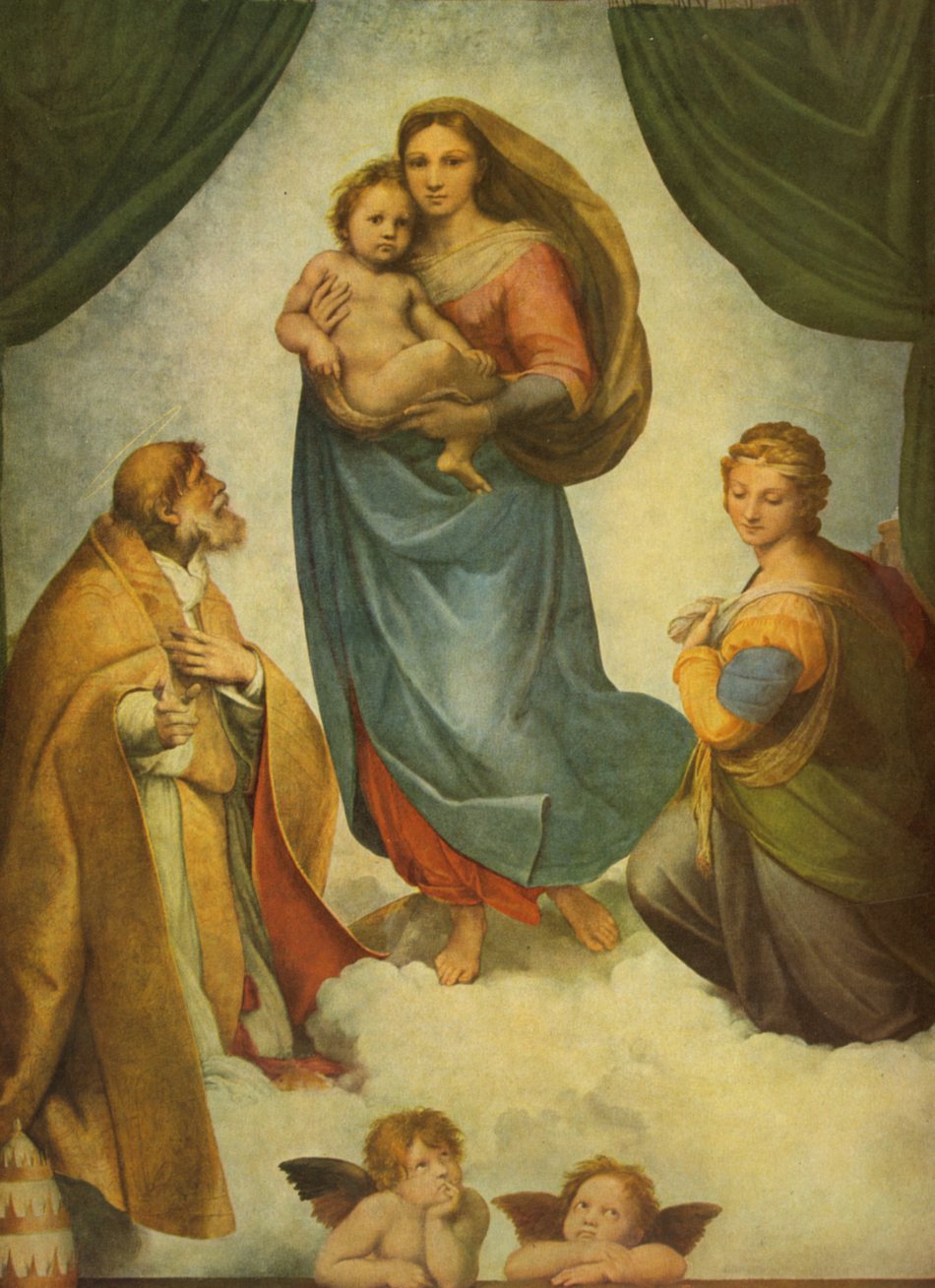
The Virgin walks on clouds straight toward us, curtains drawn aside like a stage opening, while at the bottom two small cherubs lean on the parapet in the most famous daydream in art. Painted for a high altar in Piacenza, it became, in Dresden, the very emblem of the Renaissance Madonna.
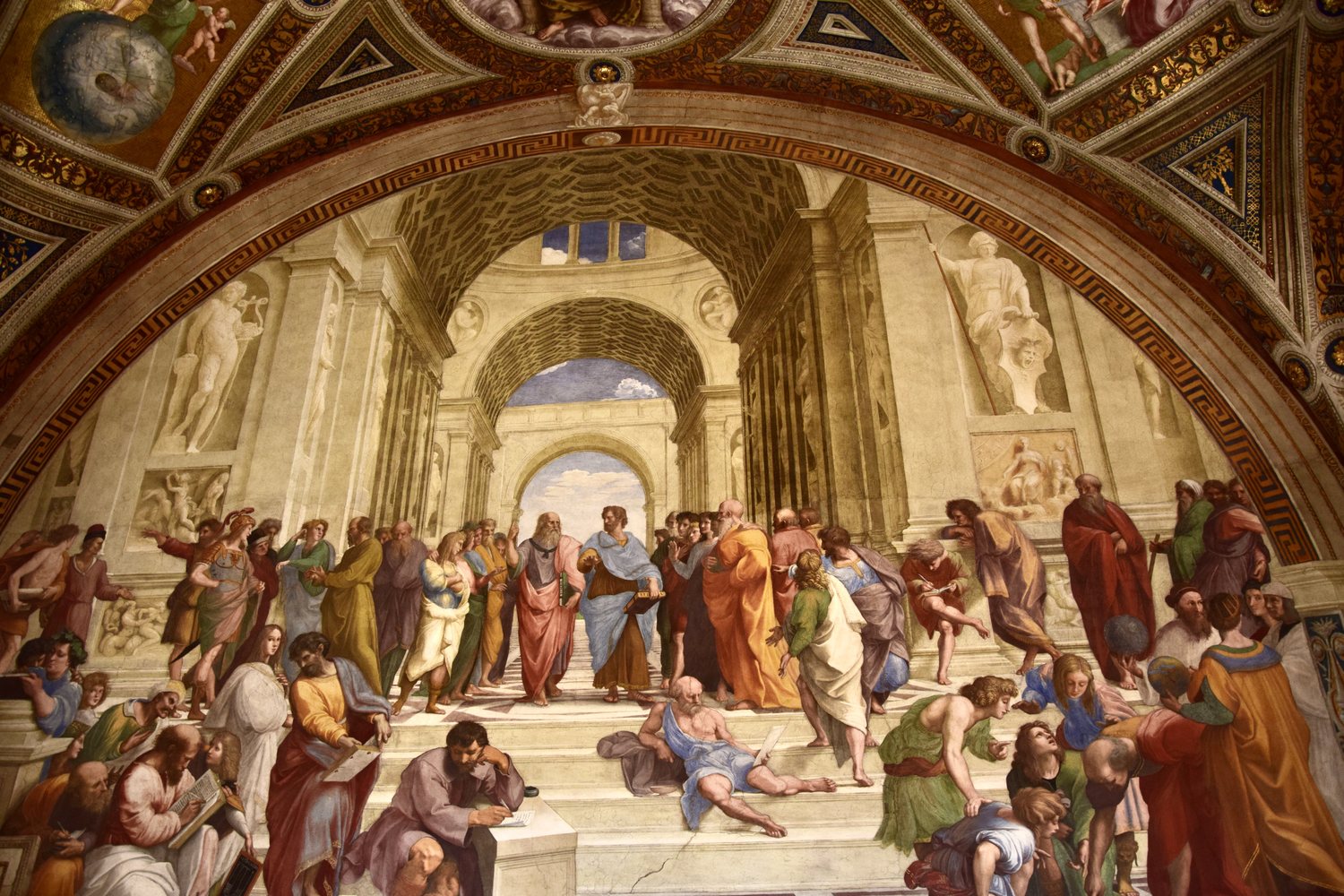
Philosophy itself, staged in a vast Renaissance hall: Plato points up, Aristotle levels his hand at the world, and around them the whole Greek mind argues, measures and dreams — many of them wearing the faces of Raphael's contemporaries, Leonardo and Michelangelo among them. It is a fresco that thinks.
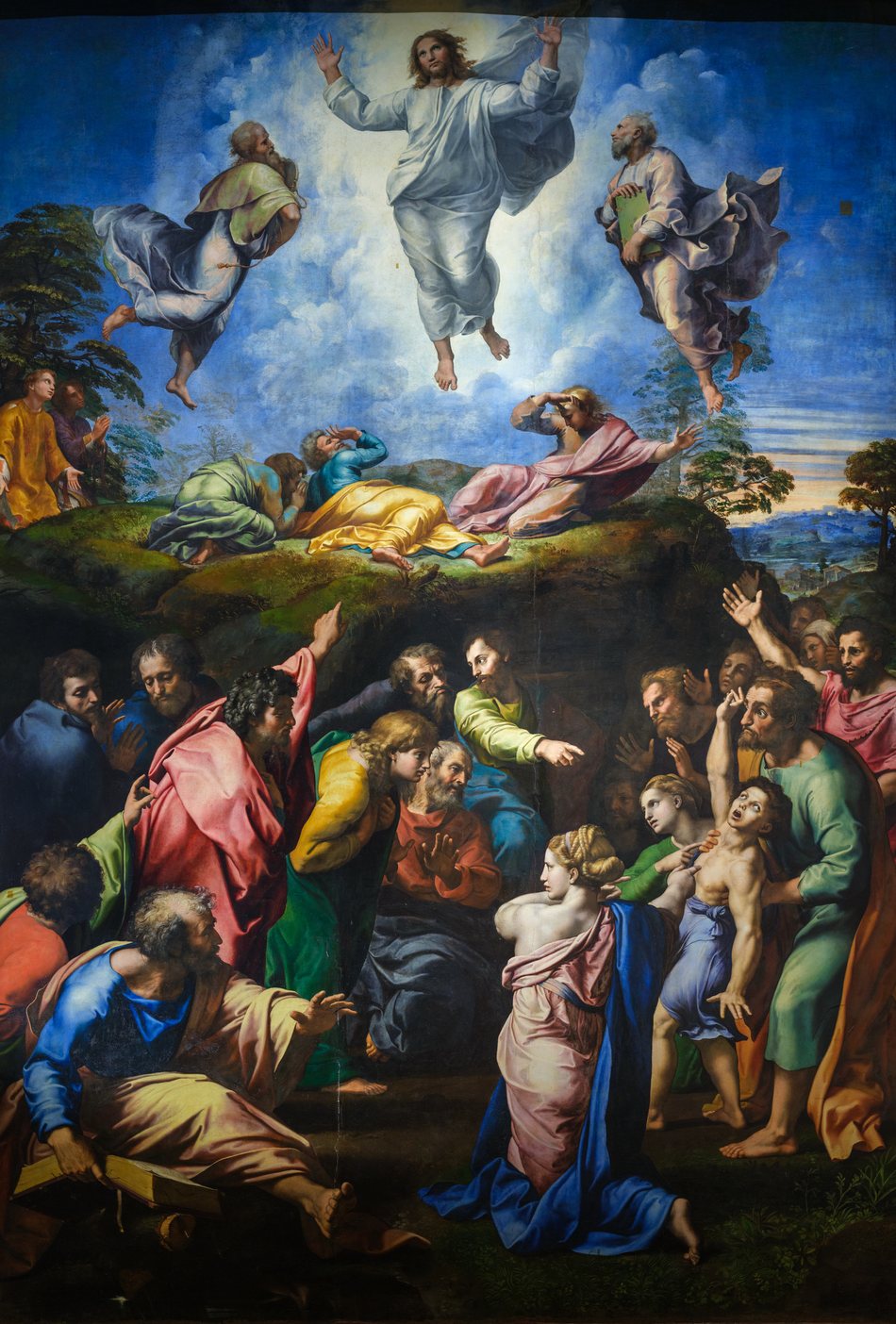
His last painting, carried in his funeral procession: above, Christ blazing in white between Moses and Elijah; below, a possessed boy and a crowd in turmoil that the apostles cannot heal. Two worlds, one panel — the serene and the desperate joined by light. The lower part was finished by his workshop after his death.
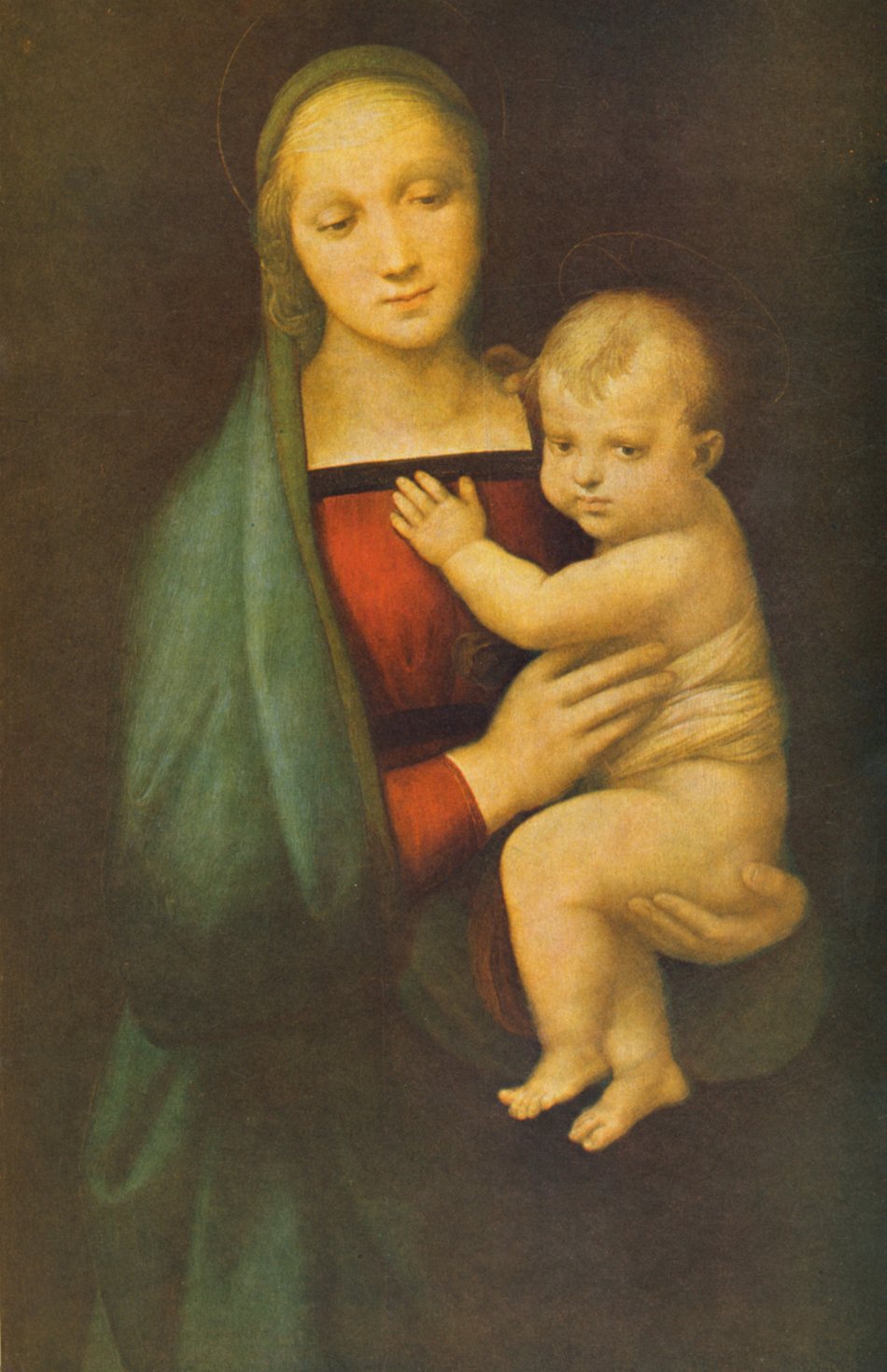
A Madonna emerging from darkness with nothing around her at all — no landscape, no architecture, just the green-black depth and the two figures. The simplicity was a sensation: the Grand Duke Ferdinand III later carried the picture with him on his travels, which is how it got its name.
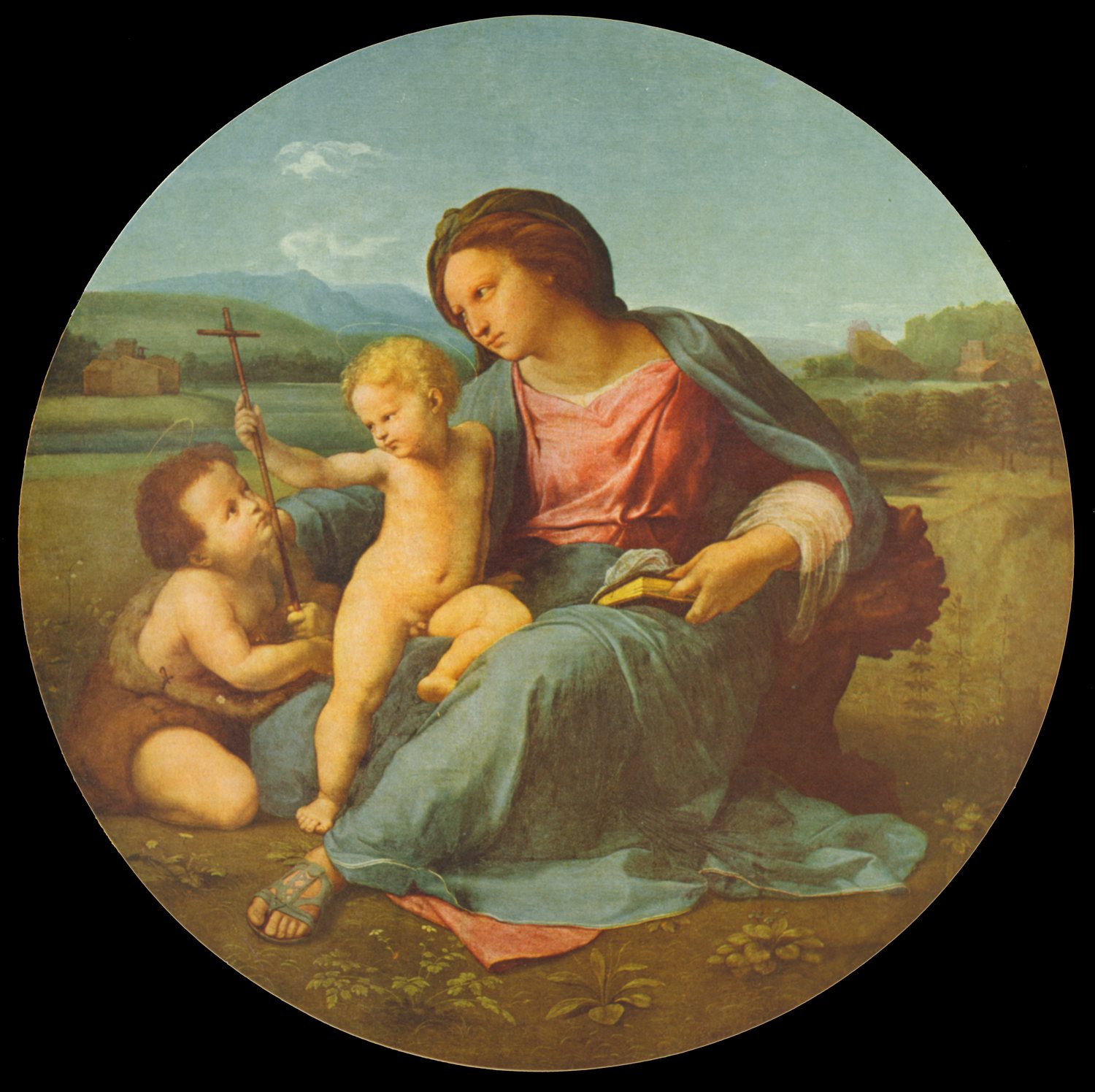
A circular composition solved like a piece of music: the Virgin seated on the ground in a wide landscape, turning to take the cross of reeds from the little St John while the Christ Child grasps it — the Passion foreshadowed in a game. Once the most expensive painting in the world, when it crossed from the Hermitage to Washington.
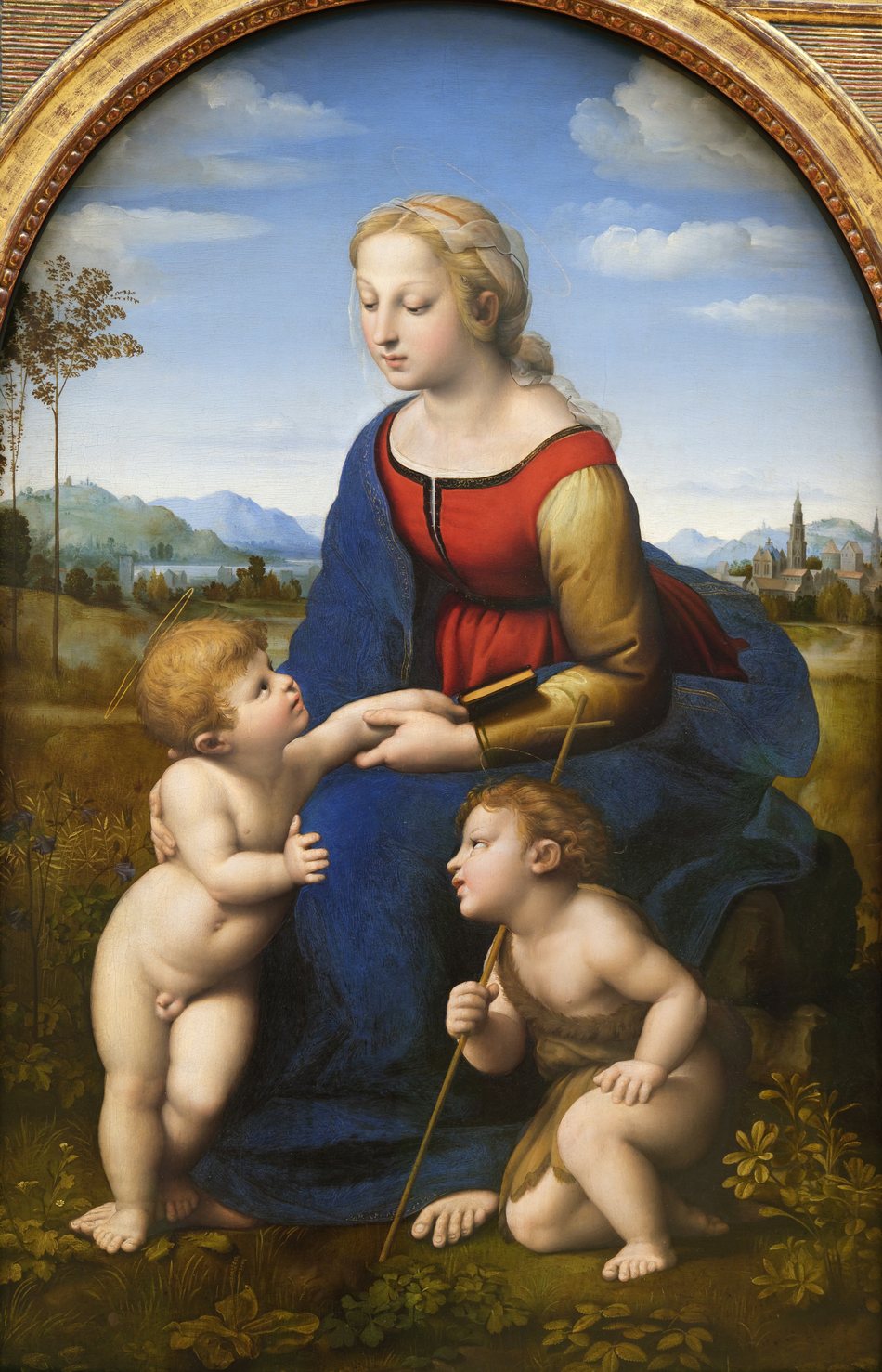
The Virgin as a beautiful gardener in a flowering meadow, the Christ Child leaning on her knee, St John kneeling with his reed cross. Signed and dated on the hem of her dress — Raphael rarely signed, but the Florentine Madonnas of these years carry his name like a seal of pride.
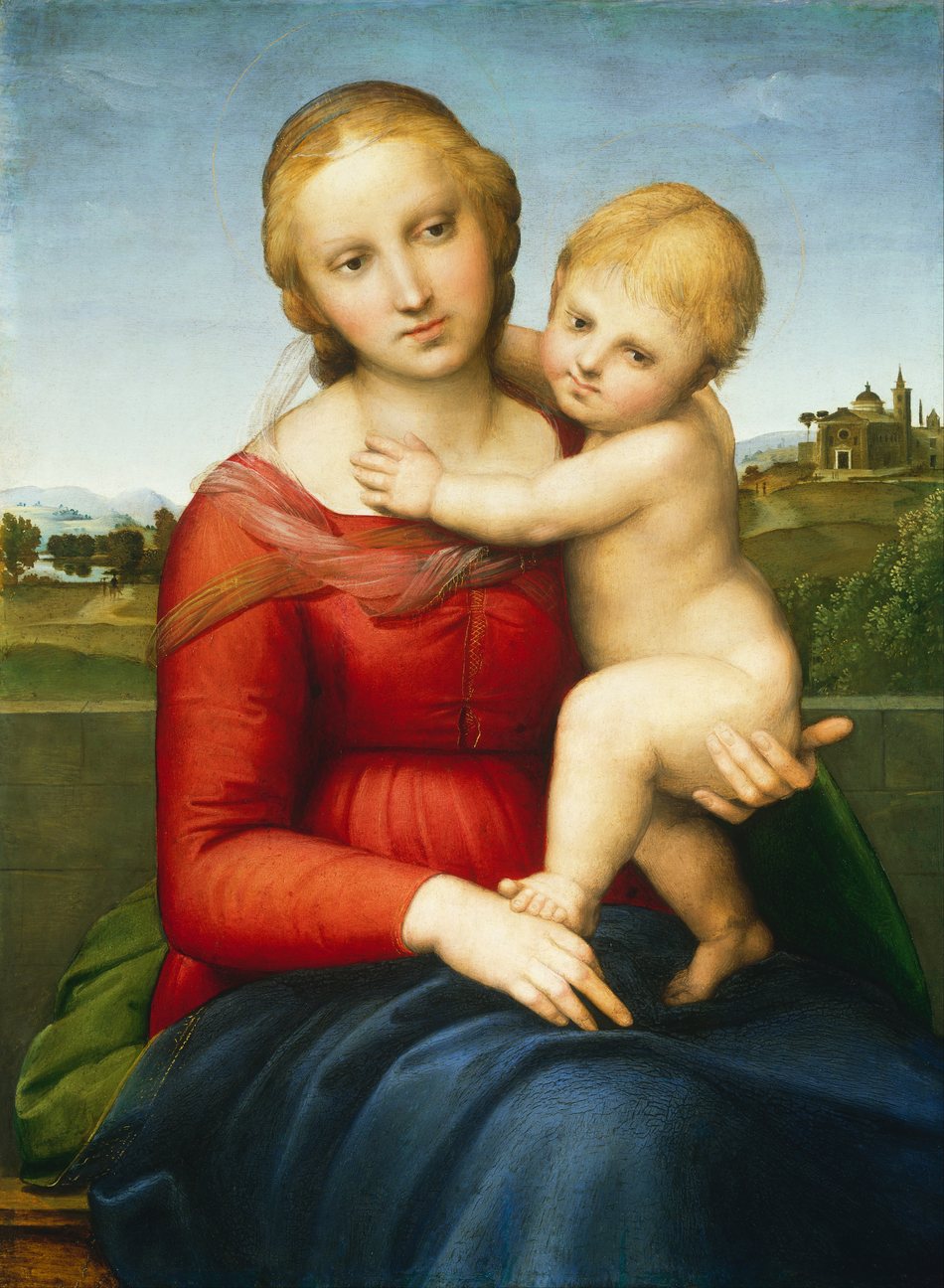
Mother and Child cheek to cheek before a Umbrian landscape with a little church on the hill — Raphael's early manner at its most tender, painted when he was barely twenty-two. The picture's calm is total, and completely engineered.
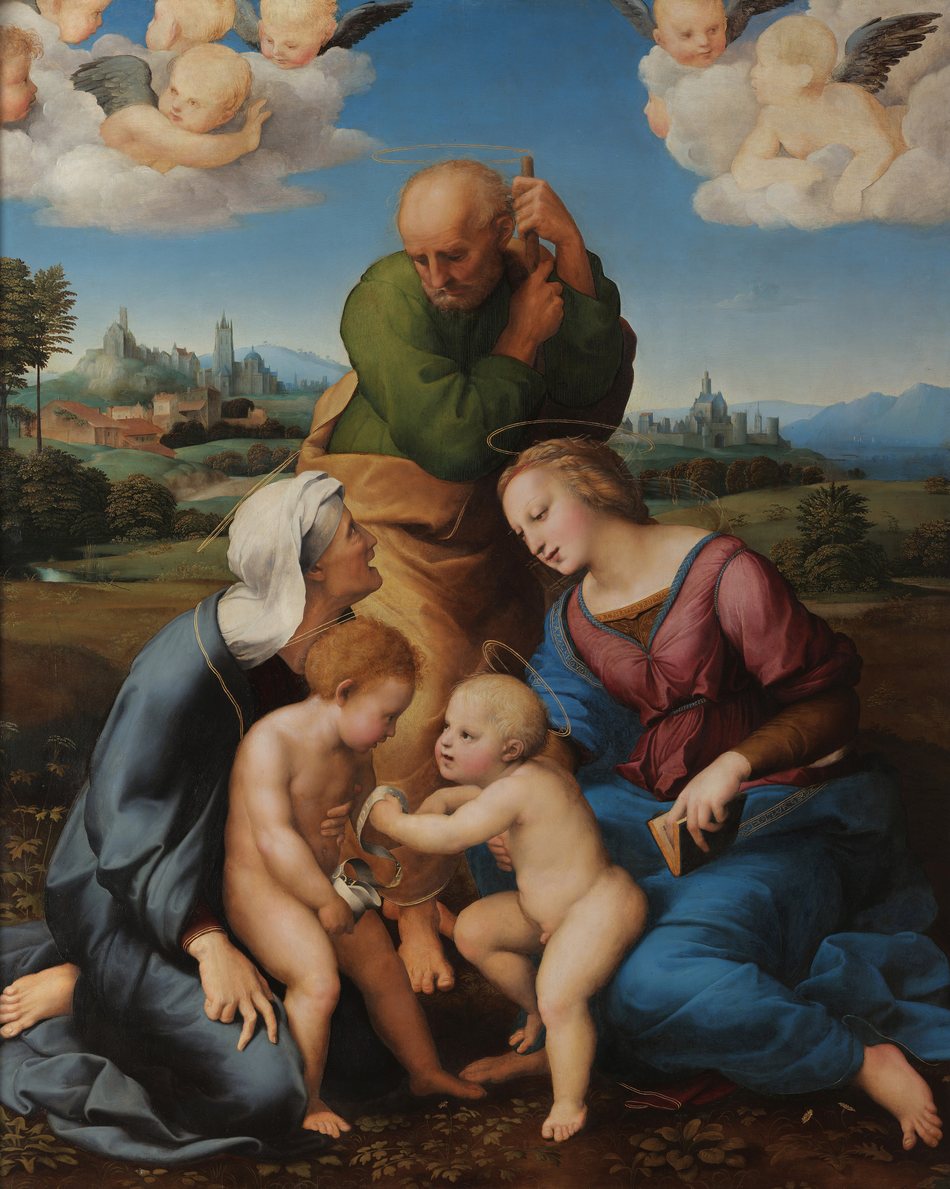
Two families arranged in a pyramid under a Florentine sky: the Virgin and St Elizabeth with the two children, Joseph leaning on his staff above them all. The putti at the top corners were painted out for centuries and only revealed again by a modern restoration.
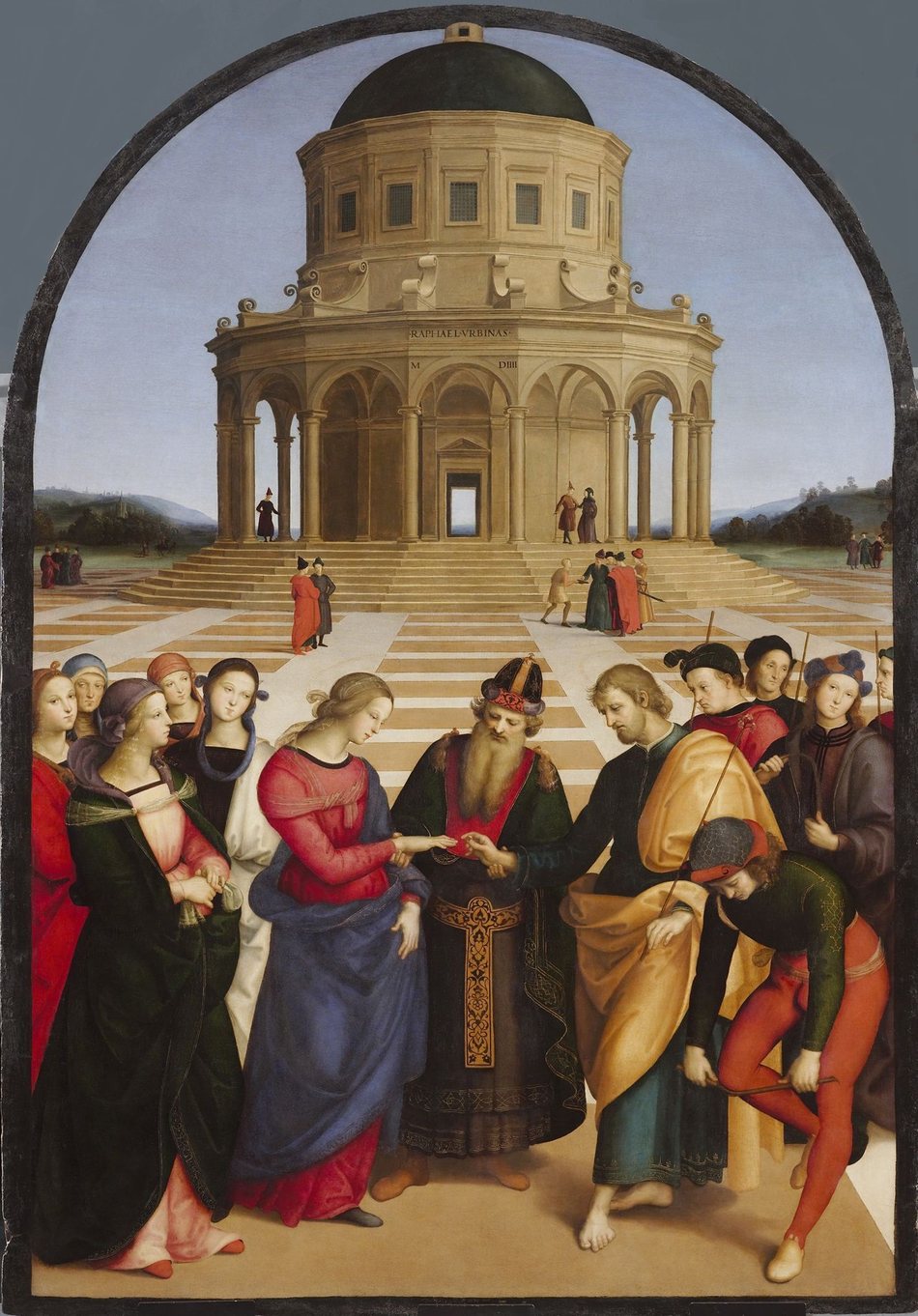
The twenty-one-year-old's manifesto: Joseph slips the ring on Mary's finger before a temple rendered in flawless perspective — a deliberate answer to his teacher Perugino's version of the same subject, and better. The disappointed suitor in front breaks his staff over his knee; the future is being decided behind him.
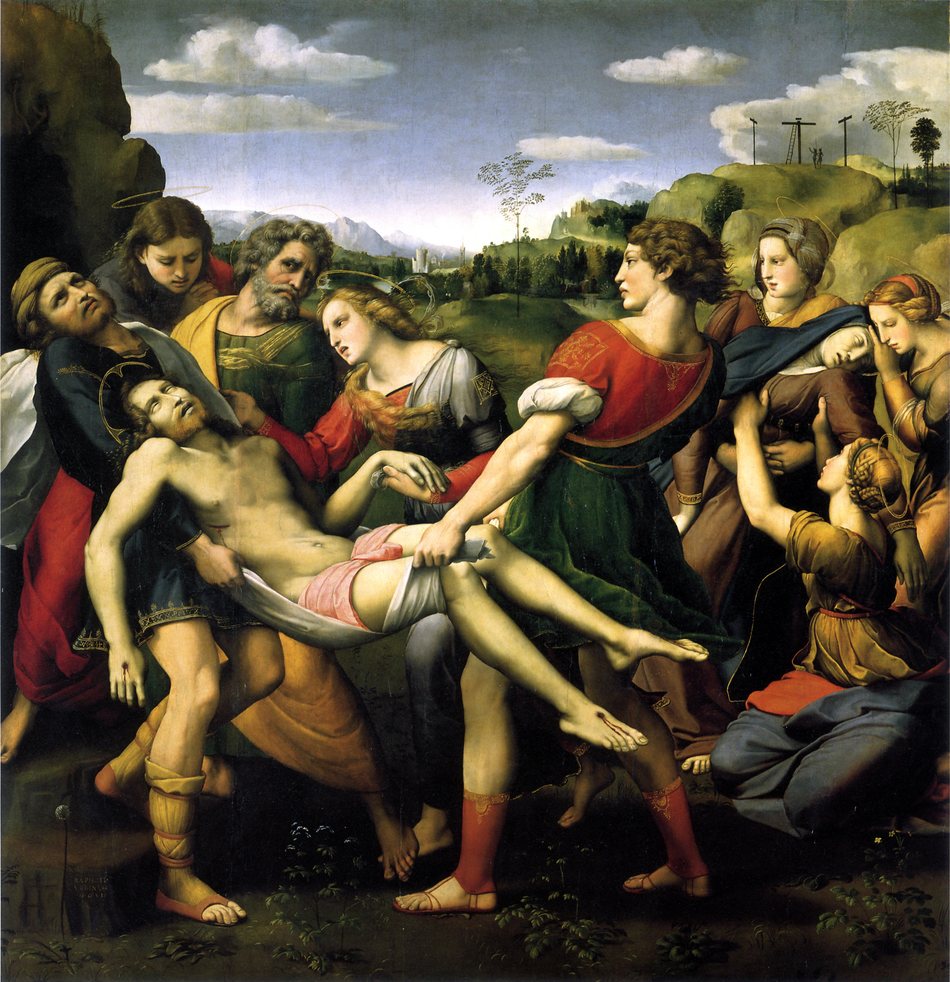
Christ's body carried across the picture like a relief in motion, the Virgin swooning at the right, every figure straining or grieving in a different key. Raphael studied Michelangelo's marble Pietà and antique sarcophagi for it — grief organised as choreography.
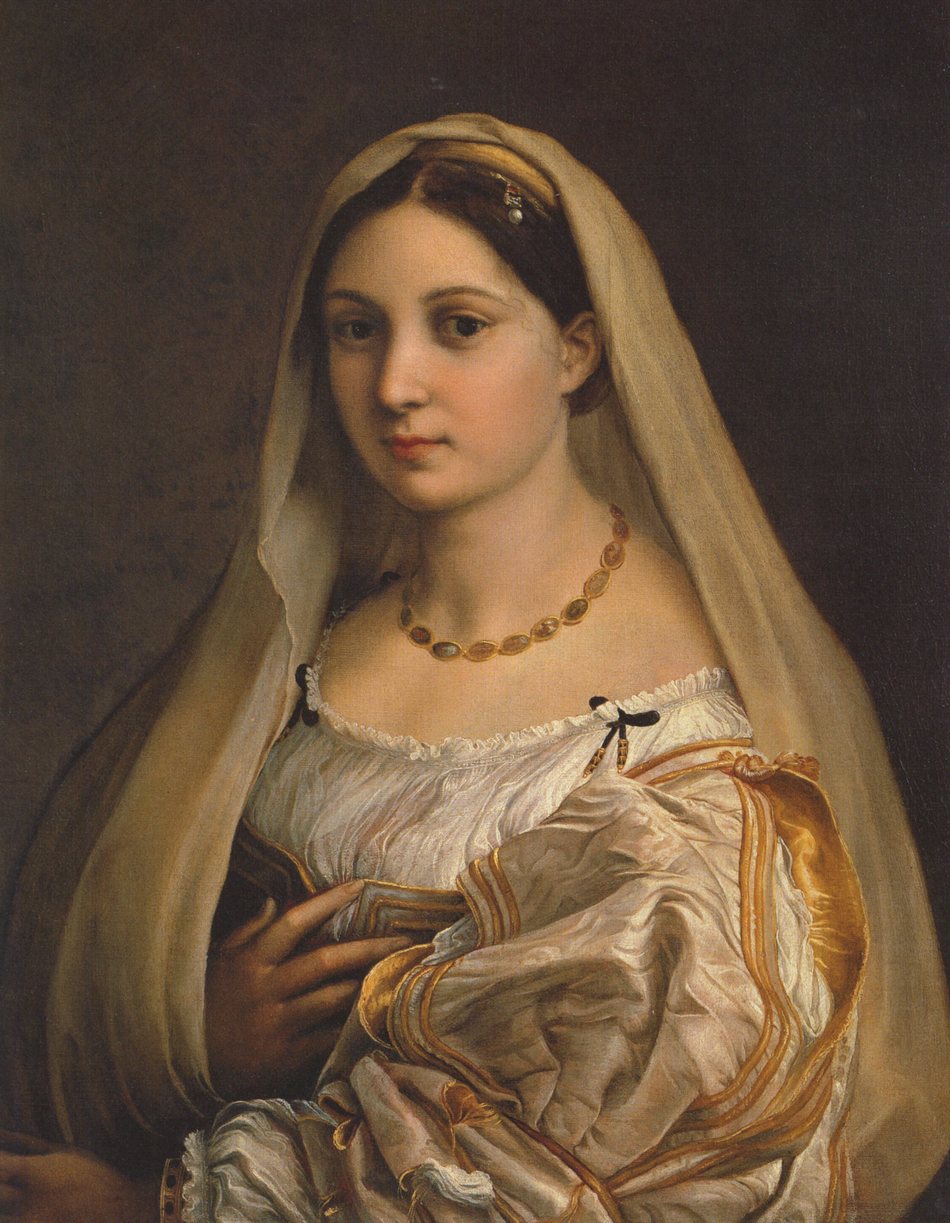
The veiled woman in silk and gold brocade, her hand on her breast — traditionally the portrait of Raphael's great love, the baker's daughter of Trastevere called La Fornarina. Whether or not the legend is true, the painting is his most intimate: no allegory, just presence.
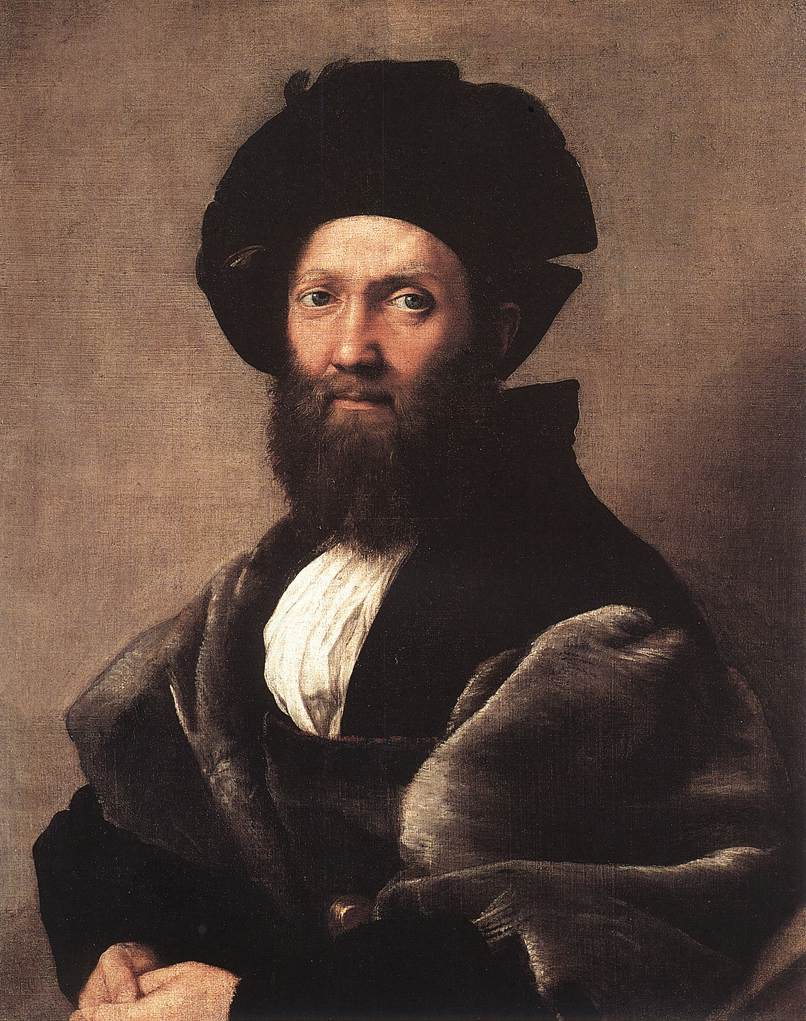
The author of The Book of the Courtier painted in greys and browns, with almost no colour at all — and yet it breathes. Rembrandt saw it and never forgot it; Titian learned from it; Matisse copied it. Portraiture's quietest masterpiece may be its most influential.
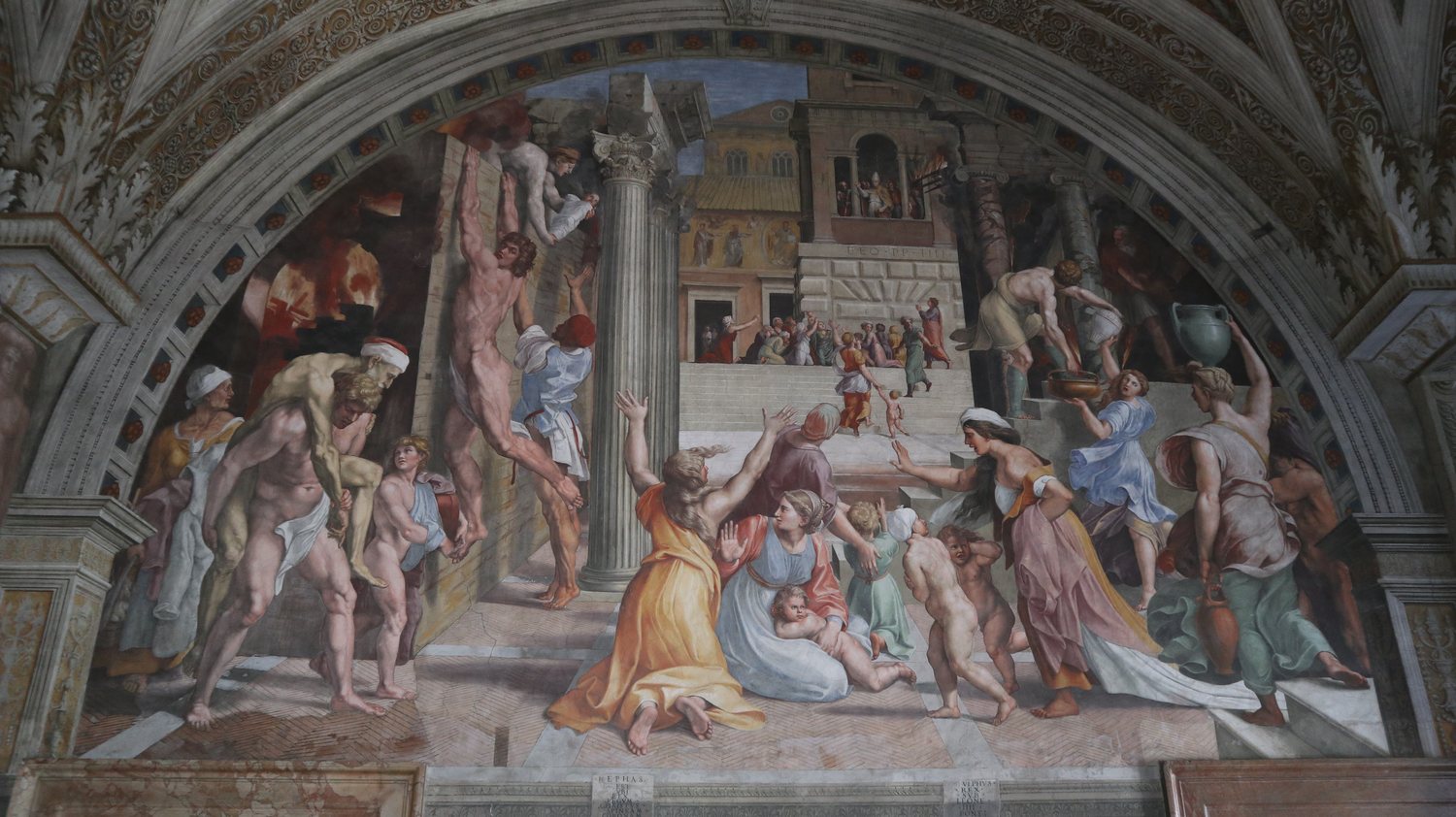
A fire in old St Peter's quarter, stopped by the Pope's blessing from a loggia — but the real subject is the crowd: women carrying water, a man lowered from a wall, Aeneas escaping with his father on his back, quoted from Virgil. Designed by Raphael, largely painted by his workshop, and none the less his.
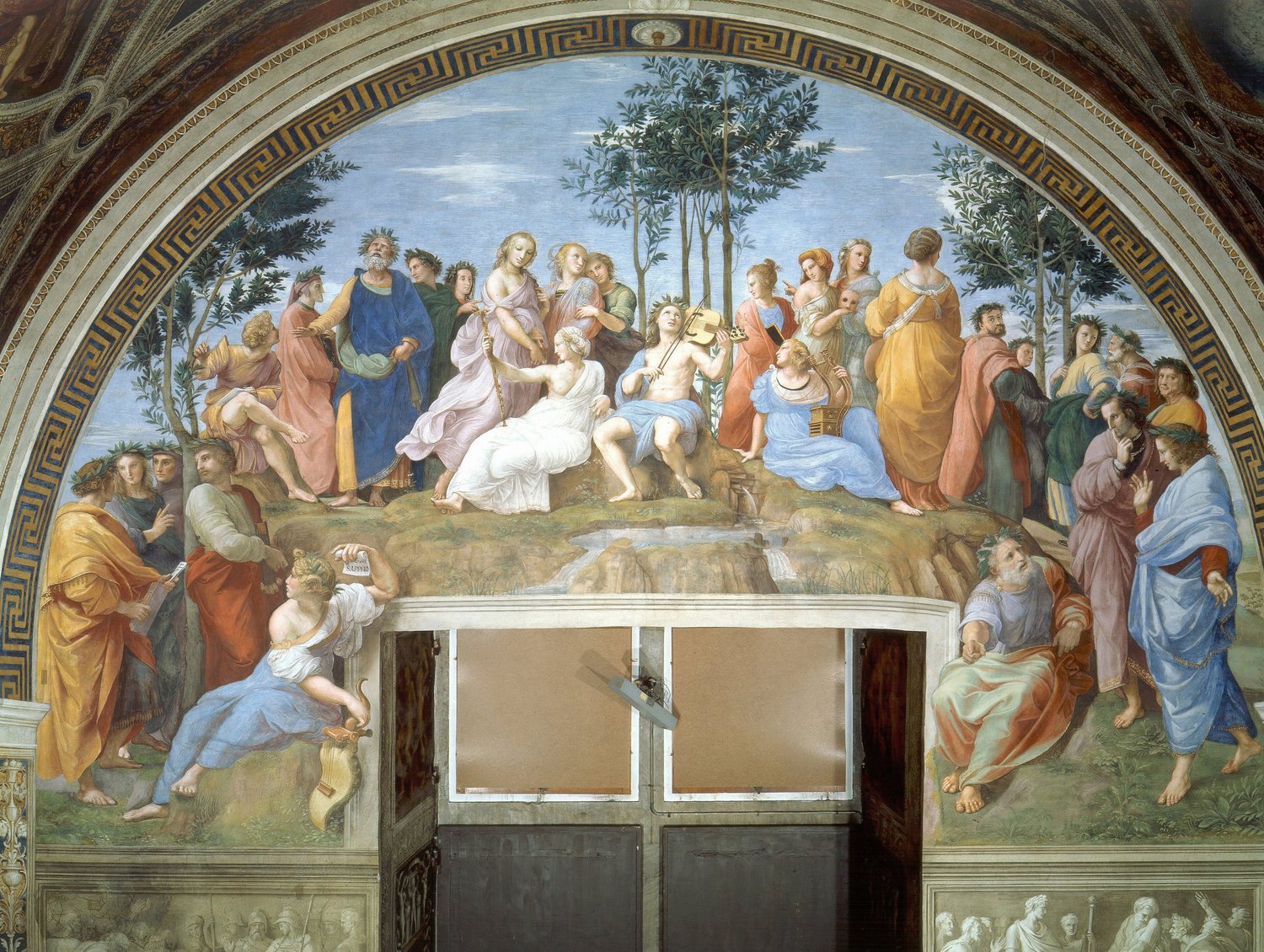
Apollo plays his lyre on Parnassus among the nine Muses and the great poets, Homer and Dante and Sappho together. The wall is pierced by a real window, and Raphael simply builds the composition around it — the poets gather above and beside the opening as if it had always been part of the mountain.
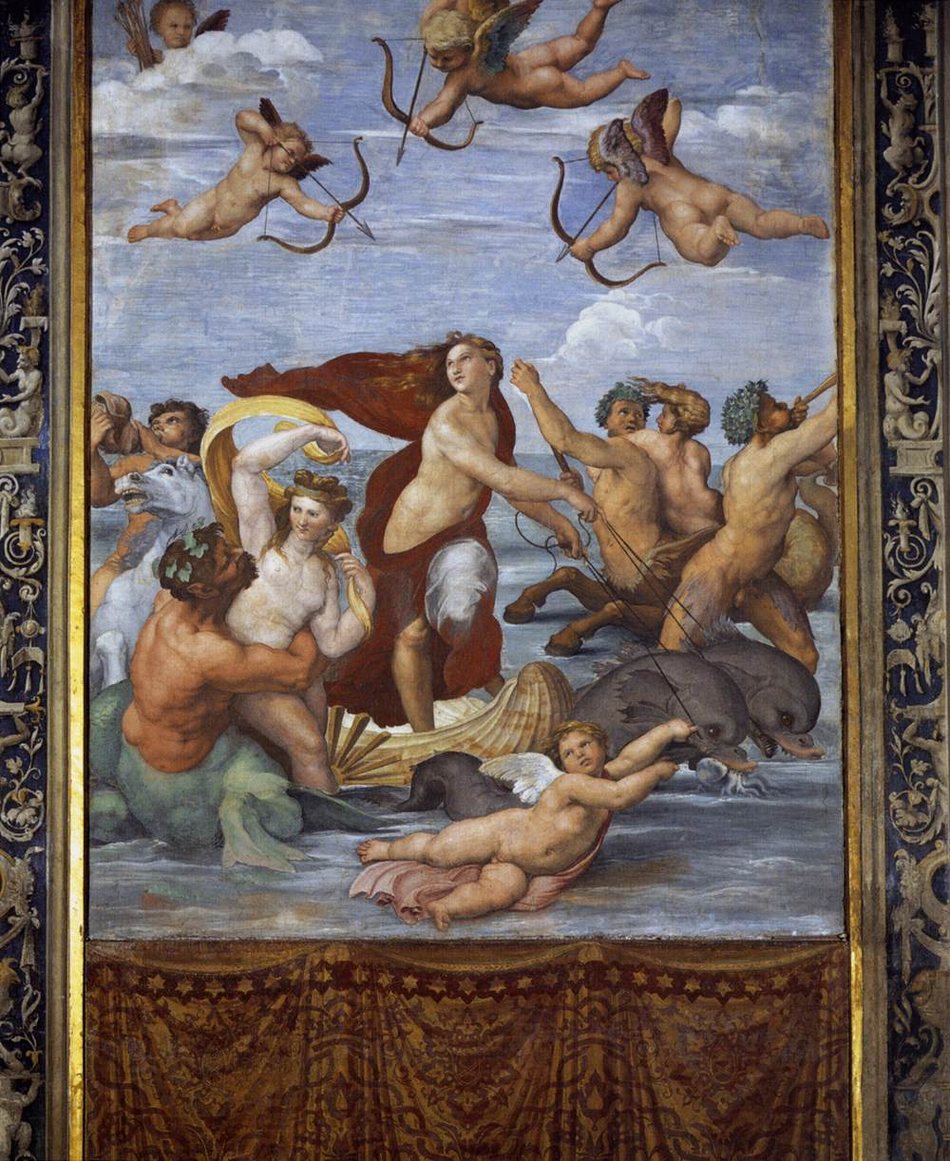
The sea nymph rides her shell chariot drawn by dolphins, tritons and nereids rioting around her, cupids aiming their bows from the sky — pure joy, painted for a banker's villa. Vasari tells that Raphael, asked where he found such beauty, answered that he painted from an idea in his mind.
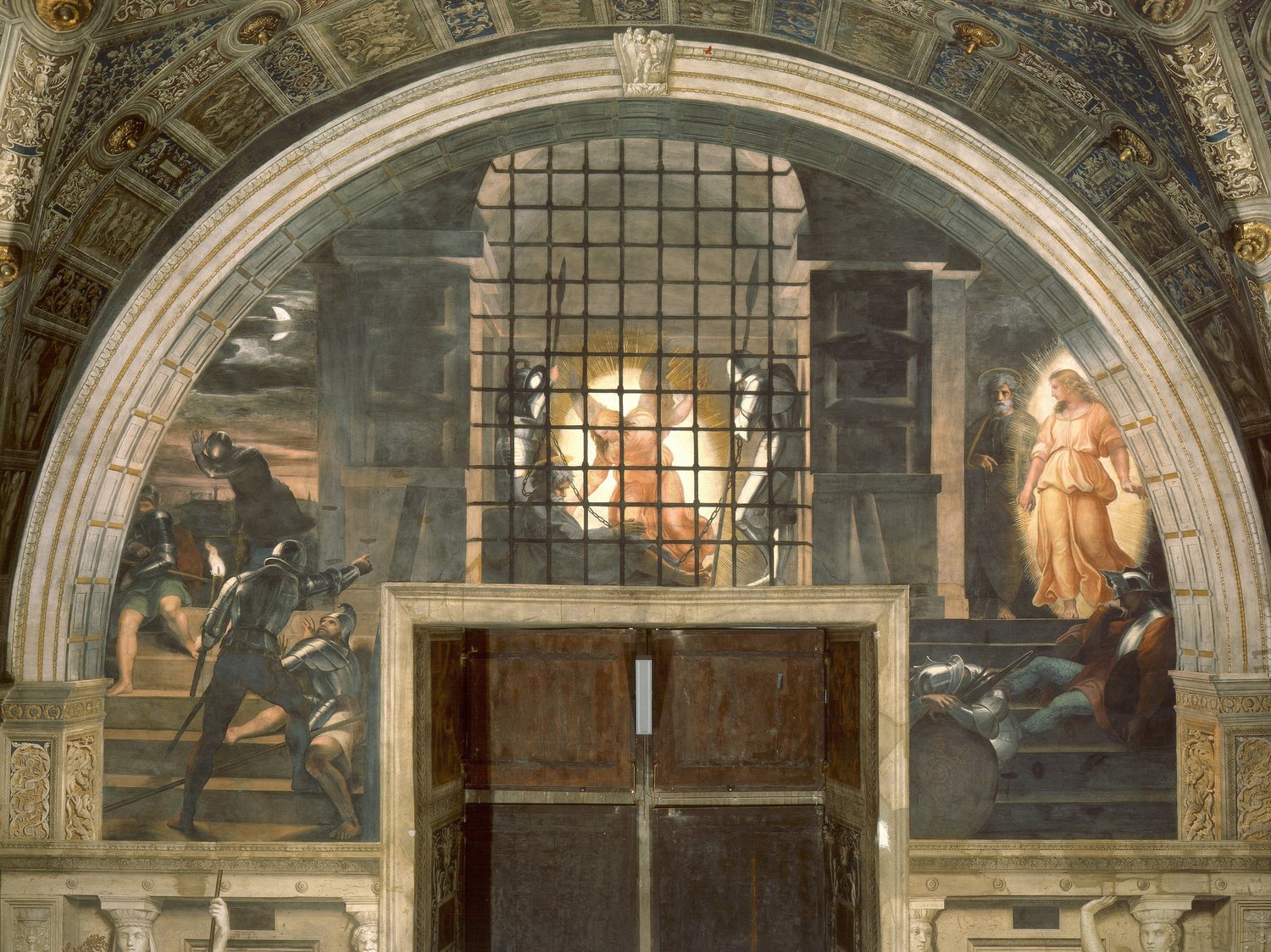
Three moments in one lunette: the angel blazing with light in the prison cell, the guards asleep, Peter led out past the sleeping soldiers, the angel vanishing on the steps. It is a fresco about light itself — moonlight, torchlight, and a radiance that outshines both.
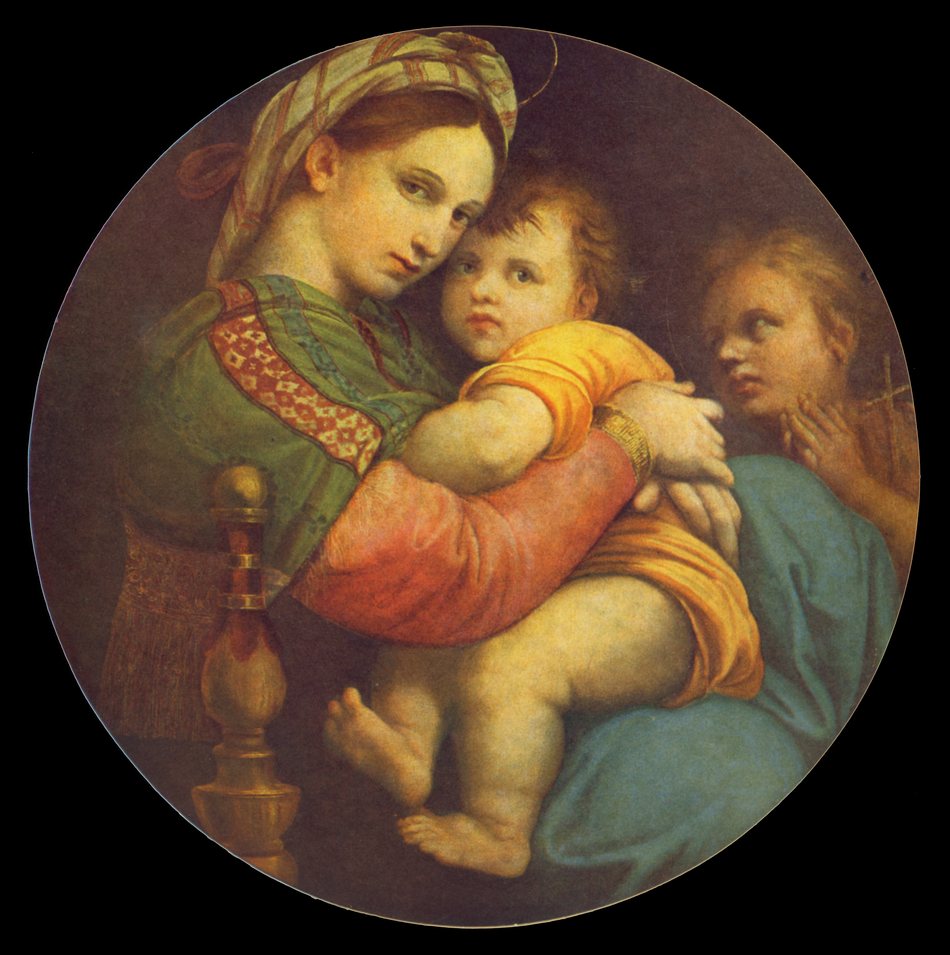
The Virgin hugs the Christ Child close on a chair-back that gives the picture its name, the little St John watching from the edge of the round frame. No landscape, no distance — the tondo is filled entirely with embrace, the most loved Madonna of the nineteenth century.
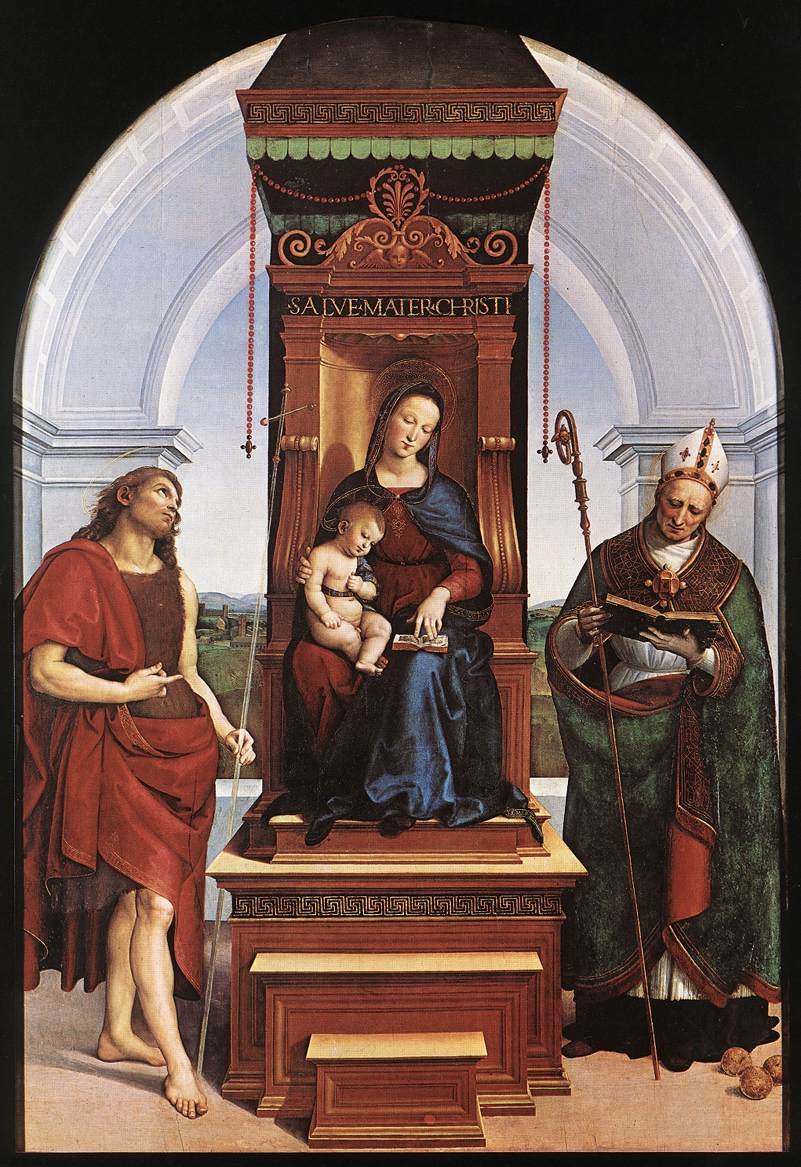
The Virgin reads on her throne between St John the Baptist and St Nicholas, under a barrel-vaulted portico of perfect perspective calm. Painted for a chapel in Perugia when Raphael was twenty-two — the serenity is already complete, only the world around it would grow larger.
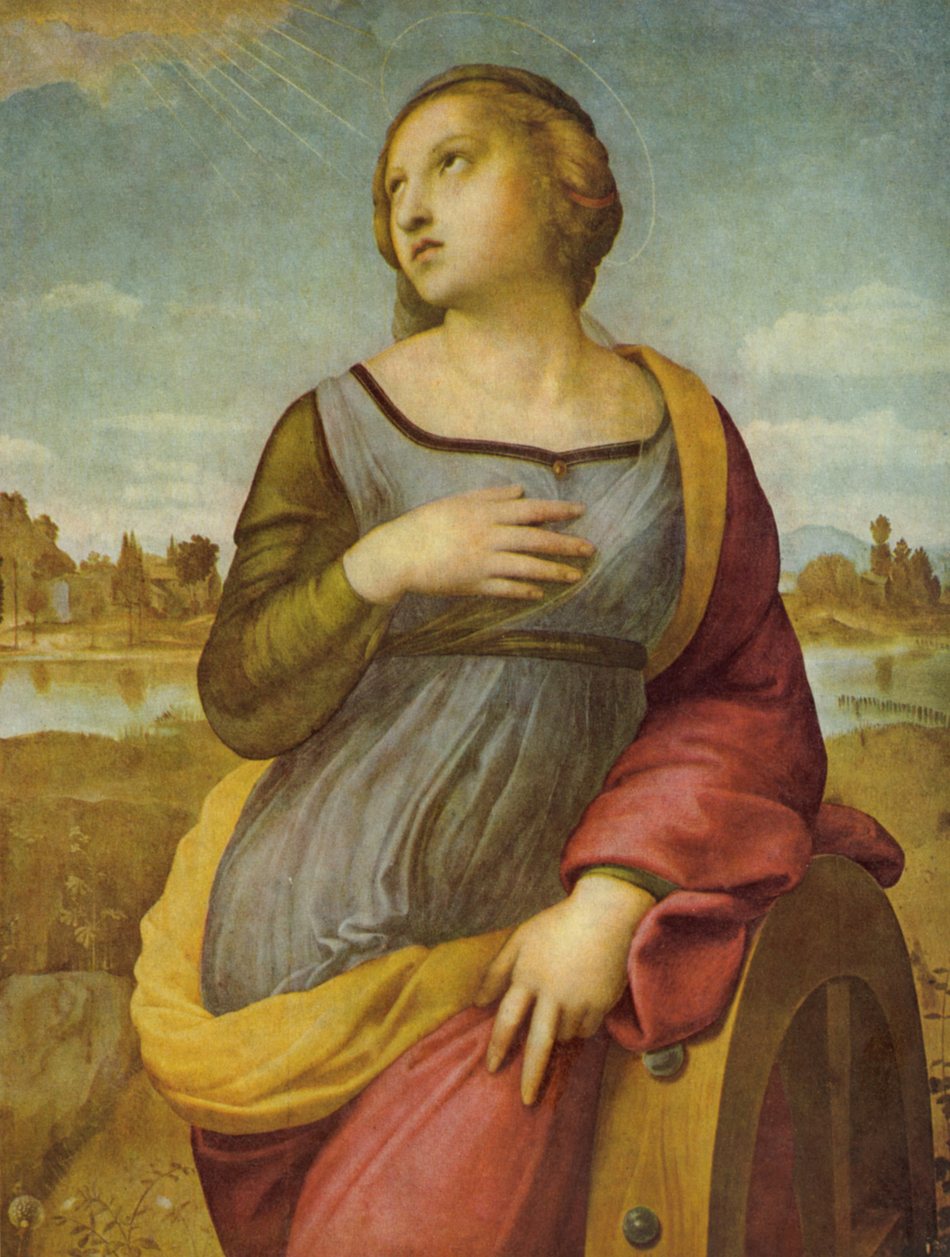
Catherine leans on her wheel and looks up in ecstasy, one hand on her breast, her body turning in a single slow spiral from head to hem. She is a Madonna's sister painted as a saint — the same face, the same grace, raised to vision.
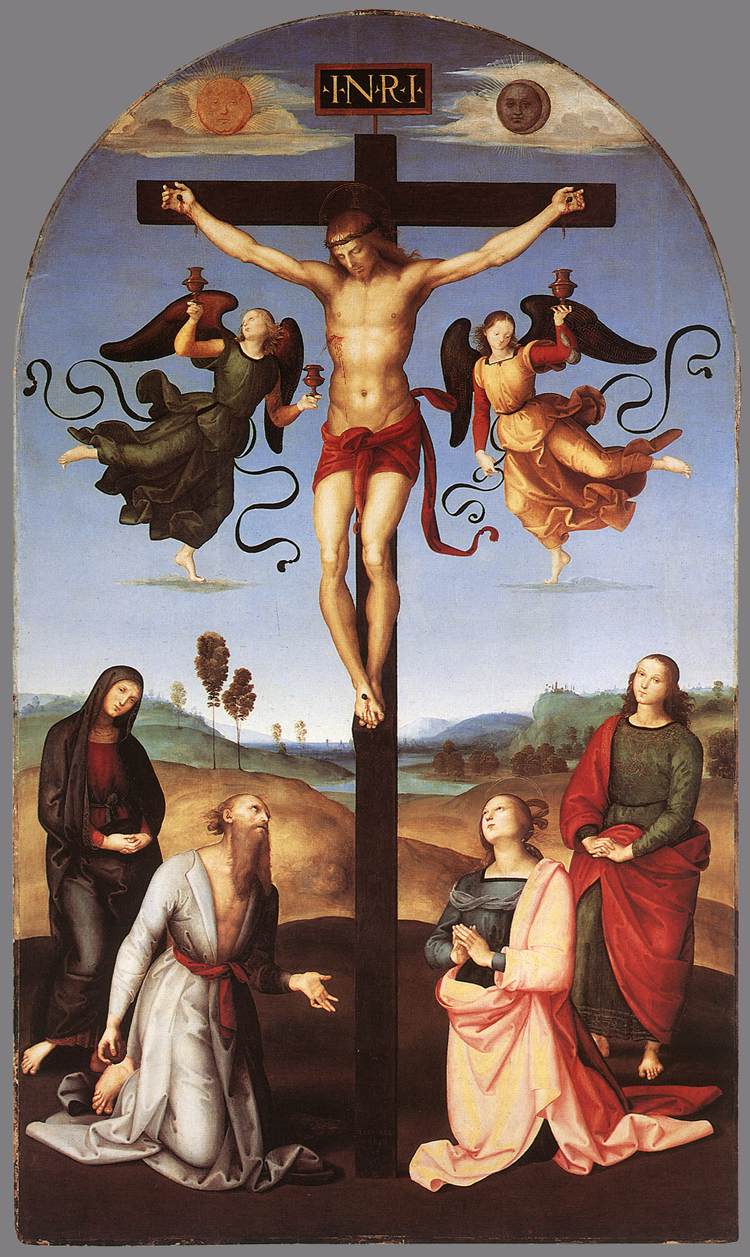
One of his earliest altarpieces, painted at about eighteen for a church in Città di Castello: Christ on the cross between two flying angels catching the blood in chalices, the sun and moon watching from above. The pupil of Perugino is still visible — and already the spacing, the air, the calm are Raphael's own.