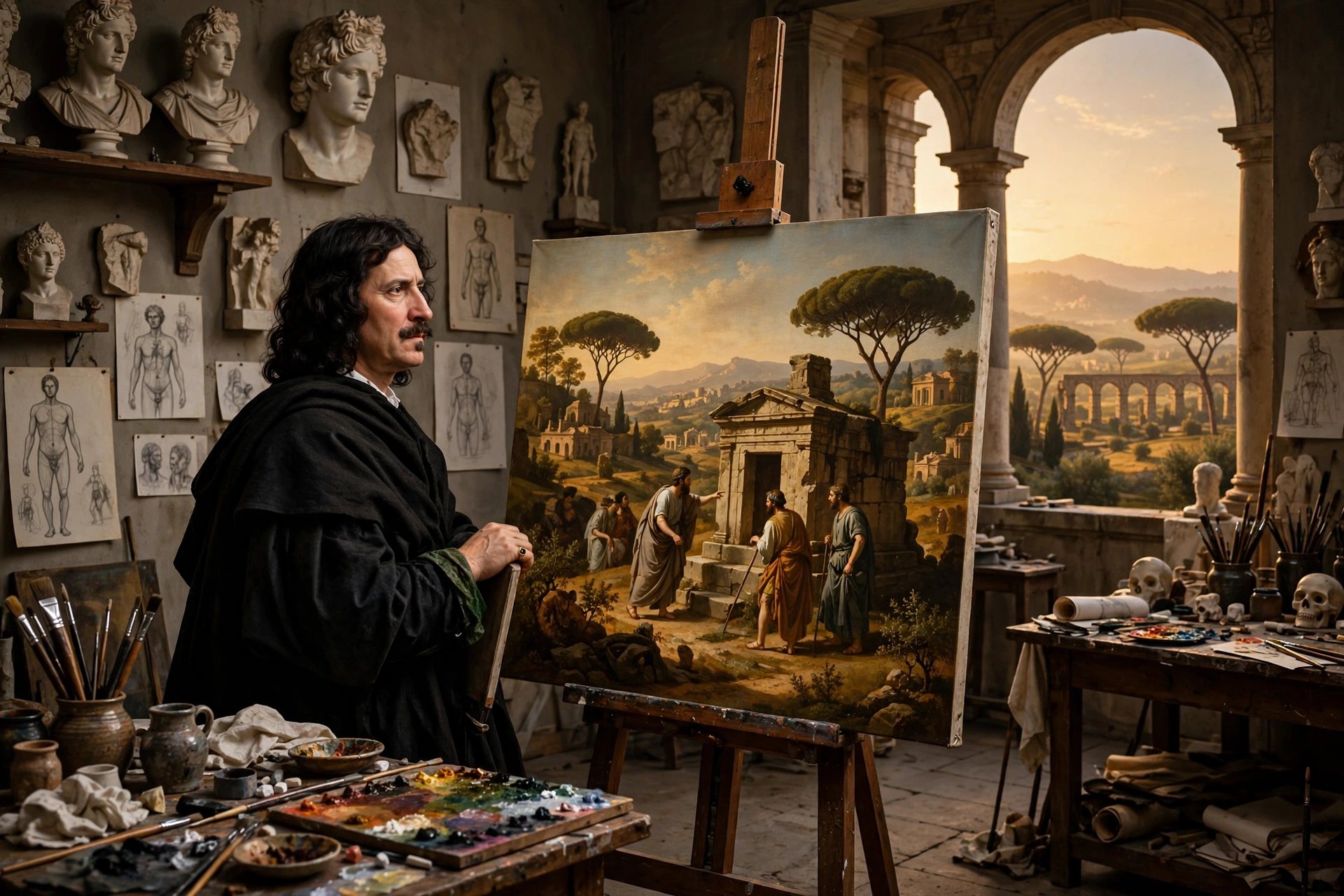
A Norman peasant's son who walked to Rome and became the most intellectual painter in Europe: Poussin composed his canvases the way a composer writes a fugue — every gesture weighed, every figure placed like an argument. Kings and cardinals collected him, French classicism was built on him, and three centuries later Cézanne still dreamed of redoing Poussin after nature.
Before touching a brush, Poussin modelled his composition in wax: small figurines, draped in wet cloth, arranged inside a little box-stage with slits for light. He moved the actors until the story read perfectly, then painted what the stage showed. It is the secret of his clarity — every canvas was first a sculpture, lit and rehearsed like a play.
In his famous letter of 1647 he explained that he composed pictures the way the ancients composed music — in modes. A terrible subject demanded the harsh Dorian manner, a joyful one the lively Ionian; the Plague of Ashdod and the Arcadian shepherds differ not only in story but in key. No painter had ever theorised his own practice so completely.
He insisted a painting must be read, not merely seen: the eye travels from figure to figure as along a line of text, and the gestures are its words — a hand raised in command, a body recoiling, a finger tracing letters on a tomb. His canvases reward the slow viewer the way a page rewards a reader; nothing in them is decoration.
He arrived in Rome in 1624 and spent nearly forty years measuring antique statues, drawing ruins at dawn and studying anatomy, Raphael and Titian. The city's stones became his vocabulary: temples, tombs, aqueducts and toga'd figures people even his biblical scenes, until antiquity looked less like a costume than like his native country.
In old age his hand shook so badly that assistants ground his pigments and he could barely sign. Yet the late work — above all the Four Seasons — turns the tremor into light itself: paint laid in small, vibrating touches, so that foliage shimmers and storm-water glitters. The infirmity became the style; the Seasons are painted by a shaking hand and hold perfectly still.
While Bernini's Rome swirled and Rubens' Antwerp blazed, Poussin stood for line, measure and reason — drawing first, colour as servant. The quarrel he started, Poussinistes against Rubénistes, organised French art for two centuries. His cool, enamelled surfaces are not coldness: they are passion passed through the intellect, and felt the longer for it.
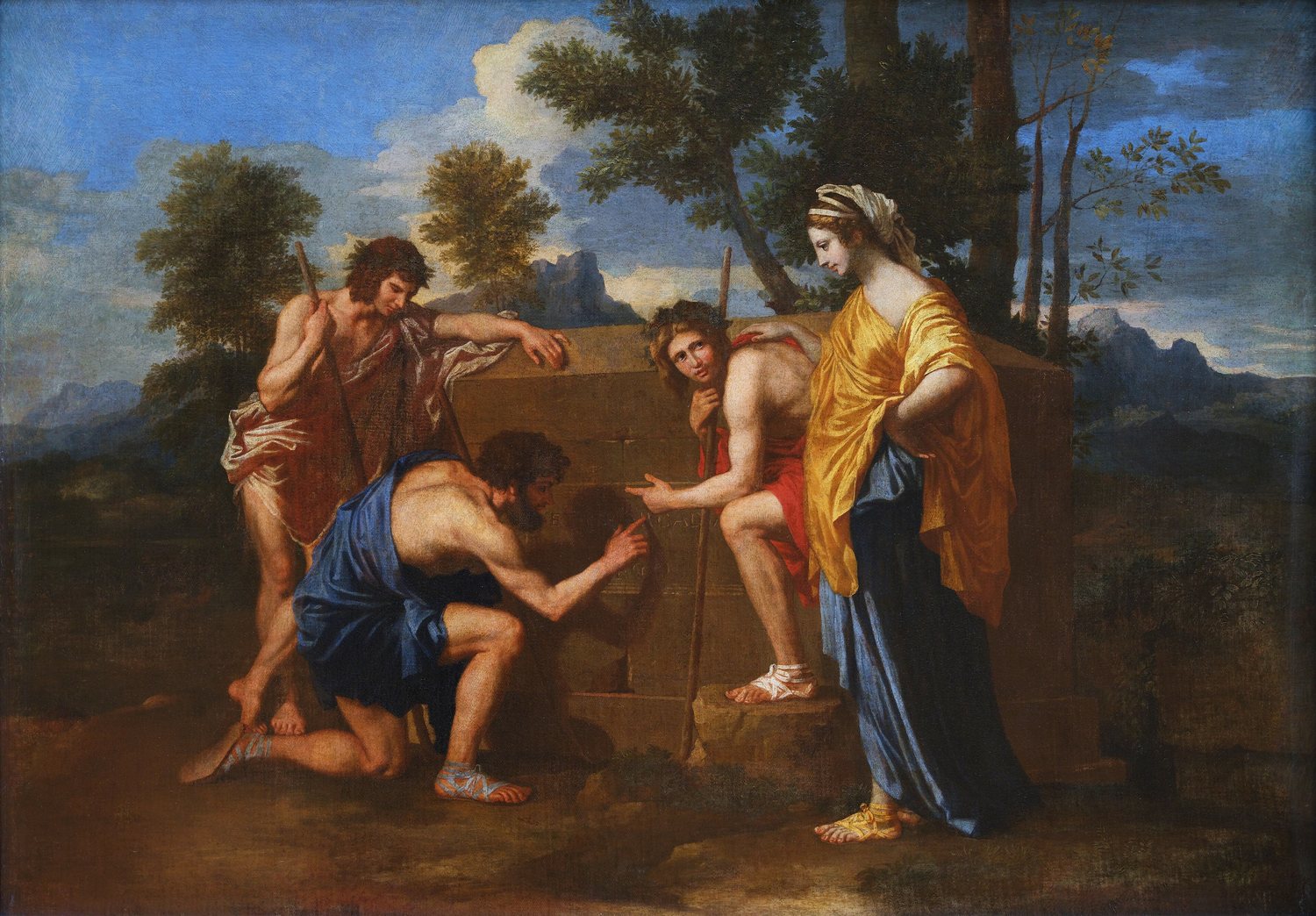
Shepherds in a golden Arcadia stop before a tomb and trace its inscription: Et in Arcadia Ego — even here, Death says, I am. One shepherd kneels to read, another turns to a woman who listens like a statue come alive. It is the most famous meditation on mortality ever painted, and the calmest: grief arranged like music.
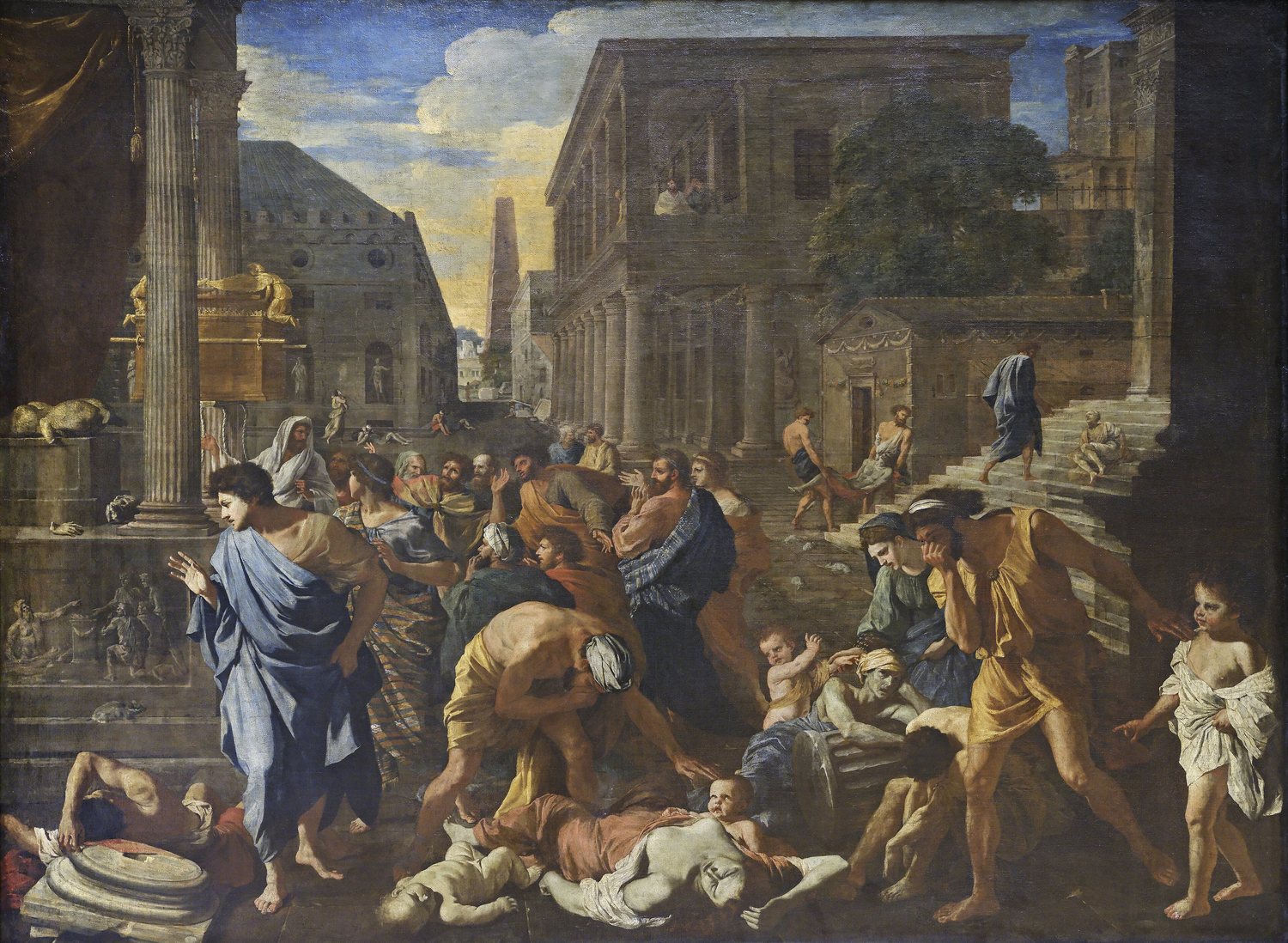
The Philistines, who stole the Ark of the Covenant, are struck by plague: the dead mother, the child pushed away from her breast, men pinching their noses against the stench, rats in the street. Painted while plague was in Italy, it made his Roman reputation — horror organised with the discipline of a stage tragedy.
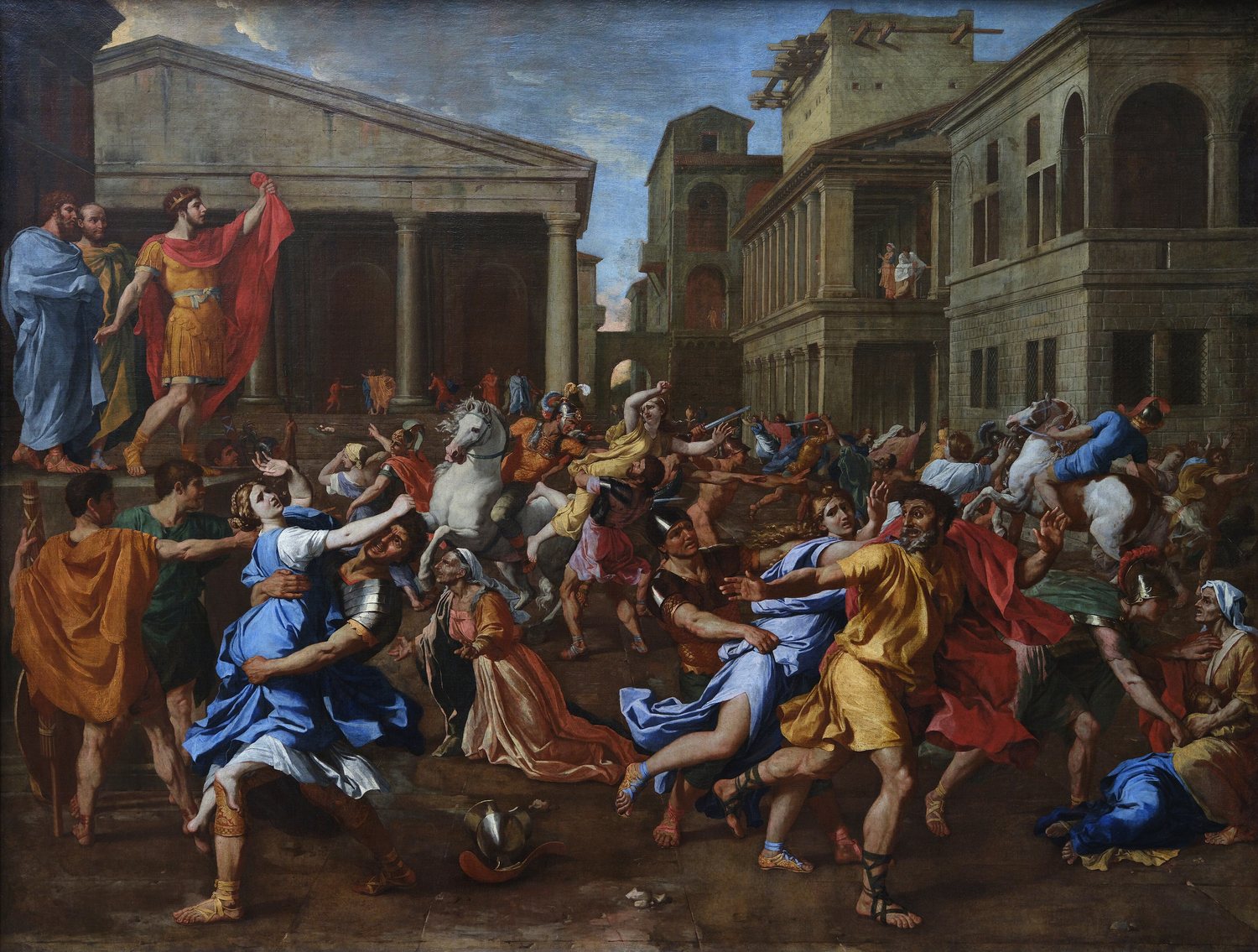
Romulus raises his cloak — the signal — and Rome's young men seize their guests' daughters in a square of perfect classical architecture. Poussin choreographs the violence like a ballet: every struggling group is a sculpture, every gesture legible, the horror held inside a composition of marble calm.
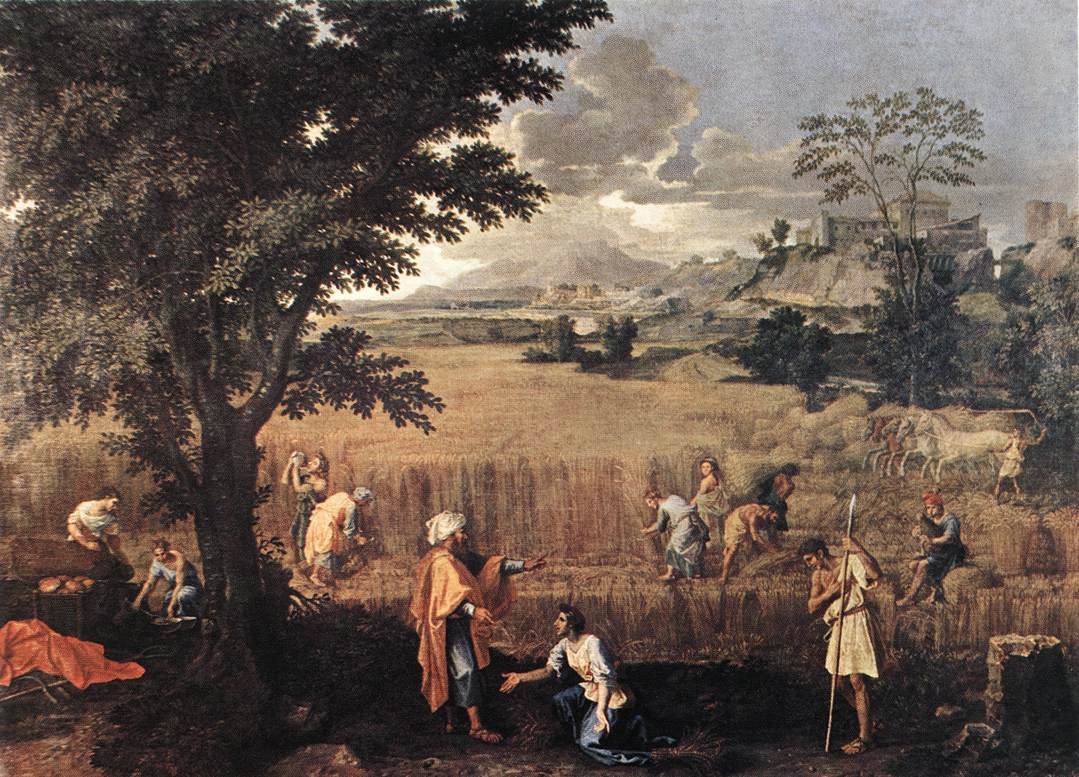
From the Four Seasons of his last years: Ruth gleans in Boaz's cornfields under a huge tree, the harvest spread across a golden plain to a distant sea. The biblical episode is small inside the landscape — the real subject is summer itself, ripeness and heat held in a design of absolute serenity.
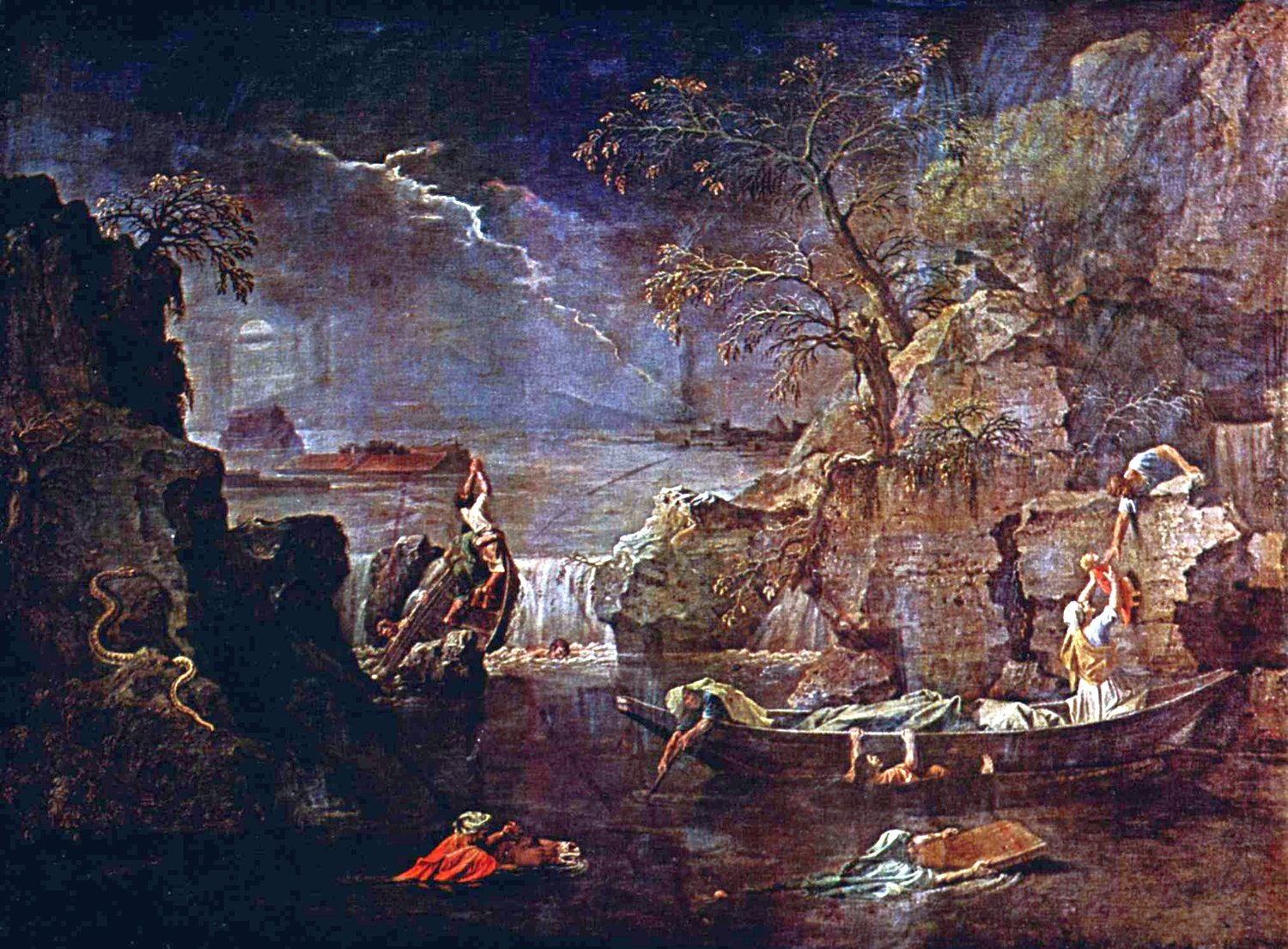
The Deluge as winter's face: lightning splits a black sky, a boat of survivors rocks among drowning horses and a serpent coils on the rock. Painted by an old man with a trembling hand, it is the most terrifying of the Seasons — the world ending not with fire but with cold water and darkness.
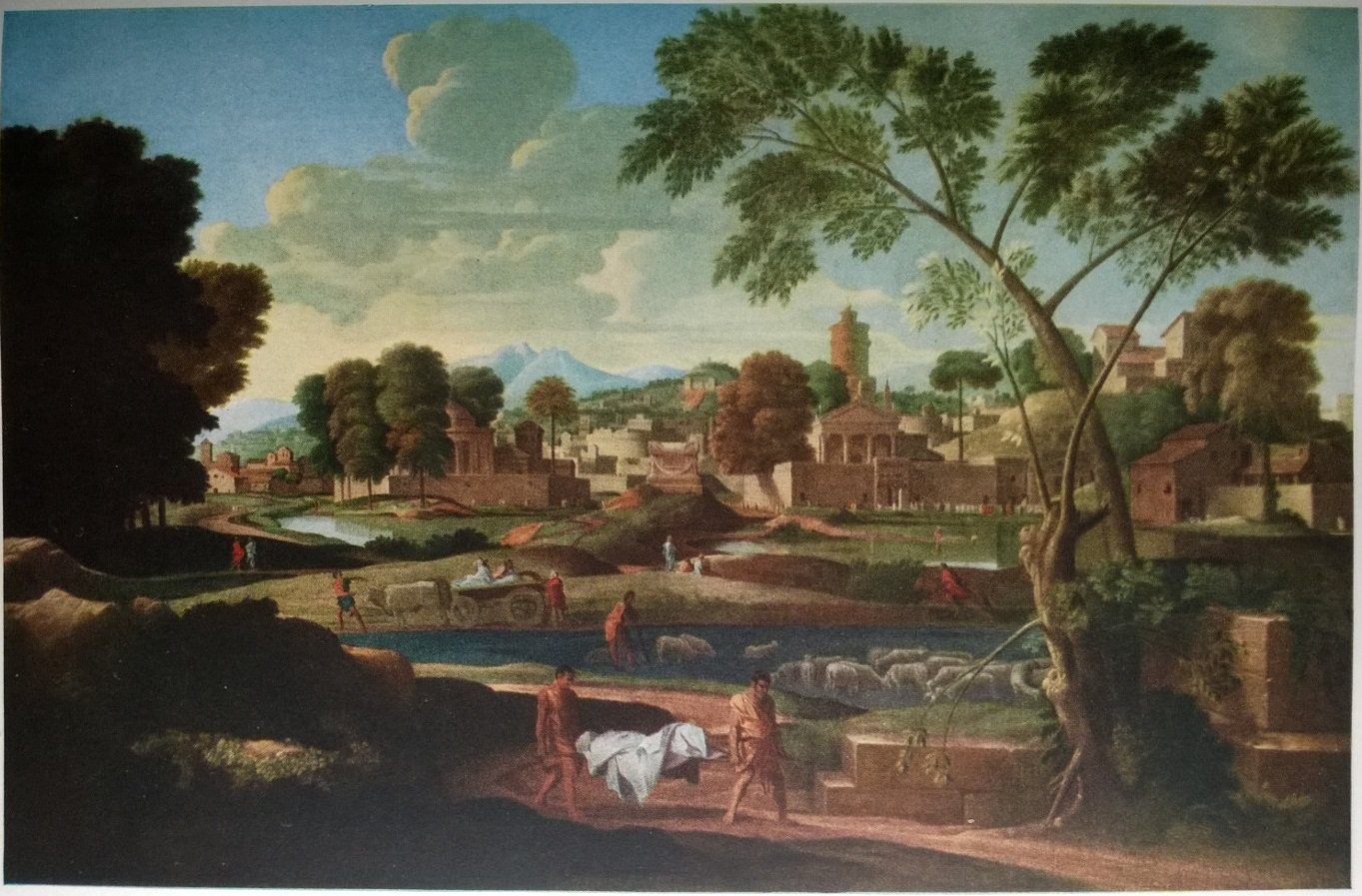
The honest Athenian general, condemned and denied burial in his own city, is carried out on a bier through a vast, indifferent landscape — two slaves with the corpse, and nature in full spring around them. The figures are tiny; the landscape is the mourner. Poussin's stoicism at its purest.
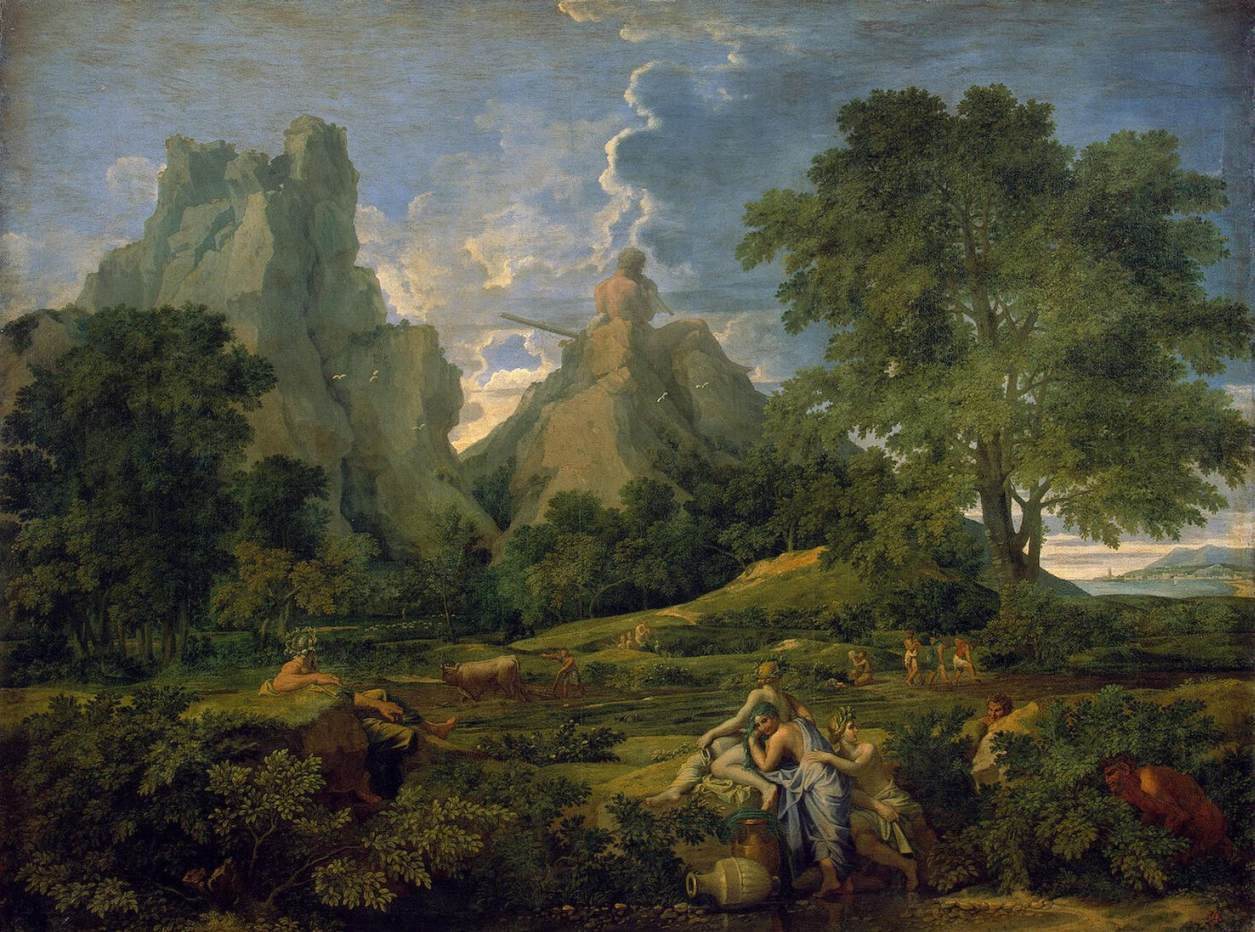
The giant Polyphemus sits high on his crag playing the pipes for the sea-nymph Galatea, while ploughmen and herds go about a fertile valley below, unaware. Myth shrunk to a detail inside a great ordered nature — Poussin's heroic landscape, where even a monster becomes part of the harmony.
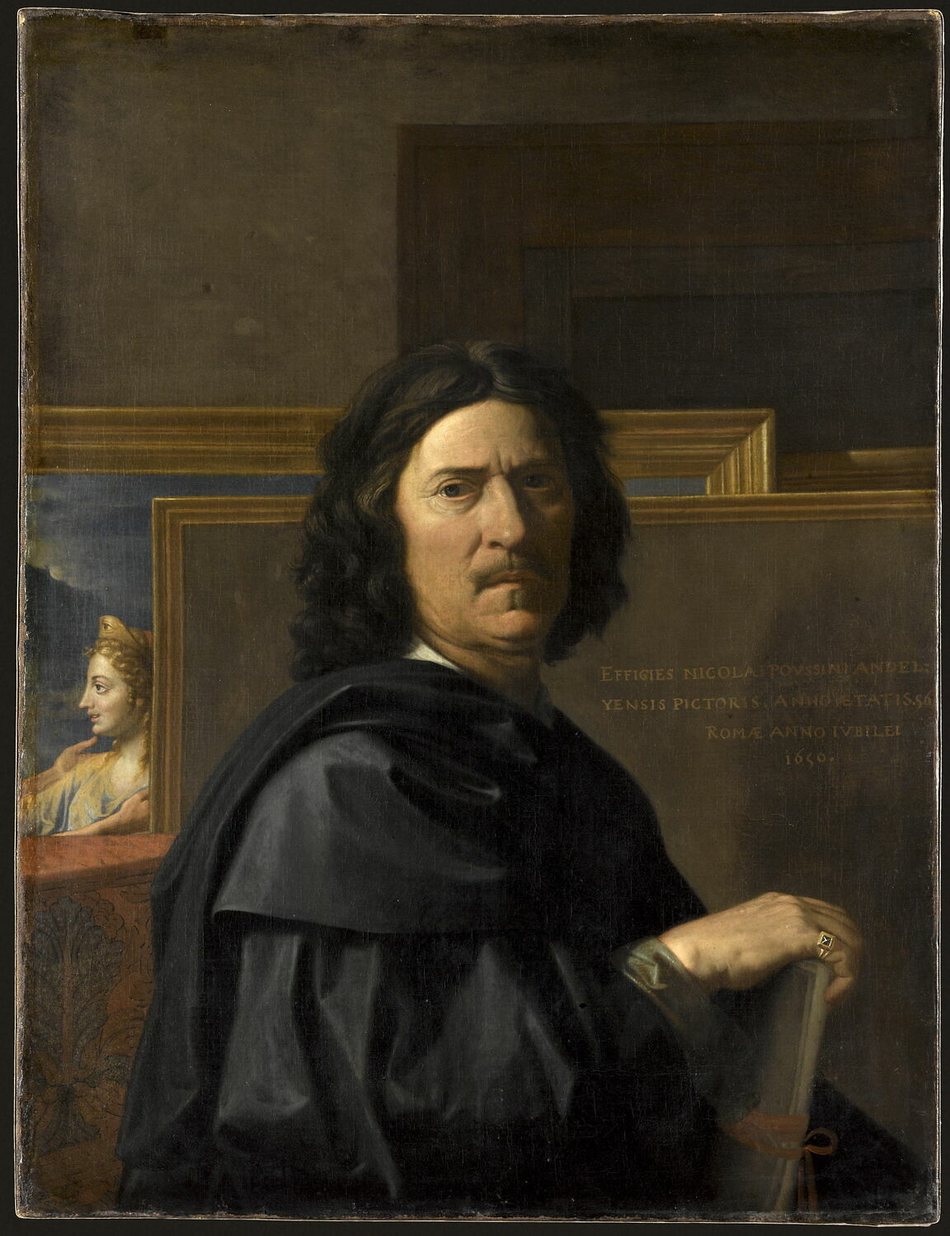
Painted at fifty-six for his patron Chantelou, after long refusal: he shows himself in a dark robe before stacked canvases, one bearing a woman's figure — an allegory of Painting — and an inscription in Latin: a portrait of Nicolas Poussin, painted by himself at Rome, in the jubilee year 1650. The severe face gives nothing away; the picture is the man.
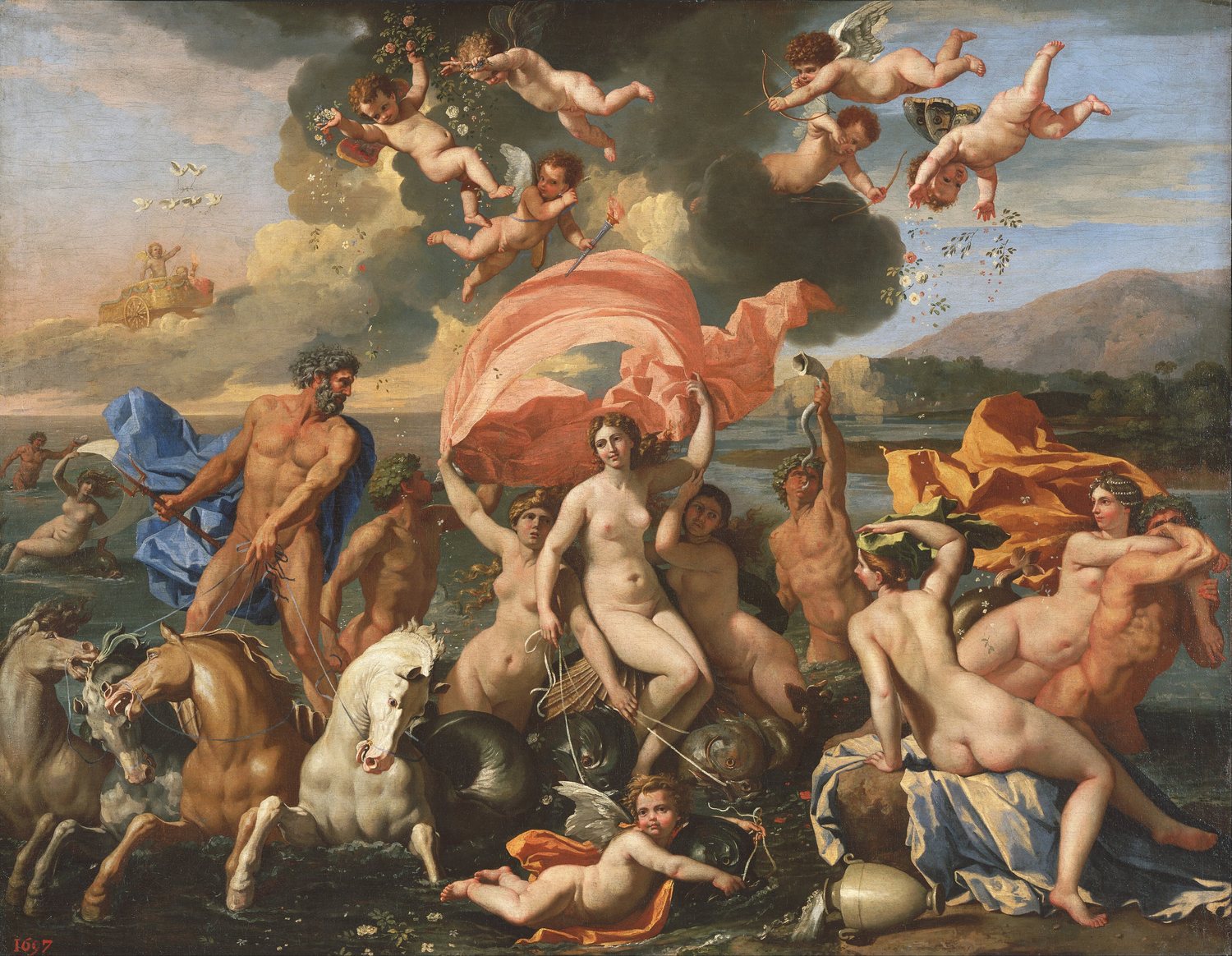
Venus rides in triumph over the sea on a shell-barge of dolphins and sea-gods, putti scattering flowers from the clouds — the most joyful of his mythologies, painted for Cardinal Richelieu's circle. Even ecstasy, in Poussin, keeps its measure: the revel is arranged like a procession on a frieze.
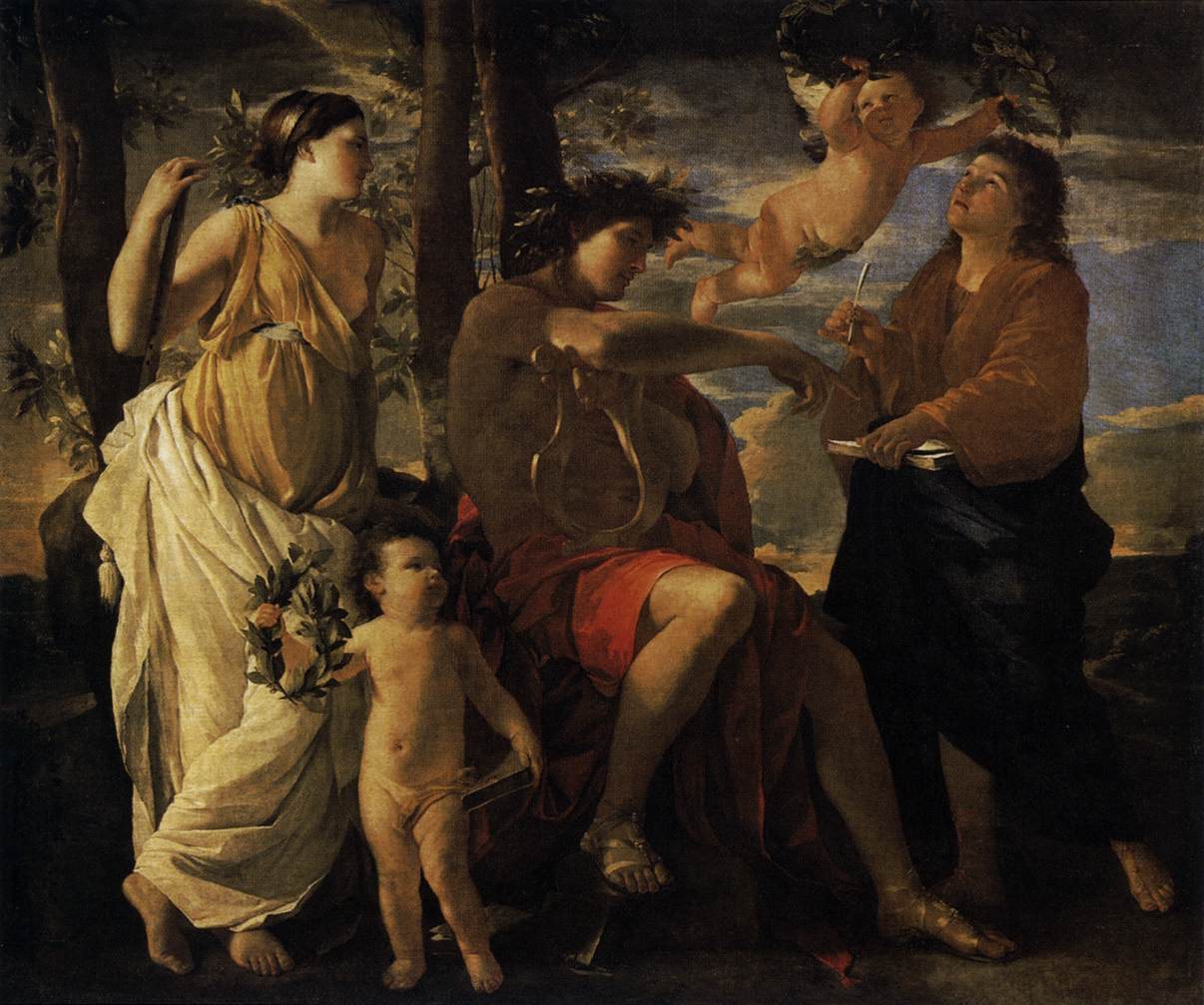
An early Roman canvas: Apollo, laurel in hand, dictates to a young poet who writes in a great book, while a putto brings more wreaths and a muse looks on. It is Poussin's own manifesto at twenty-five — poetry and painting as twin arts, inspiration received not in frenzy but in attention.