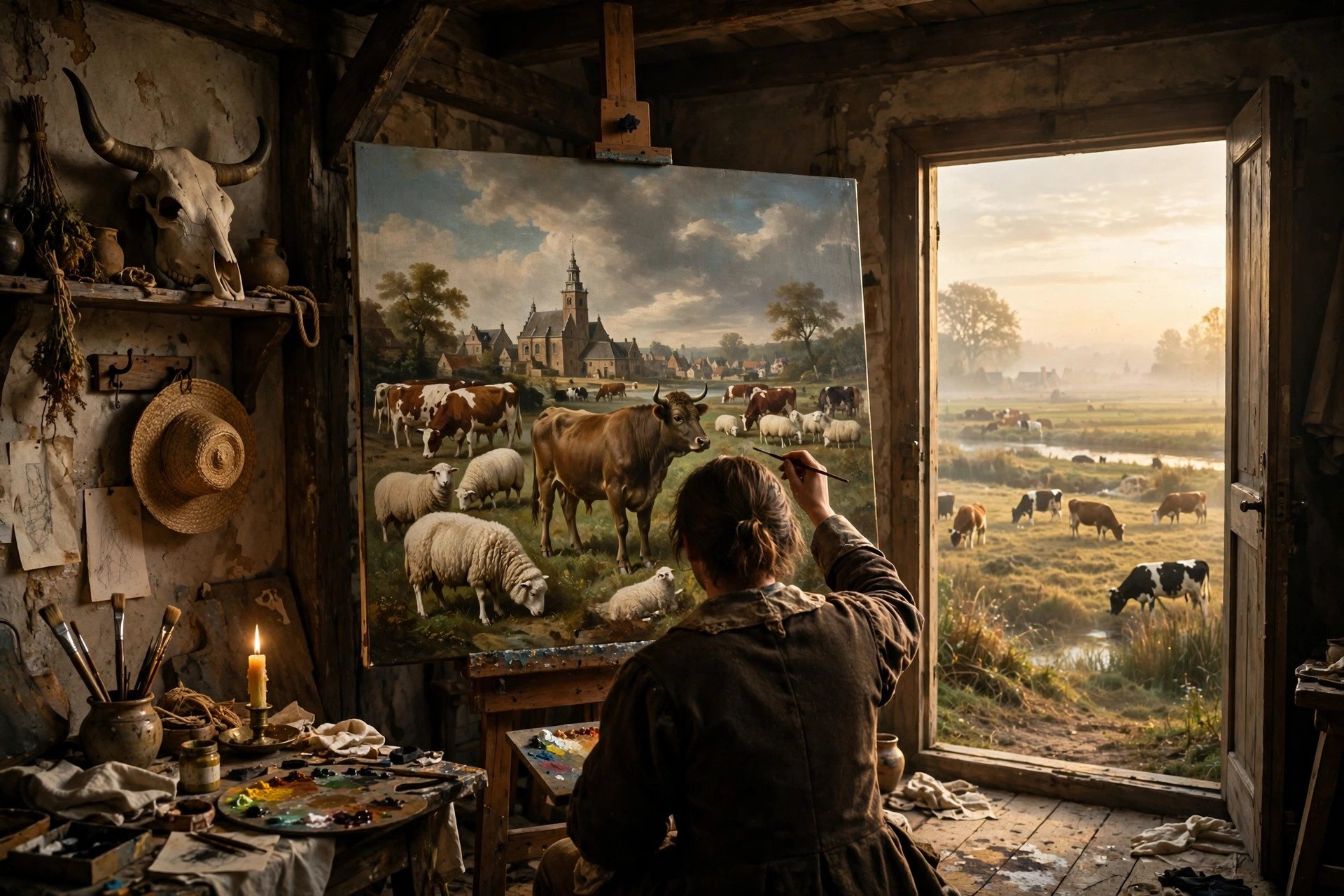
He died at twenty-eight, leaving barely a hundred pictures — and the most famous animal in Dutch painting. Potter painted cattle the way others painted kings: life-size, from life, with every hair, fly and dewdrop in place, under skies that take half the canvas. A meadow, for him, was a court.
The Young Bull of 1647 is painted at the size of the animal itself — Potter was twenty-one. He worked outdoors with a sketchbook among the herds outside The Hague and Amsterdam, drawing cows from every side, and built his pictures in the studio from those studies. Contemporaries found the scale almost indecent for so low a subject; within a generation it was the most admired picture in Holland.
Potter's paint is thin, smooth and enamel-like, the brushwork all but invisible. On the Bull's flank you can count hairs, see the flies settle, the wet shine on the muzzle, the frog at the meadow's edge. This finish comes from working wet-in-wet in fine layers over a light ground — a jeweller's technique applied to dung, mud and hide.
In picture after picture the horizon sits low and the sky takes the upper half — not empty, but studied: cumulus building, rain travelling, light breaking in shafts. Potter learned the tonal sky from Jan van Goyen, his neighbour in The Hague, and sharpened it: his clouds have weather in them, and the cattle below are lit by a specific hour.
Potter etched as beautifully as he painted: series of horses, cows and the famous frieze of animals, printed and reprinted for two centuries. The etchings carried his cattle into farmhouses and studios across Europe — for many collectors abroad, Potter was known from the prints long before a painting was ever seen.
In 1795 French troops took The Young Bull from The Hague to Paris as war booty, where it hung in the Louvre for twenty years — the Dutch cow among the Raphaels, admired by every artist in Europe. It came home in 1815 to the Mauritshuis, where it hangs today, still the largest animal portrait of the seventeenth century.
Tuberculosis killed him in January 1654, weeks after his twenty-eighth birthday and his marriage into the Amsterdam regent family of Dirck Tulp. The small oeuvre — around a hundred paintings — was complete in seven working years. Animal painting never went back: for two hundred years, every painter of cattle in Europe worked in Potter's meadow.
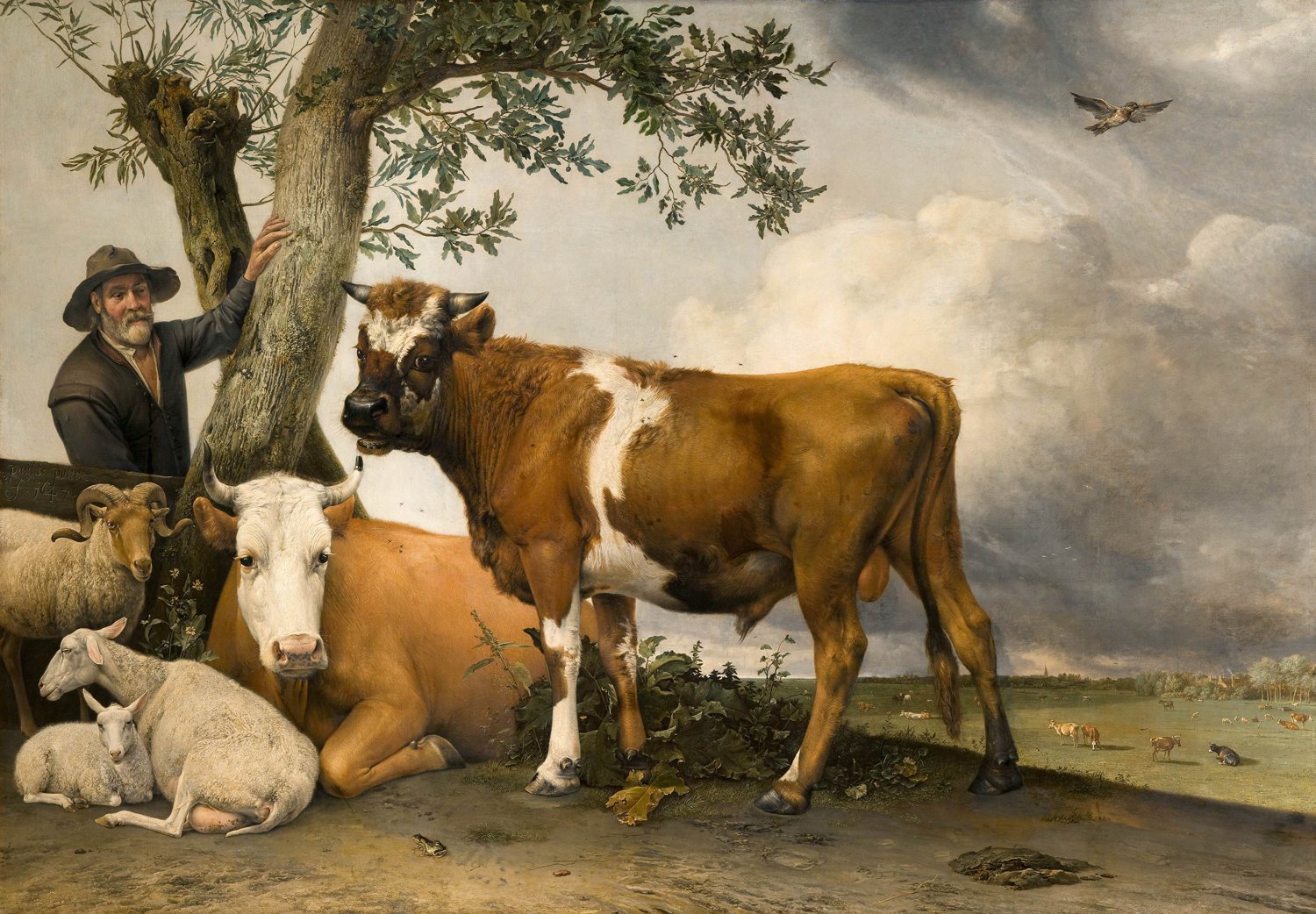
The most famous farm animal in art: a young bull at life size, a cow lying beside him, a sheep and lamb in front, the farmer leaning on his tree, a lark rising into an enormous sky. Potter was twenty-one. Everything is observed — the flies, the frog at the lower edge, the dung, the wet nose — and everything is composed, a royal portrait group translated into a meadow.
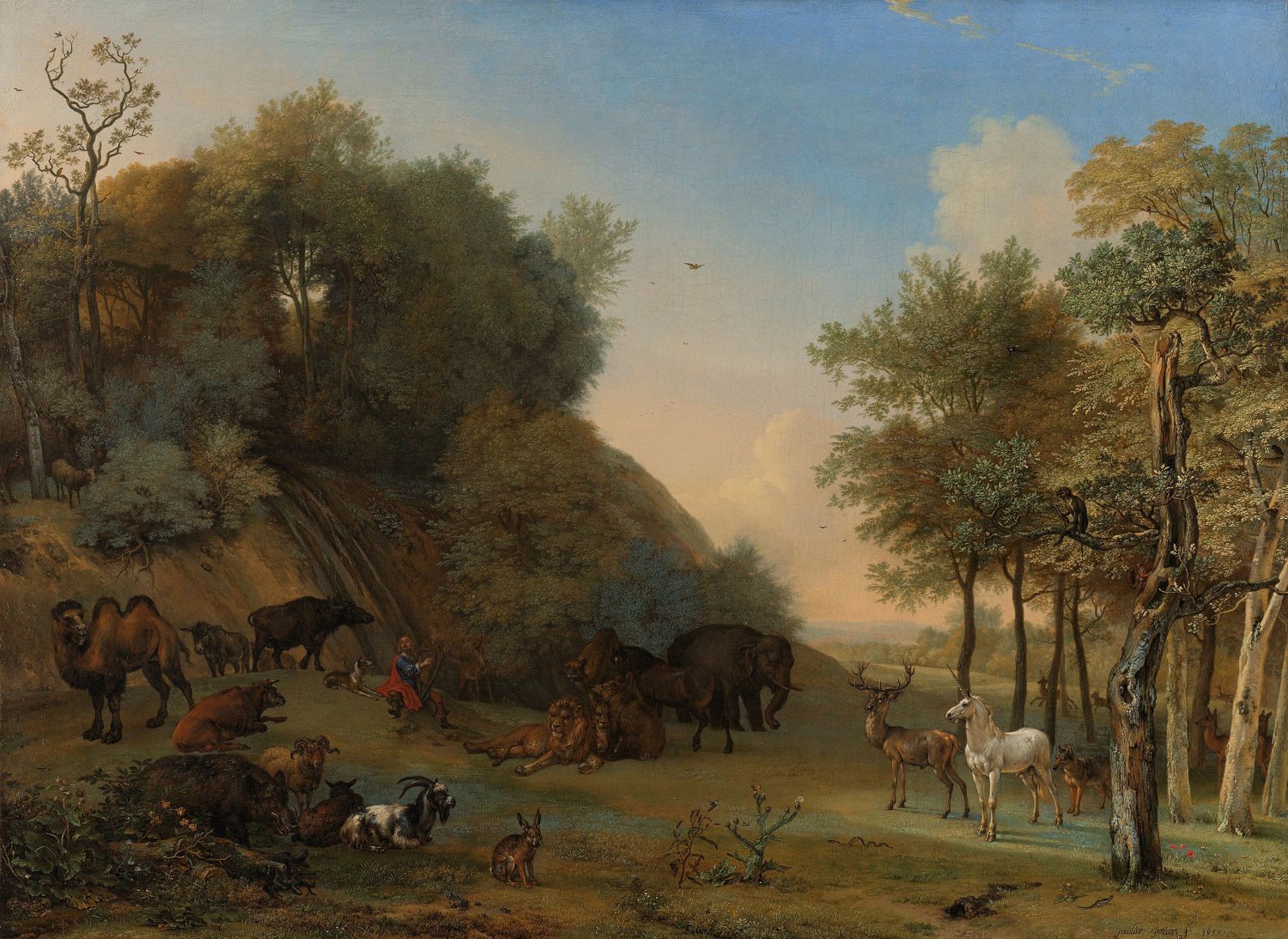
Orpheus sits small in a wooded clearing, playing, and the whole creation gathers: deer, cattle, horses, a camel, even an ostrich at the edge — a peaceable kingdom arranged around a lyre. It is Potter's one mythological picture, and he paints it the only way he knows: the animals are the true subject, each one studied from life, the god almost an excuse.
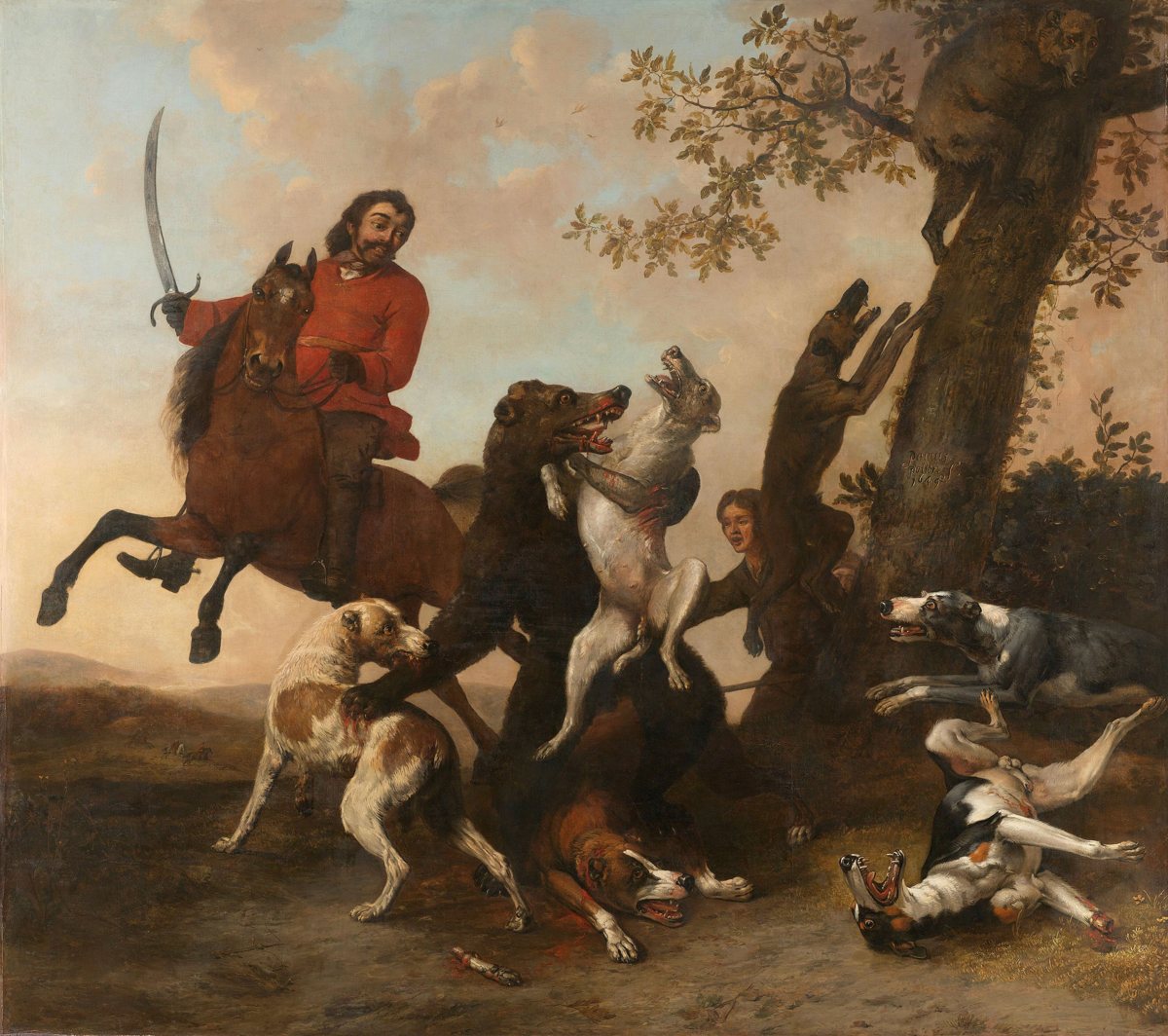
The meadow painter's one explosion of violence: hounds dragging a bear down from a tree, a second cub scrambling up the trunk, the huntsman on a rearing horse with his sabre raised. It is painted like a tapestry of fury — and even here, every dog is a portrait, every muscle observed in the kennel before it was loosed in the forest.
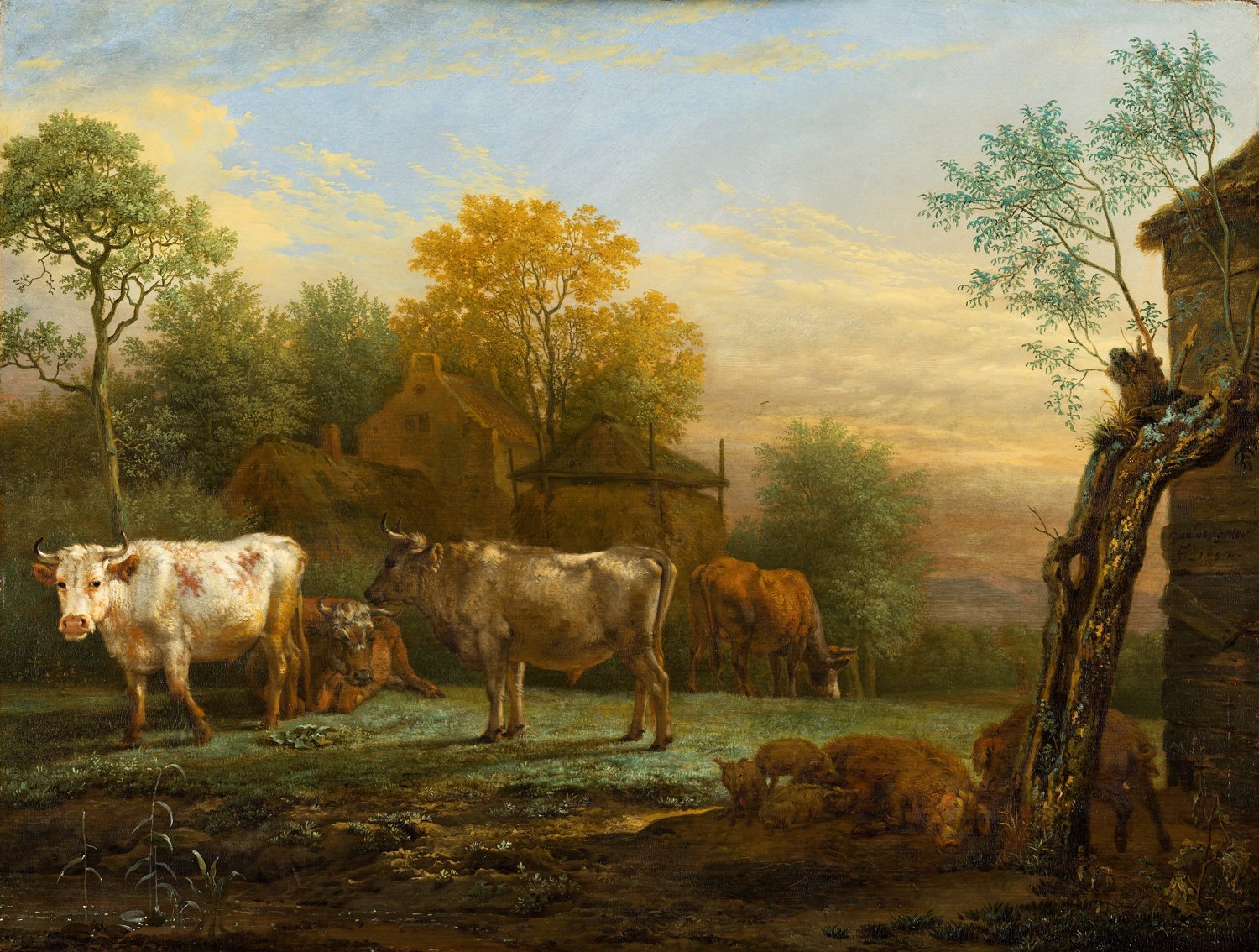
A companion piece from the year of the Bull: cows at a farm in low golden light, one drinking, one staring out at us with Potter's favourite directness. The panel is small and the world complete — farm, trees, water, weather. He could fill a wall or a hand's breadth with the same conviction.
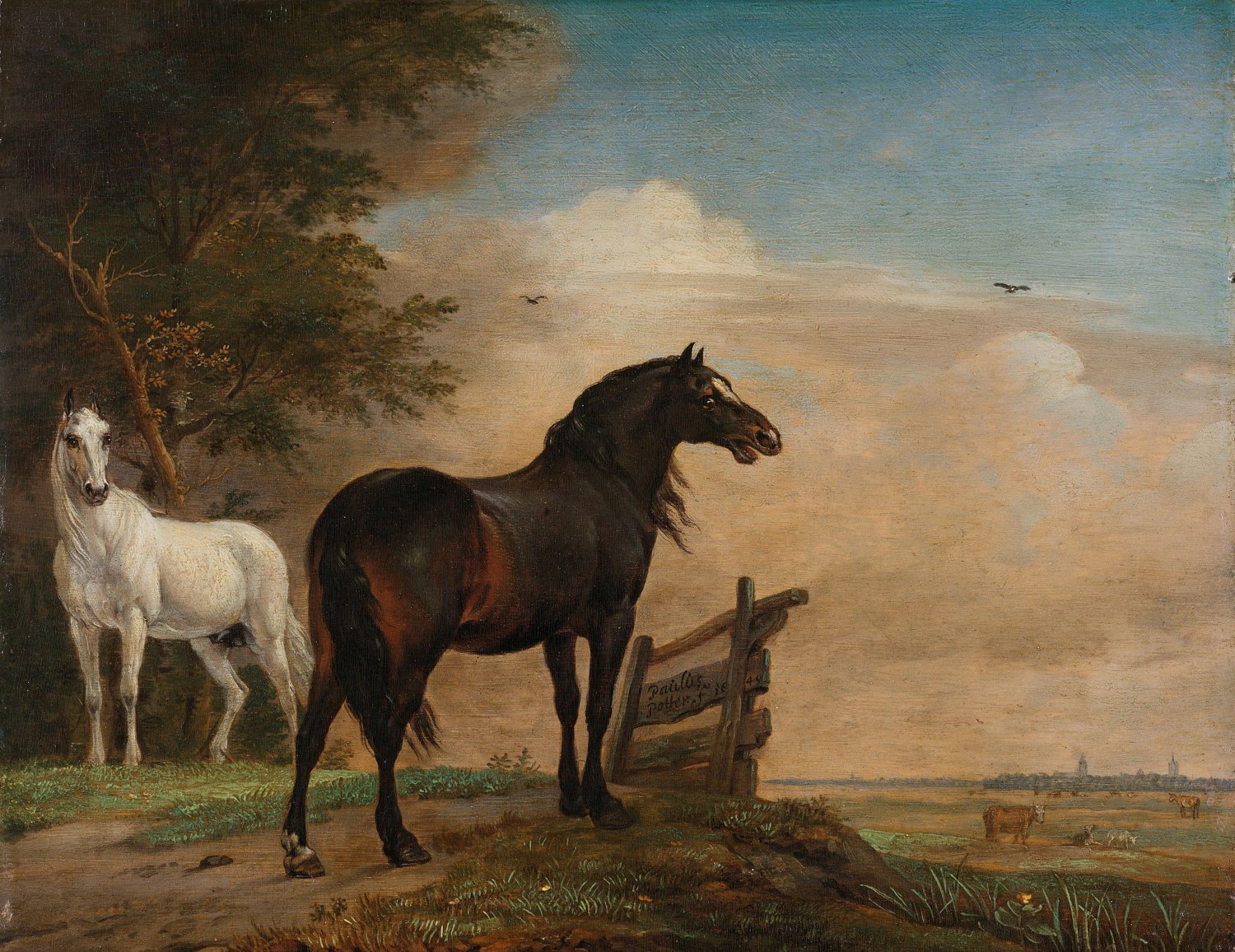
A white horse and a dark one stand by a gate in evening light, turned toward something outside the picture. Horses were Potter's second subject and he gives them the same honours as the Bull: anatomy exact to the vein, coats shining like polished wood, and a sky full of travelling weather behind them.
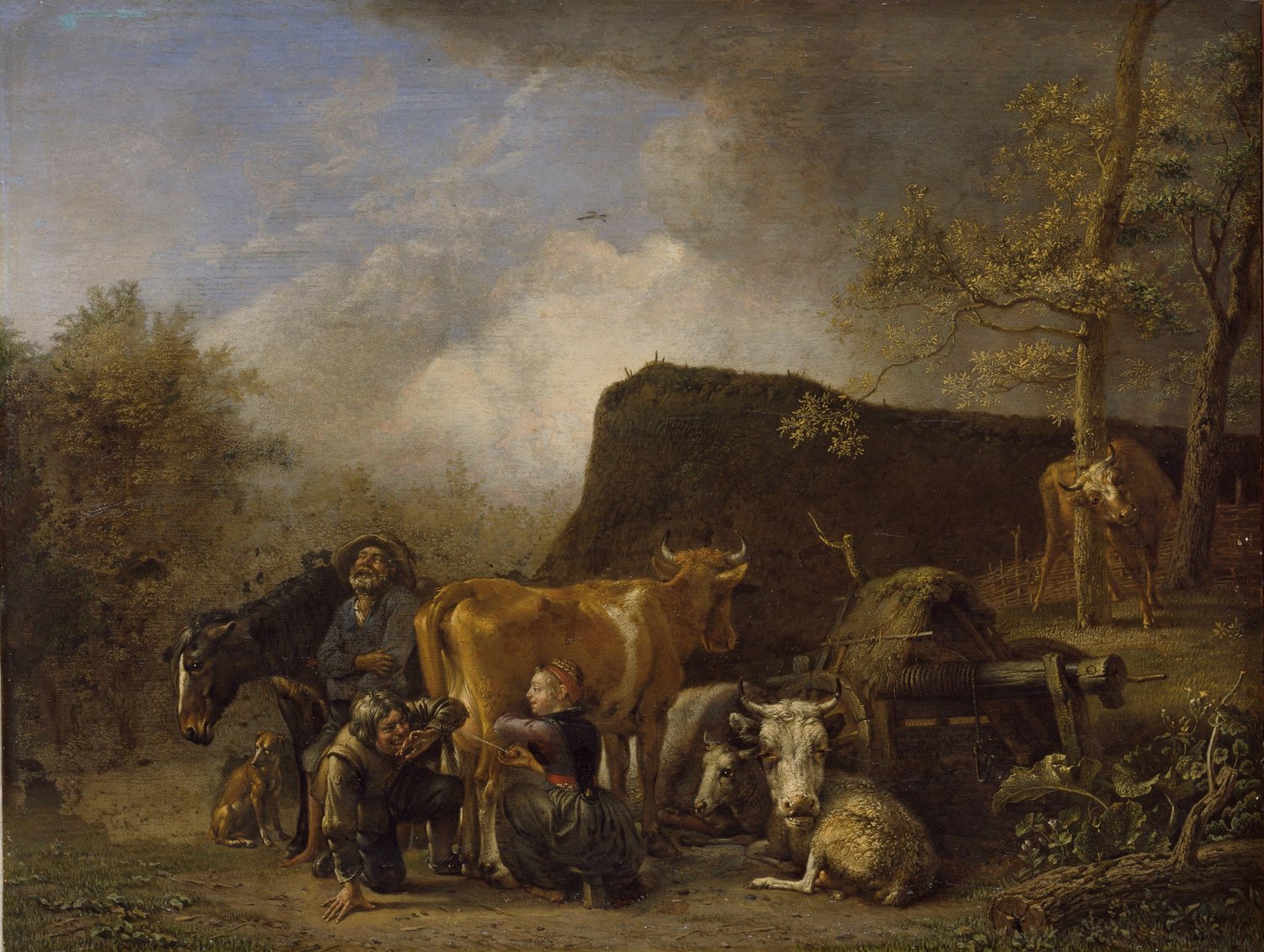
The farmyard at milking time: the milkmaid among her cows, children and a dog underfoot, the shed's shadow across the yard. Potter paints people rarely and animals always — here the humans are simply part of the herd's household, drawn with the same patience as the cow that turns its head to watch us.
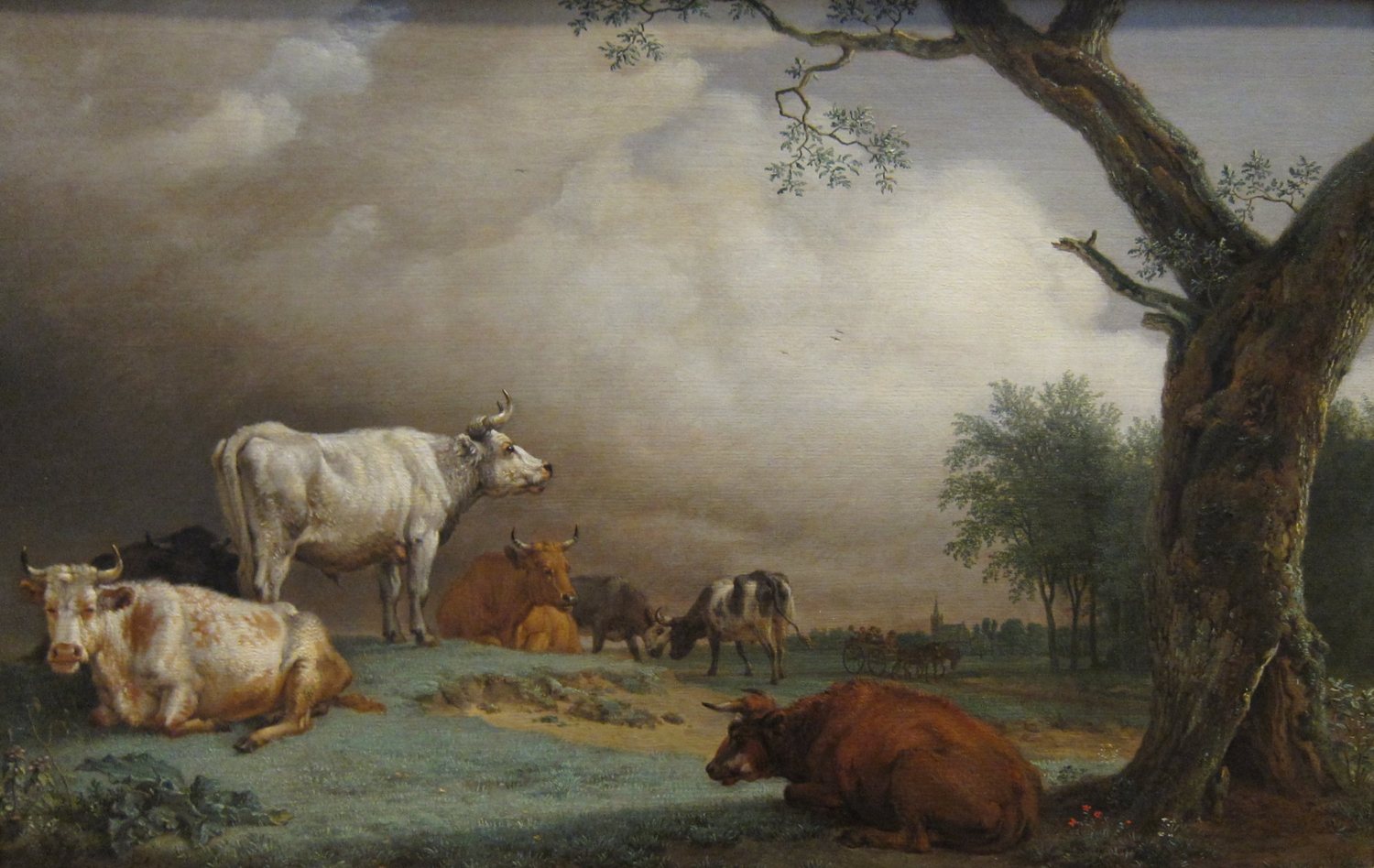
From his last full year: cattle resting at a pool under a sky of moving cloud, the white cow standing like a monument over the lying herd. The brushwork is a touch broader, the light more silvery — the beginning of a late style that tuberculosis cut off eighteen months later.
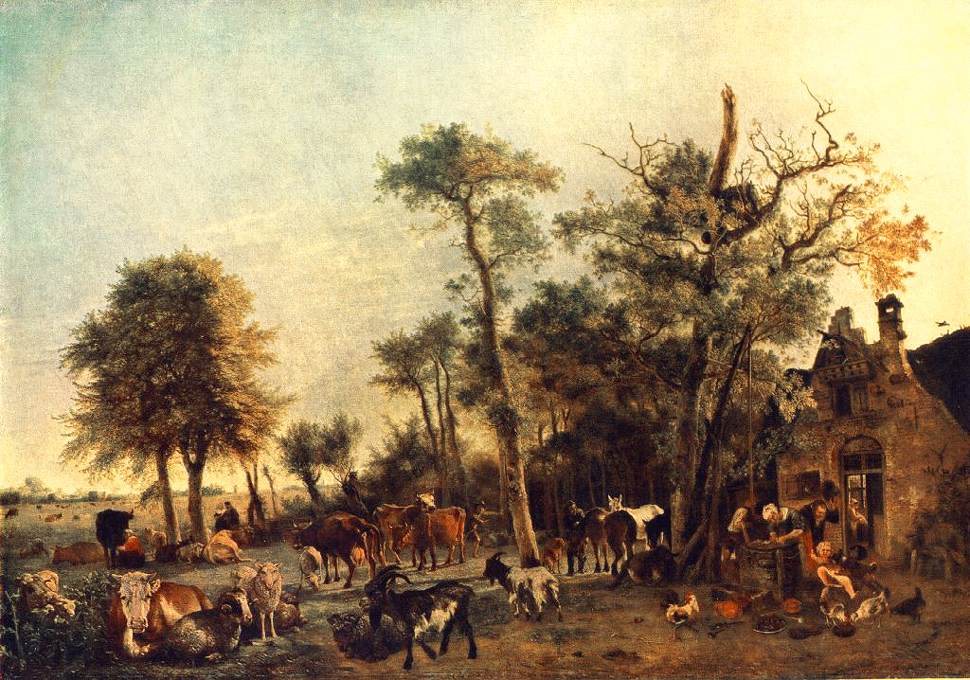
A whole village economy in one yard: cattle, sheep, pigs, poultry, dogs, farmers, children, a cart, a cottage — dozens of small lives, each given its own few square centimetres of exact painting. It is Potter's busiest picture, a census of the farm taken by a man who loved every entry in it.
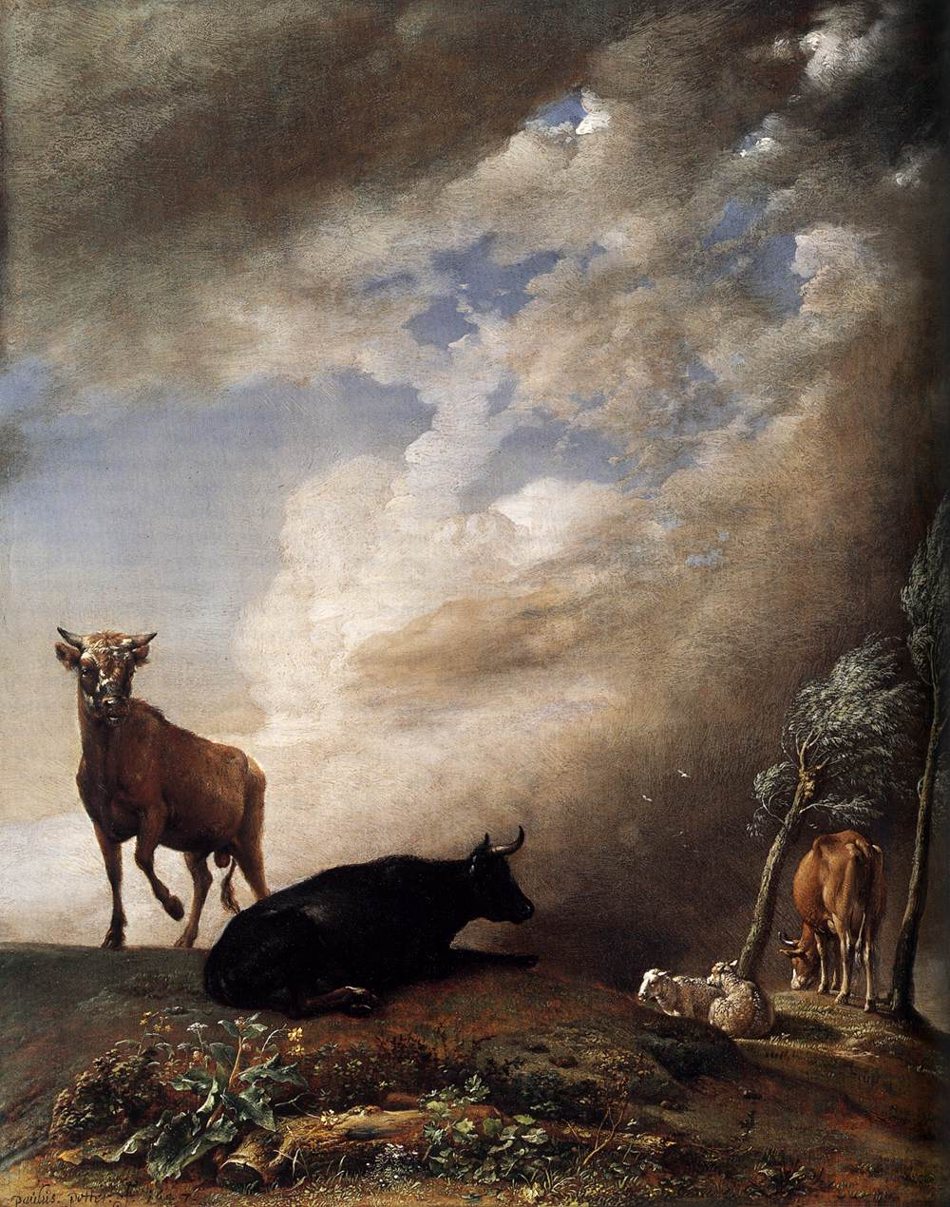
His most dramatic sky: a brown cow bellows into the wind on a rise, a black bull lies beneath her, sheep huddle by trees that bend double. Three-quarters of the panel is storm — rolling, lit, travelling cloud. The cattle are not staffage here; they are the instruments on which the weather plays.
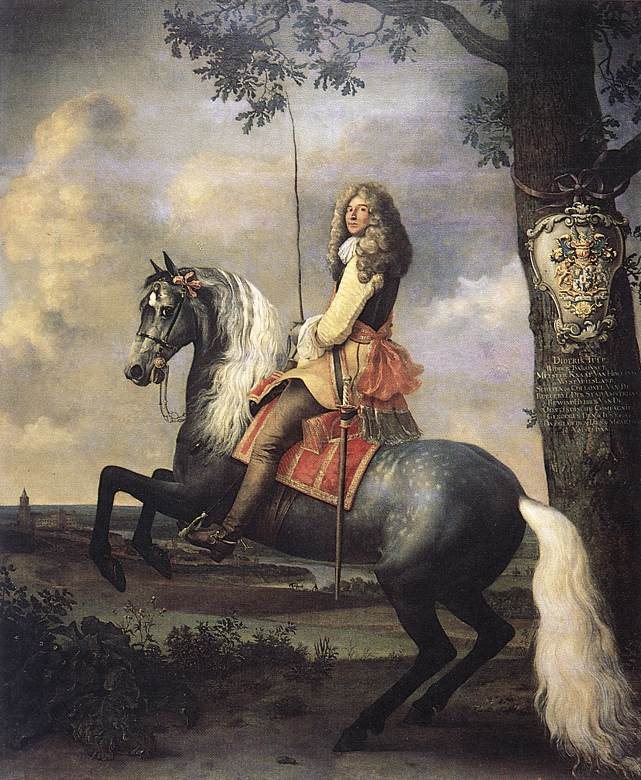
Potter's rarest thing: a man as the subject — a young rider on a rearing grey, his family's arms painted on the tree. But look where the painter's heart is: the horse is the true portrait, every muscle of the levade studied, the rider almost an accessory to his mount. Even on commission, Potter painted the animal first.