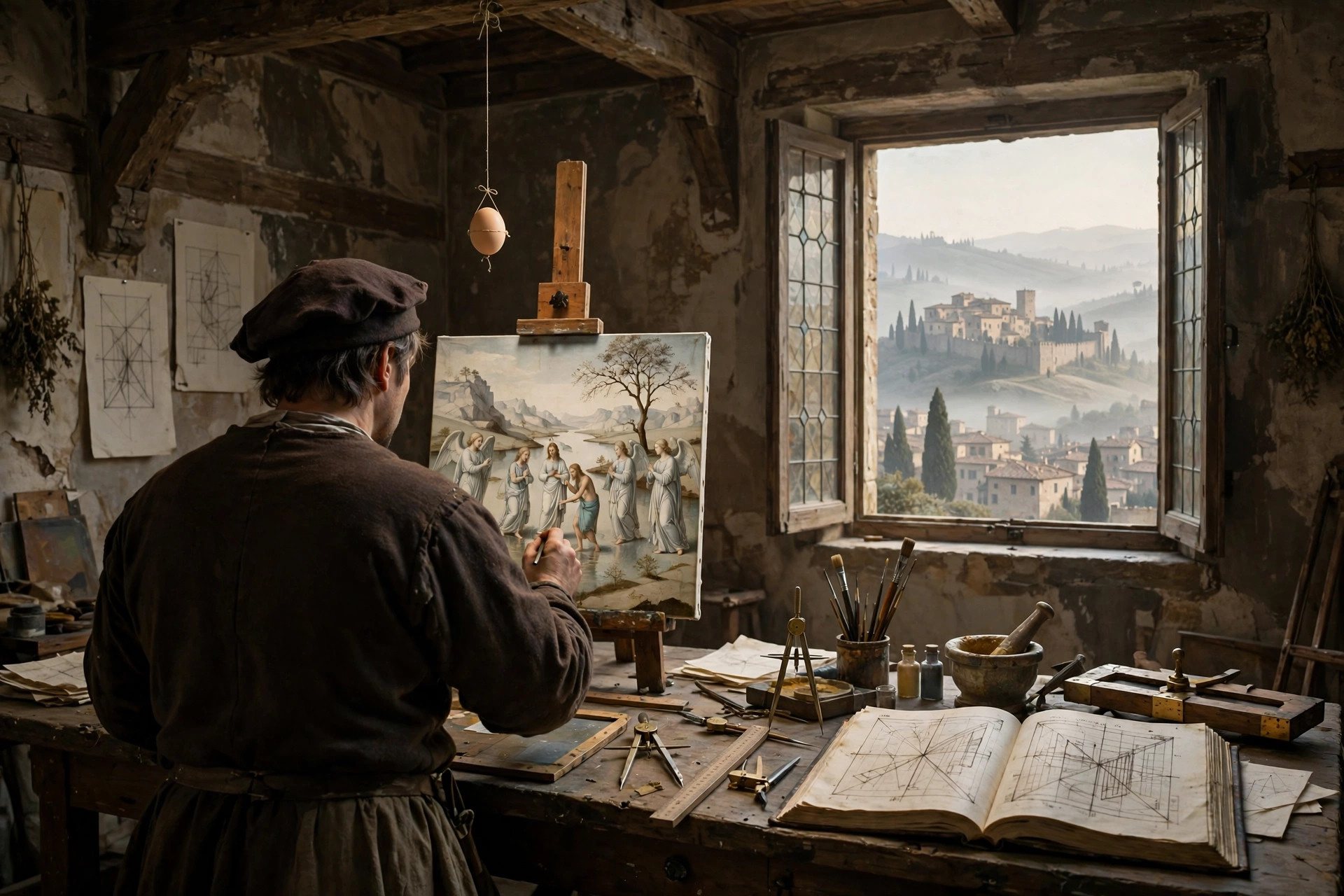
The most silent painter who ever lived. Piero was a mathematician who happened to paint: author of treatises on perspective and the regular solids, builder of pictures like theorems — and yet the theorems are full of dawn light, white rivers and faces at absolute rest. The modern age rediscovered him and recognised a contemporary.
Piero authored three treatises: on the abacus, on the five regular solids, and De Prospectiva Pingendi — the first systematic manual of perspective in painting, with heads, capitals and whole buildings constructed point by point. His pictures are the treatise made visible: every pavement, coffer and halo placed by proof. No other great painter left so much geometry behind him.
Nothing in Piero hurries. His figures stand like statues in the middle of their actions — Christ is scourged in the background of the Flagellation while three men converse in the foreground, undisturbed. Gesture is abolished; expression is abolished; what remains is presence. The stillness is not coldness but a theology: in eternity, nothing needs to move.
His light is as constructed as his space: a cool, even luminosity that seems to come from everywhere and nowhere, modelling forms in the palest of gradients. In the Baptism the Jordan is a white mirror-road running to the horizon; in the Senigallia Madonna a single shaft enters a room and strikes the floor at a calculated angle. Light, for Piero, is geometry you can see.
Above the Virgin in the Brera altarpiece hangs an ostrich egg, suspended from the scallop shell of the apse by a chain — perfectly centred, casting its measured shadow. It is a symbol of creation and of the Virgin birth, a marvel of nature in the age before ostriches were common knowledge, and a perspective exercise all at once: the still point around which the whole architecture turns.
The little Urbino panel is the most studied perspective in Renaissance art: its marble pavement is laid out so exactly that scholars have rebuilt the whole architecture from the tiles. Yet its meaning stays open — who are the three men in the foreground, and why do they ignore the scourging behind them? Five hundred years of theories have not closed the case. Piero, characteristically, left no key.
Vasari says he went blind in old age and stopped painting about a decade before his death in 1492 — the geometer losing the sense his art was built on. Then history forgot him for three centuries. The nineteenth and twentieth centuries dug him up and found, to their astonishment, a modern: Seurat's stillness, Cézanne's solids and Balthus's silence are all downstream of Sansepolcro.
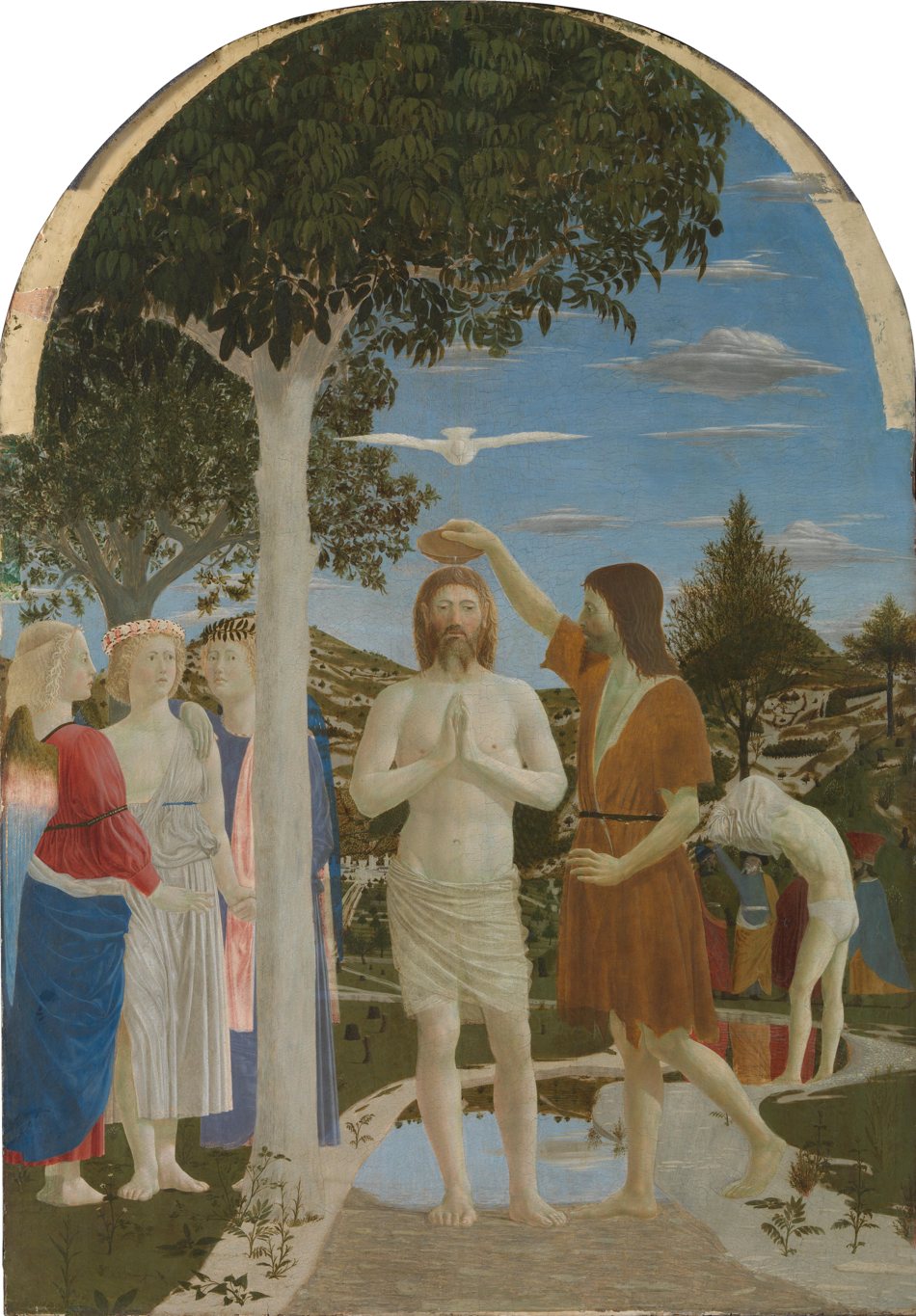
Christ stands in the Jordan like a marble column, the water a white road of light running through a Tuscan valley to the horizon. A walnut tree divides the picture; three angels hold his clothes like courtiers; a man in the background pulls a garment over his head, mid-undress, mid-century. It is the stillest Baptism ever painted — the dove descends, and the world holds its breath.
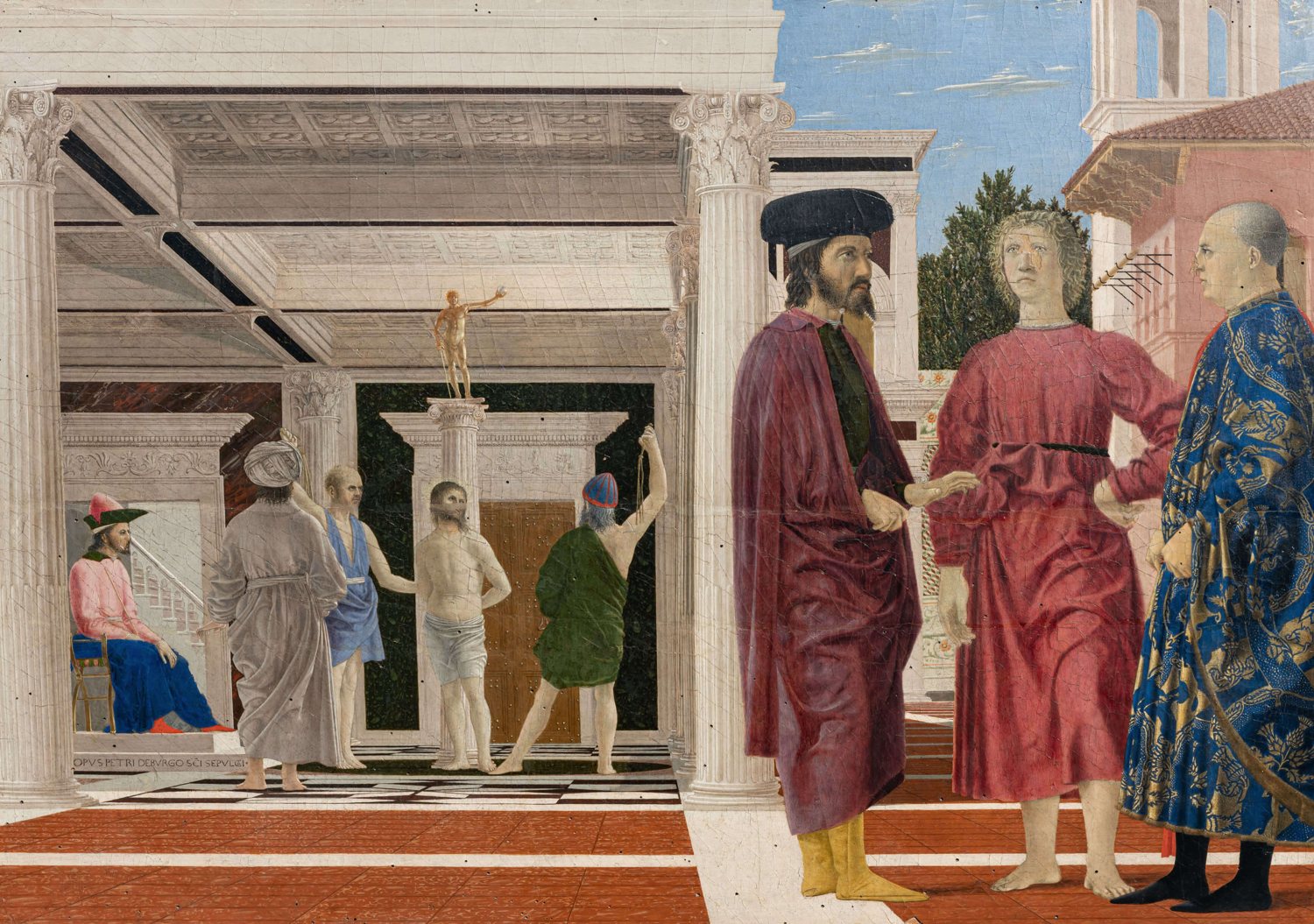
Two scenes share one perfect room of perspective: at the back, small and bright, Christ is scourged at a column; in front, three men in contemporary dress converse, giving the event their backs. The pavement's tiles have been measured by generations of scholars; the men's identity is still argued after five centuries. It is the most intellectual picture of the Renaissance, and the most withholding.
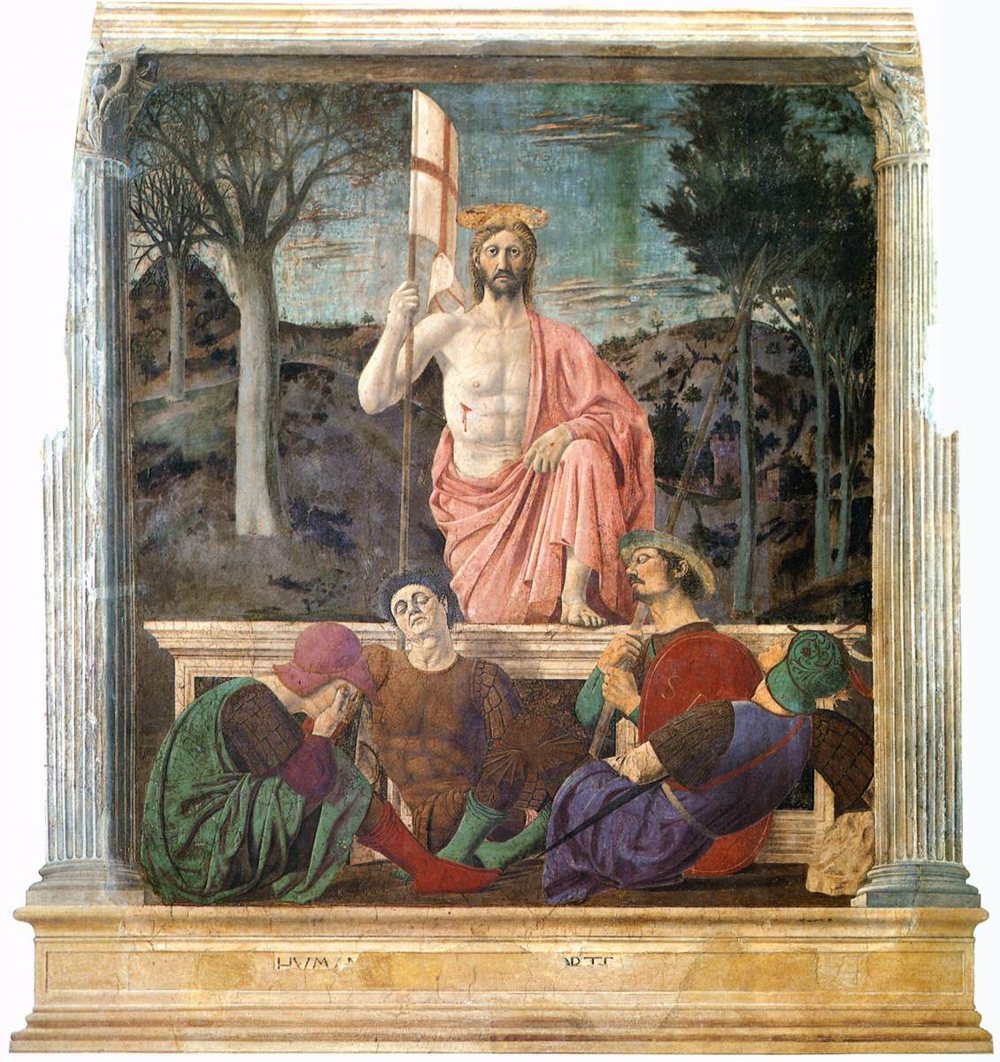
Christ steps out of the tomb in the grey hour before dawn, one foot on the parapet, looking straight at us with the famous unsleeping eyes — while the soldiers sleep below in a tangle of limbs, one of them using his shield as a pillow. Painted for his home town's council hall, it watched over Sansepolcro's meetings for five centuries. Aldous Huxley called it the greatest painting in the world.
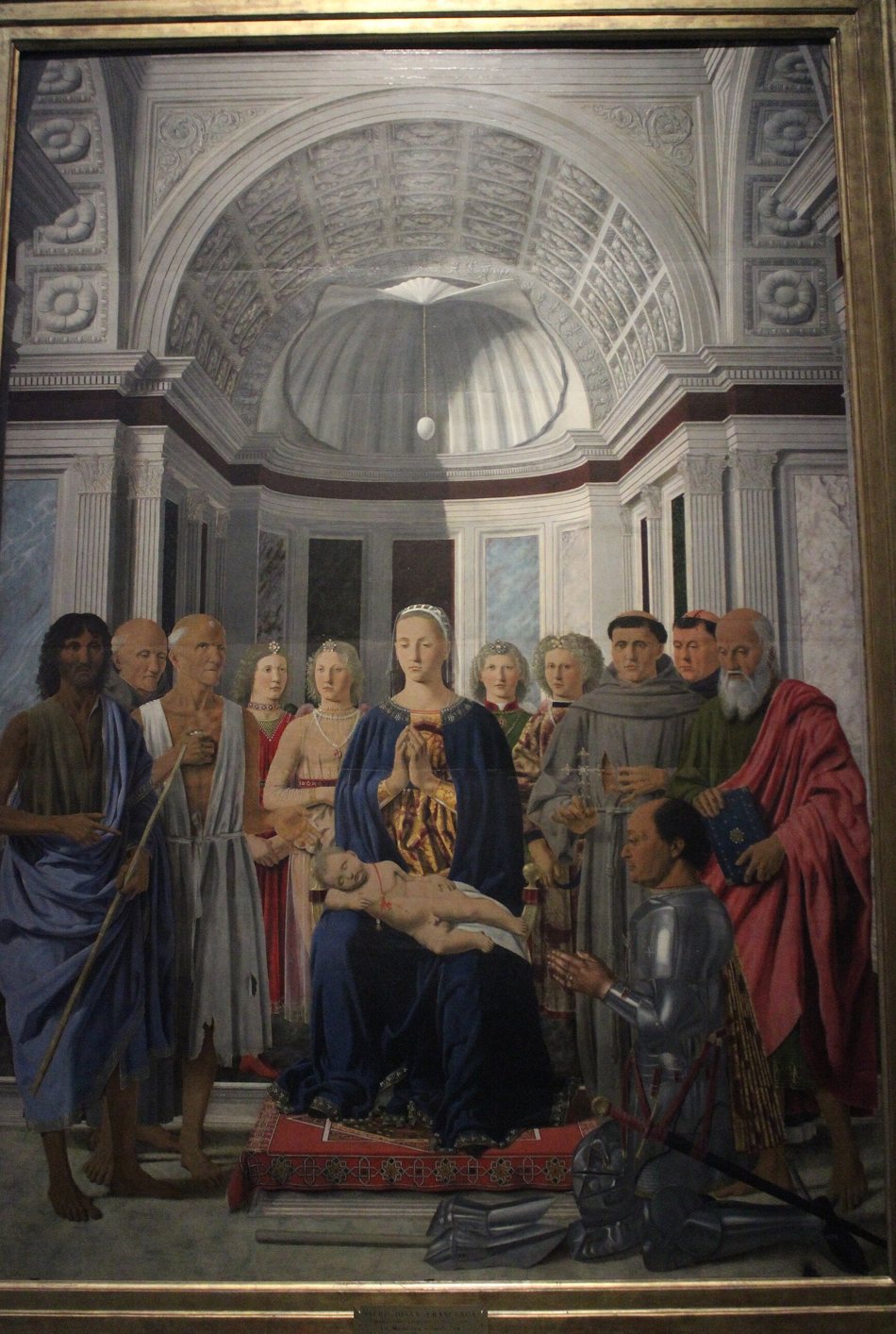
In a church of perfect perspective the Virgin sits with the Child asleep across her knees — asleep in the pose of the future Pietà. Federico da Montefeltro kneels in full armour, his hands joined, his discarded helmet and gauntlets beside him. From the shell of the apse hangs the great ostrich egg on its chain: creation, purity and geometry in a single suspended point.
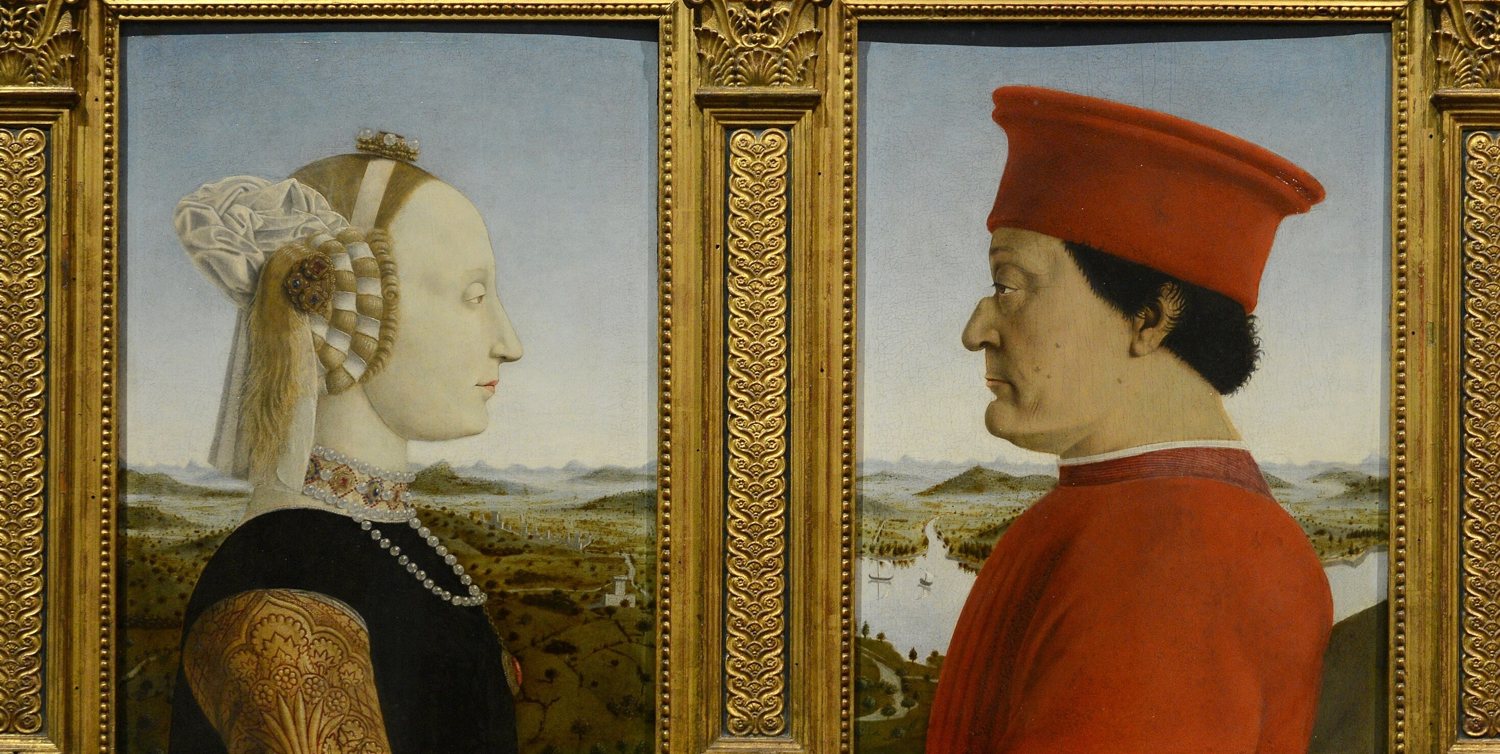
The duke and his duchess face each other in profile across a single continuous landscape of their own dominions. Federico's profile is the famous one — the nose broken in a tournament and the bridge surgically lowered, so the remaining eye could see more; Battista, dead by the time this was painted, is white as a cameo. Two profiles, one state: the most intelligent marriage portrait of the Renaissance.
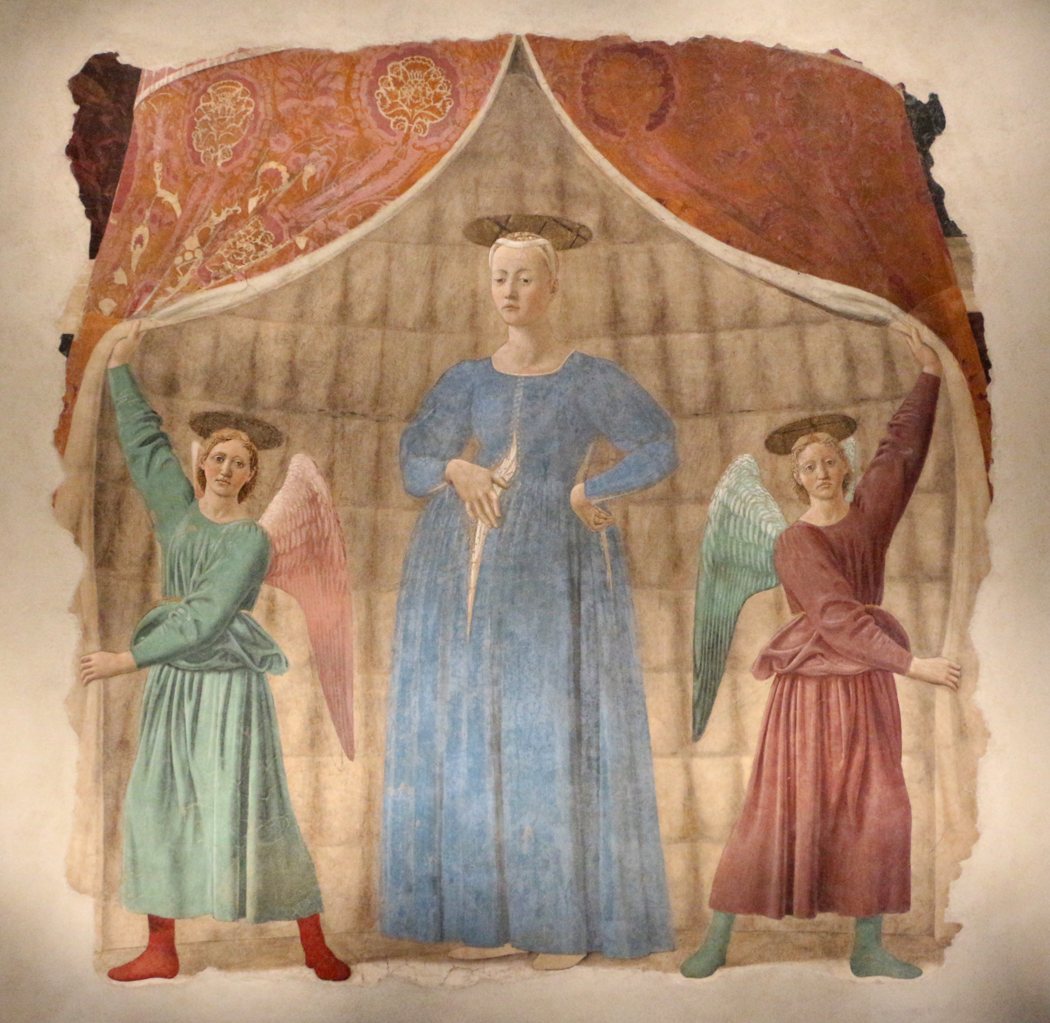
In a small tent pavilion two angels draw back the curtains to reveal the pregnant Virgin, standing, one hand on her hip, the other resting on the opening of her dress above the unborn Child. No throne, no gold, no company — a young woman in a blue dress, monumental in her solitude. Generations of pregnant women made pilgrimages to Monterchi to pray before her.
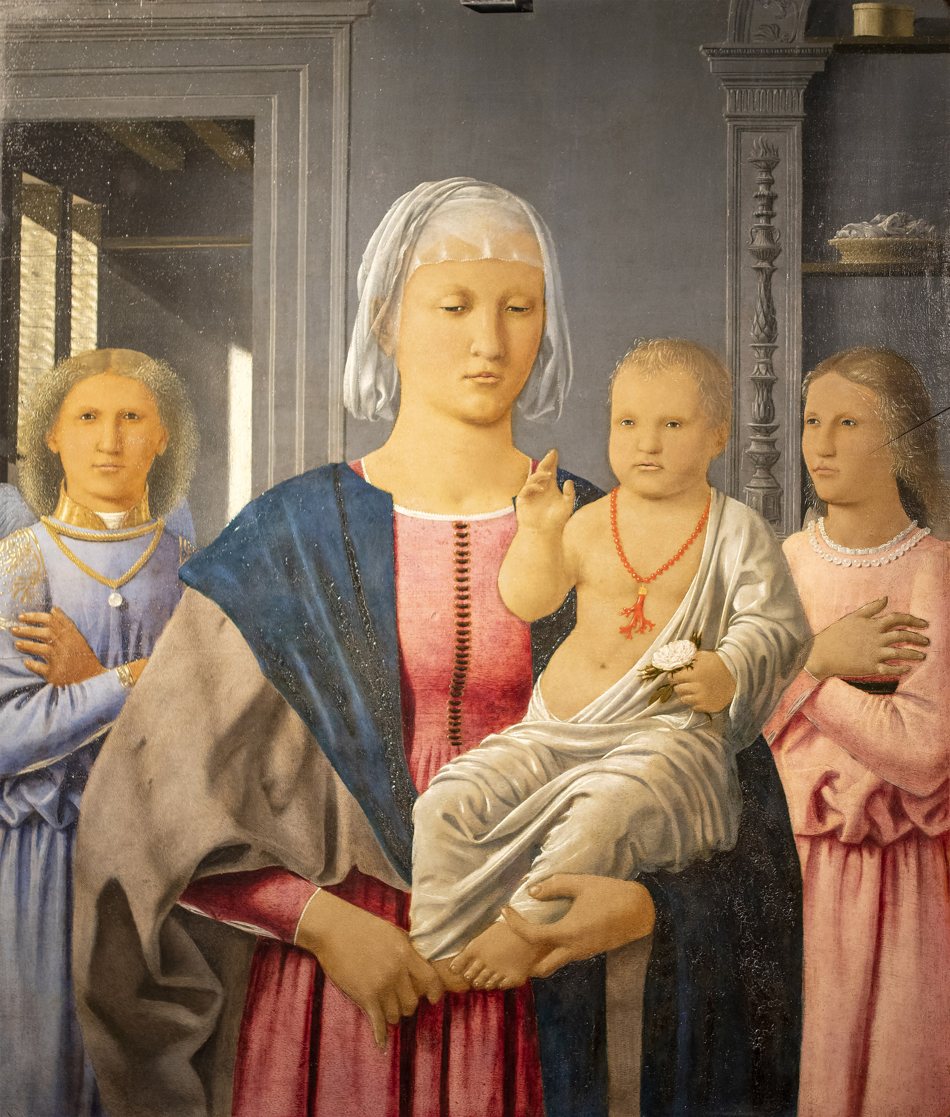
A domestic interior painted with the precision of a treatise: the Virgin holds the blessing Child between two angels while a shaft of sunlight enters from a window we cannot see and strikes the back wall at its calculated angle. The room is a real room — shelf, cloth, basket of linen — and the miracle is simply the light, arriving on time like a theorem's conclusion.
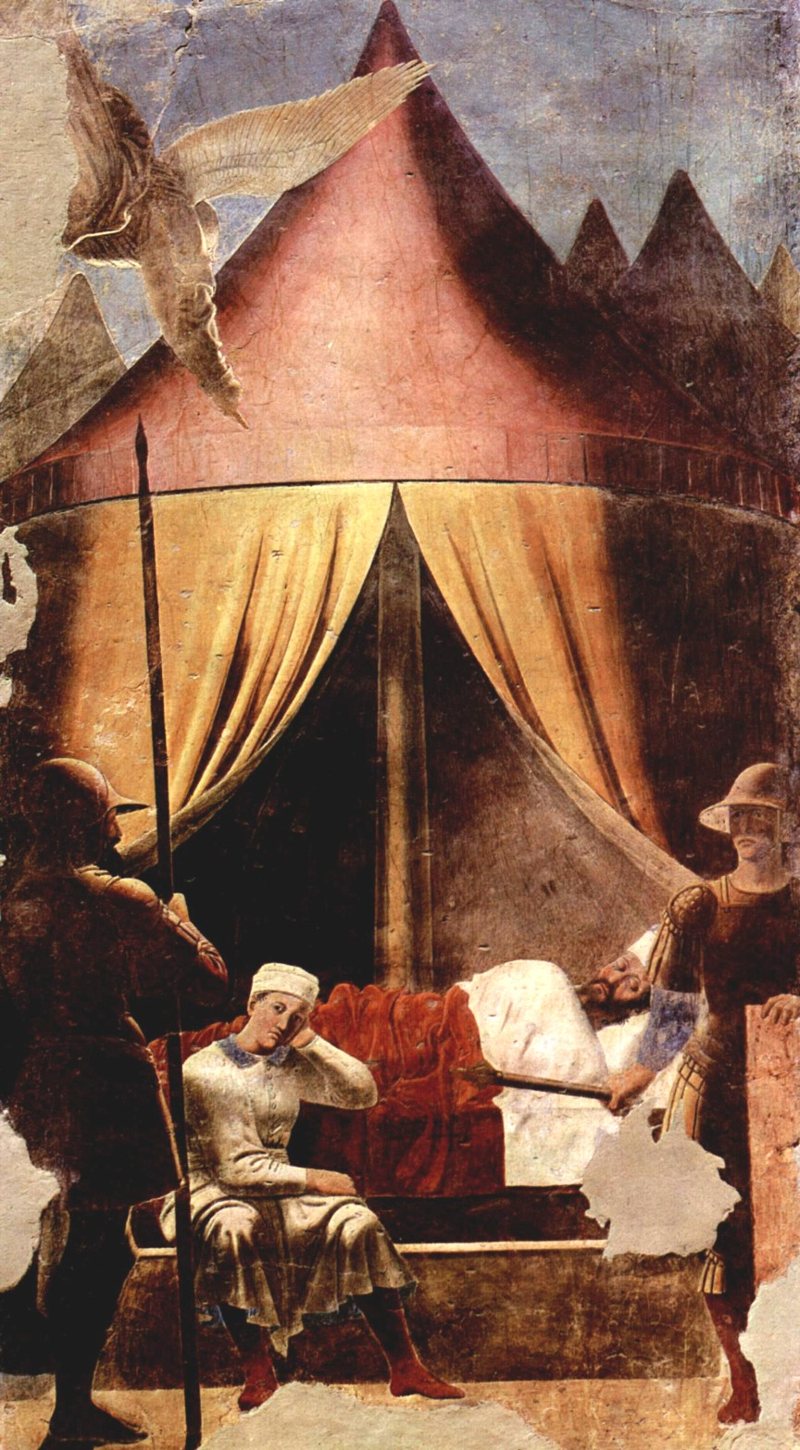
From the Legend of the True Cross at Arezzo: the emperor sleeps in his tent on the night before battle while an angel descends with a small cross of light. It is one of the first true night scenes in European painting — the darkness is painted, not merely dark: the tent glows from within, the guards sit in shadow, the servant watches from the bed's foot. History turns on a dream, in silence.
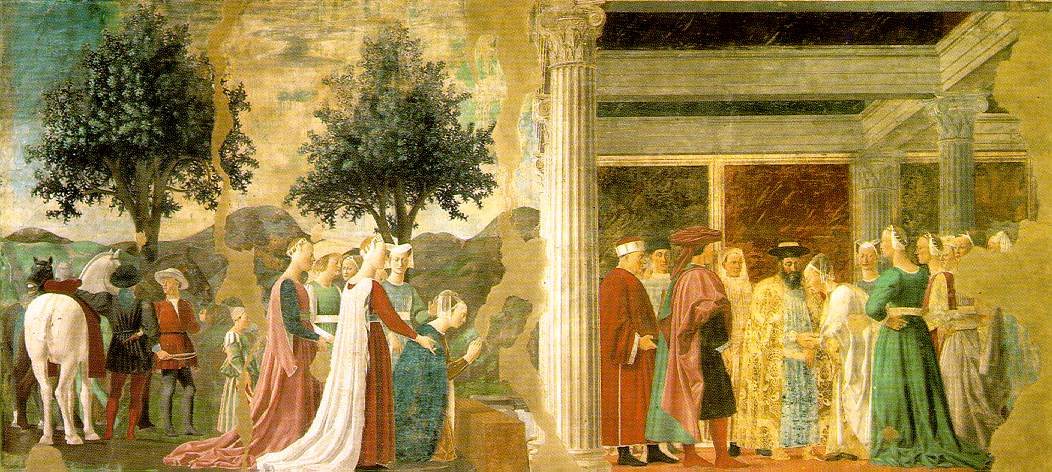
The Queen of Sheba, having knelt to the wood of the True Cross on her journey, is received by Solomon in a loggia of perfect calm. Her ladies stand like a frieze of statues; the horses wait; nobody gestures, nobody speaks above the picture's whisper. Piero turns a state visit into a theorem about dignity — the Arezzo frescoes are his largest surviving work and his testament.
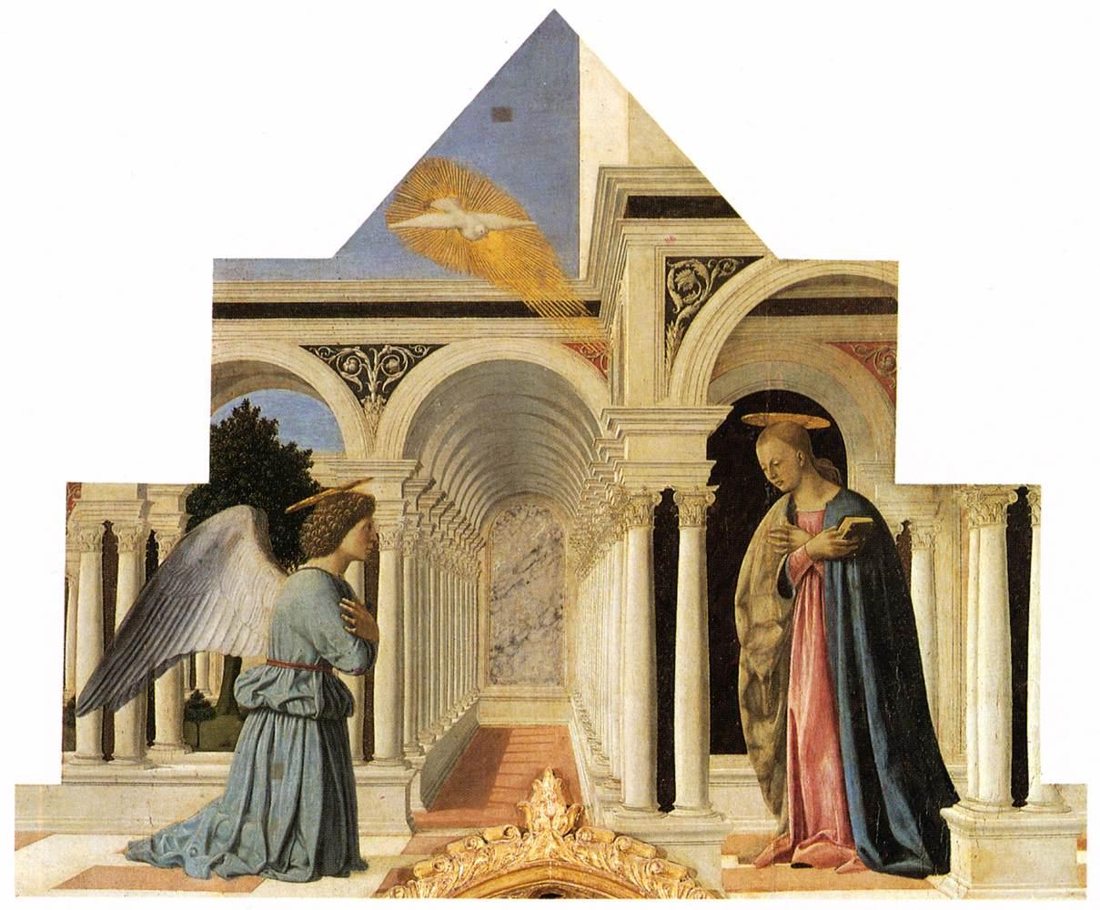
The angel kneels in a classical loggia whose columns march in perfect perspective toward the Virgin, standing grave and still at the far end. The architecture does the announcing: rank after rank of arches measuring the distance between heaven and earth, and a dove descending along the line of the beams. It crowns the Polyptych of Saint Anthony — geometry at prayer, one last time.