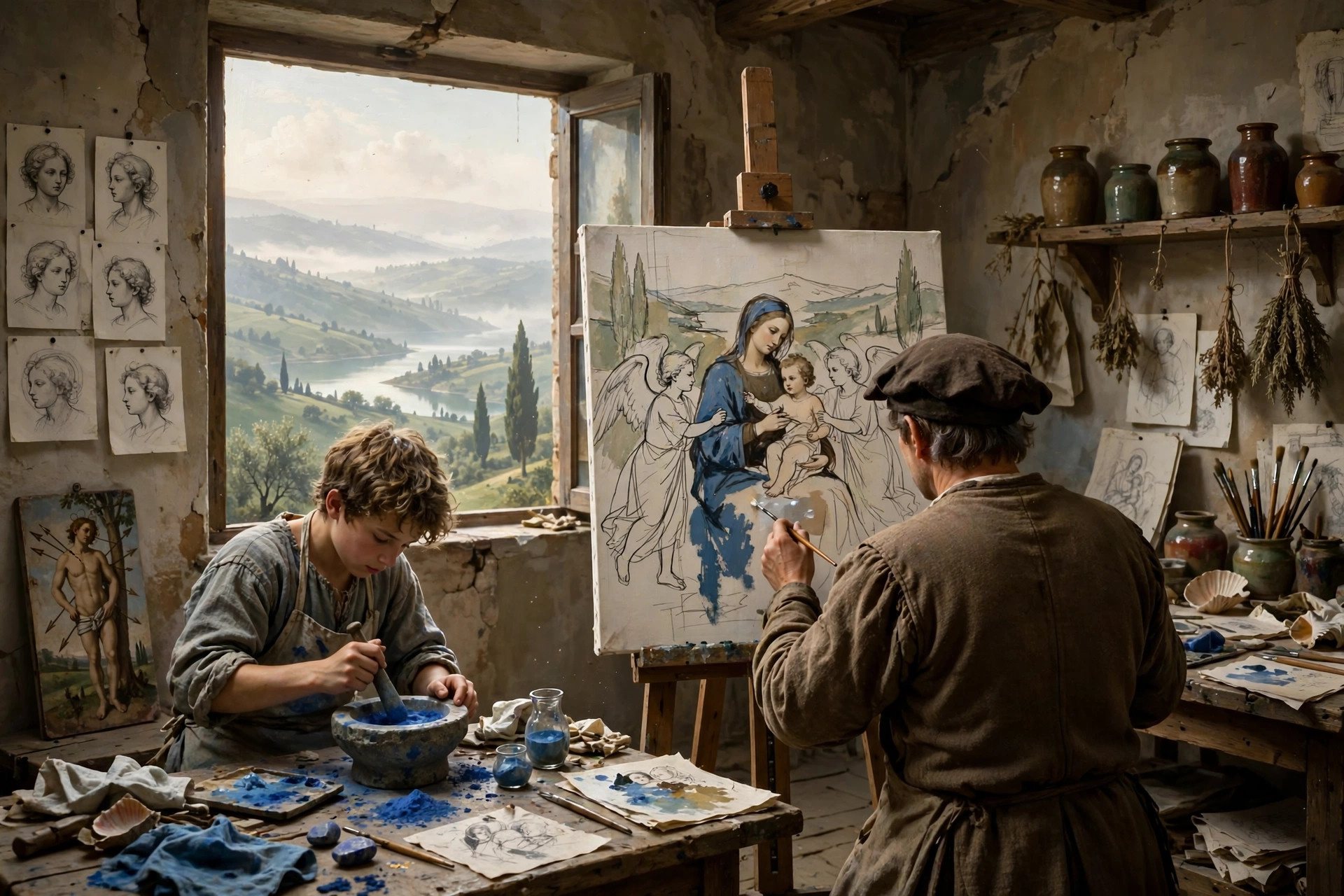
Around 1500 a banking agent wrote home that Perugino was 'the best master in Italy' — and for a generation his sweet, spacious manner was the taste of Europe. Pietro Vannucci of Città della Pieve built pictures like clear mornings: figures in calm rows, Umbrian hills dissolving into silver, not a harsh note anywhere. Then his own pupil, Raphael, took the manner and perfected it — and the master became a footnote to his student.
In 1481, in his mid-thirties, Perugino was called to Rome to paint the walls of the Sistine Chapel alongside Botticelli and Ghirlandaio — and given the place of honour: the Delivery of the Keys, the fresco that states the papacy's claim in the language of perfect perspective. For the next twenty years no Italian painter was more famous or more employed. Isabella d'Este, the Medici, the Pope, the French king's agents: everyone queued at his two workshops.
His signature is the landscape: a wide, calm Umbria of green hills, slender trees and watery distances, opening behind the figures like a held breath released. Figures stand in uncrowded rows, heads tilted at the same gentle angle, hands folded. Critics later called it monotony; his contemporaries experienced it as devotion itself — prayer needs room, and Perugino's pictures are nothing but room, light and quiet.
He ran workshops in Florence and Perugia at once, travelling between them, and industrialised grace: cartoons for his famous Madonna types were reused, varied, finished by assistants under his eye. Vasari scolds him for repeating himself out of greed; Perugino's reported answer is a professional's — the figures pleased everyone when new, so why should they displease now? It is the first modern argument about a painter's brand, made five hundred years early.
About 1500 a teenage Raphael entered his Perugia workshop. The pupil absorbed the master's manner so completely that Raphael's early works were long given to Perugino — the debt is visible in every tilted head and silver hill. The changing of the guard can be watched in one pair of pictures: Perugino's Marriage of the Virgin (1503–04) and Raphael's version of 1504, same composition, the pupil's already deeper, warmer, alive. Perugino lived to see himself become old-fashioned.
In the Collegio del Cambio, Perugia's money-changers' hall, he frescoed the walls with prophets, sibyls and classical heroes — and included himself: a round-faced man in a red cap, painted on a pilaster with a framed Latin inscription beneath praising his art in terms no modesty would allow. It is the Renaissance artist's new status made visible: not a craftsman in the corner, but a worthy among the worthies, signing the city's bank.
After 1505 the world moved on — Leonardo's smoke, Michelangelo's thunder — and the commissions thinned. He kept painting in Umbria, reusing the beloved types, into his seventies. In 1523, at Fontignano, he was frescoing a church wall when the plague took him; the work was left unfinished. Vasari's portrait of a miserly unbeliever is now discounted — the pictures, serene to the last, argue otherwise.
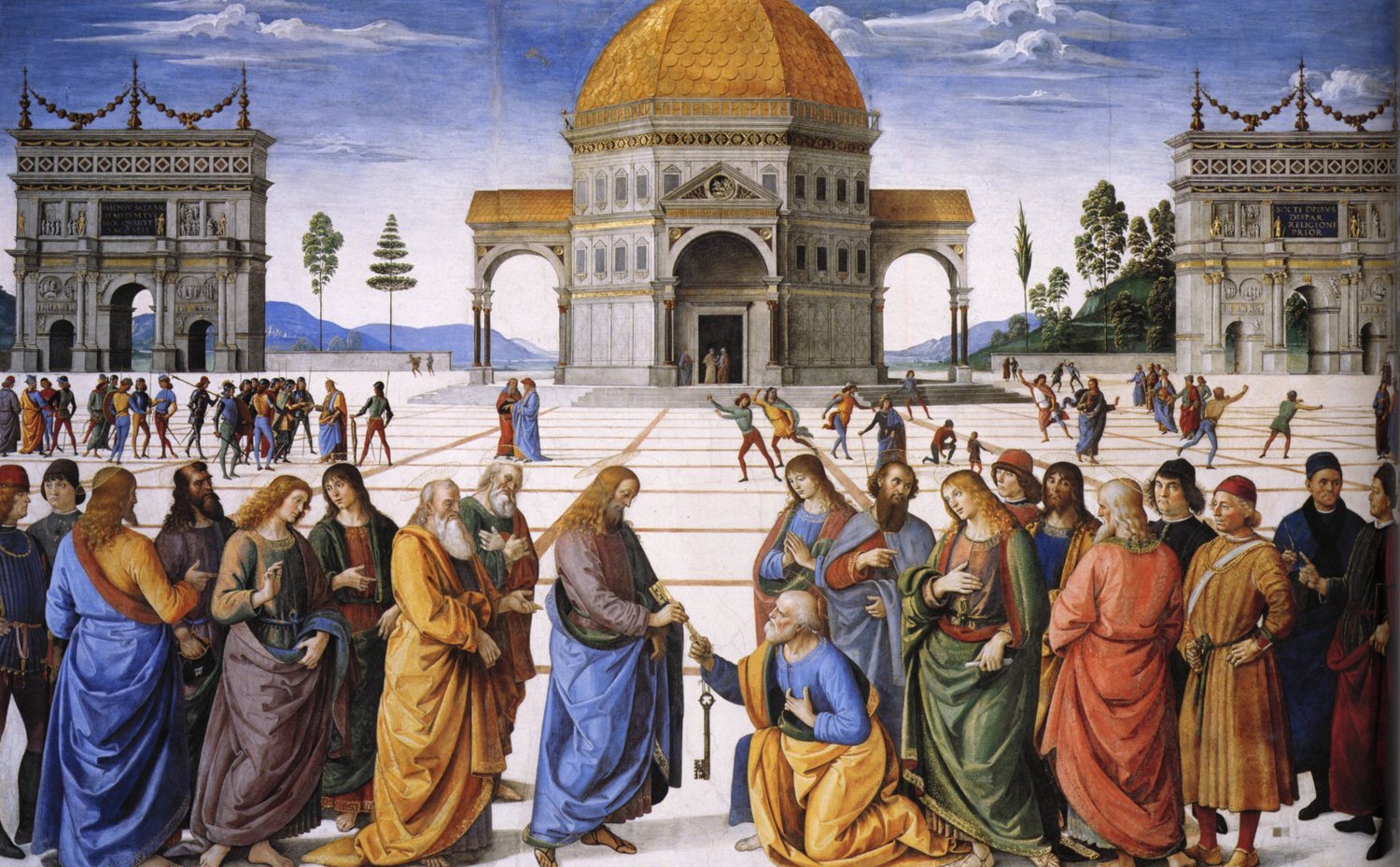
On the Sistine wall, in the most rational space of the fifteenth century: Christ hands the keys of heaven to the kneeling Peter on a vast paved piazza, Solomon's temple rising at the centre, triumphal arches at the sides, the Umbrian hills closing the horizon. Two side episodes — the tribute money, the stoning of Christ — are folded into the distance. It is a legal document painted as architecture: the papacy's charter, in perspective.
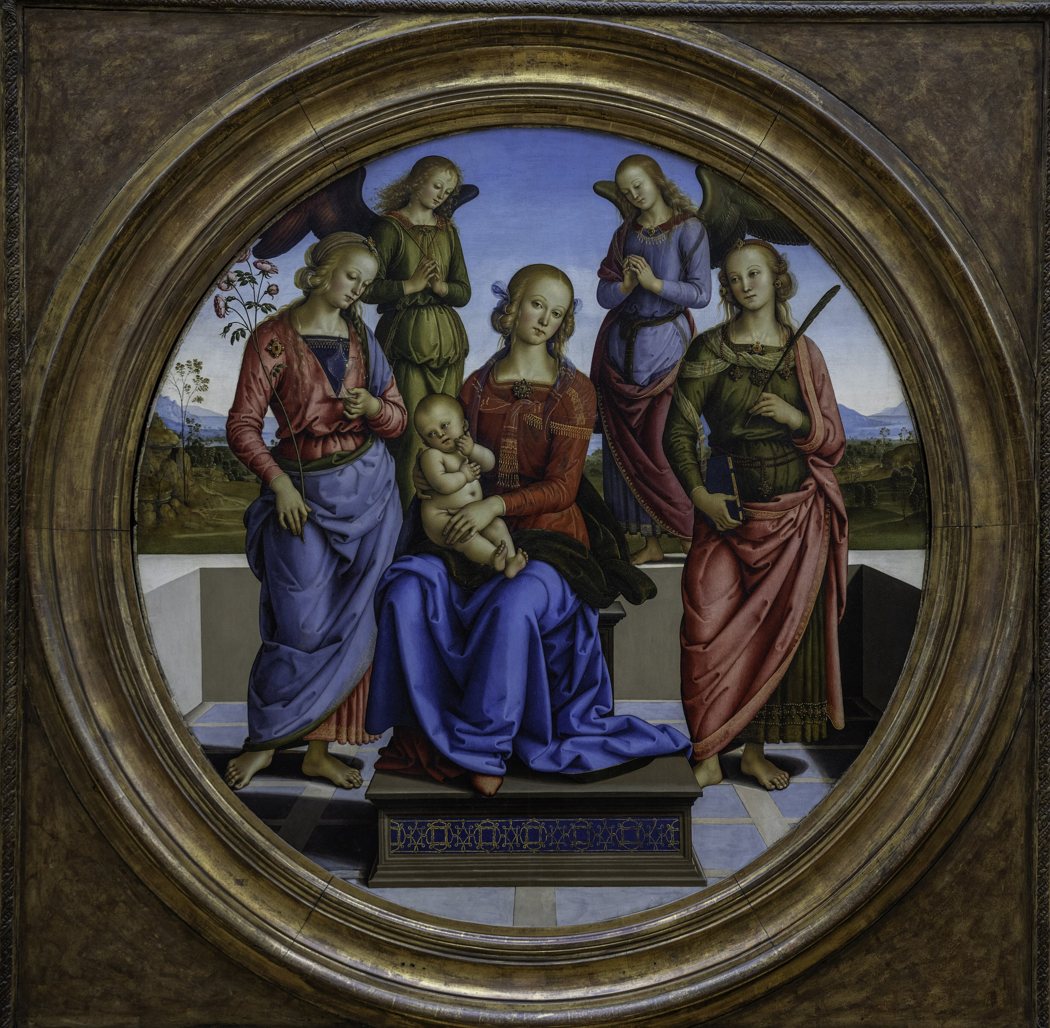
A round picture for a Florentine home: the Virgin seated with the Child on a parapet, two angels standing behind like courtiers, female saints at the sides — all of it held inside the circle's calm. The tondo was the era's favourite domestic format, and Perugino's sweetness fills it perfectly: no corners, no edges, nothing for devotion to catch on.
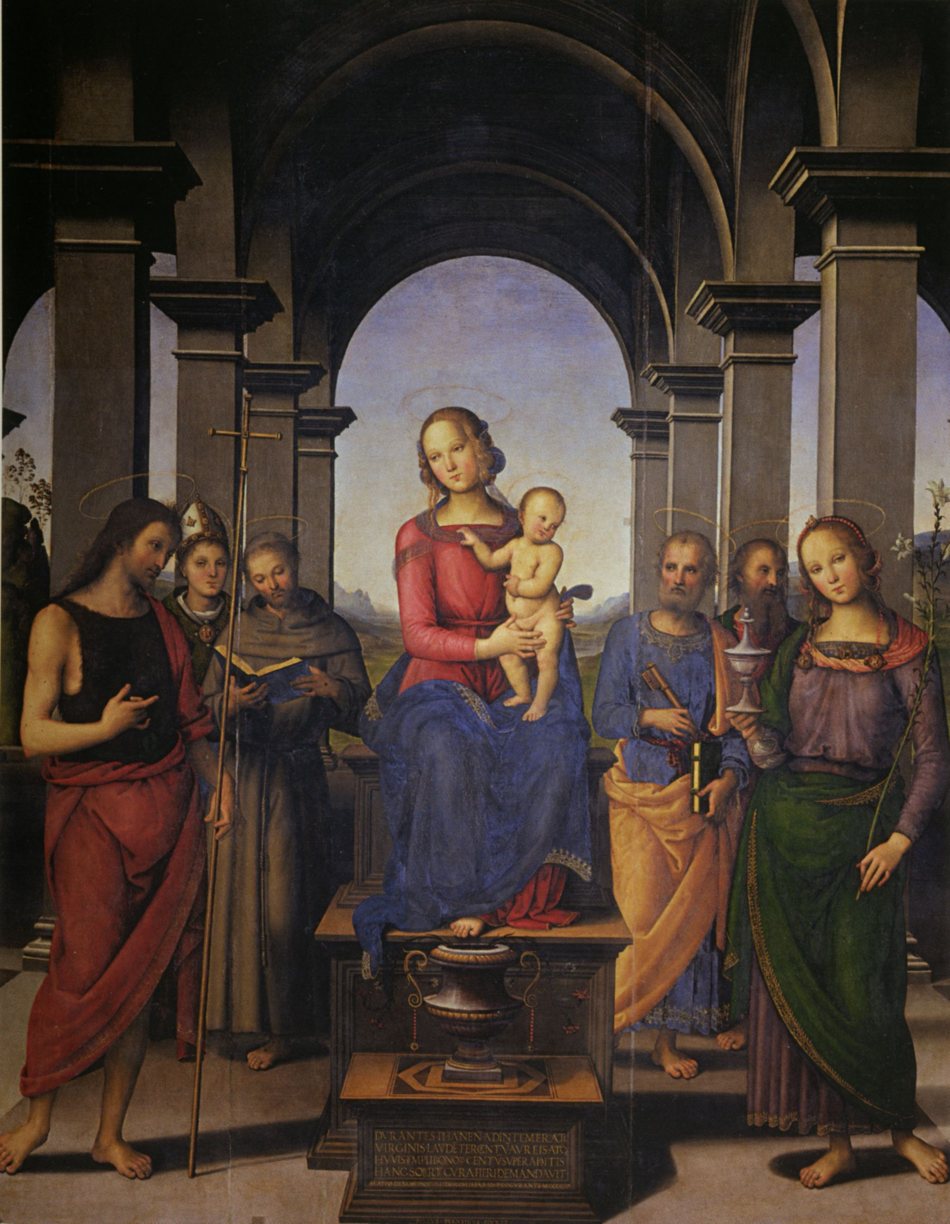
The Virgin sits high on a platform in a barrel-vaulted loggia, the Child standing on her knee, while below her stand John the Baptist, Francis, Peter, Paul and Catherine in a grave semicircle — an altarpiece built like a piece of architecture, the saints as its columns. The little urn on the step before her is painted with a goldsmith's care: Perugino's devotion is always, also, to objects.
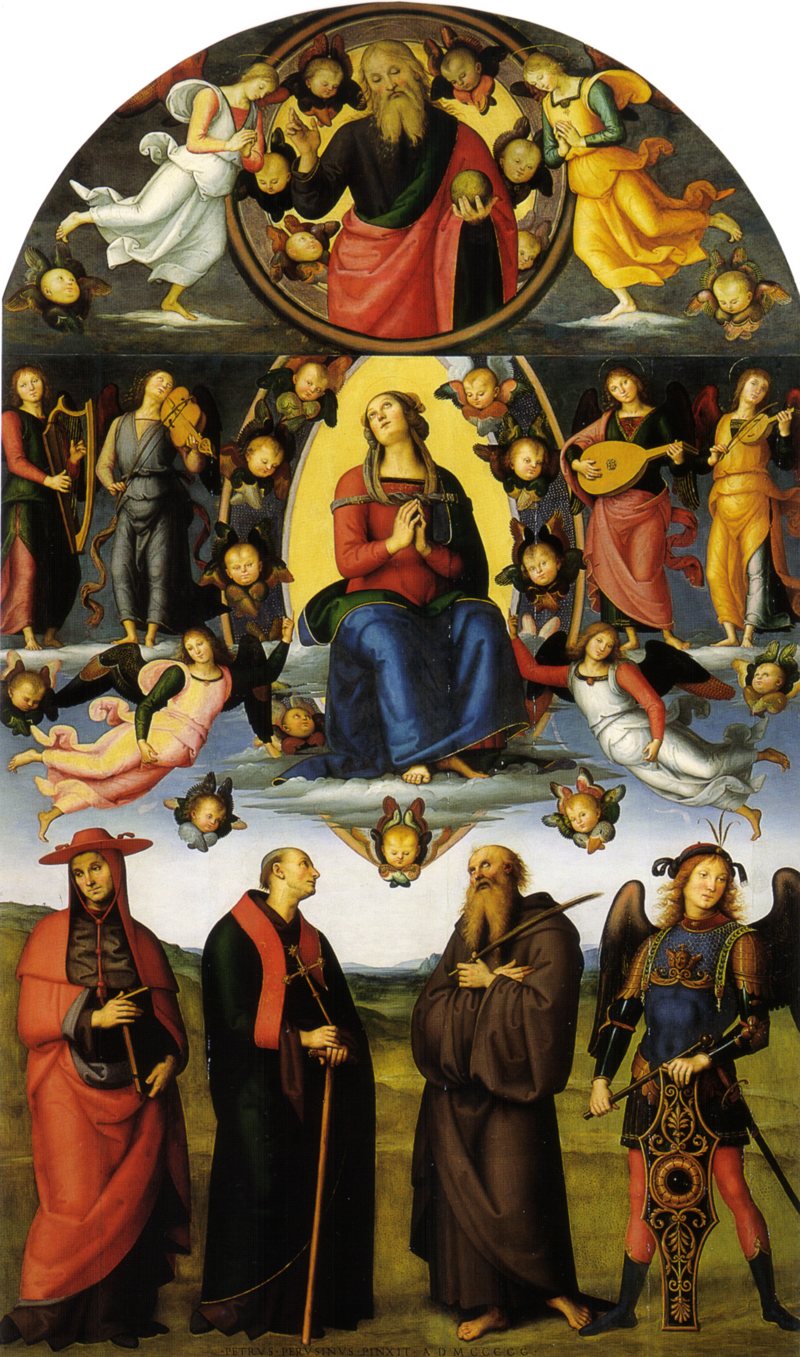
A tall two-storey heaven: above, God the Father in a glory of cherubim; at the centre the Virgin assumed into paradise, angels with music around her; below, four saints of the Vallombrosan order standing on the earthly shore, looking up. Painted for the abbey of Vallombrosa in the year of his greatest fame, it is his manner at full stretch — sweetness organised like a cathedral.
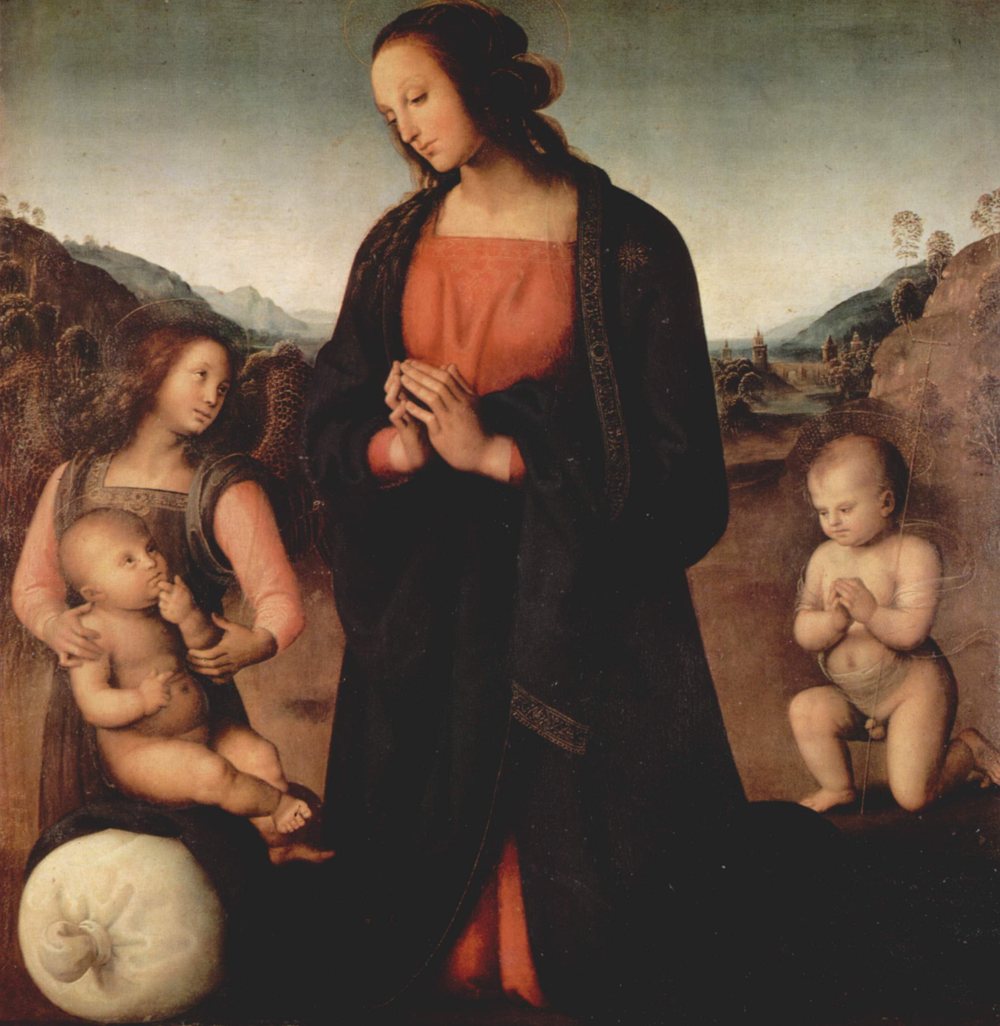
The Virgin kneels in adoration before the Child, whom an angel presents; the little Saint John watches from the right, and in the foreground sits the white sack — the bag of provisions for the Flight into Egypt — that gives the picture its name. Behind them the Umbrian distance unrolls in green and silver. A late work, and one of his most tender: the brand become, again, a prayer.
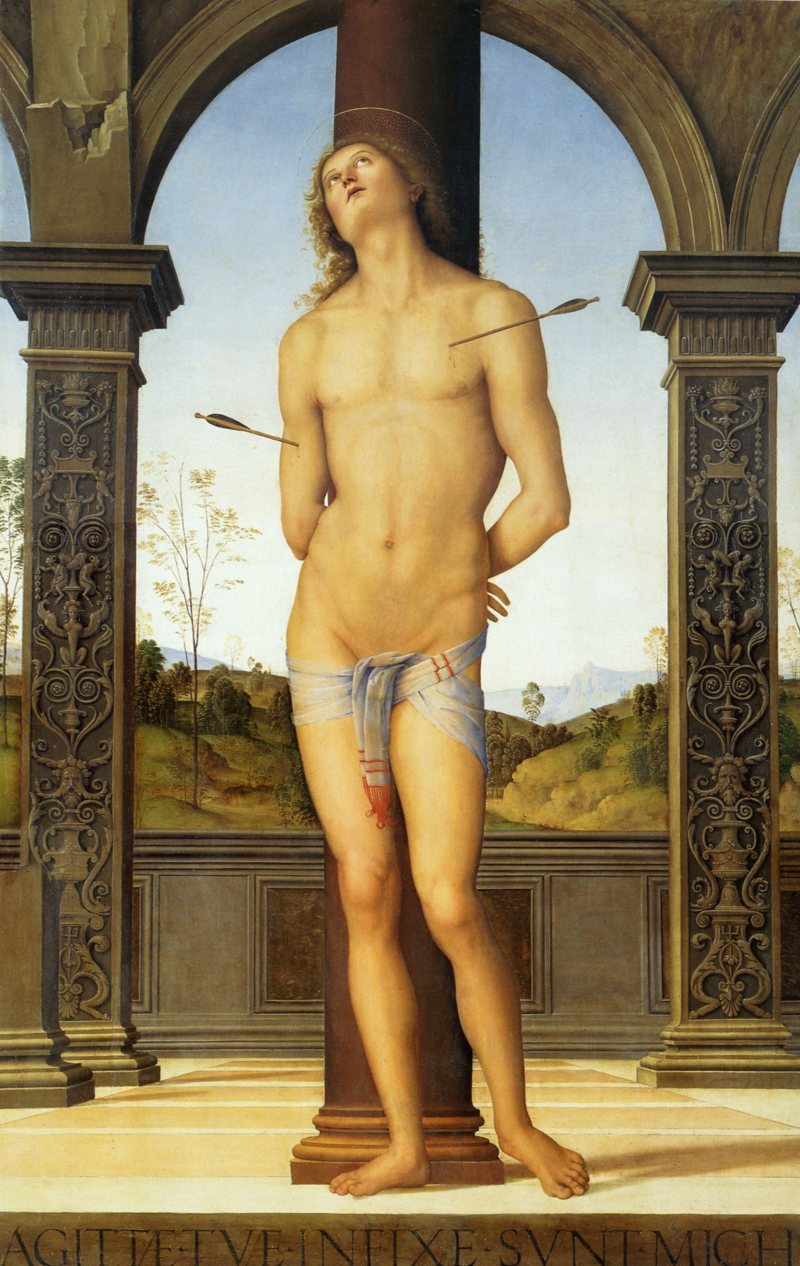
Sebastian bound to a column in a classical loggia, his body as graceful and untroubled as a dancer's, two arrows in his side, his eyes raised in patient ecstasy while the landscape breathes behind the arches. An inscription on the pedestal plays on the saint's name and the painter's pride. Perugino painted Sebastians all his life; this is the serenest — martyrdom without a mark of pain, which is either its glory or its limit.
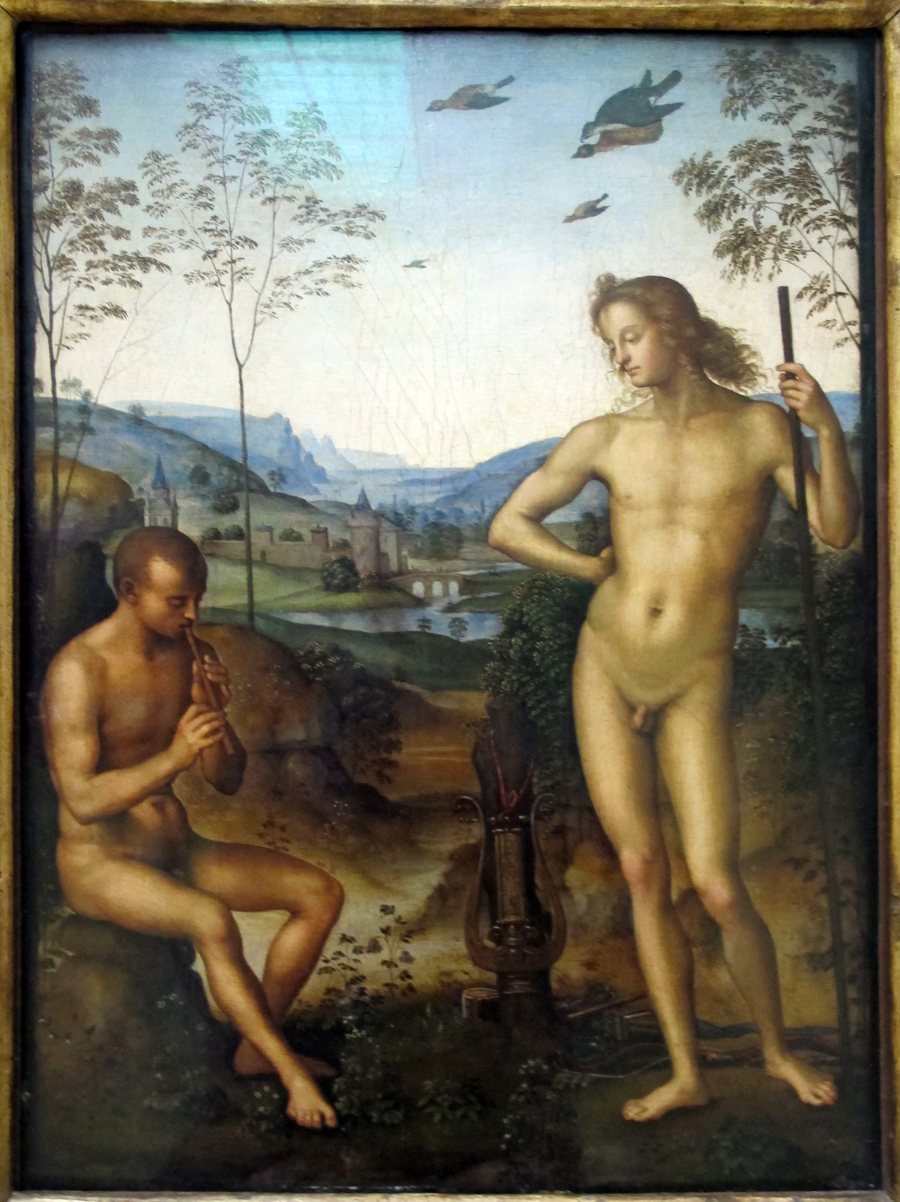
A small mythological panel, rare in his work: Apollo stands naked and calm with his lyre, the pipes of the defeated Marsyas — here a young shepherd with his flute — at his feet, the contest already decided in the god's favour, the Umbrian hills indifferent behind. The flaying that the myth promises is nowhere in sight; Perugino could not paint cruelty, and so paints the moment before, in sunlight.
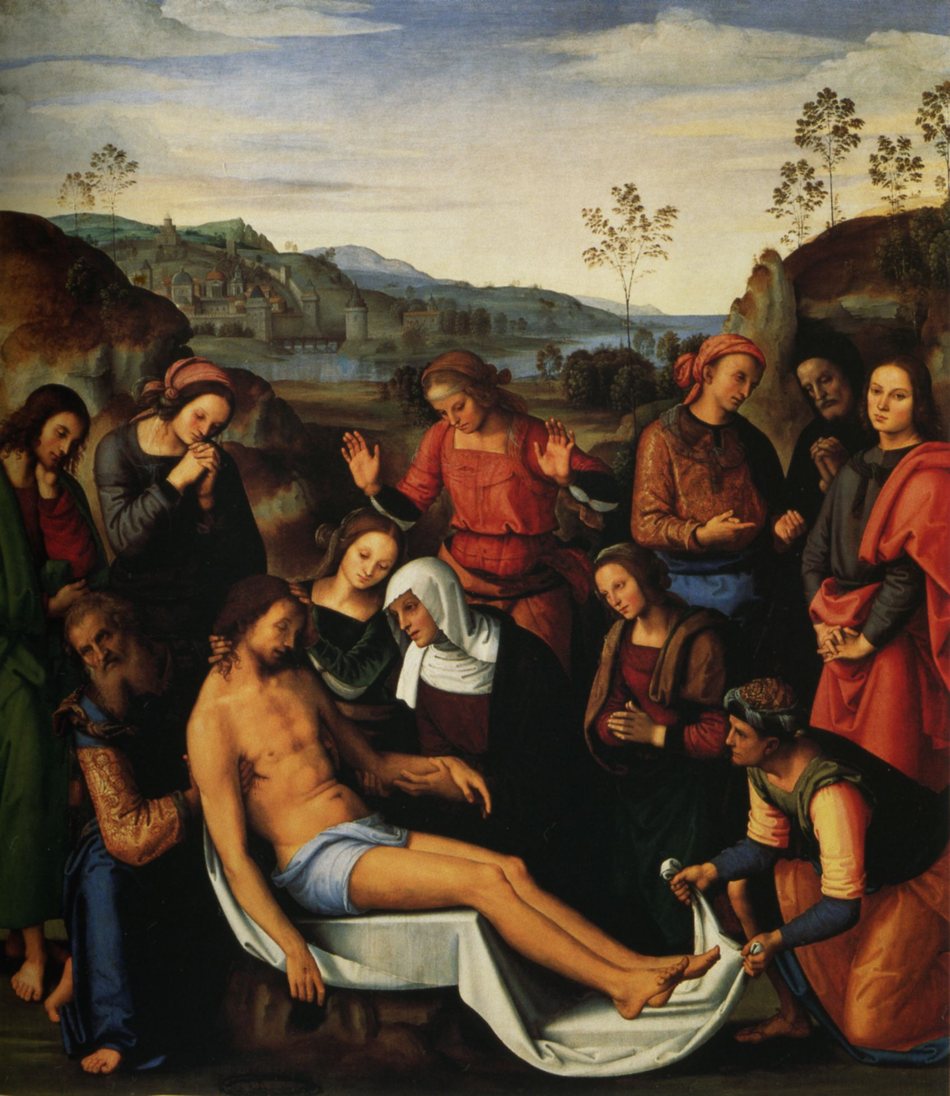
The dead Christ is lowered into the foreground across the knees of the holy women, Joseph and Nicodemus at the head and feet, the Virgin swooning gently at the side — and behind the grief, as always with Perugino, the calm green distance of Umbria, where nothing has happened. The contrast is the picture: sorrow in the front row, eternity's indifference behind it, both painted in the same sweet light.
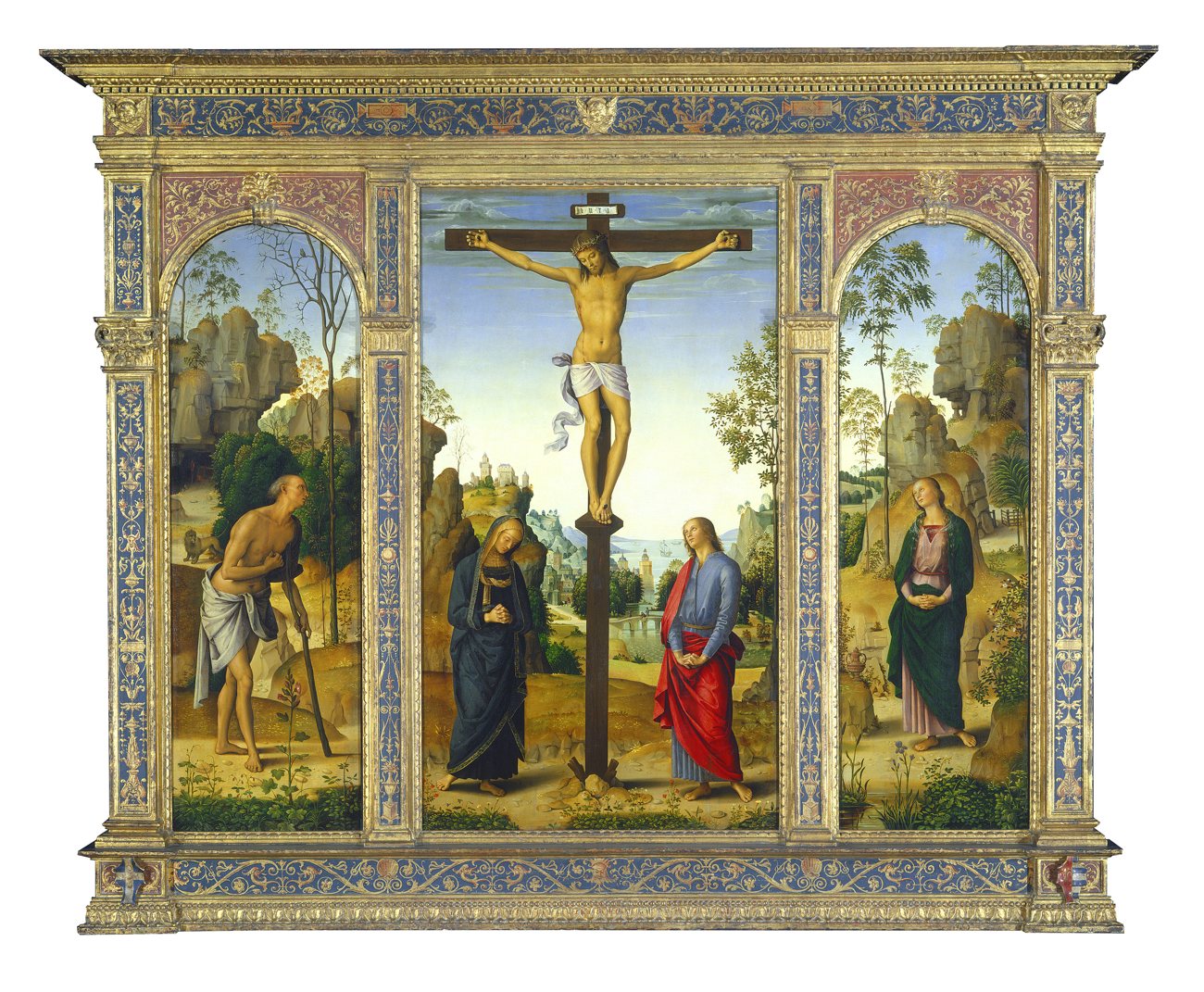
A portable triptych: Christ on the cross at the centre, raised on a rocky platform between the Virgin and Saint John in a landscape of heartbreaking calm; Saint Jerome in his cardinal's red in the left wing, the Magdalene kneeling in the right. Painted for private prayer, to be opened like a book. The Crucifixion has never been painted more quietly — the world does not darken; it holds its peace, and that is harder to bear.
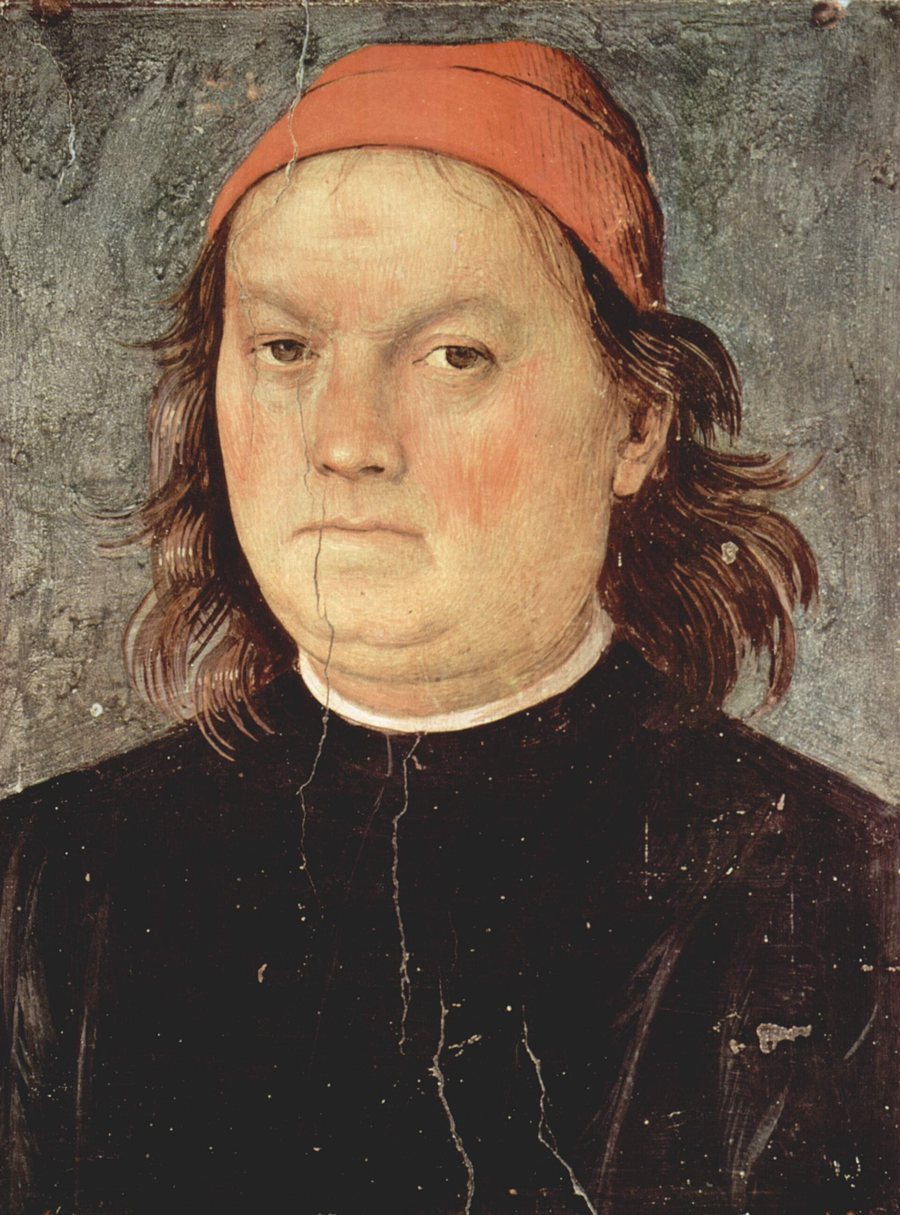
His own face, painted on the wall of Perugia's bankers' hall among prophets and pagan heroes: round-faced, red-capped, looking out with a tradesman's directness, the cracks of five centuries running through the plaster. Beneath it he set a Latin inscription praising his painting in the third person, as if history had already spoken. History, for a while, agreed with every word.