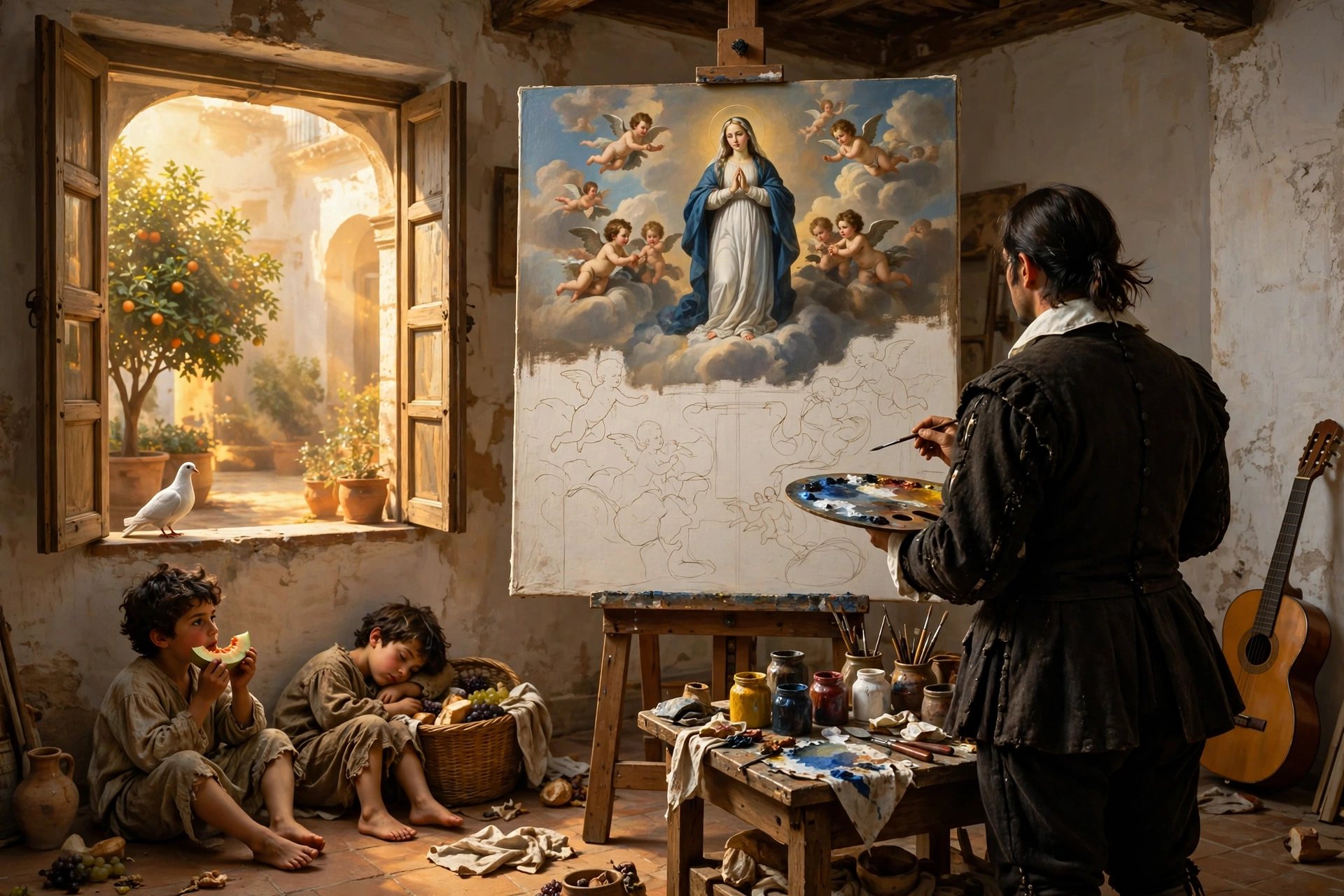
Seville's painter of golden light: Murillo filled his canvases with the city's own children — beggar boys grinning over stolen fruit, Virgins ascending through honey-coloured clouds. Where Ribera, his fellow Spaniard, chose the knife-edge of darkness, Murillo chose warmth: devotion you could reach out and touch.
Murillo never left Spain, and barely left Seville — one journey to Madrid in 1658 is all the travel his art records. He did not need the world: the city gave him its whitewashed glare, its orange-tree shade and its long golden evenings, and he learned to paint light the colour of honey, in which everything, even rags, turns gentle.
His early work is called the cold manner — estilo frío: sharp drawing, hard light, every wart and rag rendered like evidence; the Young Beggar in this room belongs to it. The late work is the vaporous manner — estilo vaporoso: edges dissolved, paint thinned to breath, forms emerging from warm haze. One painter, two weathers, and the second made him famous across Europe.
His beggar boys — eating grapes, playing dice, delousing themselves in doorways — were painted from the urchins of Seville's streets, observed with a naturalist's patience and not a drop of false pity. Northern merchants bought these scenes eagerly; that is why so many of Murillo's children grew up, so to speak, in Munich and London rather than Spain.
Seville was the beating heart of the cult of the Immaculate Conception, and Murillo painted the subject some two dozen times, perfecting a formula the whole Catholic world adopted: white dress, blue mantle, the crescent moon under her feet, a swirl of cherubs, eyes raised — all of it carried upward on golden air. The Franciscans, his great patrons, wanted doctrine you could love at first sight.
Beneath the softness lies draughtsmanship: Murillo drew constantly, in red and black chalk, and in 1660 he co-founded Seville's Academy of Art, where artists drew from the living model by candlelight. The vaporous surface of the late pictures is not vagueness — it is drawing that has learned to hide, the way a singer hides technique in a song.
Seville was a port, and Murillo's pictures sailed: merchants carried them to Flanders, England and the Americas, and his workshop kept versions and variants ready for the trade. The dispersal began in his lifetime — which is why a room of his work today must borrow its walls from Washington, London, Munich and Ottawa as much as from the Prado.
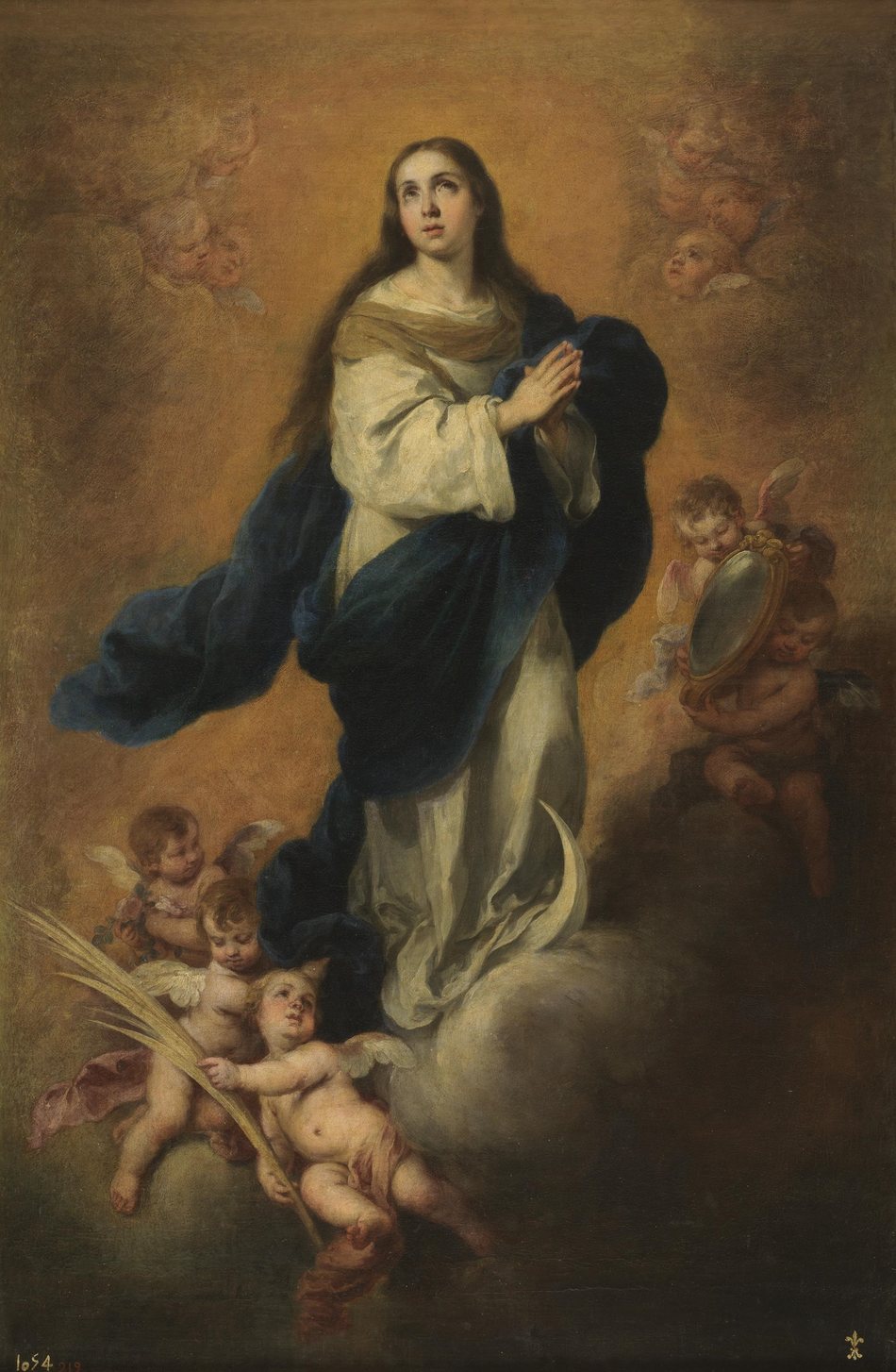
The Virgin rises on a crescent of cloud through a tumbling crowd of cherubs, hands folded, eyes lifted, her blue mantle blown wide. Seville ordered this subject again and again, and Murillo's version of it — white and blue carried up on golden air — became the image of the doctrine for the whole Catholic world.
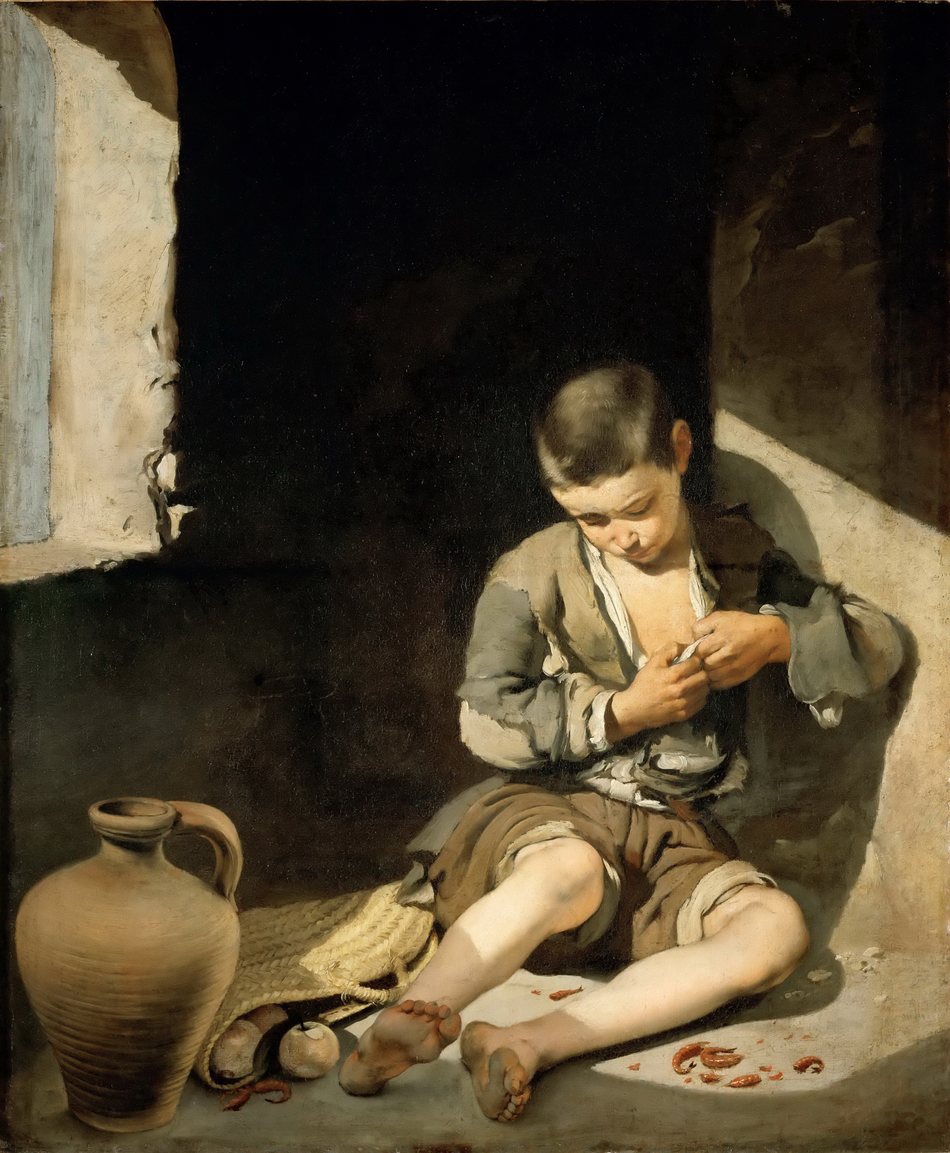
A boy sits in a shaft of window light picking the lice from his shirt, his empty bowl and earthenware jug beside him. It is the cold early manner at its most unflinching — every rag, crack and toenail observed — yet the light treats the child like the subject of an altarpiece.
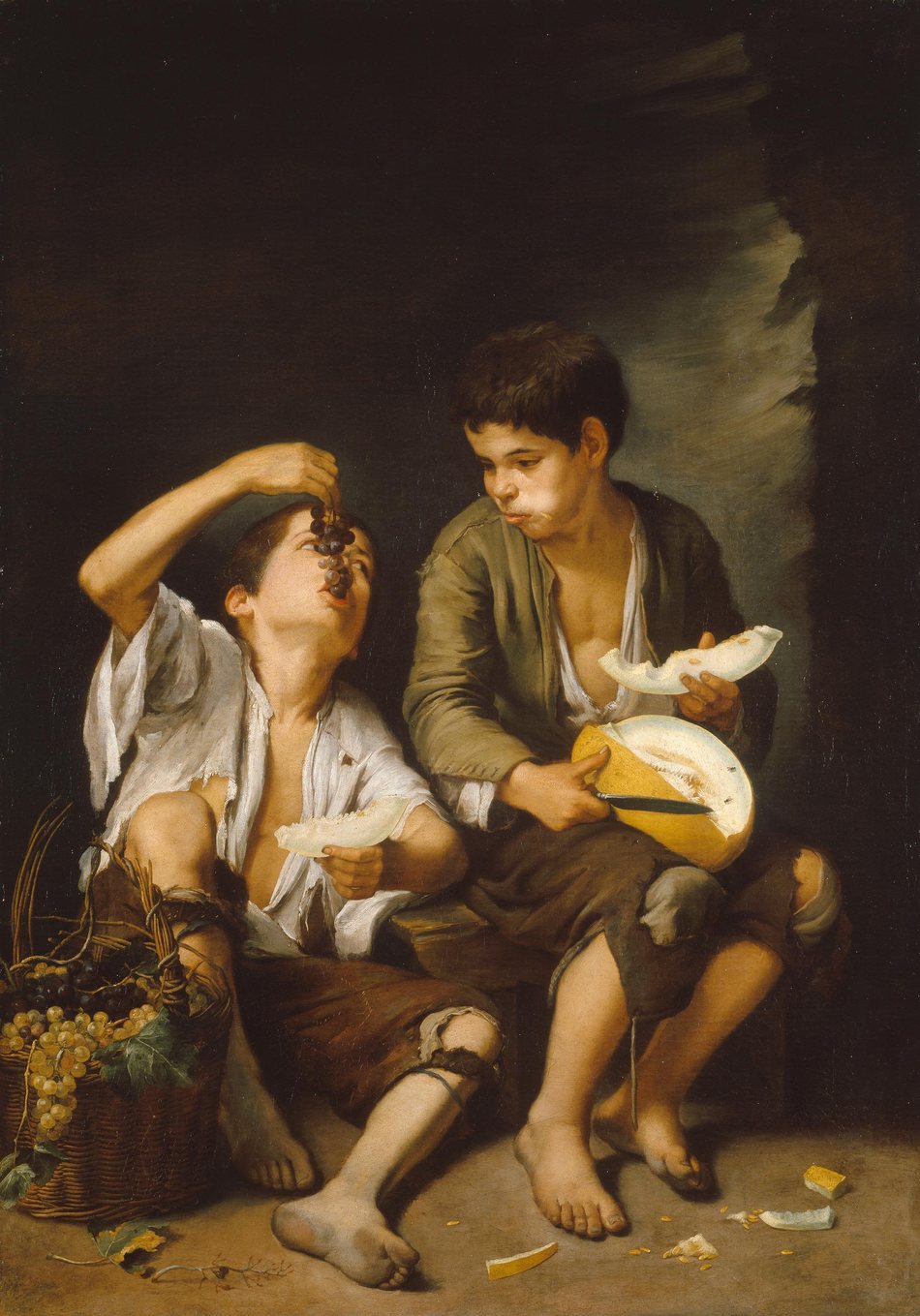
Two urchins share their takings in a dark corner: one tips a bunch of grapes into his mouth, the other is already deep in the melon, bare feet dusty from the street. Painted for a northern buyer, it left Seville young — which is why Munich, not Spain, keeps this most famous pair of Murillo's street children.
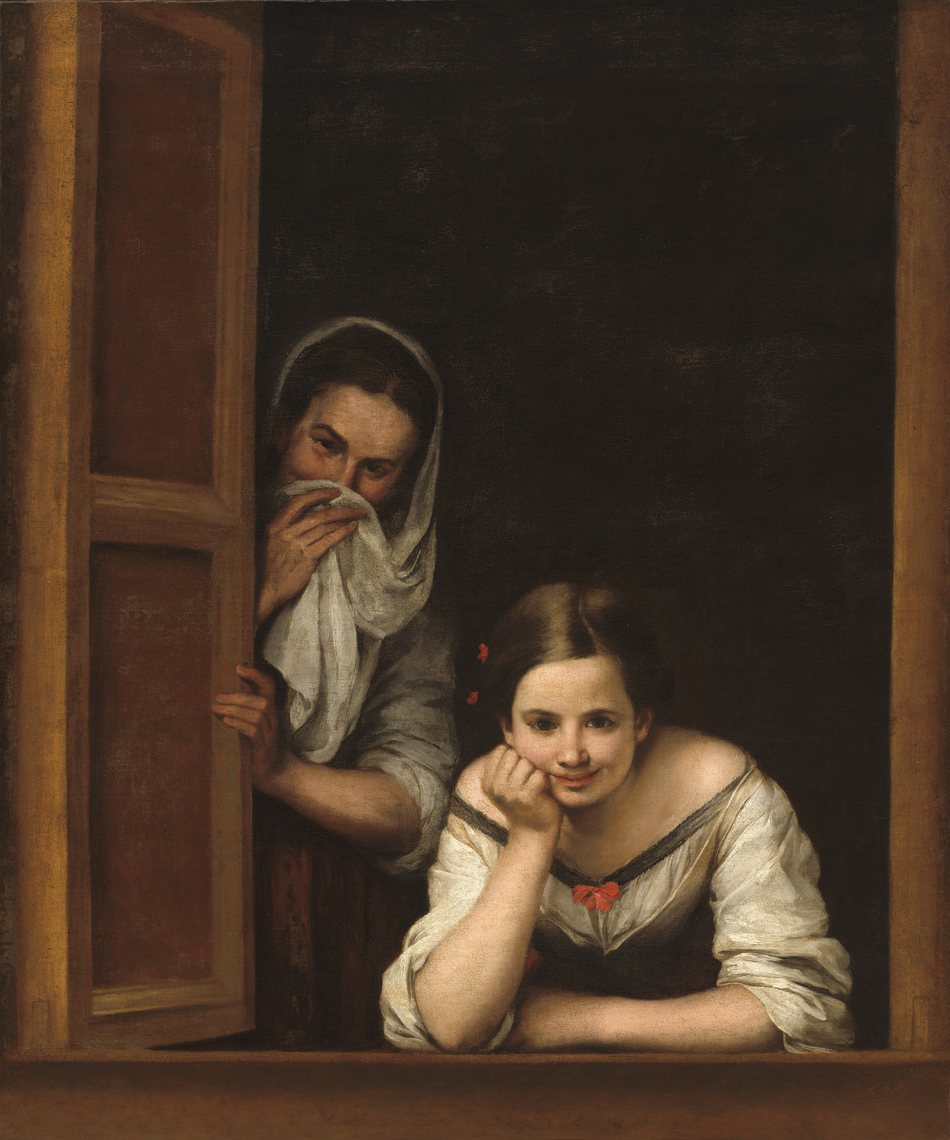
An older woman hides her mouth in her shawl, laughing at something in the street below; the younger leans on the sill, chin on hand, and smiles out at us. Nothing happens, and everything is said — a window turned into a stage, and Murillo's genre painting at its most quietly theatrical.
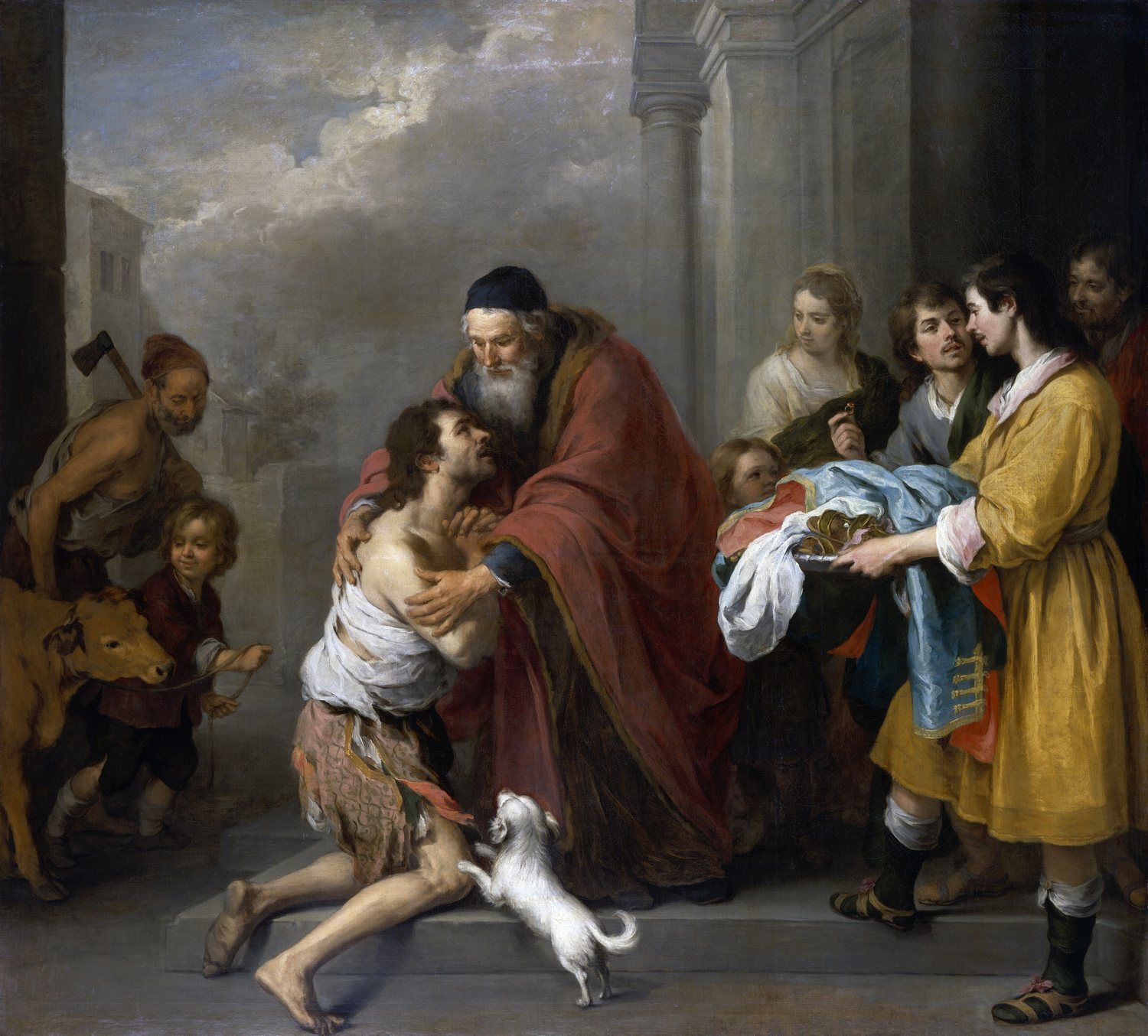
The father gathers his ragged son into his arms while servants hurry in with the robe and the ring, and a little white dog dances round their feet. Murillo painted it for the Hospital de la Caridad in Seville — a sermon on mercy, staged to be read across a church by people who had buried their own prodigals.
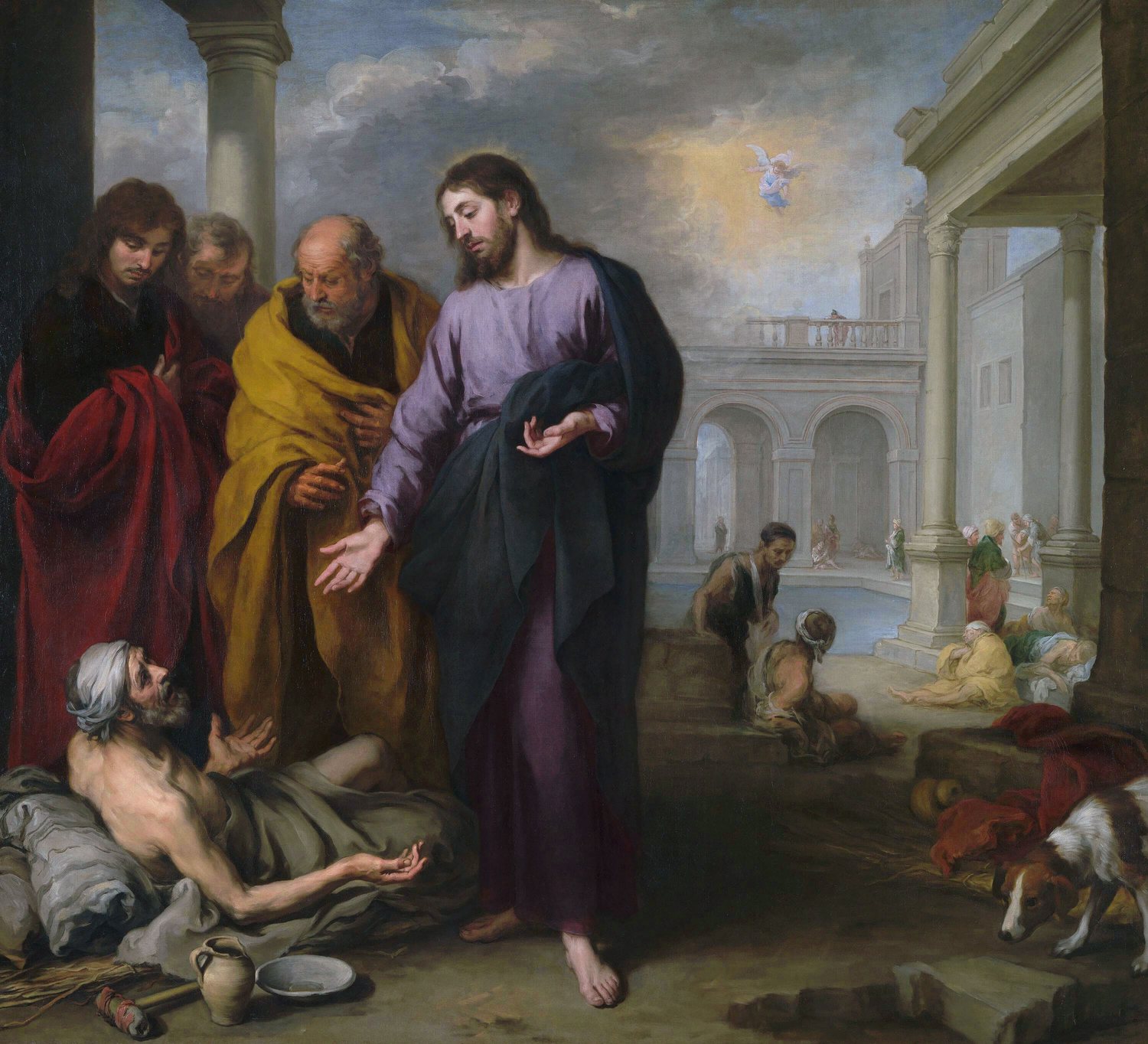
Another canvas for the Hospital de la Caridad: Christ bends over the man who waited thirty-eight years by the pool, while the colonnade behind fills with the sick and the curious of Jerusalem. Murillo stages charity as a crowd scene — the miracle happens almost casually, in the middle of an ordinary afternoon.
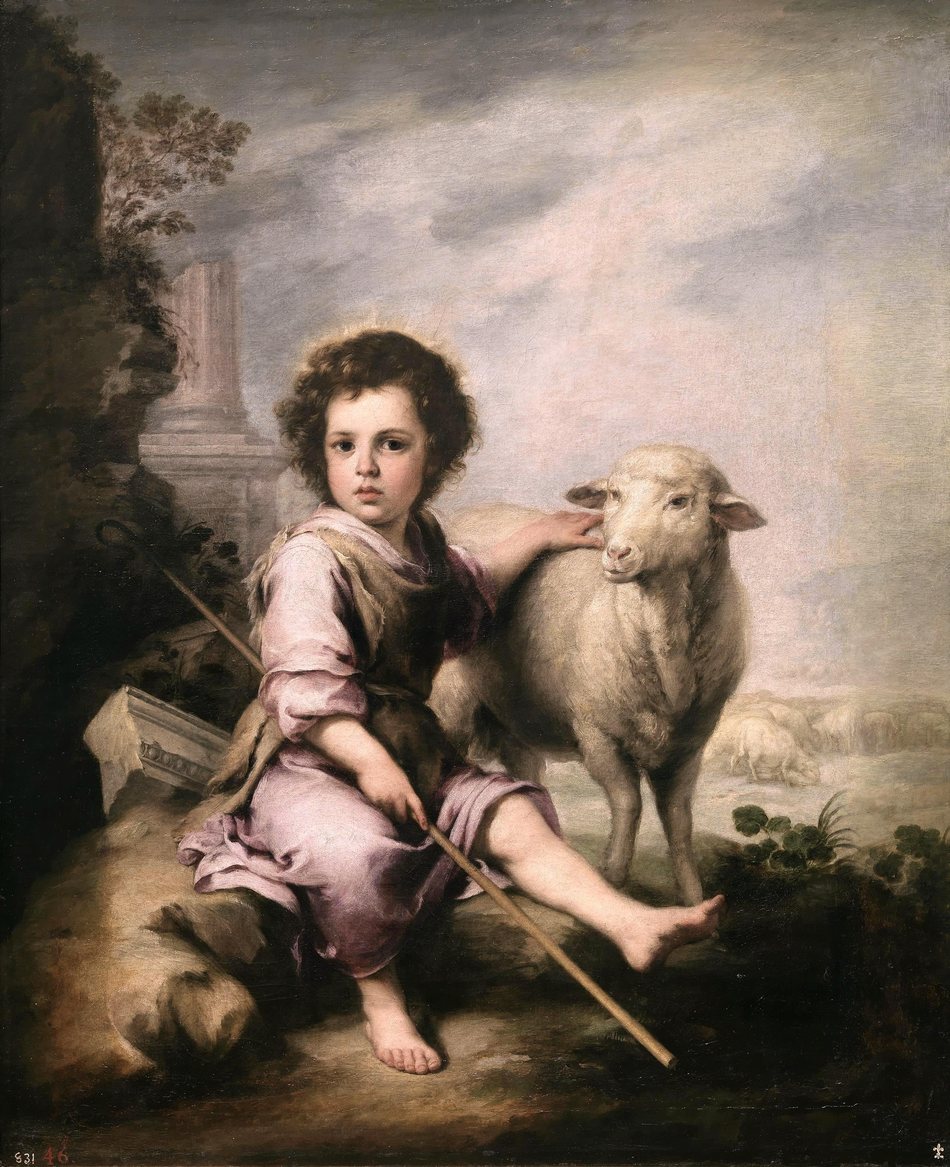
The Christ child sits in a wide landscape with his shepherd's crook, one hand resting on the lamb at his side, and looks out at us with grave, unchildlike calm. Painted as one of a pair with a young Saint John the Baptist, it turns doctrine into a child's portrait — and was copied into Spanish chapels and nurseries for two centuries.
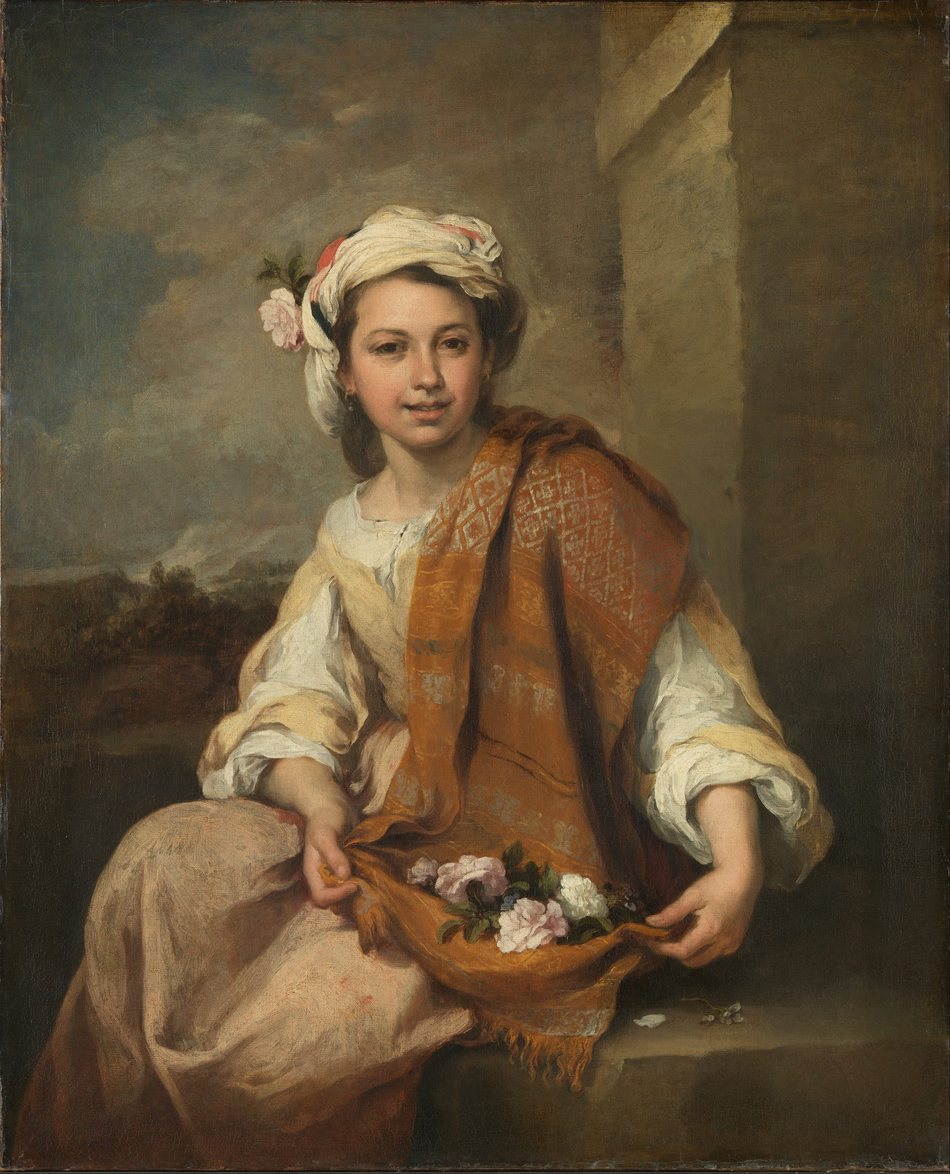
A girl in a worn shawl holds out an apron of white blossoms and looks up with a smile scholars have argued over for centuries — spring allegory, street seller, or something less innocent. The painting keeps its counsel; what is certain is the touch, the vaporous late manner in full, soft bloom.
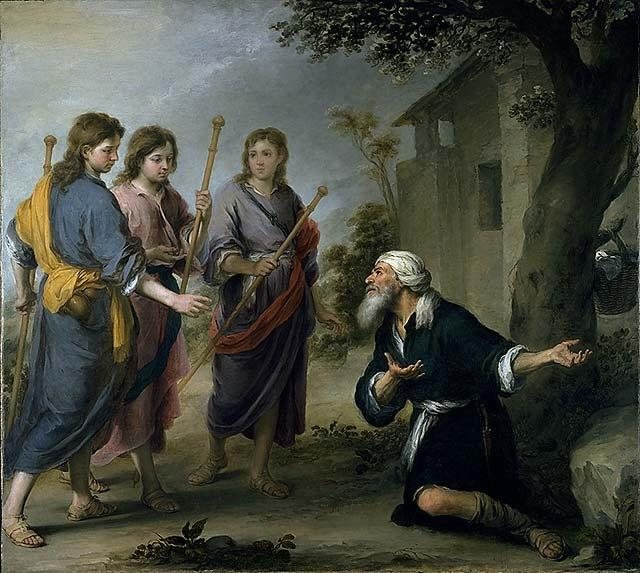
Three young travellers with staffs stand in a landscape before the kneeling patriarch, who has understood who his guests are. Painted, like the Prodigal Son, for Seville's Hospital de la Caridad, it is a lesson in hospitality — Abraham fed angels unawares, and the hospital fed whoever knocked.
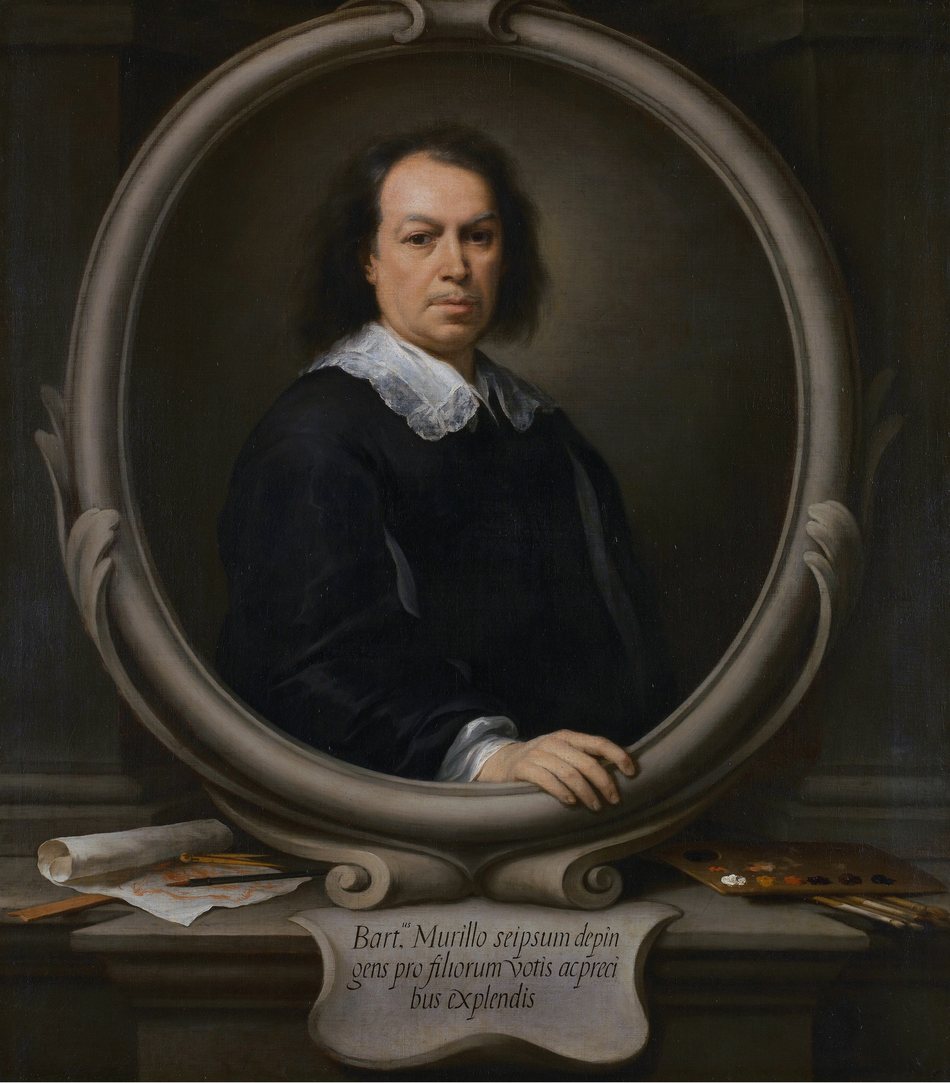
The painter shows himself inside a painted oval stone frame, one hand resting on its ledge among his palette, brushes and a drawing — the tools laid out like credentials. The Latin inscription below explains that he painted it at the wish of his children: a father's portrait, and a craftsman's signature in stone.