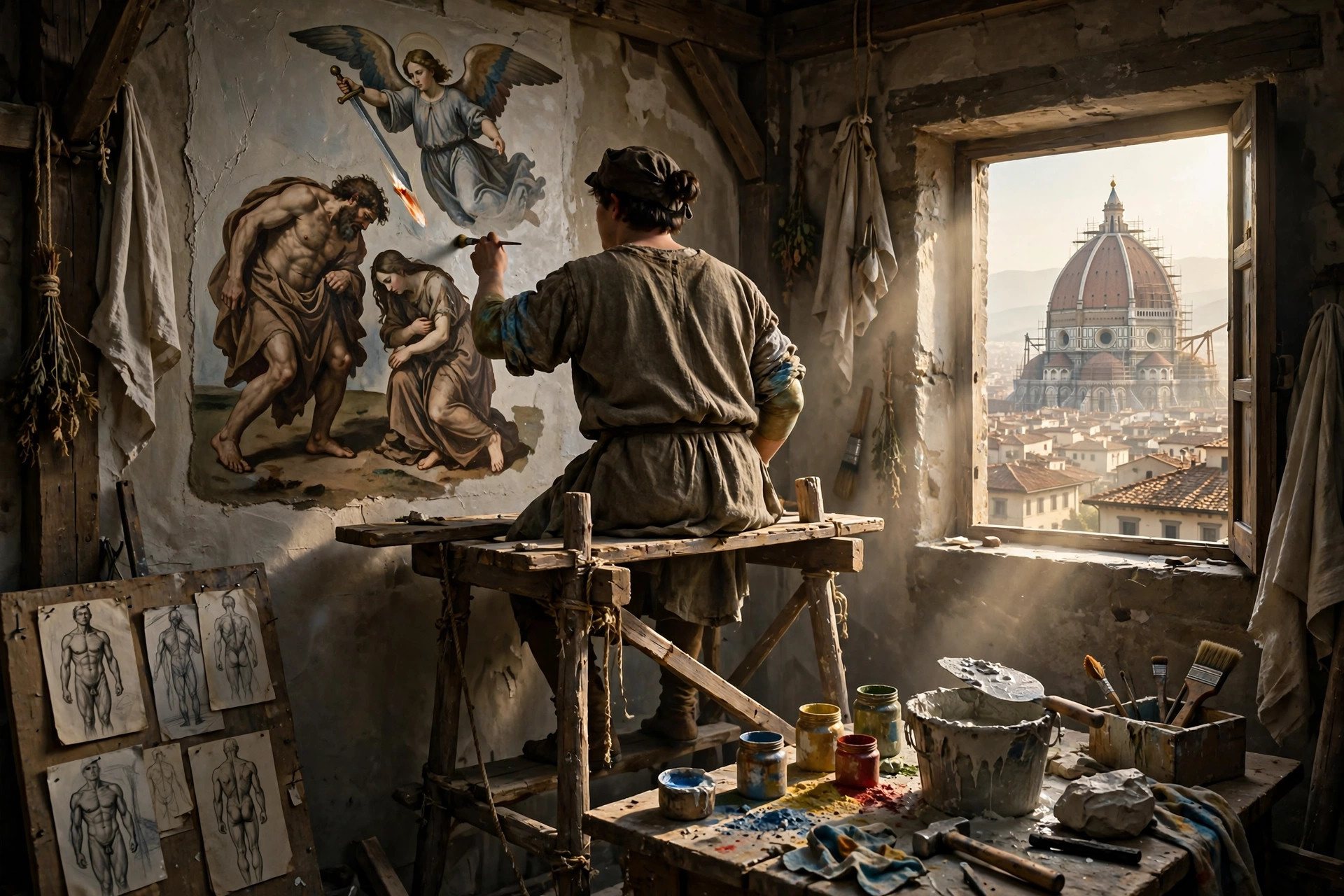
He had about six working years and died at twenty-seven — and in that span he rebuilt European painting. Masaccio gave figures back their weight, their shadows and their grief; he put them in real light, on real ground, inside architecture measured like a theorem. Michelangelo, Leonardo and Raphael all came to the Brancacci Chapel to learn from the dead boy.
Tommaso di Ser Giovanni — nicknamed Masaccio, 'big, careless Thomas' — enters the Florentine painters' guild in 1422 and is dead in Rome by 1428, aged twenty-six or twenty-seven. Between those dates stand the Brancacci frescoes, the Trinity, the Pisa altarpiece: a body of work so consequential that the rest of the century is, in a sense, its footnote. Vasari says all the great ones studied in his chapel as in a school.
Giotto had given figures mass a century before, but Masaccio's people are heavier still — built in broad, sculptural volumes, feet planted flat on the ground, drapery falling as real cloth falls over real knees. Adam in the Expulsion covers his face and his whole body shudders with the sob; Eve's cry is the first unidealised shout in modern painting. Nothing is decorated; everything is borne.
In the Brancacci Chapel the painted light comes from the chapel's real window: shadows fall consistently, as if the sun itself were cooperating. In St Peter Healing, the apostle's shadow is the instrument of the miracle — a cast shadow doing narrative work, perhaps for the first time in painting. Masaccio understood that light is not illumination added to a scene; it is the scene's physics and its meaning.
In Santa Maria Novella he painted a barrel-vaulted chapel in perfect one-point perspective — the first fully consistent perspective interior — with God the Father holding the cross, the donors kneeling outside the sacred space, and below, in a tomb, a skeleton on its slab: 'I was once what you are, and what I am you will become.' Brunelleschi's new science, turned into a machine for contemplating death.
The Brancacci walls are buon fresco, painted in day-patches of wet plaster, and Masaccio's giornate are large — whole figures laid in with a few loaded strokes before the plaster set. The Expulsion's bodies are modelled in broad tones with almost no detail, and lose nothing by it. The technique demanded decisions at speed; his never falter. What looks like simplicity is velocity, controlled.
He left the Brancacci cycle unfinished; Masolino, his partner, and later Filippino Lippi completed it. The Raising of the Son of Theophilus waited fifty years for Lippi's hand, and the join is still visible to a careful eye — two centuries shaking hands on one wall. Raphael's School of Athens and Michelangelo's Sistine ignudi are unthinkable without this chapel. The boy from San Giovanni Valdarno taught them all, posthumously.
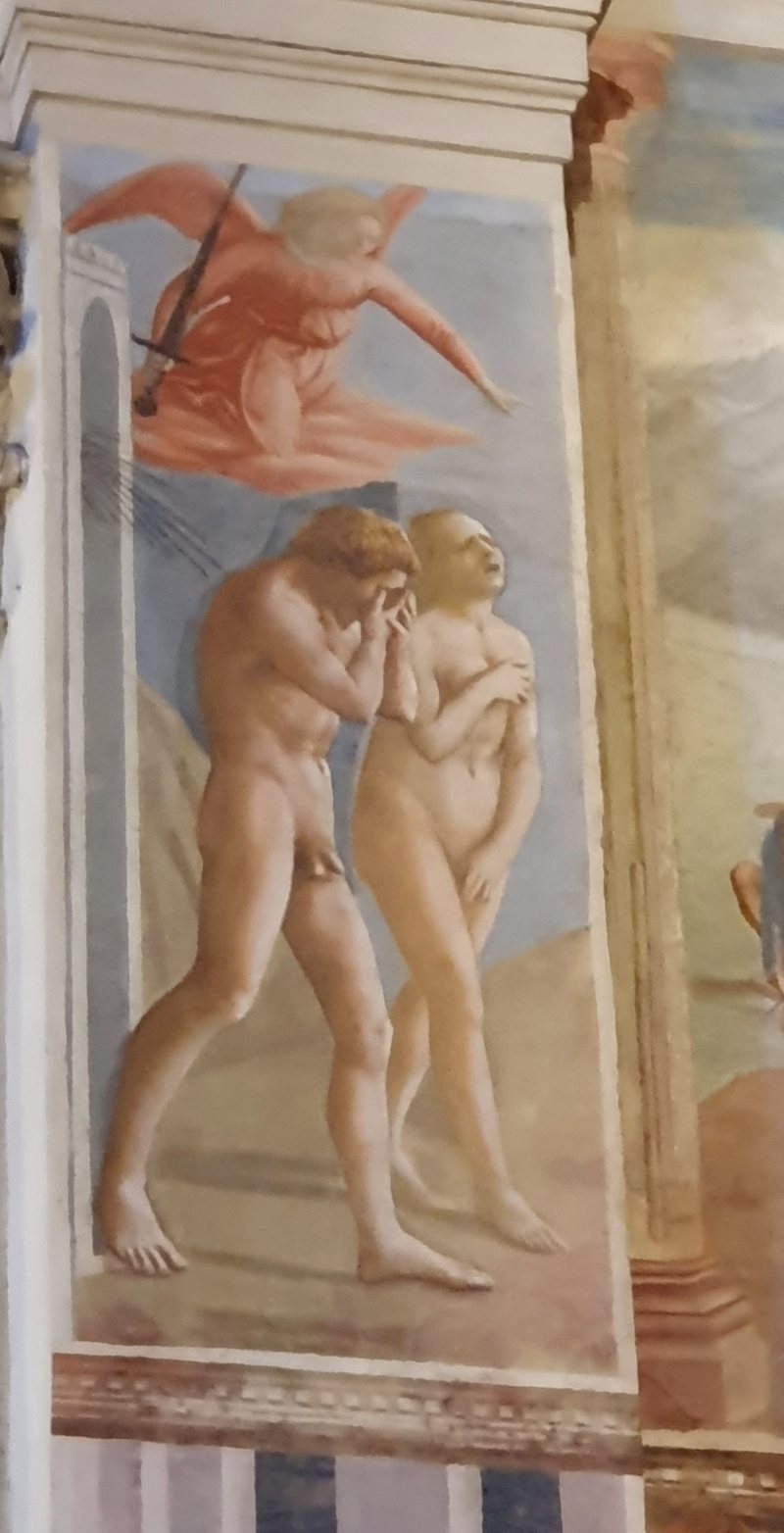
Adam walks out of Paradise hiding his face in his hands, his body convulsed; Eve throws back her head and howls, hands clutching at herself, while the angel with the sword hovers at the gate. Later centuries, embarrassed, painted fig-leaves over them; the leaves were removed in the 1980s restoration. It is the founding image of modern painting: grief with muscles in it.
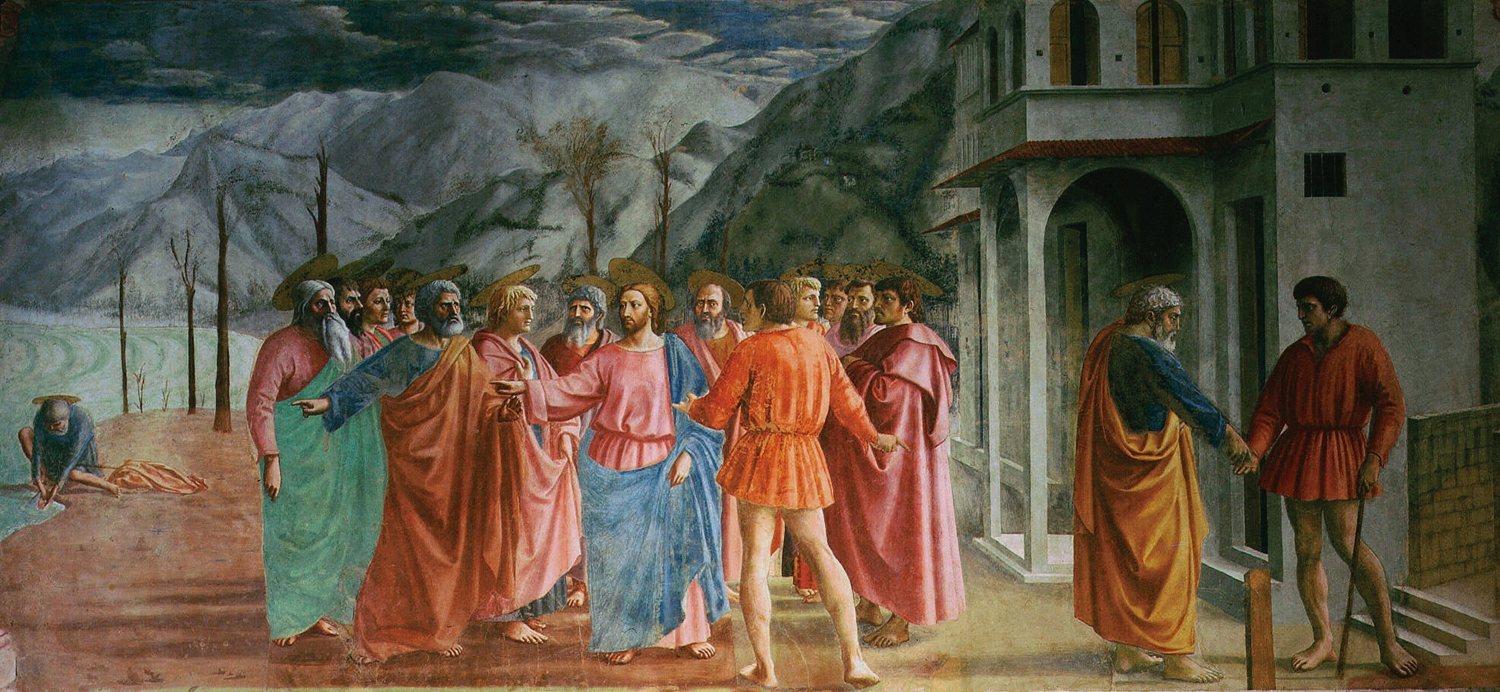
Three moments of one story in a single landscape: in the centre Christ orders Peter to find the coin; at the left Peter takes it from the fish's mouth at the lake; at the right he pays the tax collector. The figures stand in a semicircle of real air, the mountains paling with distance — aerial perspective and continuous narration, invented together. The light falls from the chapel's own window, and the shadows obey it.
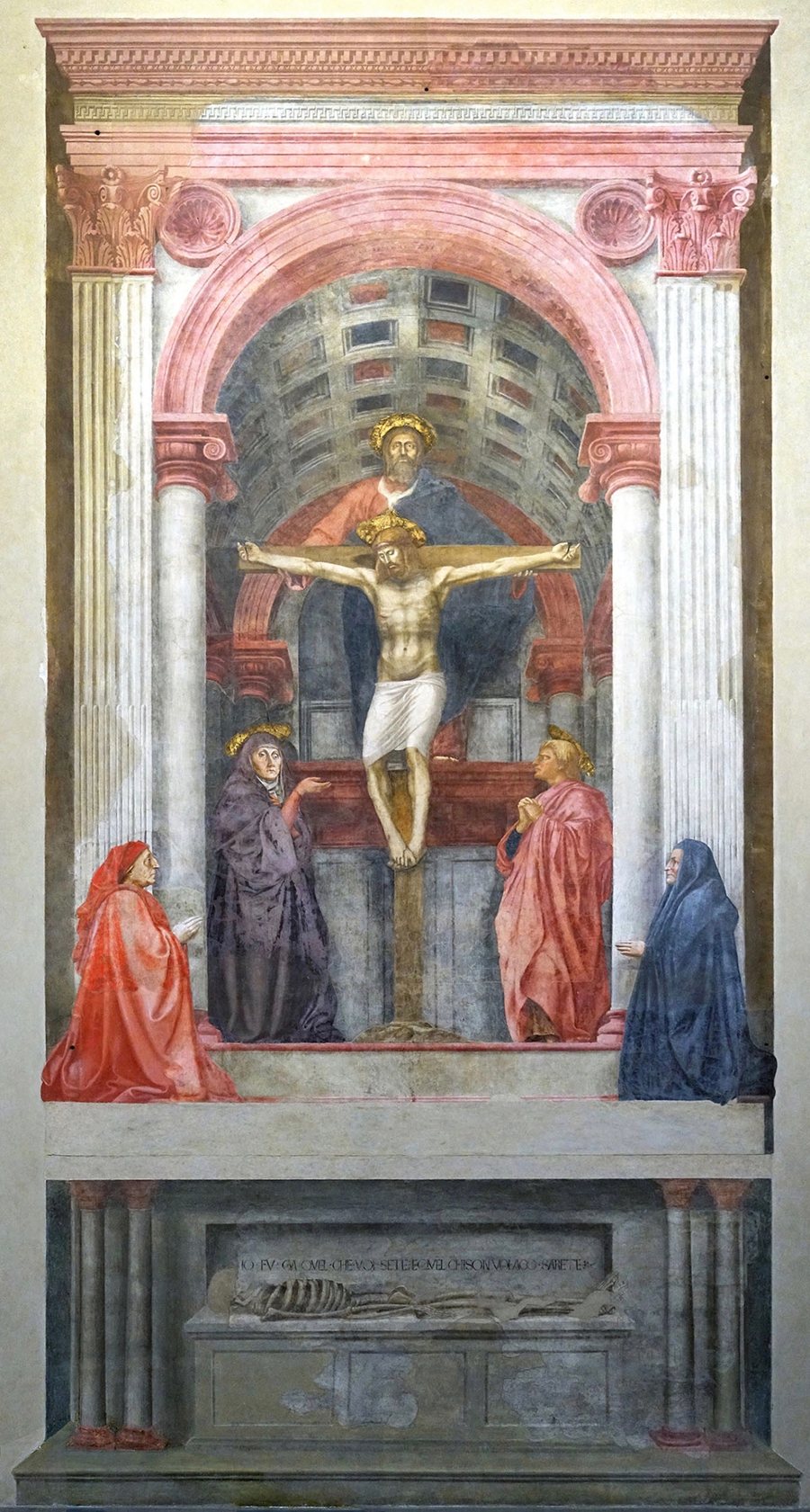
A chapel that does not exist, built of perspective alone: Ionic columns, a barrel vault in coffered recession, God the Father standing on a ledge holding the crucified Son, the Virgin and Saint John in attendance, the two donors kneeling outside the architecture — in our world, not His. Beneath everything, a skeleton in an open tomb delivers the picture's only text: I was what you are; you will be what I am.
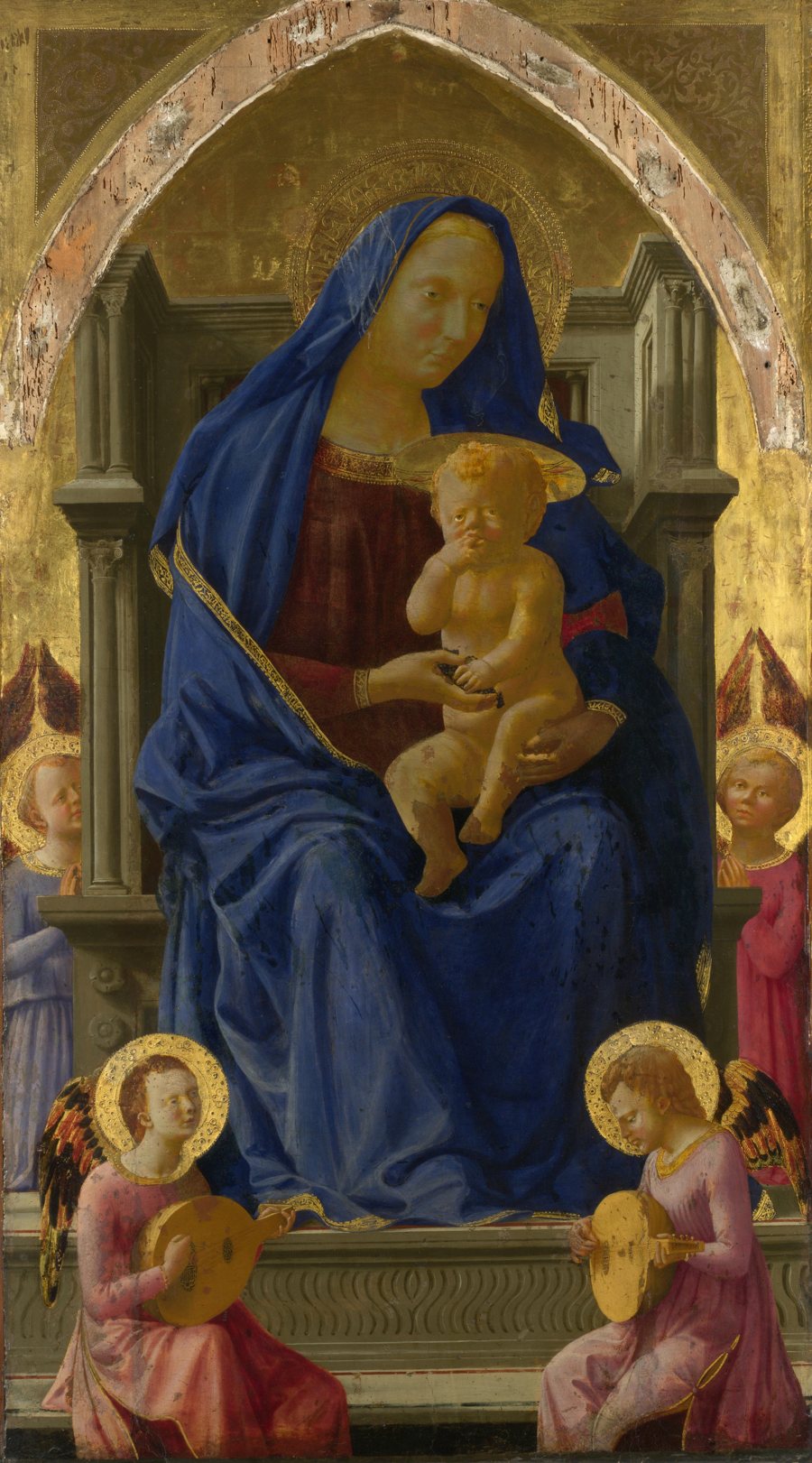
The centre of the Pisa altarpiece: a Madonna of Giotto's massiveness, seated on a low throne, feeding the Child grapes — the Eucharist in an everyday gesture — while he stuffs them in with both hands like any baby. Two angels with lutes kneel at her feet, foreshortened from below. Gold ground above, gravity below: the old world and the new in one panel.
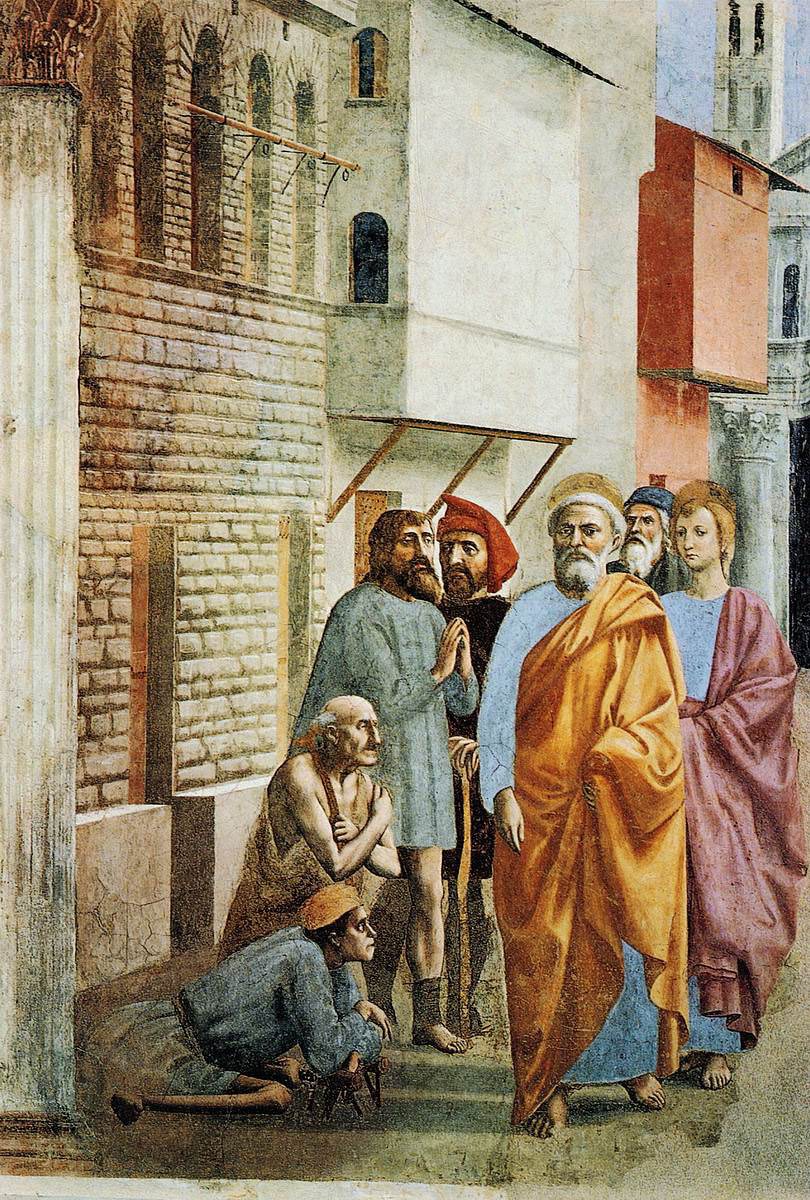
Peter walks down a Florentine street of stone houses, and the sick laid out along the wall rise as his shadow crosses them. One man is already standing, hands joined in astonishment; another is still pulling himself up. Masaccio paints the exact instant a shadow does its work — the most matter-of-fact miracle in Renaissance art, performed in daylight, on a street you could walk today.
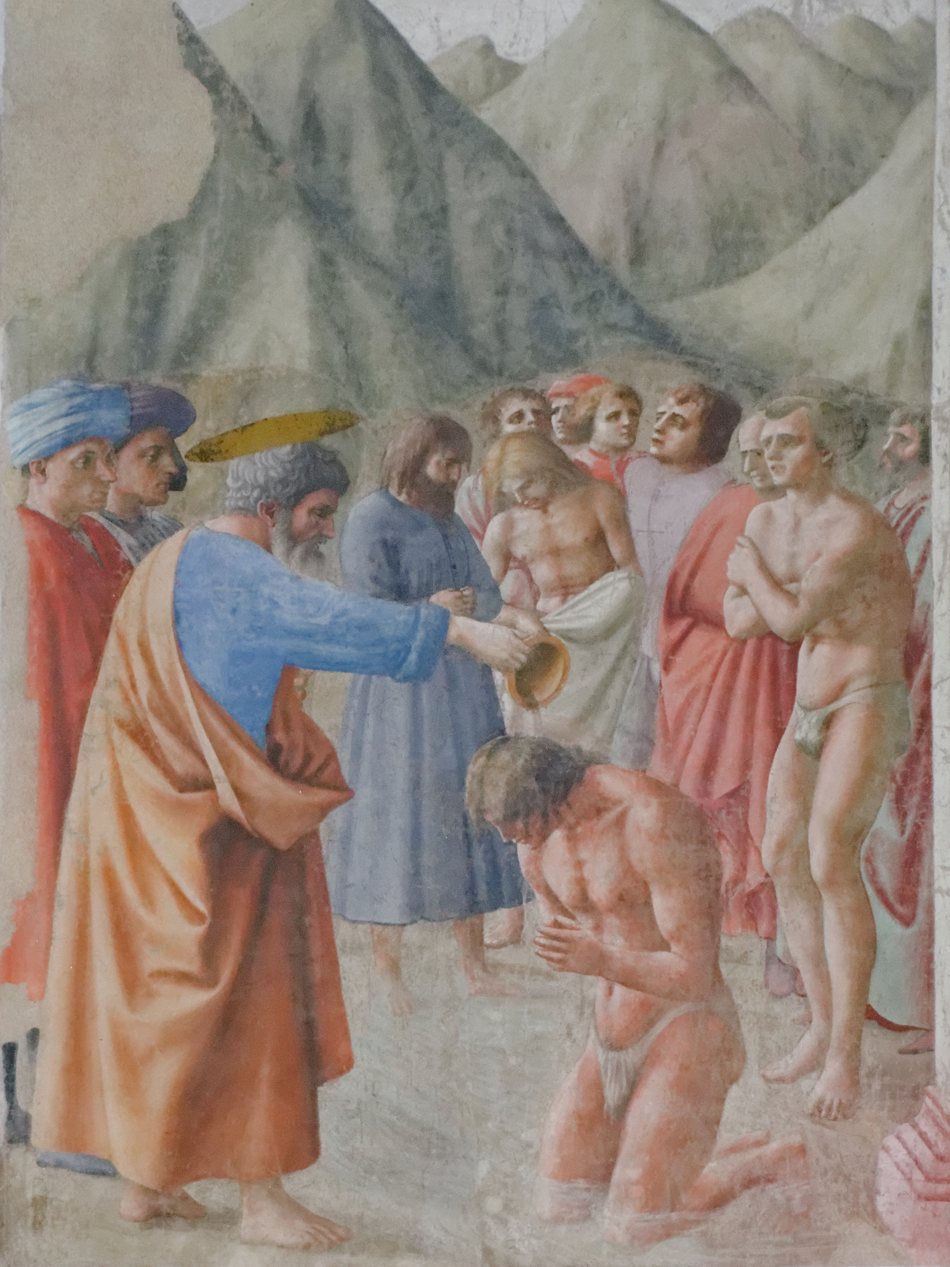
Saint Peter baptises converts in a mountain river valley. One neophyte kneels naked in the water; behind him another waits, arms wrapped around himself, shivering so convincingly that five centuries of viewers have felt the cold. It is the most famous shiver in art — proof that Masaccio's revolution was not geometry but observation: bodies first, doctrines after.
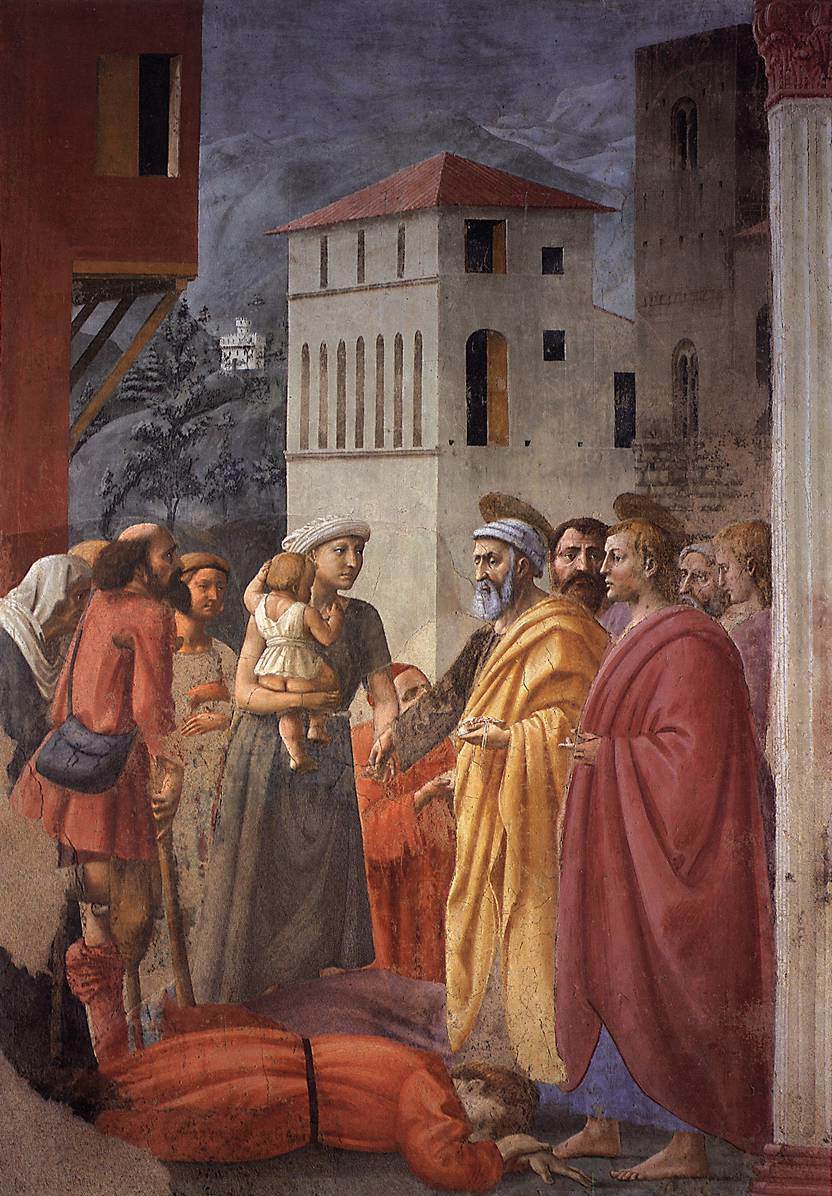
Peter distributes the community's goods: a mother with her baby receives alms in the foreground while behind, unnoticed by most of the crowd, Ananias lies dead on the pavement for lying about his gift. Masaccio composes it like a street scene he had watched — the miracle and the fraud sharing one pavement, one light, one indifferent city around them.
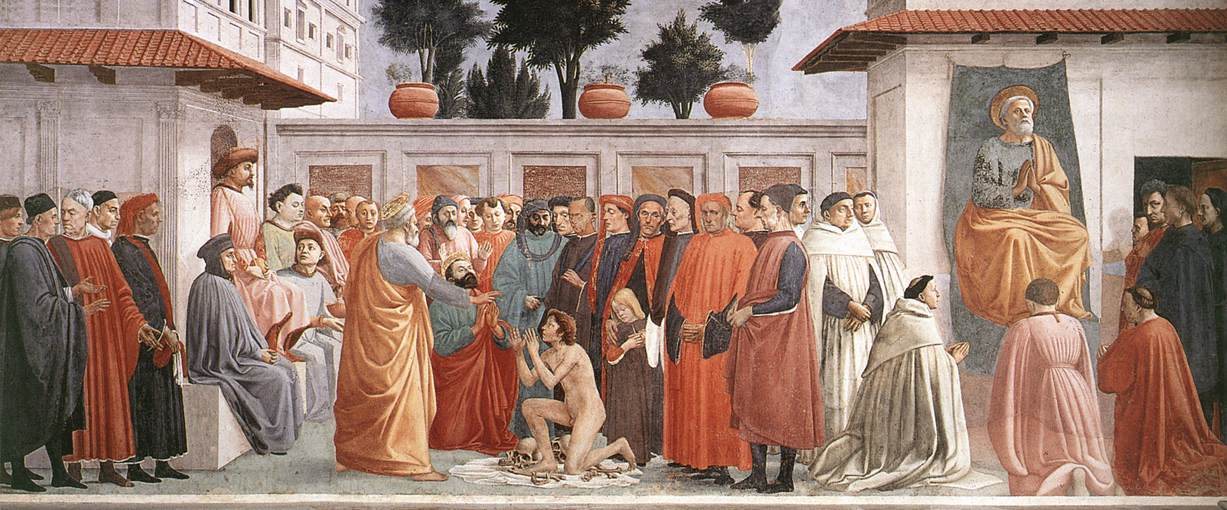
Peter raises a dead boy before the governor Theophilus, enthroned at the right; around them stand Florentine citizens in contemporary dress — portraits of Masaccio's own city watching a miracle. He left the scene unfinished at his death; Filippino Lippi completed it fifty years later, matching the dead master's space so carefully that the fresco reads as one thought across two generations.
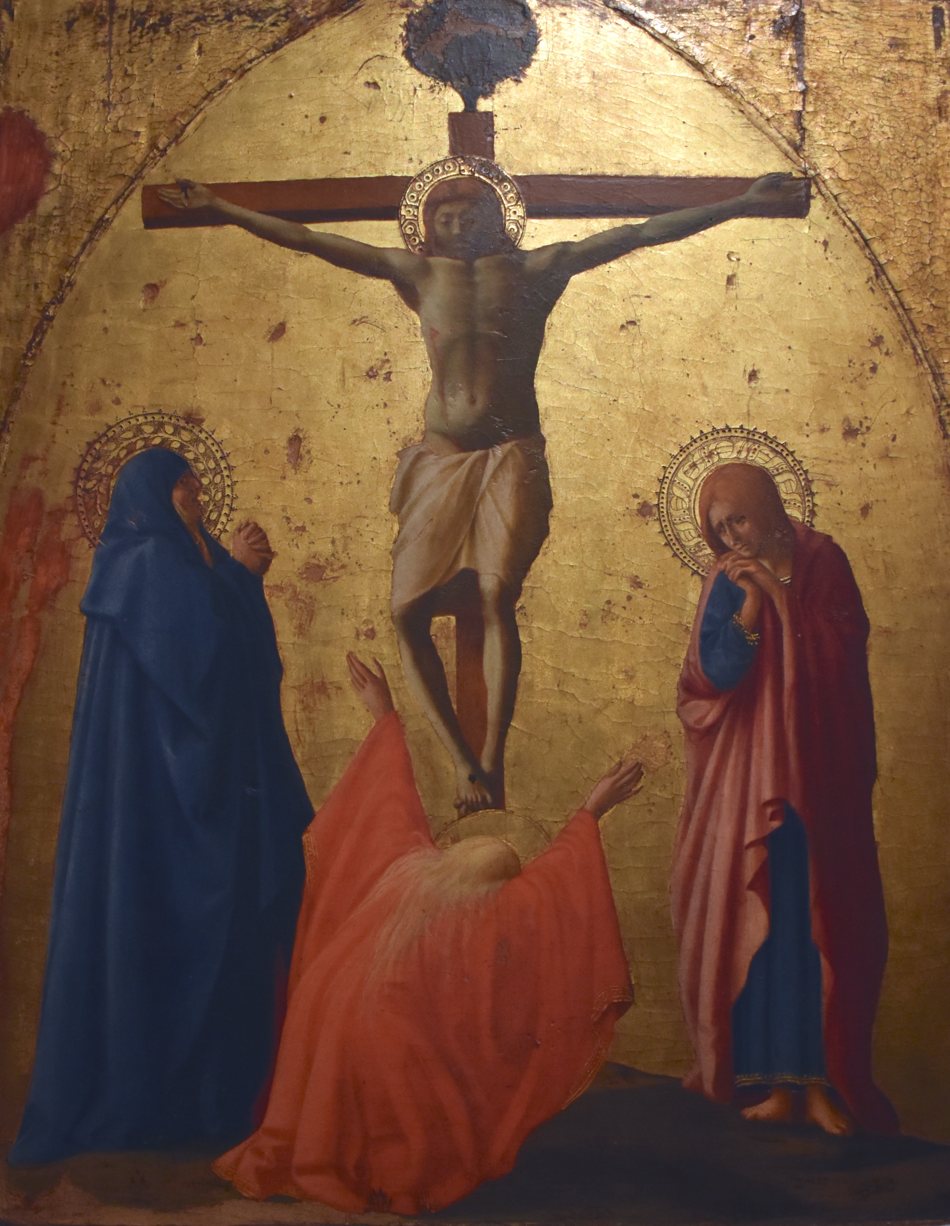
The top of the Pisa altarpiece, on gold: Christ on the cross, the Virgin rigid in blue at the left, John at the right, and the Magdalene flung at the foot of the cross in a red cloak, arms thrown up, seen from behind — a single gesture of grief that carries the whole panel. Painted to be seen from far below, the figure of Christ is deliberately distorted for the viewer's angle.
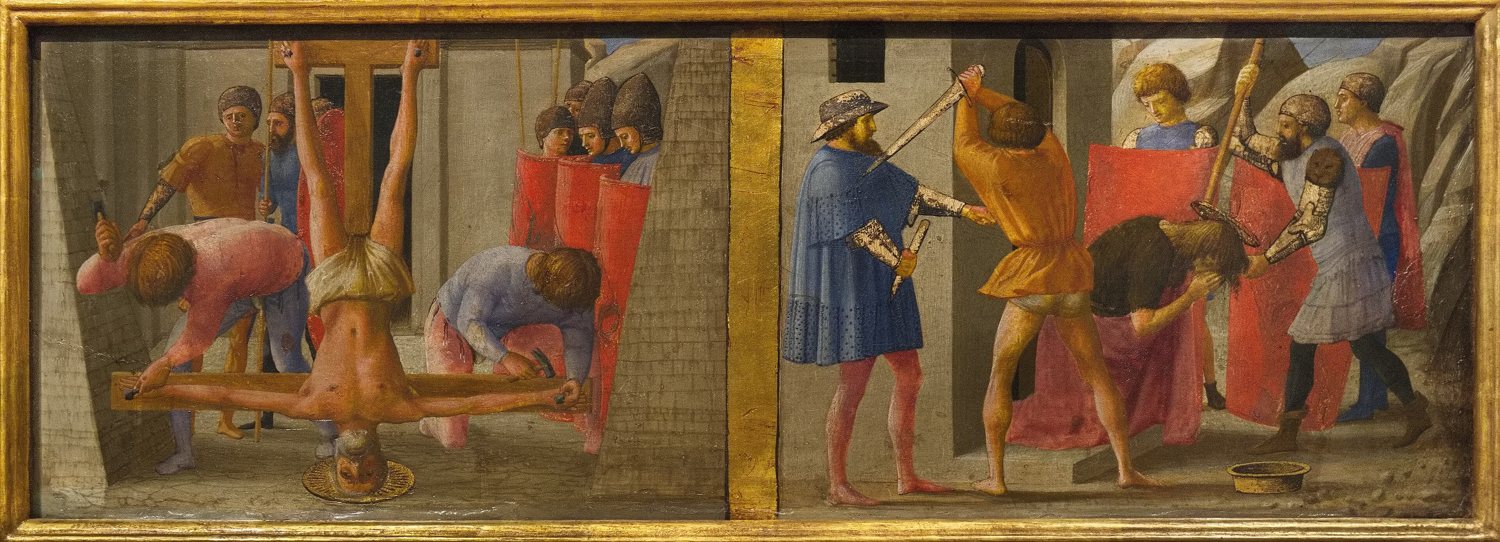
A predella panel from the Pisa altarpiece: Peter crucified upside-down between two executioners straining at ropes, and John the Baptist beheaded before a crowd, the executioner already walking away wiping his sword. Masaccio tells both martyrdoms in one breath, with the economy of a news report — small figures, huge finality.