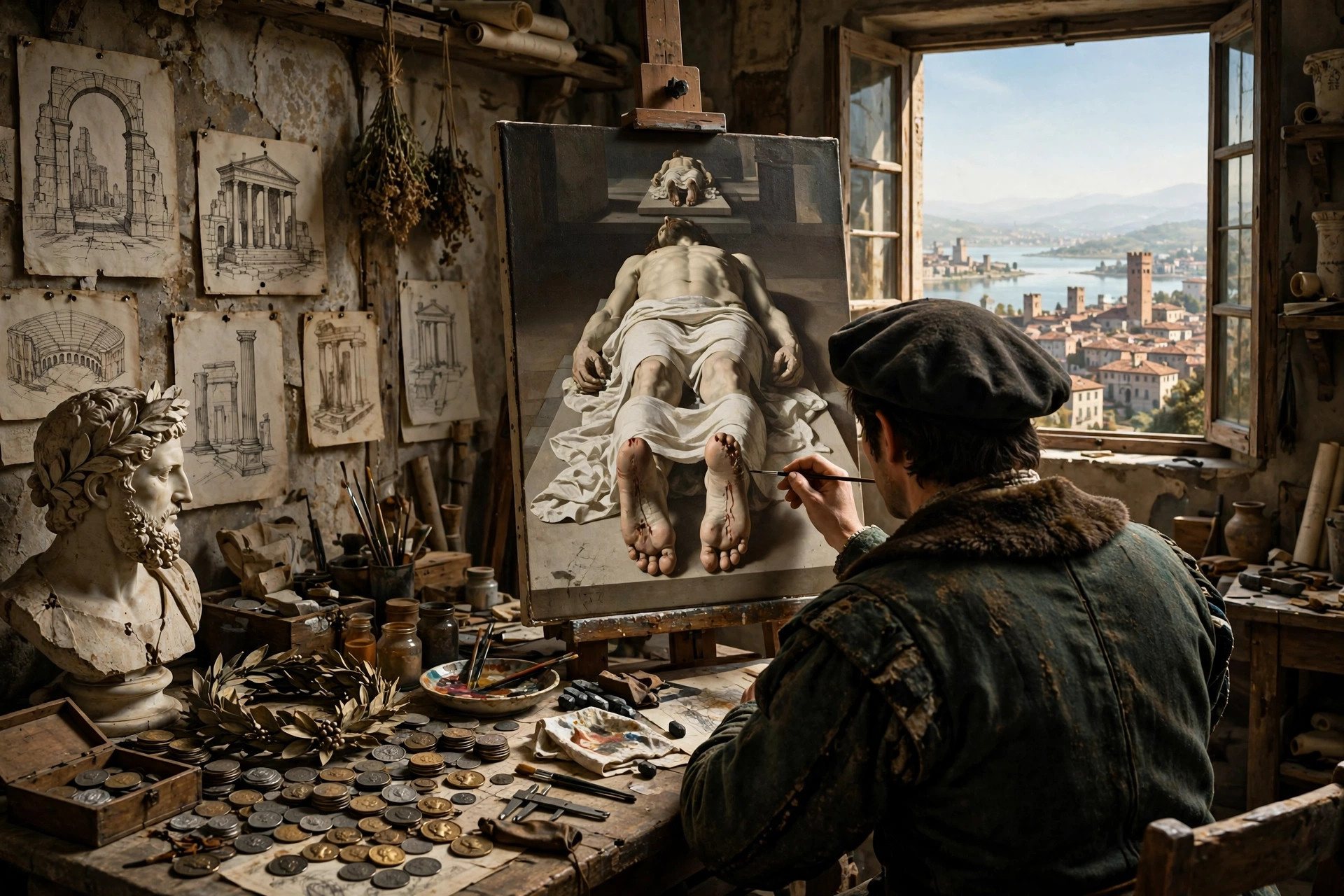
A blacksmith's son-in-law from Padua who painted like a sculptor and thought like an archaeologist. Mantegna's world is hard, clear and carved: marble flesh, landscapes of rock crystal, Rome rebuilt coin by coin. And at its centre, the most daring picture of the Renaissance — a dead Christ seen from his feet.
Mantegna was formed in Padua, in Squarcione's workshop of antiquities and casts, and his painting keeps the discipline of the burin: every form closed by a line as definite as a cut in copper. He was also one of the first great printmakers — his engravings carried his inventions across Europe, so that painters who never saw Mantua learned Rome from his lines.
Padua's humanists taught him to treat antiquity as a science: coins, inscriptions, triumphal reliefs, the texts of Livy and Plutarch. The Triumphs of Caesar are archaeology in paint — every standard, trumpet and trophy researched from Roman evidence. He collected antiquities himself and lived among them; his pictures are museums that walk.
The Dead Christ is the Renaissance's most radical foreshortening: the body laid out toward us, soles of the feet first, head sinking away, the wounds presented like evidence. Perspective here is not a parlour trick but devotion — the viewer kneels where the mourners stand. Mantegna painted it for his own chapel, and it was found in his studio at his death.
His figures have the hardness of marble and bronze — draperies fall in chiselled folds, muscles are modelled like relief. Critics called it cold; it is in fact the paragone, the great Renaissance contest of the arts, argued in paint: painting claiming it can do everything sculpture does, and more — colour, distance, sky. His grisailles, pictures painted to imitate stone relief, make the claim openly.
In the Camera dei Sposi he dissolved a real room into a painted loggia: curtains drawn back, the Gonzaga court standing on a terrace above its own landscape, and on the ceiling the first true di sotto in su oculus in modern painting — putti leaning over a balustrade, a peacock, a tub of plants precarious above the viewer's head. Illusionism in fresco starts here, in Mantua, in a bedroom.
While Venice converted to oil, Mantegna kept faith with tempera — egg and glue on panel and fine canvas — long after it seemed old-fashioned. Its matte, enamel-hard surface suited his line and his stone aesthetic: nothing melts, nothing glows softly, everything is decided. The Triumphs, painted in glue-tempera on canvas, survive like nine banners of that discipline.
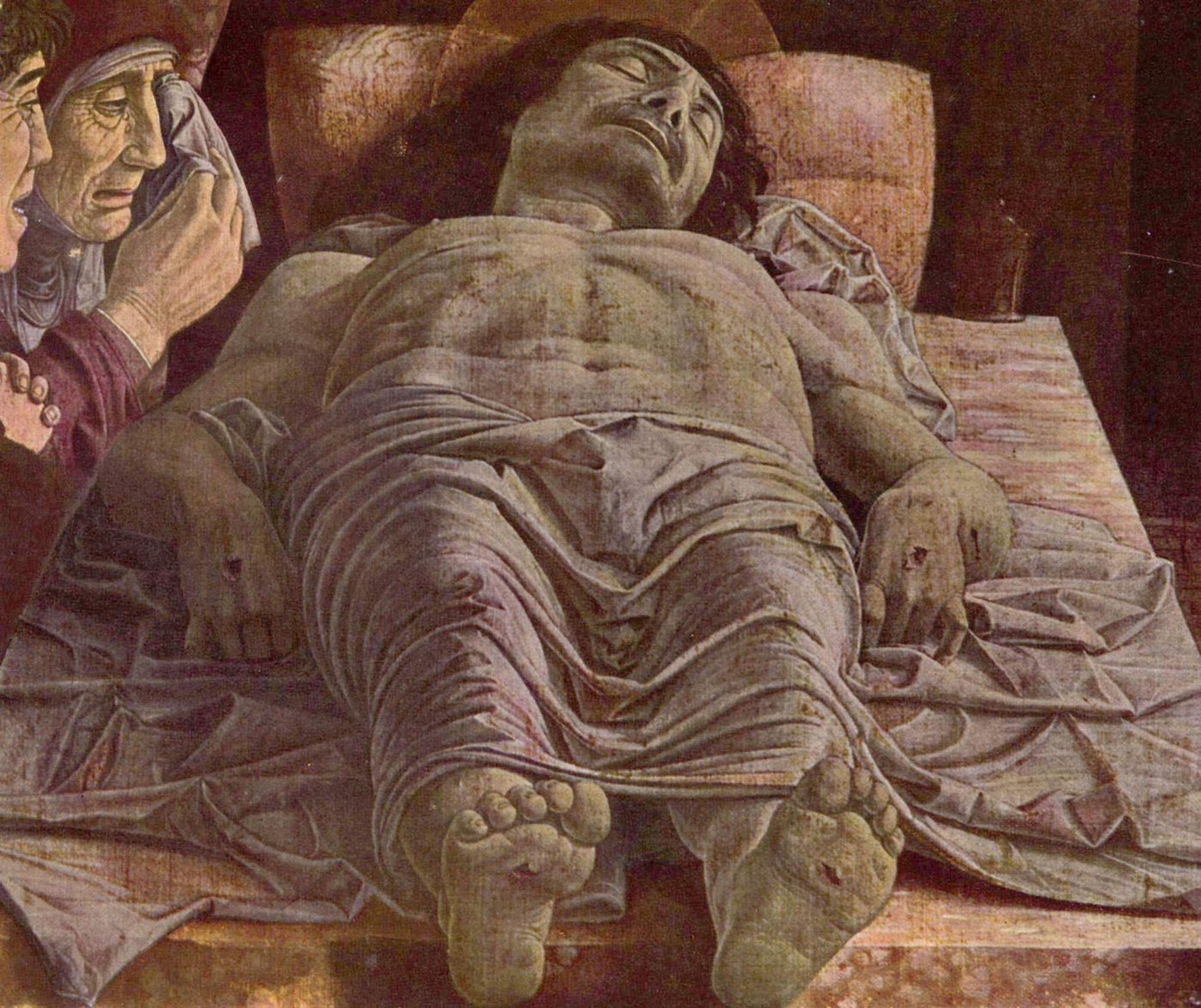
The soles of the feet come first, then the body telescopes away on its marble slab — the most famous foreshortening in Western art. The Virgin's face is squeezed into the top corner, her tears carved as hard as the stone pillow. Mantegna kept it in his studio all his life; it is less a picture than a piece of evidence, laid out for inspection: this is what death does to a body.
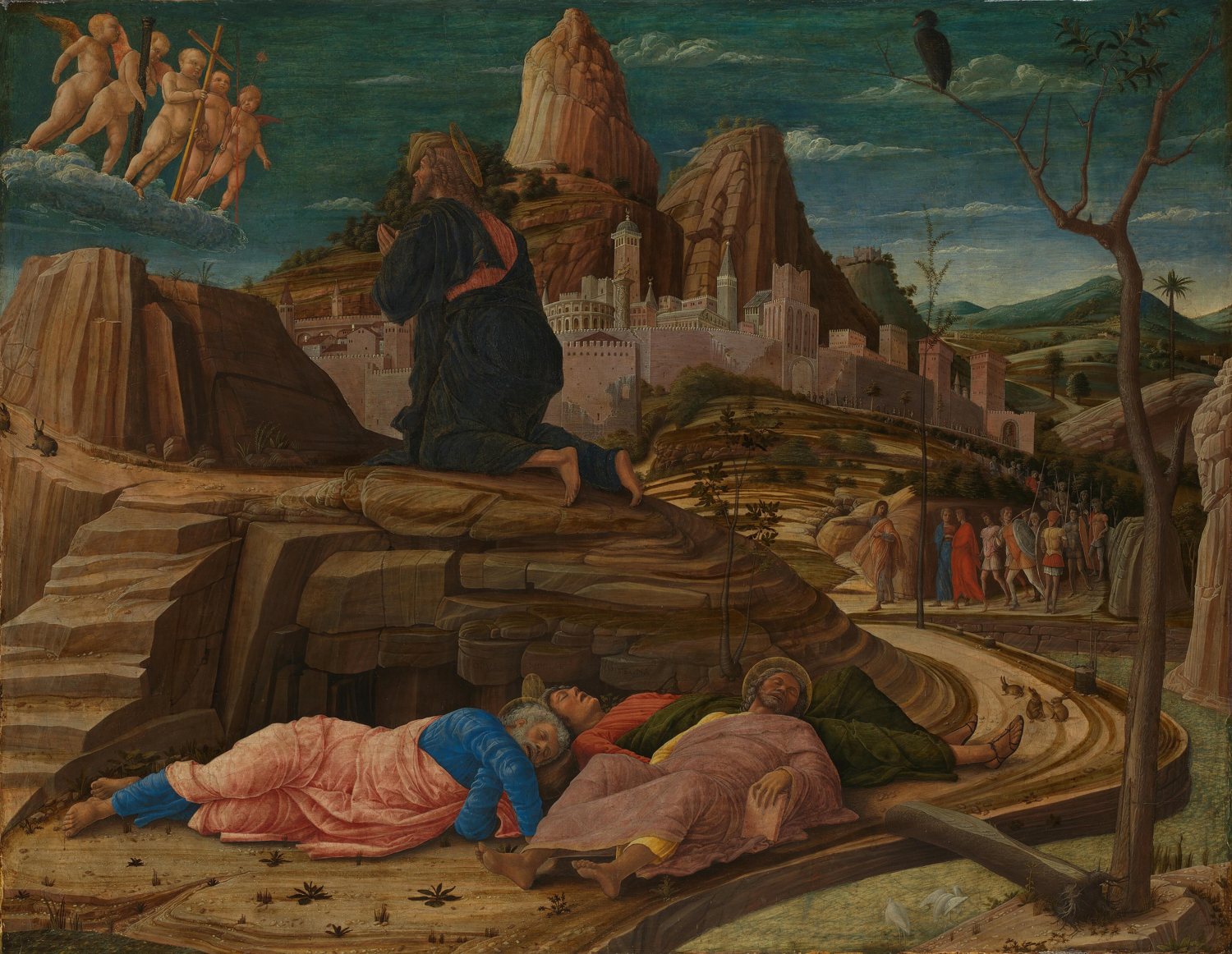
Christ kneels on a rocky platform while the apostles sleep below like stones themselves; in the distance Judas leads the soldiers down a winding road from a turreted Jerusalem. Every rock is a crystal, every tree a specimen. His brother-in-law Giovanni Bellini painted the same subject in dawn light — the two pictures are a family argument between stone and morning.
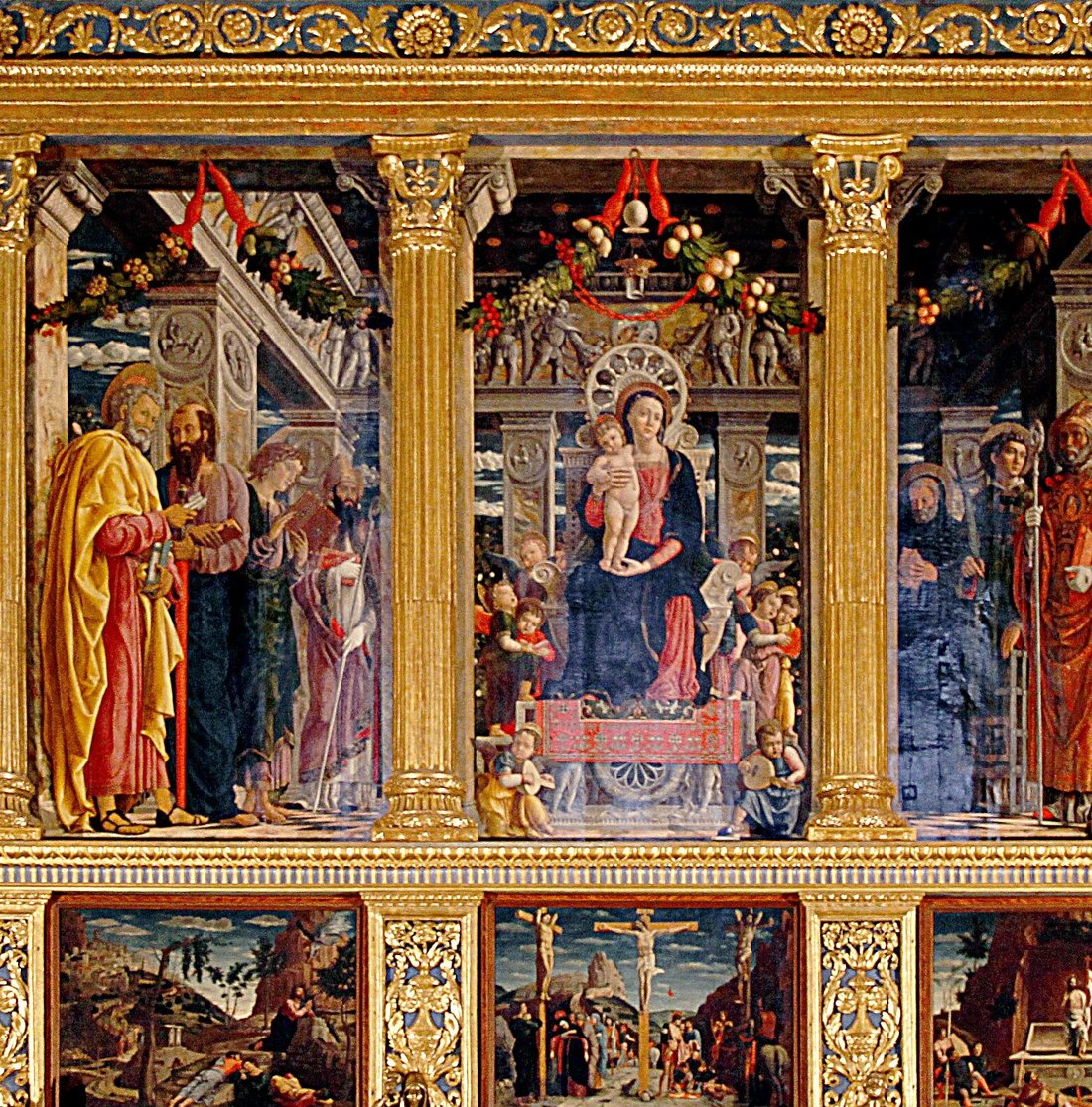
The altarpiece that reinvented the Italian altarpiece: instead of separate gold compartments, one unified space — the Madonna and saints standing in a classical loggia, framed by painted architecture that continues the real frame. Napoleon carried it off to Paris; the main panels came home to Verona, the predella scenes stayed in France. It still presides over San Zeno's choir, garlanded with painted fruit.
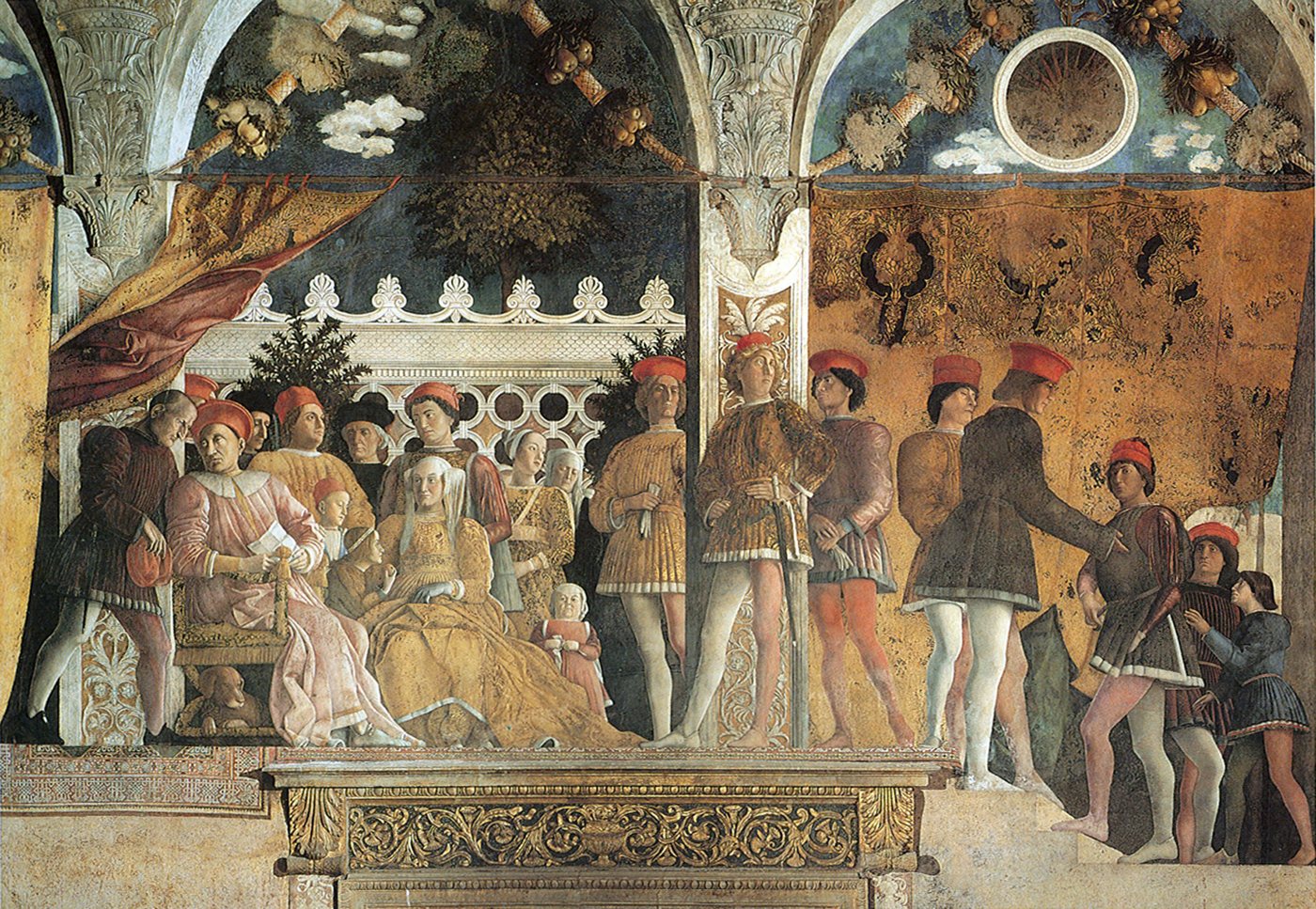
Marquis Ludovico Gonzaga sits with his wife Barbara, his children, his courtiers, his dog Rubino and his dwarf — the whole court painted life-size on its own palace wall, receiving a letter as if the room had simply been opened to the air. It is the first great group portrait of the Renaissance, and the most relaxed: power caught in the middle of an ordinary morning.
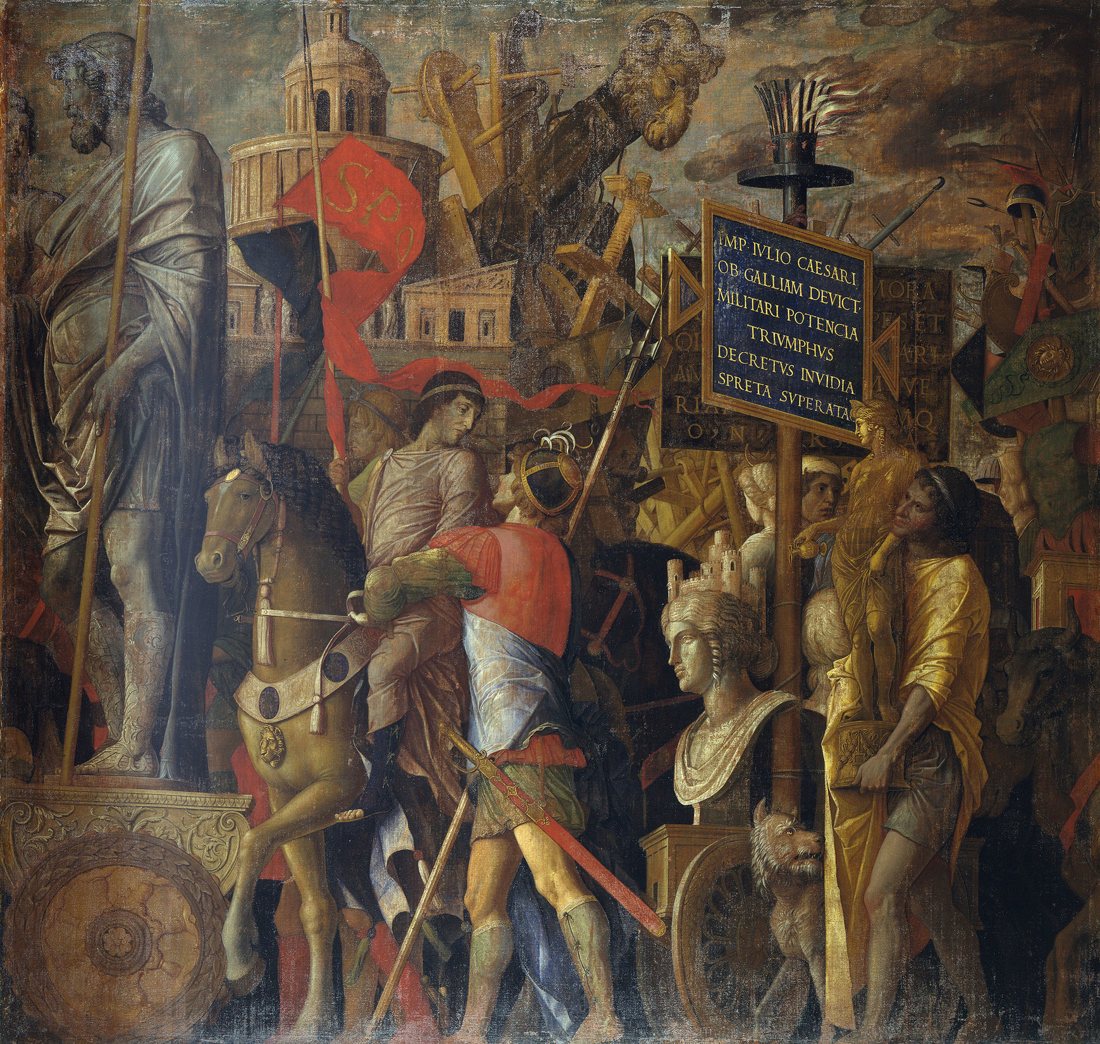
Nine enormous canvases carry Caesar's triumph past the viewer in a single slow procession — standards, siege engines, trumpeters, treasure, captives — every object researched from Roman texts and reliefs. Mantegna worked on them for twenty years; Charles I bought them for Hampton Court, where they still march. It is the Renaissance's grandest act of historical reconstruction.
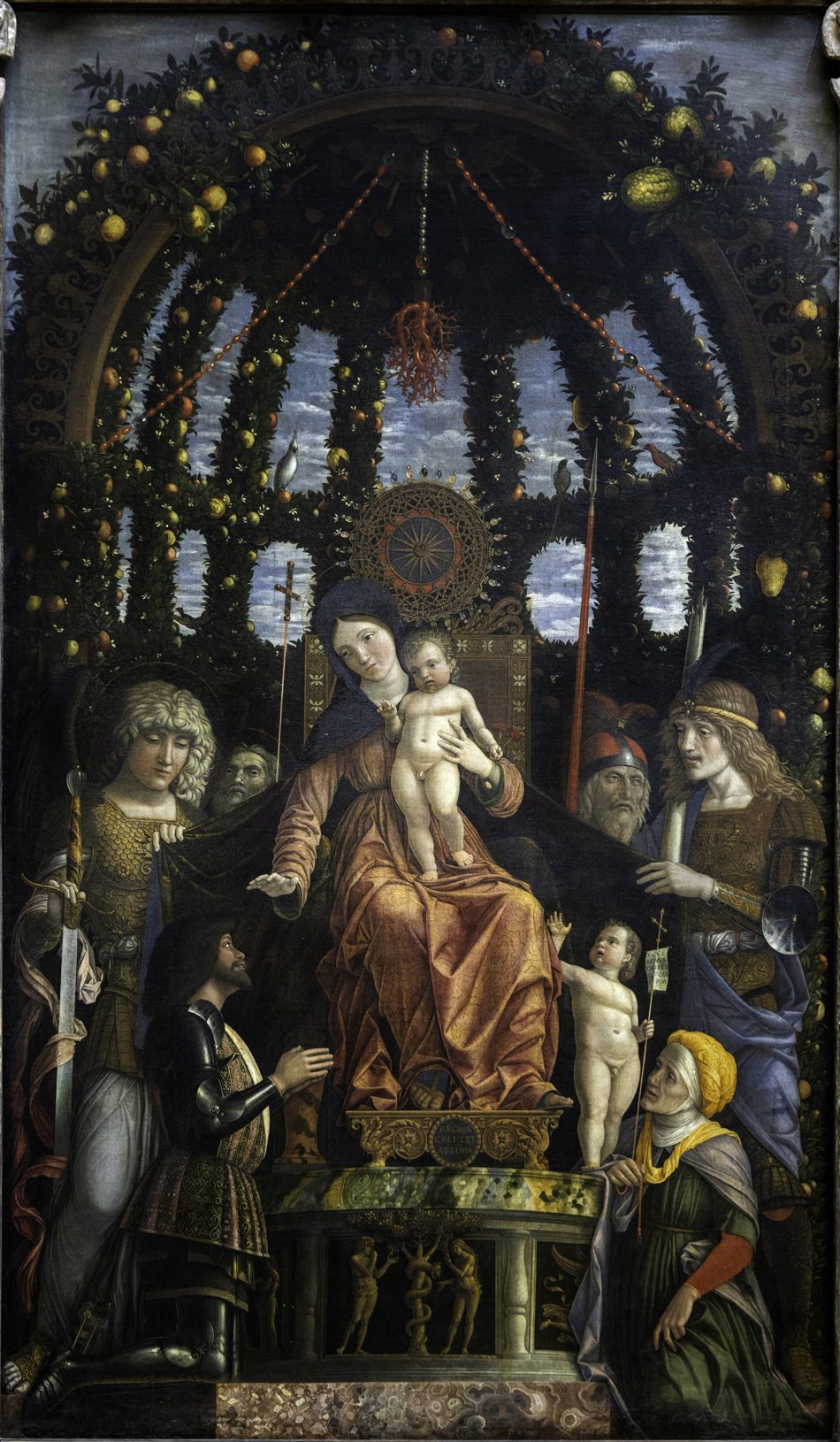
Francesco II Gonzaga kneels in armour before the Virgin, thanking her for surviving the Battle of Fornovo — a victory he claimed and history doubts. The Madonna sits in a bower of fruit and coral with warrior saints around her, blessing the kneeling marquis with diplomatic neutrality. Stolen by Napoleon, it never came back from Paris. As propaganda it is magnificent; as painting, more so.
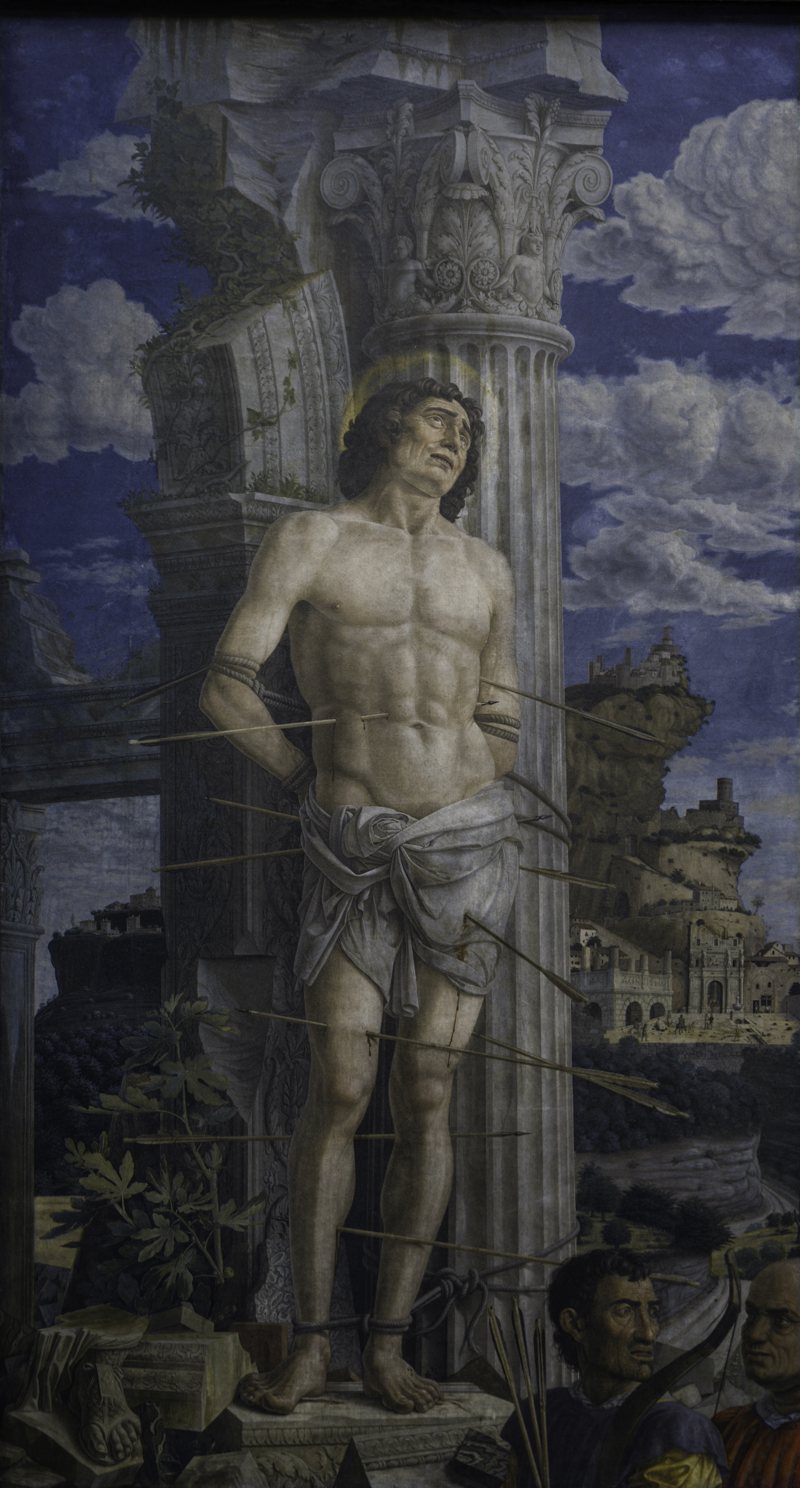
Sebastian bound to a broken classical column, his body a marble statue that bleeds, arrows arriving from a tiny archer far below. Behind him a classical city dissolves into evening. Mantegna painted Sebastian three times — the saint of plague years, beautiful and pierced, antiquity and martyrdom in one figure. A candle burns out at the bottom edge: life, exactly that long.
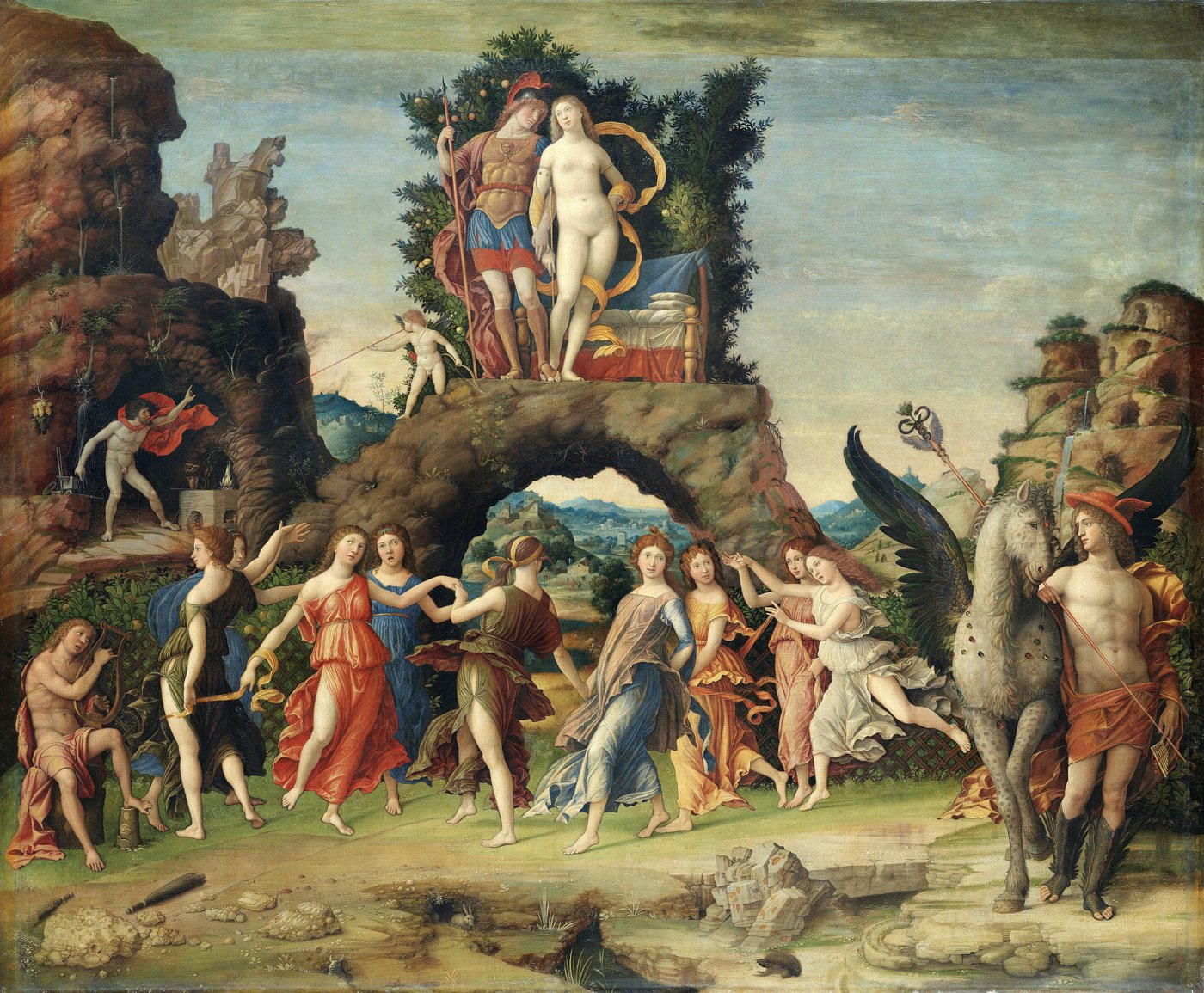
For Isabella d'Este's studiolo: Mars and Venus stand on a rocky arch — her husband's planet and hers, an astrological marriage portrait — while the nine Muses dance below to Apollo's lyre, and Mercury waits with Pegasus. Vulcan, the deceived husband, shouts from his cave at the left. Mythology as court gossip, painted with a jeweller's precision in tempera.
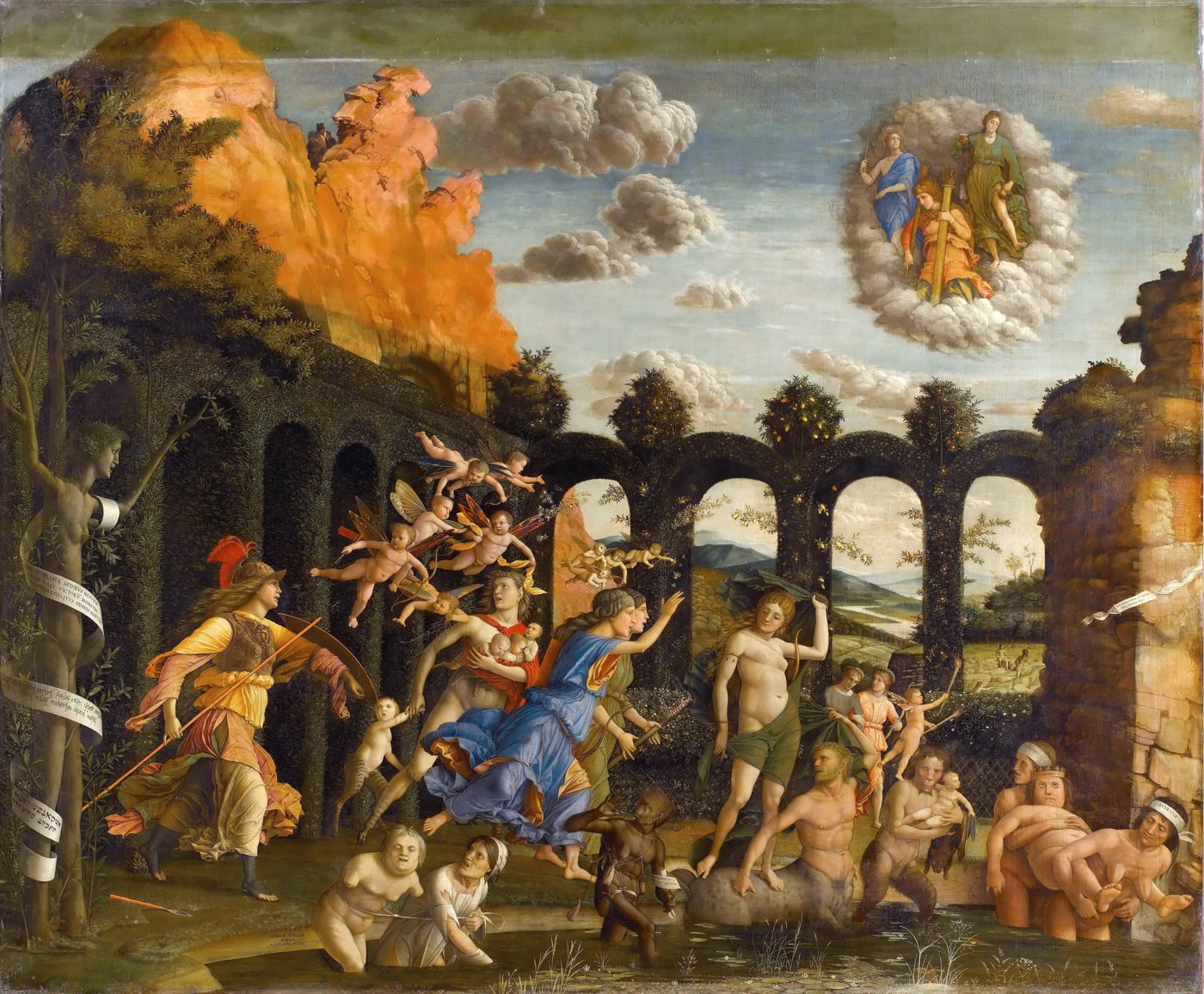
The sequel to Parnassus in Isabella's studiolo: Minerva storms in with spear and shield to drive the Vices — monsters of sloth, lust and ignorance — out of the garden of Virtue, whose gates they had occupied. A cloud-borne inscription in Latin, Hebrew and Arabic pleads the Virtues' case. It is an allegory you could lecture from, and a painting that needs no lecture at all.
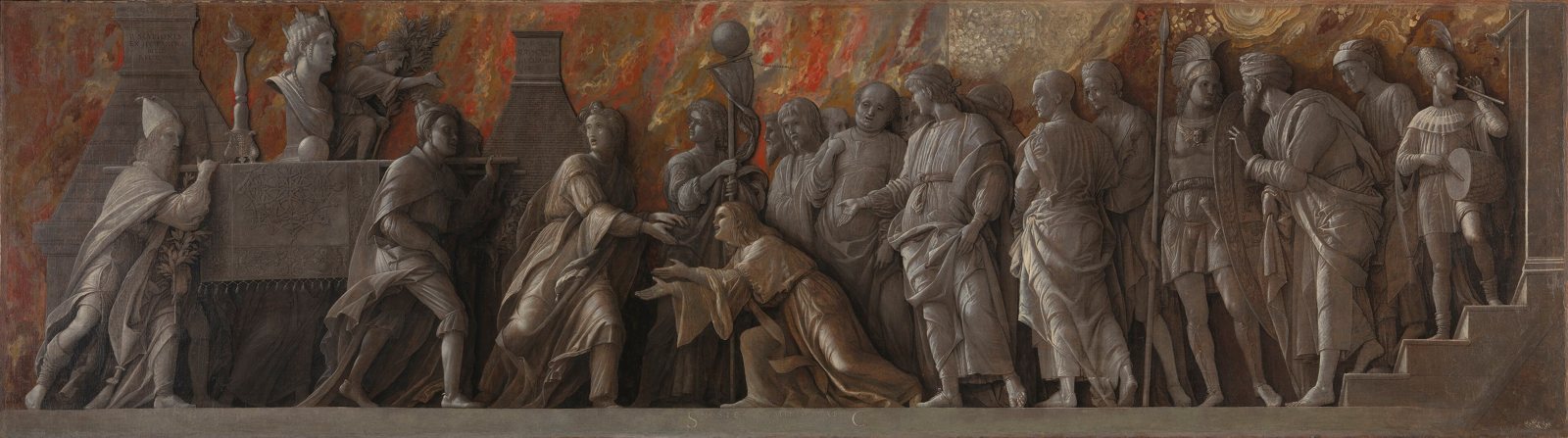
His last picture, painted in grisaille to imitate a Roman marble relief: the sacred stone of the goddess Cybele arrives in Rome in 204 BC, carried in procession past the kneeling Claudia Quinta. An old man of seventy-five painting in imitation of carved stone — the sculptor's aesthetic he began with, carried to its purest end. He died the year it was finished.