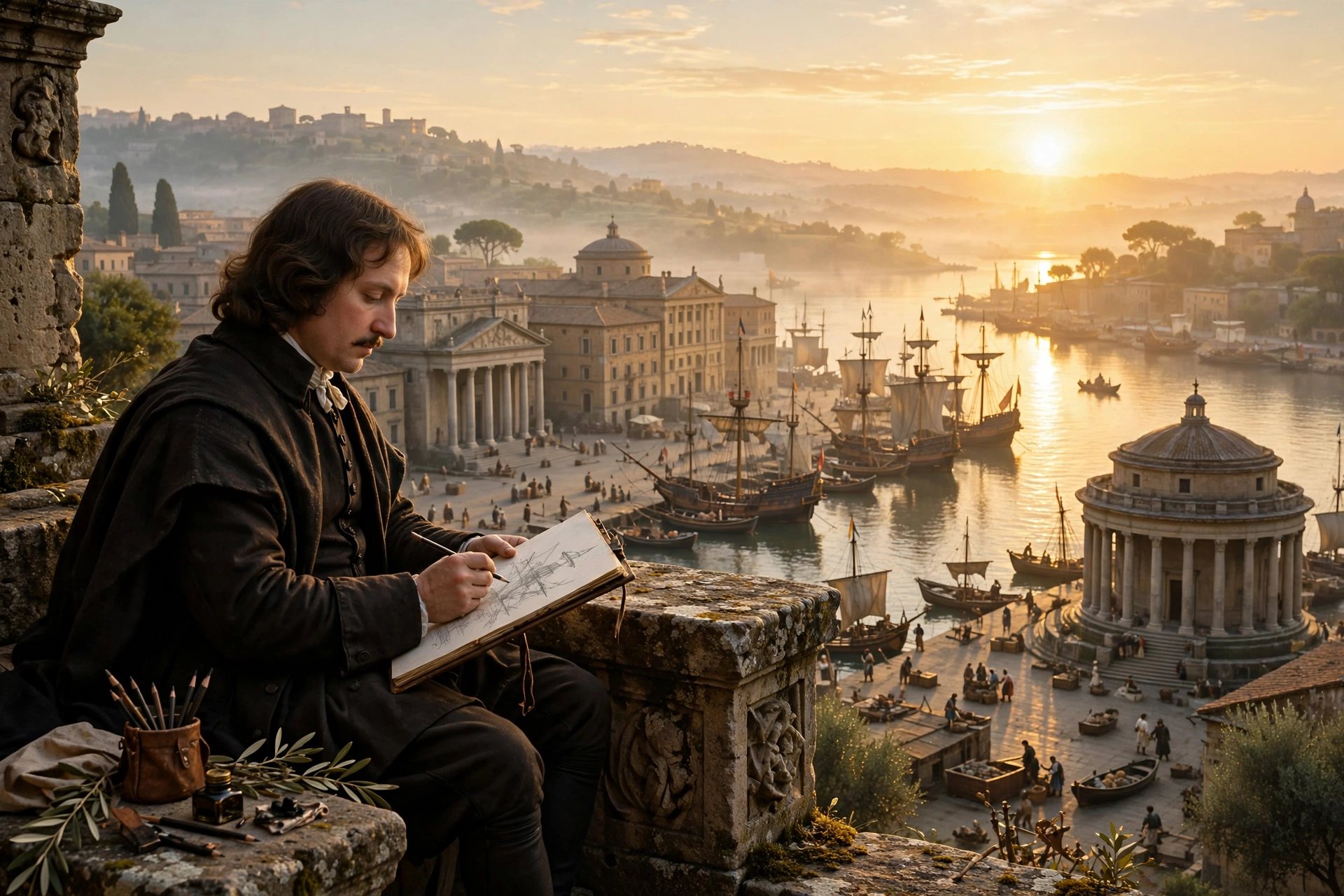
Claude Gellée, called Lorrain, left Lorraine as a pastry-cook's boy and became, in Rome, the painter of light itself. His seaports and Campagna landscapes — all golden air, classical ruins and tiny figures — taught Europe what landscape could be; Turner worshipped him, and for two centuries no great garden or canvas of nature escaped his shadow.
Claude did what painters had avoided: he put the sun itself in the picture, low over water, and built the whole canvas around its blaze. To study it he rose before dawn and lay in the Campagna dew until his health broke — the golden haze in these seaports is not a formula but fieldwork, paid for with fevers.
So many Claudes were forged in his lifetime that he kept a book — the Liber Veritatis, the Book of Truth — drawing a small copy of every painting he sold, with the buyer's name on the back. It survives in the British Museum: nearly two hundred compositions, the first catalogue raisonné, made not for fame but as a weapon against fakers.
His landscapes are built like his seaports: dark framing trees or palaces at the sides, a middle distance of water or plain, and then light dissolving into infinity. The recipe sounds simple; the execution is a gradient of atmosphere so fine that the eye travels for miles inside a metre of canvas. Turner studied these transitions all his life.
The stories — Cleopatra landing, Ulysses, the Queen of Sheba — are pretexts, and Claude knew it: the figures were sometimes added by other hands, and always small. What matters is the hour. Morning or evening, the sun at the exact height that gilds the rigging and turns the sea to a mirror: he painted time of day the way portraitists paint character.
Orphaned young, apprenticed to a pastry cook, he reached Rome in his teens and worked as a servant in the house of the landscape painter Agostino Tassi, grinding colours and learning the trade from the kitchen up. Within twenty years popes and kings — Urban VIII, Philip IV of Spain — were ordering his sunrises by the pair.
He worked almost to the end, and his final canvas — Ascanius Shooting the Stag of Sylvia, finished in the year of his death at eighty-two — is among his greatest: a silvery, elegiac landscape with the temple of Venus and the fatal shot about to be taken. The hand that had painted light for sixty years did not falter.
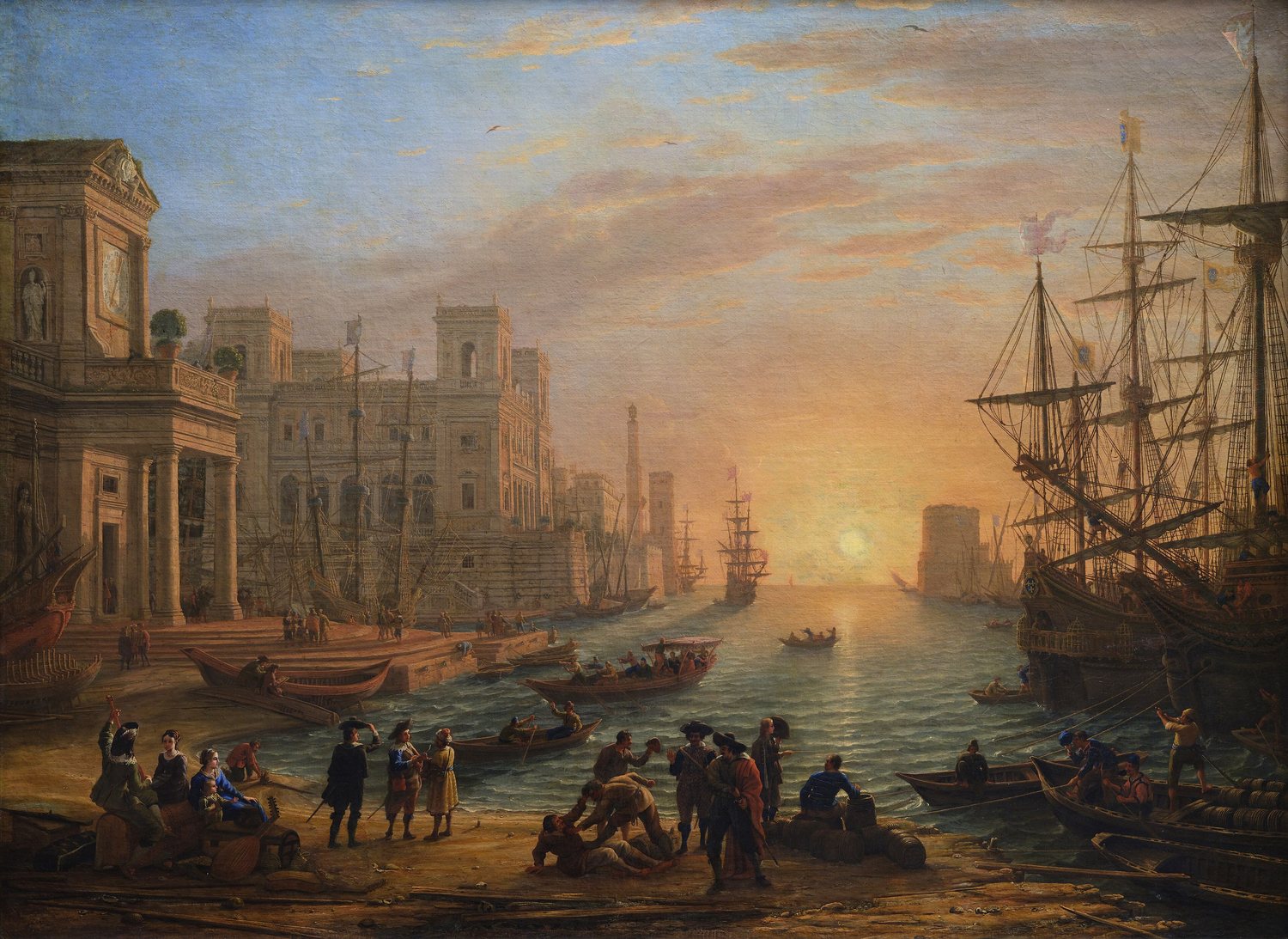
A pair with the Cleopatra: the sun sinks straight into the harbour mouth, gilding the water and the rigging, while stevedores and idlers crowd the quay in shadow. Painted for Pope Urban VIII — a sunset so influential that it became the default evening of European landscape for a hundred years.
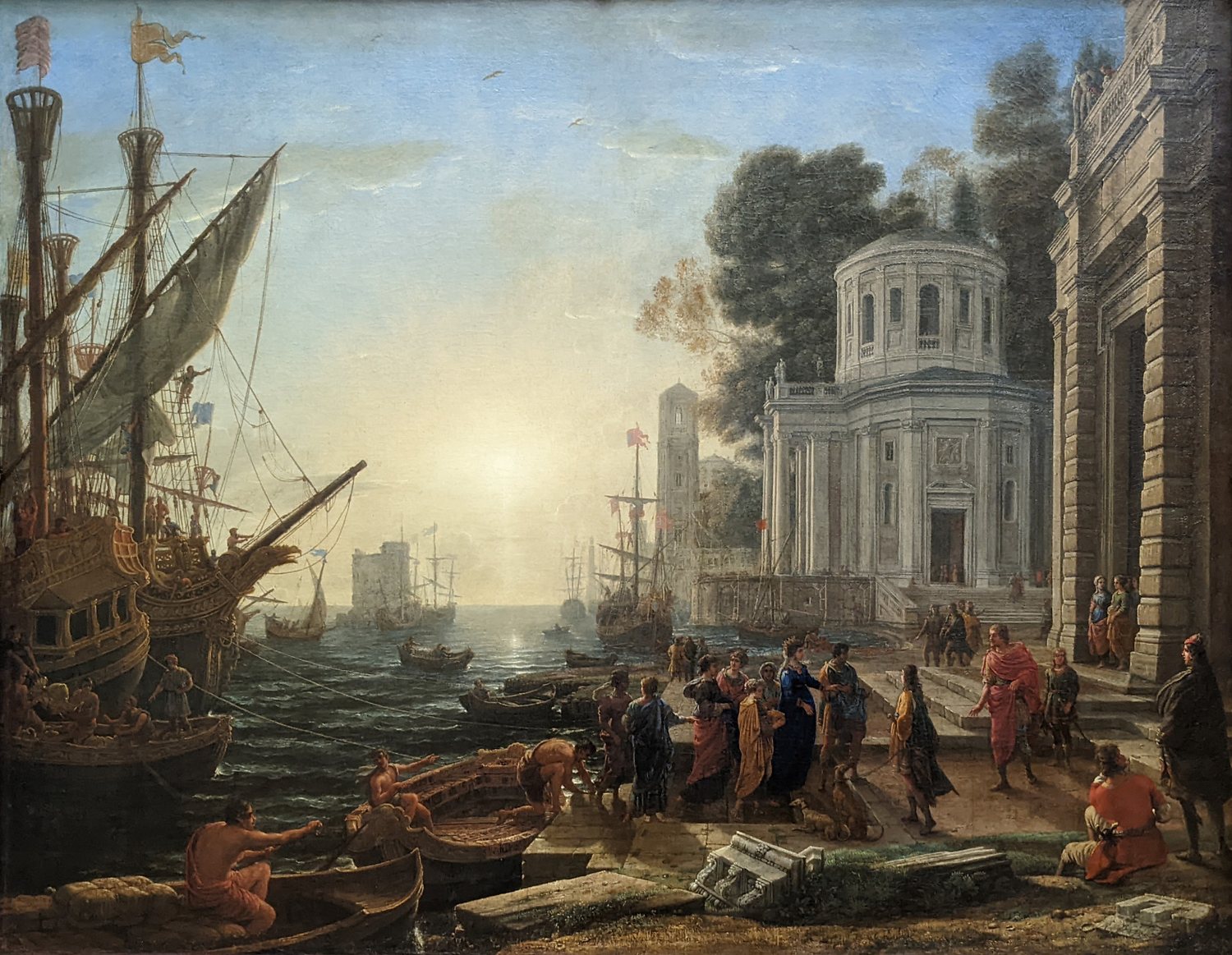
Cleopatra steps ashore to meet Mark Antony — but the queen is a speck in her own spectacle: the true sovereign is the morning sun rising between the temple and the galleys. History painting dissolved into light; the Louvre hangs it beside its sunset twin.
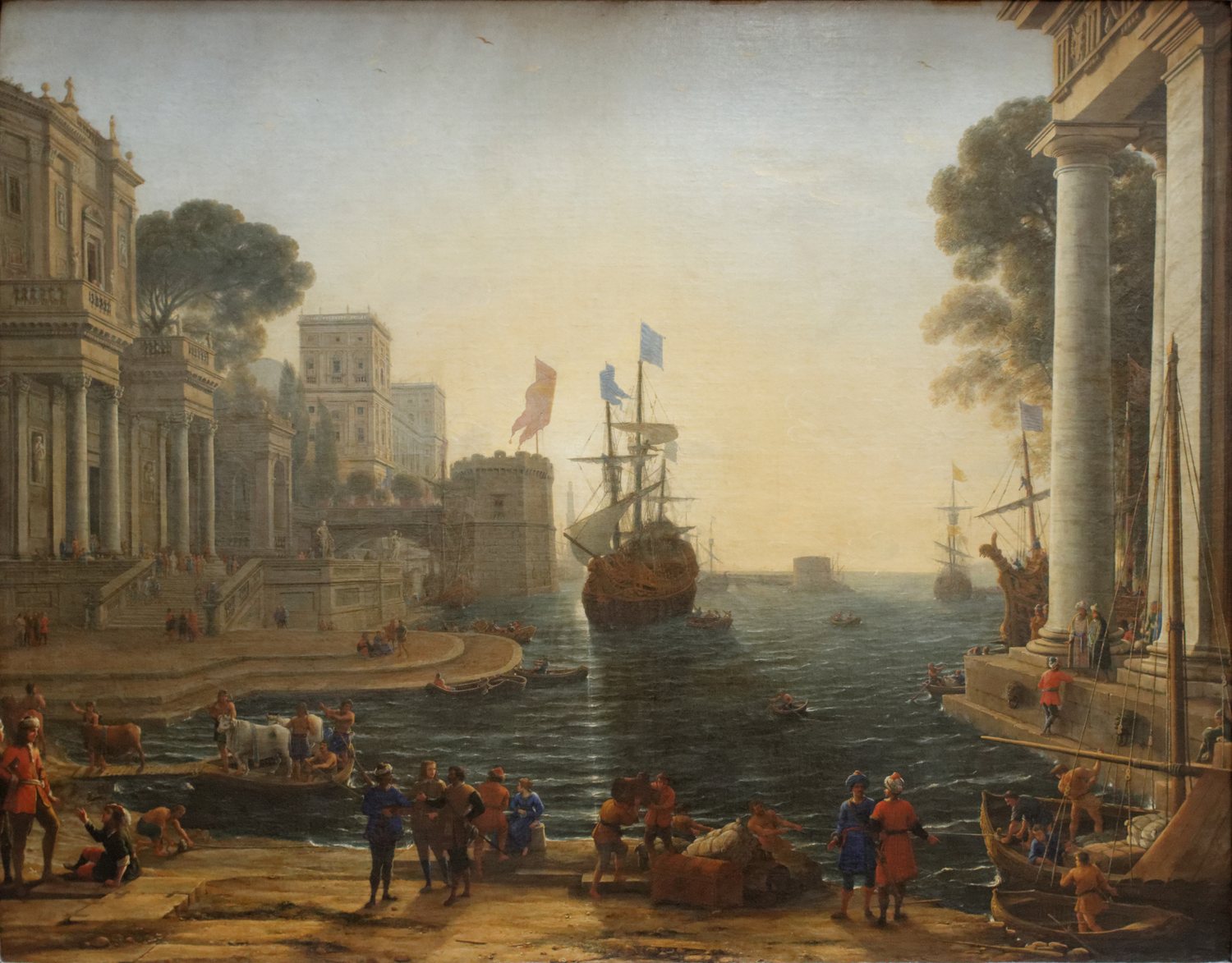
The opening of the Iliad, staged as a seaport: Odysseus returns the girl Chryseis to her father, a priest of Apollo, on a quay of classical palaces. Homer's wrath and plague are all politeness here — Claude turns the epic's first act into a ceremony of golden calm.
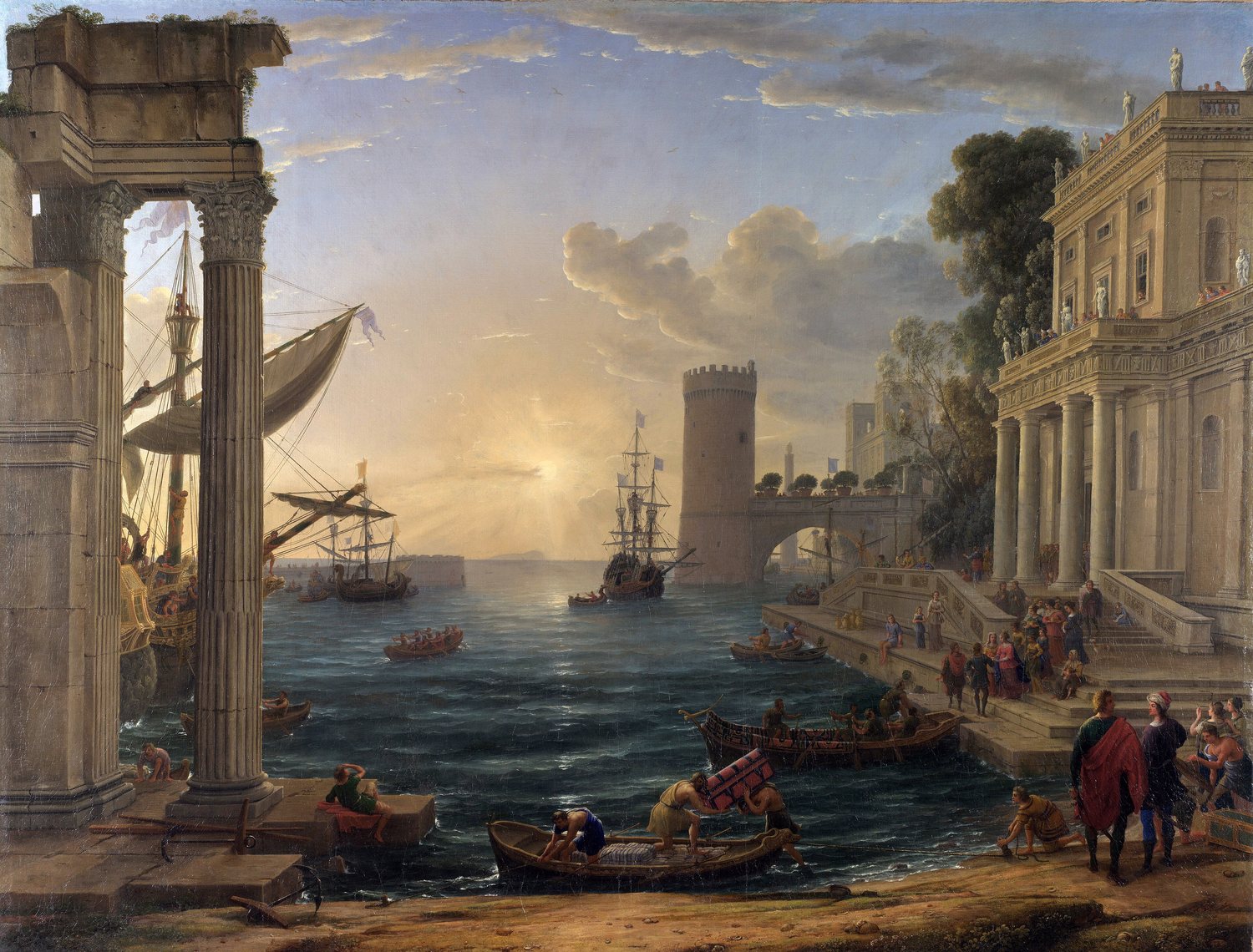
His most famous seaport, painted for the Duc de Bouillon: the queen descends the palace steps to her ship in a sunrise of perfect clarity, every rope and ripple in place. Turner, dying two centuries later, left his own canvases to hang beside this one — and be judged by it.
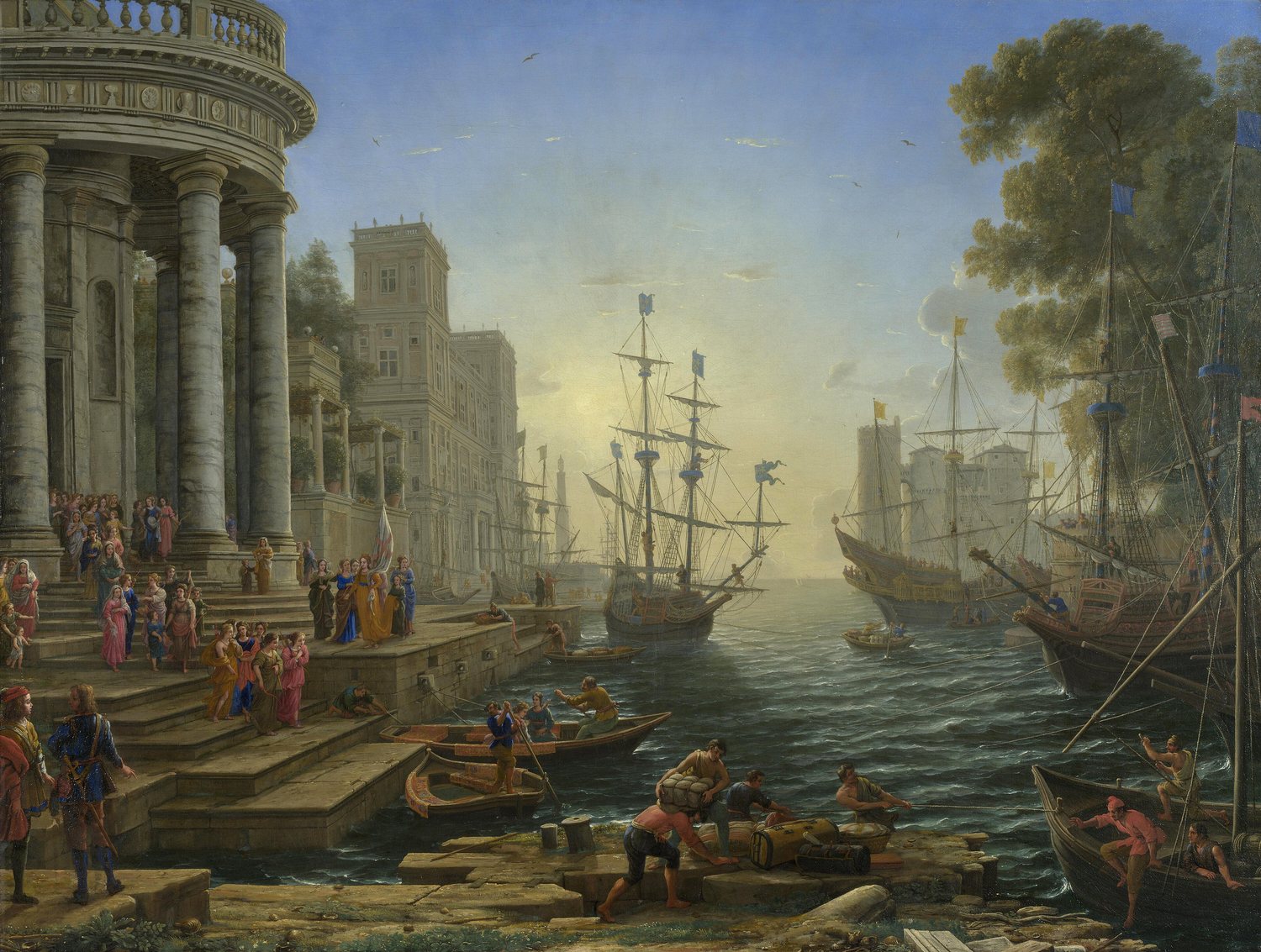
Saint Ursula and her eleven thousand virgins embark for their voyage — and martyrdom — from a port of dreamlike order: a round temple, banners, morning mist on the water. The legend is grim; the painting is all serenity, the ships of the saint lit like a festival.
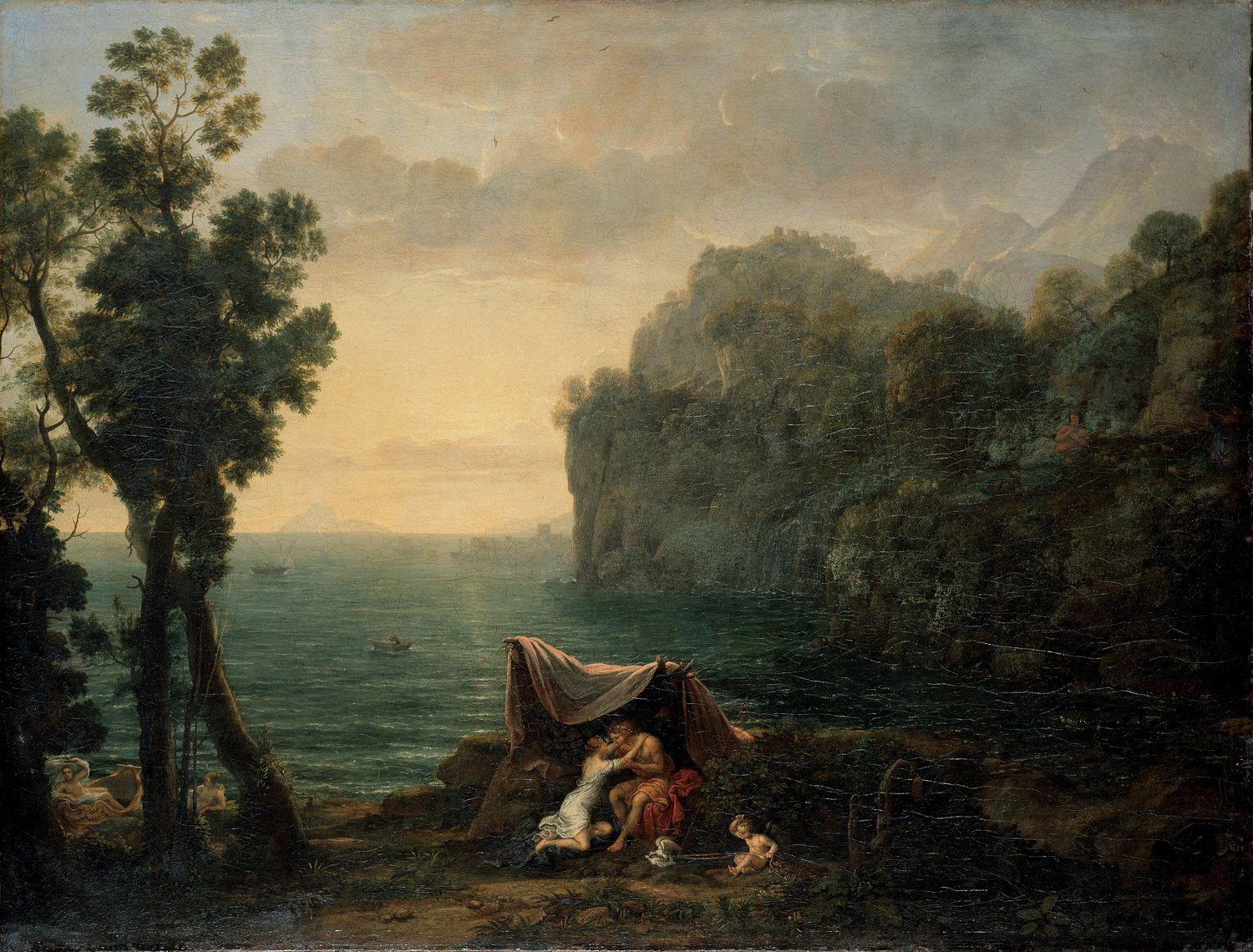
The lovers Acis and Galatea embrace under a cloth of shade on a rocky coast, while the jealous giant Polyphemus watches from the cliffs above — the murder that Ovid tells is minutes away. Claude paints the last calm: sea, rock and evening light holding their breath.
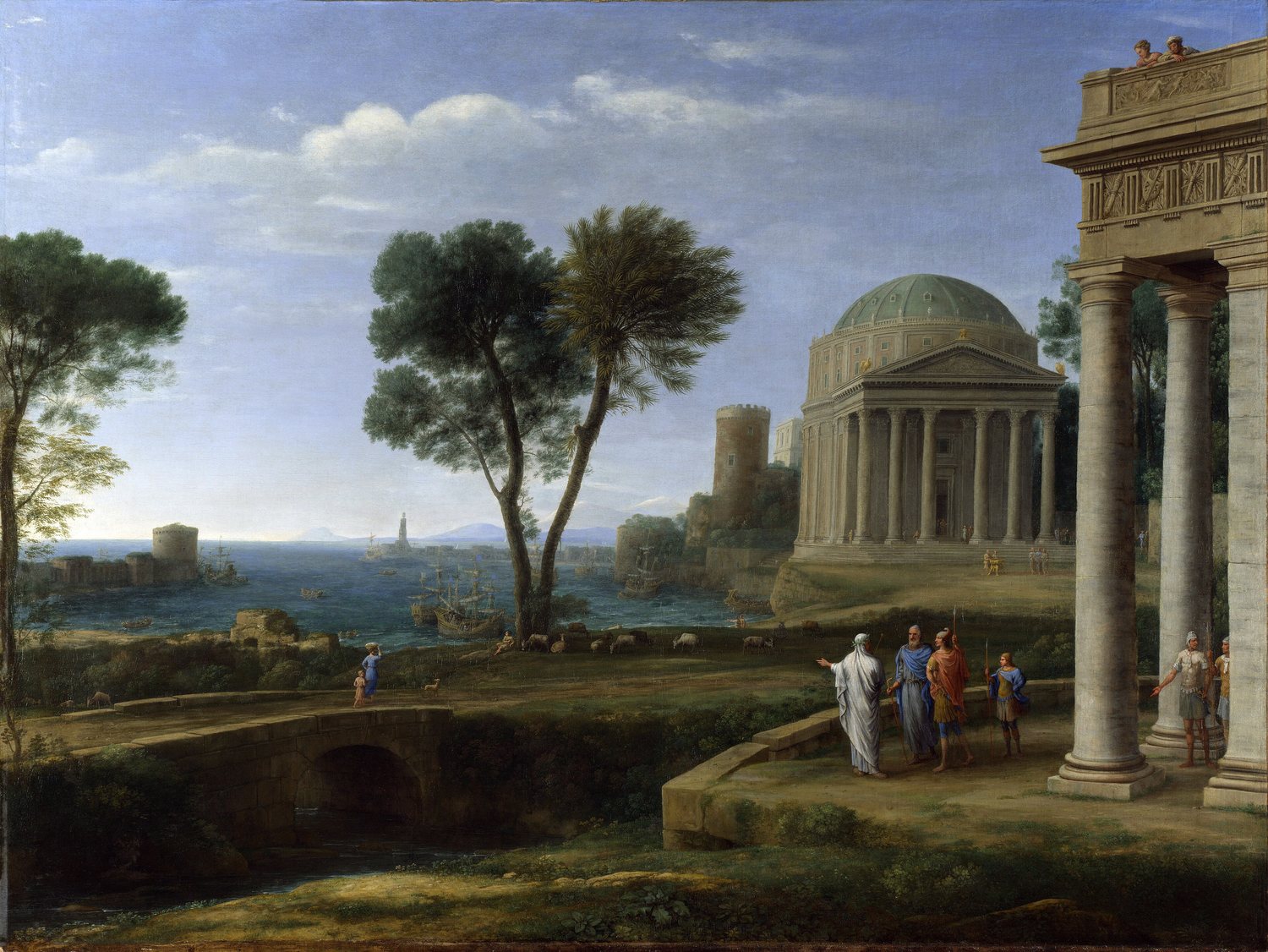
A late, silvery landscape: Aeneas and his Trojans consult the oracle at Apollo's temple on Delos, in a composition Claude had been refining for forty years — temple, tree, water, distance. The figures are staffage; the architecture of light is the hero.
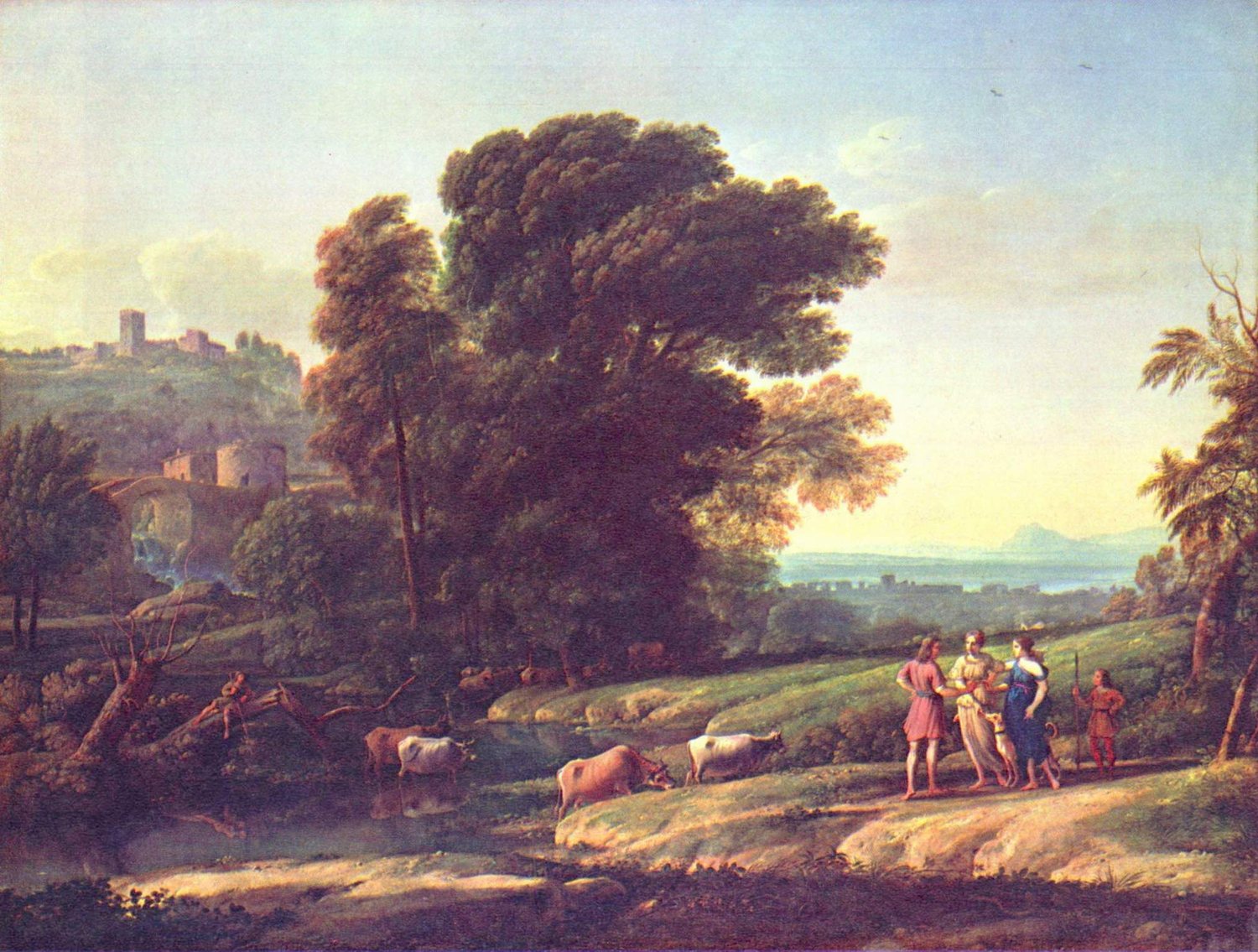
Diana reconciles the hunter Cephalus with his wife Procris — the goddess gives him the hound and javelin that will, in the end, kill her. Claude sets the reconciliation in a landscape of evening gold, cattle coming home, as if nature itself approved the pardon that fate will revoke.
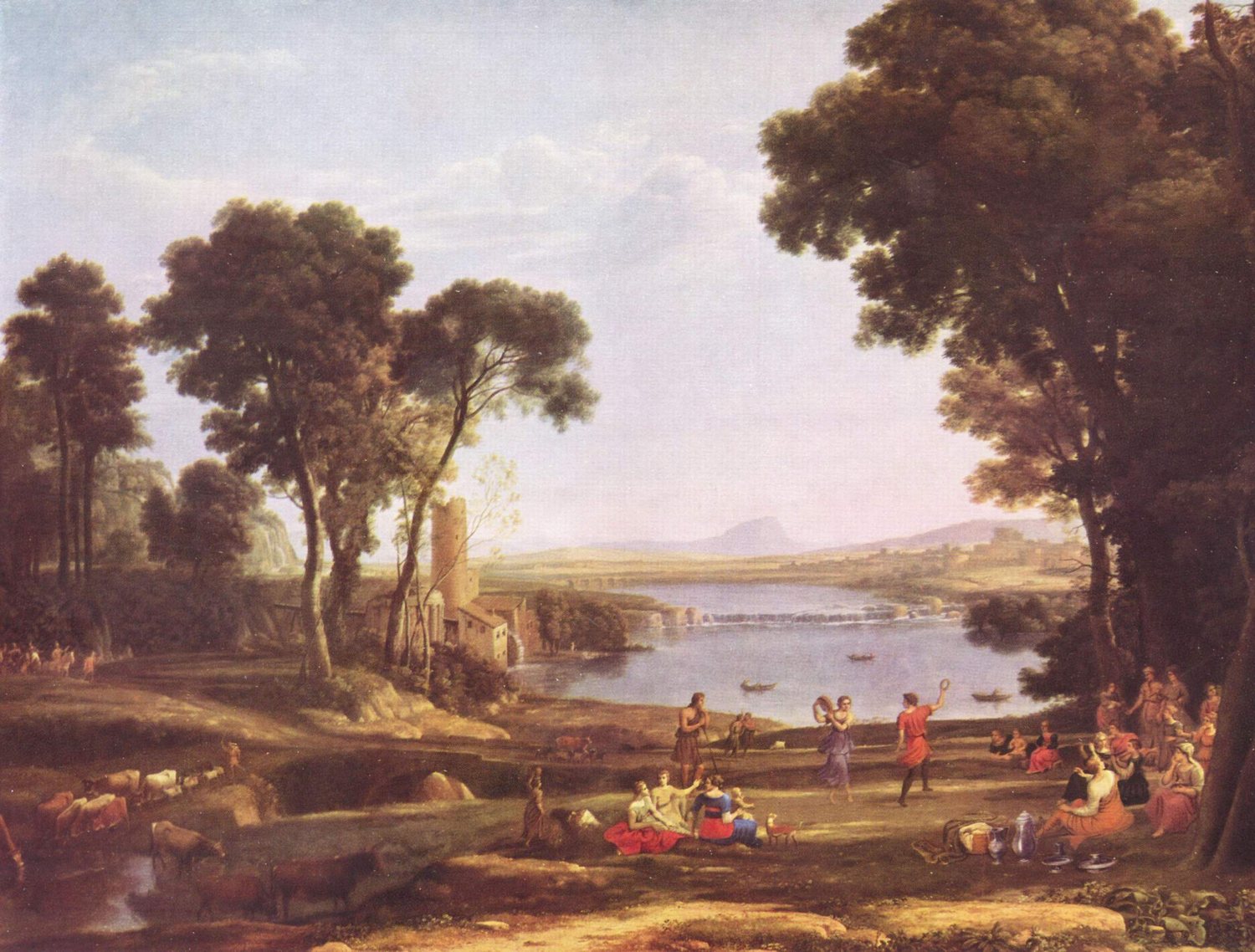
Peasants dance on a riverbank by a mill while, almost unnoticed, Isaac meets Rebecca — the companion piece to the Queen of Sheba, and the great example of his pastoral manner: a whole world at leisure inside one luminous valley, painted the same year as the seaport's sunrise.
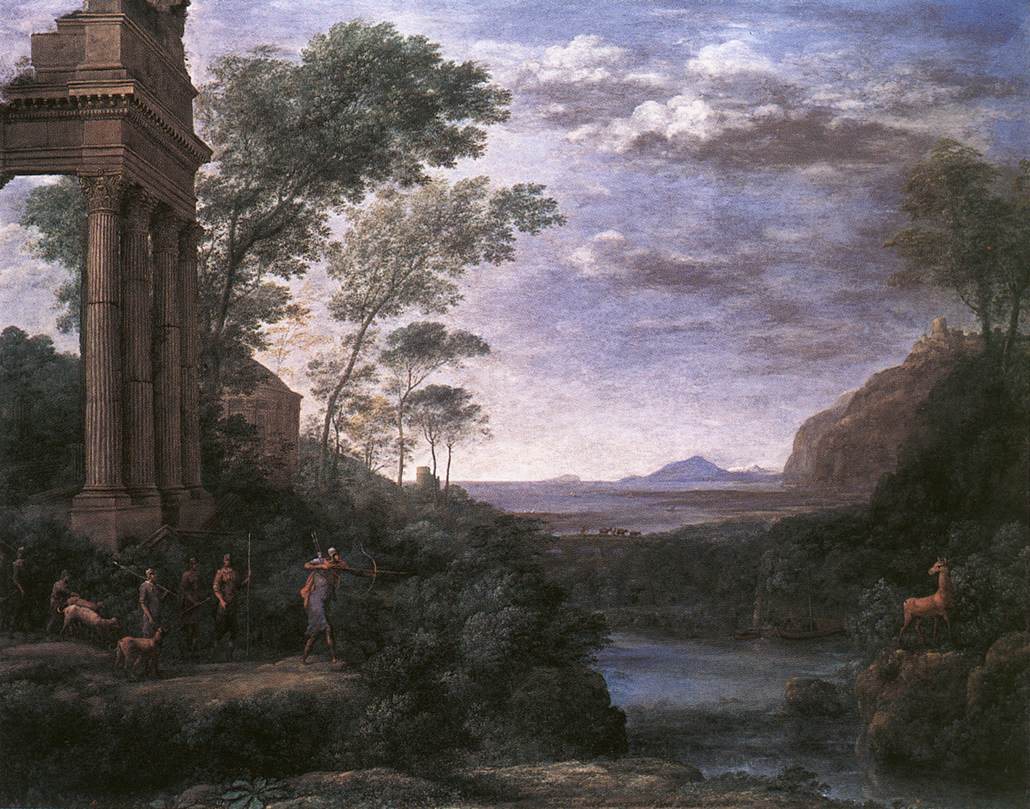
His last painting, finished in the year he died: Ascanius aims at the tame stag whose death will ignite the war of the Aeneid, in a landscape of silver and shadow with Venus's temple on the hill. Sixty years of sunrises end in this twilight — and the hand never shook.