The painter of one candle. In plague-ridden Lorraine, Georges de La Tour stripped painting down to a flame, a face and a darkness without end — Magdalenes contemplating skulls, card-sharps at midnight, a carpenter boring wood while his son holds the light. Then he was forgotten so completely that his works were given to Dutchmen and Spaniards, until the twentieth century lit his candle again.
His night scenes have a single light source, usually shielded — a candle behind a hand, a flame in a lantern — and no visible window, sky or second lamp. The darkness is not a background but a substance, painted in deep warm browns, against which the lit faces emerge with the stillness of sculpture.
Look at the construction: the Magdalene's head is an oval, her skirt a great cone, the volumes simplified almost to abstraction. La Tour built his figures like a mason — cylinders, spheres, planes — which is why these candlelit scenes, for all their devotion, feel so modern: Cézanne's advice to treat nature by the cylinder and sphere is already here.
He painted in two manners: broad daylight scenes — the Fortune Teller, the Hurdy-Gurdy Player, the Cheats — with enamel colours and sharp observation, and the nocturnes for which he is loved. The daylight works are satires, full of sly glances; the night works are prayers. One man, two weathers of the soul.
He was painter to Louis XIII, worked for the Duke of Lorraine, and grew rich and respected in Lunéville — then plague, war and fire passed over Lorraine, his name dissolved, and for nearly three centuries the candlelit pictures hung under other men's names: Murillo, Zurbarán, anonymous Dutch. The rediscovery began only in 1915.
Because he was famous in his day, his best compositions exist in several versions — two Cheats, several Magdalenes, two Saint Sebastians — painted by his hand, his workshop, or followers, and scholars still argue over which is which. In this room the versions shown are the ones the great museums hold as his own; the arguments are part of his story.
Nothing happens loudly in these pictures: a woman thinks, a boy holds a candle, an old man endures. La Tour's brushwork matches — smooth, unfussy, without bravura, the paint laid like enamel so that no gesture of the painter disturbs the hush of the scene. He is the quietest of the great painters, and the quiet is the point.
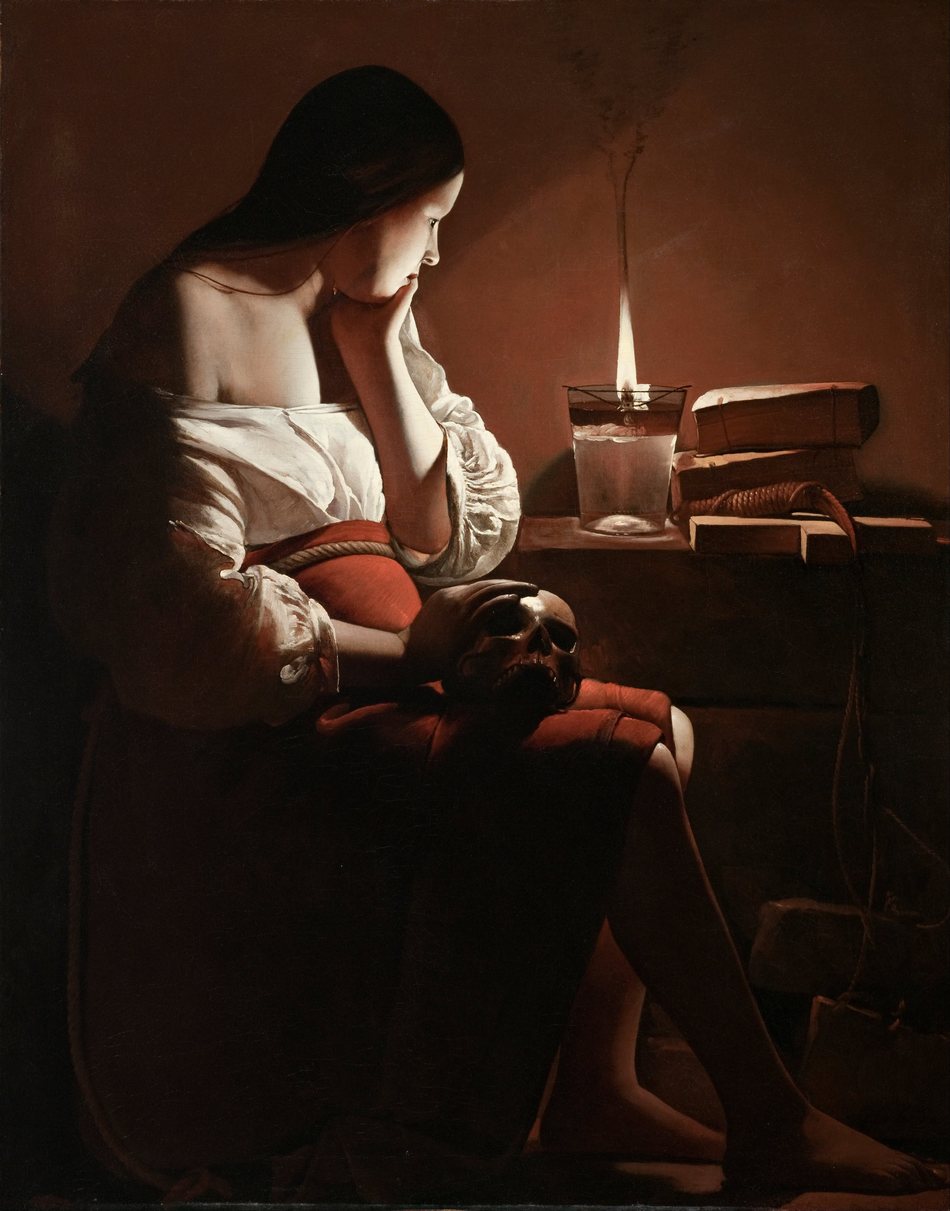
Mary Magdalene sits in the dark with a skull on her knees, watching a candle burn down in a glass — the flame smoking as it dies. Vanity of vanities, painted without a word of preaching: a woman, a skull, a light going out. The simplest of his nocturnes and perhaps the most perfect.
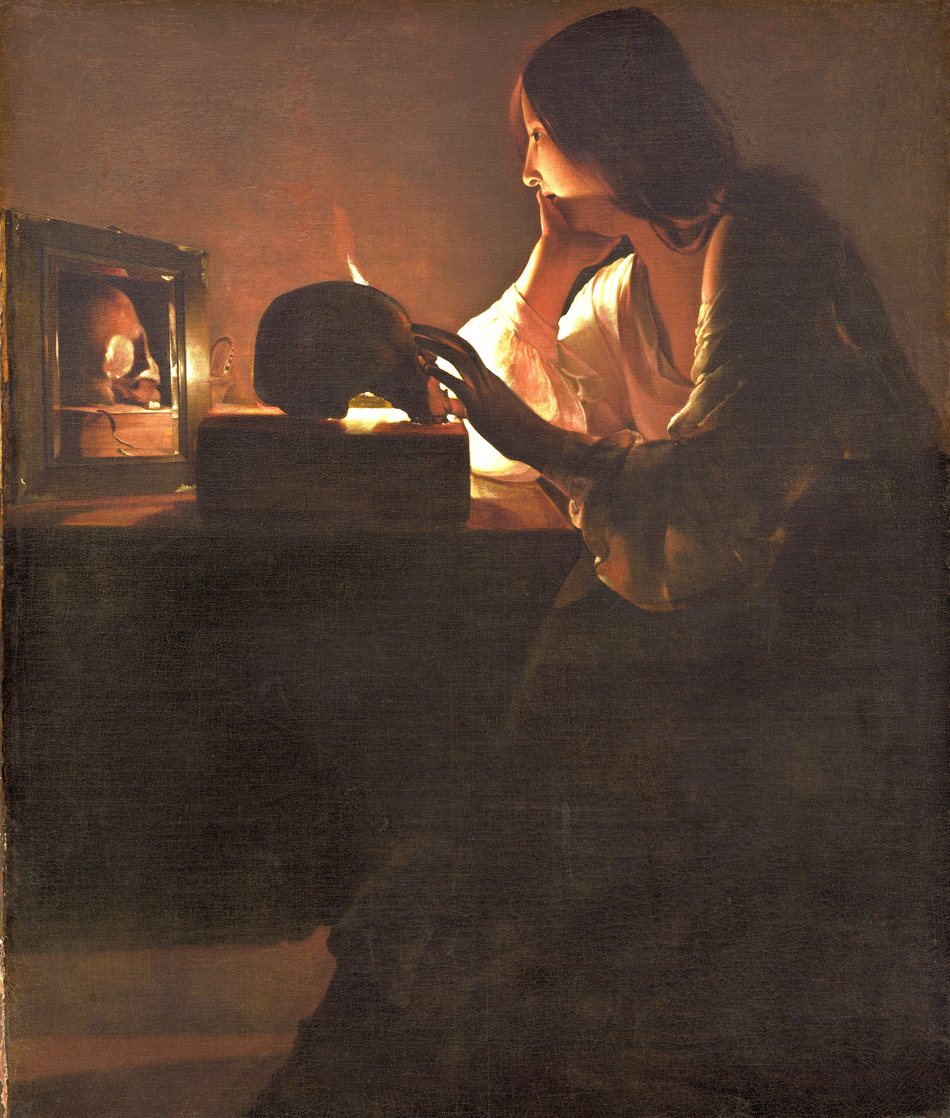
The Magdalene turns from her mirror — in its glass a single candle burns — and rests her hand on a skull, her face propped in thought. The mirror that once served her vanity now shows her the flame of a different life. Two lights, two worlds, one decision, painted in near-darkness.
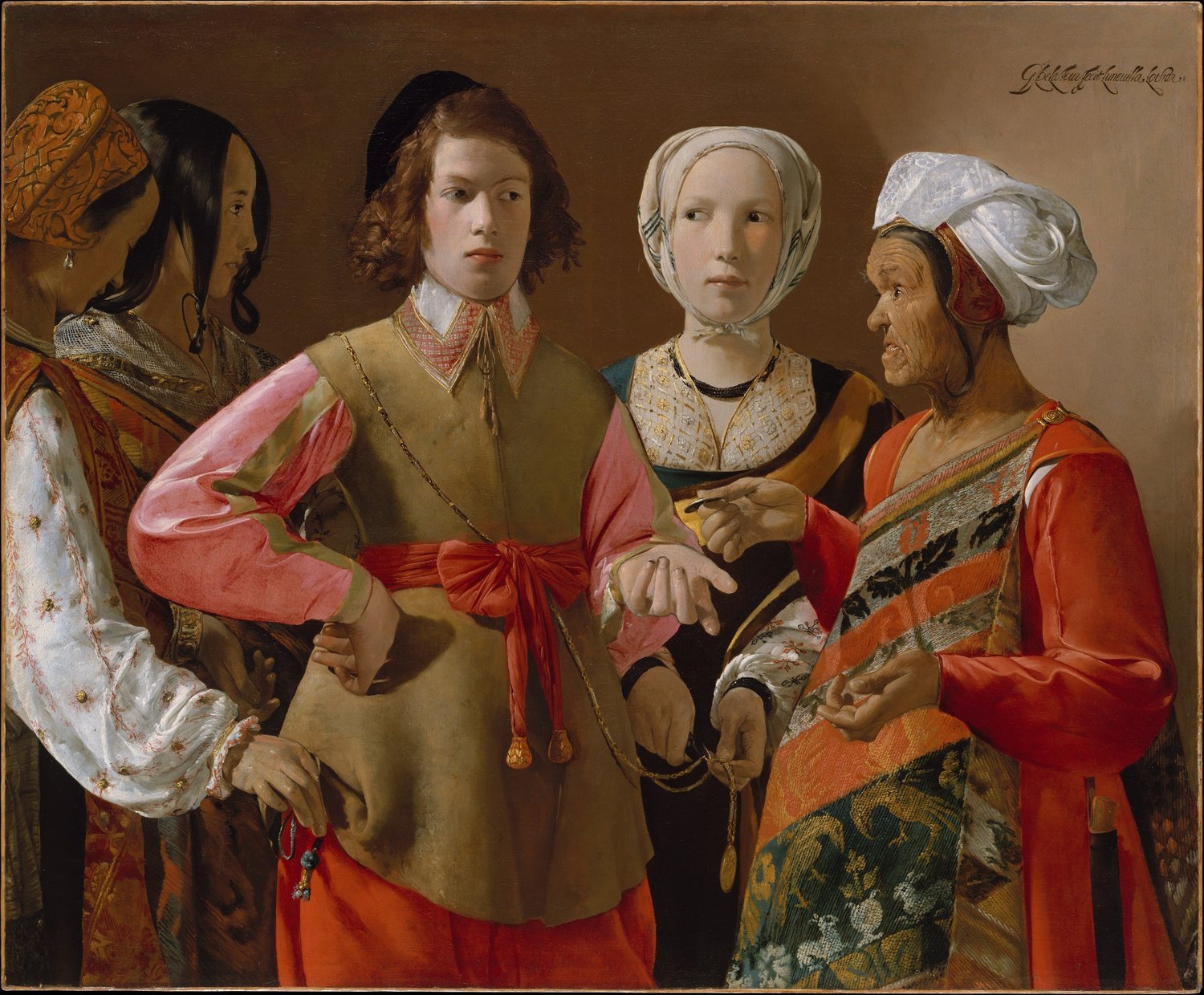
A daylight satire: a rich young fool has his fortune told by an old gypsy woman while her accomplices pick his pockets and snip the medallion from his chain — and he notices nothing. Every sly glance is placed like a chess move. The picture surfaced only in 1960, found in a French attic of art history, and caused a sensation.
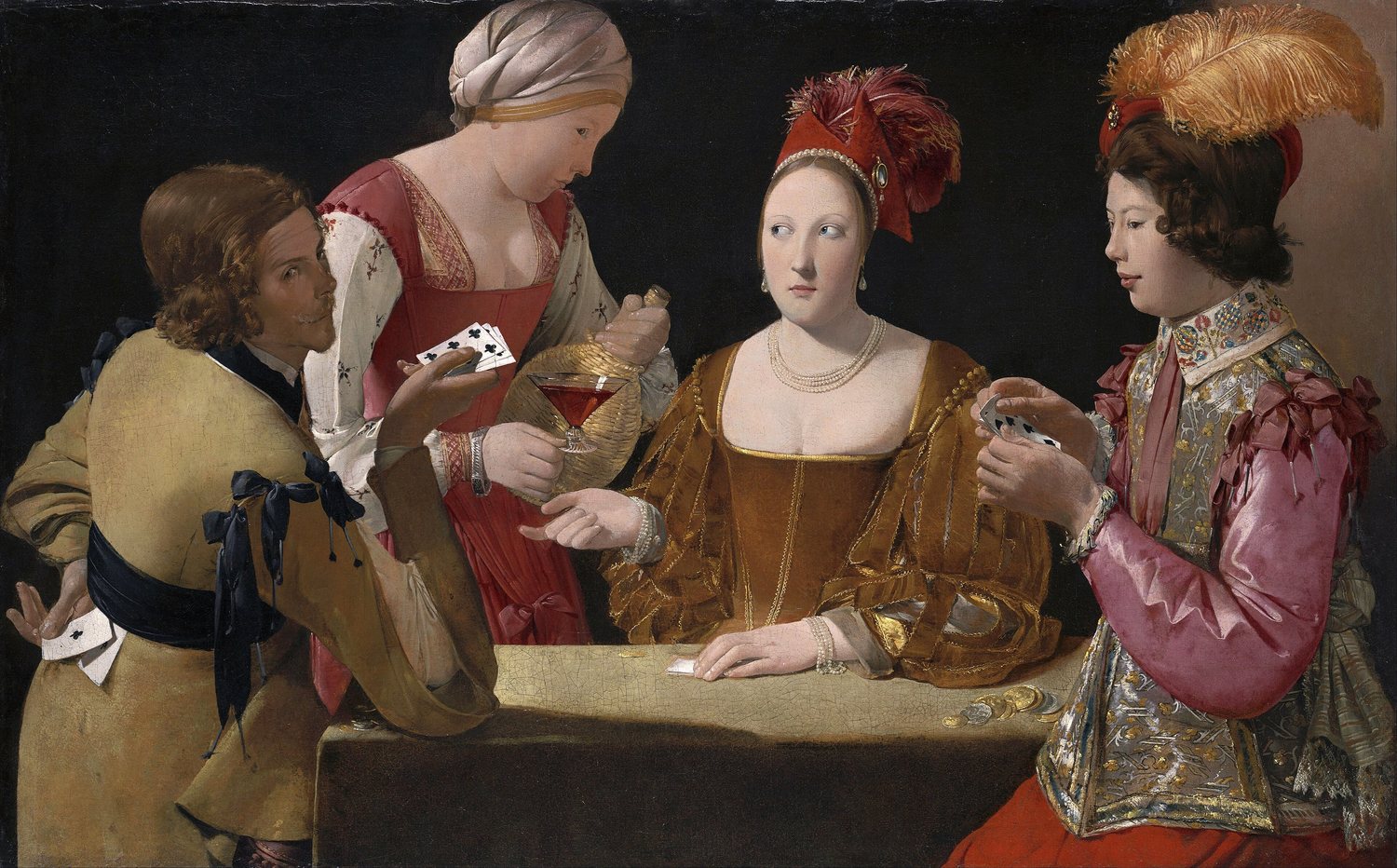
A card game at night: the courtesan signals, the maid pours wine, the cheat on the left pulls the ace of clubs from behind his back, and the young player in feathers studies his hand, suspecting nothing. A twin version with the ace of diamonds hangs in the Louvre — La Tour painted the trap twice, and it closes twice.
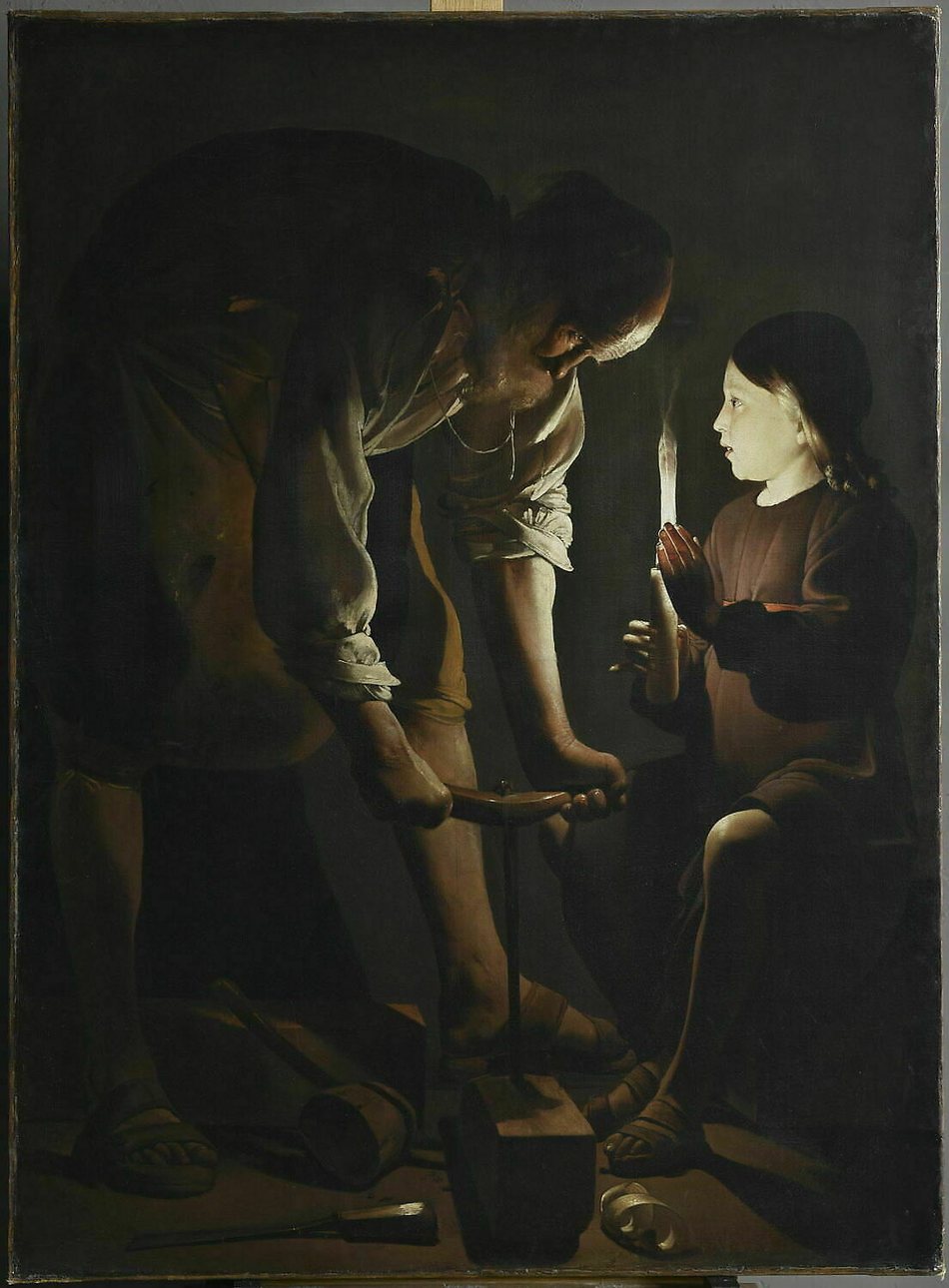
Joseph bends over his auger, boring a piece of wood by candlelight, while the young Christ holds the candle for him — its flame shining through the child's fingers. The wood prefigures the cross; the old man's labour and the boy's stillness fill one of the most tender pictures of the century.
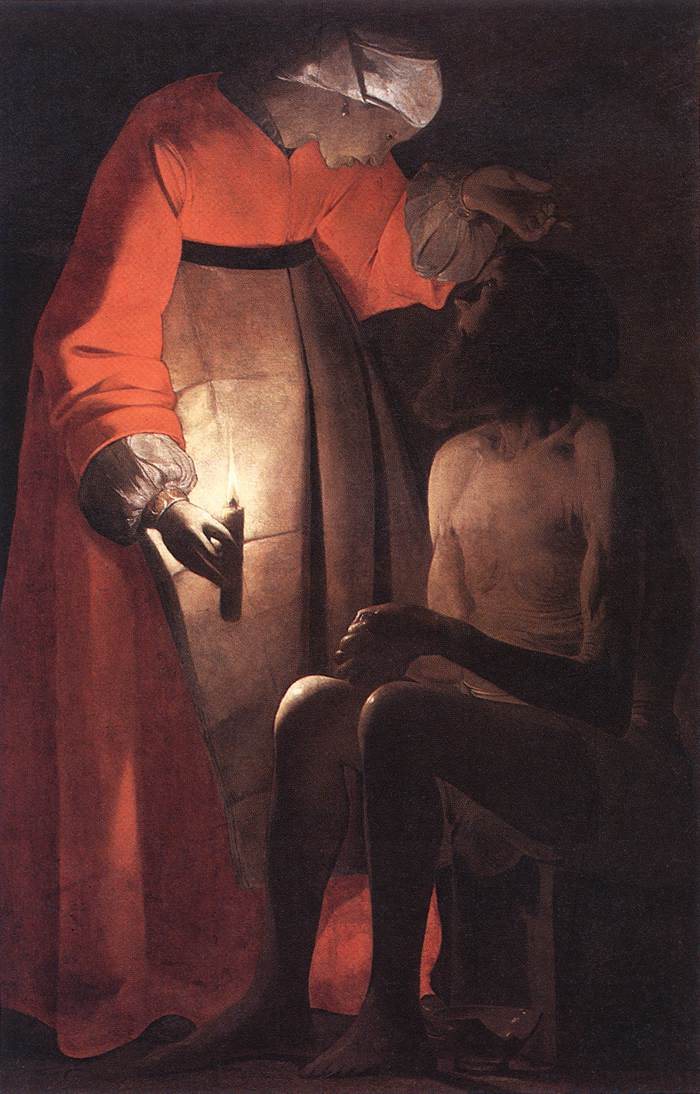
Job, ruined and diseased, sits in rags while his wife stands over him with a candle, urging him to curse God and die. She blazes red against the dark; he answers with silence, his wasted body catching the candlelight like a statue's. The argument of the whole Book of Job in two figures and one flame.
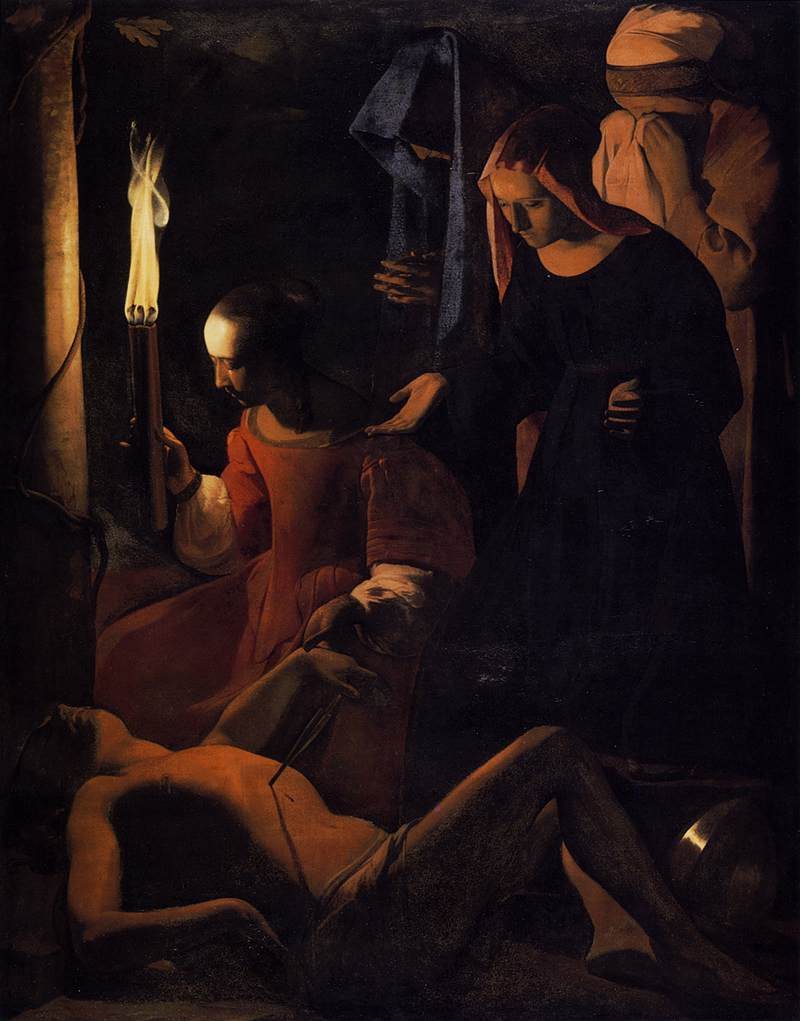
Irene and her maid find Sebastian by torchlight and draw the arrows from his body — the largest and most solemn of his late nocturnes, painted in the year plague and war were consuming Lorraine. The saint lies like a fallen statue; the women's care is the only warmth in the black world of the picture.
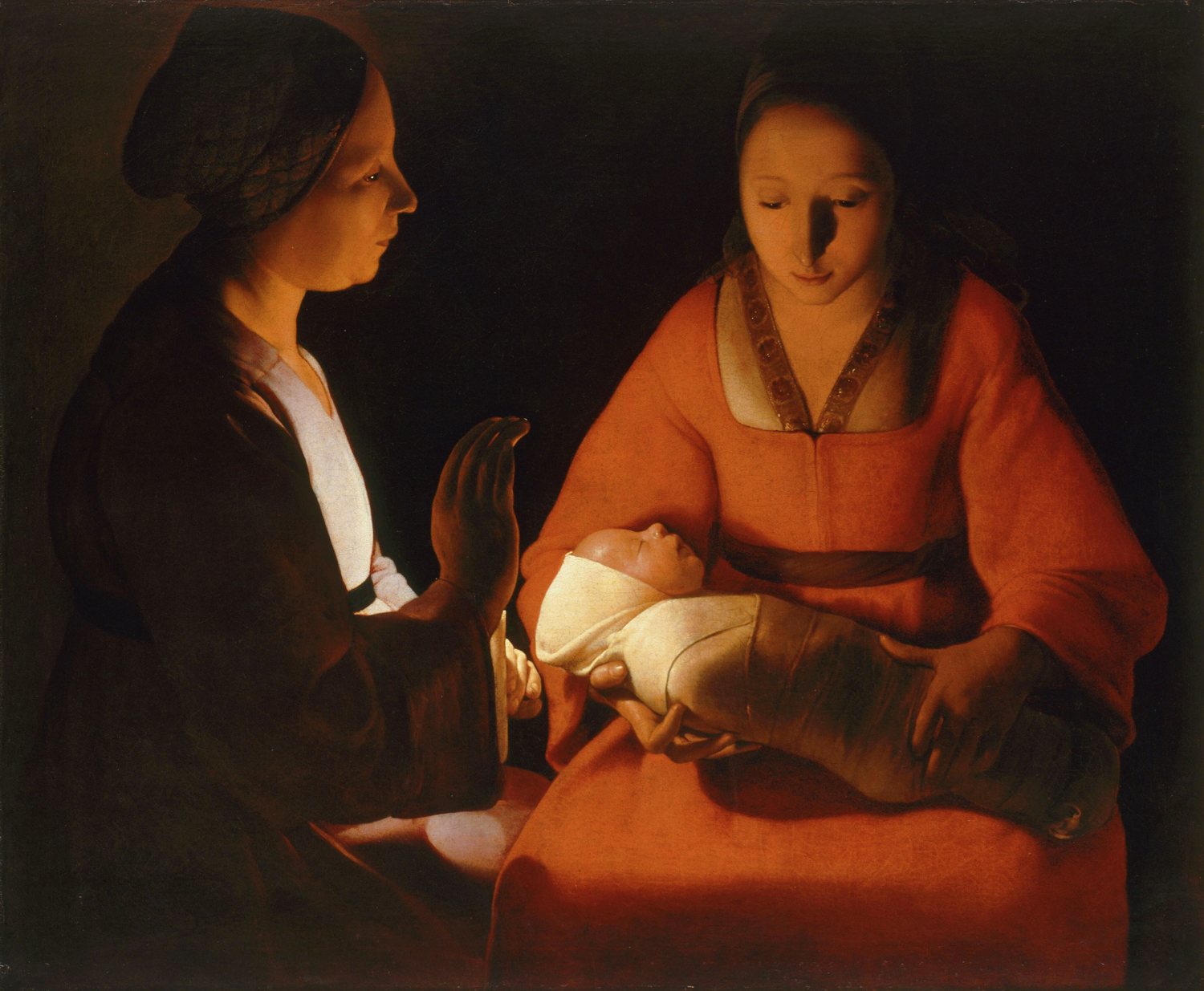
Two women by candlelight gaze at a swaddled infant — a Nativity with Joseph, angels and stable all removed, leaving only the mystery itself. Is it the Christ Child, or simply a baby in a Lorraine cottage? La Tour leaves the question open, and the candlelight makes both answers glow.
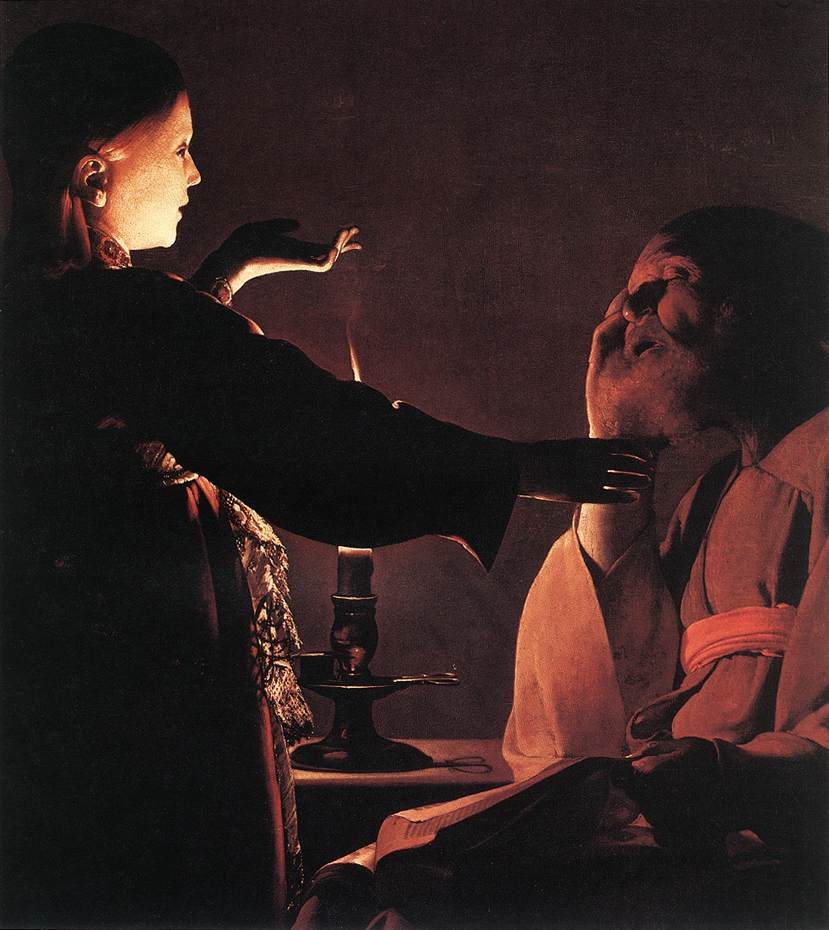
An angel touches the sleeping Joseph's face to wake him with the news that will change the world — and the angel is a girl with a candle, her gesture gentle as a mother's. The supernatural enters La Tour's world not with trumpets but on tiptoe, by a small flame, in a carpenter's sleep.
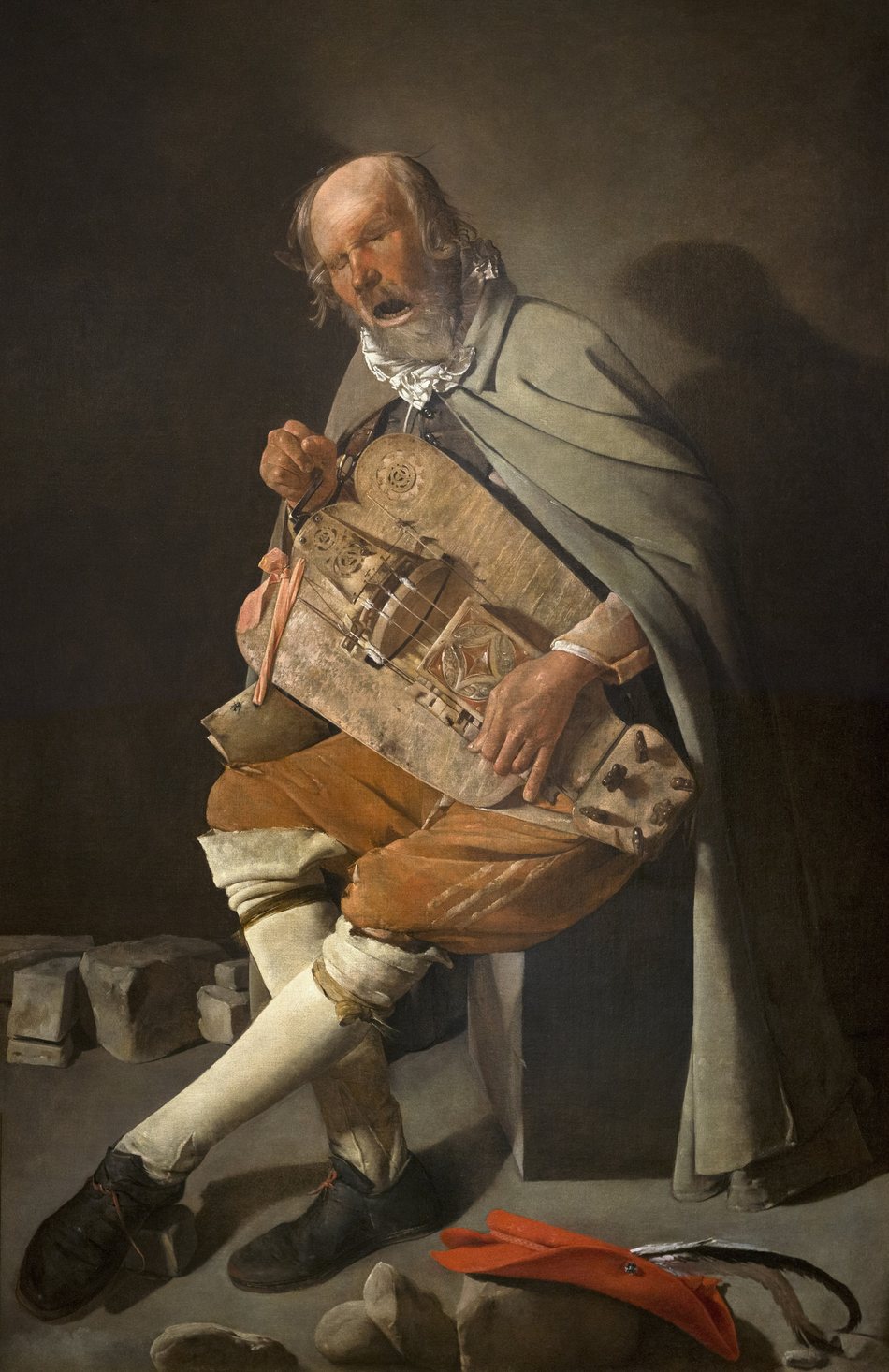
A blind beggar-musician cranks his hurdy-gurdy and sings for alms, painted life-size with unsparing truth — the rags, the sore feet, the dignity intact. One of the great daylight pictures: La Tour looked at the poor of his war-torn province the way he looked at saints, and found no difference in the light.