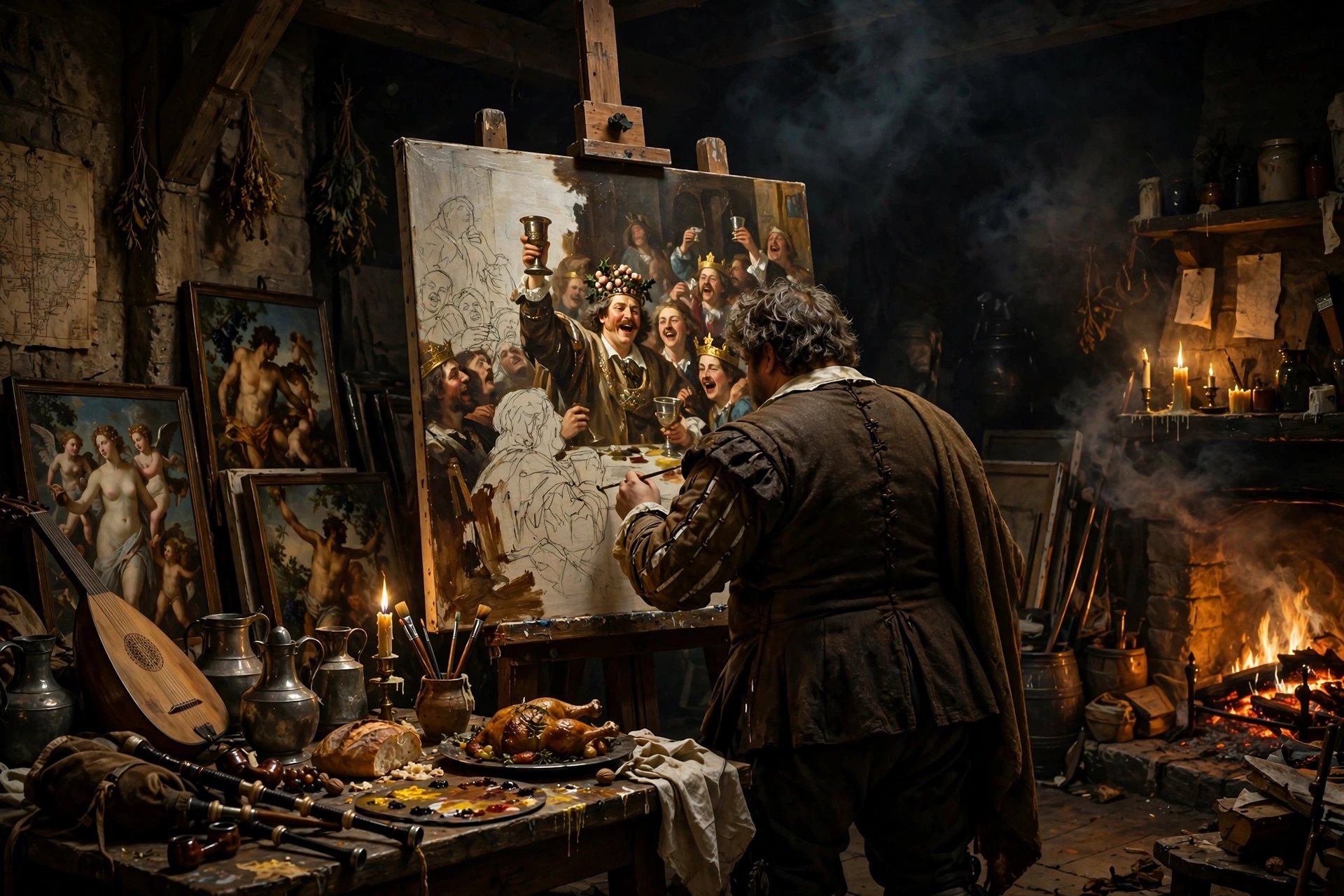
Rubens went to Italy and became a prince of painters; Jordaens stayed in Antwerp, married his master's daughter, and became the city's other great engine of paint. He never crossed the Alps, yet nobody painted flesh, food and noise like him: feasts that roar, satyrs at the peasant's table, gods built like dockers. His house was his model pool, his subjects were proverbs, and his canvases are crowded to the last inch.
Jordaens never went to Italy — the only one of Antwerp's great trio of whom that is true. Caravaggio reached him second-hand: through Rubens's copies, through Utrecht painters who had been to Rome, through prints. He took the candlelit flesh and the half-length crowd and made them Flemish: heavier, warmer, hungrier.
Half his living came from tapestry: full-scale cartoons for Brussels weavers, series of country life, proverbs, and the history of Odysseus. Designing for wool teaches economy — bold contours, few and large forms, colour that survives translation into dyed thread. His easel paintings keep the same architecture: nothing small, nothing timid, everything readable across a room.
Jordaens composes by compression: bodies packed to the frame, a diagonal surge of arms and glasses, heads at every height. Where Rubens organises, Jordaens crowds — the feast is convincing precisely because there is no room in it. The eye is given a hundred incidents and left to find its own way through the noise.
His household sat for everything: his wife Catharina, his children, his servants, himself. The same faces drink at the Twelfth Night table, blow the bagpipe, and play satyrs and apostles. It was economy and it was truth — these are not studio types but people he ate with, painted at the size of life with the affection of familiarity.
His flesh is built warm: a brown underpainting left working in the shadows, ruddy mid-tones of vermilion and ochre, highlights struck in lead white while the paint was still wet. Skin in Jordaens is never porcelain — it is heated by wine, firelight and exertion, and the red of a cheek is mixed like the red of a roast.
Antwerp's burghers bought moralising pictures for their walls: as the old sing, so the young pipe; the king drinks, and so must you. Jordaens delivers the sermon as a party — the warning against drunkenness painted by a man plainly in love with the feast. The joke lands first; the moral seeps in with the second look.
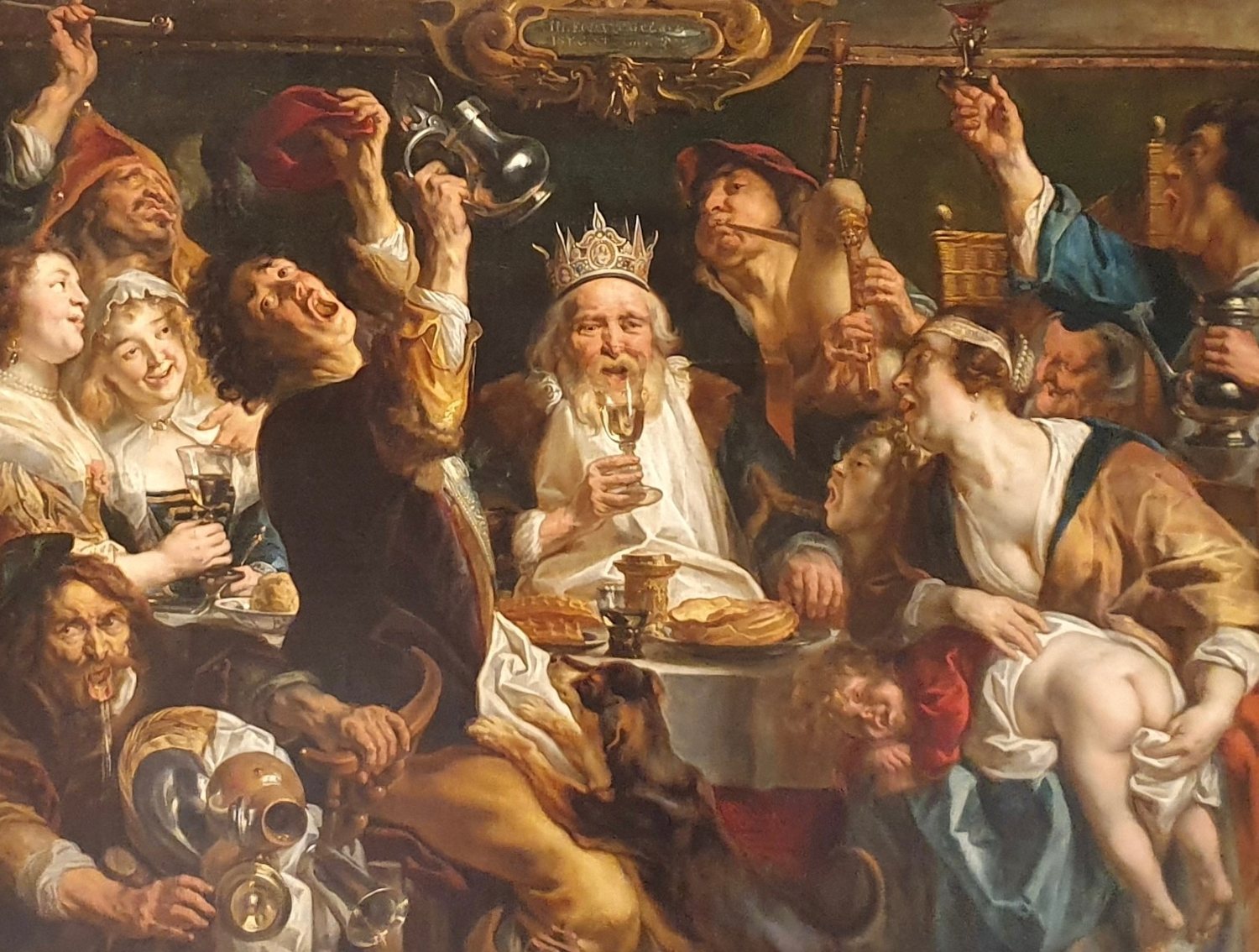
Twelfth Night: the man who finds the bean in his cake is king for the evening, and when the king drinks, the whole table must drink — the cry goes up, glasses, jugs and the bagpiper all answering at once. Jordaens painted the subject again and again; this is its fullest roar, with the motto in the cartouche above like a caption to the noise.
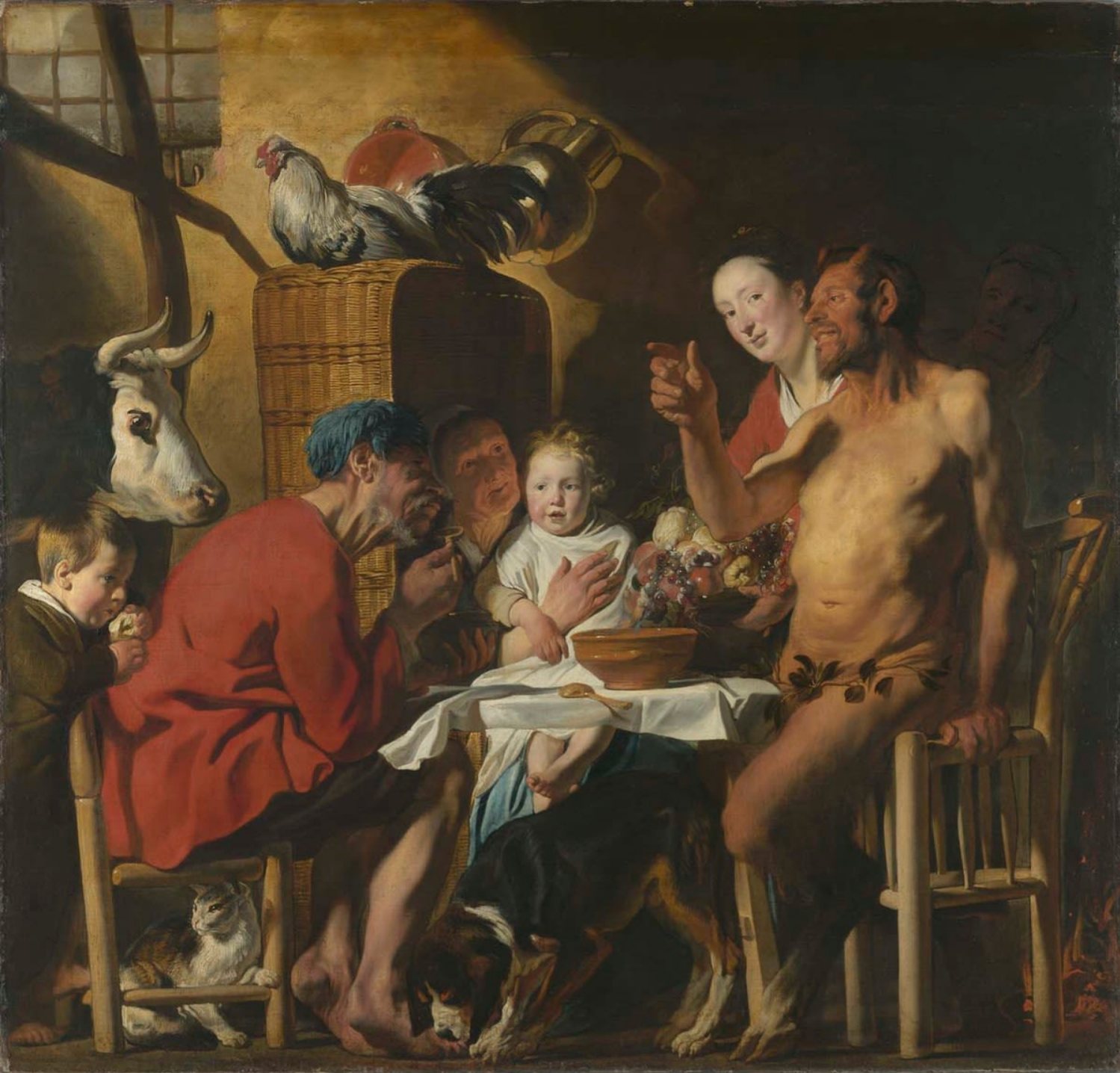
Aesop's fable, told at the table: the satyr, guest of a peasant family, watches his host blow first on his cold fingers and then on his hot soup — and leaves, refusing to trust a man who blows hot and cold from the same mouth. Jordaens makes the fable a farmhouse supper, the satyr's hoof tucked under the bench.
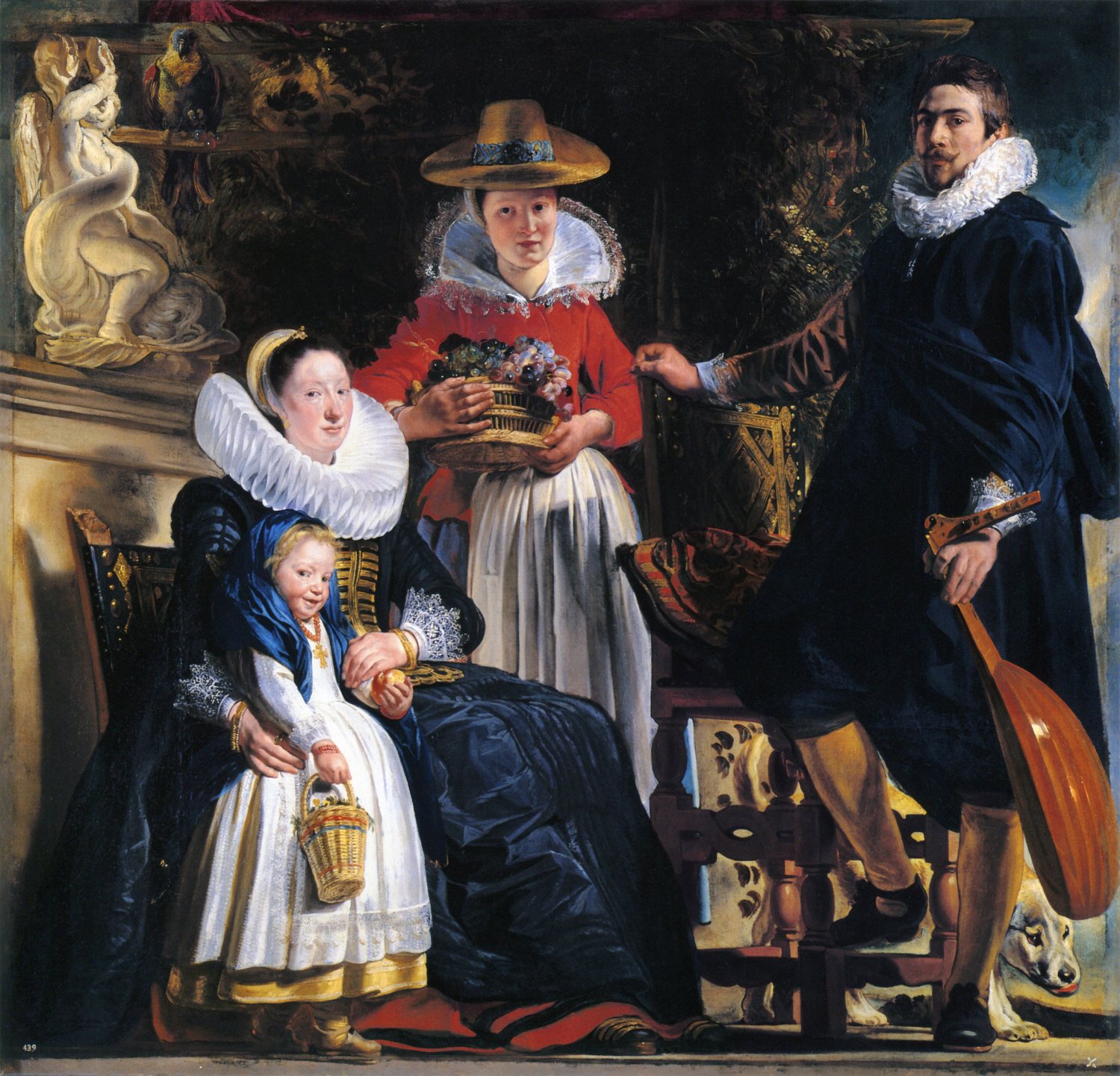
The painter at twenty-eight, with his wife Catharina — his master's daughter — their little daughter Elizabeth, and a maid bringing fruit. He holds a lute; the family is arranged like a piece of music. It is a young man's announcement: a household, a craft, and a house style, all founded at once.
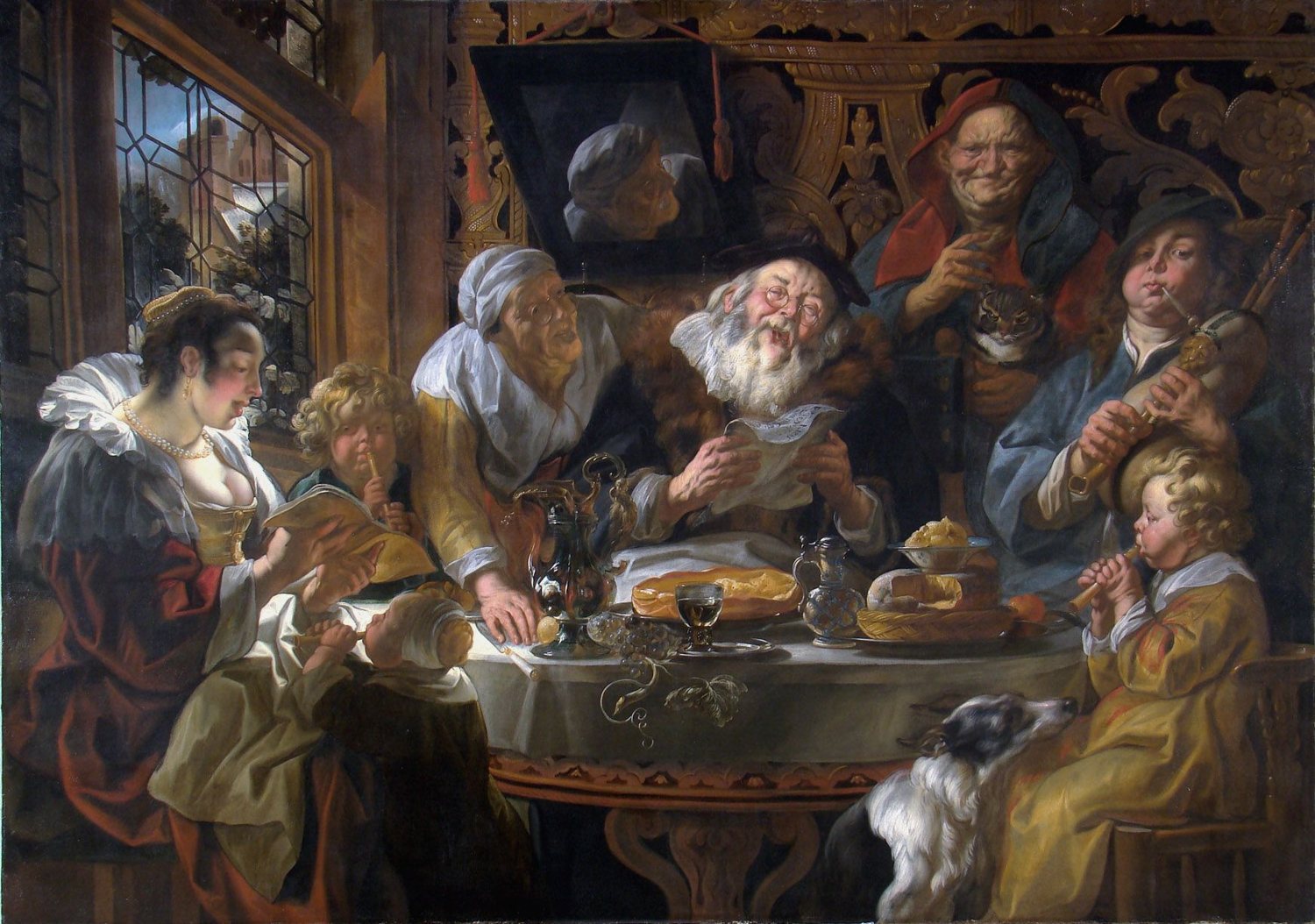
The proverb made visible: the old sing over their wine, the bagpiper plays, and the children pipe along on their little flutes — the young learn exactly what the old teach. A grandmother sings from the sheet, a dog begs at the table, and the moral hides inside the merriment like the bean in the cake.
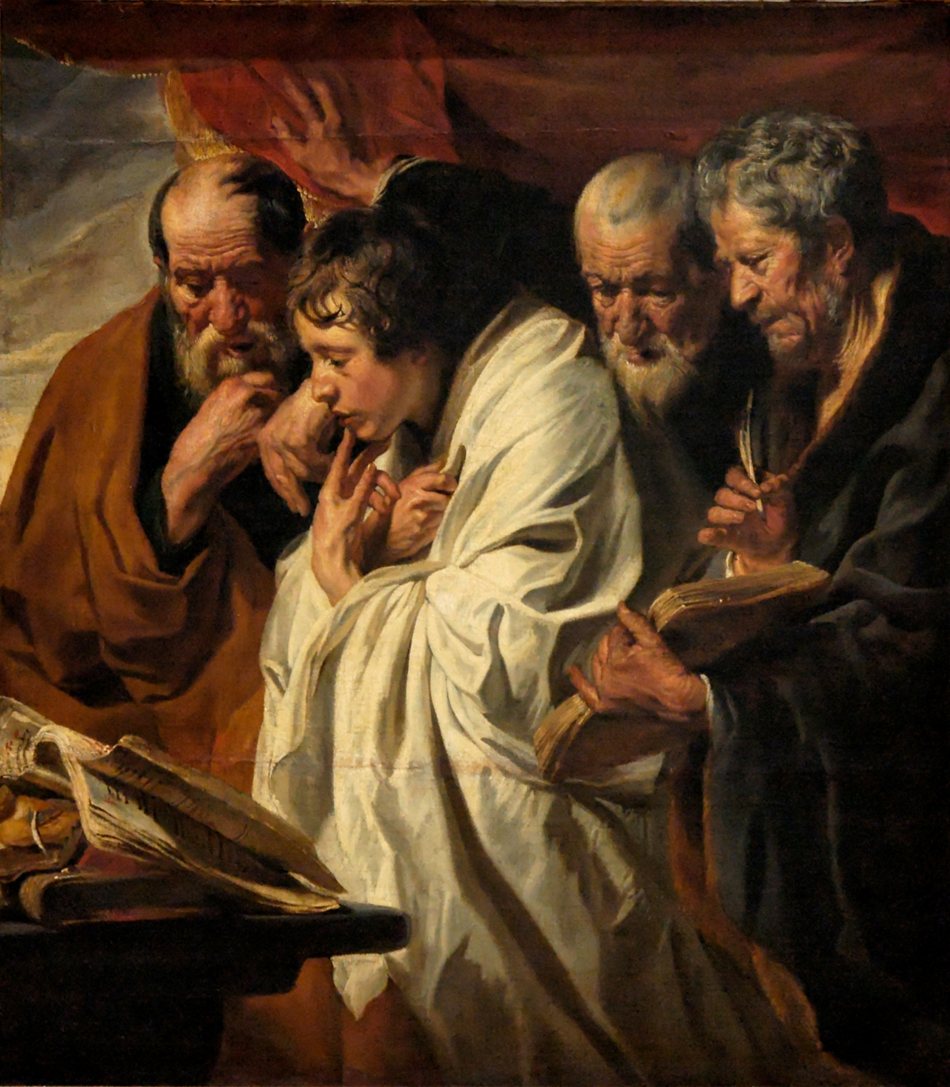
Matthew, Mark, Luke and John as four old workmen crowded round a book — three reading over one another's shoulders, the youngest, John, looking out at us. Painted when Jordaens was in his early thirties, it is his Caravaggism at its most serious: no feast, no noise, just lamplight, paper and attention.
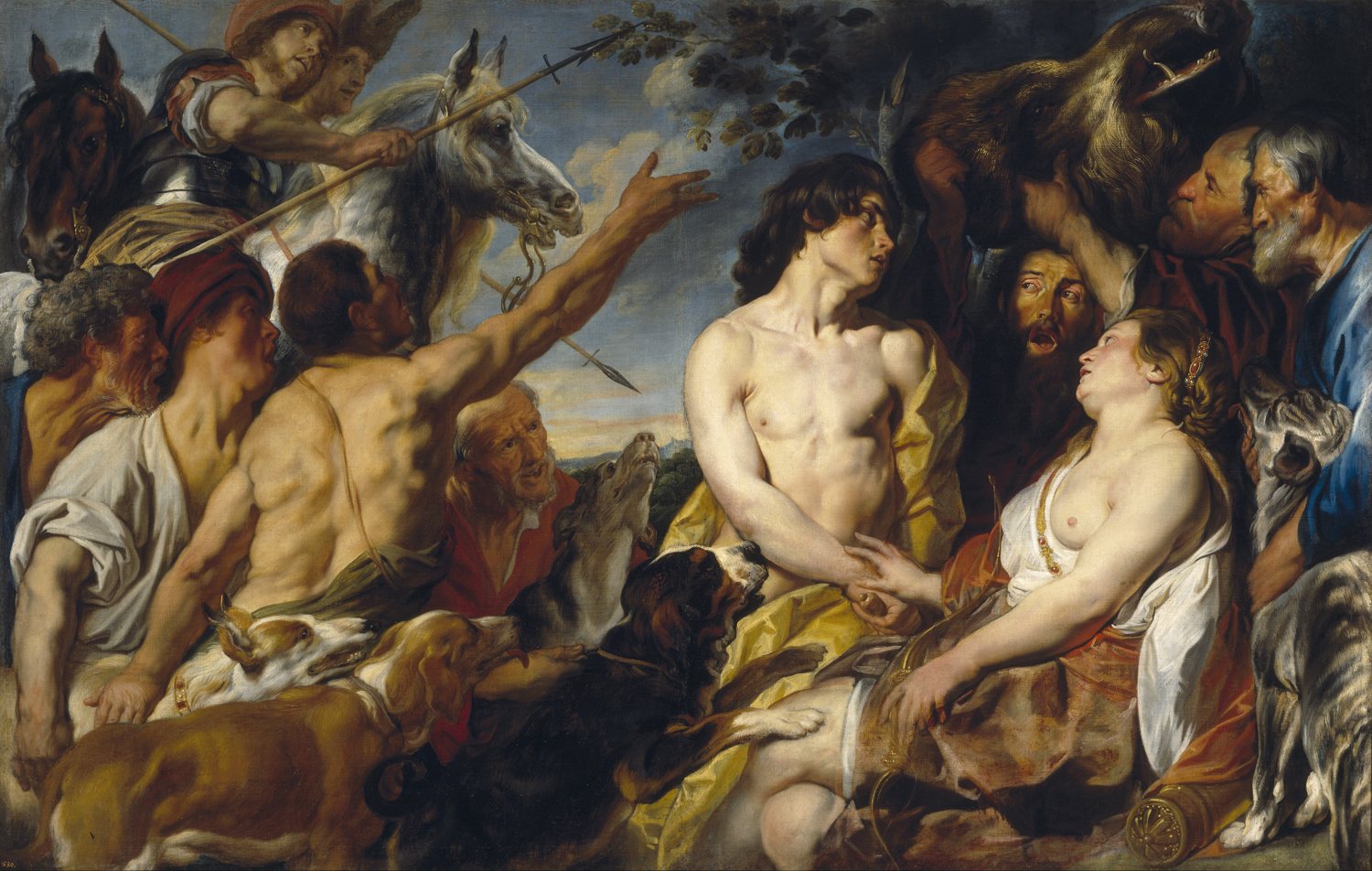
The Calydonian hunt is over: Meleager presents the boar's head to Atalanta, who struck the first blow, while the hunters surge and argue around them and the hounds worry the carcass. Painted when Jordaens was twenty-five and fresh from Rubens's orbit, it already has his signature — a myth with the manners of a fairground.
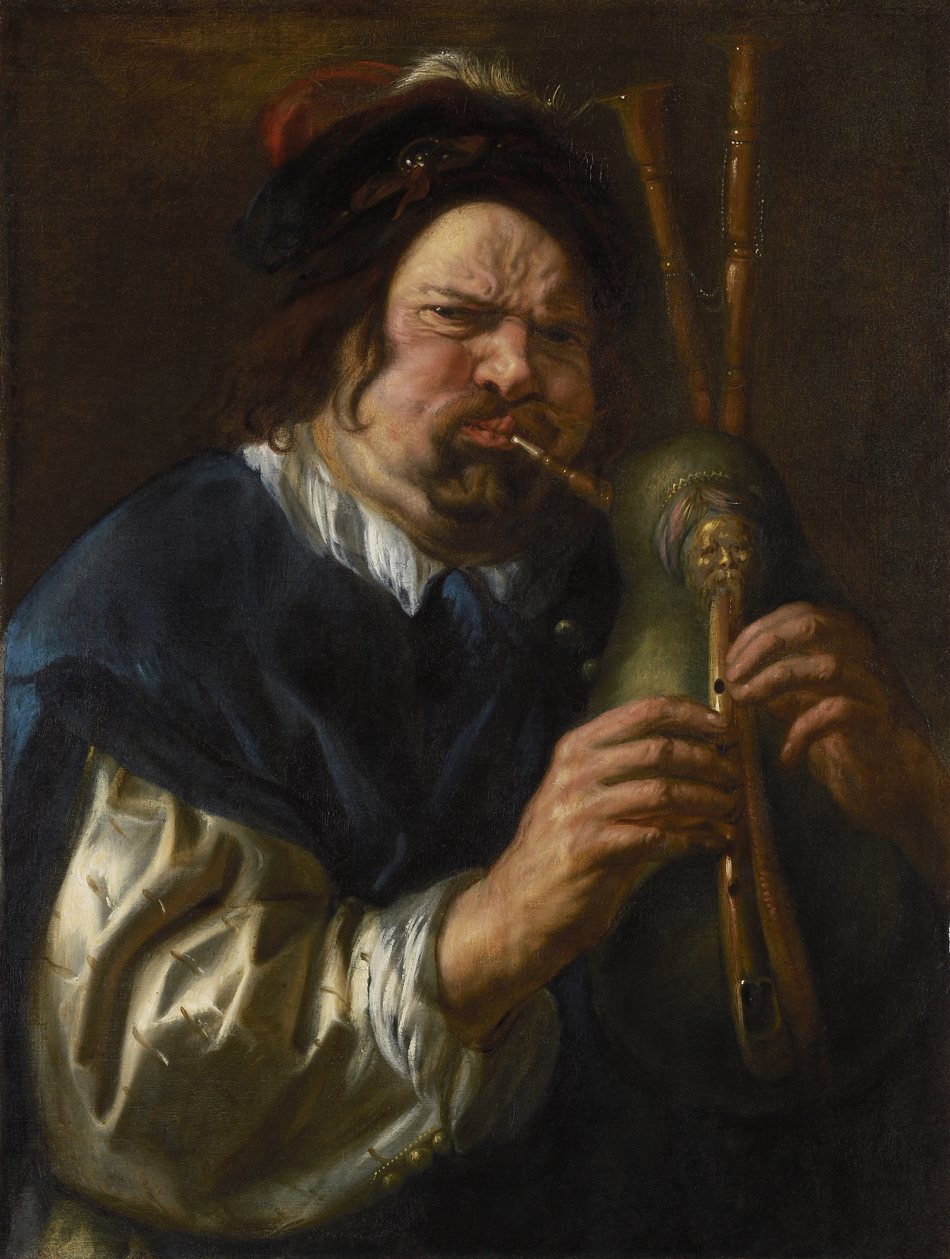
The painter himself, cheeks blown out, fingers on the chanter, giving the bagpipe everything he has. It is a self-portrait as a self-verdict: no brushes, no finery — the artist as the loudest man at his own feast, painted with the same relish he gave to kings of the bean.
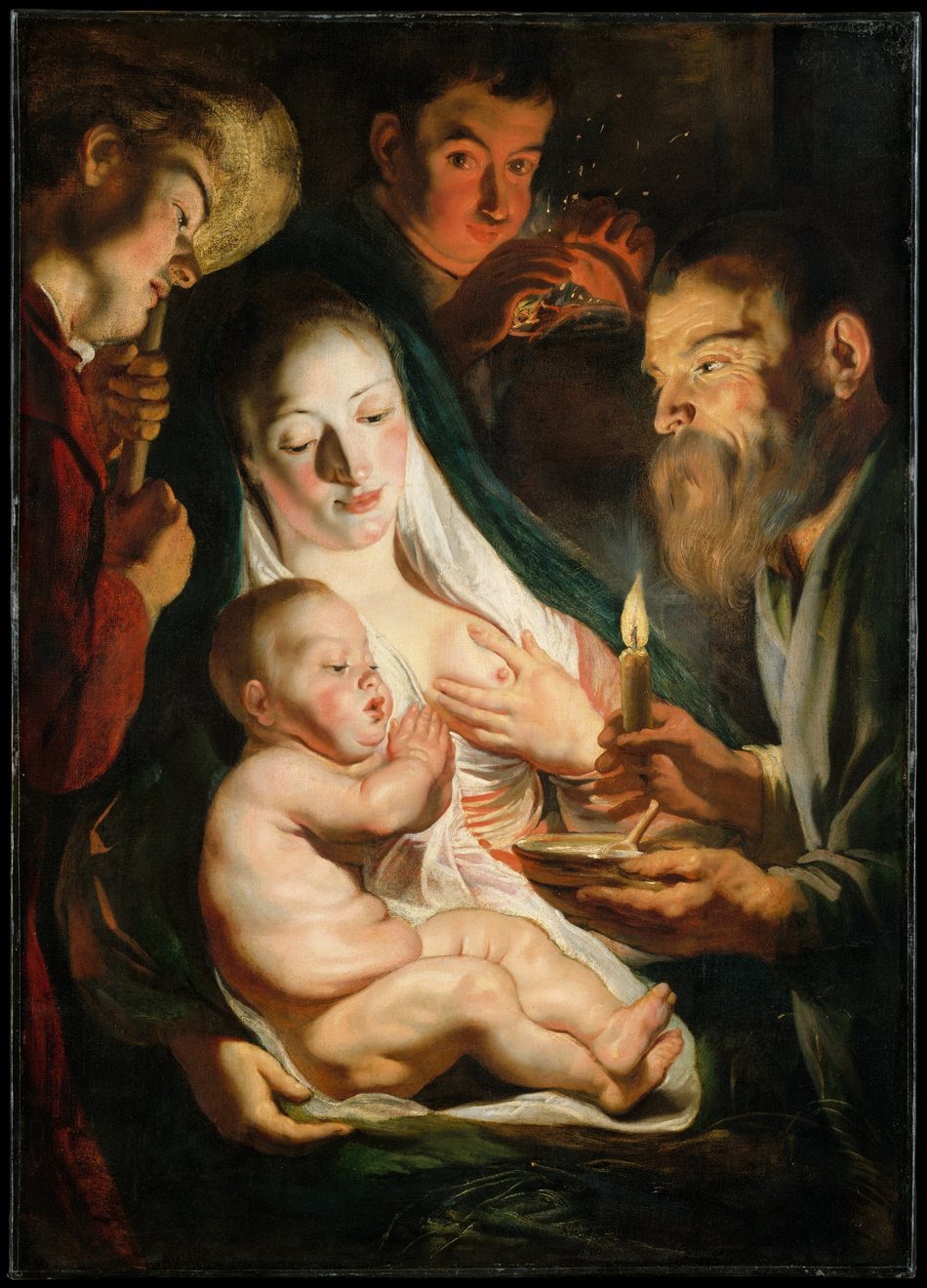
One of his earliest surviving canvases, painted at twenty-three: the Virgin with the Child by candlelight, shepherds crowding in with their gifts, an old woman warming her hands at the brazier. The Flemish stable is a farmhouse kitchen, and the wonder is measured in faces leaning toward the light.
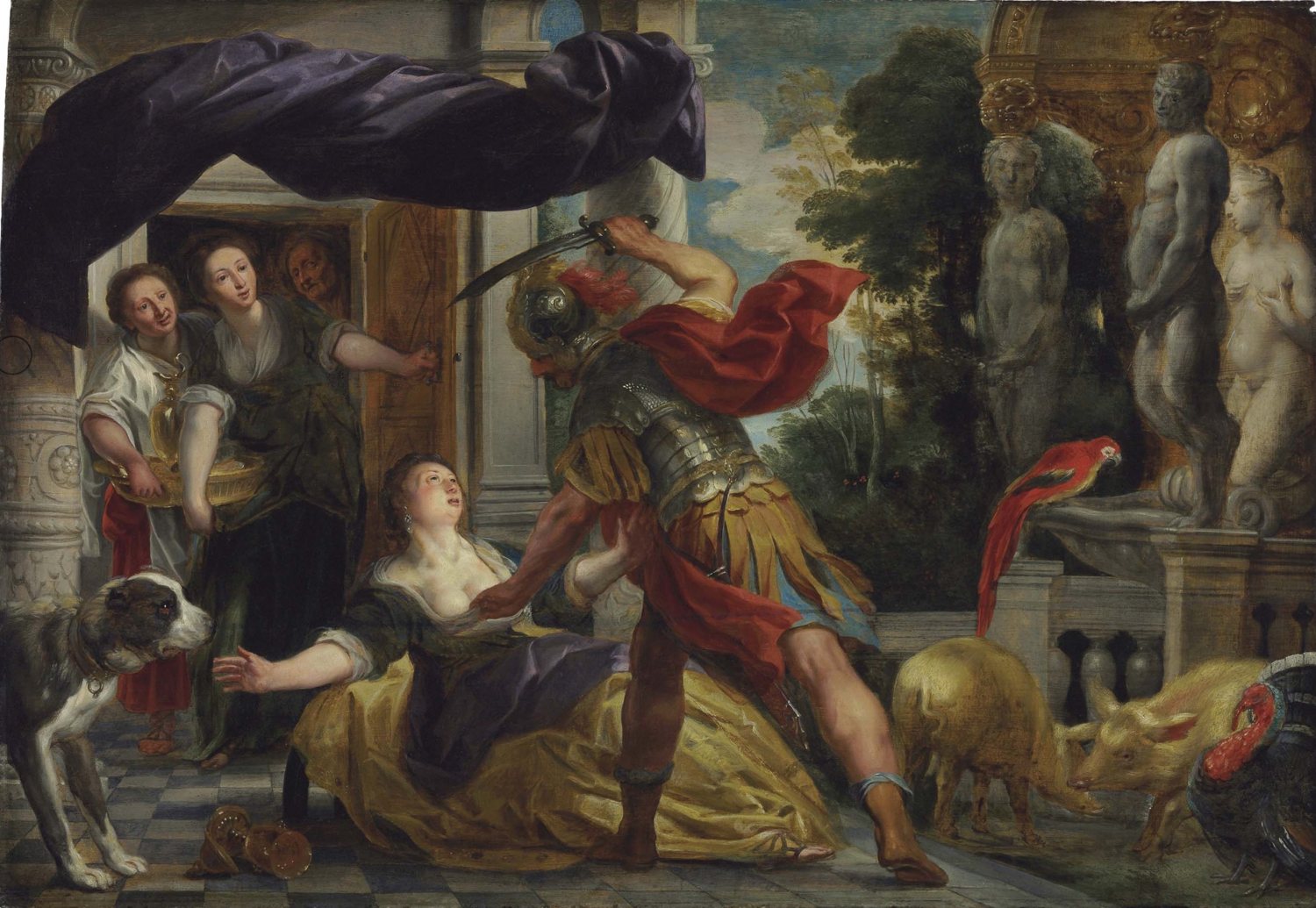
Odysseus bursts in with his sword drawn; Circe recoils; in the foreground her last guests, already pigs, root among the dishes. Jordaens designed a whole Odysseus series for the tapestry weavers, and this canvas has the cartoon's energy — a palace coup staged like a tavern brawl.
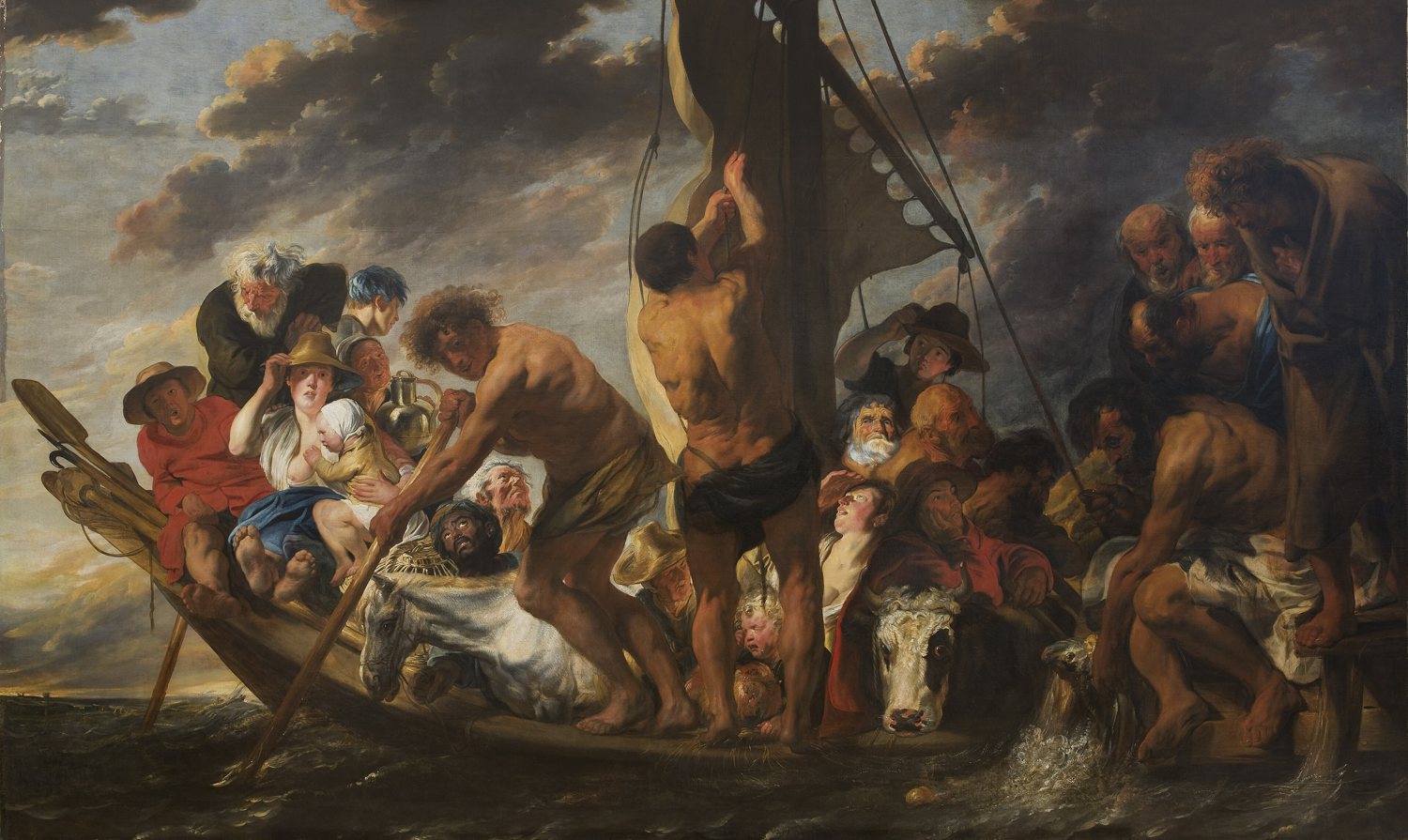
The ferry to Antwerp is loaded past reason — apostles, passengers, cattle, luggage — while Peter hauls up the fish with the coin in its mouth for the temple tax. A Gospel scene staged as a Flemish river crossing, painted when Jordaens was thirty, with the water, the sail and the crowd all competing for the light.