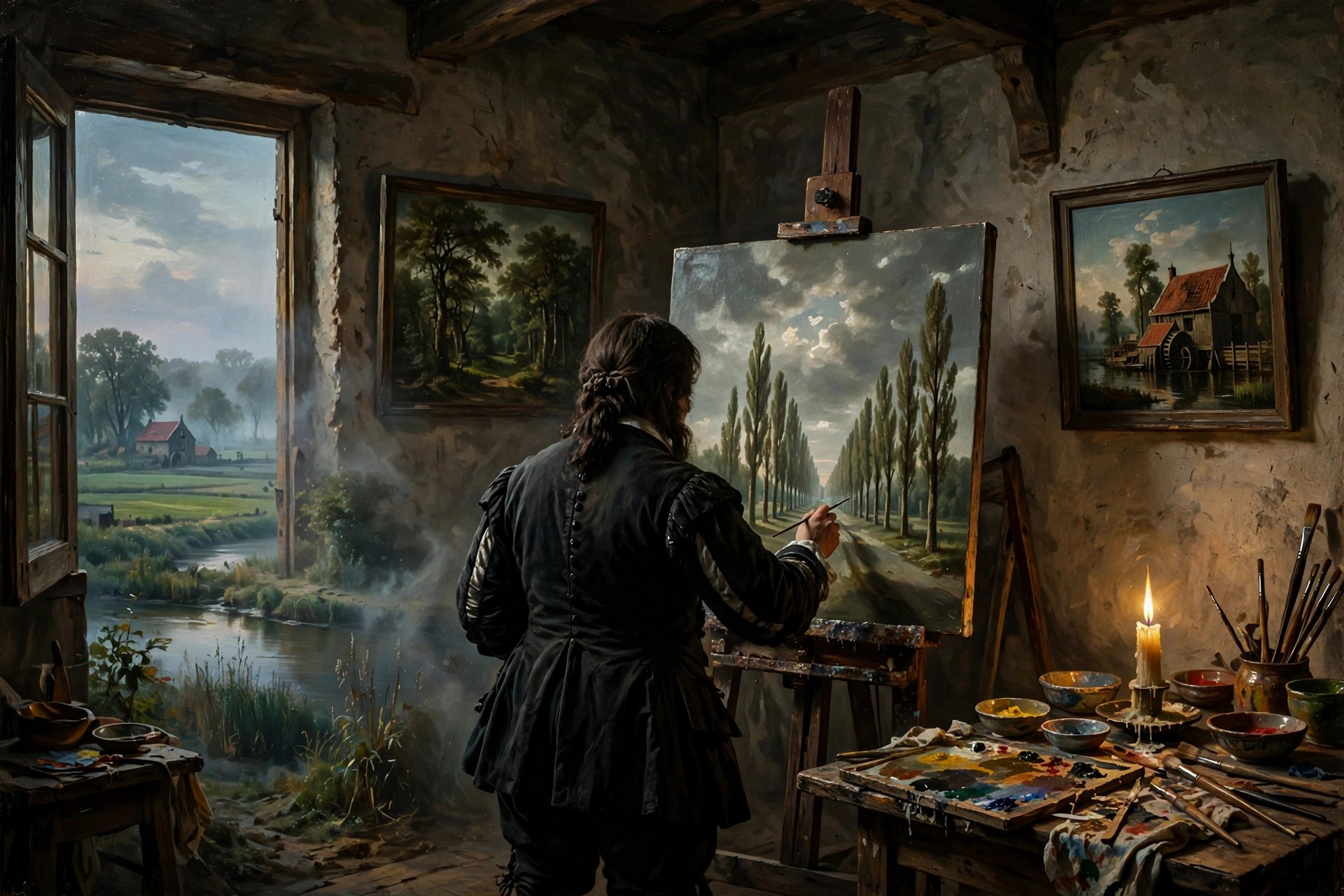
He took one corner of his master's art — the wooded lane, the watermill, the sandy road between oaks — and spent a lifetime making it perfect. Hobbema's Holland is not dramatic; it is inhabited: paths worn by feet, water held by sluices, trees that shade a cottage and a traveller alike. Then, in 1689, the exciseman of Amsterdam laid down his gauge, picked up his brush, and painted the most famous avenue in art.
Hobbema is the one documented pupil of Jacob van Ruisdael, the great landscapist of the age. From Ruisdael's workshop he took the method: drawings made out of doors, in the woods east of Amsterdam and on journeys toward the German border, then composed in the studio into landscapes that never existed in quite that arrangement — every tree observed, the whole invented.
His early landscapes are on oak panel, painted thin and smooth, the surface almost enamelled; the big late works, the Avenue among them, are on canvas. The paint film stays lean throughout — no impasto mountains. Light is built by layering: a warm ground, cool shadow masses, then foliage and sky worked up in separate, patient campaigns.
Foliage is the hardest thing in landscape: a thousand leaves that must read as one tree. Hobbema models each oak first as a dark mass against the sky, then lays the lit side in yellow-green touches, cluster by cluster, keeping the edges ragged where light eats them. Distant woods go blue-green and flat; near trees keep their drawing. It is why his lanes feel walked-in rather than staged.
He painted watermills more than thirty times, and one mill — at Singraven near Denekamp, on the Dinkel — again and again. The construction is always exact: the undershot wheel turned by the sluice stream, the millrace, the great roof riding over it all. Then the painter's licence: the wheel doubled in still water, the red roof set against the bluest passage of the sky.
The little walkers, hunters and riders who animate his lanes were often painted by specialists — Adriaen van de Velde among them — into spaces Hobbema reserved in the finished landscape. Division of labour was normal workshop practice: the landscape painter sold the world, the figure painter peopled it, and the buyer got both hands for one price.
In 1668 Hobbema married and took a salaried post as a gauger of wine for the Amsterdam excise — measuring other men's casks for tax. Painting shrank to the margins of his life, and after 1689 it seems to stop altogether. Which makes the Avenue, dated that year, the stranger and greater: a part-time painter in his fifties producing, sapling by sapling, the most patient landscape of the century.
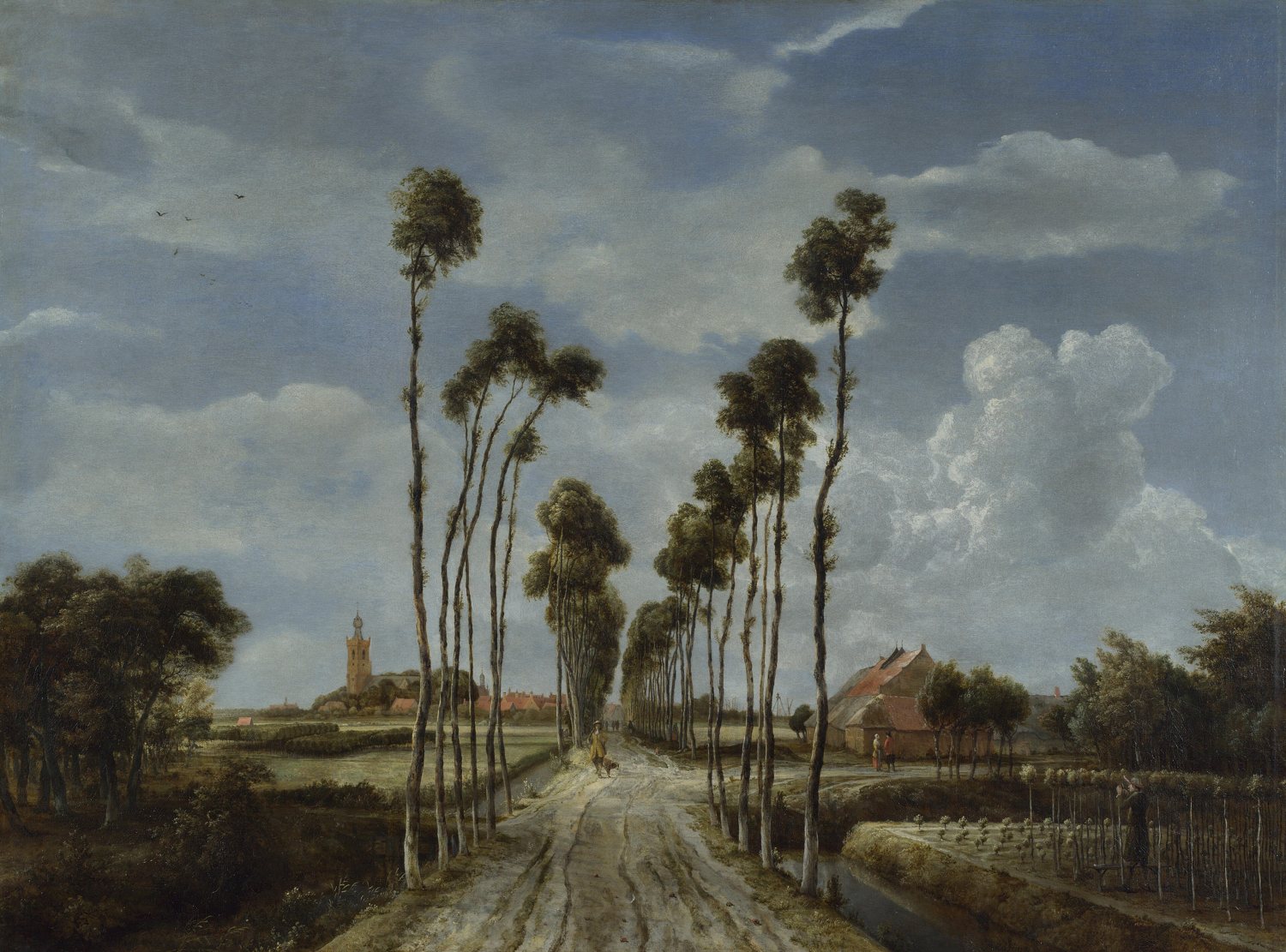
A straight road runs between young poplars to the village of Middelharnis, its church tower on the left, a man pruning the saplings on the right, a sportsman with his dog on the left. One tree on the right is already withering. Painted when Hobbema was fifty and barely practising, it has become the most famous avenue in European art — perspective you can walk down.
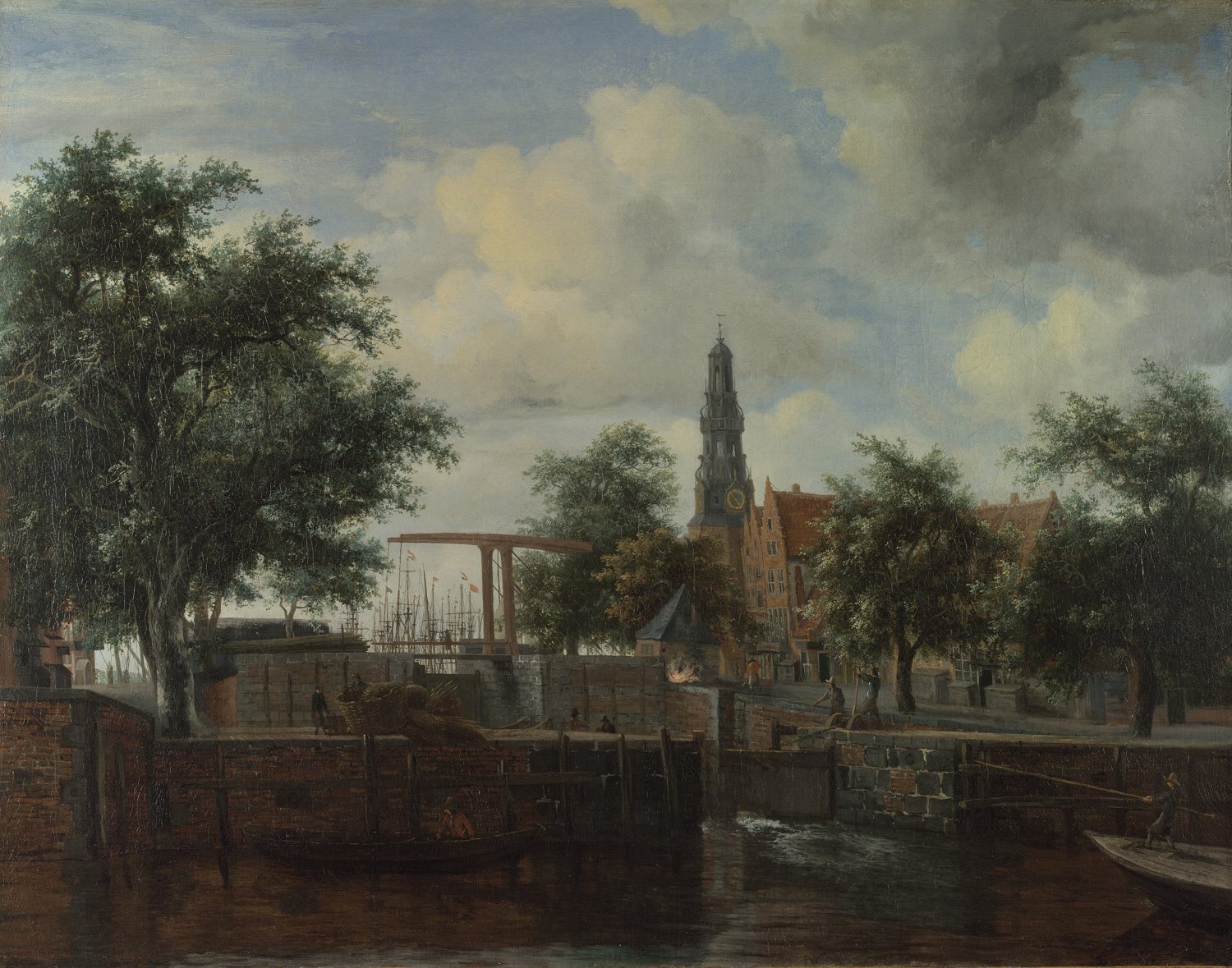
His only townscape: the lock where the Singel meets the Brouwersgracht, the herring-packers' tower rising behind, boats waiting on the water. Even in the city Hobbema keeps his habits — the foreground belongs to trees and water, and the town is allowed in only behind them.
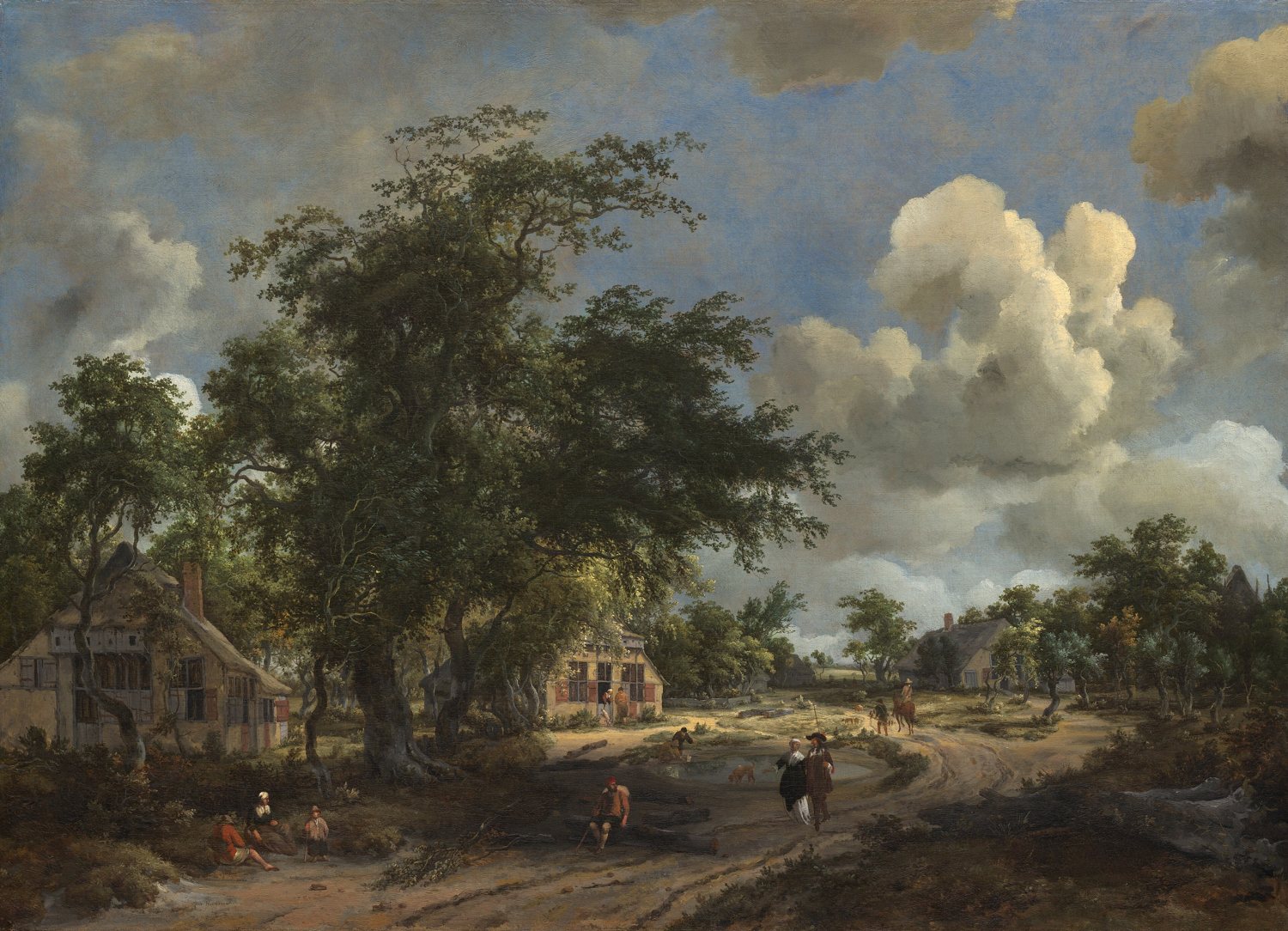
The high road is a sandy track lifted above the wet lowlands, and Hobbema sets his whole picture on its climb: cottages under great oaks, travellers small against the sky, the land falling away on either side. It is a road painting the way a portrait paints a face — the sitter is the way itself.
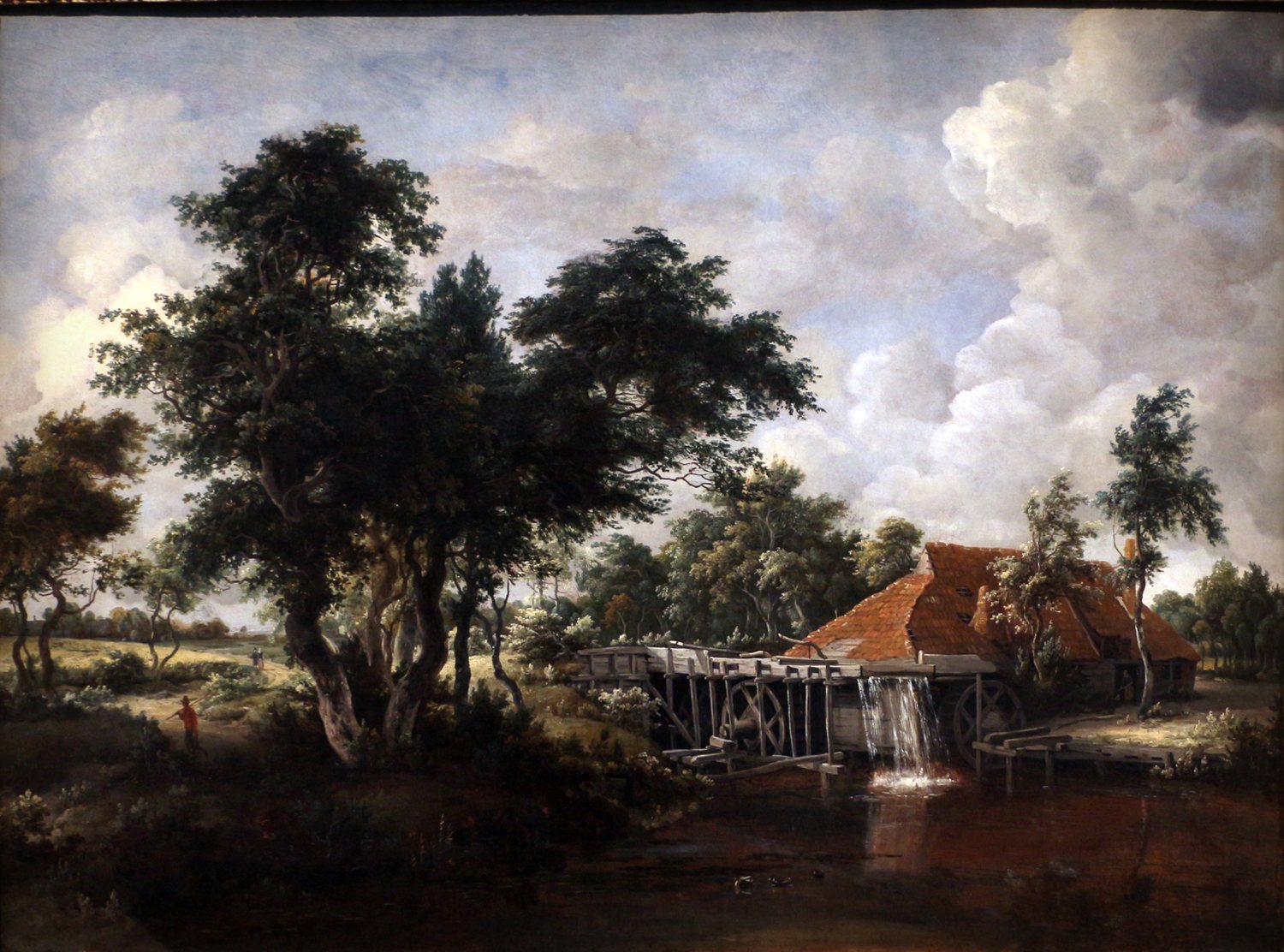
The mill he painted all his life, in its grandest version: the wheel at work under the sluice, the water dark and still around it, and over everything the enormous red roof — the one warm note in a world of greens, placed dead centre like a signature.
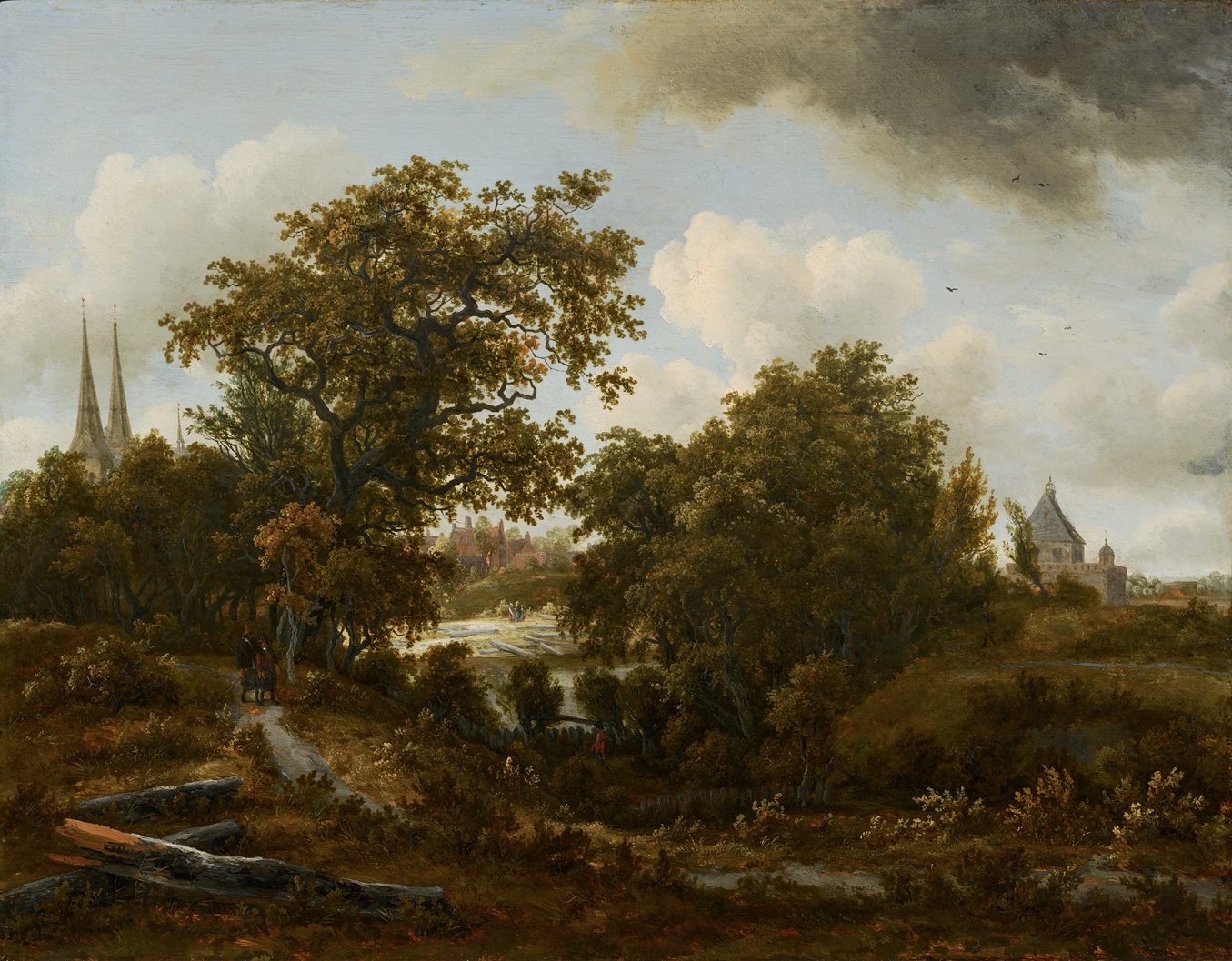
From the eastern journeys with Ruisdael: the twin spires of Deventer on the horizon, a river plain in the middle distance, and in front the broken, brushy ground Hobbema loved to draw. The town is a rumour; the country is the fact.
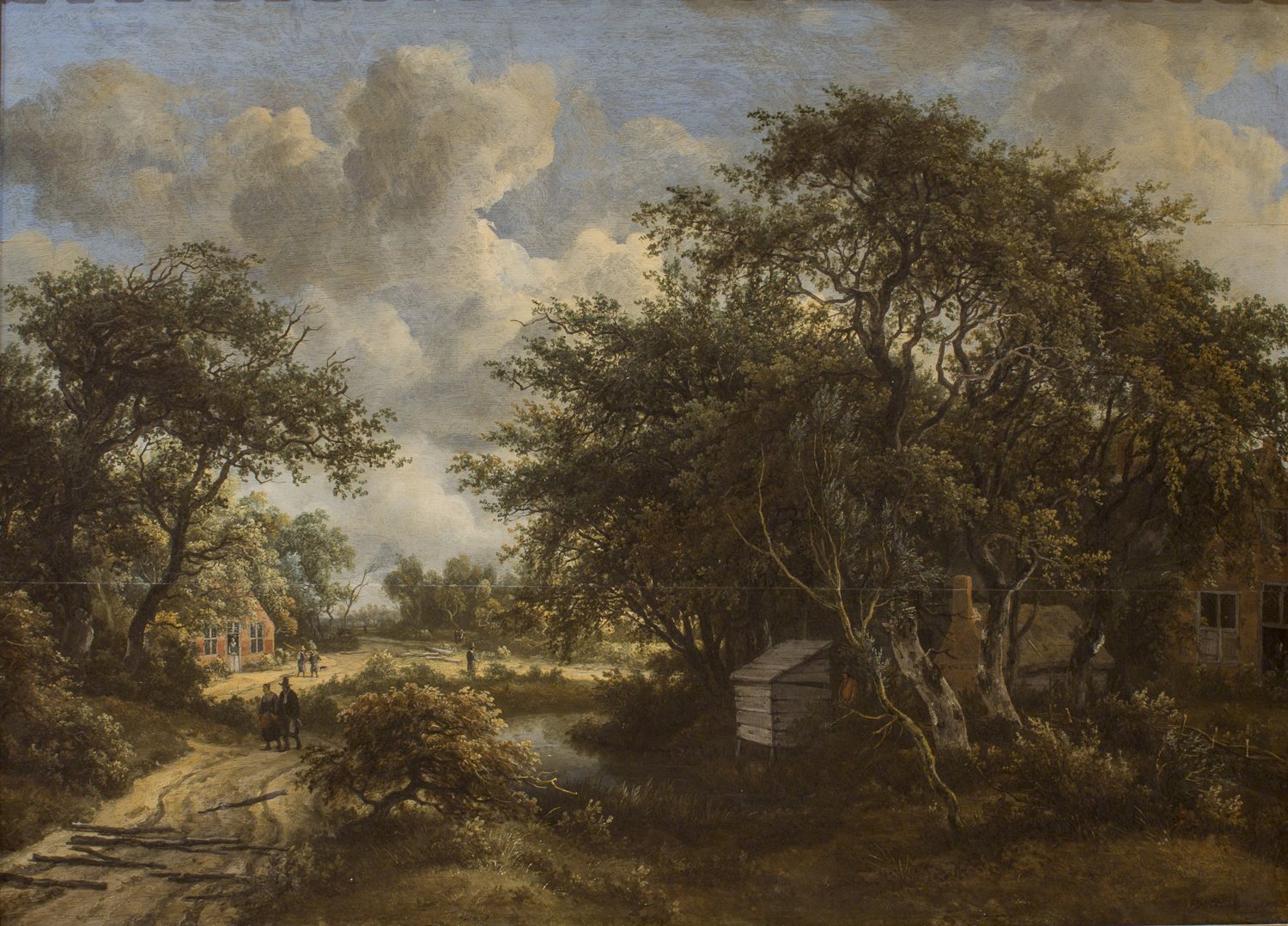
The village is almost lost in its own trees — a roof here, a gable there, a path losing itself between gardens. Hobbema's Holland is a place where building and planting have grown together so long that the picture cannot say where one ends and the other begins.
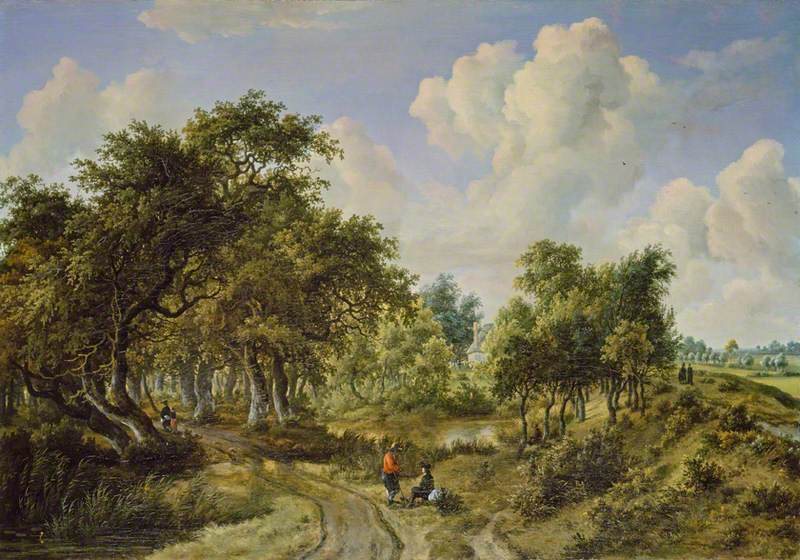
A sunlit clearing, a sandy path, two small figures resting at the wood's edge. Nothing happens, and everything is in place: this is the Hobbema subject reduced to its elements — light, leaves, earth, and a road going somewhere out of sight.
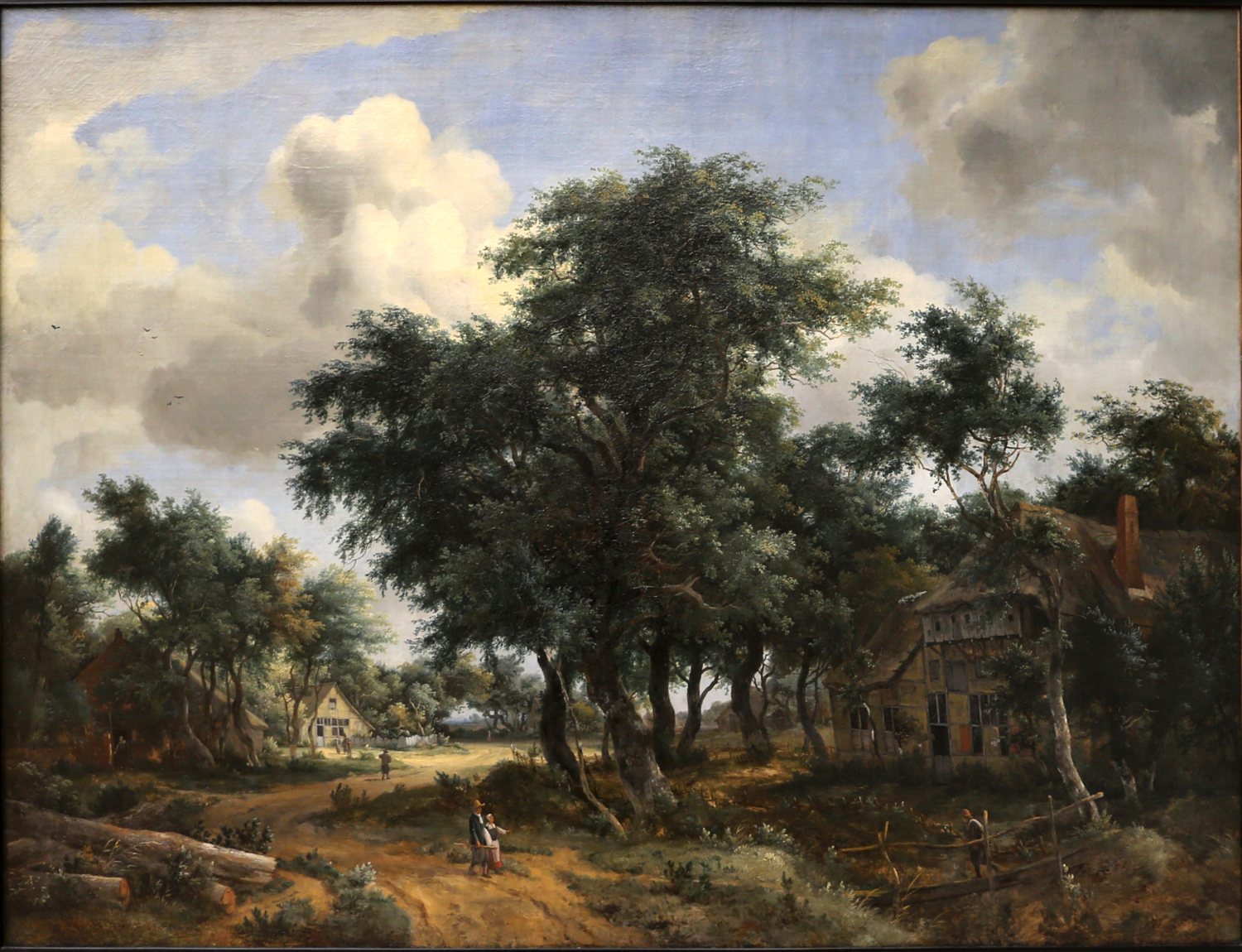
The road bends left into shadow, cottages stand back behind their fences, and the great trees lean together overhead like neighbours talking. Early Hobbema, still close to Ruisdael's manner, but the lane is already his own invention: a village street painted as a piece of woodland that happens to have houses in it.
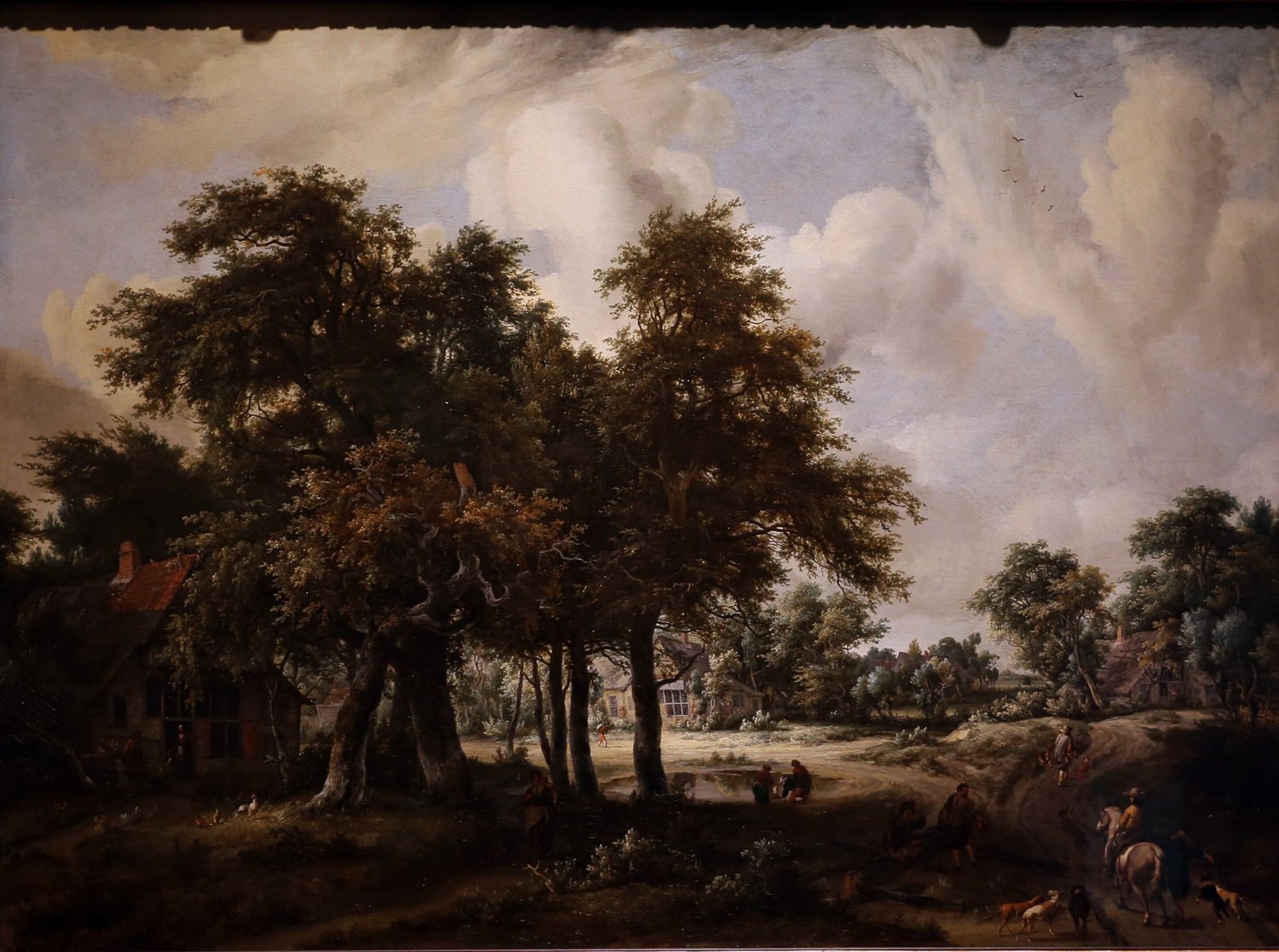
Cottages at the left, a pond in the middle, and at the right a hunting party with horses and dogs crosses the clearing — the one flash of ceremony in Hobbema's quiet world, kept small and far away, as if the landscape had politely declined to make room for it.
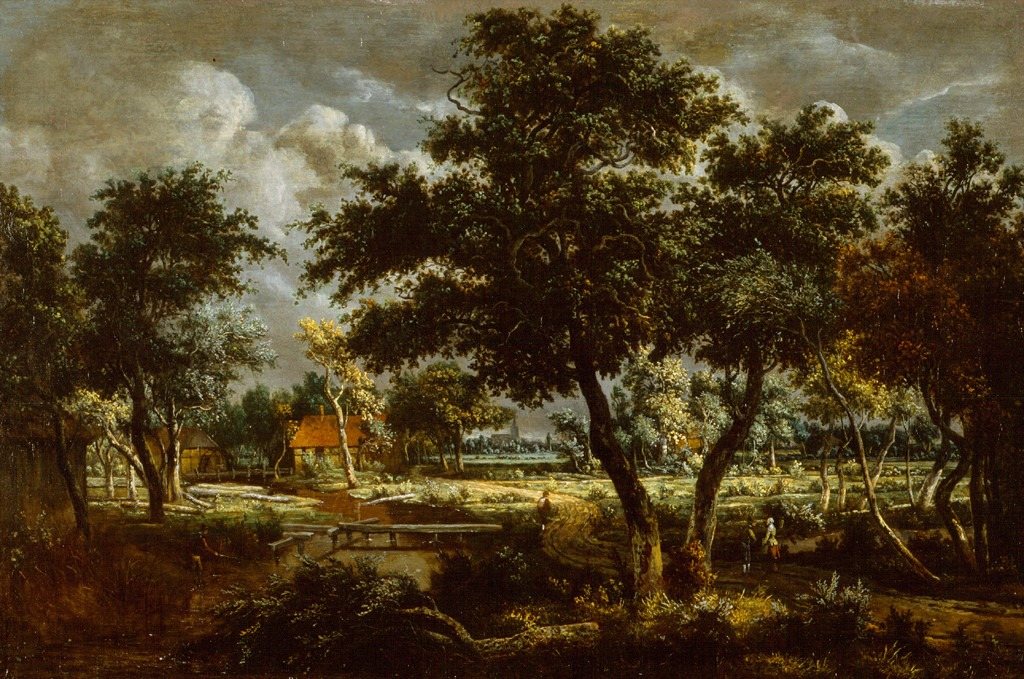
A plank bridge crosses the stream in the middle distance, an orange roof glows beyond it, and the whole wood stands in that clear, silvery light Hobbema could lay over a scene like glass. The bridge is small; the painting is really about everything the bridge connects.