Almost nothing is known of him — not even his real name, which was Mathis Gothart — and barely ten works survive. But one of them, the Isenheim Altarpiece, painted for a hospital of men dying of plague and fire-sickness, contains the most harrowing Crucifixion and the most radiant Resurrection of the Northern Renaissance. Grünewald painted suffering from inside the ward.
The Isenheim Altarpiece stood in the chapel of a hospital run by Antonite monks, who treated ergotism — Saint Anthony's fire — a poisoning that blackened and rotted the limbs. The patients prayed before it. That is why Christ's body here is covered in sores and thorns like their own: the picture told the dying that God had suffered their exact disease.
No painter of the age gives hands such eloquence: the Baptist's impossibly long pointing finger, the Magdalene's fingers laced in grief, the Virgin's hands clasped until the knuckles whiten. Grünewald stretches and twists anatomy past nature — the bodies are wrong by every rule of proportion, and right by the only rule he served: expression.
His palette runs to extremes no contemporary dared: the Crucifixion is painted in the colours of a corpse against a darkness like a tomb, and the Resurrection in a blaze of red, gold and blue-white light that dissolves the body into radiance. Between those two panels lies his whole theology — agony and glory, with nothing lukewarm between.
Isenheim has three views: closed, it shows the Crucifixion between Saints Sebastian and Anthony; opened once, the Annunciation, the angels' concert, the Madonna and the Resurrection blaze out for feast days; opened twice, carved saints stand in a gilded shrine between the Temptation and the hermits' meeting. The monks changed the picture with the calendar — consolation in instalments.
He was court painter at Aschaffenburg, worked in Frankfurt and Mainz, lost his post in the Peasants' War years, and died in Halle in 1528 — after which his name was so thoroughly forgotten that later centuries called him Grünewald by mistake and attributed his panels to Dürer. The Isenheim Altarpiece waited in Colmar, through revolutions and wars, for the twentieth century to rediscover its maker.
His paint handling is as extreme as his drawing: thin, stained darks in the shadows, flesh built in greenish, bruised tones, highlights dragged on almost dry so the surface itself feels raw. Nothing is polished. Stand close to the Crucifixion and the panel seems to suffer with its subject — the technique is the meaning.
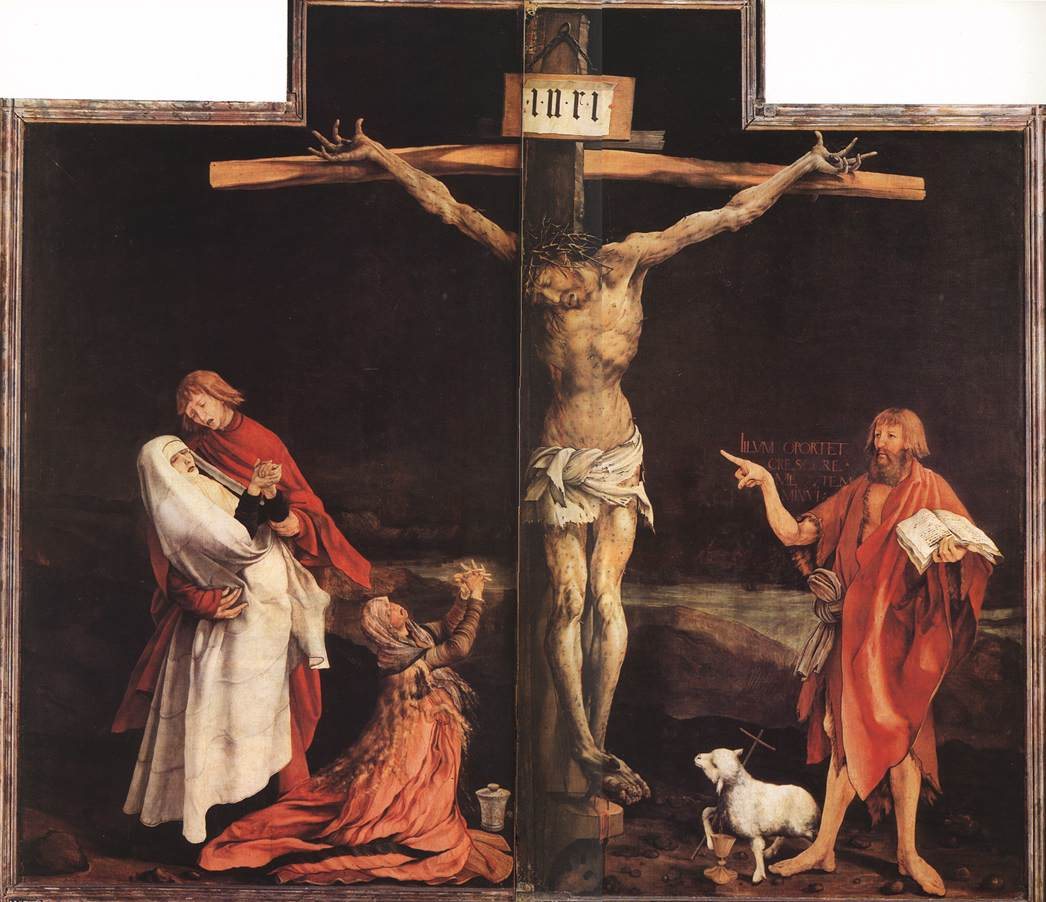
The closed view of the altarpiece, and the most devastating Crucifixion in Northern art: the body sagging and thorn-torn, the Baptist pointing with his endless finger — He must increase, I must decrease — the Magdalene wringing her hands, the Virgin swooning in white. It hung where the dying could see it from their beds.
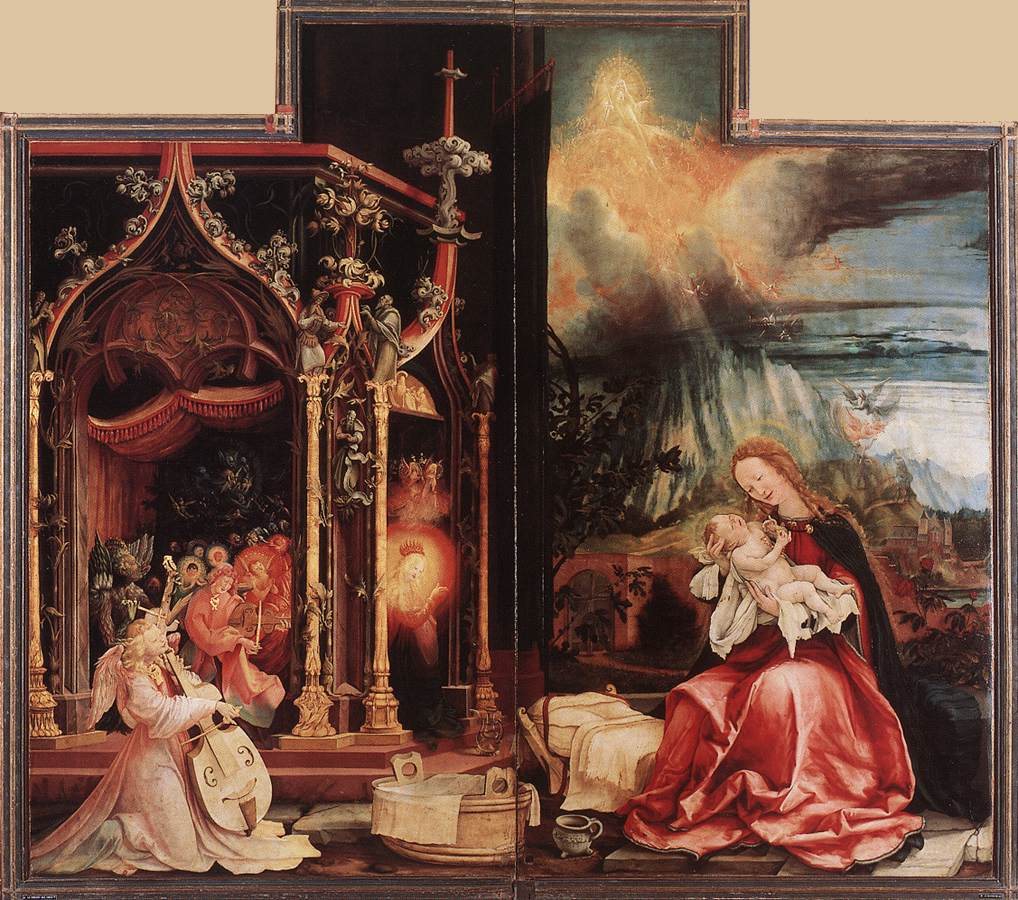
The centre of the opened altarpiece: on the left, under a Gothic canopy, angels make music with viols and strange radiant instruments; on the right the Virgin holds the Child in a landscape where a mountain of light breaks open above them. After the darkness of the Crucifixion, the monks opened the wings to this — joy, painted at full blaze.
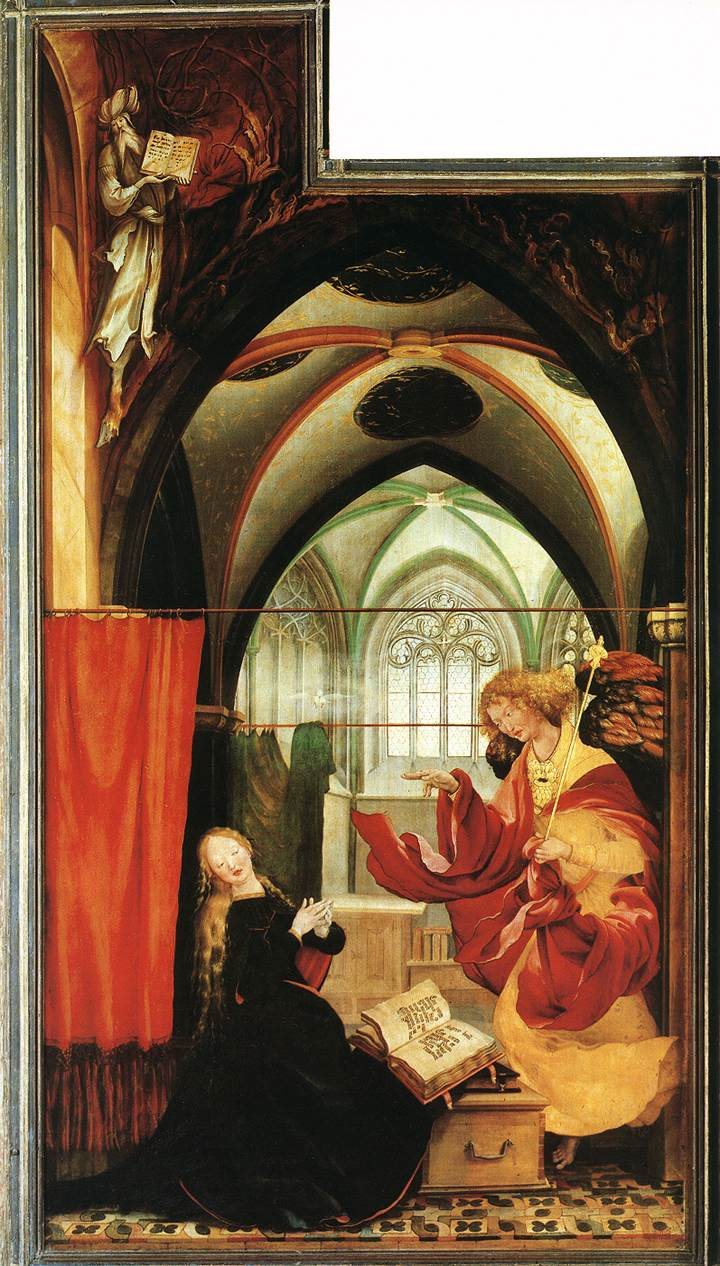
Gabriel storms into a Gothic chapel in a whirl of red drapery, and the Virgin recoils from her prayer book like a startled girl — the moment painted as a disturbance, not a ceremony. The church around them is the hospital's own world: stone, glass and candlelit air.
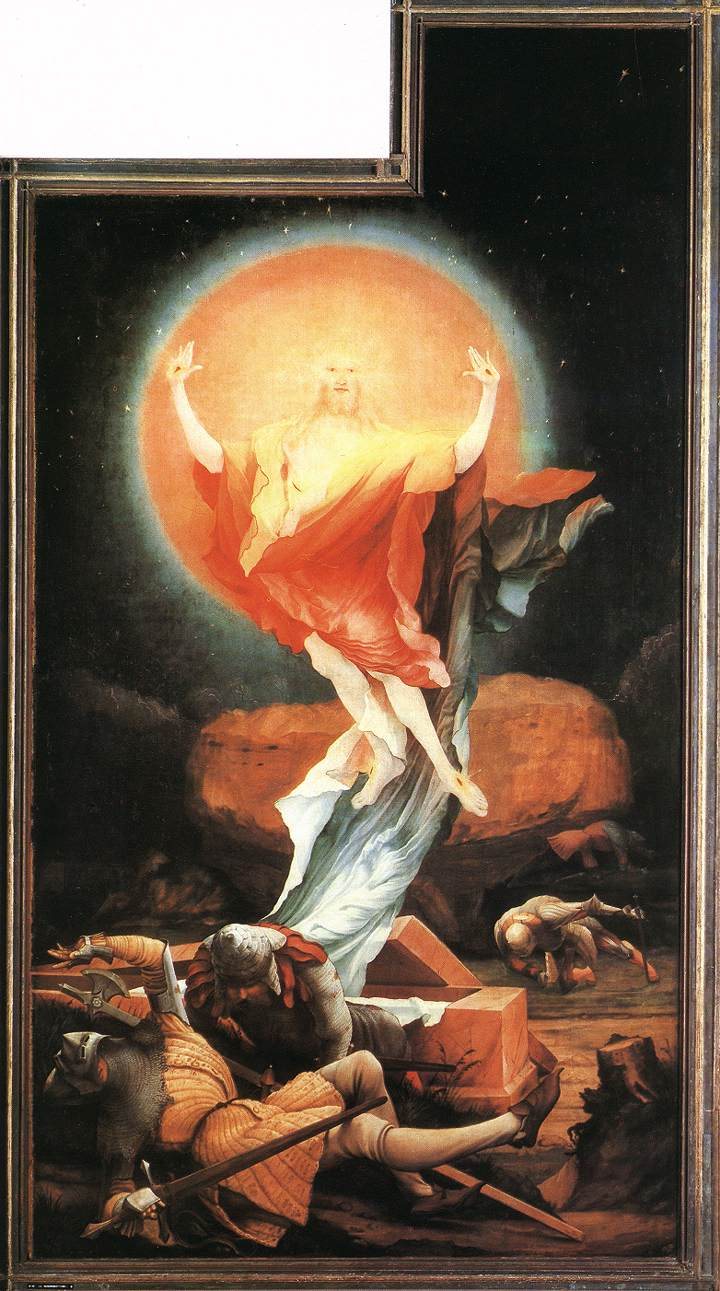
Christ rises not so much from the tomb as out of matter itself, his body dissolving into a sun of red and gold while the soldiers crash in the dark below. Painted for men who expected no cure, it is the altarpiece's promise made visible: the same flesh that rotted on the cross, transfigured into light.
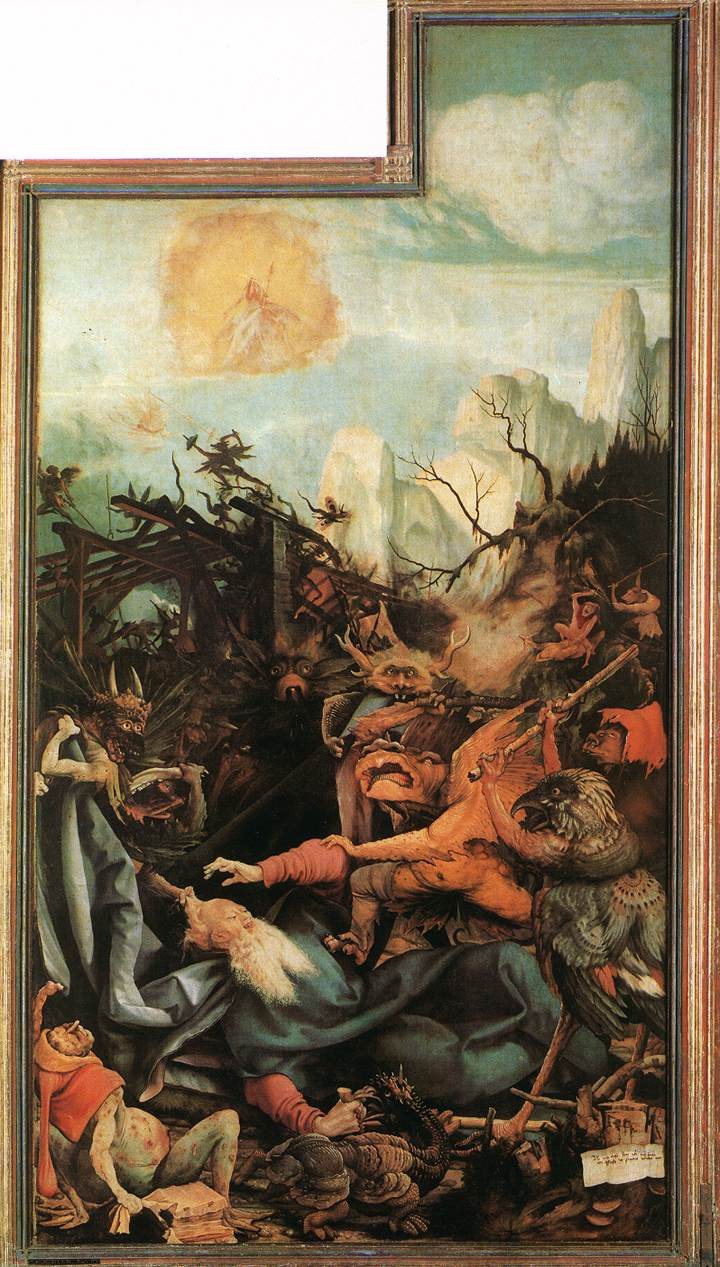
The hospital's patron saint, dragged and beaten by a menagerie of demons — beaked, clawed, bloated inventions that pour out of a burning landscape. In the corner lies a swollen sufferer, his belly distended by the very sickness the Antonite monks treated: the patients saw their own affliction inside the saint's torment, and his endurance beside it.
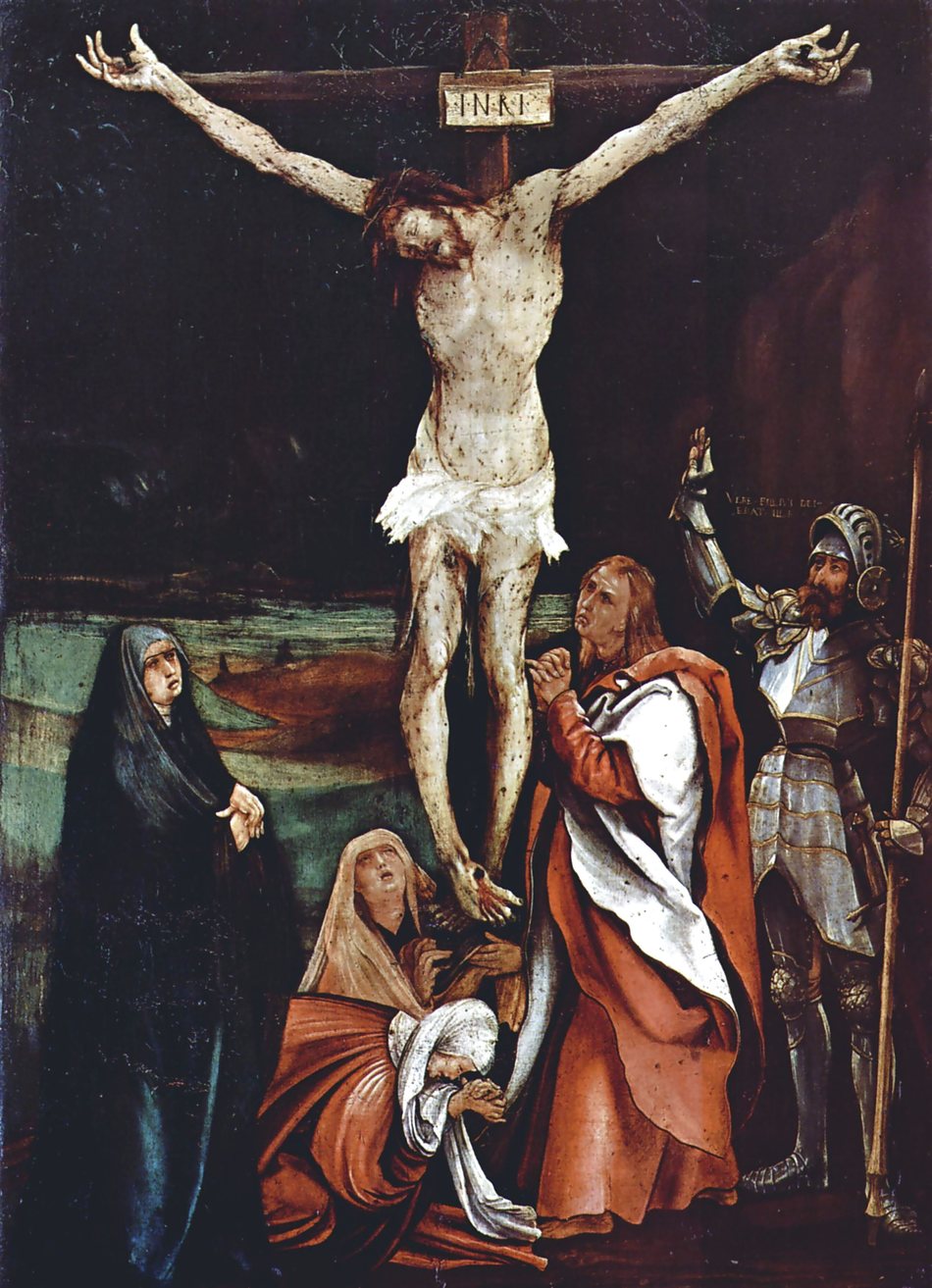
His earliest surviving Crucifixion, painted a decade before Isenheim: already the twisted hands, the body hanging its full dead weight, the mourners pressed close in the dark. A soldier in German armour stands at the right — the Passion brought home to the viewer's own streets.
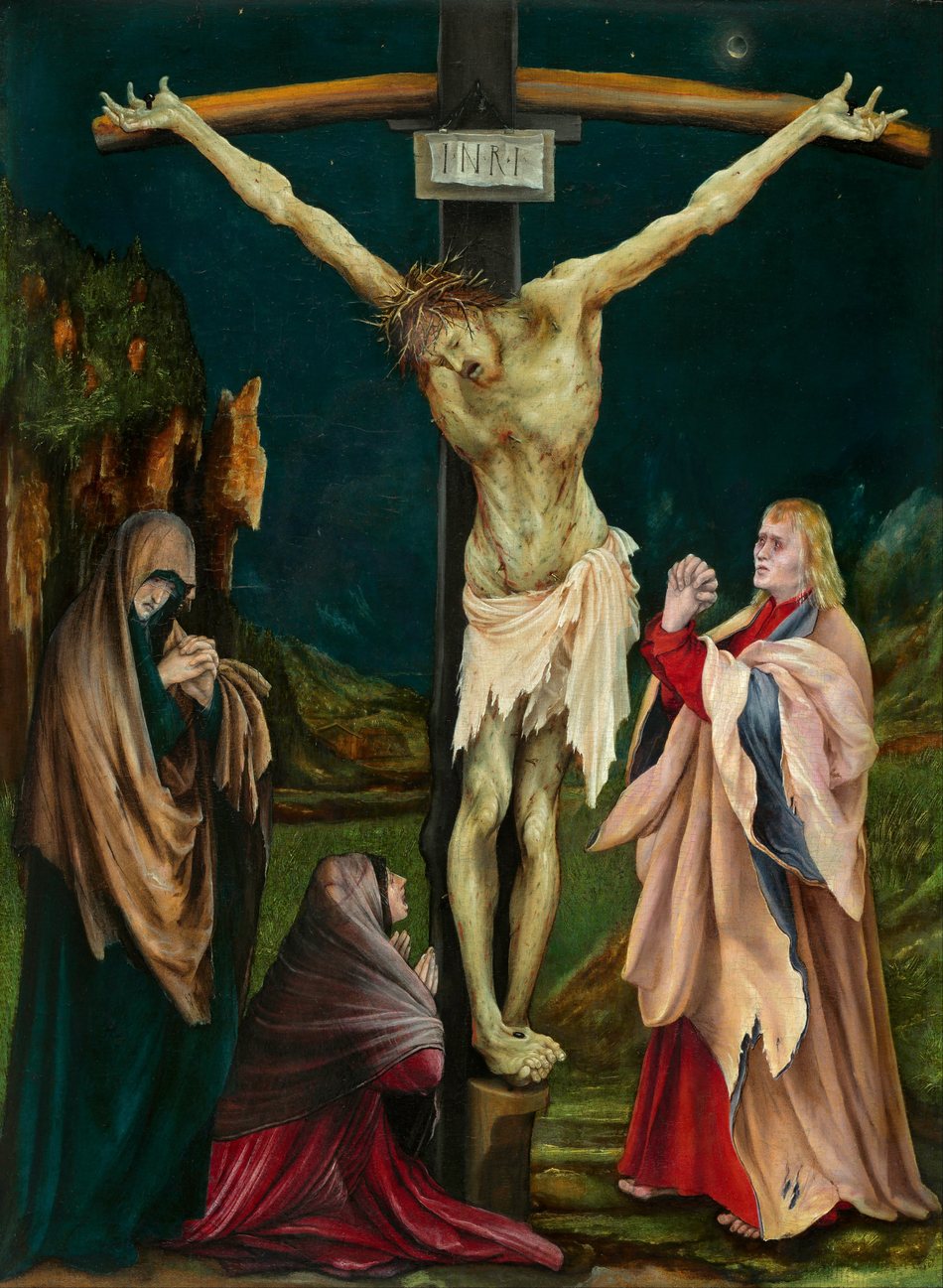
Barely seventy centimetres high and as concentrated as a held breath: the cross fills the panel, the Virgin and Saint John twist in grief beneath it, and the Magdalene kneels at the foot with her jar. A private picture for prayer — Isenheim's agony, reduced to the size of a book and none of its force lost.
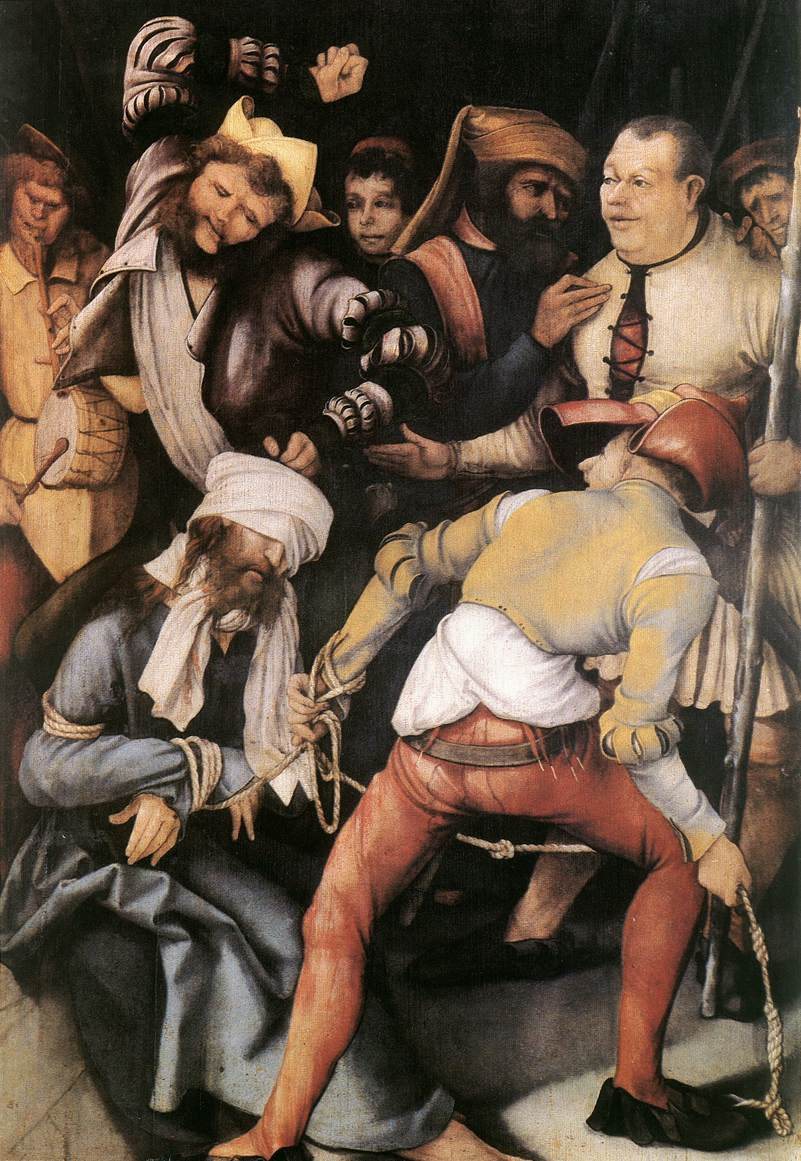
Christ sits blindfolded on a stone bench while a tormentor raises a knotted rope and the crowd leans in, grinning, from the dark. An old man at the left whispers — tradition says he pleads for mercy. The picture is painted close and low, at the victim's own eye level: you sit where he sits.
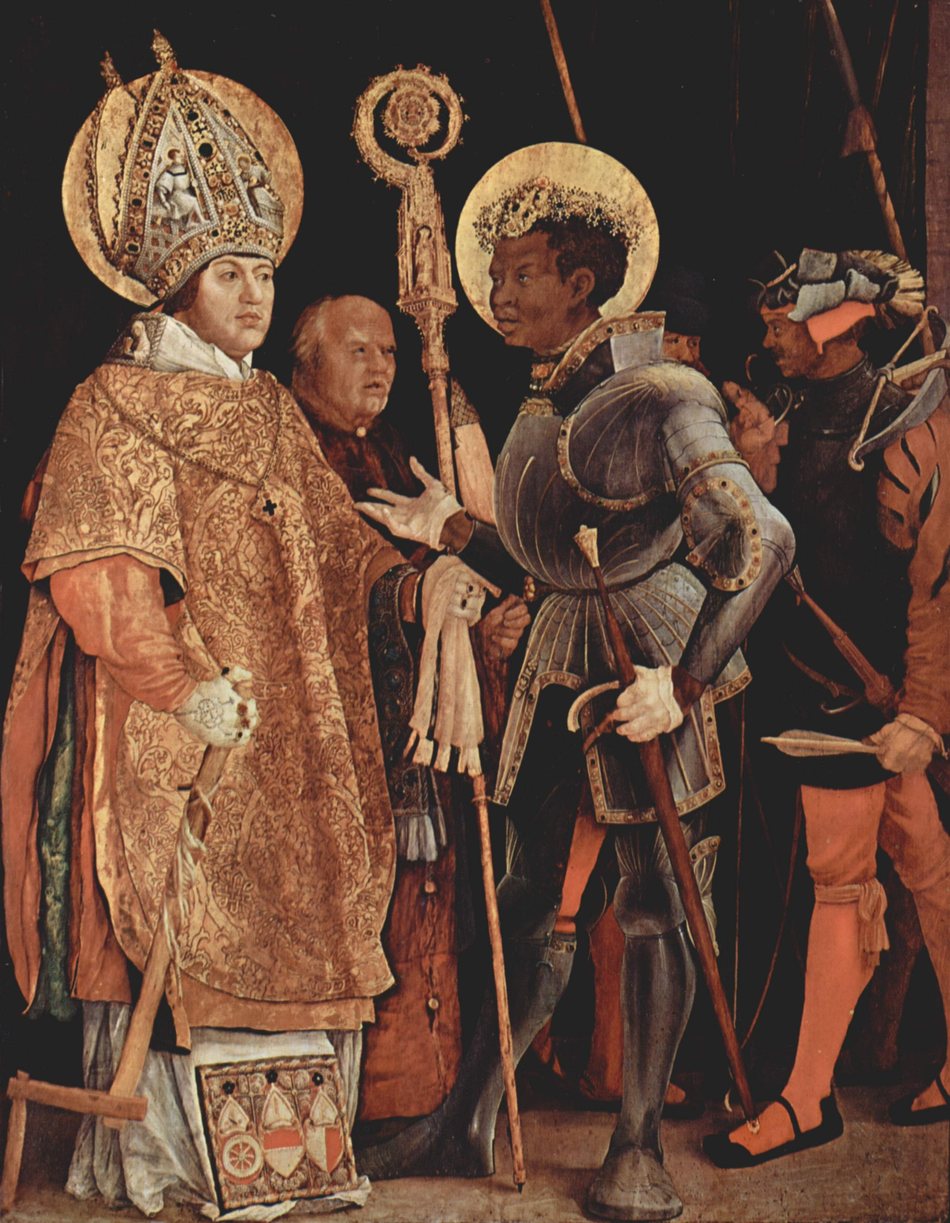
His last great panel: the bishop Erasmus, in a cope embroidered like a treasury, receives the African soldier-saint Maurice, who stands in parade armour with his hand on his sword. Painted for Cardinal Albrecht of Brandenburg — whose features Erasmus wears — it is Grünewald at his most splendid, gold and steel in a dark church.
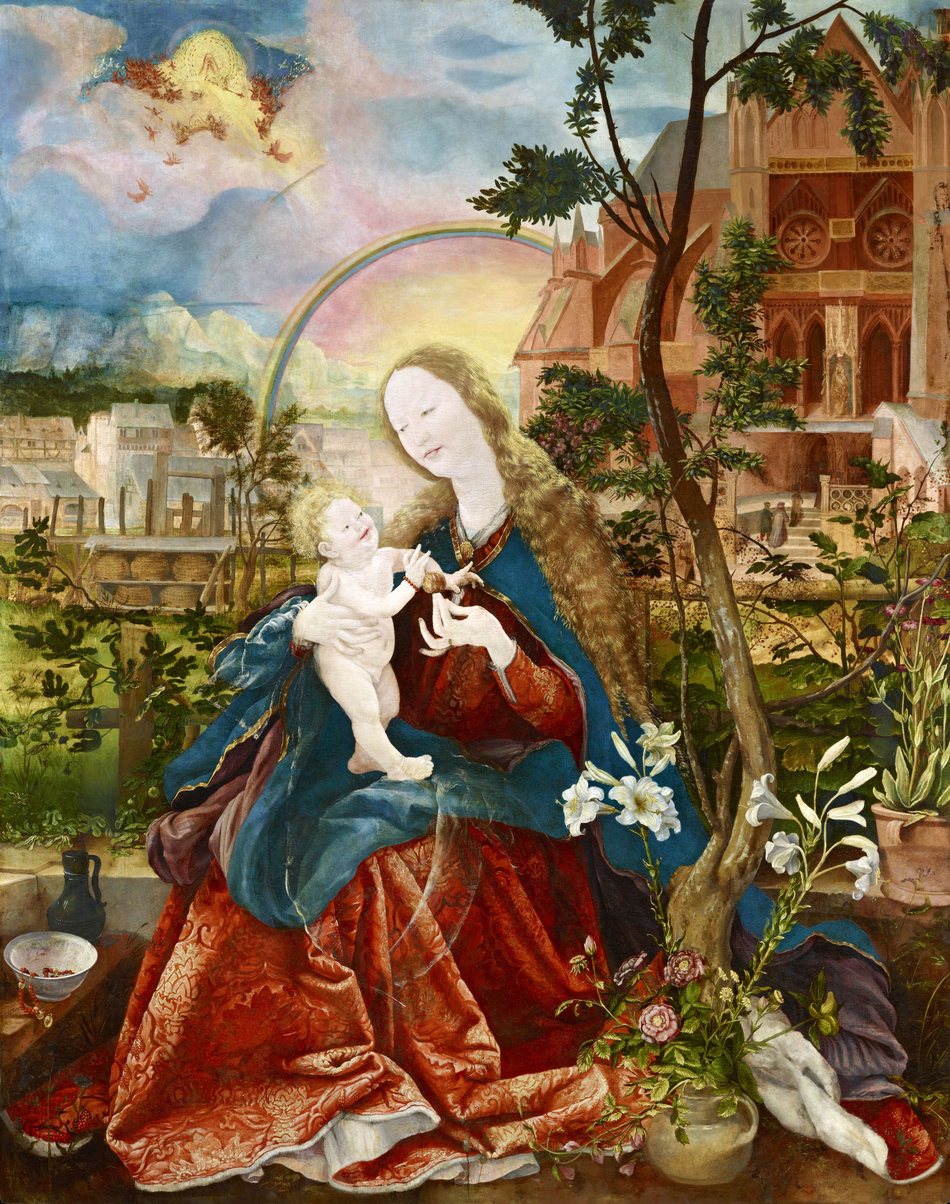
Painted in the same years as Isenheim and still in the village church it was made for: the Virgin in a garden of symbolic flowers, a rainbow over the town behind her, the Child reaching for a fig. After the altarpiece's darkness, this is his daylight masterpiece — every leaf and petal prayed over.