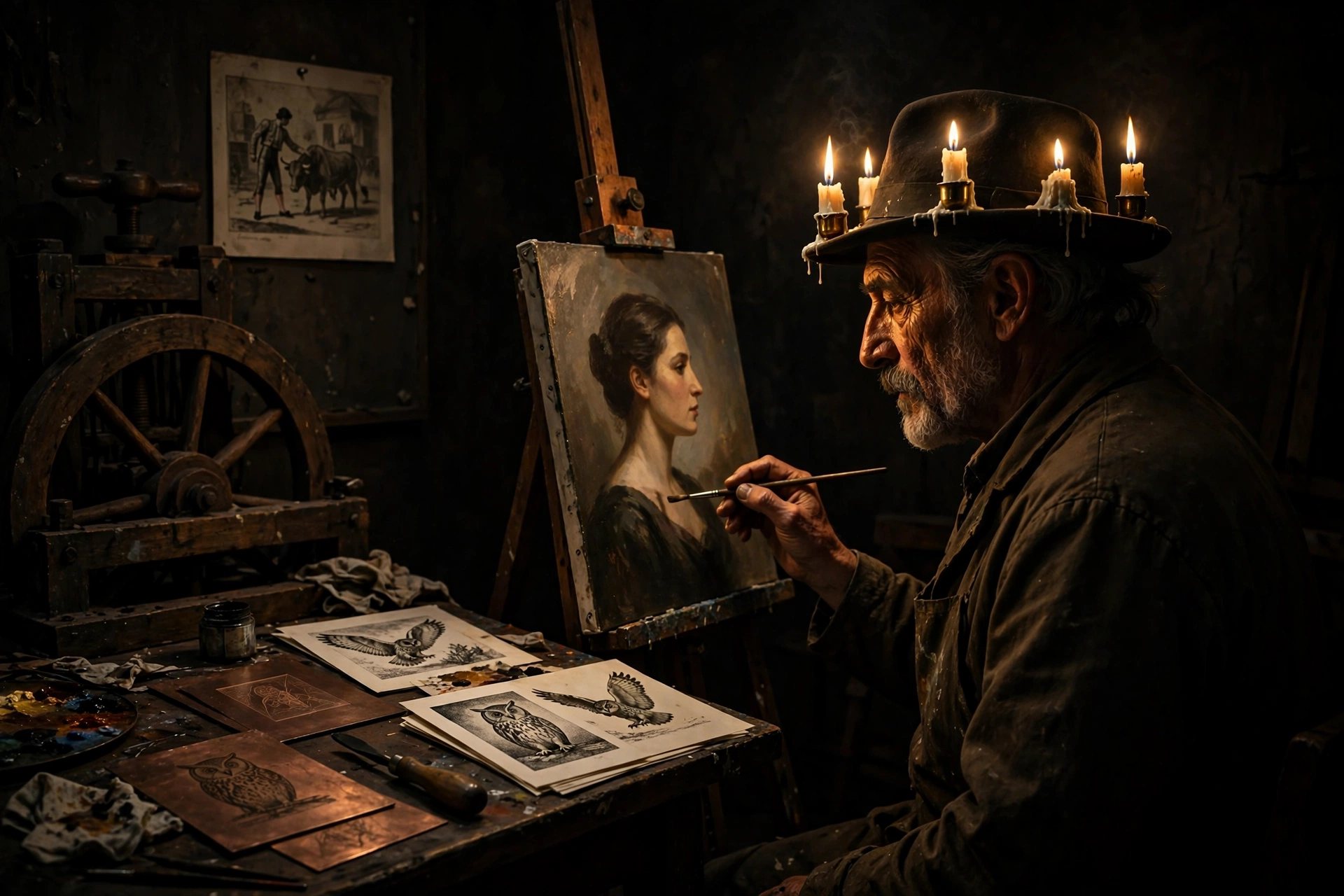
Court painter to four kings, and the first modern painter: Goya began with bright tapestry designs and ended painting nightmares on the walls of his own house. Between those poles lie the portraits that flattered no one, the etchings that indicted everyone, and two canvases of May 1808 that invented the modern image of war.
For ten years Goya painted cartoons — full-size oil designs — for the Royal Tapestry Factory of Santa Bárbara, to be woven into hangings for royal dining rooms. Wool swallows light, so the designs had to be brighter and clearer than any picture meant for a wall: that factory discipline of daylight, big shapes and enamel colour stayed in his hand for life.
The Caprichos of 1799 are etching married to aquatint: the line bitten by acid through a needle's drawing, the greys made by dusting the plate with rosin grains and melting them into a sand of tiny pits. Goya bought a press, printed his own proofs and corrected the plates by hand — the prints are not reproductions of his art; they are half of it.
His colours were the old Spanish shelf: lead white, yellow ochre, vermilion, Prussian blue, bone black. Decade by decade the shelf empties — the portraits keep a few rich notes, the war pictures fewer, and the Black Paintings are painted with almost nothing: earth, black and white dragged over darkness, colour remembered rather than used.
The fourteen Black Paintings were never canvases and never for sale: around 1820–1823 Goya painted them in oil straight onto the plaster of the Quinta del Sordo, the house he lived in deaf and alone outside Madrid. In the 1870s the plaster was cut from the walls and transferred to canvas — a rescue that saved the images and scarred their surfaces forever.
Goya said he saw no lines in nature, only bodies lit and bodies in shadow. His late paint is laid accordingly — with the palette knife, a sponge, his fingers — lights dragged over a dark ground in broad stains, detail left for the eye to finish. It is the method of Velázquez's last manner, pushed until the stain becomes the subject.
In Bordeaux, exiled and seventy-nine, Goya took up the newest print technique of all — lithography, drawing with a greasy crayon straight onto limestone. The Bulls of Bordeaux of 1825 are among the first lithographs by a great painter treated as art in themselves: four sheets of bullring chaos drawn with a young man's speed.
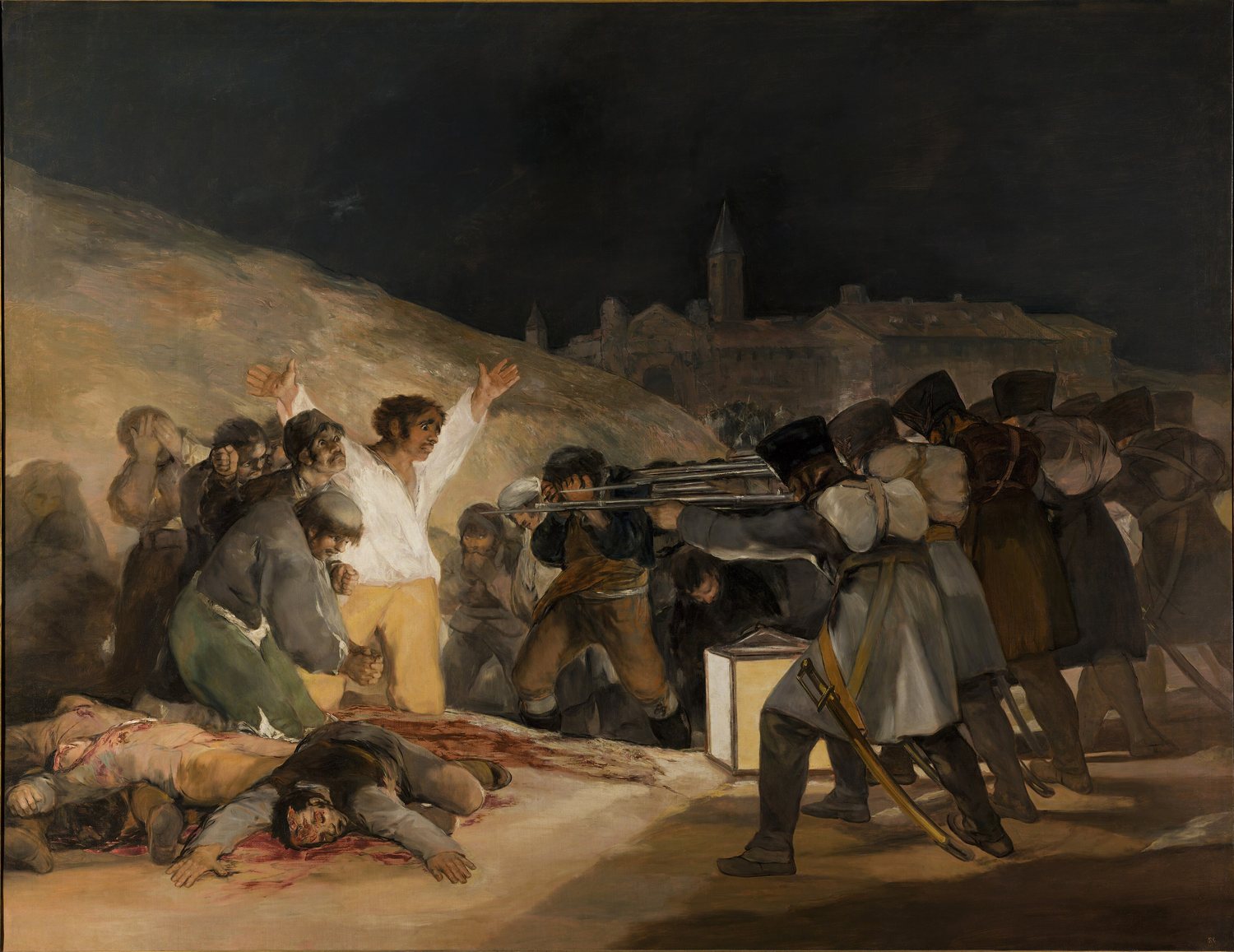
Painted six years after the event, when Goya offered the new regime a monument to the uprising. The only light is the lantern at the soldiers' feet — a stage lamp in a black night — and the brightest paint in the picture is the white shirt of the man with his arms flung wide, an instant before the volley.
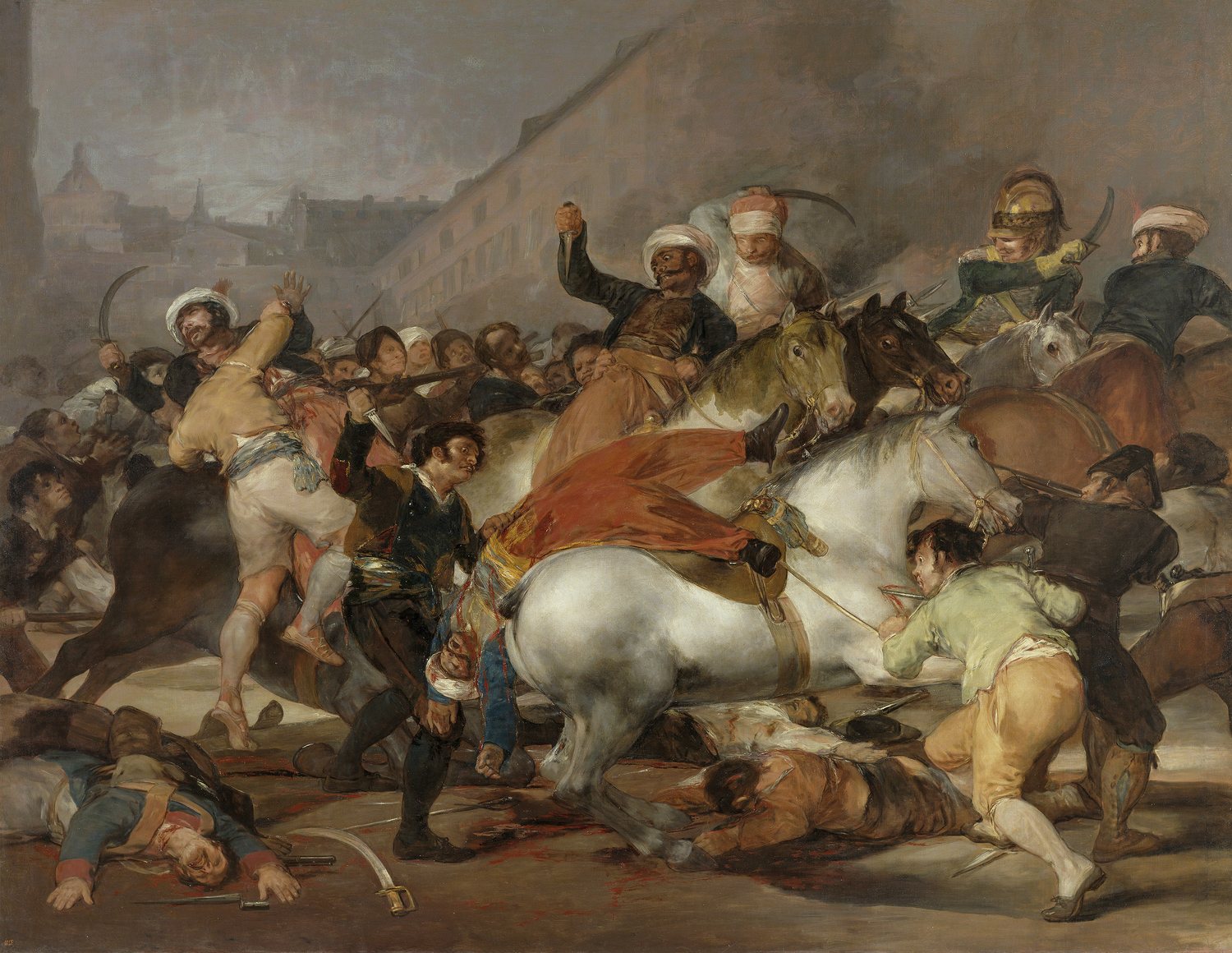
The companion piece: the charge of the Mamelukes at the Puerta del Sol, all horses, blades and falling bodies locked in one knot of movement. Where the Third of May is a still execution, the Second is pure melee — Goya paints the uprising as it was lived, without a single hero to stand behind.
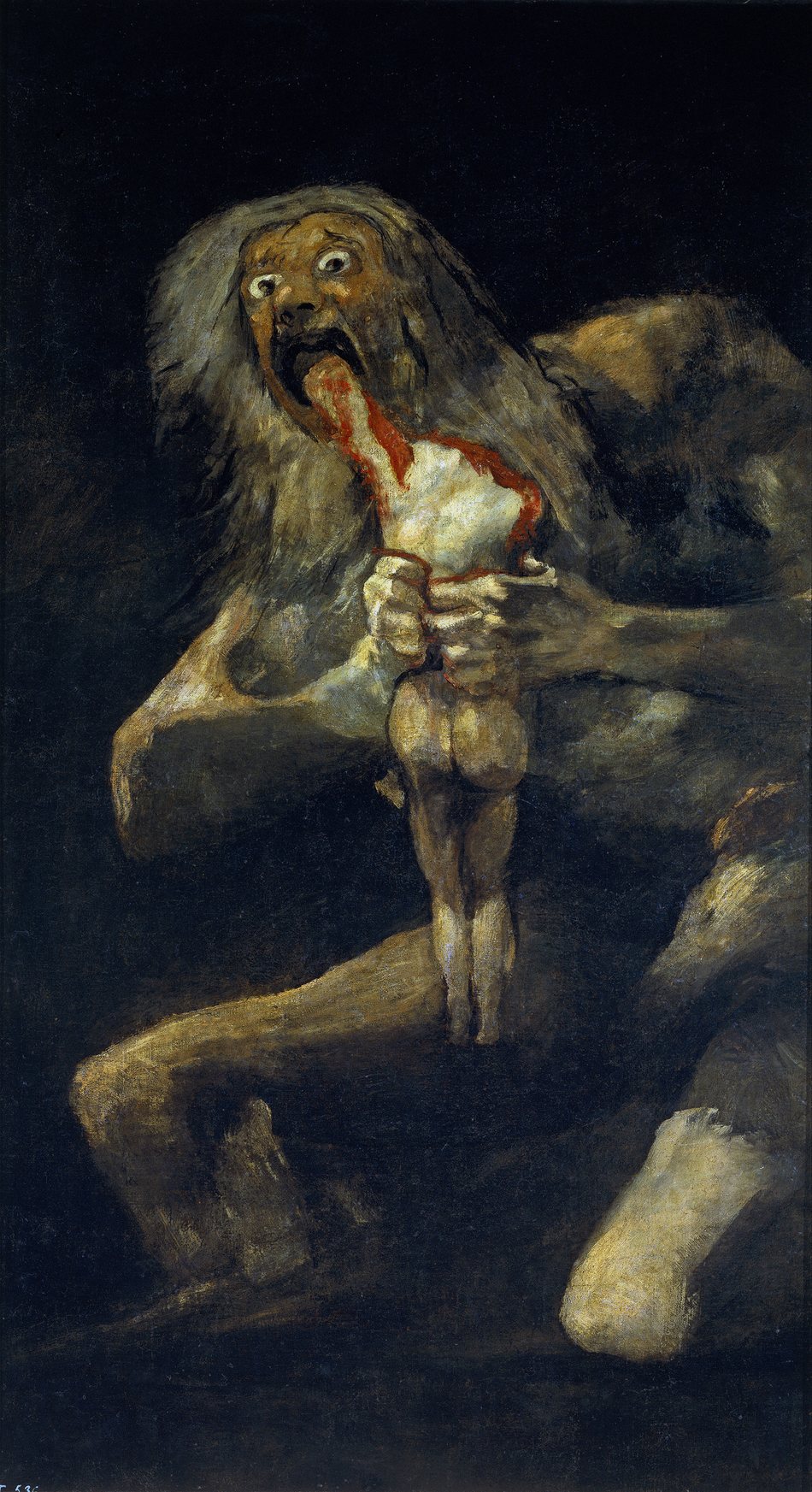
From the dining room wall of the Quinta del Sordo, painted straight onto plaster for no viewer but the household. The body is already headless in the god's hands, and Saturn's eyes stare out in horror at what he is doing — the most terrible of the Black Paintings, and the one that never leaves the memory.
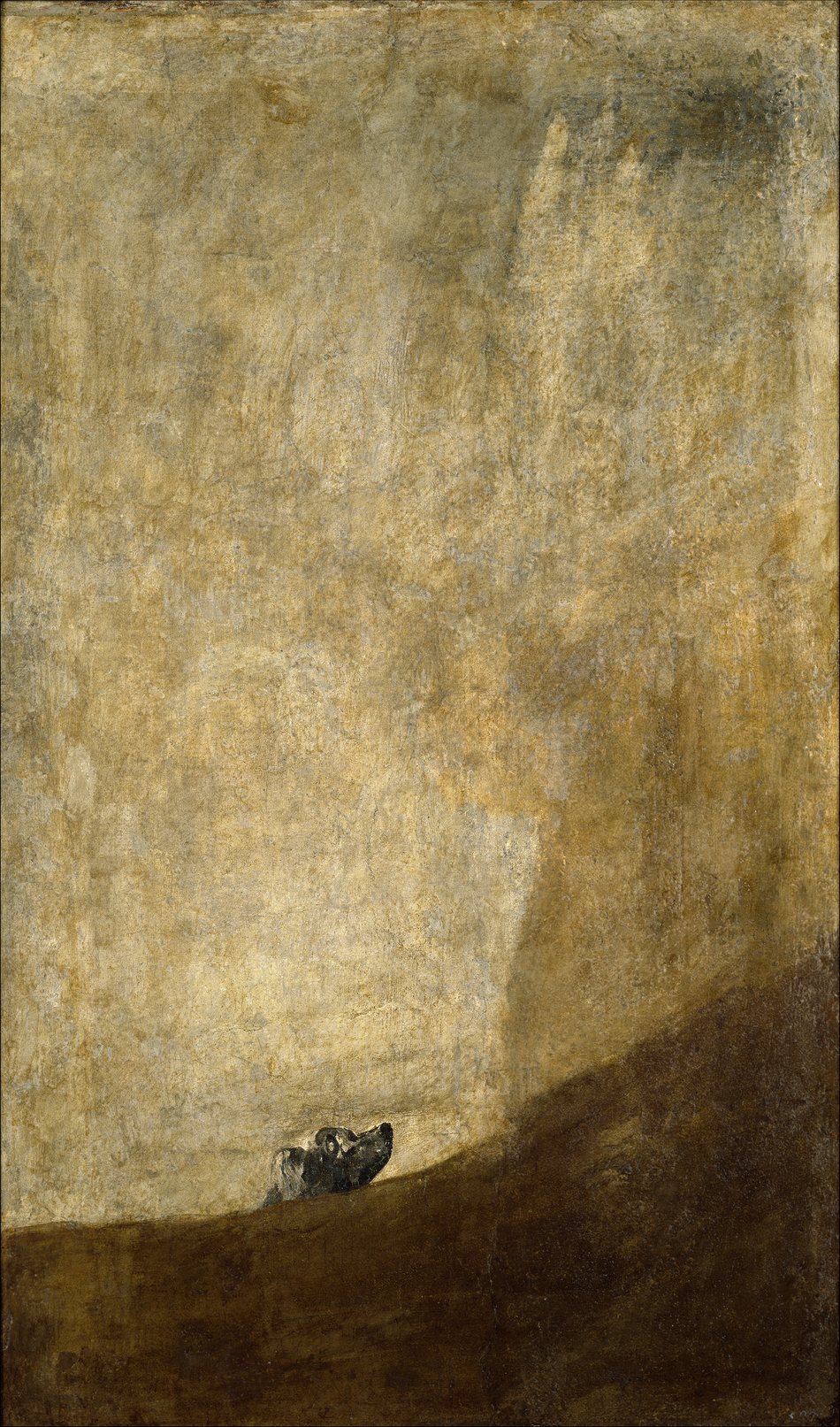
A dog's head rises behind a slope of ochre, looking up at something we cannot see, while the rest of the picture is painted emptiness. The most minimal of the Black Paintings — a few square feet of wall, a handful of earth colour, and an image modern art has never stopped quoting.
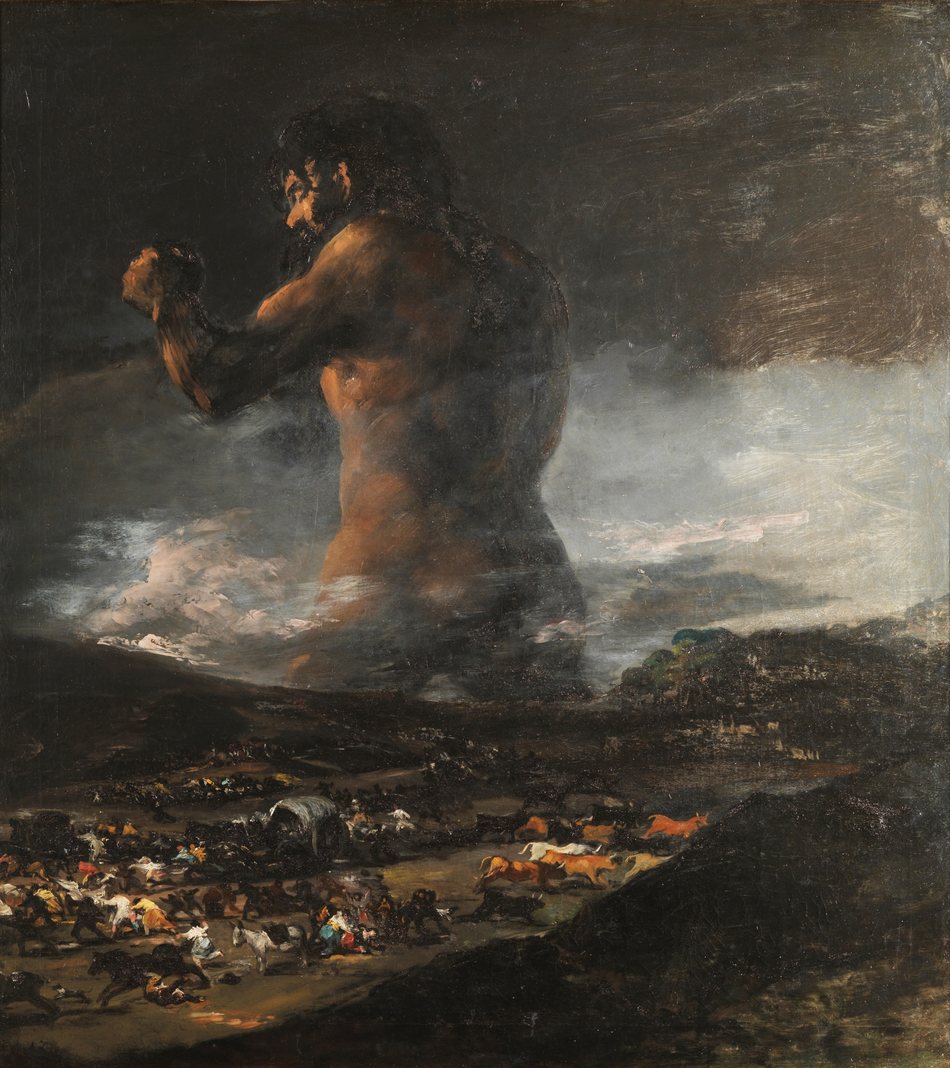
A giant climbs out of the clouds behind the hills while the valley below dissolves into fleeing crowds and cattle. Painted during the Peninsular War and long given to Goya without question; since 2008 some scholars have argued it is the work of his pupil Asensio Juliá — the attribution is still honestly disputed.
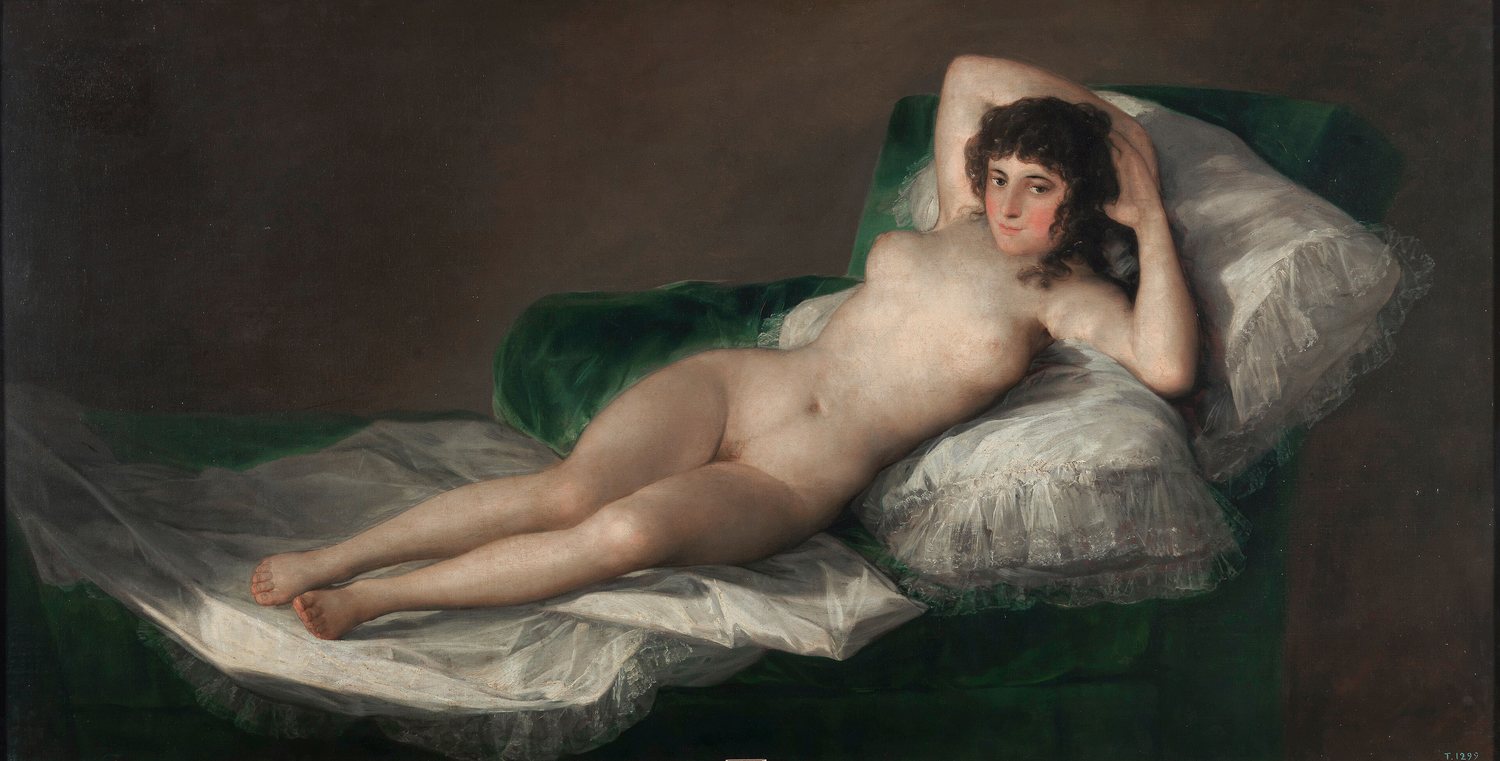
No goddess, no myth, no excuse: a real woman on a green couch, looking straight out at whoever looks at her. It scandalised Madrid, was confiscated by the Inquisition, and remains startling for its plainness — the body painted with the same unsparing attention Goya gave to kings.
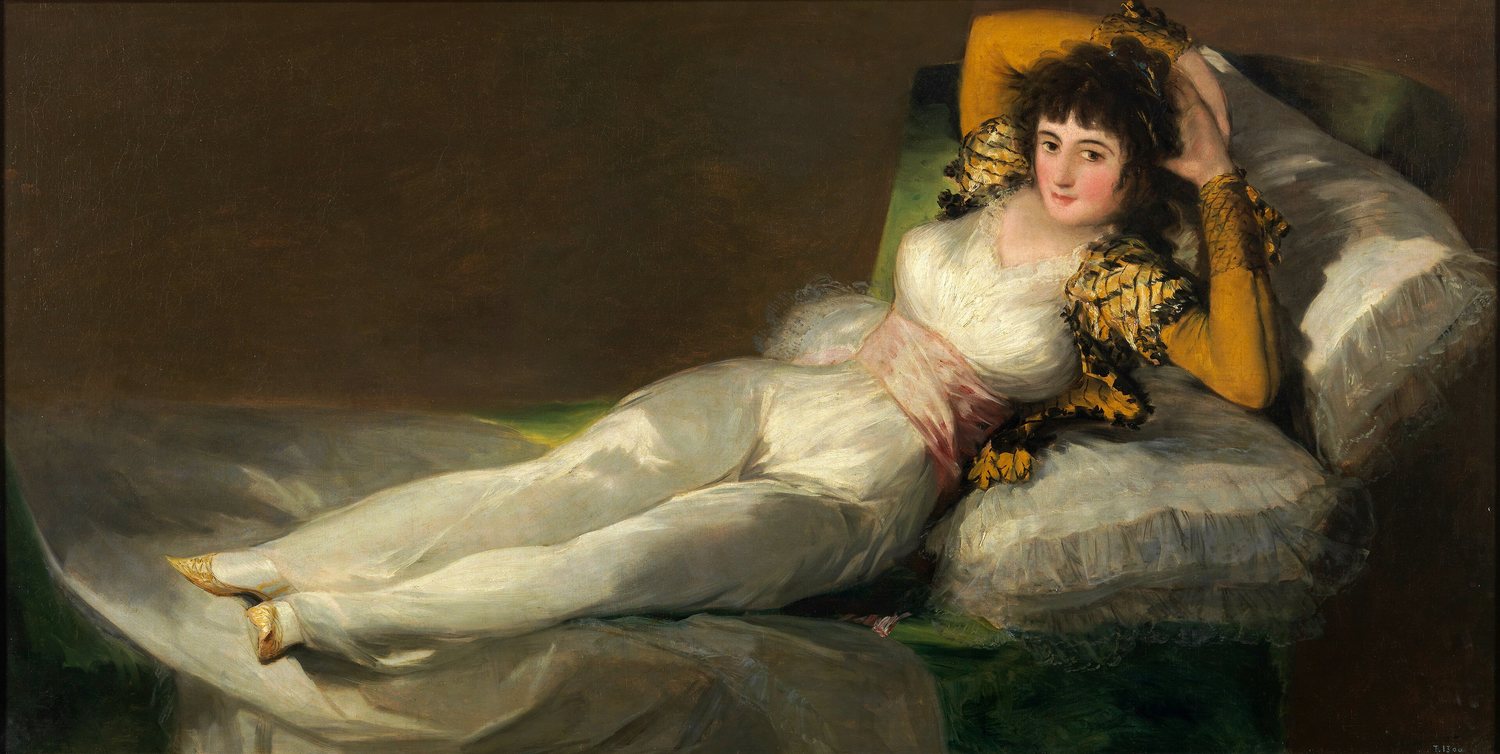
The same model, the same couch, the same gaze — now dressed as a maja in white, yellow sash and laced jacket. The pair were kept together, and legend says the clothed picture hung in front of the nude one, to be drawn aside for chosen guests: modesty as a curtain over its opposite.
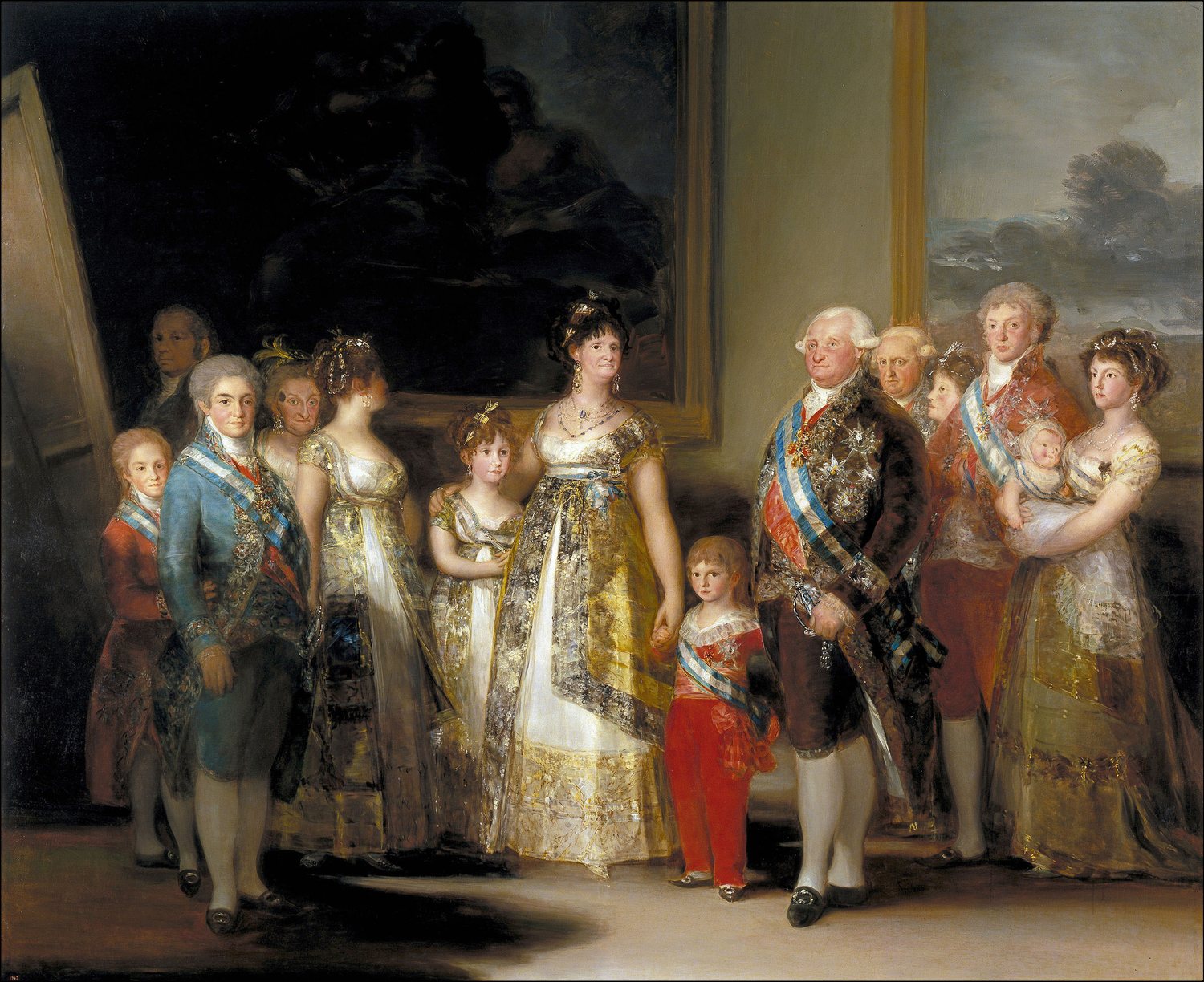
Fourteen figures in a row, silk, orders and jewels rendered to the last thread — and not one face flattered. At the left edge, half in shadow behind his canvas, Goya paints himself into the picture, exactly where Velázquez stood in Las Meninas a century and a half before: the servant among the masters, seeing everything.
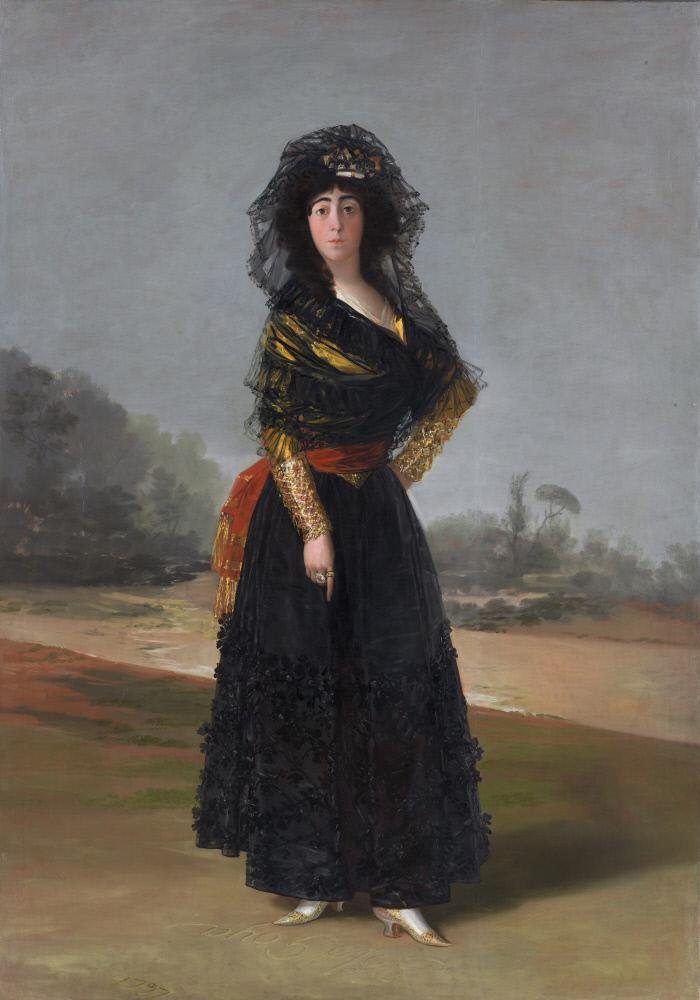
Painted at Sanlúcar in her widowhood, the duchess in black lace points down at the sand at her feet, where two words are traced: Solo Goya — only Goya. She wears two of his rings on her fingers. Whether it was love, patronage or a game between two proud people, the painting declines to explain itself.
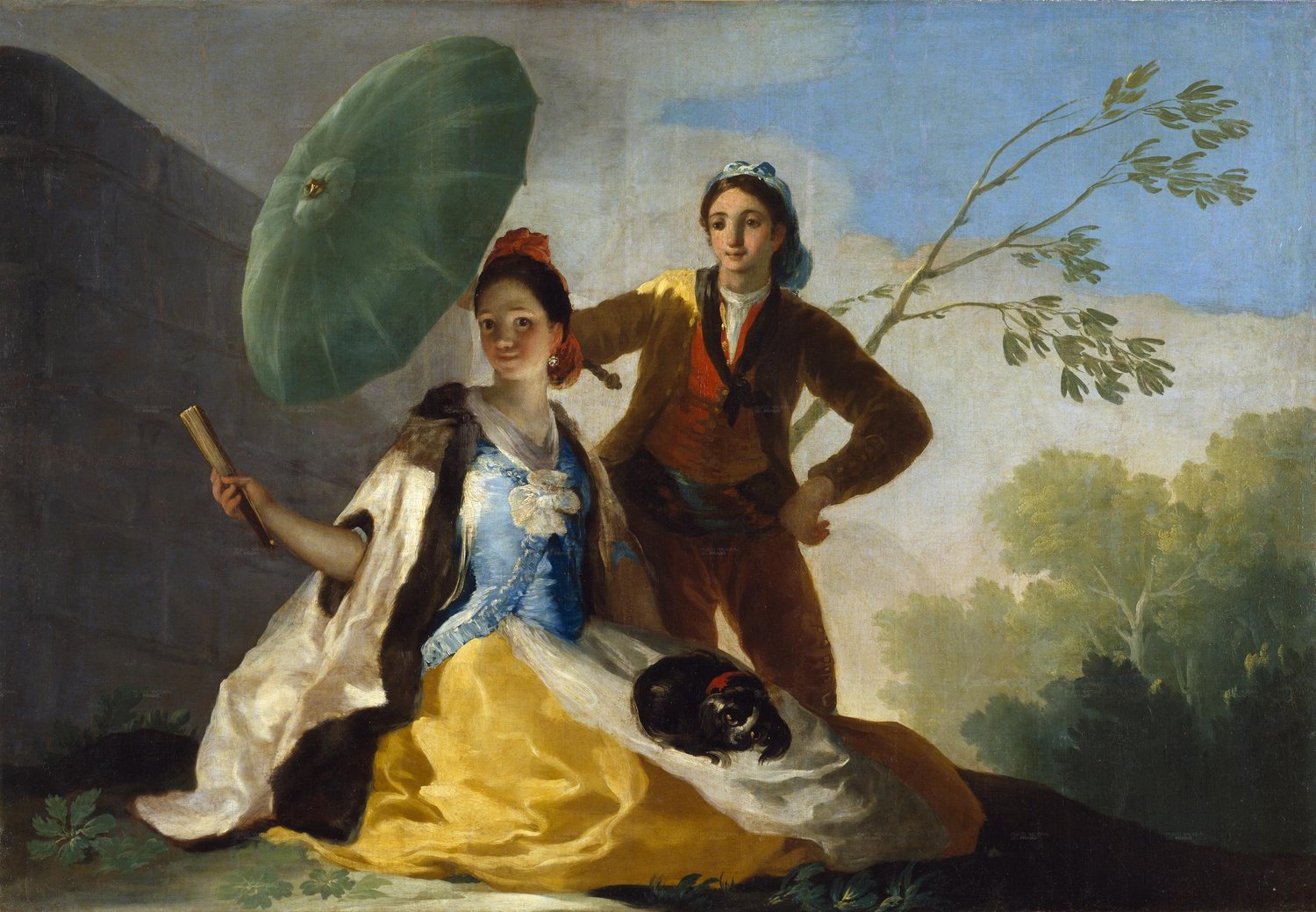
A tapestry cartoon from the twenty-year-old Goya: a young man holds a green parasol over a seated girl with a lapdog, in light so clear it seems enamelled. It was designed to be woven, not framed — every tone calculated to survive its translation into wool.
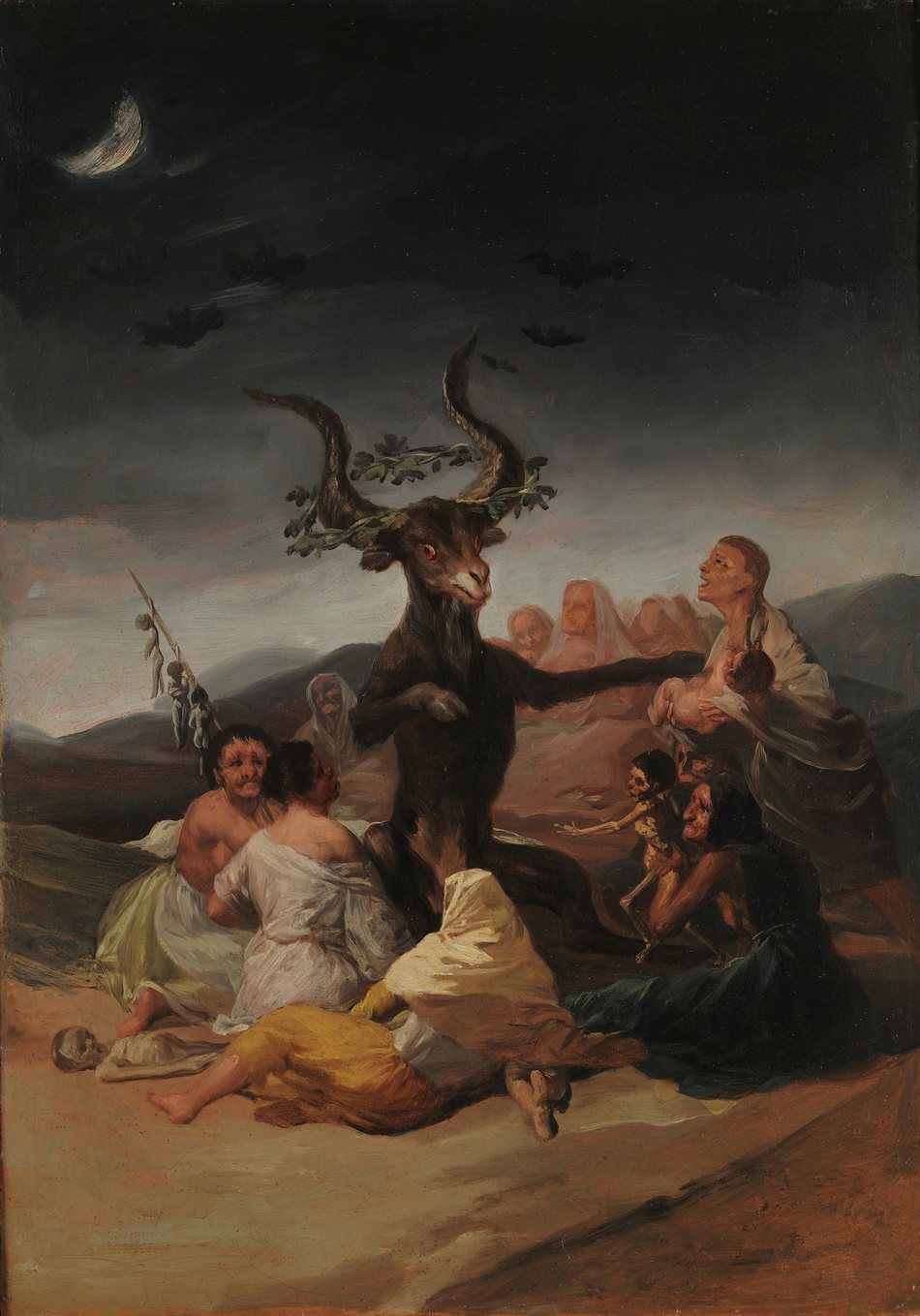
One of six small witchcraft scenes painted for the Duchess of Osuna's country house: by moonlight the he-goat, upright in a wreath of oak leaves, receives the offering of a dead child from a circle of witches. Miniature in scale, painted with a jeweller's precision and an unbeliever's irony.
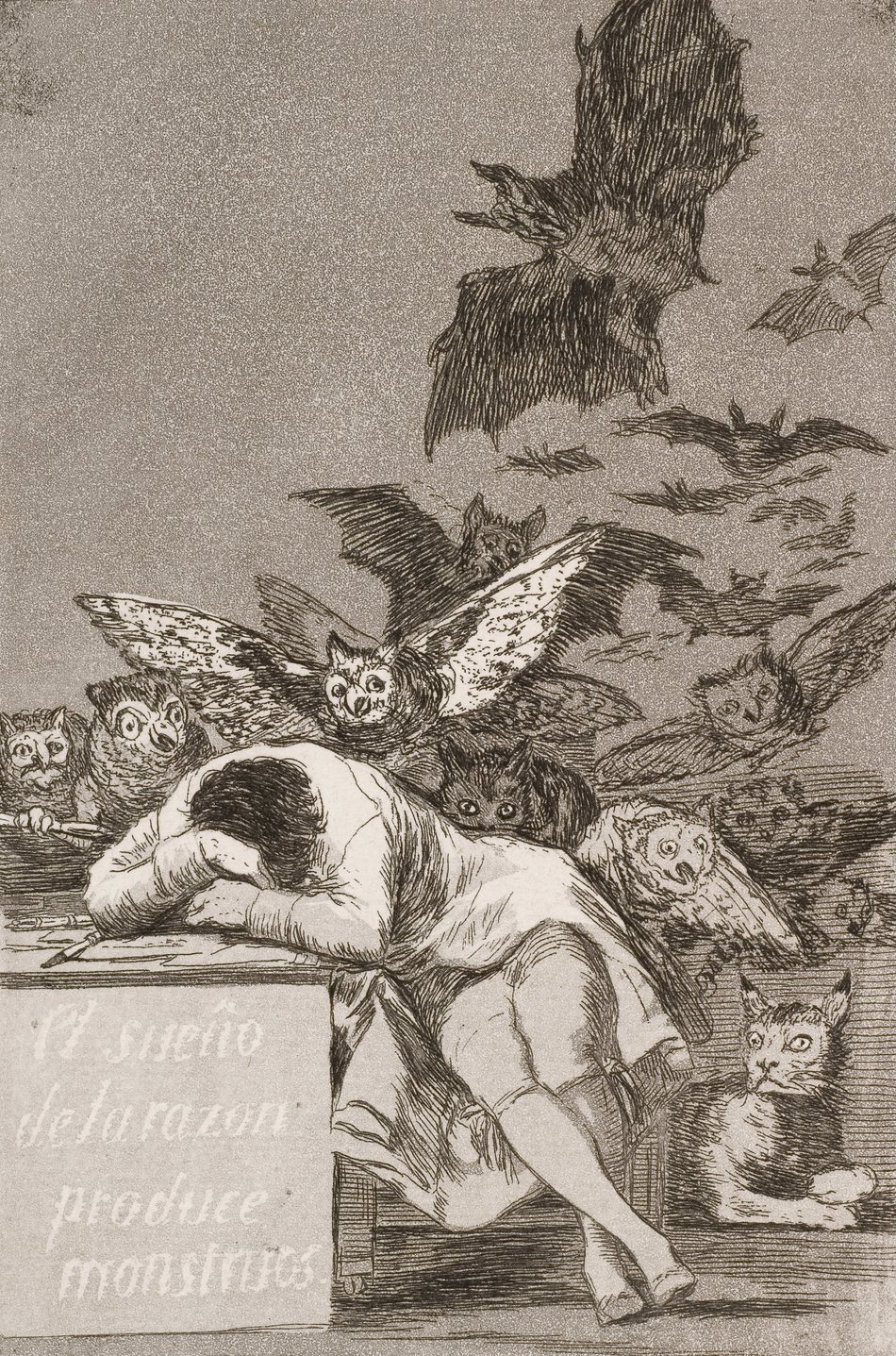
The most famous print of the Caprichos: the artist asleep at his desk, head on his arms, while owls and bats swarm out of the dark behind him — the greys bitten into copper with rosin dust. Goya's own note says imagination abandoned by reason produces impossible monsters; united with her, she is the mother of the arts.
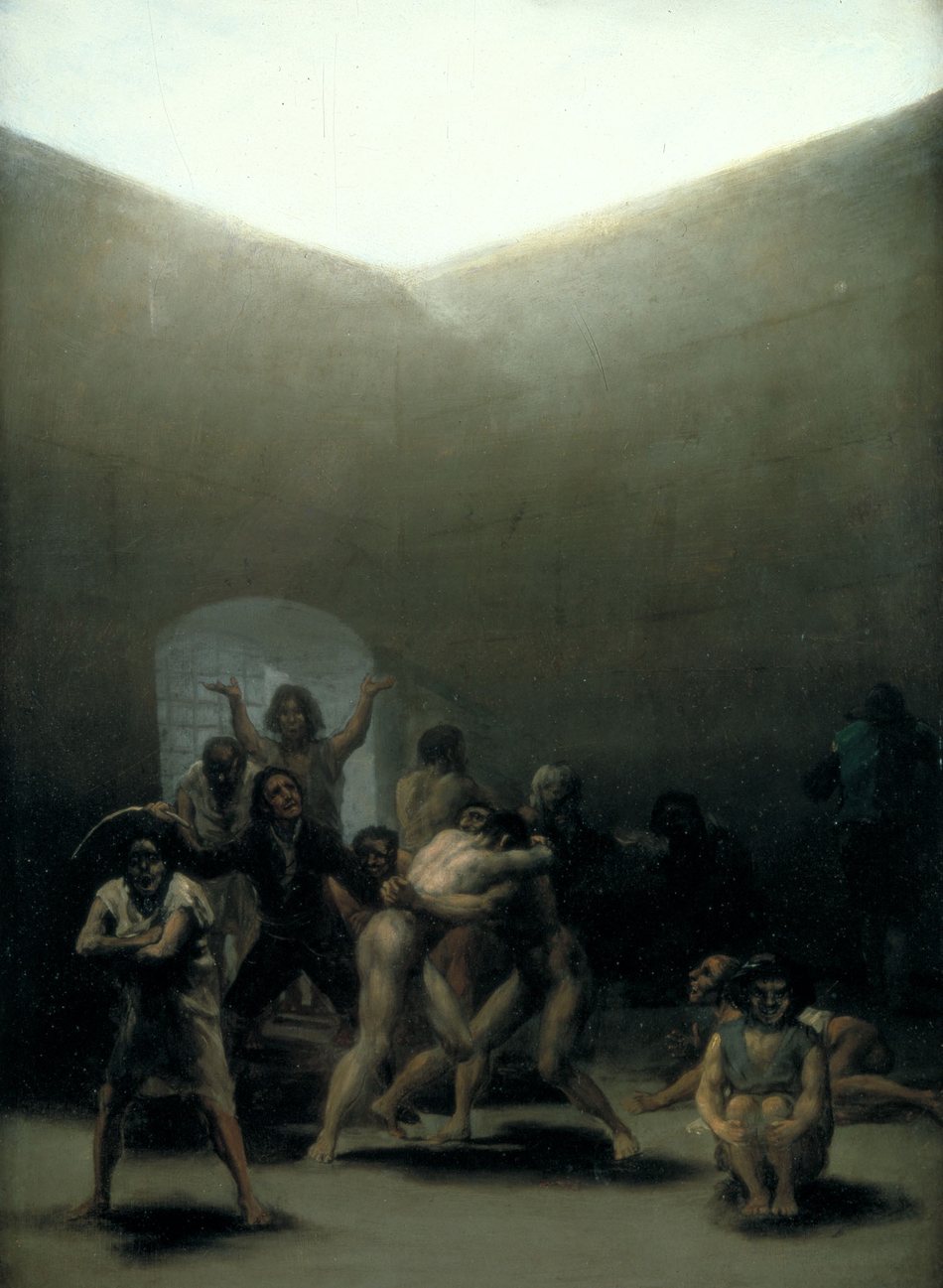
Painted just after the illness that left him deaf, on a small sheet of tin: a bare courtyard flooded with light from above, naked inmates wrestling and grinning while the keeper watches. Goya wrote that such scenes let him paint what the imagination, abandoned by reason, produces — a yard he had seen with his own eyes in Zaragoza.
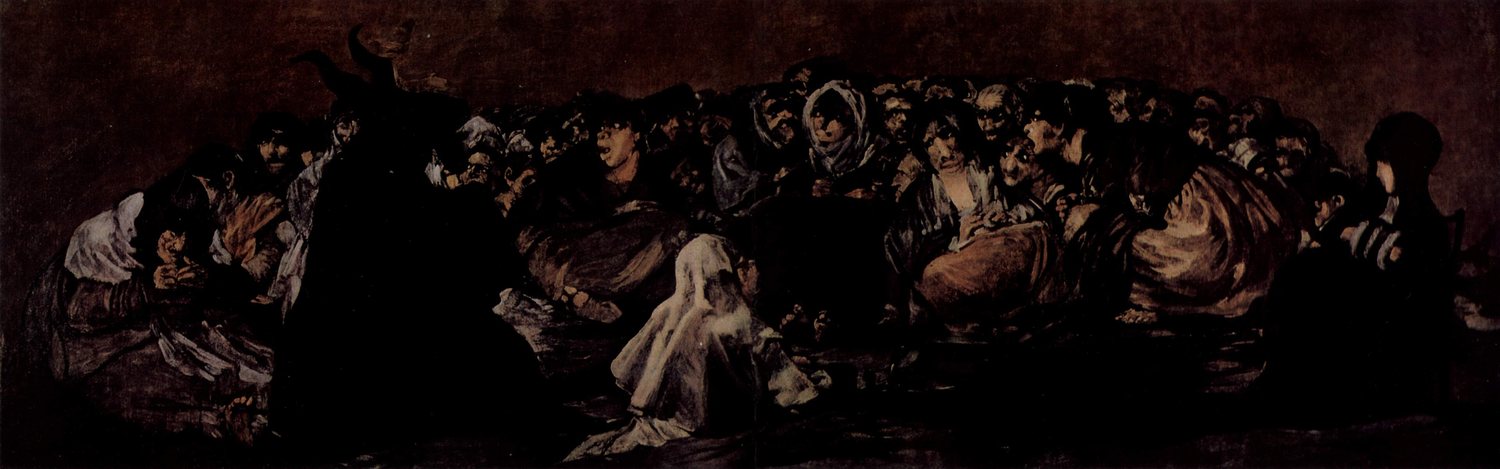
The longest of the Black Paintings, over four metres of wall: a silhouetted goat preaches in darkness to a hushed, huddled crowd of witches, their faces catching a little cold light. Nobody knows what rite this is, or whether Goya invented it whole — a congregation painted by a deaf man, listening to nothing.
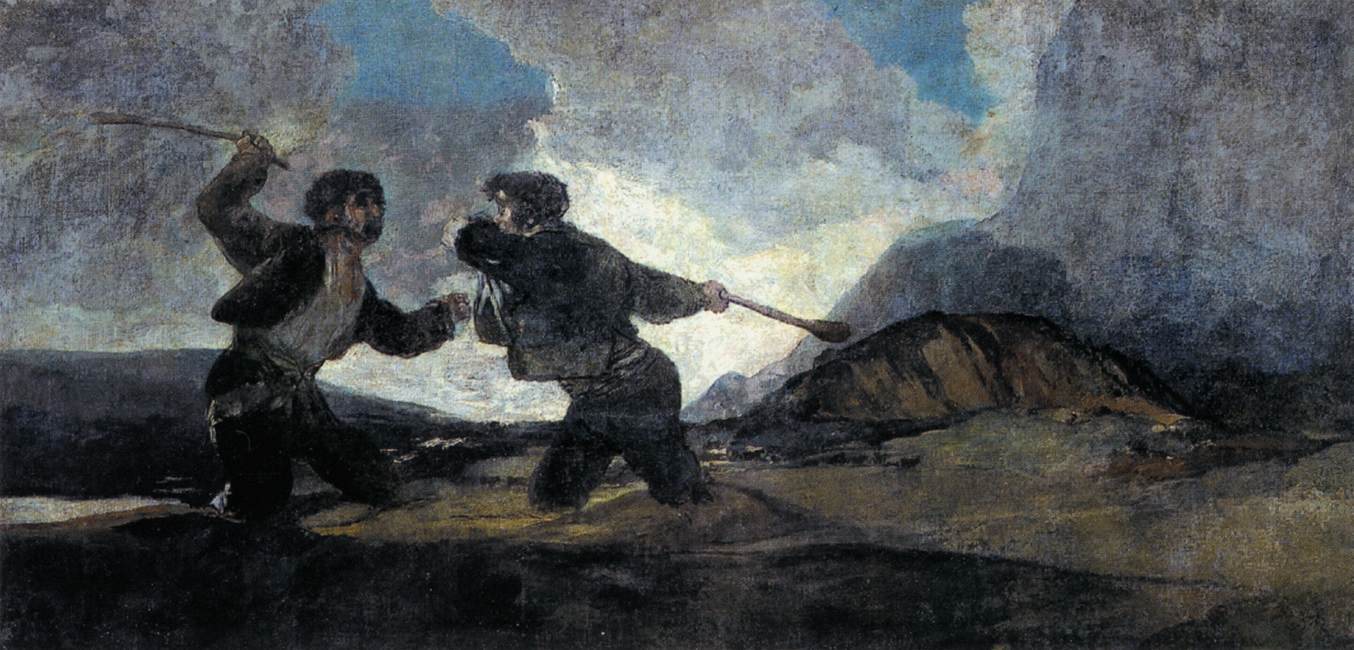
Two men sunk to their knees in the earth swing clubs at each other's heads, neither able to dodge or step back. Of all the Black Paintings this is the one most often read as Spain itself — two halves of a country locked in a fight that the ground will not let either of them leave.
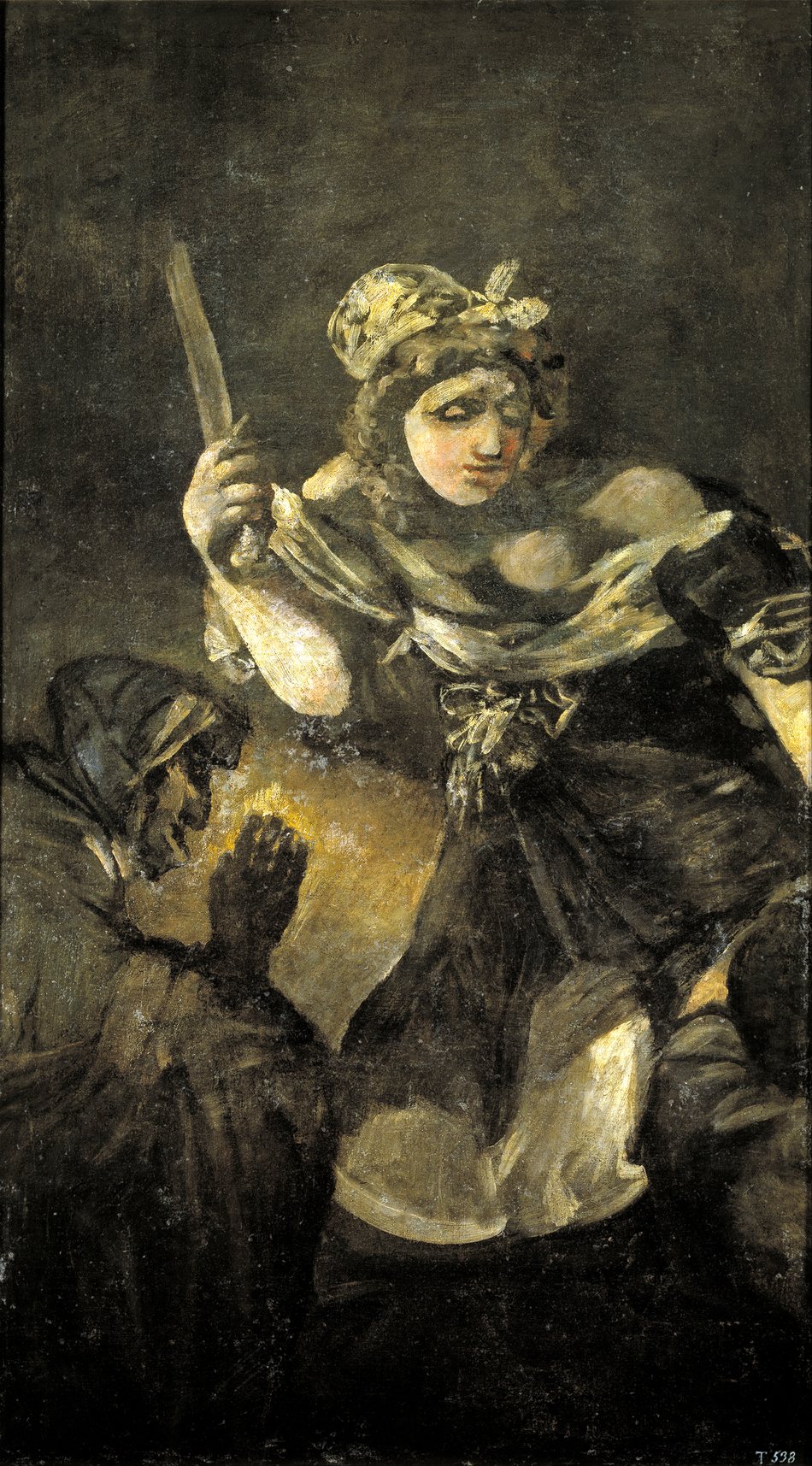
Judith raises the sword with a transported, almost ecstatic face while the old maid crouches below with folded hands — the Bible's most violent heroine painted in a few broad, dark strokes on the ground floor wall of the Quinta, more apparition than narrative.
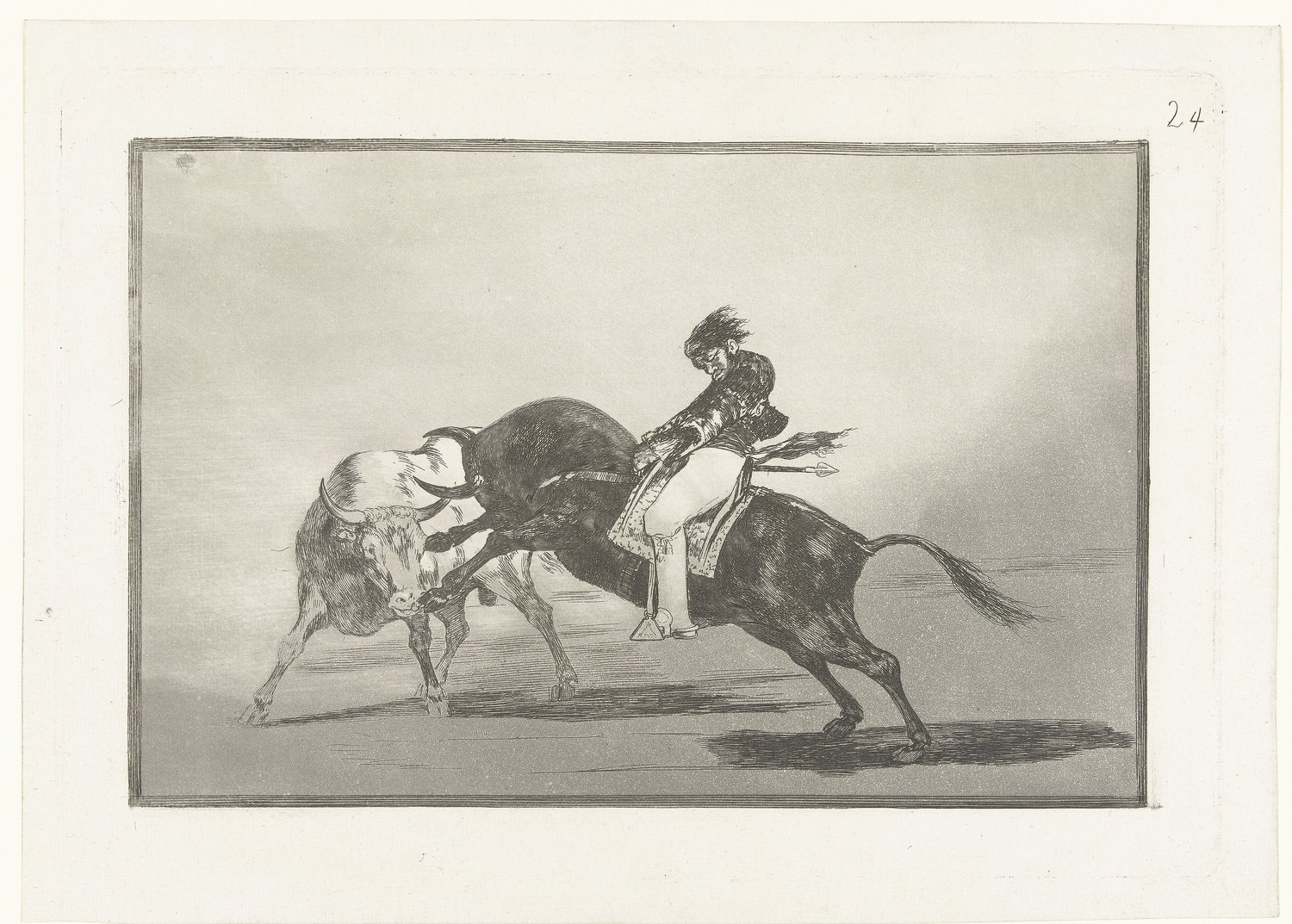
From the Tauromaquia, Goya's history of bullfighting in thirty-three plates: the bullfighter Mariano Ceballos, famous for riding one bull while lancing another, performs his impossible feat in a bare ring. Goya, a lifelong aficionado, etched the series in his seventieth year with undiminished appetite for the spectacle.
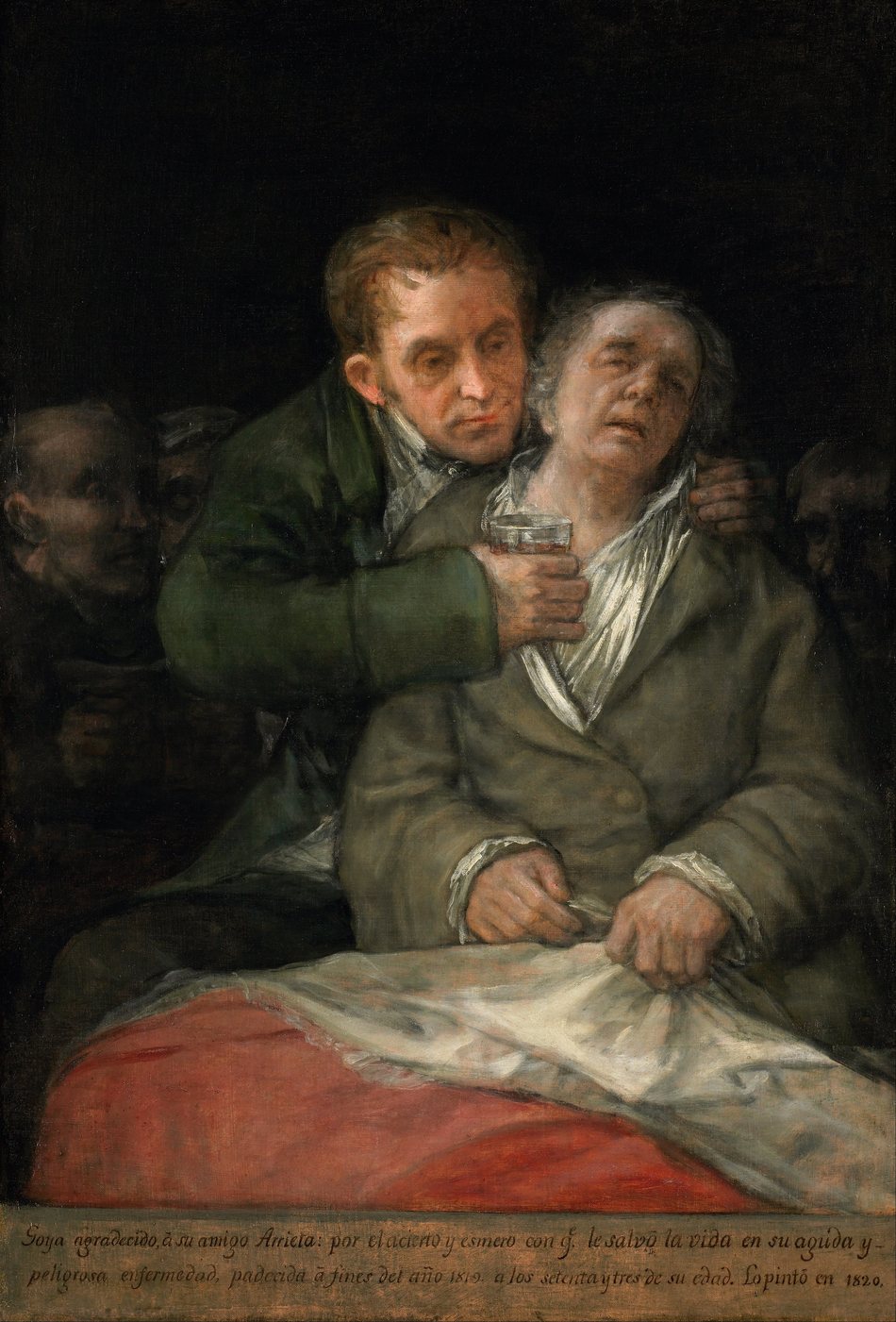
Goya, feverish in bed, is held upright by his doctor, who supports him with one arm and offers a glass with the other; dim faces crowd the shadows behind the bed. The long inscription below is the painter's thanksgiving — Arrieta's skill, he writes, saved his life in the acute and dangerous illness of 1819.
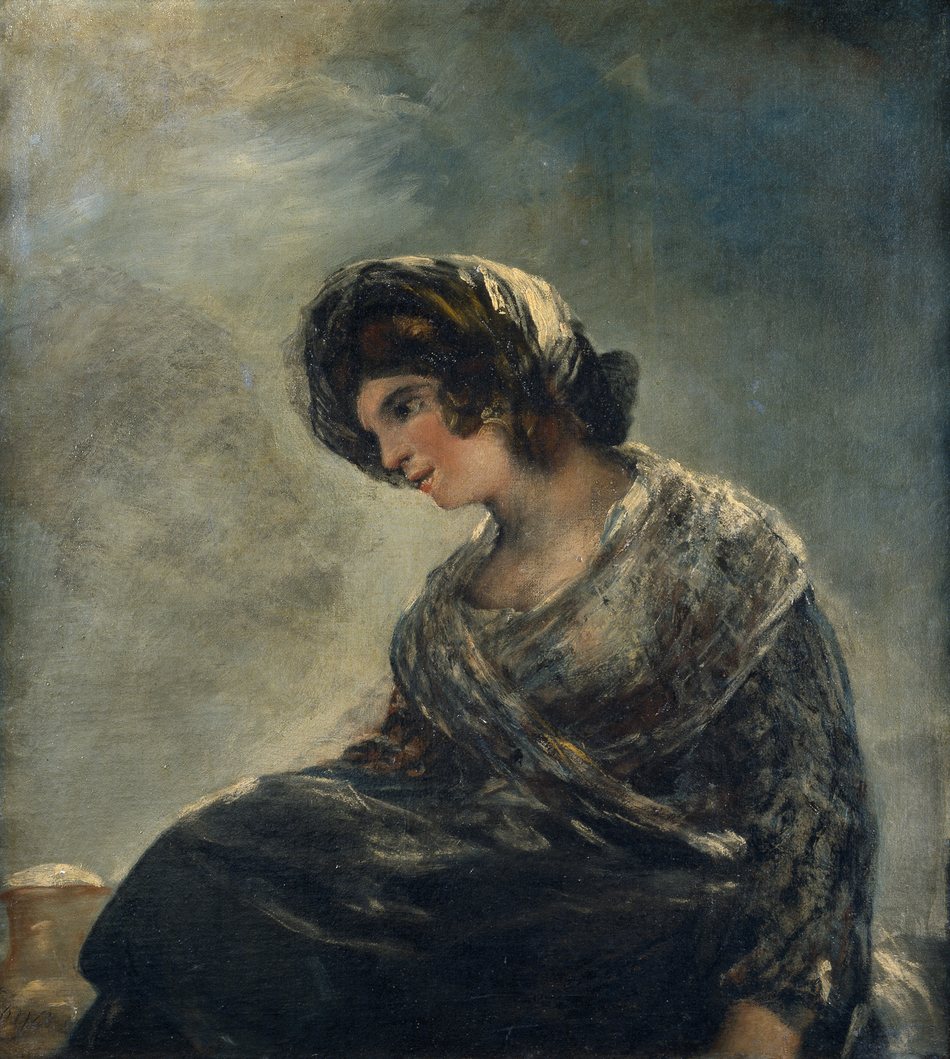
One of the last paintings, made in French exile: a young milkmaid in half-shadow, her face turned down, the paint laid in soft, sketch-like strokes that look forward to Impressionism. It is the old man's farewell to the craft — gentle where the Black Paintings, five years earlier, were savage.
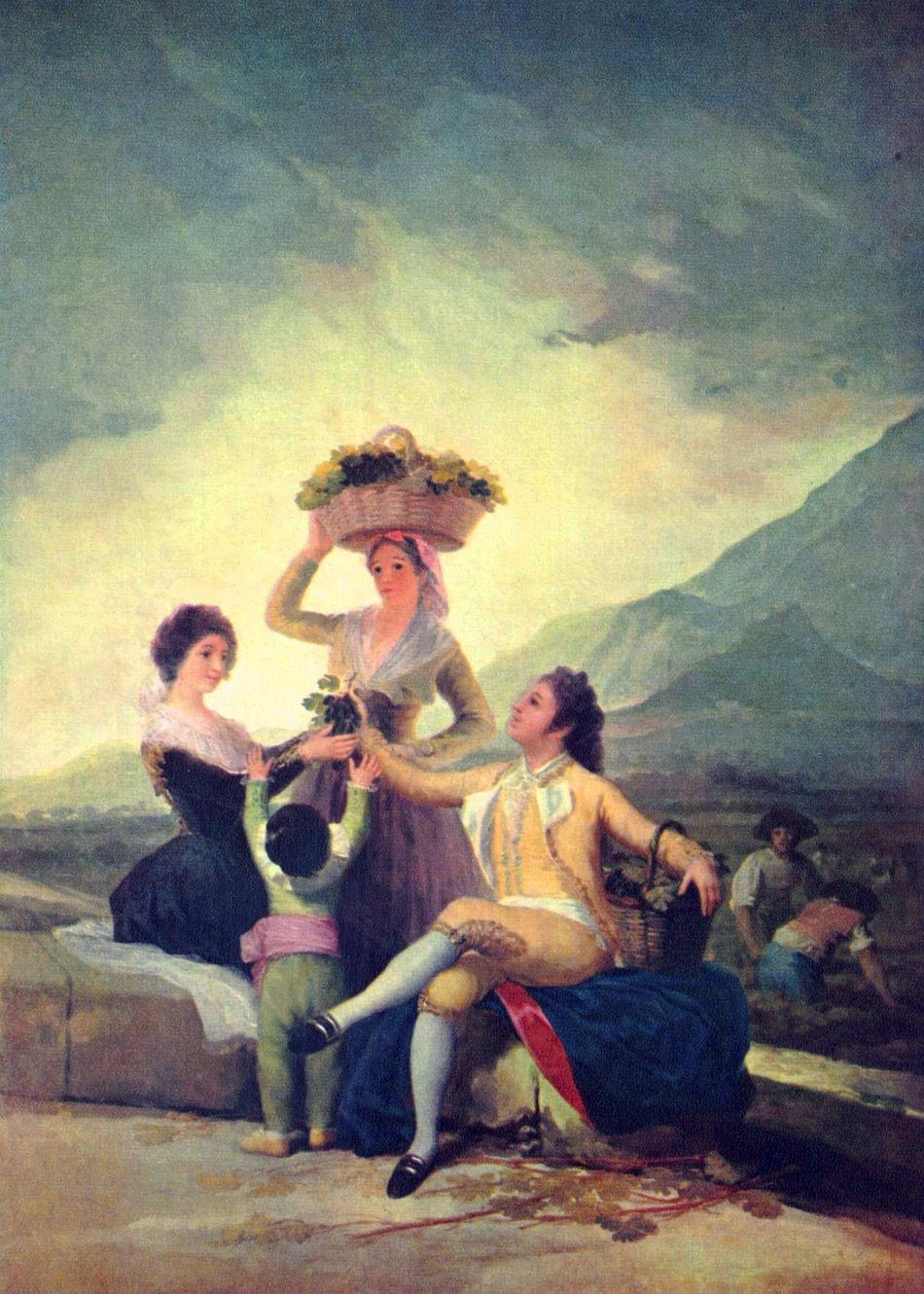
A tapestry cartoon from the Seasons, designed for the Prince of Asturias's dining room at El Pardo: harvesters rest in clear daylight while a small boy solemnly holds up a bunch of grapes. The young court painter at his most serene — the storm of the later Goya nowhere yet in sight.