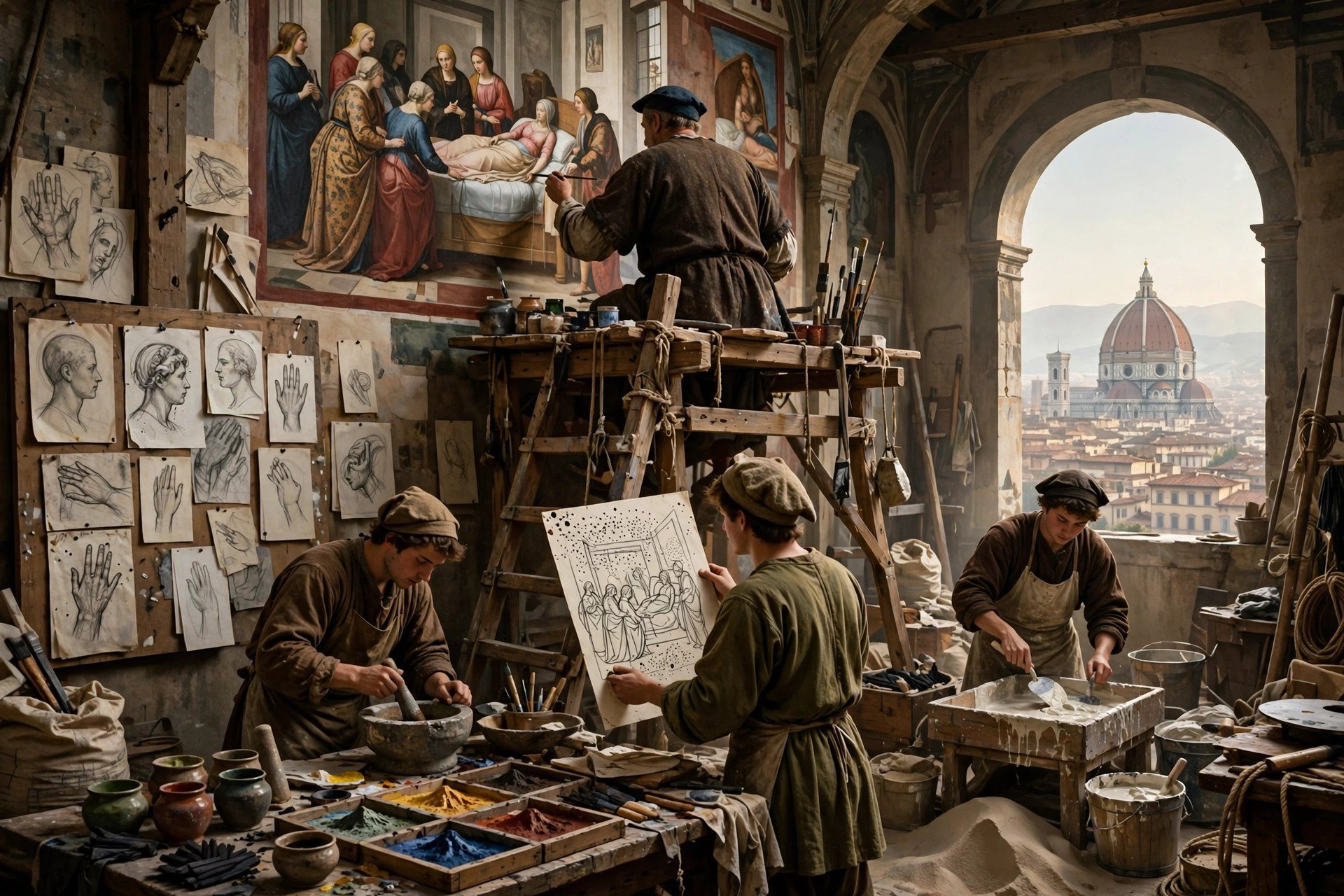
Domenico Bigordi was called Ghirlandaio — the garland-maker — after his goldsmith father's trade, and he never quite left the goldsmith's bench: the jewels, brocades and polished architecture of his frescoes are made with a jeweller's patience. With his brothers he ran the most successful painting business in Florence, and filled the city's chapels with the Bible restaged as contemporary Florentine life — every saint a neighbour, every miracle a society occasion.
His father Tommaso was a goldsmith famous for the gilt garlands Florentine girls wore in their hair — hence the family nickname. Domenico was trained toward the same bench before painting claimed him, and the training shows for life: nobody in Florence renders a necklace, a brocade pattern or a piece of carved marble with his exactness. In the Tornabuoni Chapel even the fictive marble frieze is painted like jewellery.
His great cycles — the Sassetti Chapel (1482–85) and the Tornabuoni Chapel (1485–90) — stage sacred history in the Florence of his patrons: the women visiting Saint Anne are ladies in the latest brocade, the bystanders are bankers, poets and the Medici children with their tutor Poliziano. Giovanna Tornabuoni, the patron's daughter-in-law, walks into the Visitation scene herself. It is not irreverence; it is devotion by identification — the city saw itself inside the story.
The workshop was a company: Domenico the master and designer, his brothers Davide and Benedetto, his brother-in-law Sebastiano Mainardi, and a stream of assistants and apprentices. Contracts were taken on chapels, altarpieces, mosaics, portraits — and delivered on time, a rarer virtue than genius. The Tornabuoni choir, an enormous cycle, was contracted in 1485 and finished in 1490, every wall frescoed, with the woodwork and stained glass arranged by the firm as well.
In April 1488 a thirteen-year-old named Michelangelo Buonarroti was apprenticed to the Ghirlandaio workshop — the contract, signed by his father, survives, with the boy's wages rising year by year. He learned fresco and drawing there for about a year before Lorenzo de' Medici took him into the Medici garden. Vasari tells that the master, seeing the boy correct a drawing of a woman's head, said Michelangelo knew more about the art than he did. Within twenty years the pupil had redefined it.
His two most famous panels are the two poles of portraiture. The Old Man and his Grandson shows age without mercy — the grandfather's nose disfigured by rhinophyma, drawn from life (and from a deathbed study) — yet the picture is all tenderness, the child gazing up in trust. The Giovanna Tornabuoni, painted after her early death, is the opposite: a perfected profile with a Latin epigram wishing art could render her soul as it renders her face.
Fresco is a race: each day's plaster patch — the giornata — must be painted before it dries. Ghirlandaio was famous for fluency: large, confident giornate, cartoons pricked and dusted onto the wall, heads and hands finished with a jeweller's calm inside the deadline of drying lime. He died of plague fever in 1494, aged forty-four, with the firm at its height; the brothers carried the name on, but the calm encyclopaedia of Florence closed with him.
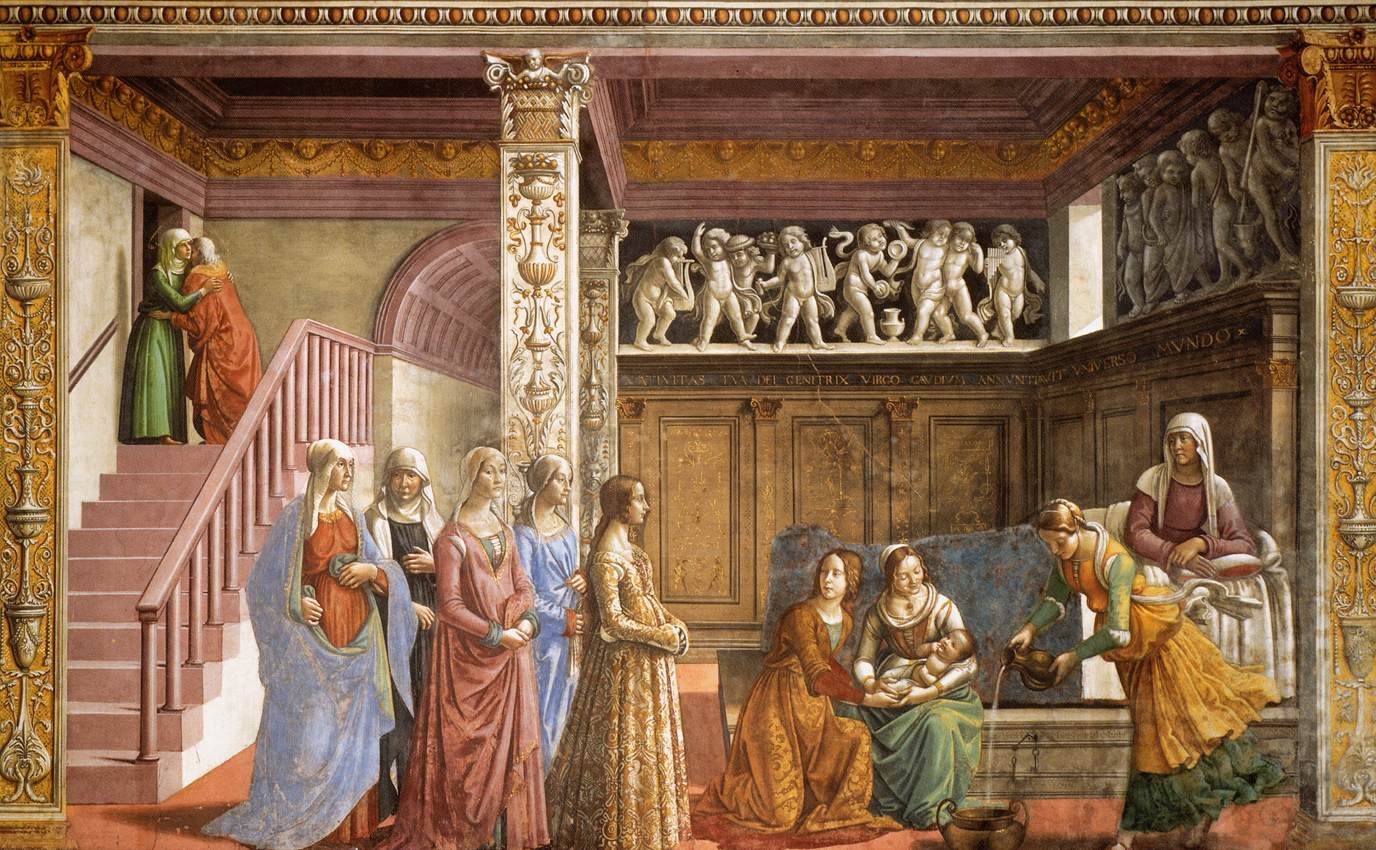
Saint Anne rests in a canopied bed in a marble-panelled Florentine bedroom while a procession of the city's great ladies — led by Ludovica Tornabuoni in brocade — files in with gifts, and a nurse below pours water for the child's first bath. A frieze of putti dances along the wall above. The birth of the Virgin, staged as a lying-in visit in a banking family's palace: the Tornabuoni choir's most beloved wall.
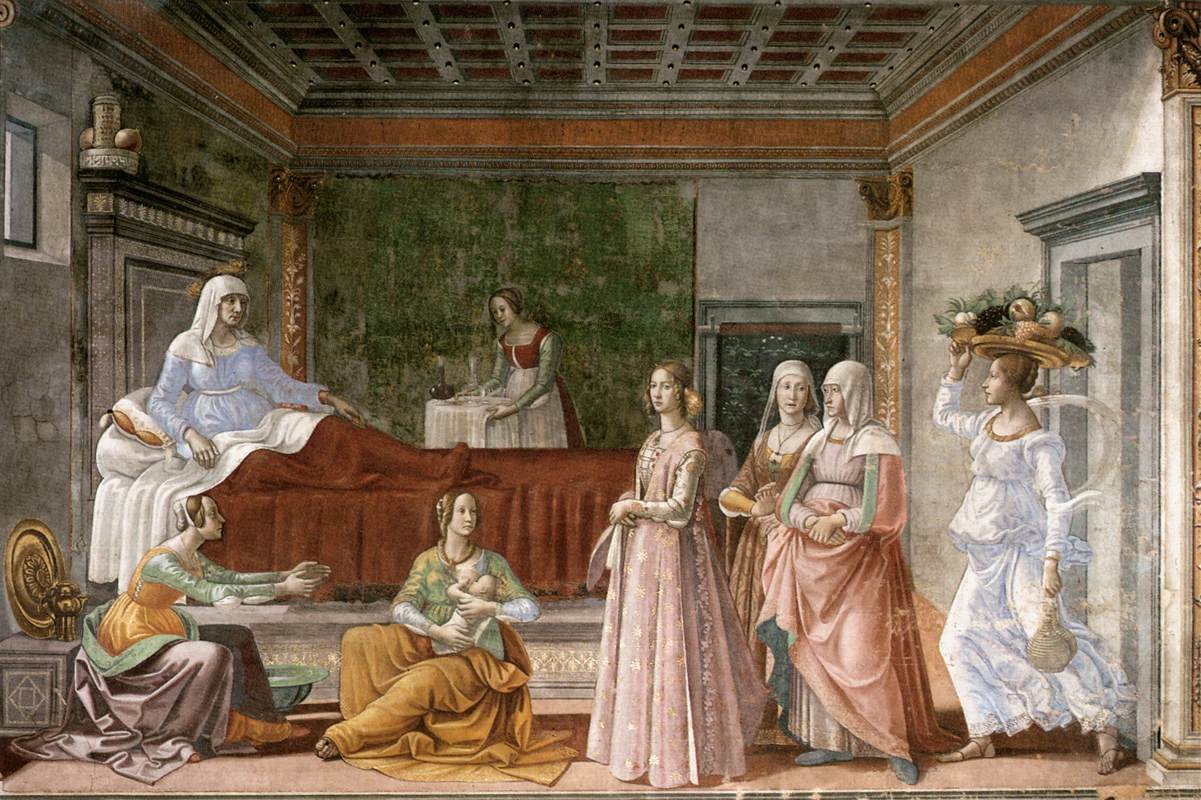
Across the choir, the pendant scene: Elizabeth in bed, the infant John being nursed in the foreground, and at the right a maid hurrying in with a tray of fruit and wine, her dress fluttering — one of the freshest figures in all Florentine fresco. The visitors wear the Tornabuoni colours; the room is a Florentine interior down to the majolica. Sacred history, domesticated with complete conviction.
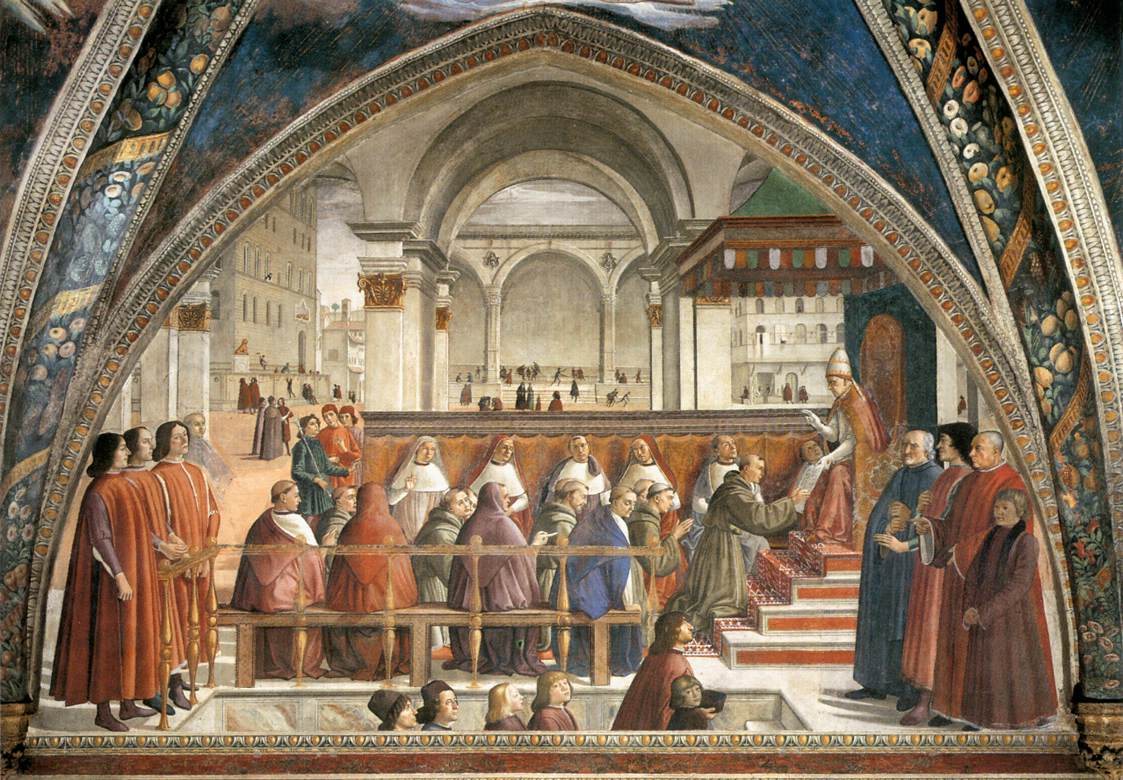
Saint Francis kneels before Pope Honorius to receive approval of his Rule — but the scene is set in Florence: behind the cardinals' bench opens a view of the city, and in the foreground stand the patron Francesco Sassetti with Lorenzo de' Medici, while Poliziano leads the Medici children up the steps. A thirteenth-century audience with the Pope, attended by the whole Medici court: the Sassetti Chapel's central and most political fresco.
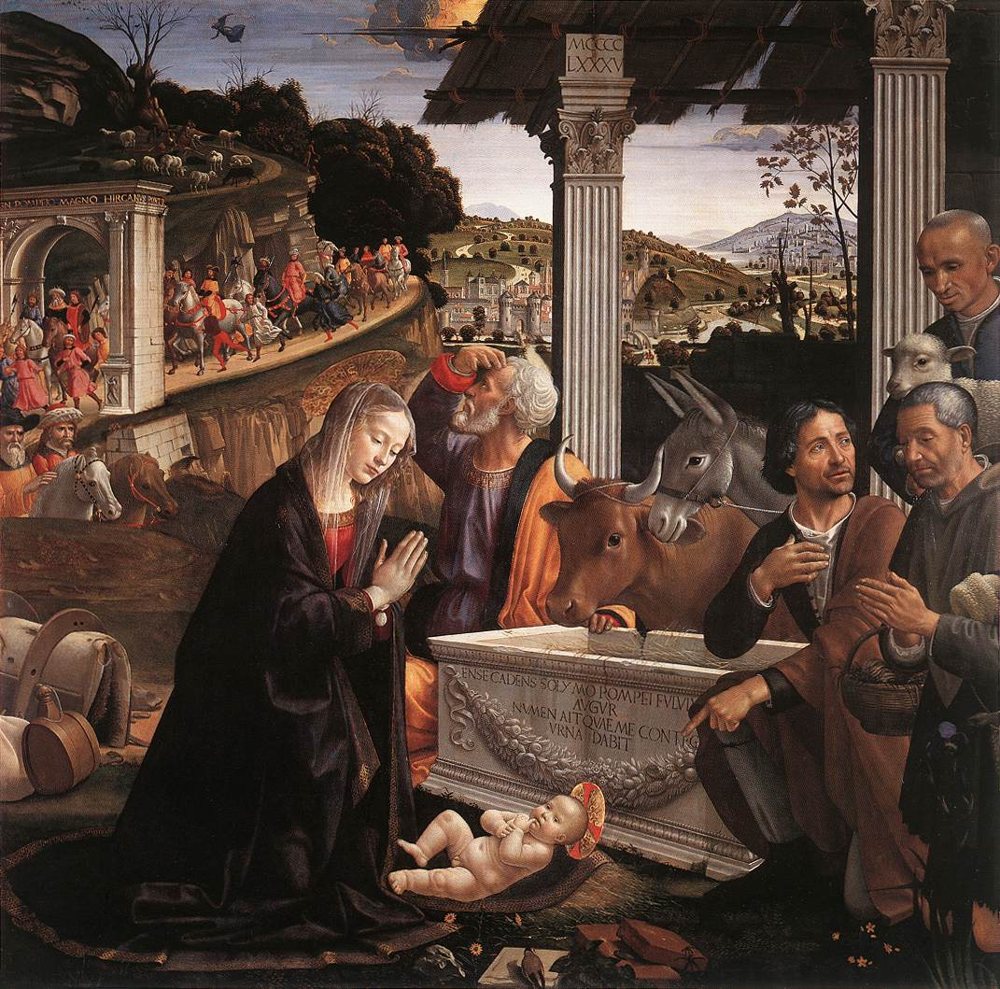
The Sassetti altarpiece: the Virgin adores the Child lying on the ground before a Roman sarcophagus that serves as the manger — its Latin inscription turned into a prophecy of Christ. Joseph looks up at the angel's news; the shepherds press in at the right, the foremost of them the painter himself; and far down the road at the left winds the procession of the Magi, still on its way. Learned, crowded and tender at once.
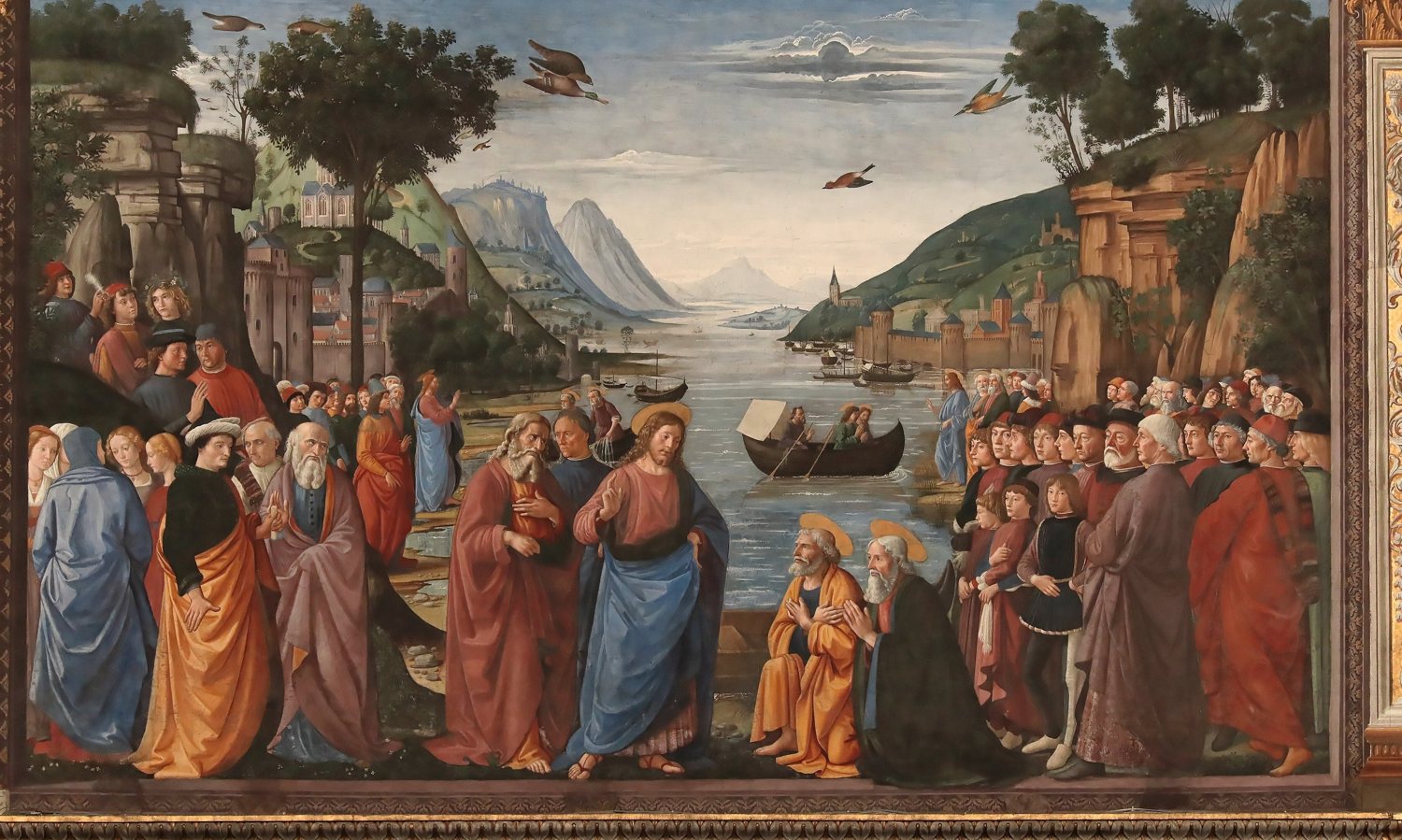
Ghirlandaio's wall in the Sistine Chapel: on the shore of a wide lake Christ calls Peter and Andrew from their nets, and calls again — James and John kneeling at the right — while a crowd of contemporary Florentines, exiled or resident in Rome, watches from both sides. Behind, the water opens to a luminous distance with boats and birds. The young master's Roman calling card, painted next door to Perugino's Keys.
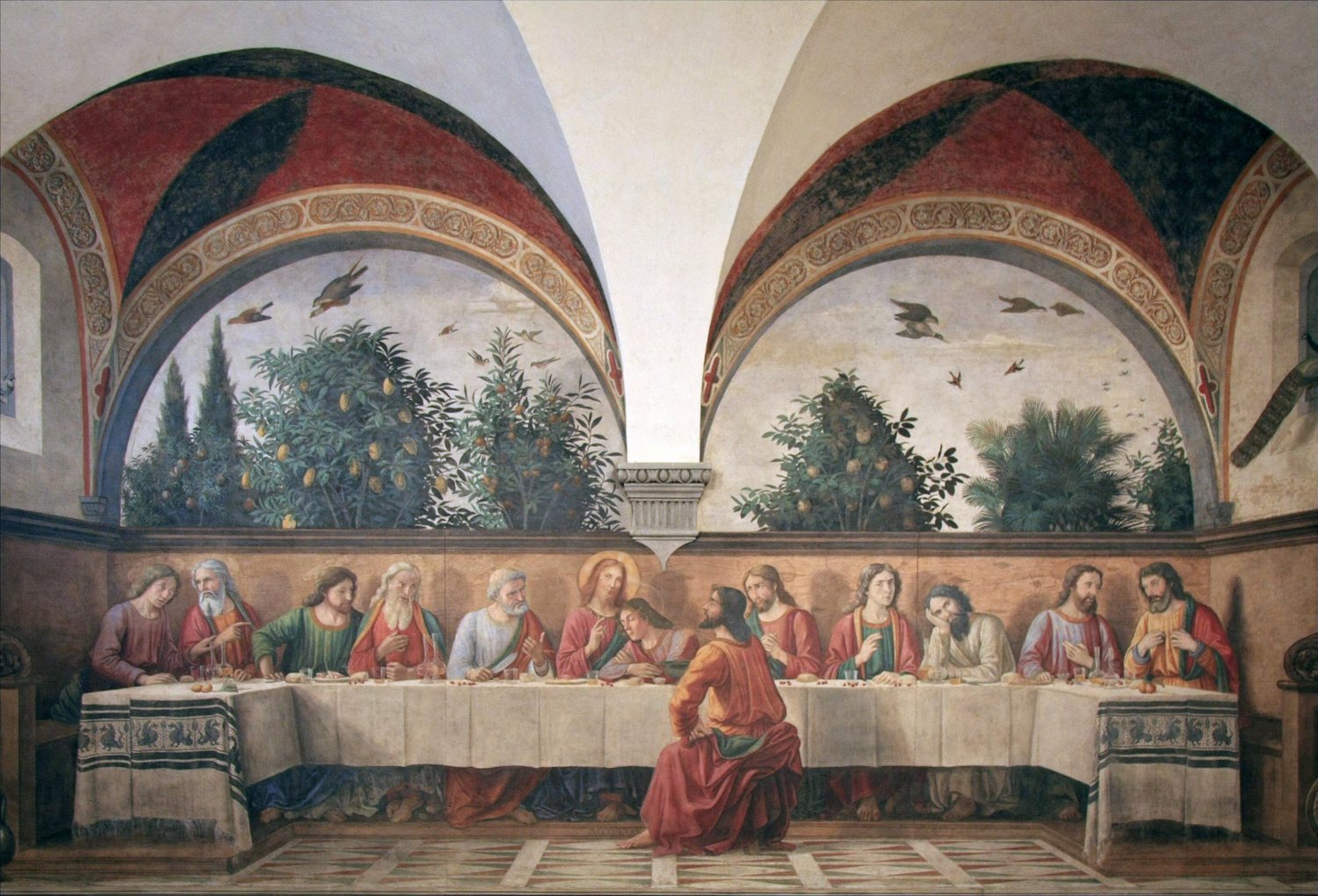
For the Umiliati friars' refectory: Christ and the apostles at a long table set with embroidered cloth, glass and bread, painted with still-life precision — and behind them the wall opens into painted arches, beyond which a garden breathes with trees, peacocks and flying birds. The monks ate their meals before it daily: the first Supper in Florence to turn the refectory wall into a window.
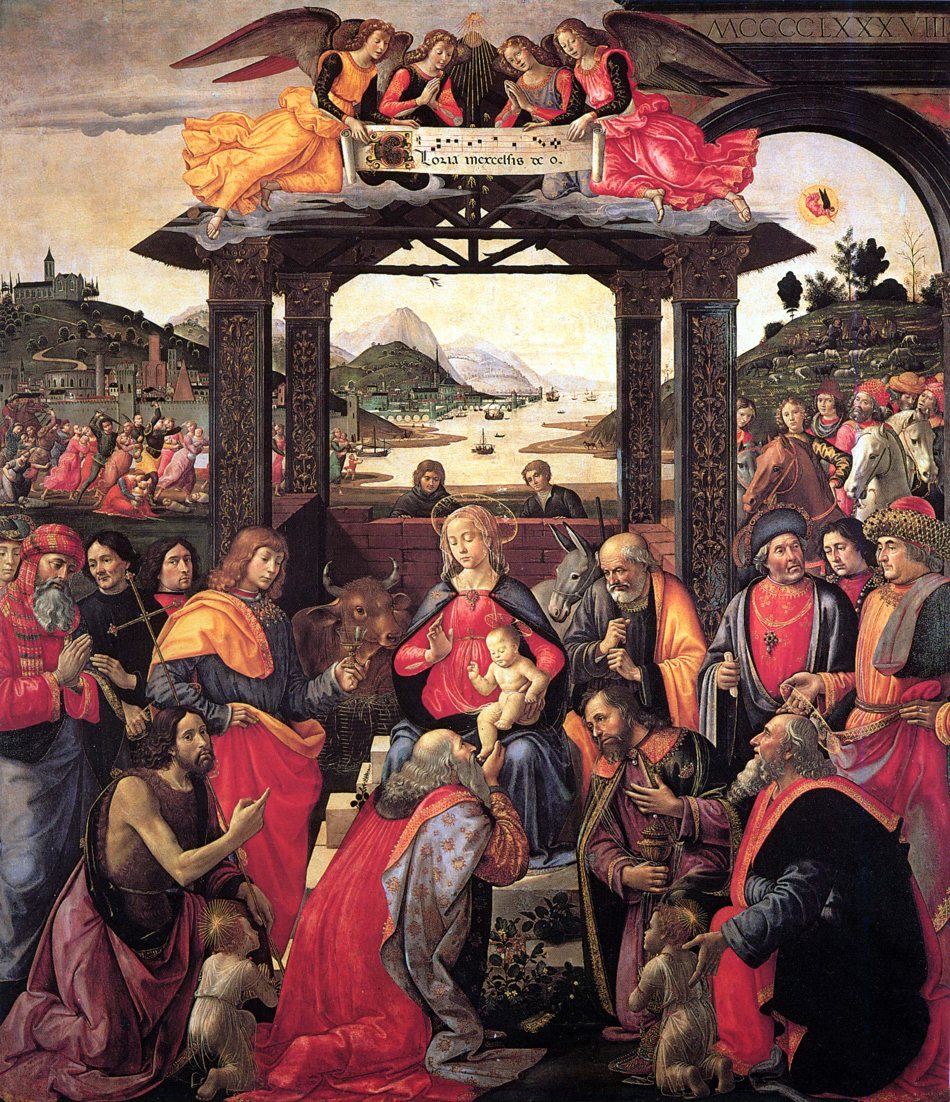
Painted for the church of the foundling hospital: under a ruined classical arch the kings kneel in a dense, glittering crowd, angels unfurl a banner of praise above, and the Virgin presents the Child from a raised platform like a little throne. Among the bystanders the workshop placed portraits — and the painter himself, at the left edge, looks out at us. Charity's altarpiece, crowded as a festival.
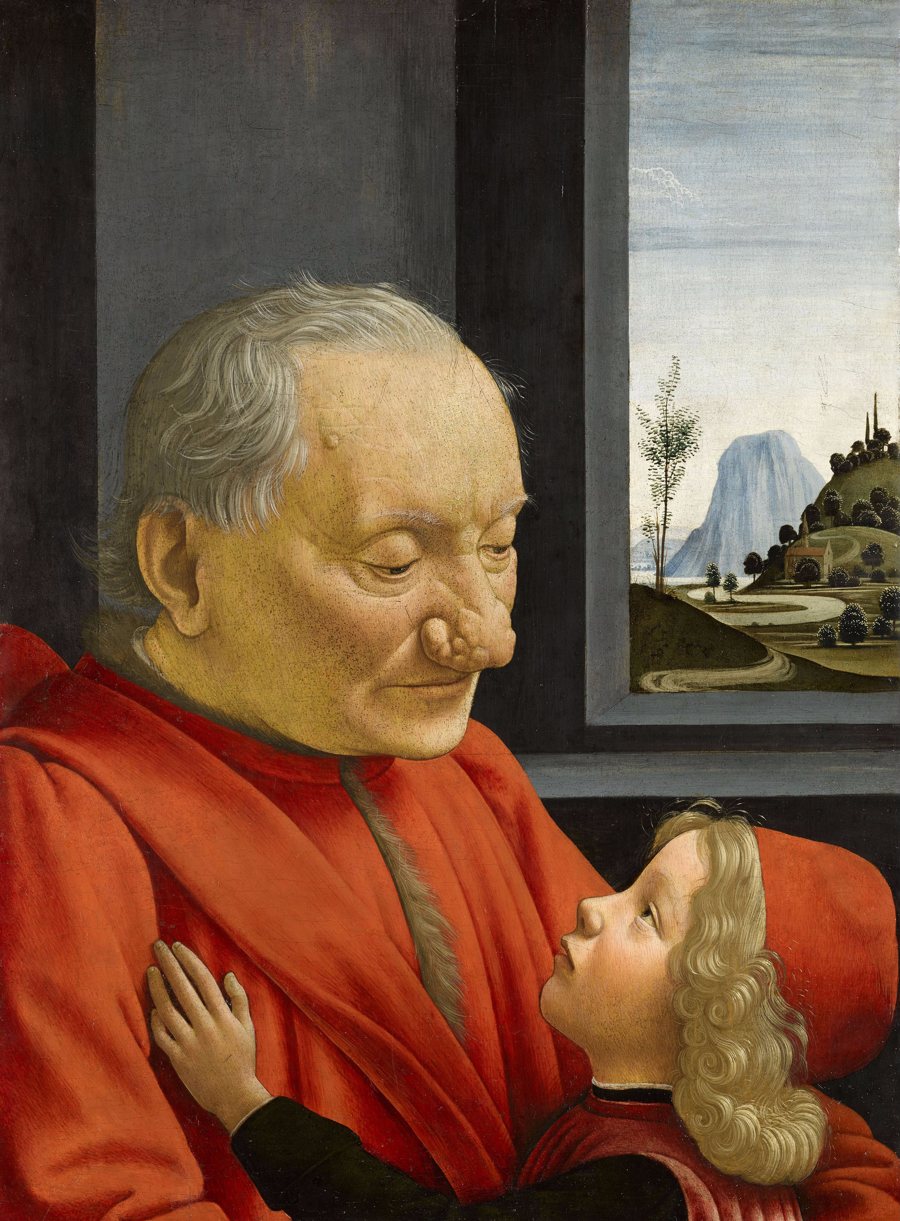
The most loved portrait of the Florentine Renaissance: an old man in red, his nose disfigured by disease, bends with infinite gentleness toward the small boy who looks up into his face, one hand on the old man's chest. A silverpoint study of the grandfather's head, made after death, survives in Stockholm. Nothing is hidden and nothing is cruel — the picture's honesty is its tenderness.
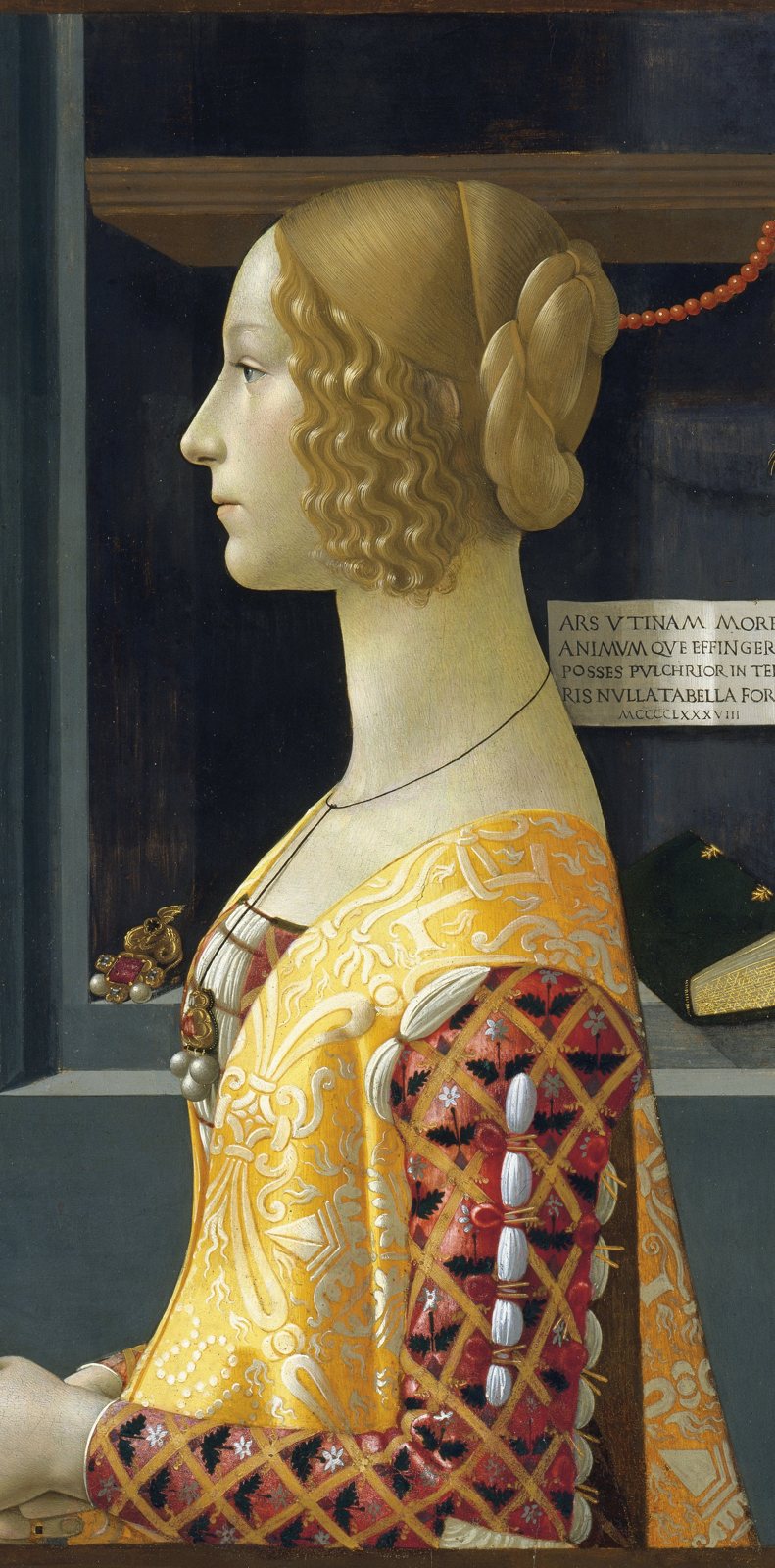
Giovanna degli Albizzi, wife of Lorenzo Tornabuoni, died in childbirth in 1488, aged nineteen; her father-in-law commissioned this posthumous portrait. She stands in strict profile in a brocade dress, coral necklace and jewels arranged on the shelf behind her, beside a tablet with Martial's epigram: 'Art, if only you could reproduce character and spirit — no lovelier painting would exist on earth.' The Tornabuoni Chapel's Visitation includes her again, alive in fresco.
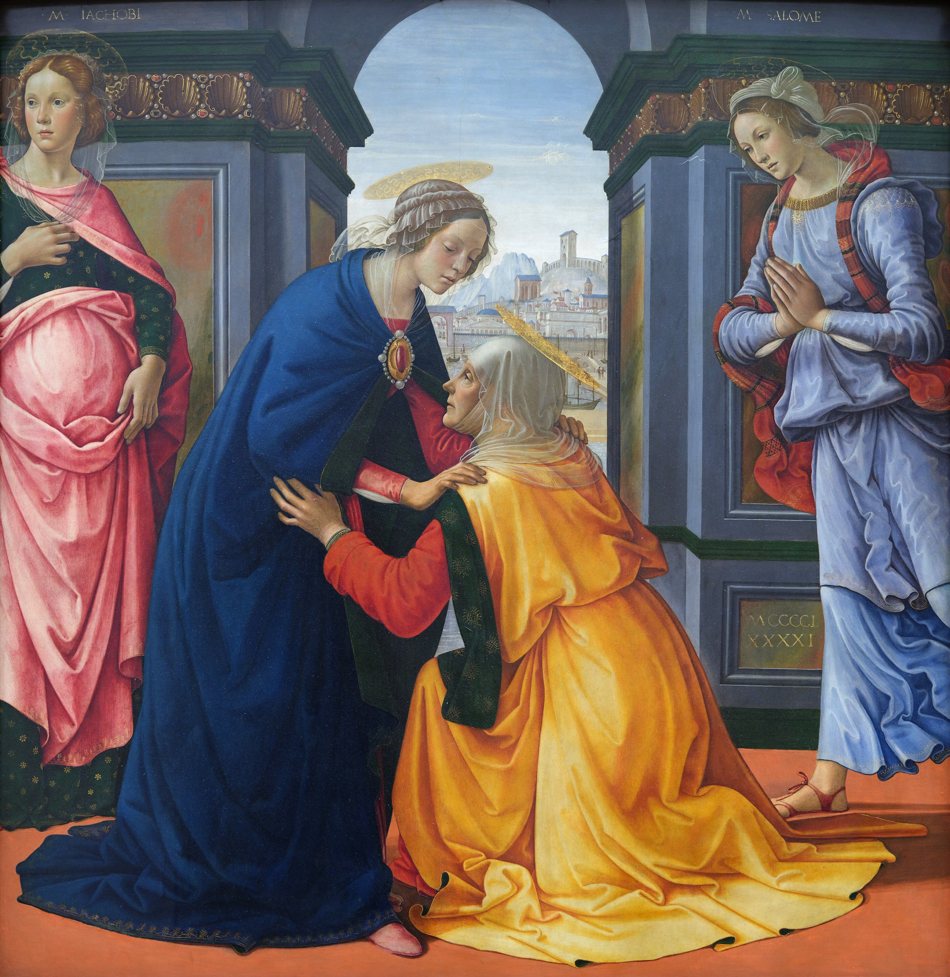
His last dated panel, signed and dated 1491 on the classical arch: the Virgin and Elizabeth meet in an embrace at the centre, attended by Mary Jacob and Mary Salome in the dress of Florentine ladies, a walled city and a harbour below. It distils the Tornabuoni fresco of the same subject into a panel of enamelled calm — the master's manner, perfected and quiet, three years before his death.