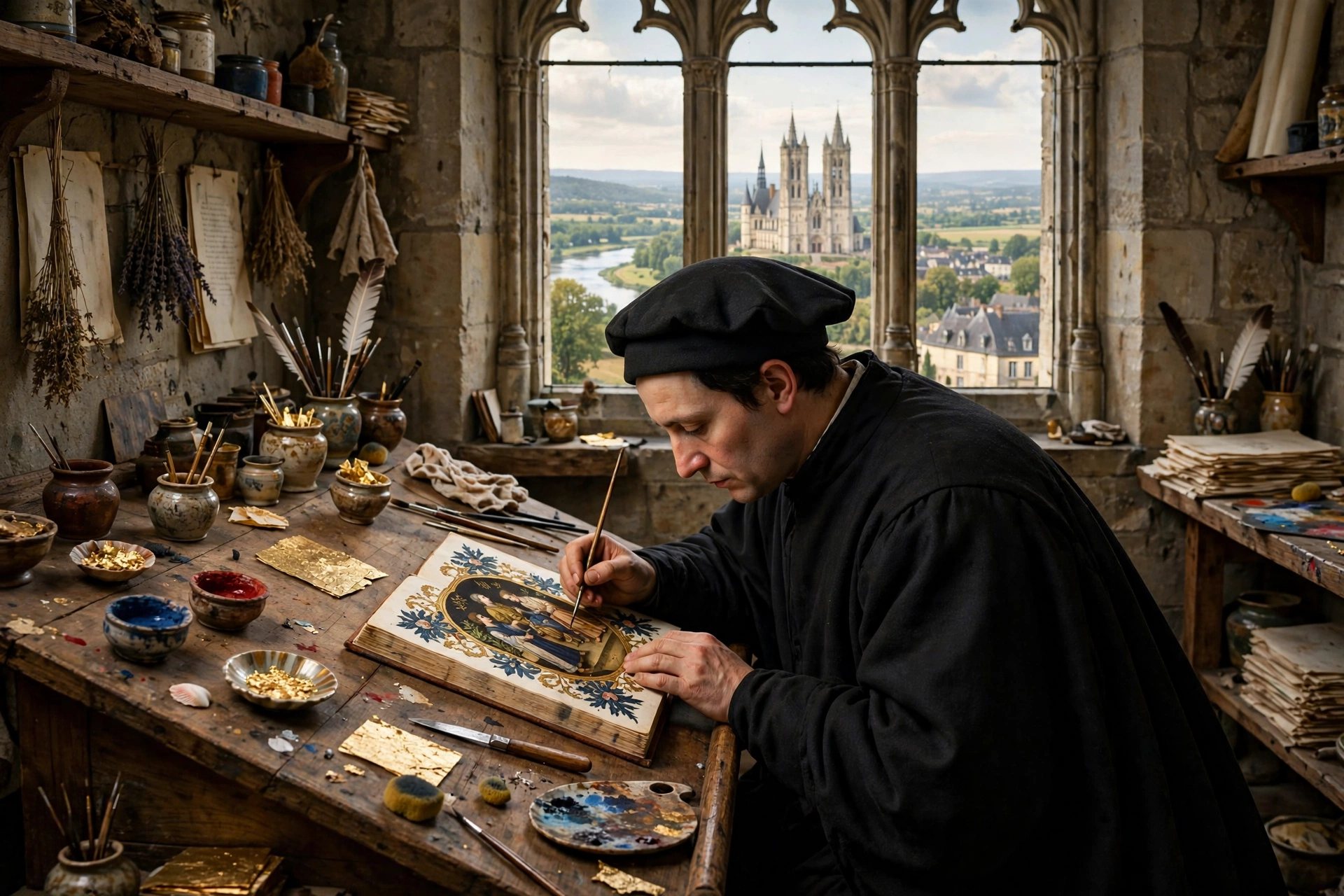
France's first great painter was a miniaturist. Jean Fouquet of Tours travelled to Italy, absorbed the new Renaissance perspective and light, and brought them home to the page and the panel: a Madonna among red angels that still shocks, portraits of pitiless truth, and book illuminations in which whole cathedrals, battles and theatres unfold inside a few centimetres of parchment.
Fouquet worked at two scales that rarely meet: the panel portrait, near life-size, and the miniature, where a cathedral fits in a matchbox. He carried the lessons each way — the miniatures have the monumentality of altarpieces, the portraits the enamel precision of jewels. No contemporary moves between the two so completely.
In the 1440s he was in Rome, painting the Pope's portrait (lost) and studying the new art — Fra Angelico, the revived antiquity, the mathematics of perspective. He came home able to do what no French painter could: build a room, a church, a landscape in convincing depth, and light it like morning.
His miniatures are painted in gouache on parchment with brushes fine as needles: ultramarine from Afghan lapis, red lead, malachite green, and gold laid both as leaf and as shell gold paint. The Hours of Étienne Chevalier was cut apart leaf by leaf in the nineteenth century; its surviving pages, scattered from Chantilly to London, are hunted like treasure.
His Charles VII is no flattery: a weary, suspicious king in a fur-trimmed robe, painted from life with the bags under the eyes left in. The Juvénal des Ursins kneels in cloth of gold, every thread counted. Fouquet served the court by telling it the truth in paint — a dangerous gift, and the reason these faces still look back at us undeceived.
His Martyrdom of Saint Apollonia is not only a martyrdom: it shows a medieval mystery play in performance — the scaffold stage, the director with his script, devils at the traps, the audience of Heaven above. It is the best surviving picture of how the fifteenth century staged its faith, hidden inside a prayer book.
Around 1450 he painted his own likeness in enamel on copper — a small round medallion, the face modelled in grisaille gold against black, signed Johannes Fouquet. It may be the earliest self-portrait in European art that is a work in itself, not a detail of a larger picture: the artist presenting his face as his credential.
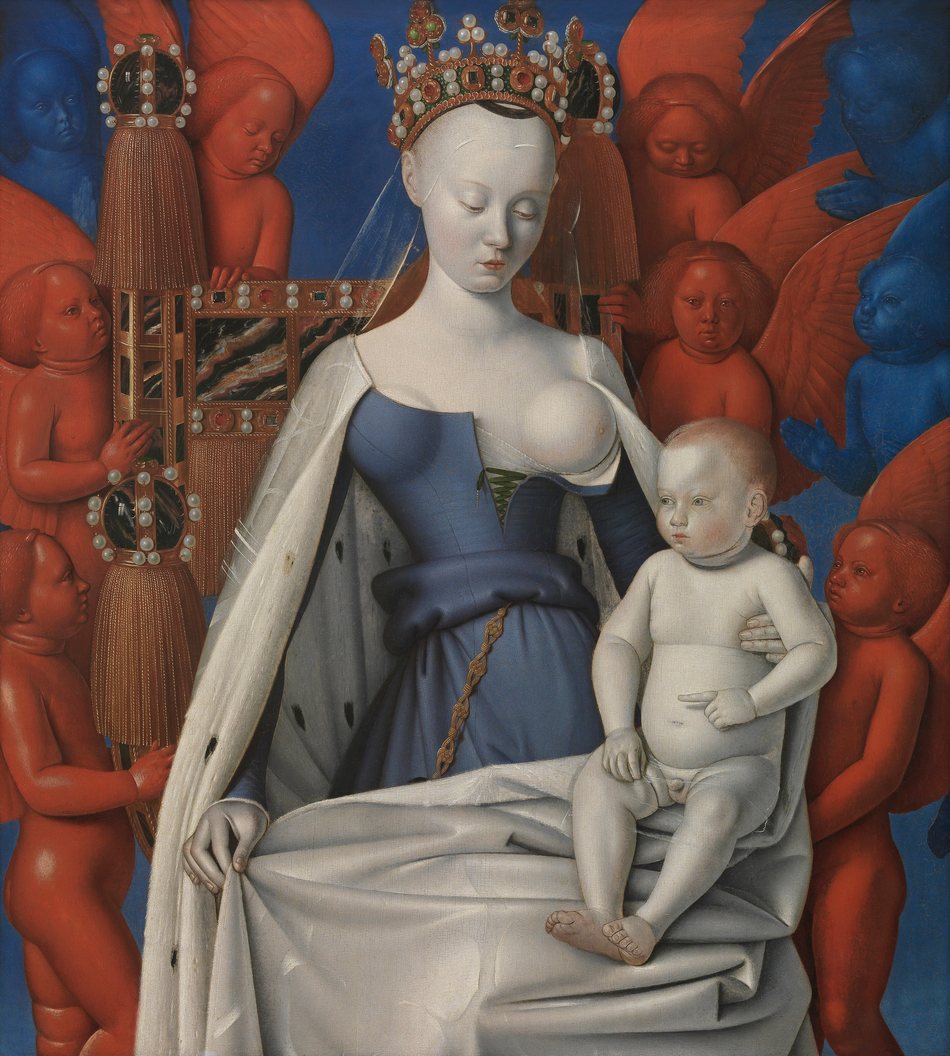
The right wing of the Melun Diptych: the Virgin as a court lady of unearthly pallor, crowned, one breast bare for the Child, enthroned among seraphim in solid red and blue. Tradition says her face is Agnès Sorel, the king's beloved mistress. Nothing in French painting prepares you for its strangeness — a Madonna as cold and perfect as a jewel.
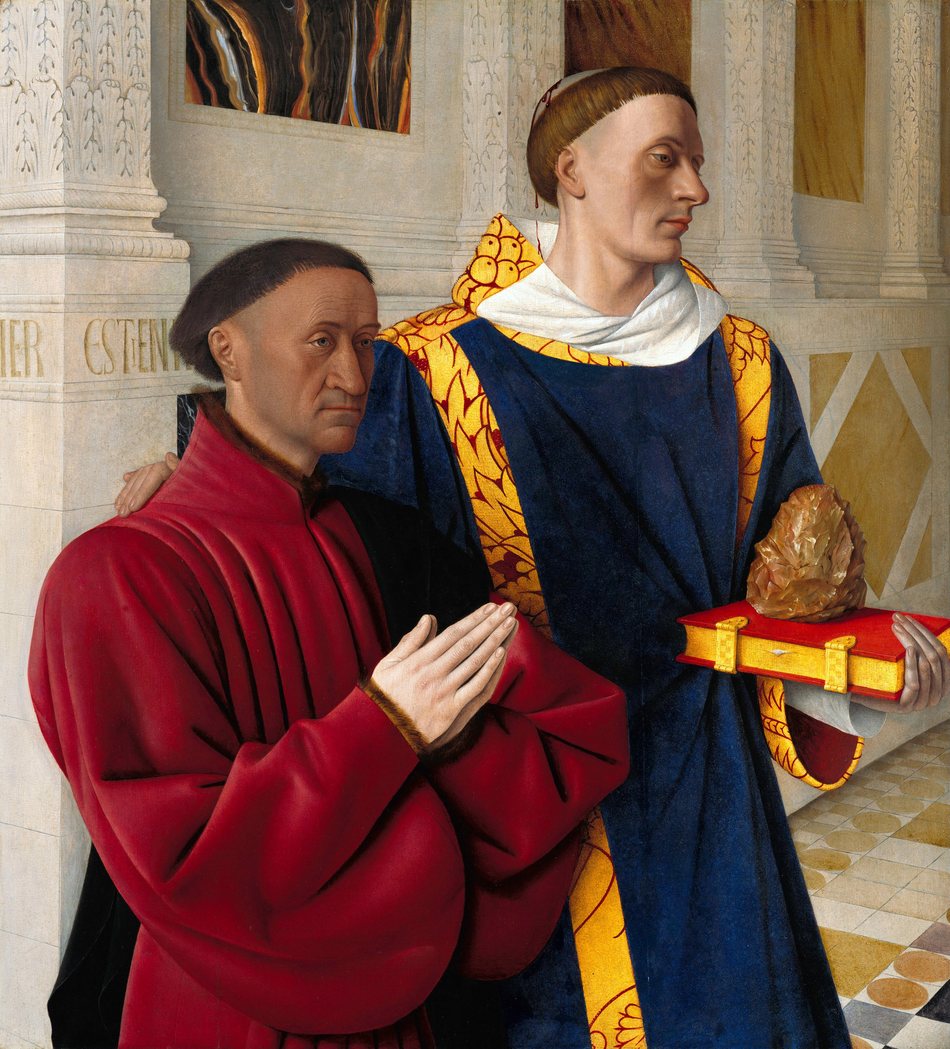
The left wing of the diptych: the king's treasurer Étienne Chevalier kneels in prayer, presented by his patron Saint Stephen, who holds the stone of his martyrdom on a book. The two wings were separated centuries ago — the donor prays in Berlin, his Madonna glows in Antwerp, and the diptych meets only in reproductions like this room.
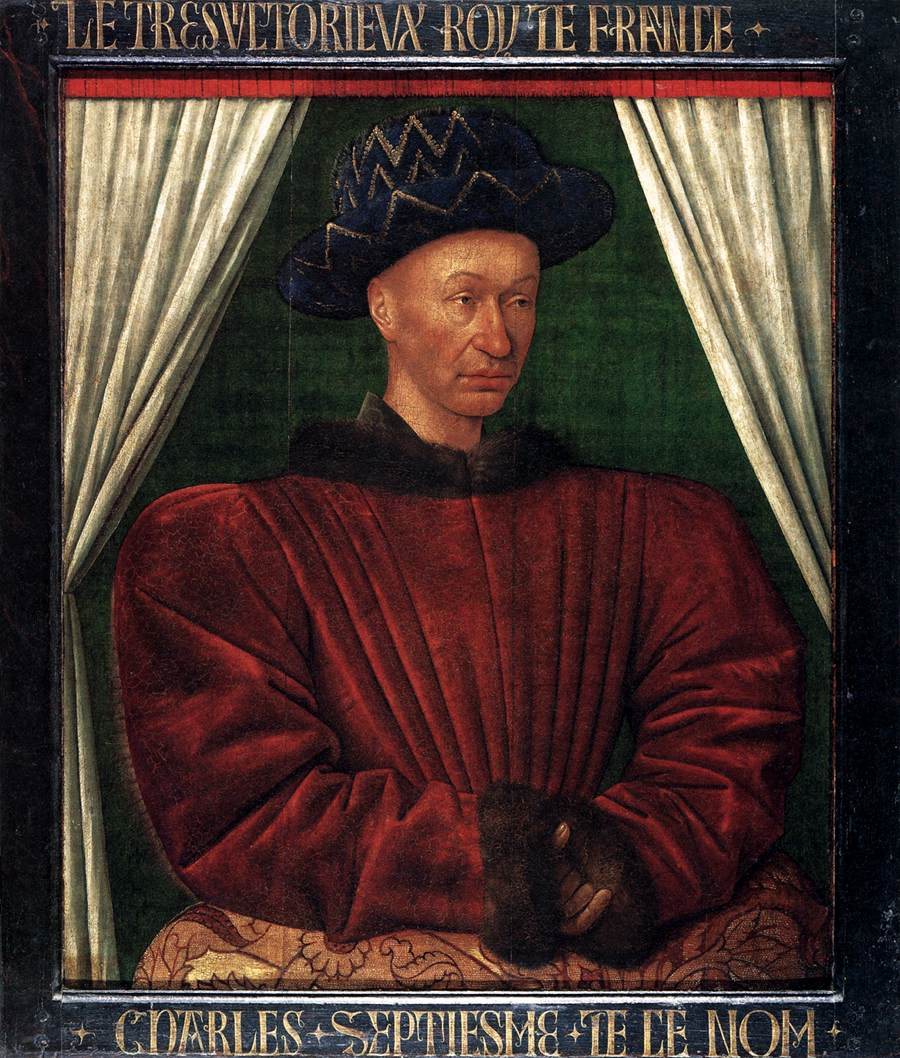
The king who, with Joan of Arc, won back France — painted not as a hero but as a tired man in a red robe between white curtains, his long face and wary eyes observed without a grain of flattery. The inscription calls him the most victorious king of France; the face tells you the price of the victories.
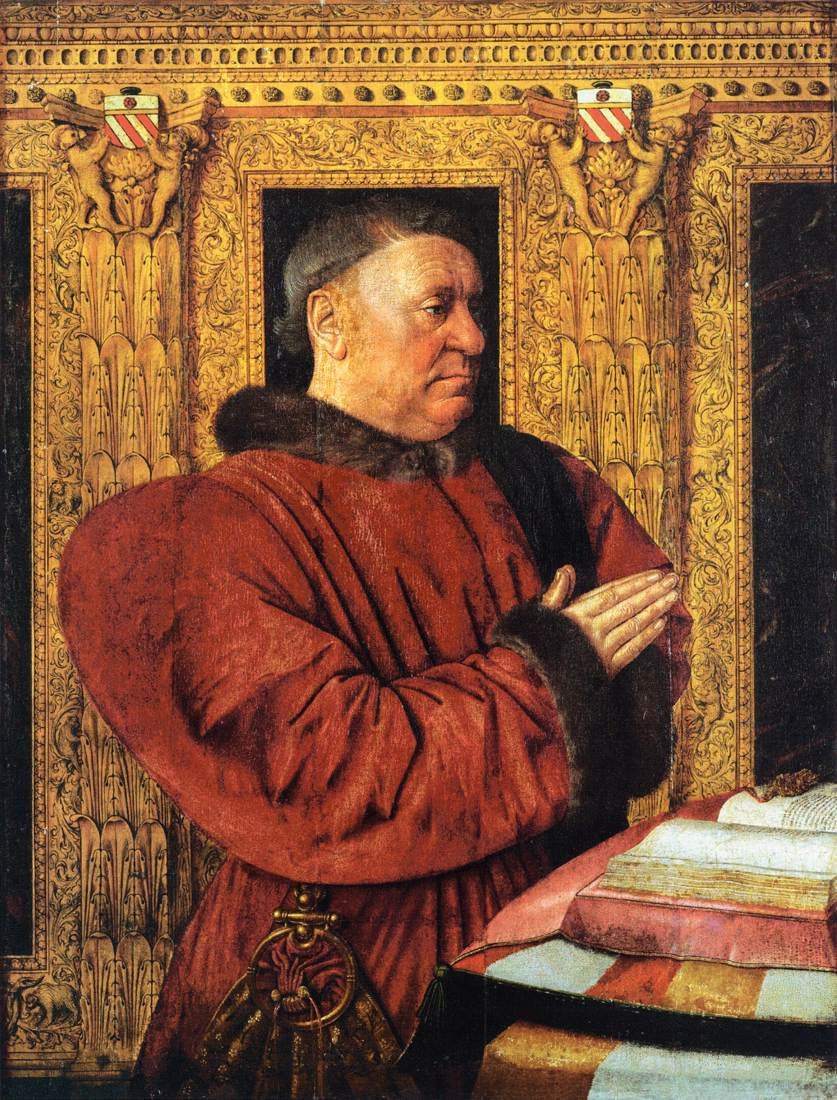
The Chancellor of France at prayer, in profile against a gold ground carved with his arms and devices, his prayer book and cap beside him. Every fur hair and brocade thread is rendered with a miniaturist's patience at a portrait's scale — power shown as patience, wealth as workmanship.
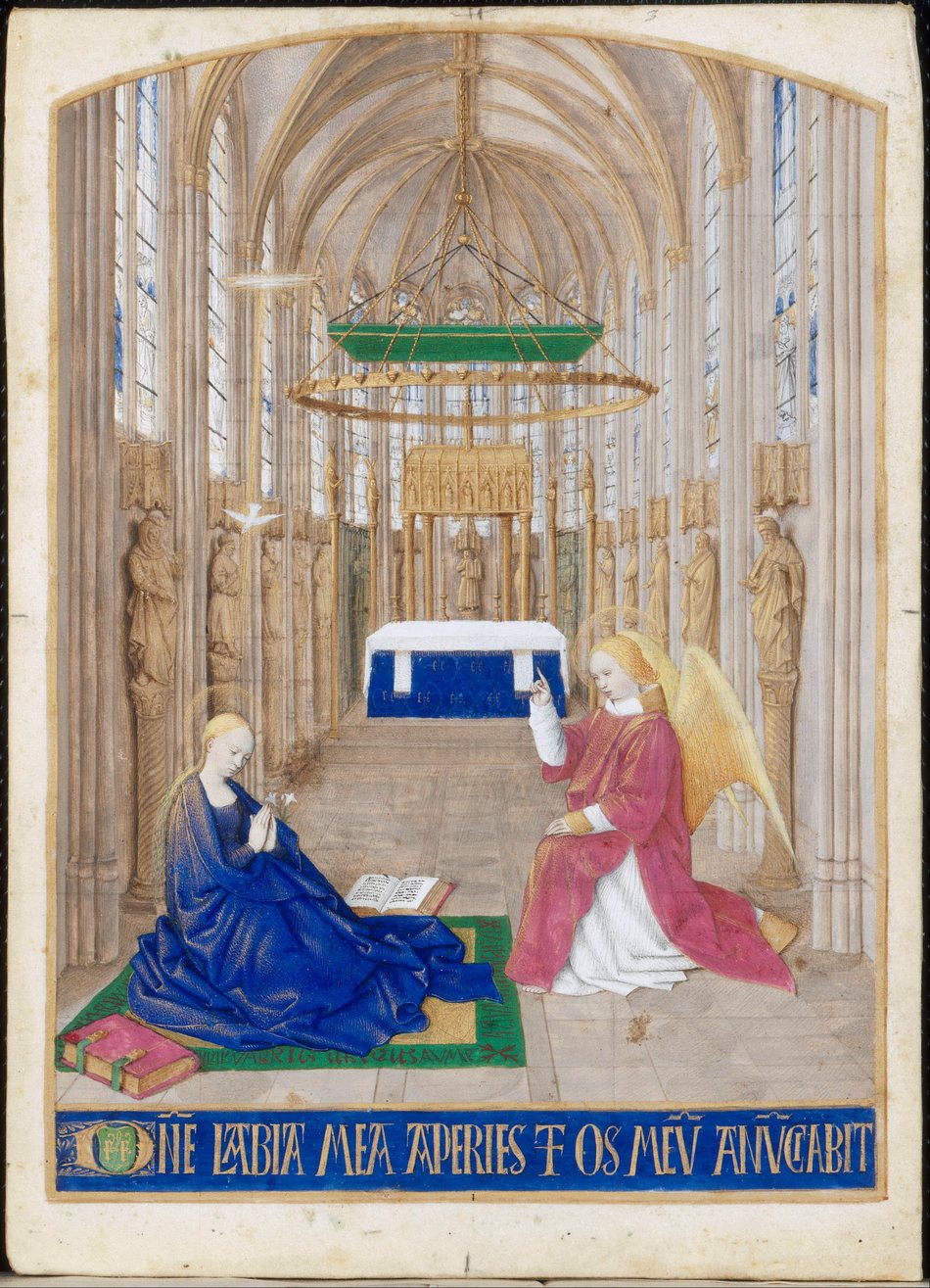
The angel finds the Virgin inside a soaring Gothic chapel — in fact the Sainte-Chapelle itself — rendered in perspective of Italian correctness and flooded with cool light. A whole cathedral interior, complete and luminous, inside a page you could cover with two hands: the miracle of the miniature is the space.
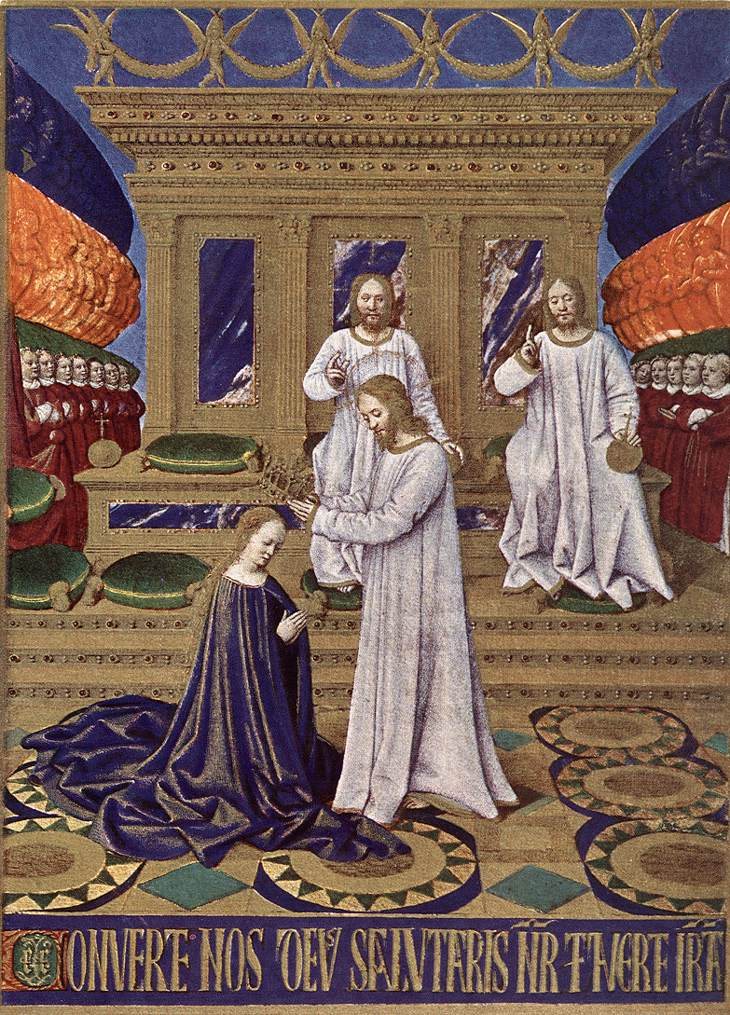
Heaven as a French court ceremony: the Trinity enthroned under a canopy, the Virgin kneeling to be crowned, saints in rows like courtiers, and below, a patterned floor that runs out to the picture's edge like a carpet of tiles. Fouquet builds paradise with the same order he gave to cathedrals and palaces.
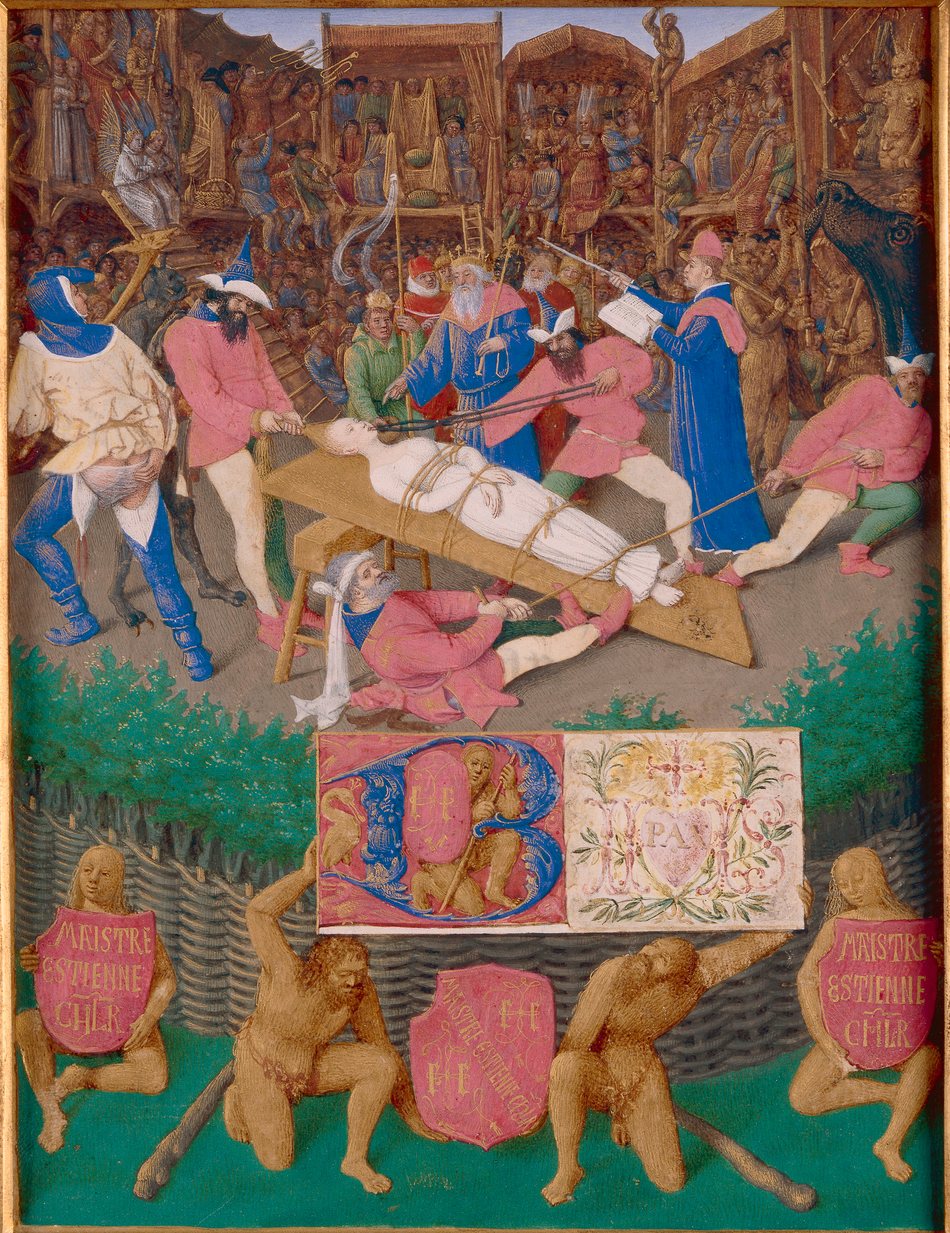
A mystery play caught mid-performance: Saint Apollonia on the scaffold-stage, her torturers at work, the play's director in the middle with his script and baton, musicians below, devils at the corners and God watching from above. The most vivid record ever made of medieval theatre — painted small enough to hold in one hand.
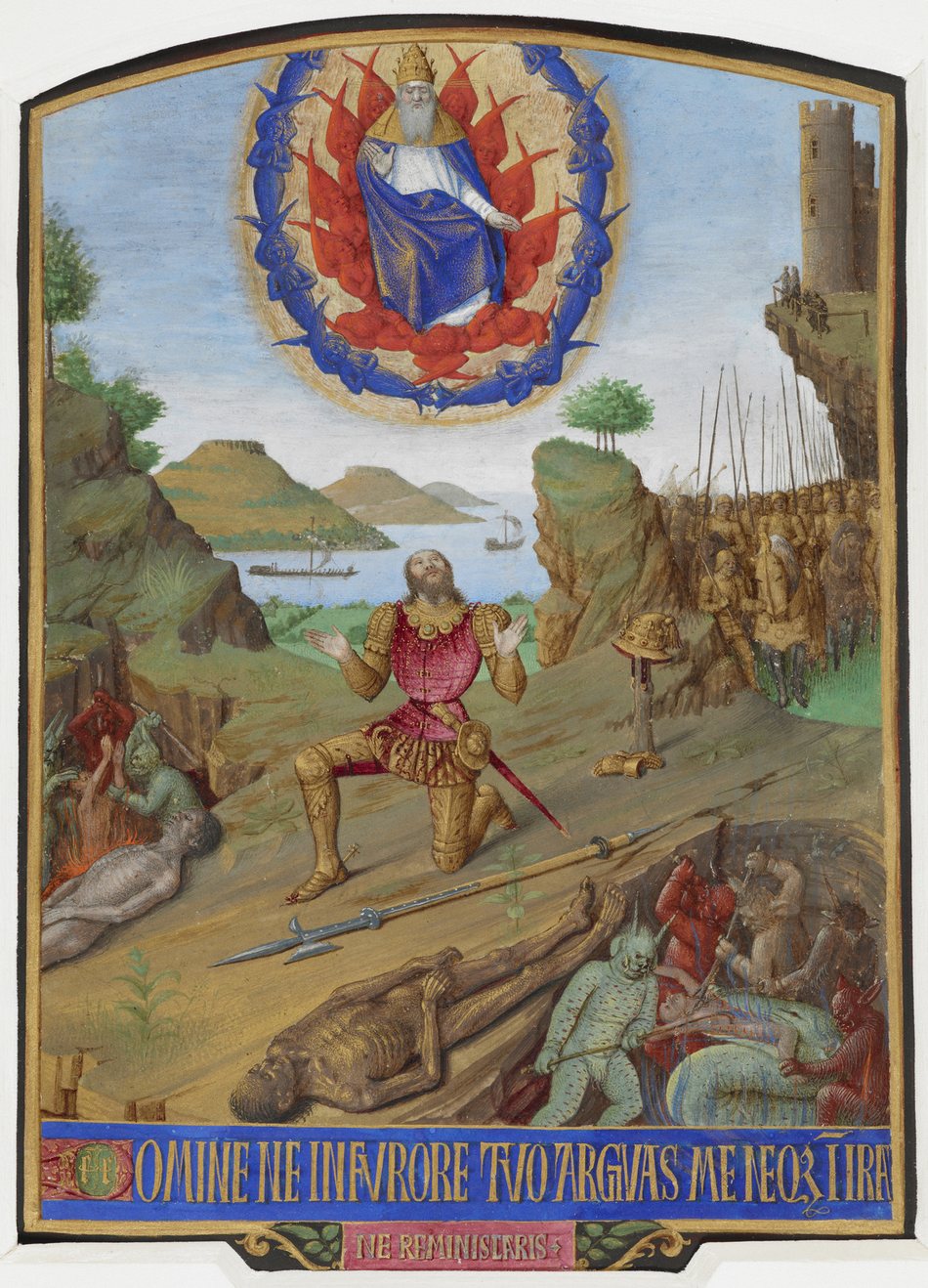
A detached leaf of the scattered Hours: King David kneels in a rocky landscape among the casualties of the plague he chose, while above, in a wreath of red and blue, God's hand stays the destroying angel. Fouquet packs a whole psalm — guilt, punishment, mercy — into a single page's theatre.
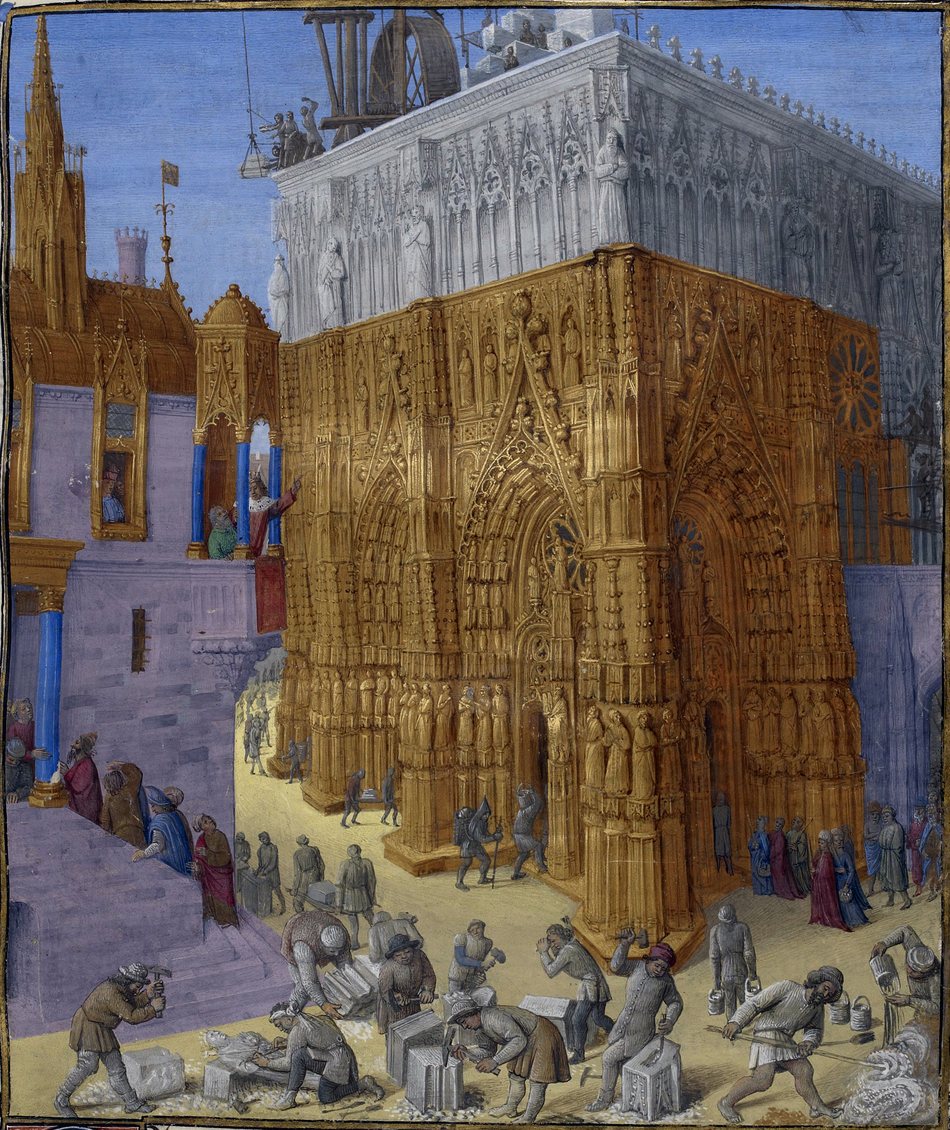
From Josephus's Jewish Antiquities: Solomon's Temple rises as a Gothic cathedral, its golden façade swarming with masons, cranes and scaffolding, while the city of Jerusalem — unmistakably a French town — looks on. Fouquet's workshop turns biblical history into a building site of his own century, stone by observed stone.
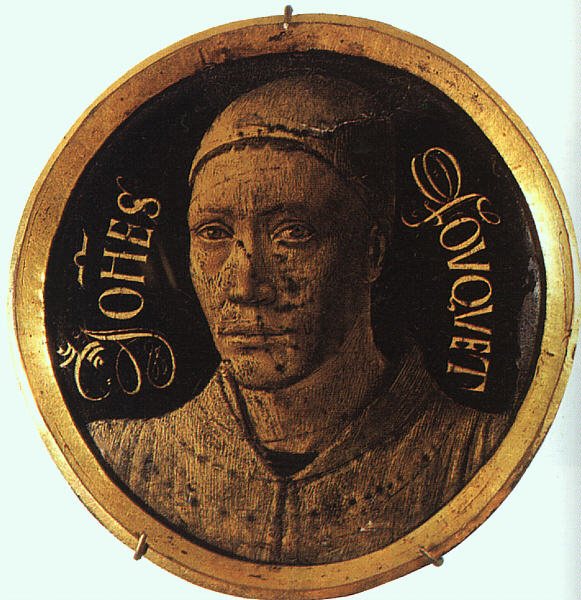
A face five centimetres across, enamelled in gold grisaille on black copper and signed around the rim: Johannes Fouquet. Probably once set in the frame of the Melun Diptych, it is among the earliest independent self-portraits in European art — the painter, at the height of his powers, looking out at us with level, unsmiling eyes.