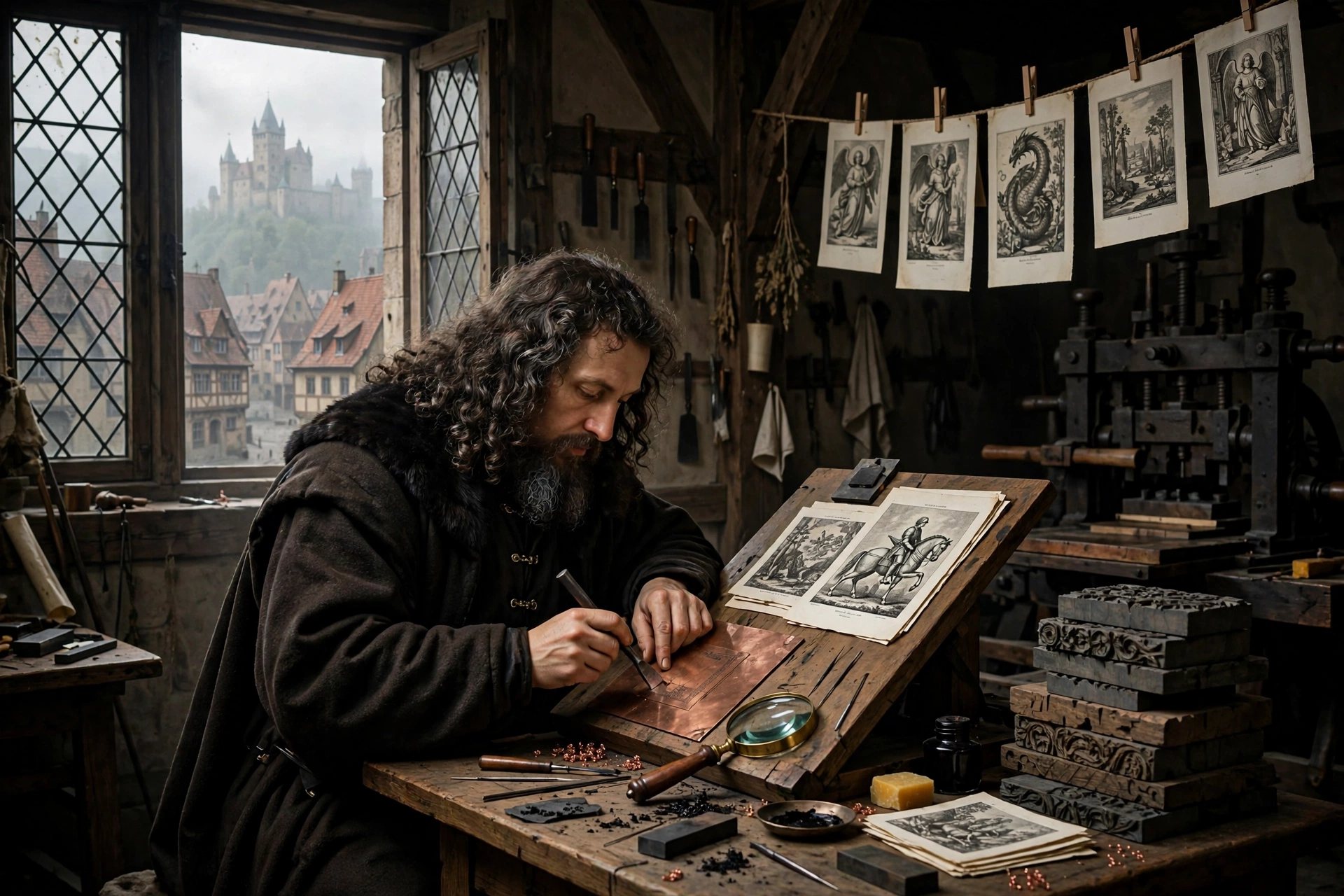
A goldsmith's son from Nuremberg who made the printed image into high art: Dürer painted like an Italian and engraved like no one before him, signed everything with two letters — AD — and sold his woodcuts and engravings from market stalls across Europe. His room here mixes the panels with the papers: self-portraits, altarpieces, a hare, a piece of turf, and the three master engravings of 1513–14.
An engraving is cut, not drawn: the burin is pushed through copper, and the line swells and thins as the tool turns and presses — Dürer made that swelling line do everything, from the fur of a dog to light falling through a window. A master engraving like Melencolia holds hundreds of distinct tones, and not one of them is a wash: all are lines, dots and cross-hatching.
For woodcuts Dürer drew the design on the block — in ink, or on paper pasted down — and specialist block-cutters, the Formschneider, carved away everything that was not his line. The Apocalypse of 1498, fifteen huge woodcuts published by Dürer himself with the text in Latin and German, made his name across Europe before he was thirty.
His monogram, the great A sheltering a D, was a trademark before the word existed, and he protected it like one: when Marcantonio Raimondi copied his woodcuts in Venice — monogram included — Dürer complained to the Venetian authorities. The ruling: the copies could stay, but the AD had to go. The signature itself had become the valuable thing.
The Young Hare, the Great Piece of Turf and the Wing of a Roller were not made for any patron or altar: they are studies, watercolour and bodycolour built up hair by hair and blade by blade, by a painter looking at ordinary nature as if it were a cathedral. The Hare's eye reflects the window of the room it was painted in — the studio itself, caught in an animal's gaze.
Dürer wrote books as well as pictures: a treatise on measurement and perspective, one on fortification, and the Four Books on Human Proportion published in the year of his death. He believed beauty could be investigated like a science — measured, constructed, proven — and his Adam and Eve of 1504 is the demonstration: two bodies built on ideal proportions, engraved to the millimetre.
Prints were multiples, and multiples were income: Dürer's mother, and later his wife Agnes, sold his sheets at markets in Nuremberg, Frankfurt and the Netherlands, while agents carried them further. His Netherlandish diary of 1520–21 reads like a tradesman's ledger — what each engraving fetched, what a woodcut was traded for — the account book of the first artist who lived by reproduction.
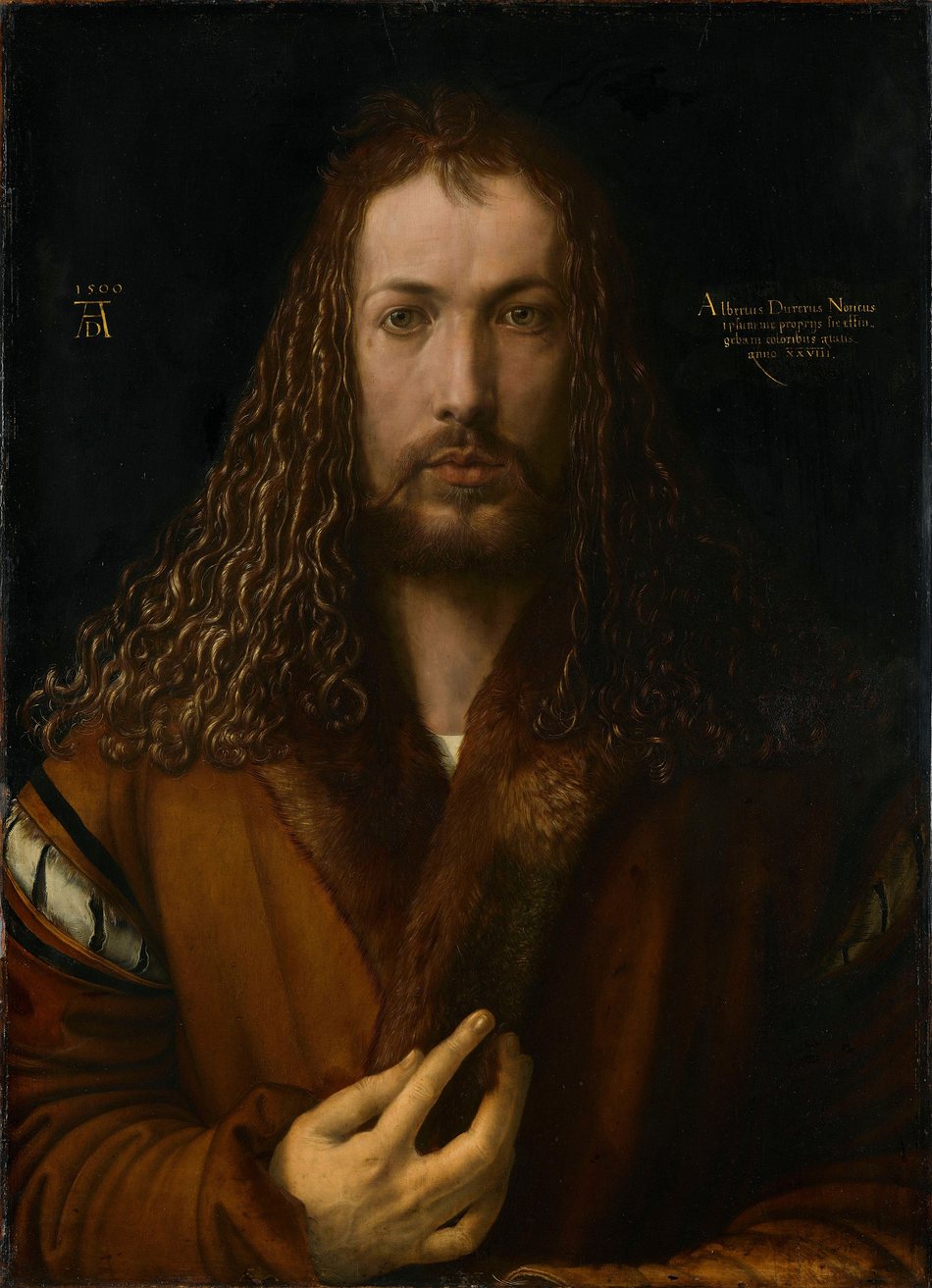
The most famous self-portrait of the Renaissance: frontal as a Christ, hand raised to the fur collar, the inscription at the right declaring that he, Albrecht Dürer of Nuremberg, painted himself thus, with undying colours, at the age of twenty-eight. A painter presenting himself not as a craftsman but as a creator.
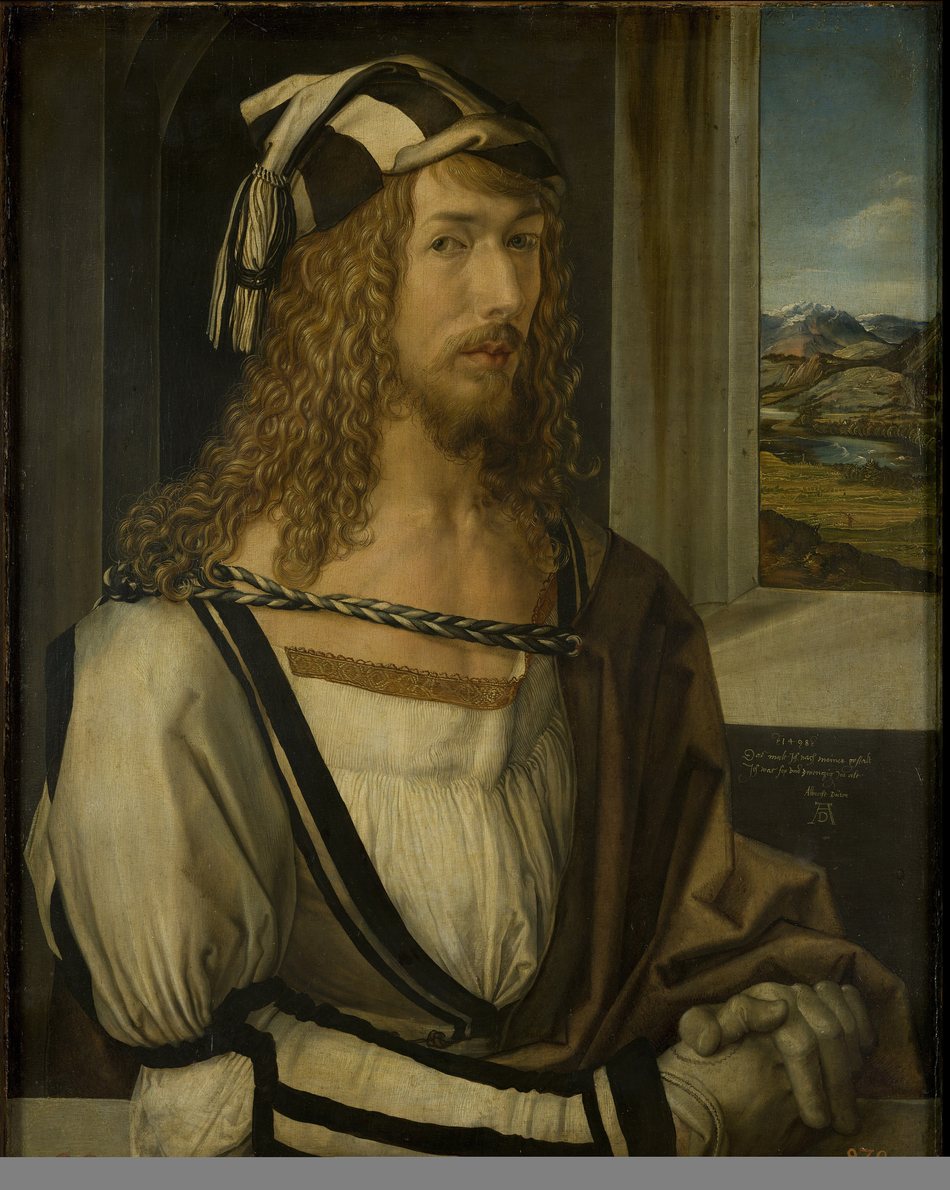
Two years earlier and already sure of himself: gloves in hand, a fashionable striped cap, and behind the window a landscape of his own invention. Painted the year the Apocalypse appeared — the young publisher of the most famous prints in Europe, dressing for the part.
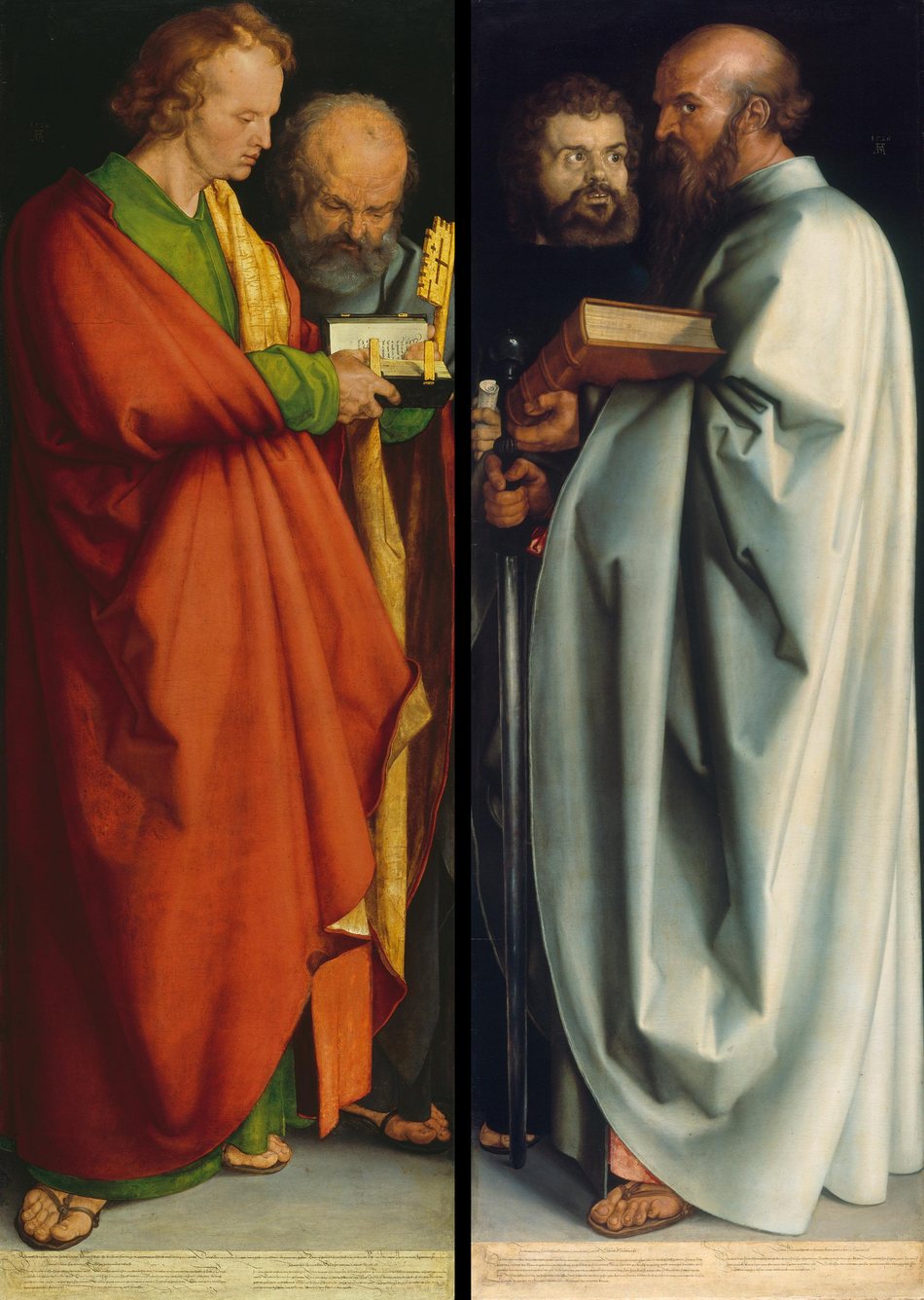
His last great painting, given not to a church but to the city council of Nuremberg: John and Peter on one panel, Mark and Paul on the other, with long passages from Luther's Bible inscribed beneath them. A gift, a warning to the council to heed the Word — and a monument in paint.
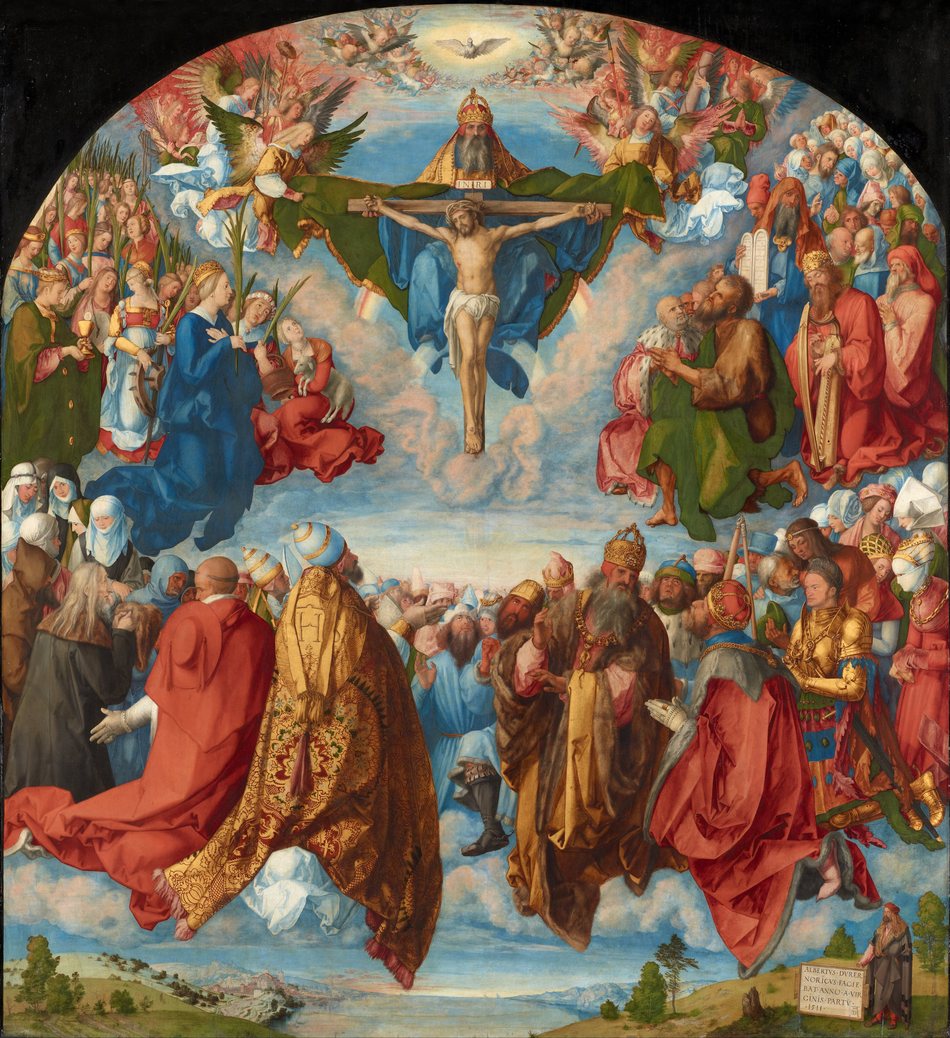
All heaven and earth adoring the Trinity in one great arc: popes and emperors, martyrs and monks crowd the clouds, and far below, tiny in a wide landscape, stands Dürer himself beside a tablet that signs and dates the work — the painter taking his place at the edge of eternity.
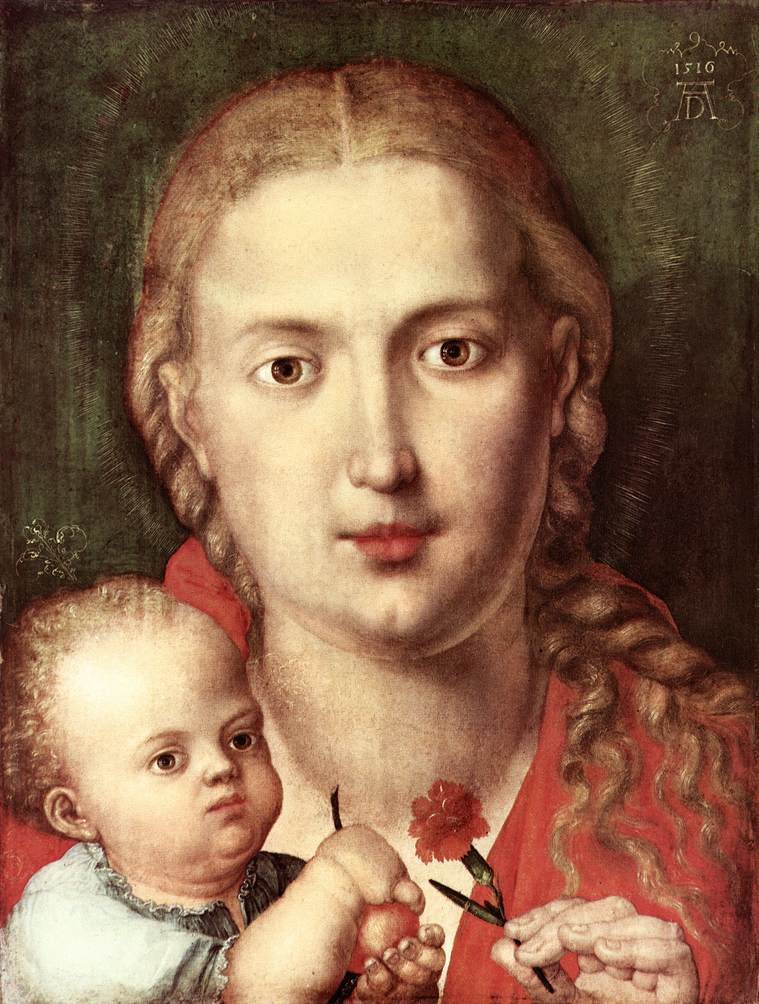
Painted when he was forty-five, in the clear light of his maturity: the Virgin holds a carnation — a flower of the Passion — and the Child reaches past it for a pear. Nothing here is wasted; even the date and the AD are worked into the dark green air behind her head.
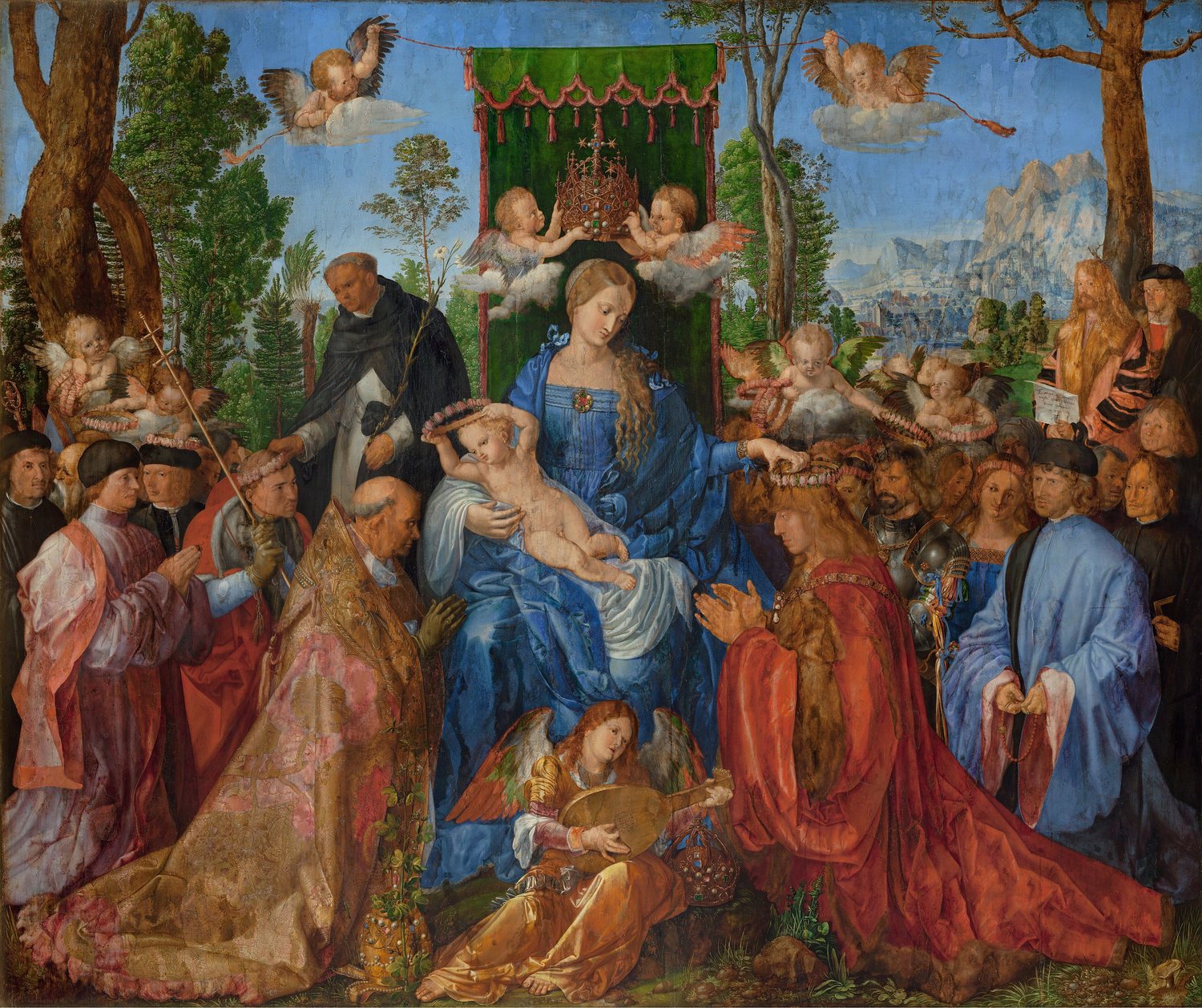
Painted in Venice in five months, and the picture that made the Venetians concede a German could paint: the Virgin hands rosaries to an emperor and a pope while putti rain down flower crowns, and Dürer — at the right, behind the tree — watches his own triumph, a sheet of paper in his hand naming him.
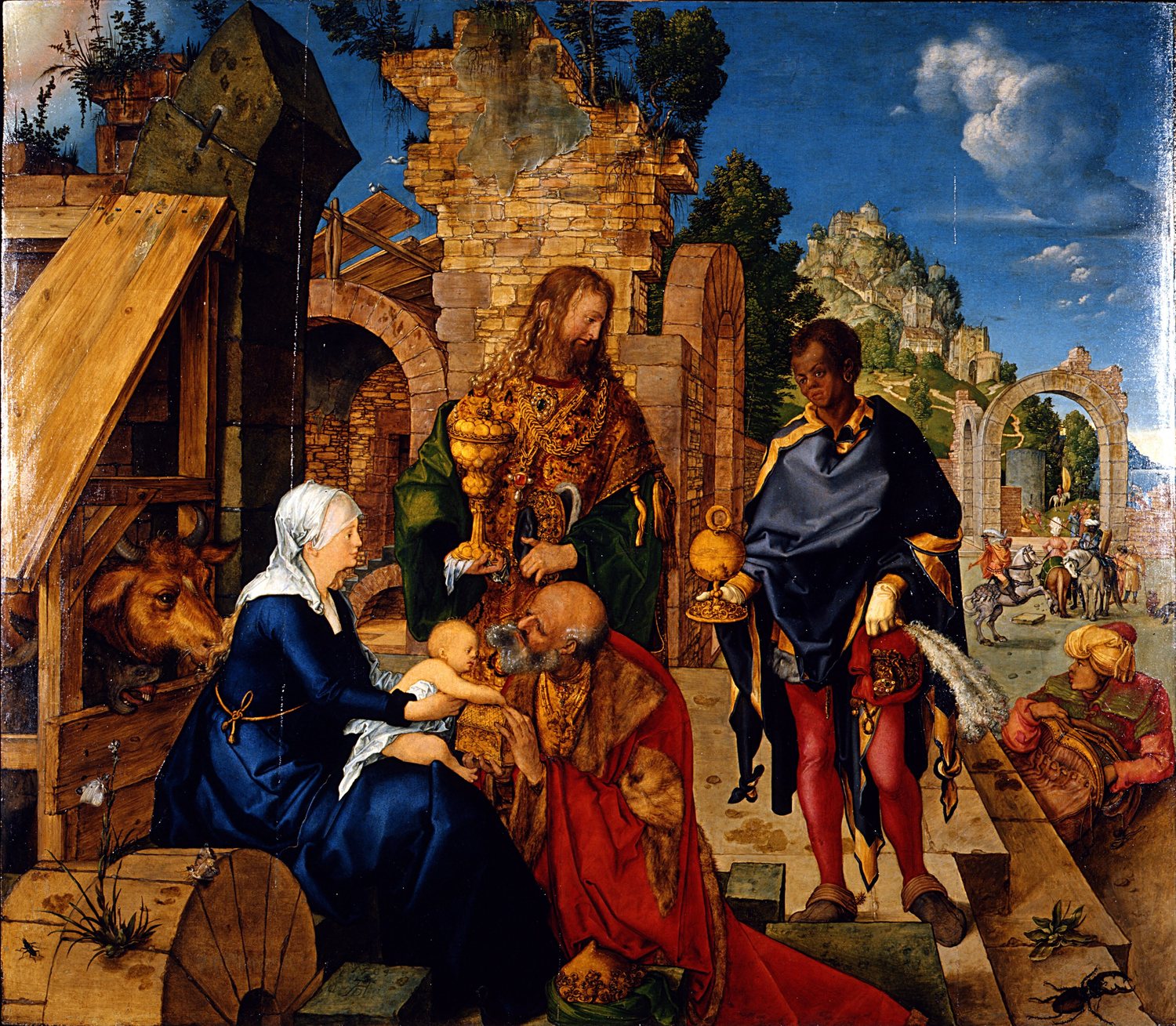
The Magi arrive in a ruined Roman archway drawn in perfect perspective, and the eldest king — kneeling, in green and gold — has Dürer's own face. Italian architecture, German detail: the picture is the treaty between the two halves of his art, signed the same year as the Adam and Eve engraving.
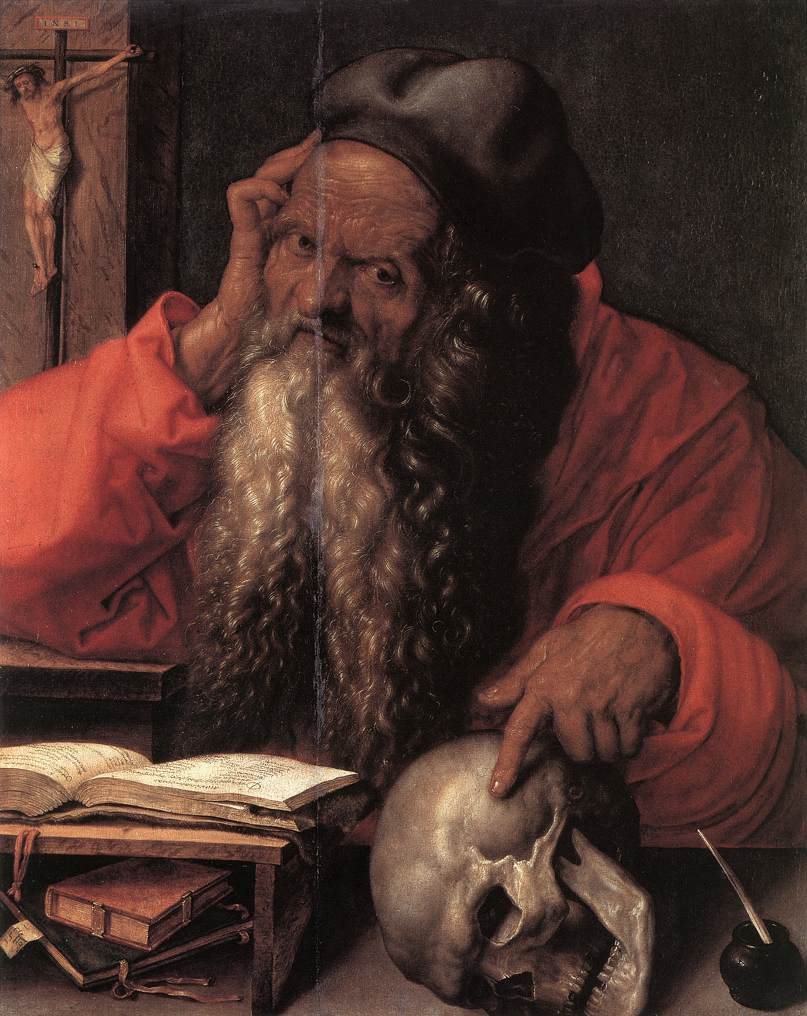
An old man thinking about death, painted from a model of ninety-three: one finger on the skull, the other marking his place in the book, an hourglass and a crucifix on the wall behind. Dürer gave it away in Antwerp and recorded the gift in his diary — Jerome was his own patron saint of scholarship.
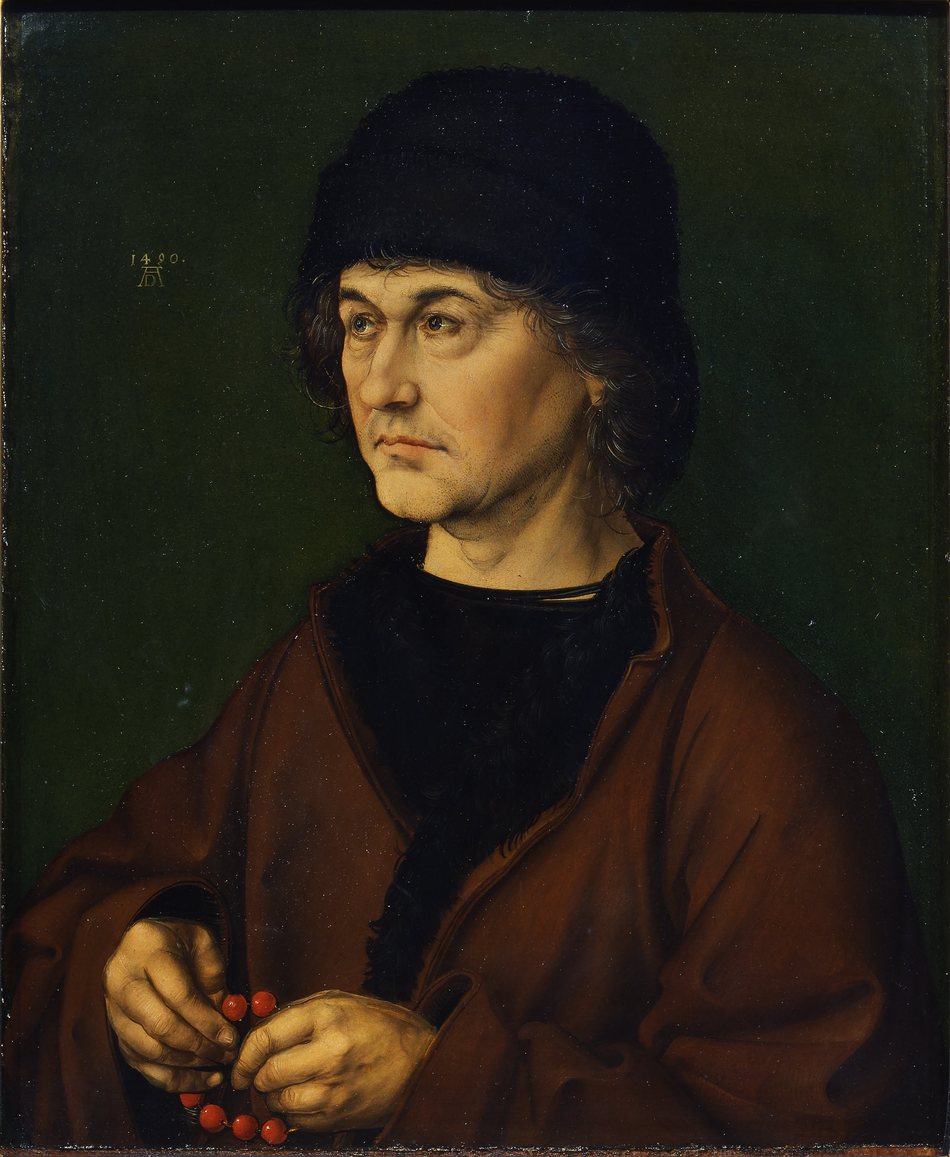
Painted at nineteen, of the Hungarian goldsmith who had taught him to use his hands: Albrecht the Elder in his best brown coat, turning a rosary in his fingers, against the dark green his son would use for decades. The apprentice's examination piece is already a portrait of character, not just of a face.
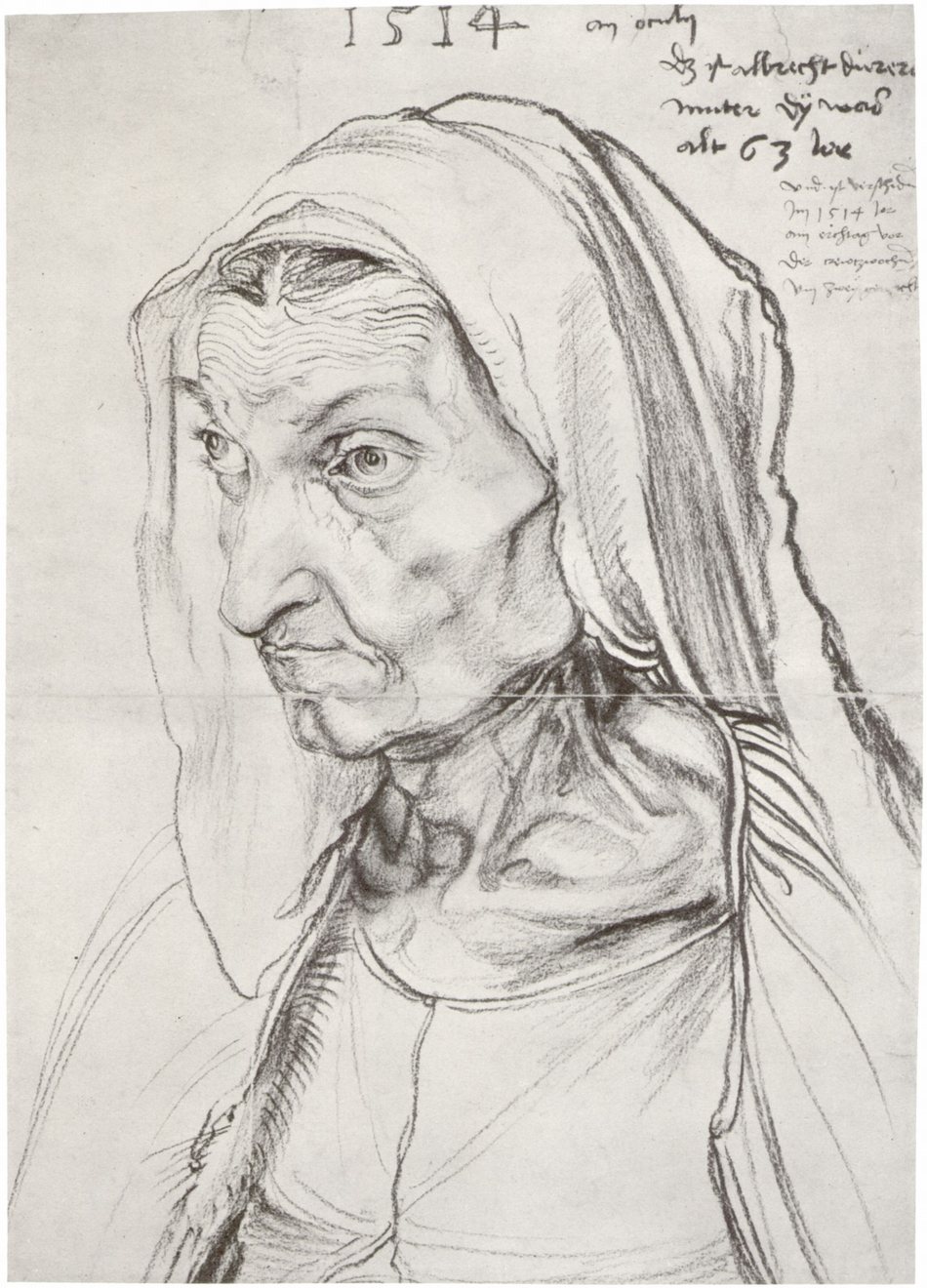
Drawn two months before her death, and the least merciful portrait a son ever made: Barbara Dürer at sixty-three, worn by eighteen children and a lifetime of work, every line of age set down without flattery. His inscription above her head records the day and hour she died.
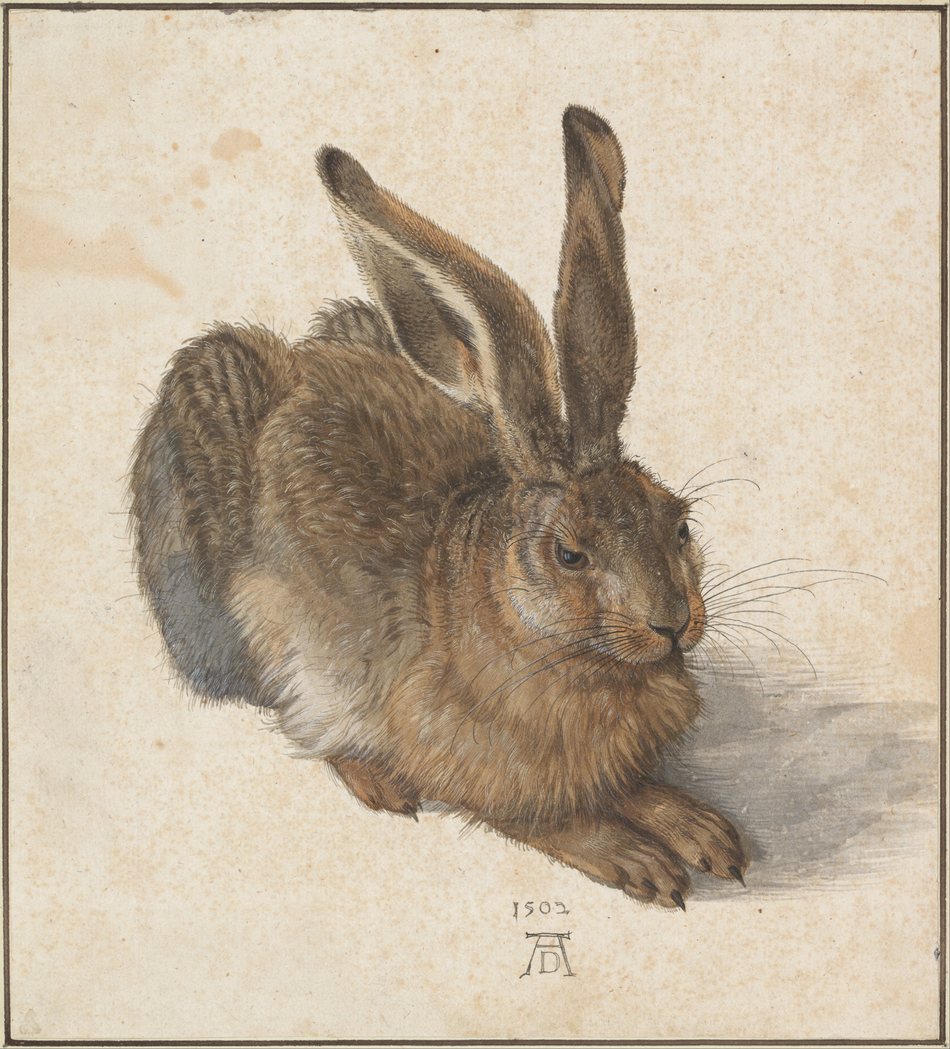
The most famous animal study in art: a hare built from thousands of individual strokes, its shadow thrown across the paper, the window of the studio reflected in its eye. Whether Dürer painted it from a living hare or a stuffed one, scholars still argue — the picture itself refuses to say.
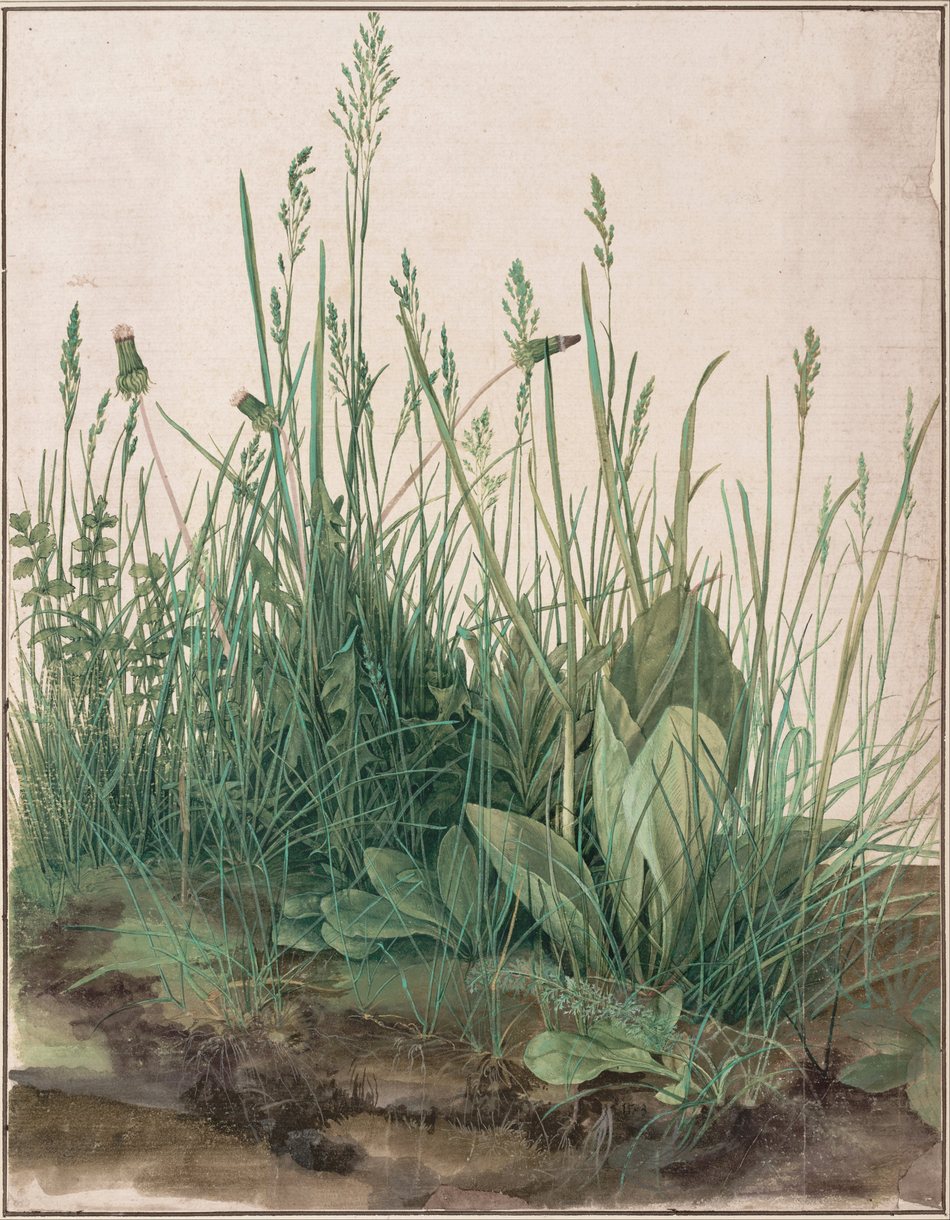
A square of meadow painted at ground level, blade by blade — plantain, dandelion, grasses going to seed — with nothing in it that a painter of altarpieces was supposed to notice. It is the companion manifesto to the Hare: nature looked at so closely that looking itself becomes the subject.
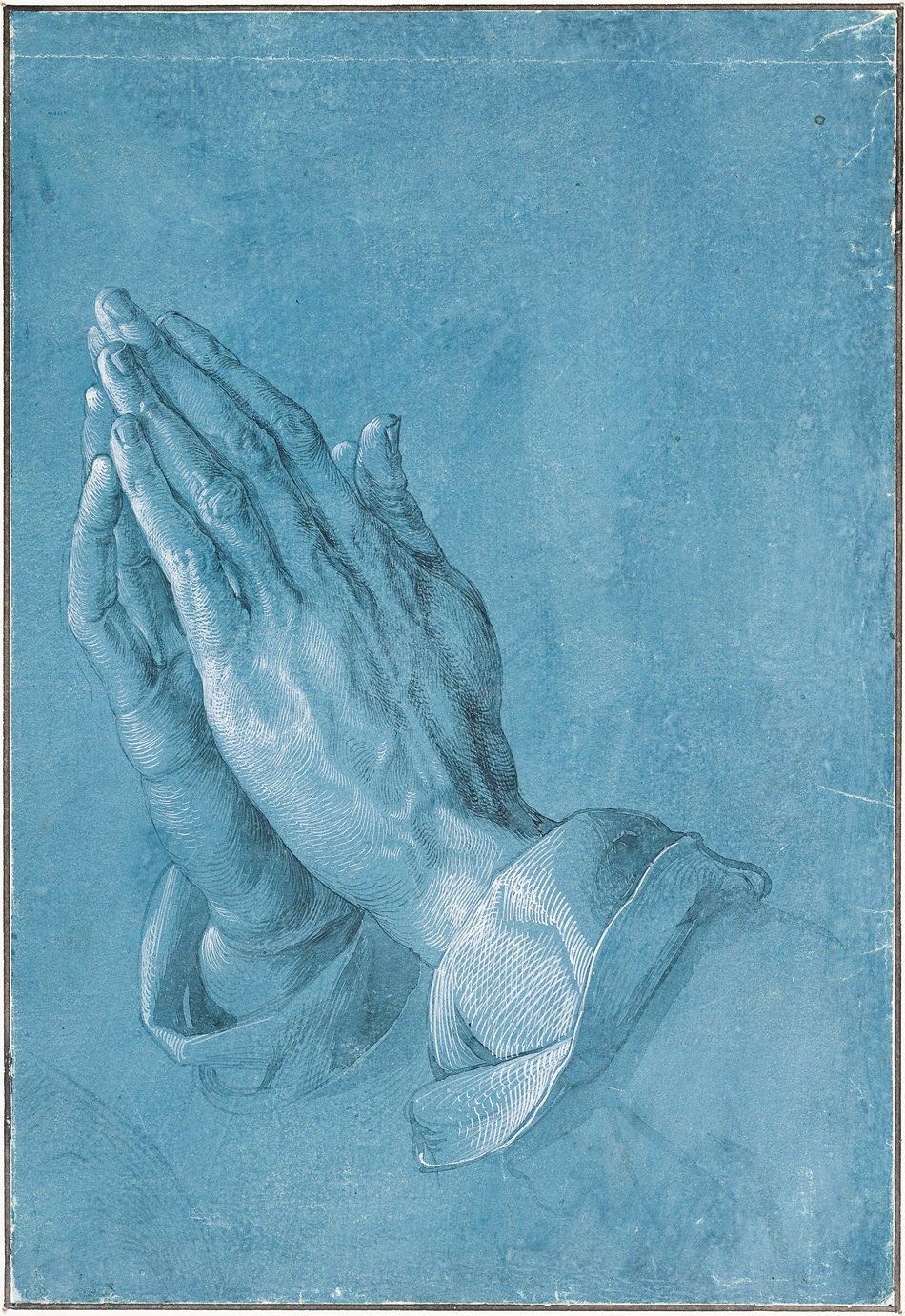
A study for an apostle's hands, drawn in ink on blue prepared paper with the lights raised in white — and now the most reproduced drawing in the world, printed on everything from prayer books to gravestones. Dürer made it as a workshop note; posterity made it an icon.
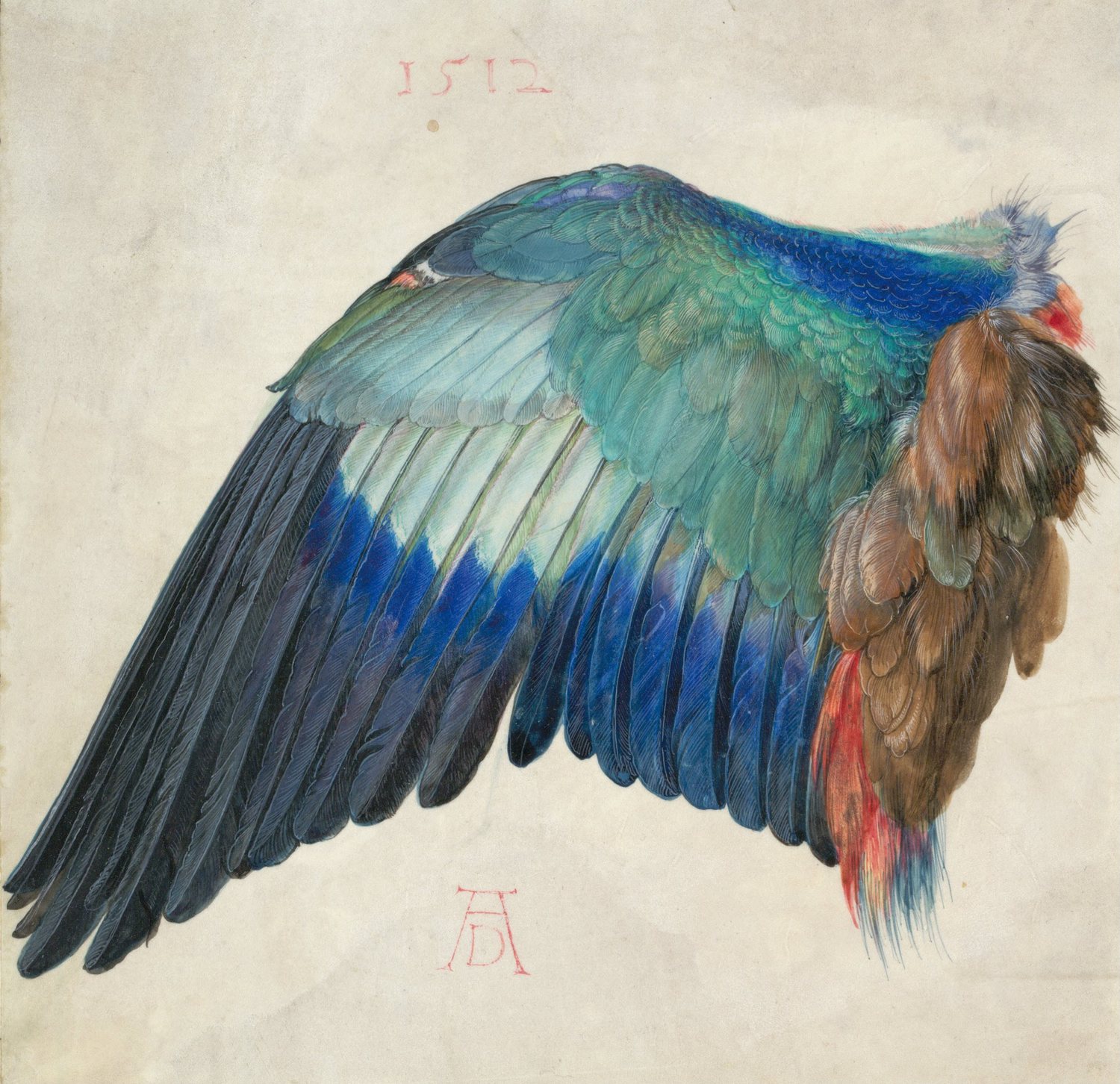
One wing of a dead roller, painted feather by feather from the corpse: emerald, turquoise and deep blue laid over the brown of the coverts, dated 1512 and signed with the AD. A jewel of a study — colour itself, examined like a specimen and loved like a relic.
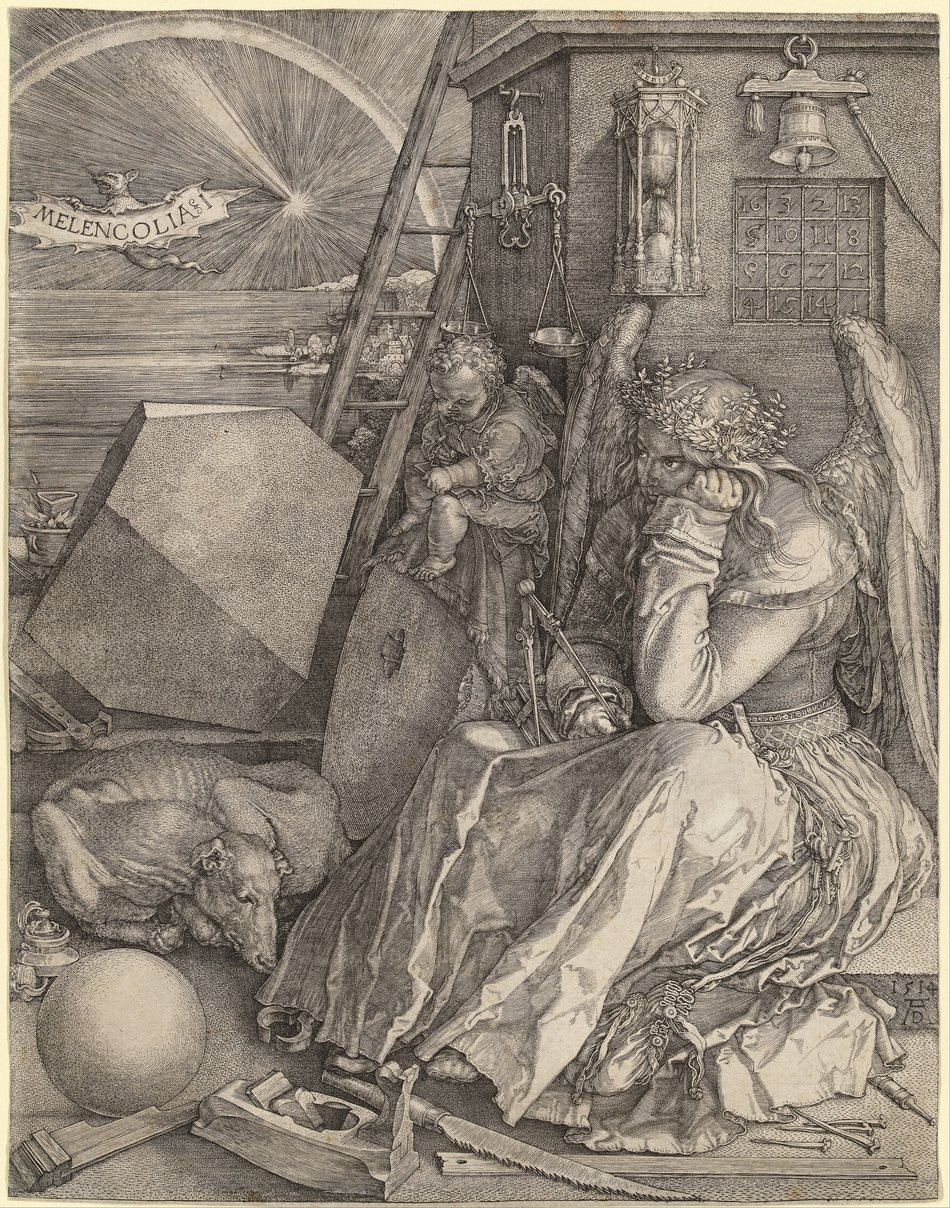
The winged figure sits idle among the tools of geometry and craft — compass, plane, saw, a magic square on the wall, a bat carrying the title through the dusk. Five centuries of writers have tried to solve this engraving; it remains what it was: the portrait of a mind surrounded by instruments it cannot, for the moment, use.
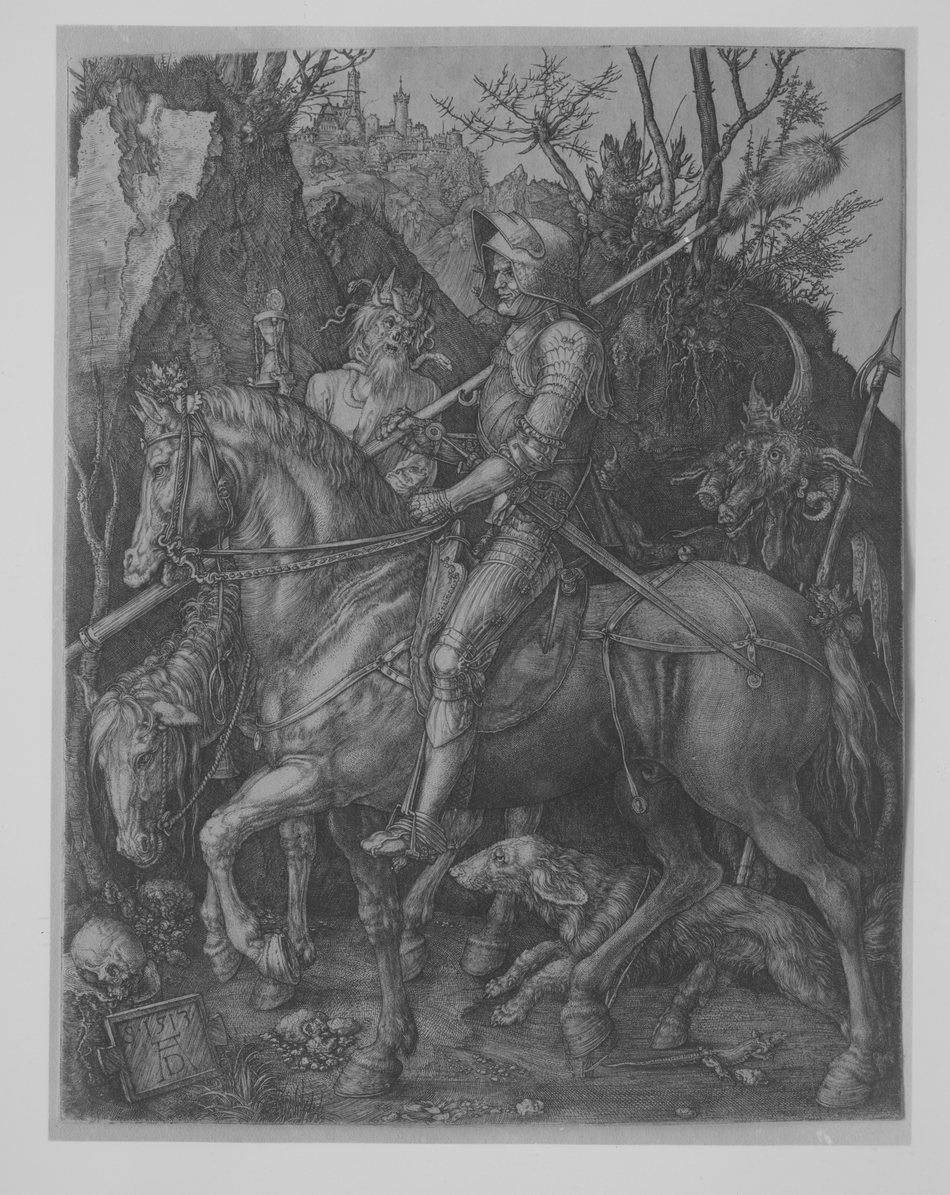
The Christian knight rides through a gorge without looking at the two figures who ride with him — Death on a pale horse, holding an hourglass, and the Devil with a pig's snout behind. Every hair of the horse, every link of the armour is burin work: the most technically finished engraving of the three master prints.
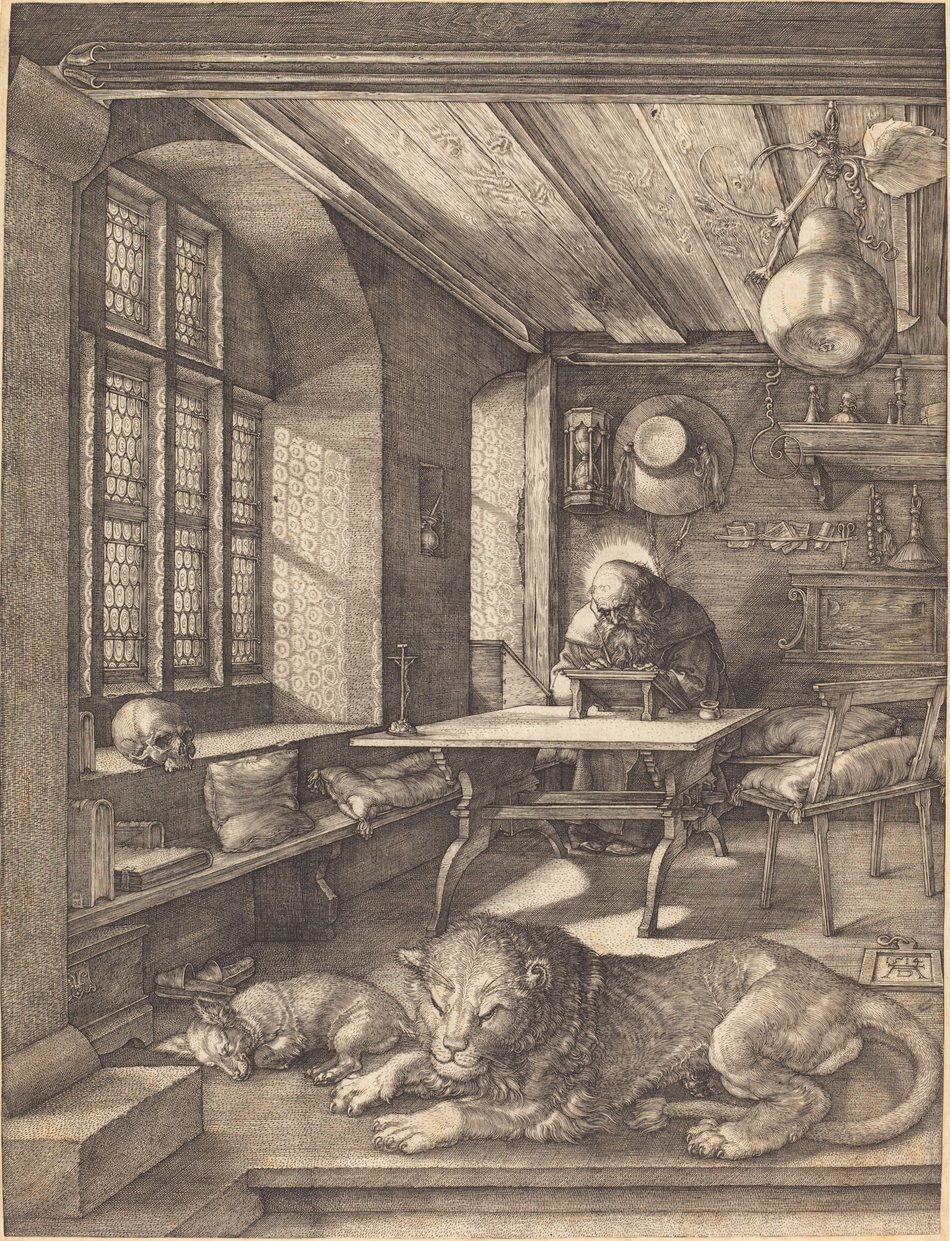
The third of the master engravings, and the quietest: Jerome writing in a sunlit room, his lion and dog asleep in the foreground, light flooding through the bull's-eye window panes and pooling on the floor. Nothing happens in this picture, and everything is in its place — scholarship as a state of grace.
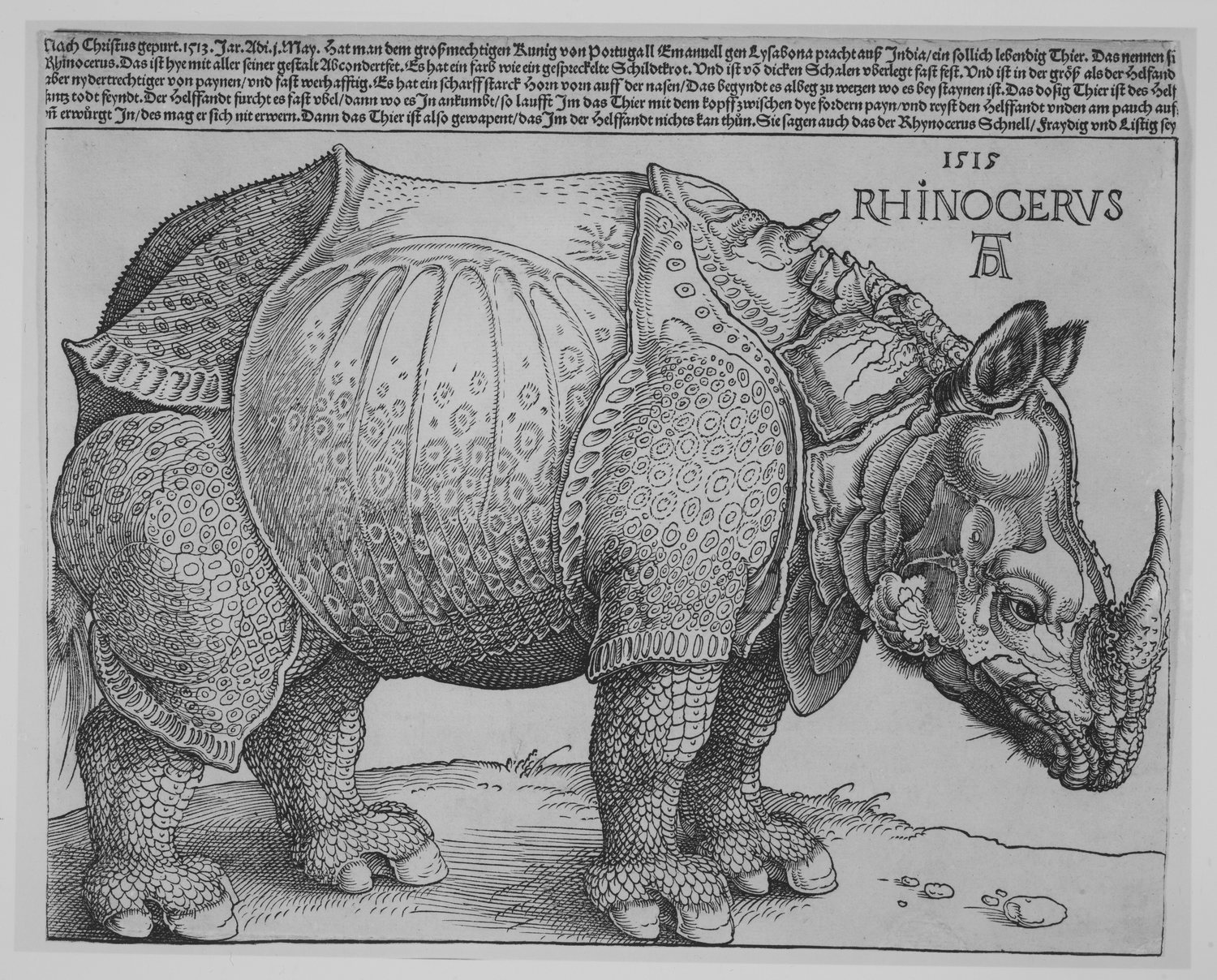
Dürer never saw the animal: he worked from a sketch and a letter sent from Lisbon, where an Indian rhinoceros had arrived as a gift for the king. He armoured it in riveted plates, gave it a spare horn on its shoulders — and his invention, reprinted for two centuries, became Europe's picture of the rhinoceros.
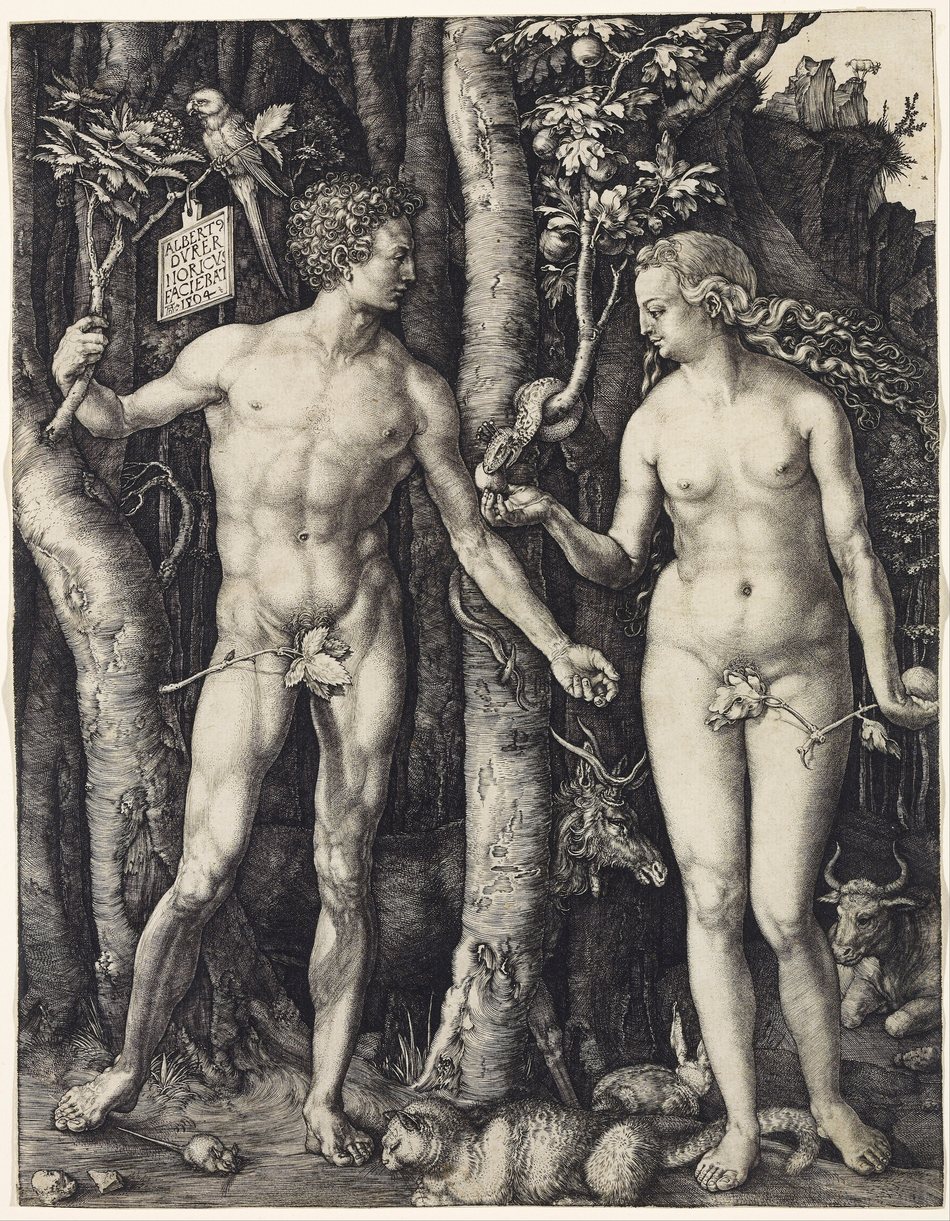
His first great engraving and his manifesto of proportion: Adam built like a classical statue, Eve turning with the apple, and around them the cat, the mouse, the elk, the ox and the parrot — the four temperaments of man, waiting for the Fall that will set them at war.
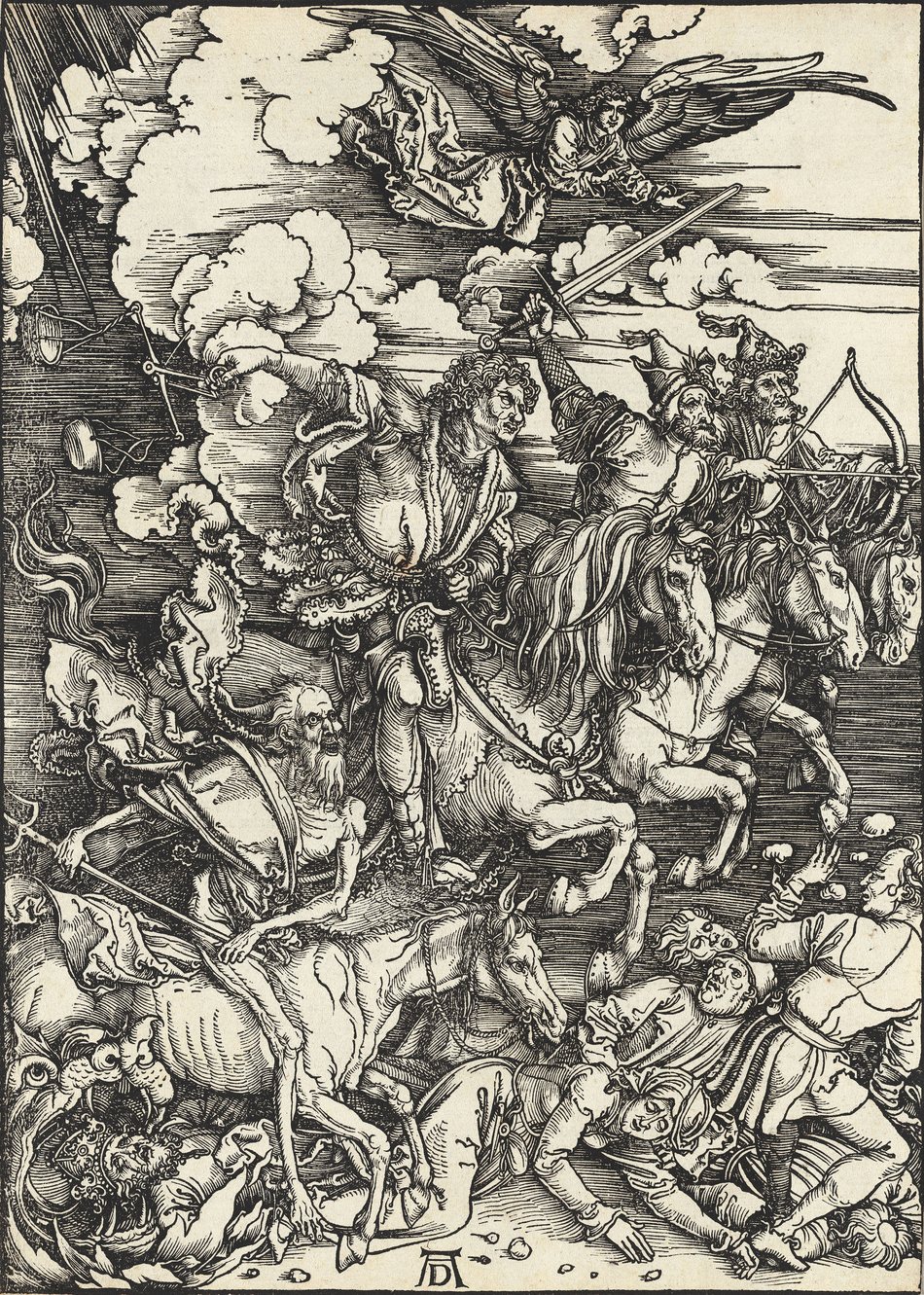
The most famous sheet of the Apocalypse book: Death, Famine, War and Plague riding down mankind in one trampling diagonal, while the angel's trumpet sounds above and the earth opens below. Dürer was twenty-seven; the woodcut's violence of line had no precedent in print.