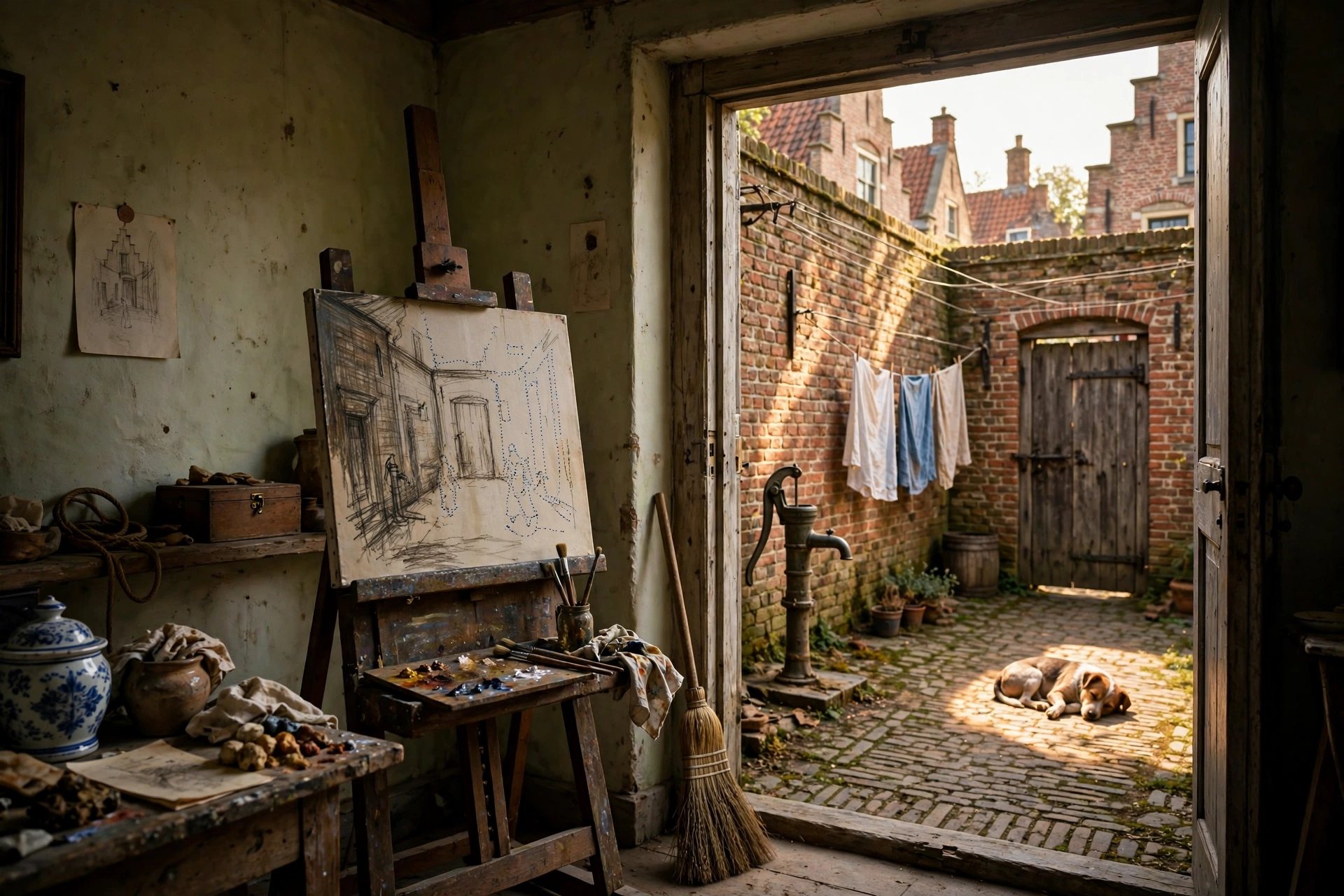
Before Vermeer, there was de Hooch — the first master of the sunlit Dutch interior. His world is courtyards and tiled rooms at the cleanest hour of the day, seen through doorways that open like chapters: a woman, a child, a dog asleep in the sun, and light doing all the talking.
His signature device has a Dutch name: the doorkijkje, a view through a doorway into a second room, a corridor, a courtyard — two or three spaces deep, each holding its own quality of light. De Hooch builds depth the way a house is built: room behind room, sun behind sun.
Above the archway in his most famous courtyard hangs a carved stone tablet with a verse about fleeing the plague into St Jerome's valley. The stone was real — it came from a Delft monastery — and it survives today, kept in Amsterdam, long after the little courtyard itself was swept away.
His Delft brickwork is painted brick by brick, the mortar lines as regular as the real thing, the paving worn exactly where feet would wear it. The courtyards are so precisely observed that the very houses have been argued over and identified — a portrait of a place, not just a scene in it.
His rooms argue that order is a form of beauty: tiles swept to a shine, brass polished, a broom placed like an object in a still life, a child's hair being searched for lice as an act of love. Art historians read these pictures as the Dutch domestic ideal, painted at the moment it was cleanest.
De Hooch was painting sunlit interiors in Delft before Vermeer turned to them, and the younger man's great theme — a figure in a bright room, geometry, silence — grows partly out of de Hooch's courtyards. In the 1650s they were neighbours in one small town; the influence ran first from the elder.
His marble floors are laid out on a perspective grid so exact that you could rebuild the room from the painting, tile by tile. The floor is the engine of the picture: sunlight walks across it in squares, and every figure stands on a measured world.
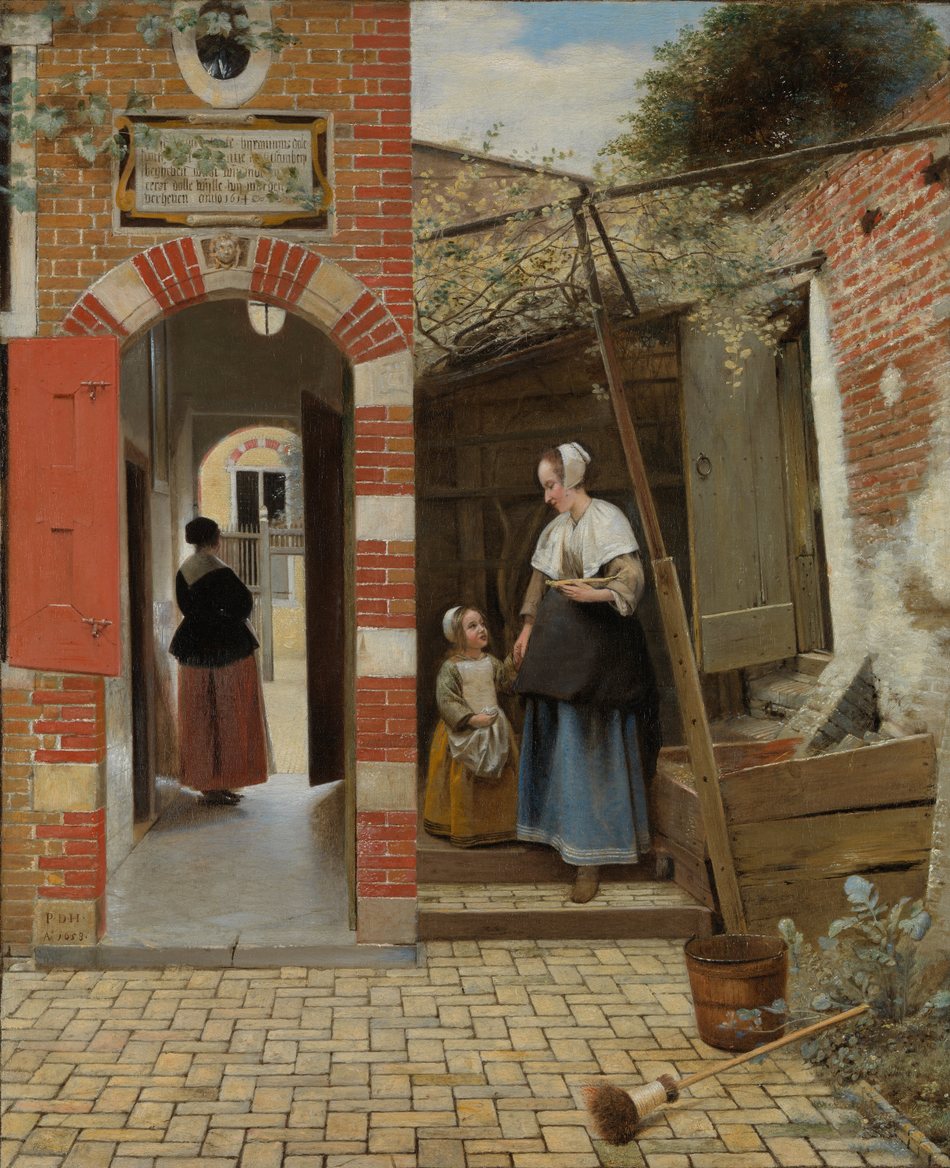
His masterpiece and the most famous courtyard in Dutch art: a maid and a child in the passage, the mistress in the side court, brick, stone and sunlight in perfect calm. Above the arch, the real carved tablet from a Delft monastery — the painting is dated 1658, and nothing in it has aged a day.
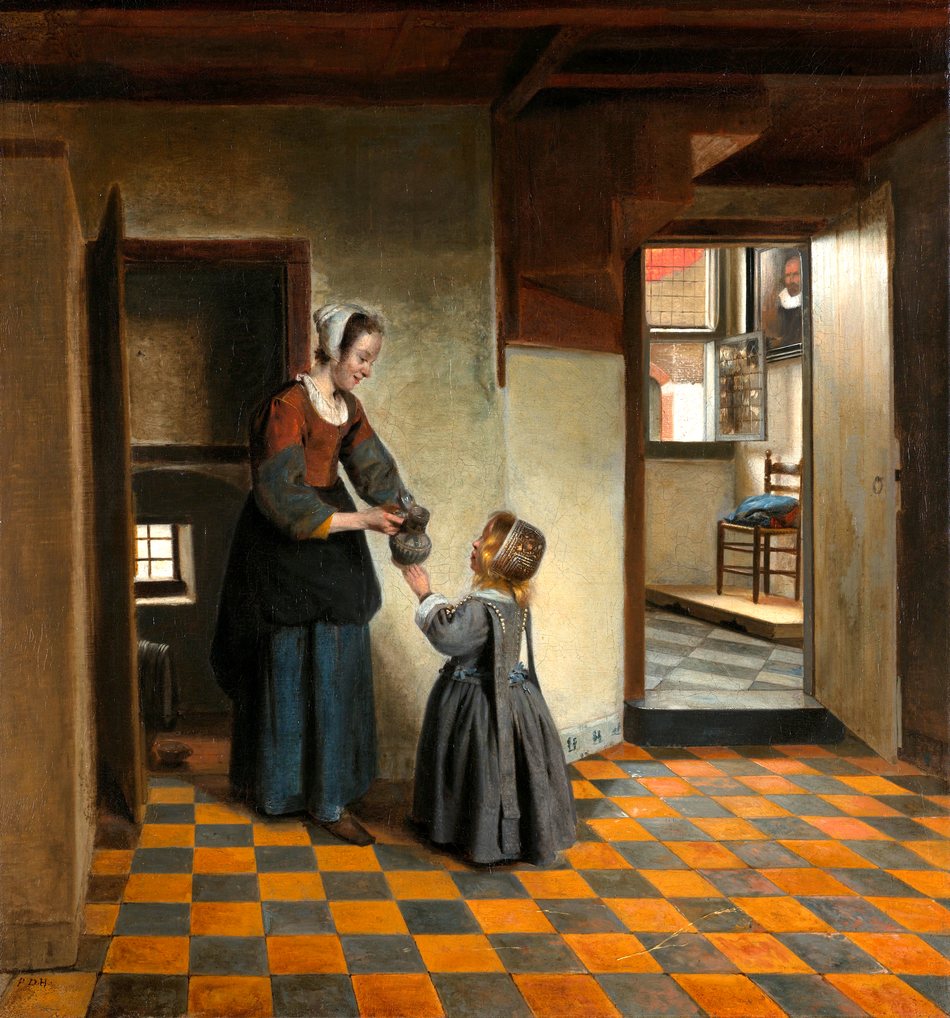
A mother gives her small daughter a drink in a cool pantry hall, on a floor of orange and black tiles laid like a chessboard of light — and through the open door behind them, a second room glows. It is the doorkijkje at its most tender: depth itself, domesticated.
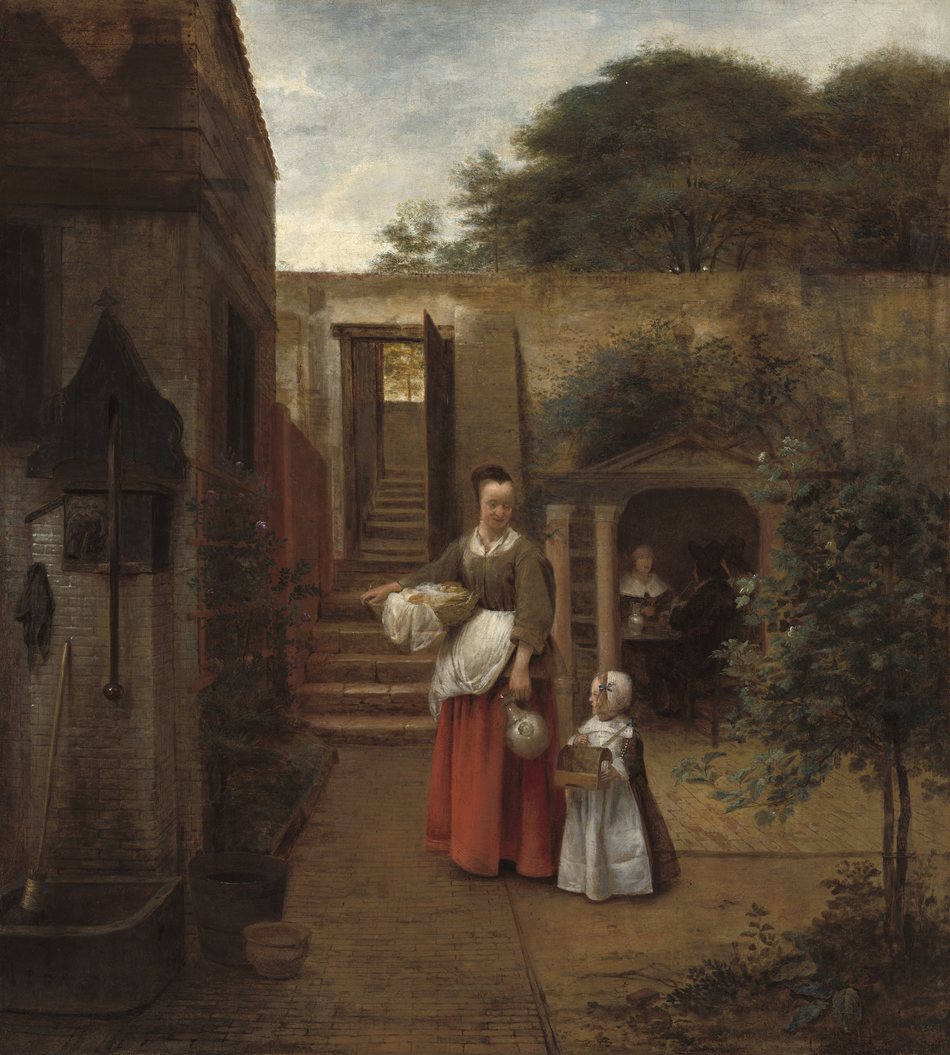
A mother and child in a walled garden court, the town shut out, the sky let in. De Hooch's Delft years are full of these small enclosures where the world is reduced to brick, green and two figures — and somehow contains everything.
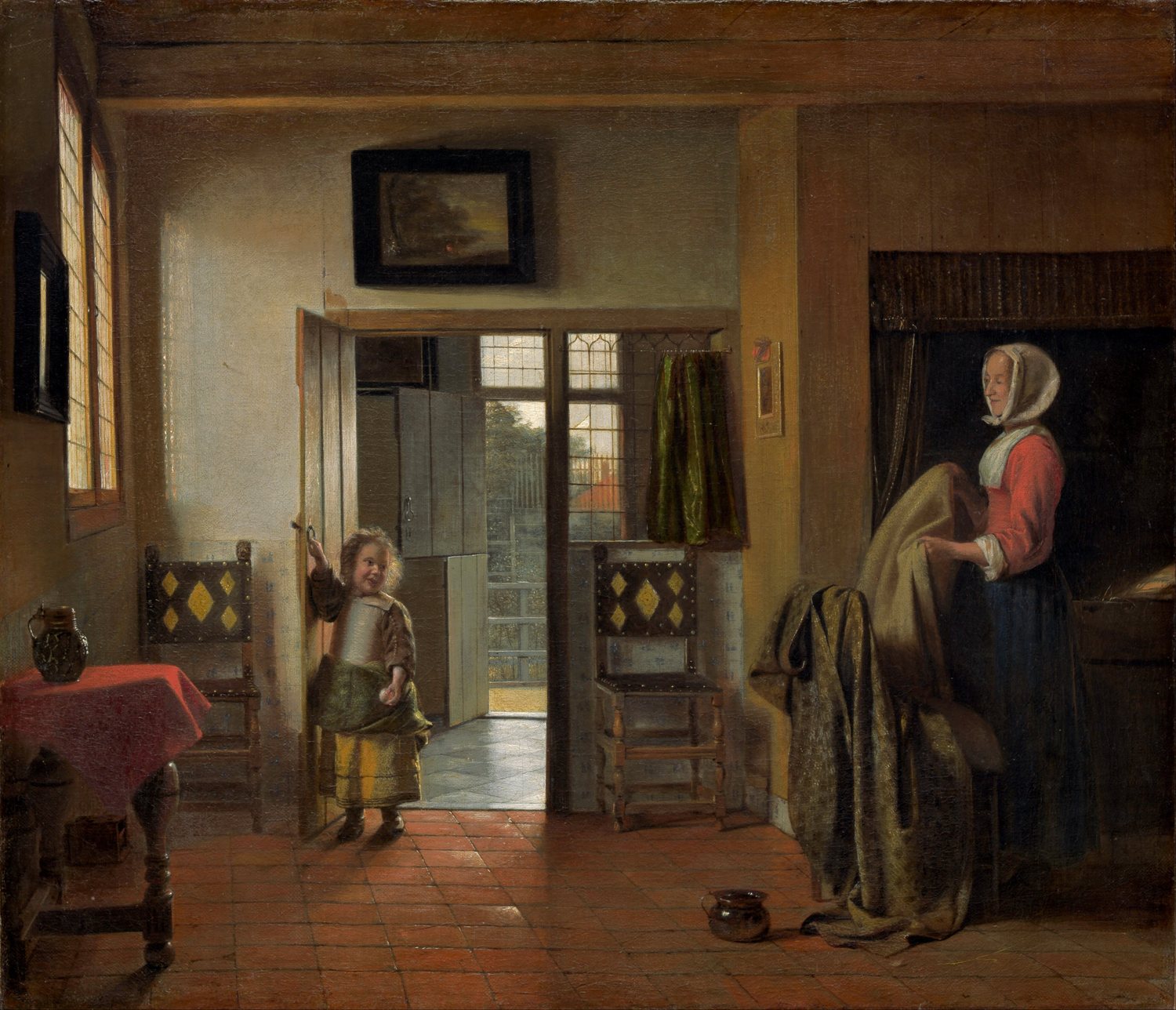
A woman makes the great box bed while her little girl stands in the doorway holding her skirt, halfway between the dark room and the bright court. Morning, in one image: the day being aired, the bed being made, the child deciding which world to enter.
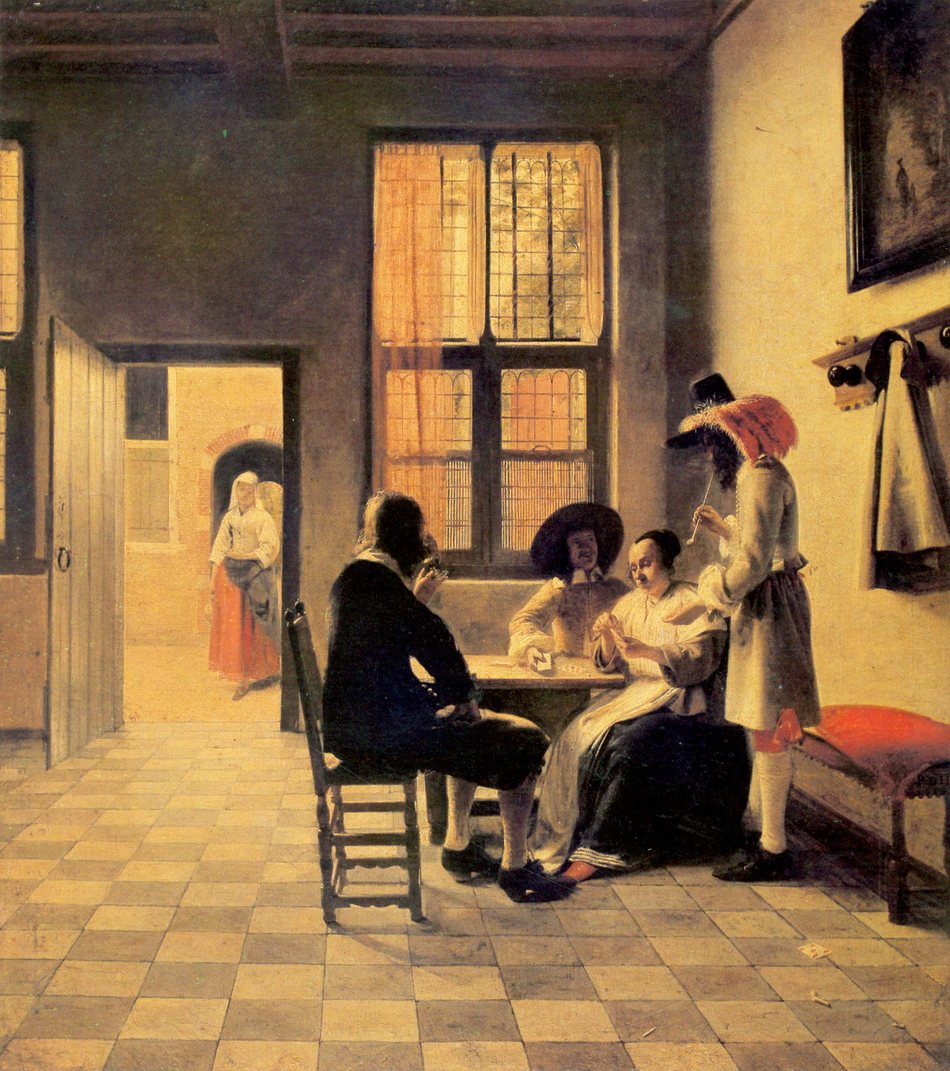
A company plays cards in a room flooded with late light, the window glowing like a furnace door, a servant girl watching from the doorway behind. De Hooch paints the light first and lets the card game happen inside it — the true subject is the hour.
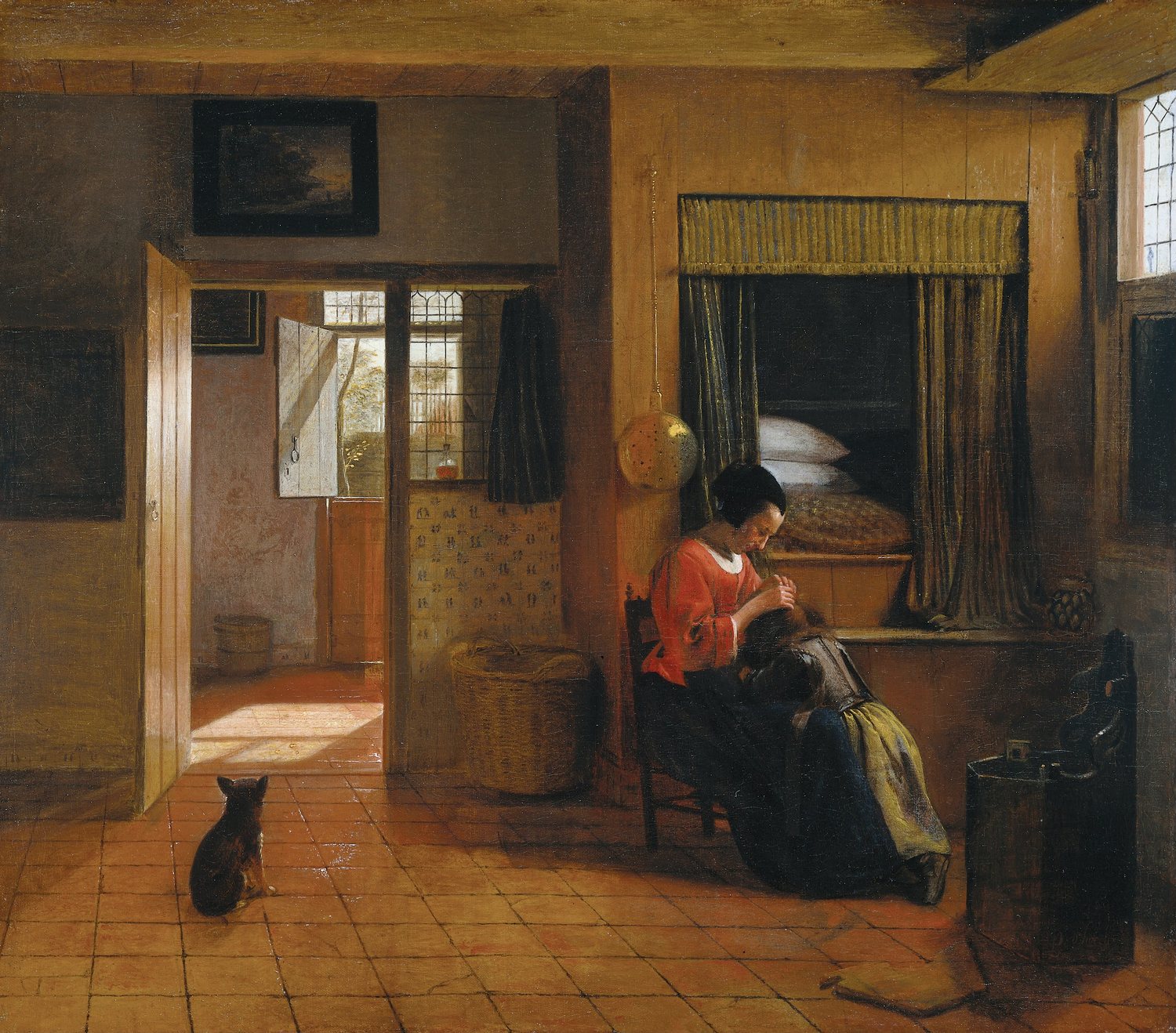
In a tiled room by the box bed, a mother searches her child's hair — the unglamorous chore that Dutch emblem books praised as a picture of care itself. The little dog waits, the sun does the lighting, and de Hooch makes hygiene look like tenderness, because it was.
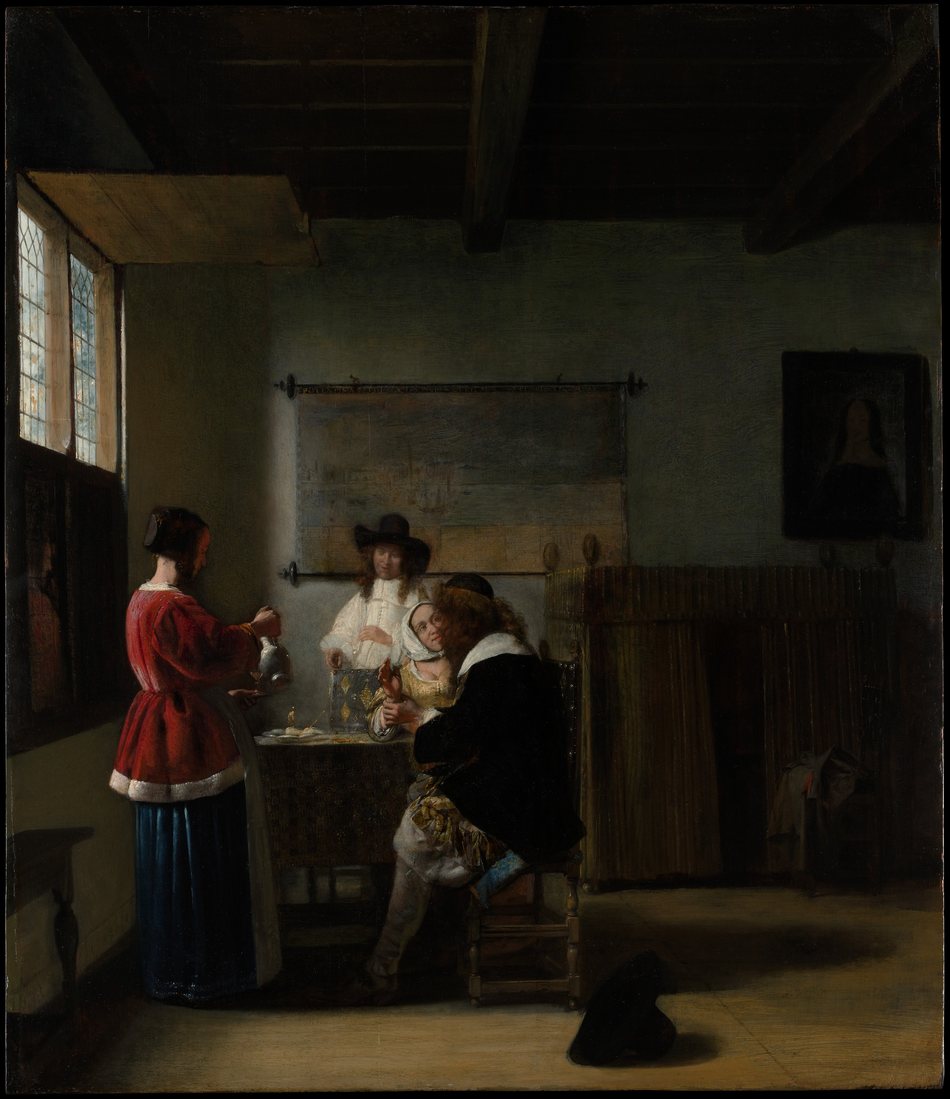
An early interior, darker than the Delft sunrooms to come: visitors around a table, a map on the wall, a dog in the foreground keeping the painter's accounts. The geometry is already de Hooch — doors, windows and people arranged like furniture of light.
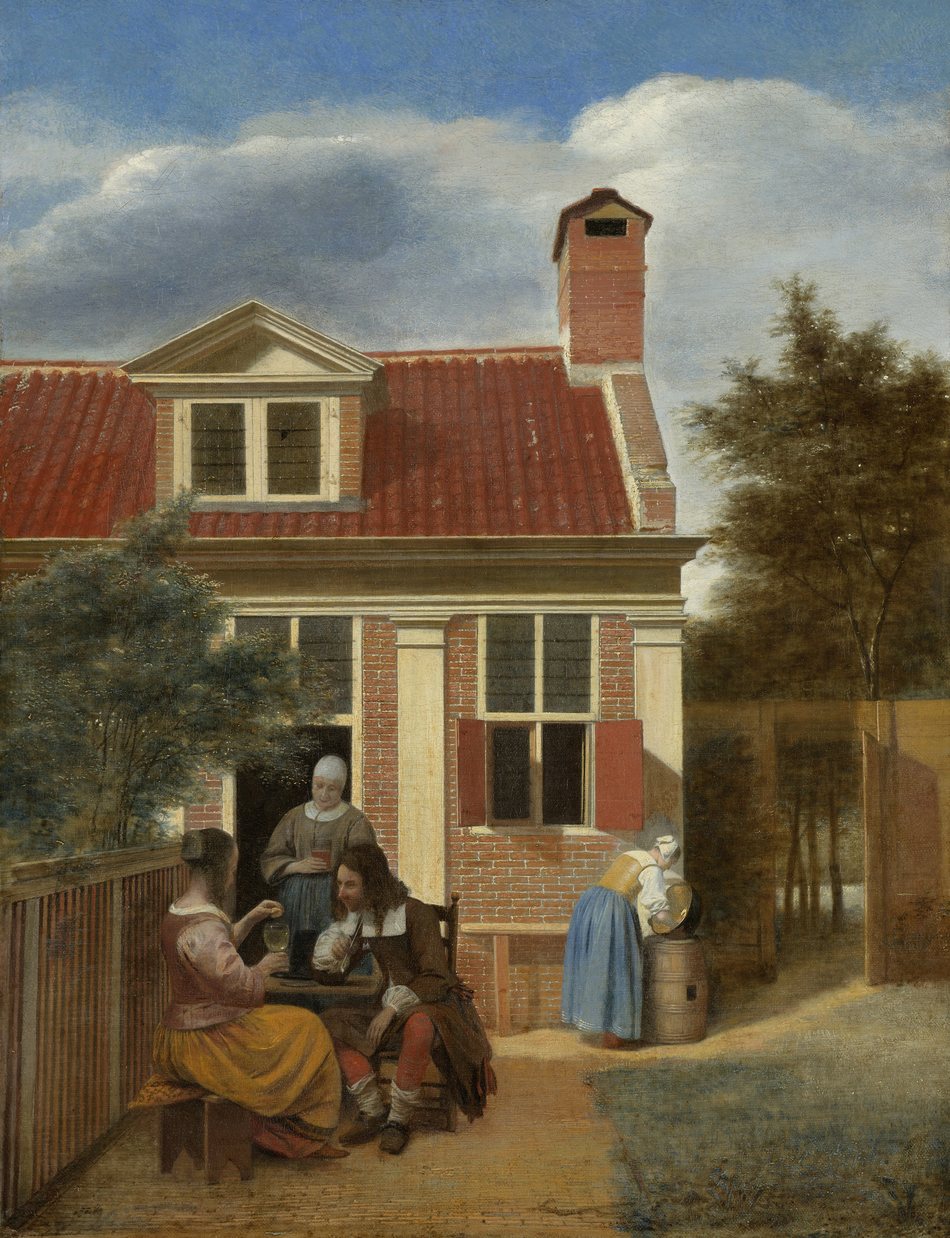
From the Amsterdam years: a family at a table in the yard behind a tall house, the city domesticated into one fenced garden. The bricks are Amsterdam bricks now, the light a degree cooler — the courtyard idea travelled with him and adapted.
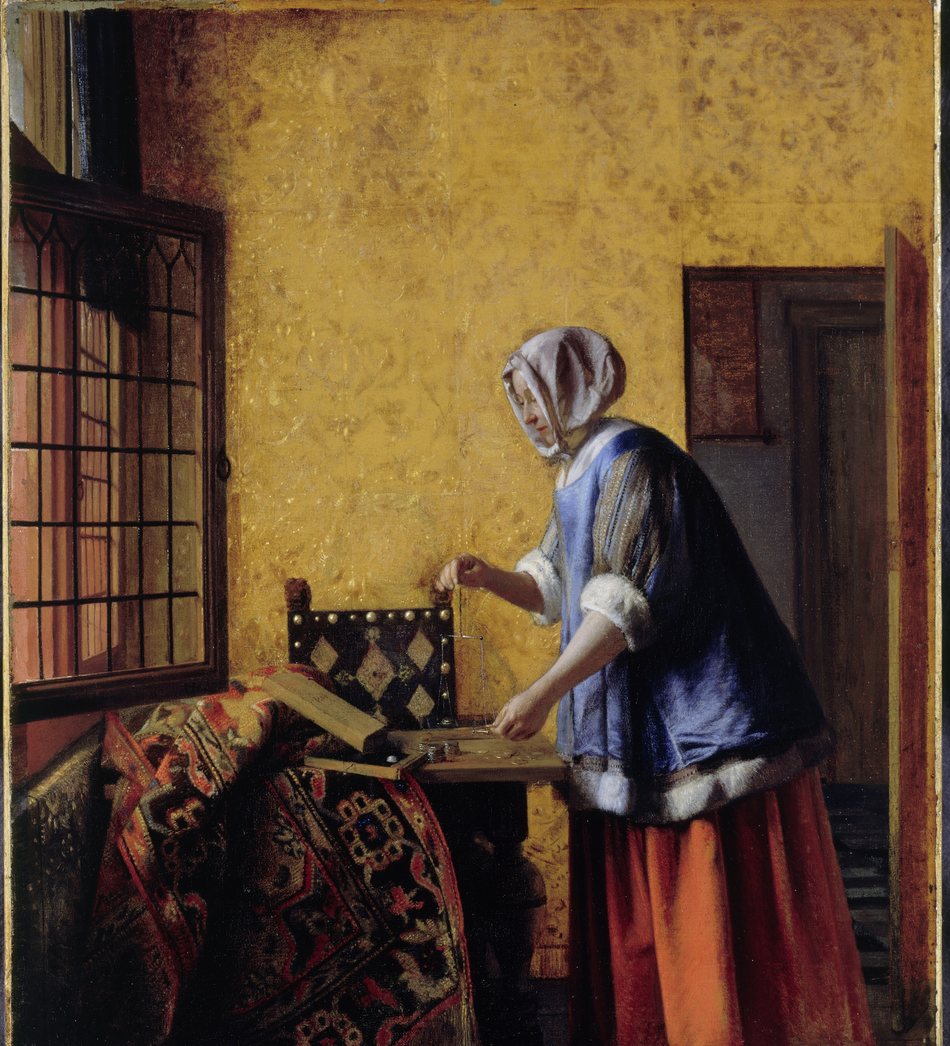
A woman weighs gold coins at a table in a room hung with gold leather, the little balance trembling in her fingers. Berlin catalogues it as de Hooch; its stillness has often made viewers think of Vermeer — the two Delft masters meet in this small, exact, golden room.
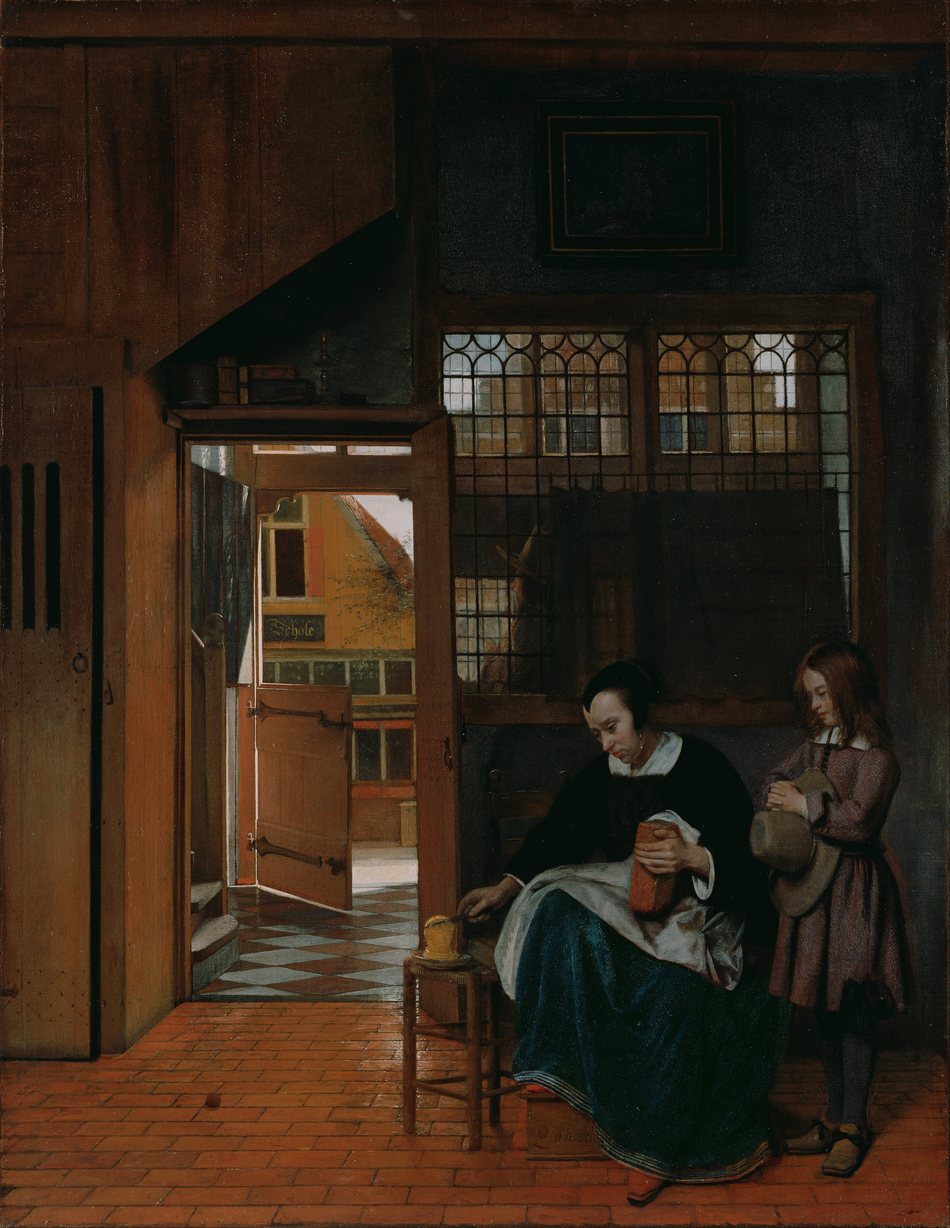
A mother butters bread for her son before school, the lunch basket ready, the doorway behind them opening through two more spaces of light. Nothing could be more ordinary, and de Hooch gives it the gravity of a ceremony: breakfast as the first sacrament of the Dutch home.