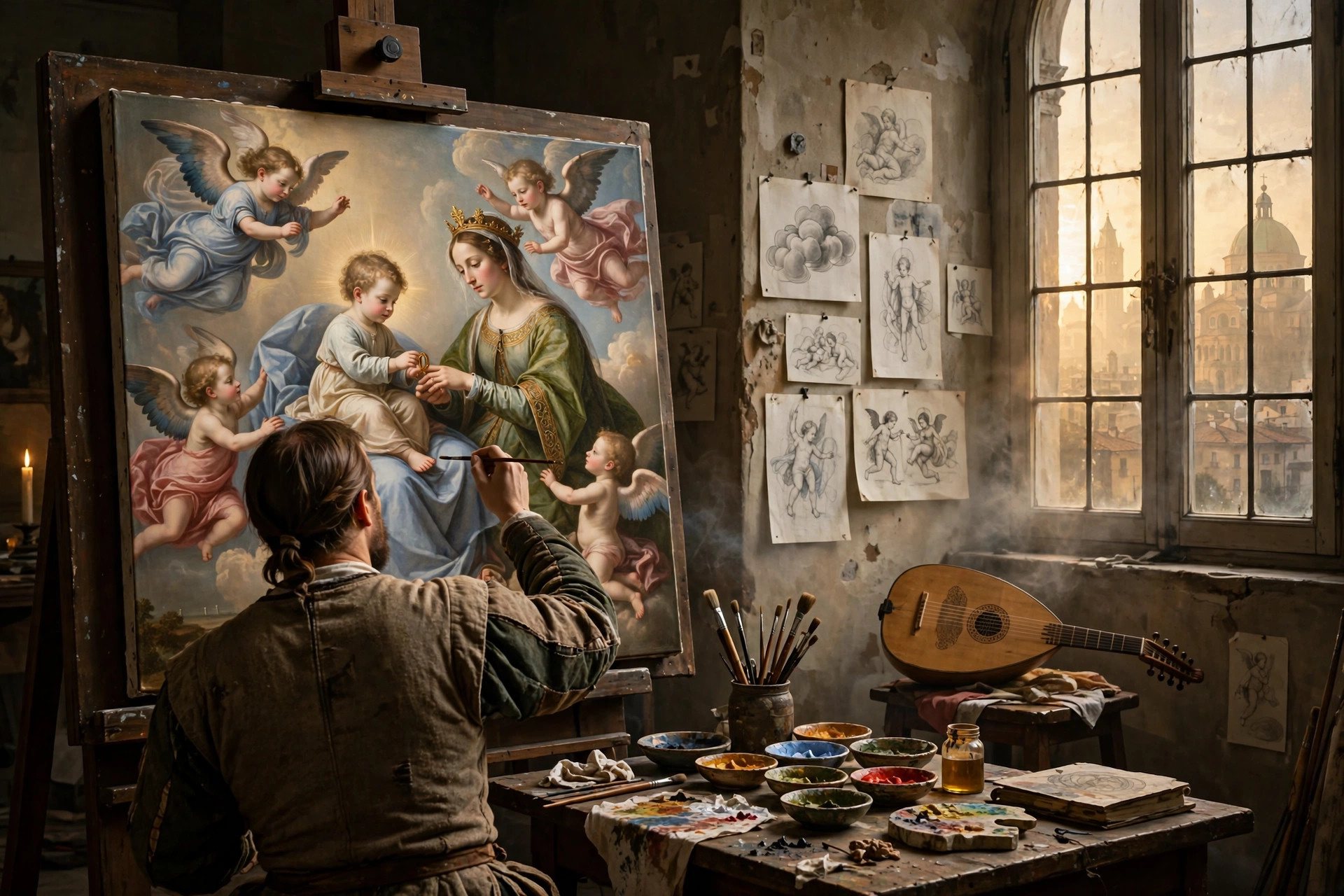
He never left his corner of Emilia, probably never saw Rome — and reinvented painting anyway. Correggio dissolved form in light and tenderness: flesh soft as breath, glances half-lowered, heavens that open in spirals of bodies. Raphael's grace and Leonardo's smoke pass through his hand and come out warmer than either.
Antonio Allegri took his name from his small home town, Correggio, and his whole career unfolded within a few dozen miles of it — Parma, Modena, Mantua. No Roman years, no famous master. He formed himself on Mantegna's example, on Leonardo's passing shadow in Milan, and on looking. The most influential Italian painter of his generation was, geographically, a provincial.
His sfumato goes beyond Leonardo's: contours are not just blurred but breathed away, flesh modelled in transitions of warm half-tone with no line anywhere. Underdrawing gives way to painting directly, revising in the wet paint — pentimenti everywhere. The effect his contemporaries called grazia is in fact a discipline: nothing hard may survive to break the spell of tenderness.
In Parma Cathedral (1526–1530) he painted the Assumption as a vortex: the Virgin rising through rings of apostles, angels and saints, bodies foreshortened from directly below, the whole dome dissolved into golden light. A canon of the cathedral sneered that it was 'a hash of frogs' legs'. It became the model for every Baroque ceiling in Europe — the Baroque begins in this dome.
The domes demanded di sotto in su — figures seen from underneath, soles of feet and chins first, limbs telescoped by perspective. Correggio learned the problem from Melozzo and Mantegna and solved it in flesh rather than geometry: his foreshortened angels are convincing not because the drawing is provable but because the bodies feel weightless, already halfway into light.
In the Holy Night the light does not fall on the scene — it is born in it, radiating from the Christ Child onto his mother's face and the shepherds' hands. Correggio builds the glow with layered glazes over dark grounds, so the radiance seems to come through the flesh. Night painting after him, from the Caravaggisti to Rembrandt, lives on this invention.
For Federico II Gonzaga of Mantua he painted the Loves of Jupiter — Io, Ganymede, Danaë, Leda — pictures for private rooms, where mythology licensed the most sensuous painting of the century. The flesh is soft beyond precedent, the embraces dissolved in cloud and cloth. These four canvases taught Europe what oil paint could do with desire; Rubens and the Rococo are their grandchildren.
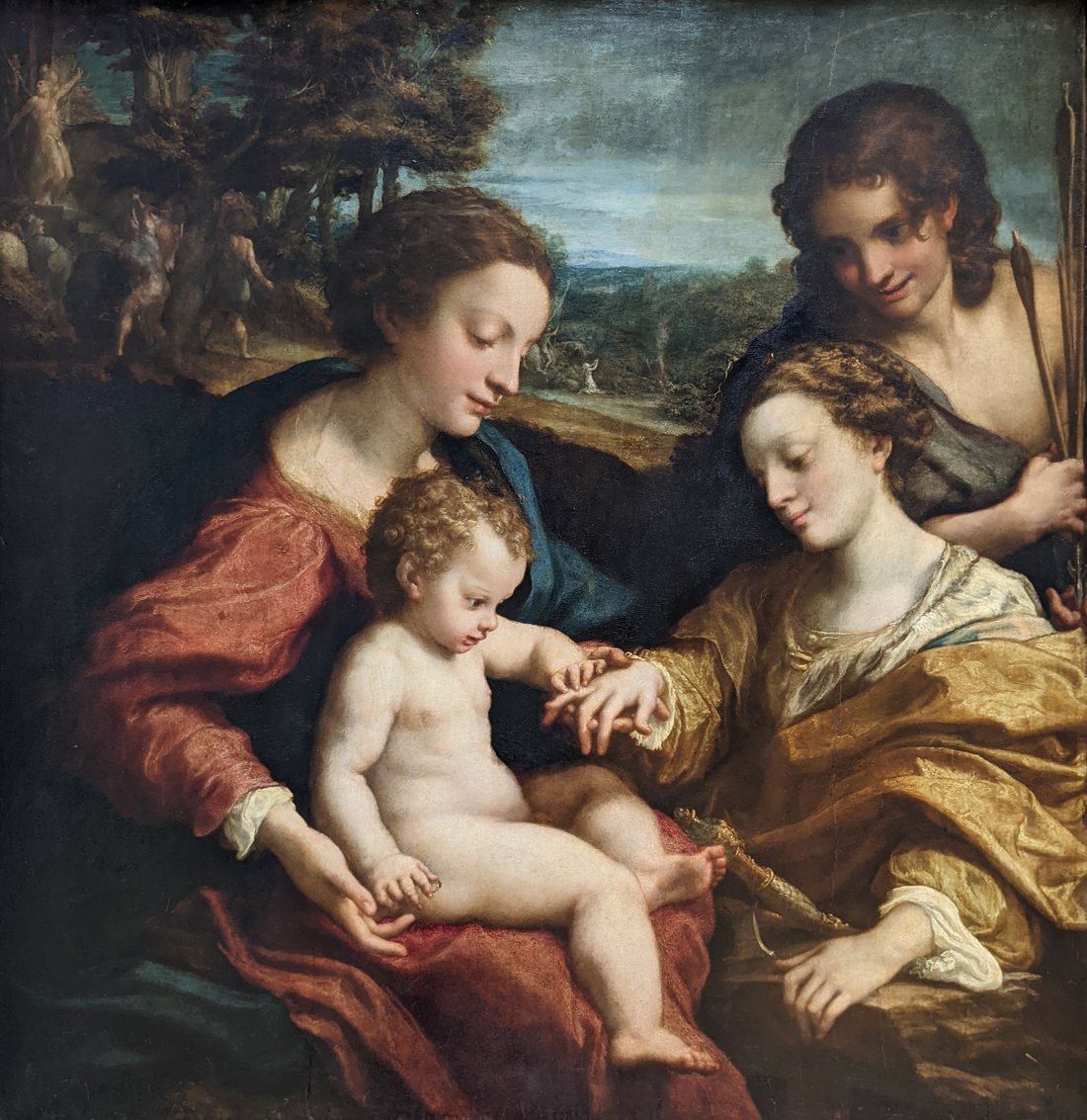
The Christ Child, held by his mother, slips a ring onto Saint Catherine's finger while Saint Sebastian looks out at us from behind. It is Correggio's most tender invention: a wedding conducted by hands and glances, the flesh soft as candlelight, the whole sacrament reduced to one small ring crossing between two hands in the centre of the world.
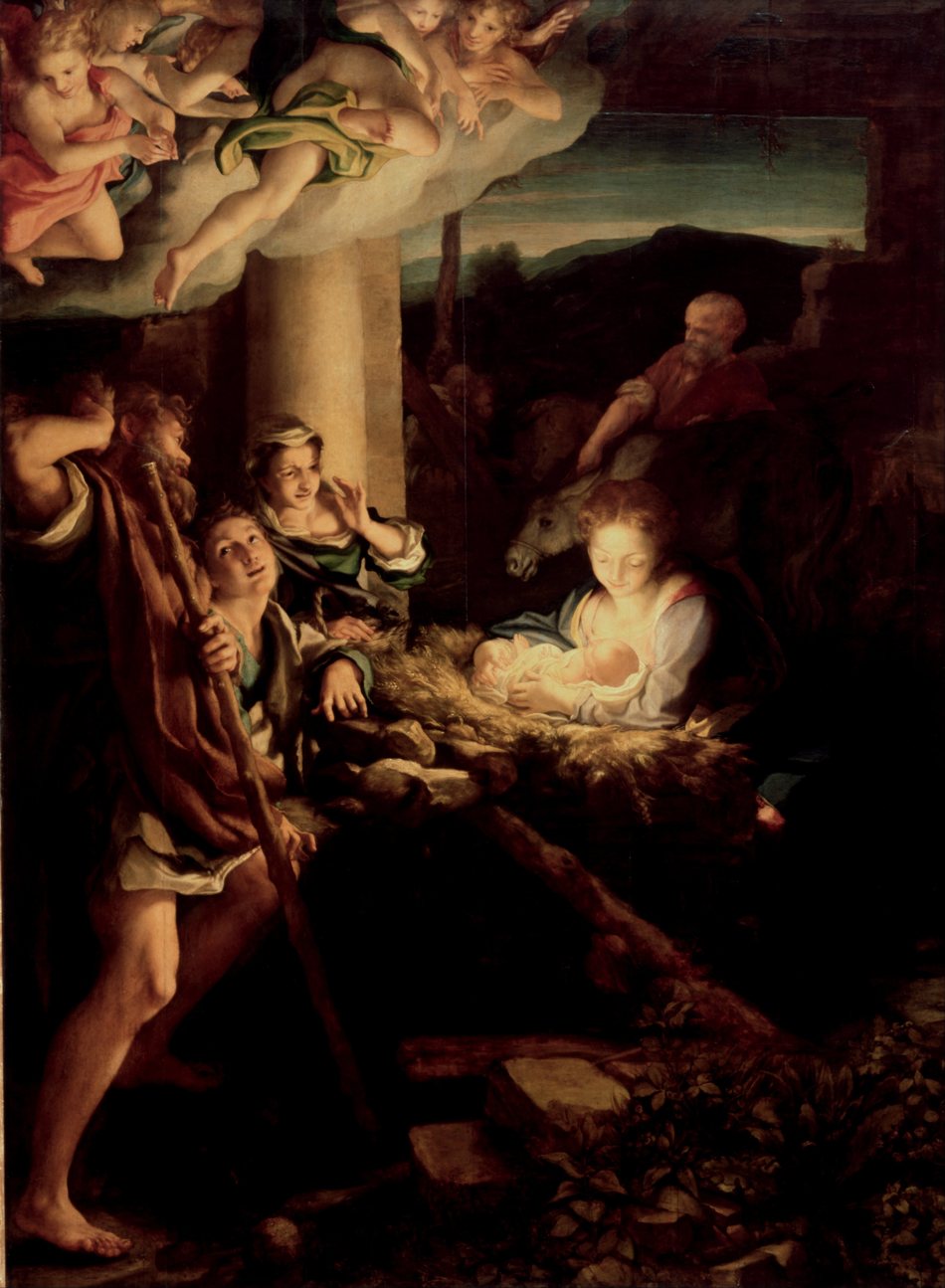
The Adoration of the Shepherds known simply as The Night: the newborn radiates the picture's only light, his mother kneels in its glow, a shepherd shields his eyes, angels tumble through the dark above. It was the most famous night piece of the Renaissance — generations of painters copied its central miracle, a light that is born, not lit.
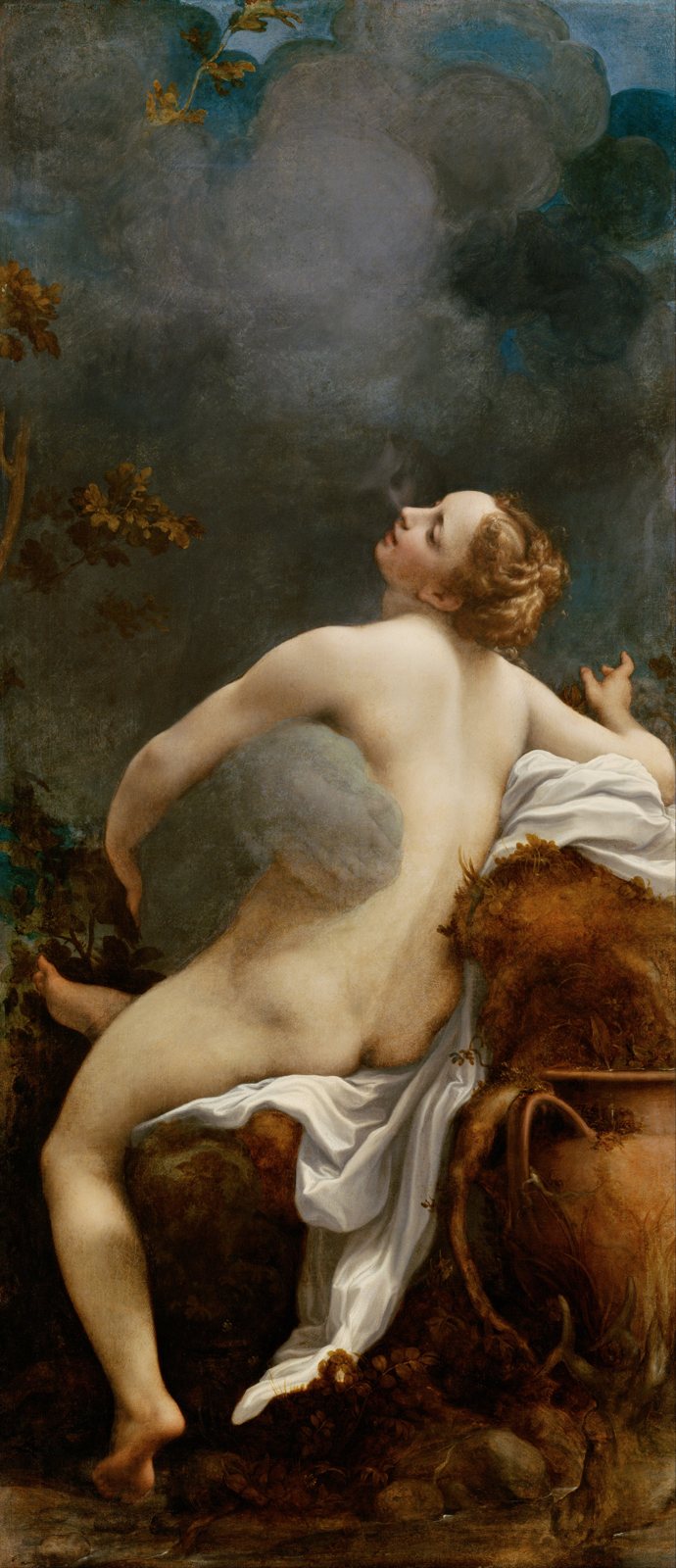
Jupiter comes to Io as a cloud, and Correggio paints the cloud with a face and a hand barely emerging from the vapour to caress her. Io swoons backward, her body the softest passage of paint in the whole century. The tall, narrow canvas was painted for the private rooms of the Duke of Mantua — mythology as an excuse for pure sensation.
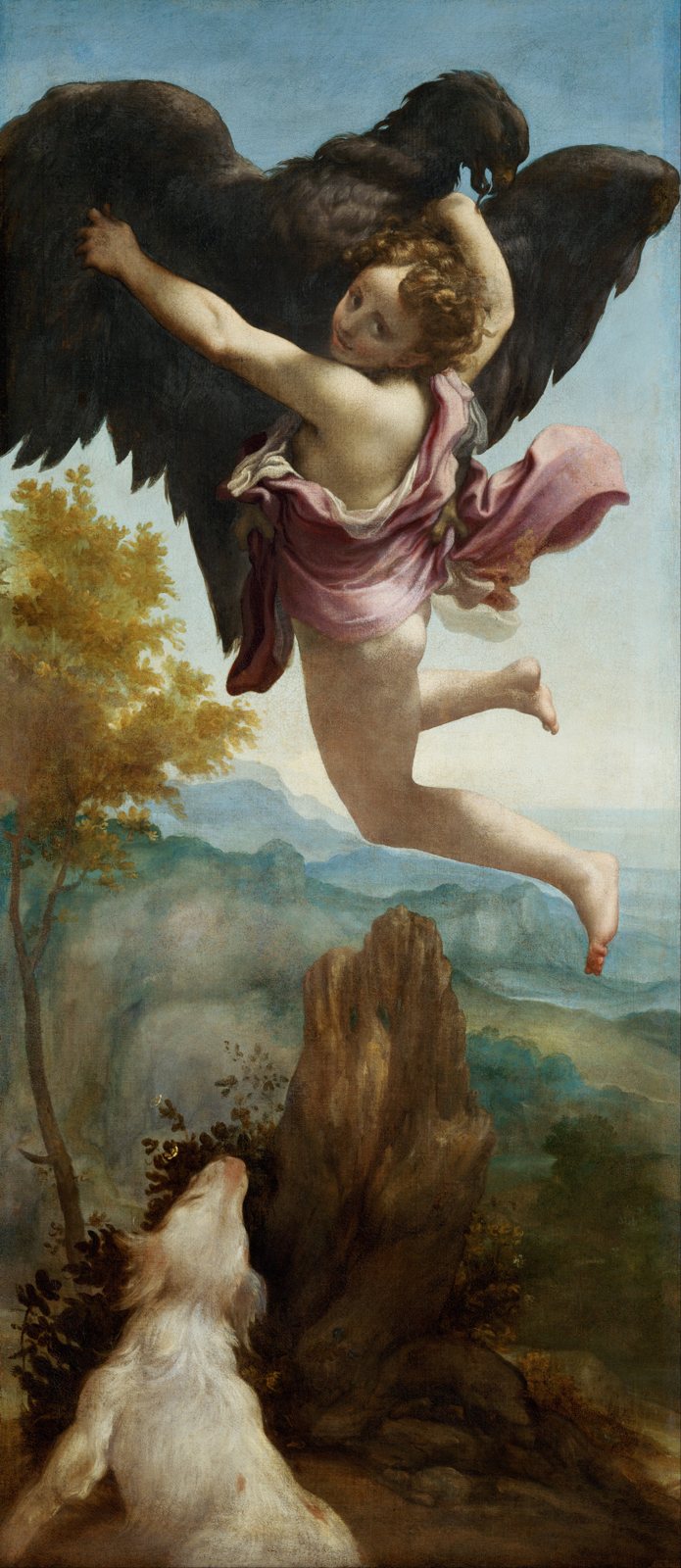
The pendant to Io: Jupiter's eagle carries the boy Ganymede up through a luminous sky, his little dog barking helplessly at the earth left below. The vertical canvas is mostly air — Correggio paints altitude itself, the ground falling away into blue distance, the boy's body twisting between fright and wonder in the eagle's grip.
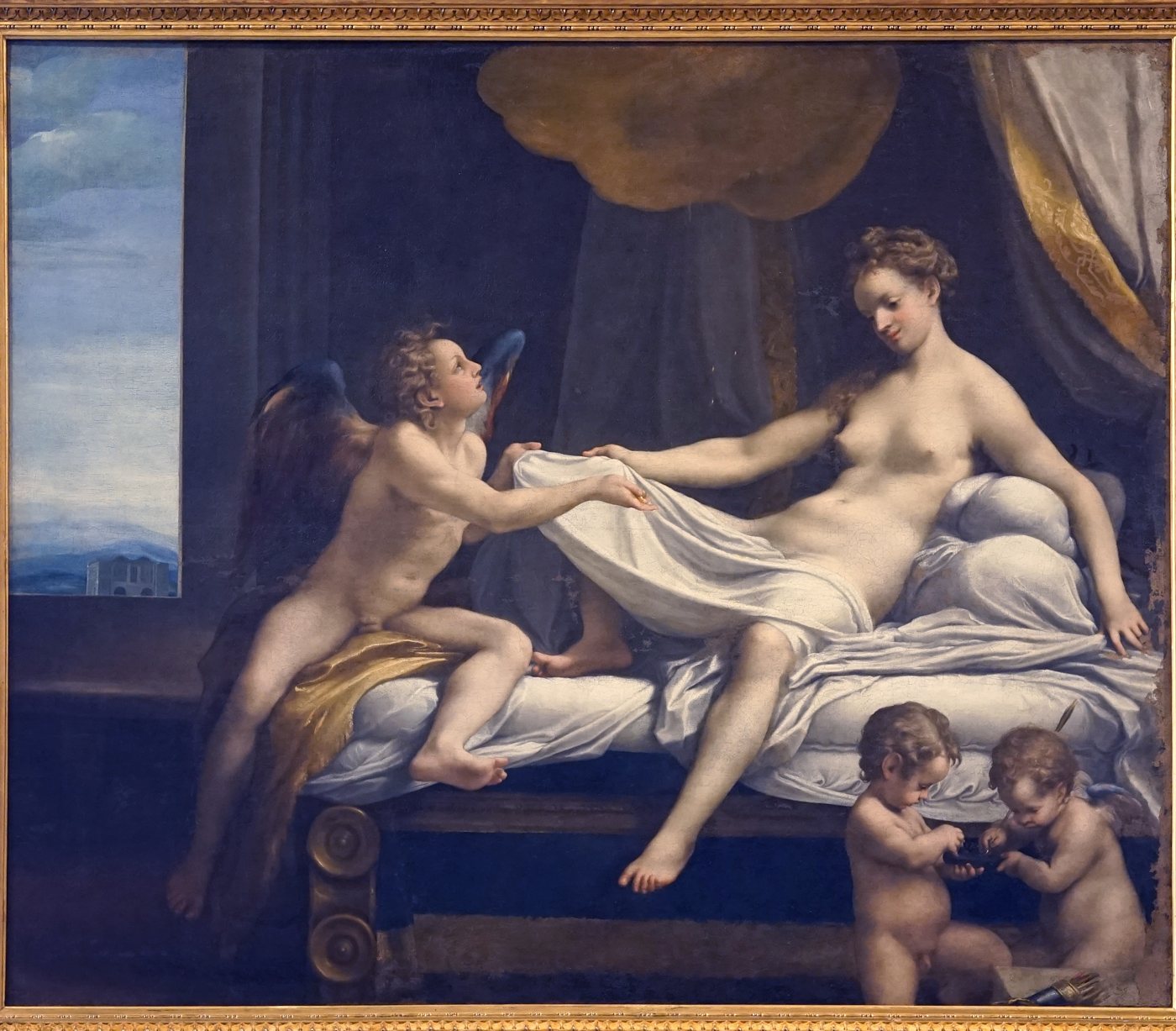
Danaë receives Jupiter as a shower of gold — painted, with a smile, as actual gold coins, which two putti below are testing on a touchstone like little bankers. Above them Cupid holds back the sheet and Danaë's body glows against the dark bed. Myth, eroticism and a joke about money, in the softest flesh of the Italian Renaissance.
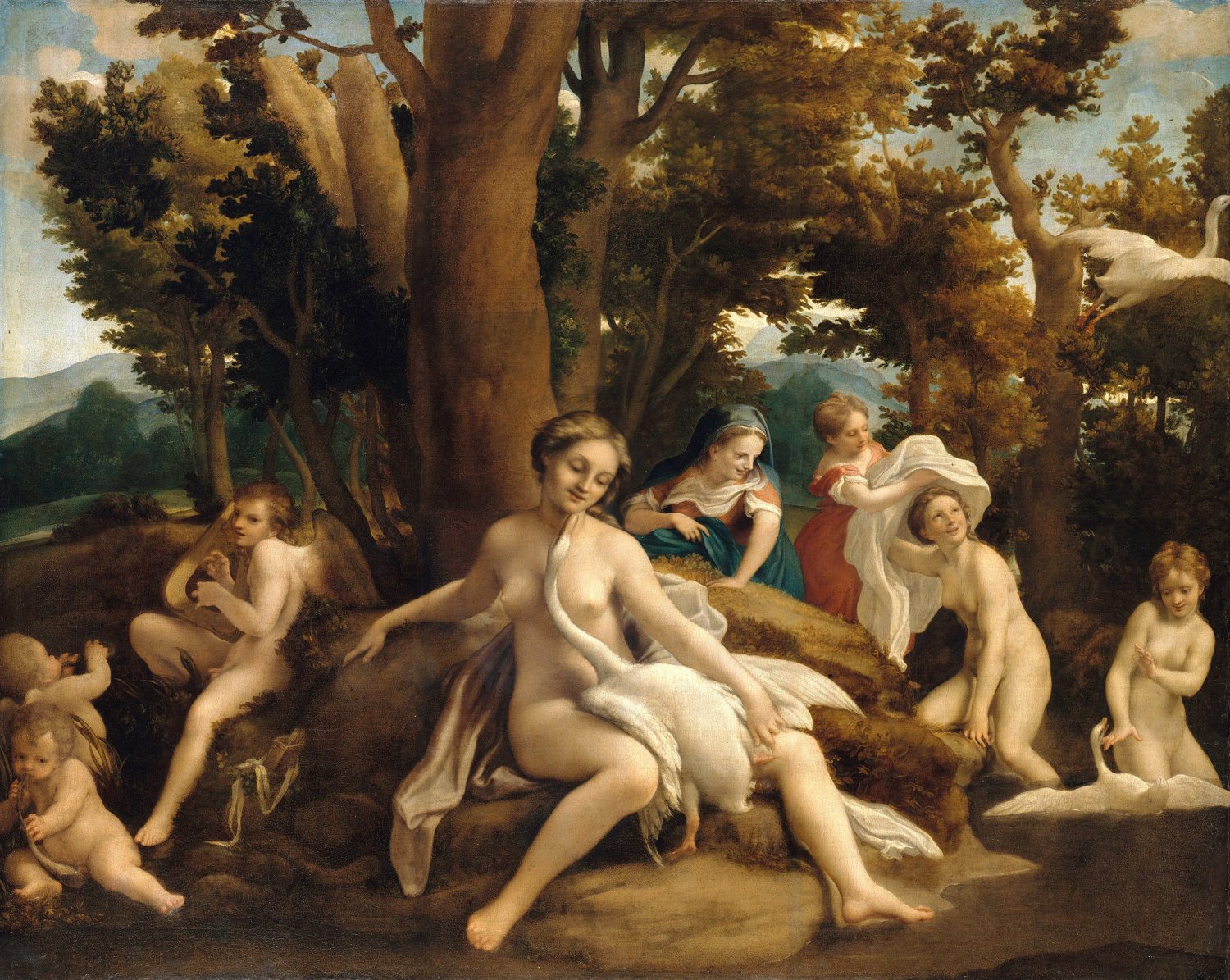
Leda sits with the swan in a golden landscape, her companions bathing behind, putti playing at the water's edge — the most idyllic of the Loves of Jupiter. A later owner, scandalised, cut out Leda's head and had it repainted; the smile you see is an eighteenth-century restoration of a sixteenth-century swoon. The body, the landscape and the light are untouched Correggio.
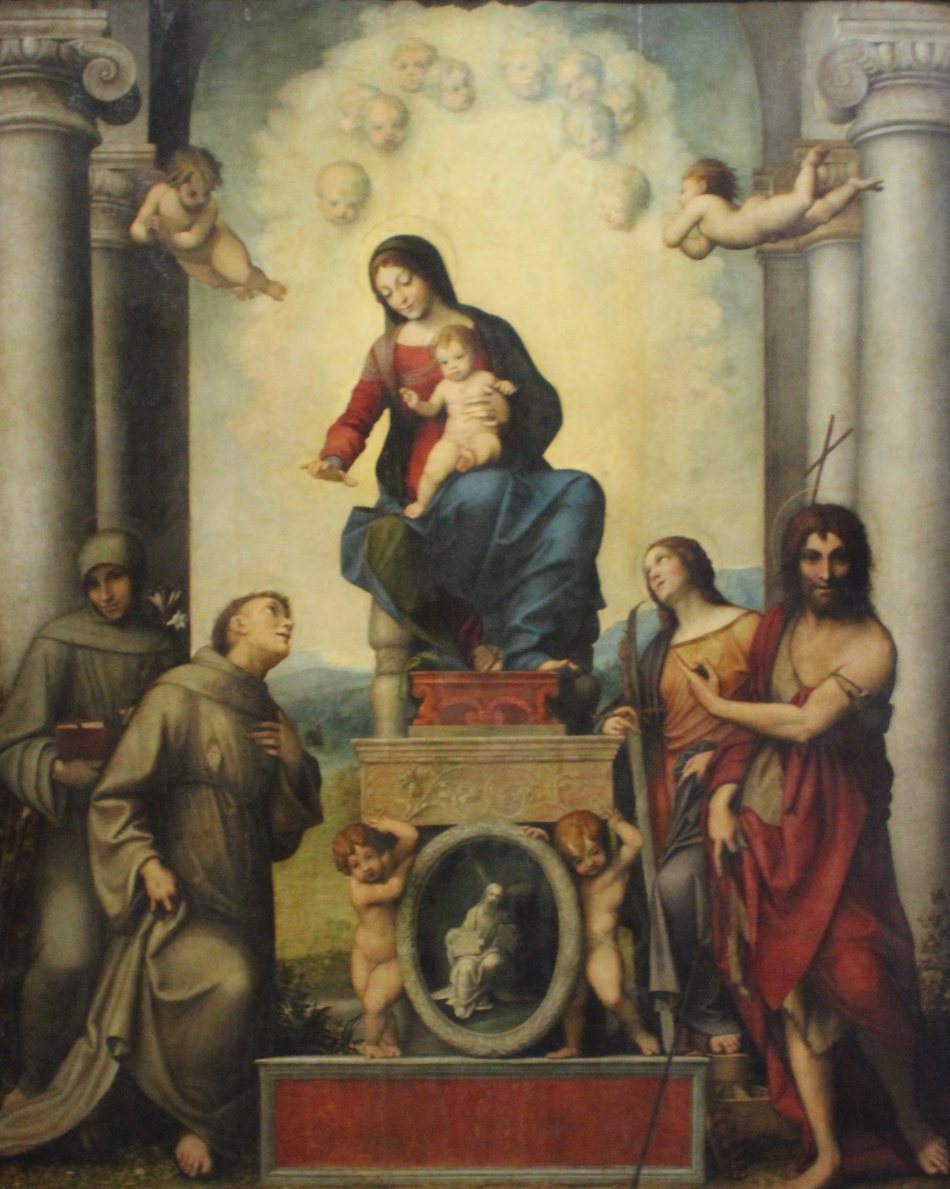
His first great altarpiece, painted at twenty-five for the Franciscans of his home town: the Madonna enthroned in a marble loggia, Saint Francis presenting the donors' world to her, saints in conversation below. Mantegna's architecture and Leonardo's softness are already fused — and already the glances cross like quiet music between the figures.
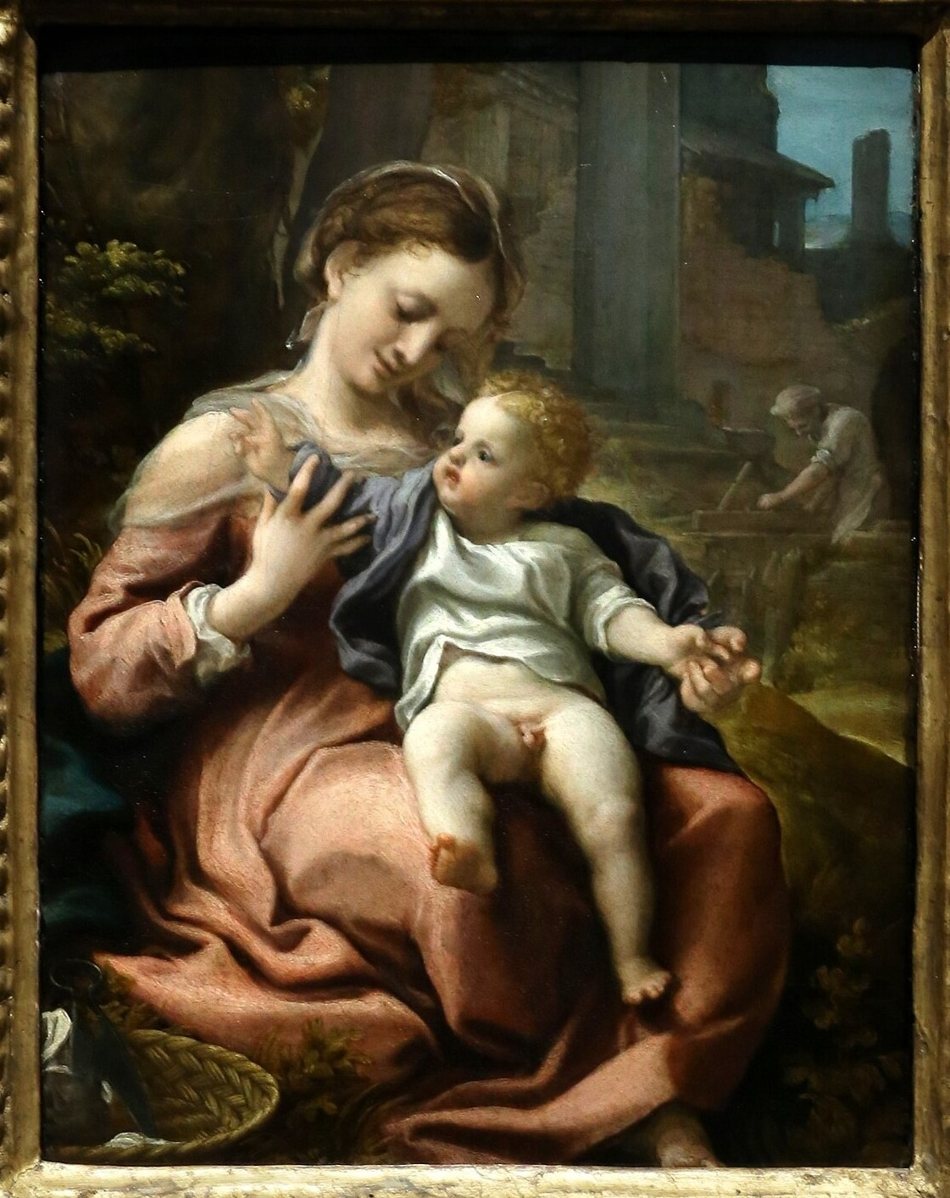
A small panel for private devotion: the Virgin has set down her weaving basket — the cesta that names the picture — to dress the Child, while Joseph works at his carpenter's bench in the shadows behind. The Flight into Egypt becomes a domestic pause: a mother, a basket, a moment of rest on the road, painted at the scale of a held breath.
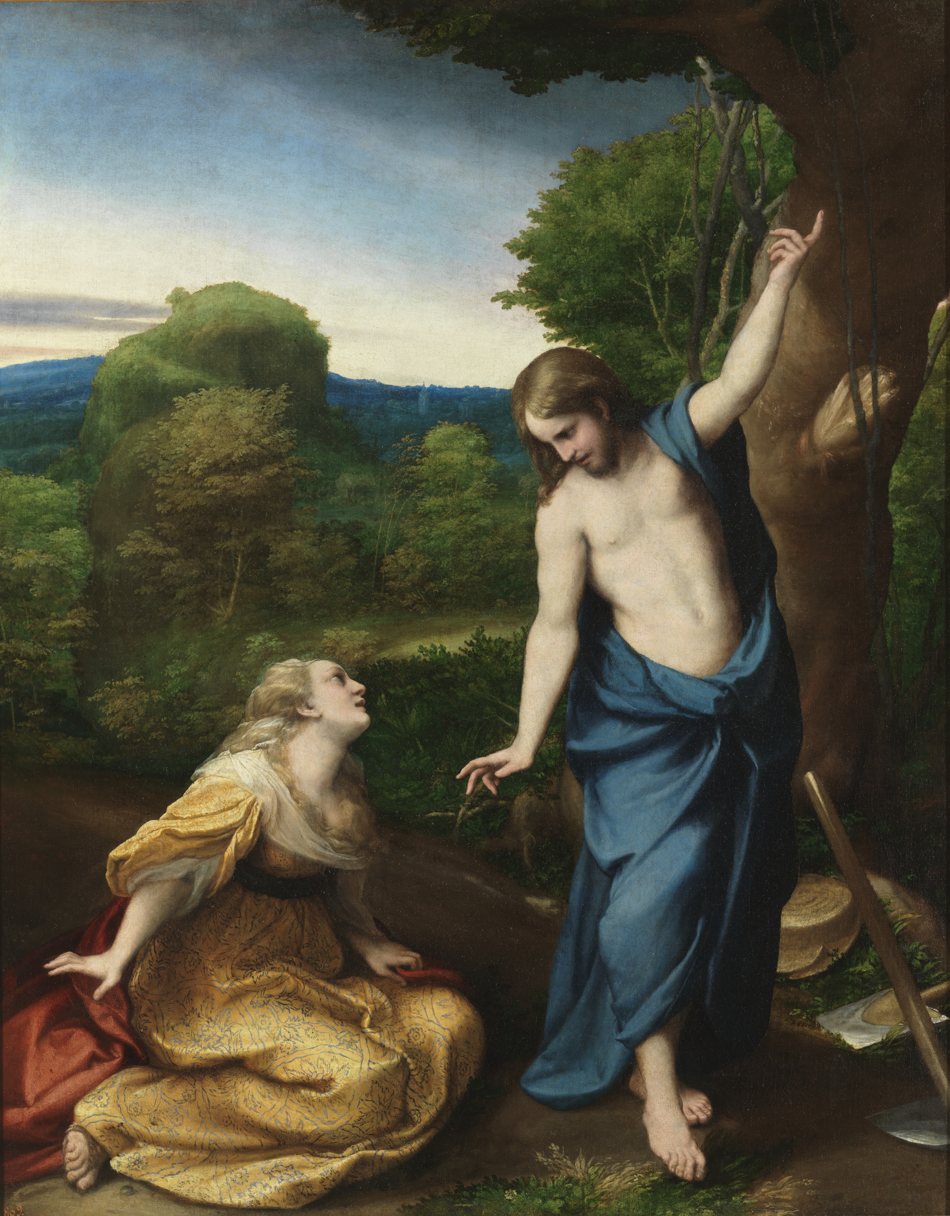
In a garden at dawn the risen Christ, a gardener's hoe on his shoulder, gently refuses the Magdalene's reaching hands: 'Do not touch me.' Correggio paints the most delicate refusal in art — his blue drapery sweeping in one long curve, her golden hair and outstretched arms answering it, the whole meeting held at the distance of a single step.
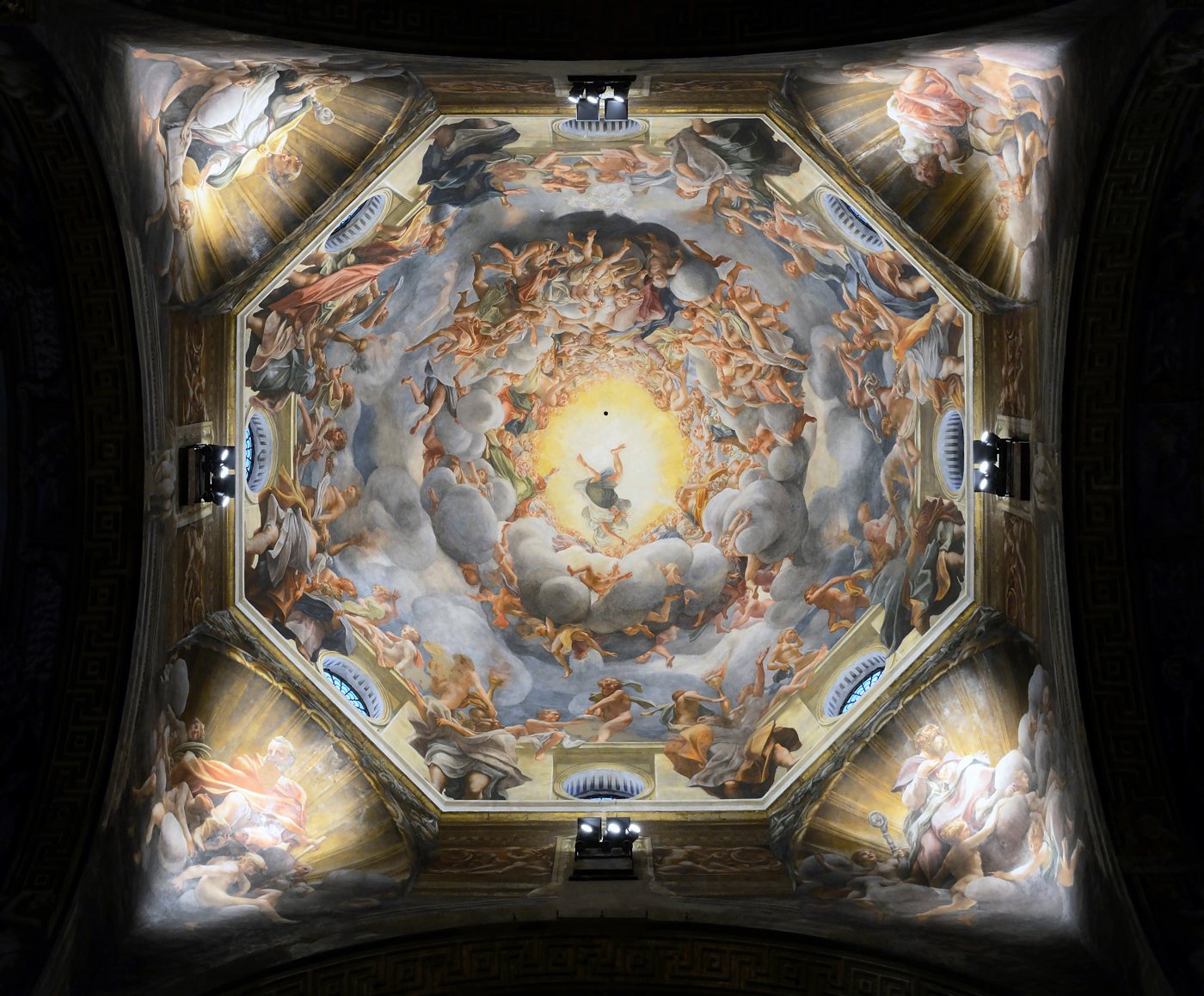
Seen from the cathedral floor: the Virgin rises through a spiral of apostles, saints and angels toward a burst of golden light, the dome's architecture dissolved entirely into bodies and radiance. Worshippers have craned their necks at it for five hundred years. Every painted heaven of the Baroque — and there are hundreds — is this dome's descendant.