In the loudest century of French painting he was the quietest man in it: a painter of copper pots, dead fish, governesses and boys with soap bubbles, who composed without drawings, painted slowly in thick, patient layers, and made Diderot call his colour a kind of magic. Nothing in his pictures shouts. Everything in them stays.
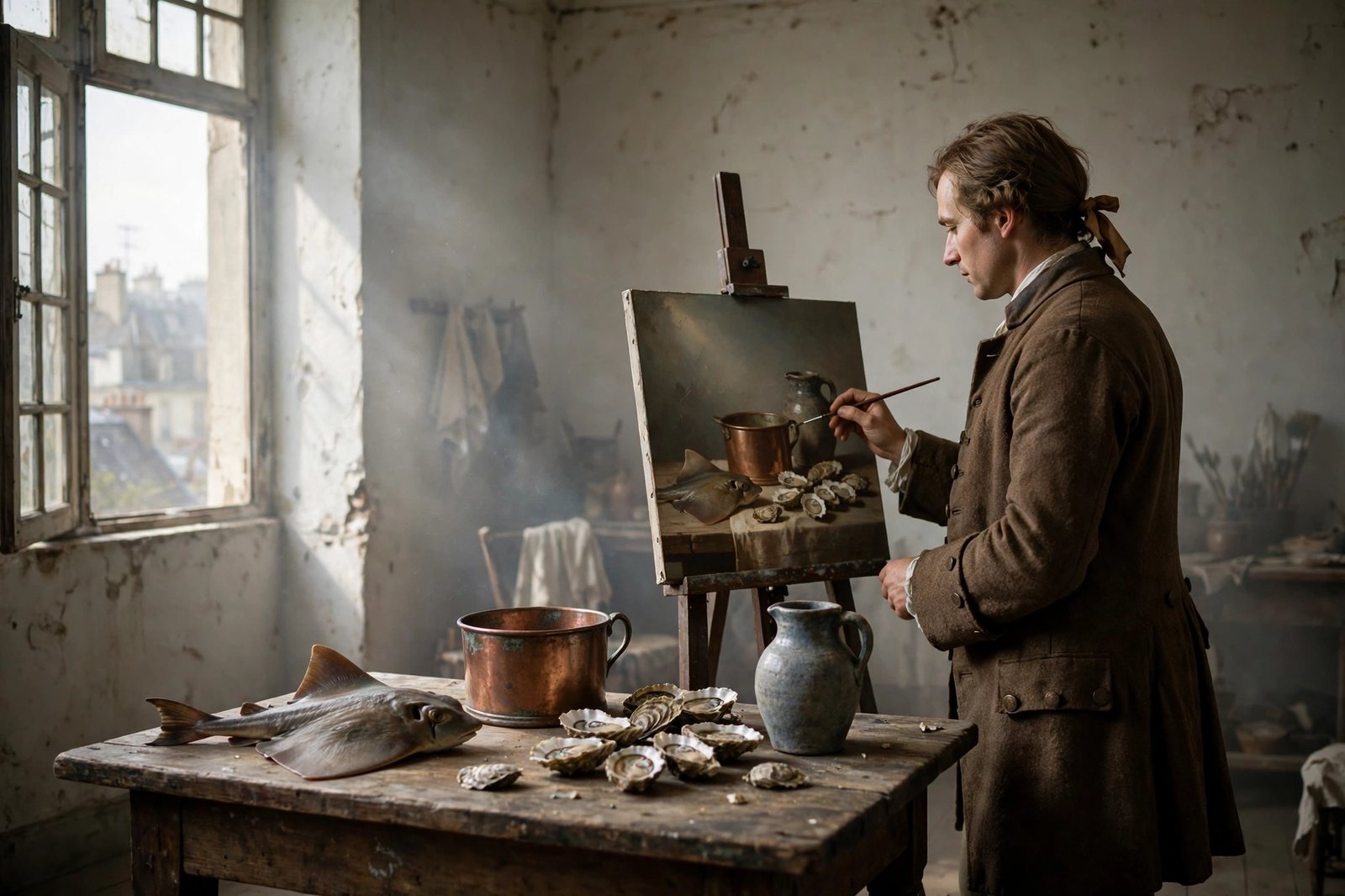
Almost alone among the masters in this gallery, Chardin left virtually no drawings. He composed directly on the canvas in paint, arranging the motif in front of him — the pot, the jar, the model — and working out the picture in the medium it would live in. Pentimenti under X-ray show him shifting a jug an inch, raising a horizon: the composition was found by painting, not before it.
His surfaces are built, not sketched: loaded brushes, paint worked wet into wet and scraped and reworked over weeks, until a copper pot has the density of the thing itself. He was famously slow — a handful of pictures a year — and contemporaries joked about it while copying the effect. Diderot, watching the Salons, concluded the method was sorcery: 'thick colour' laid by a hand that thought in tones.
Earths, greys, muted blues, a disciplined red, whites that are never white: Chardin tuned a small set of pigments the way a viol is tuned, and played chords instead of contrasts. His thumb, contemporaries reported, did as much blending as his brush. The result is harmony you feel before you see it — pictures that hang in a room like a low, steady note.
The same copper cistern, silver goblet, terrine and game birds return in his still lifes for thirty years. This was not poverty of invention but method: a laboratory of seeing, in which the known object is painted again until perception itself becomes the subject. The still life, a low genre when he began, leaves his hands as the most philosophical painting in France.
Successful compositions — the House of Cards, Soap Bubbles, the Governess, the Young Schoolmistress — he painted again himself, in versions that differ in a curtain, a hand, a fall of light. Engravers spread the designs across Europe, but the replicas are autograph: Chardin treated a good invention the way a composer treats a theme, and each return to it is a variation, not a repetition.
In the 1770s, his eyesight ruined — he blamed the lead white he had ground for fifty years — Chardin turned to pastel, the medium that needs no grinding and no waiting. The self-portraits of those years, in eyeshade and spectacles, are drawn with the same unsentimental accuracy he had given to fish and copper: the last still lifes are of himself.
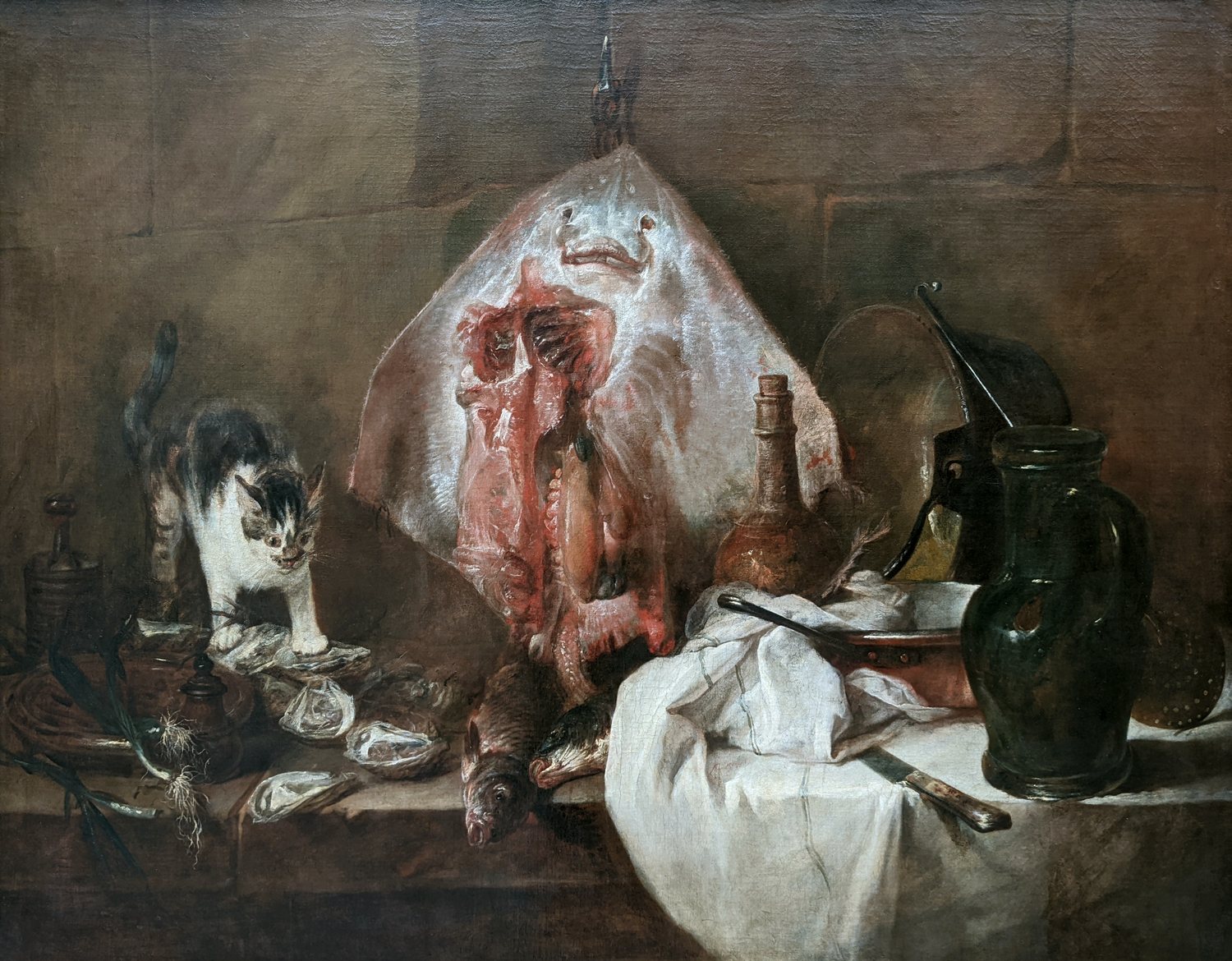
A gutted ray hangs from a hook, its pale belly grinning like a face, while a cat arches over oysters on the ledge below and kitchen metal gleams in the dark. With this picture and its companion, The Buffet, the Academy received the twenty-nine-year-old Chardin as a painter of animals and fruit — he spent the next fifty years proving how much more that meant.
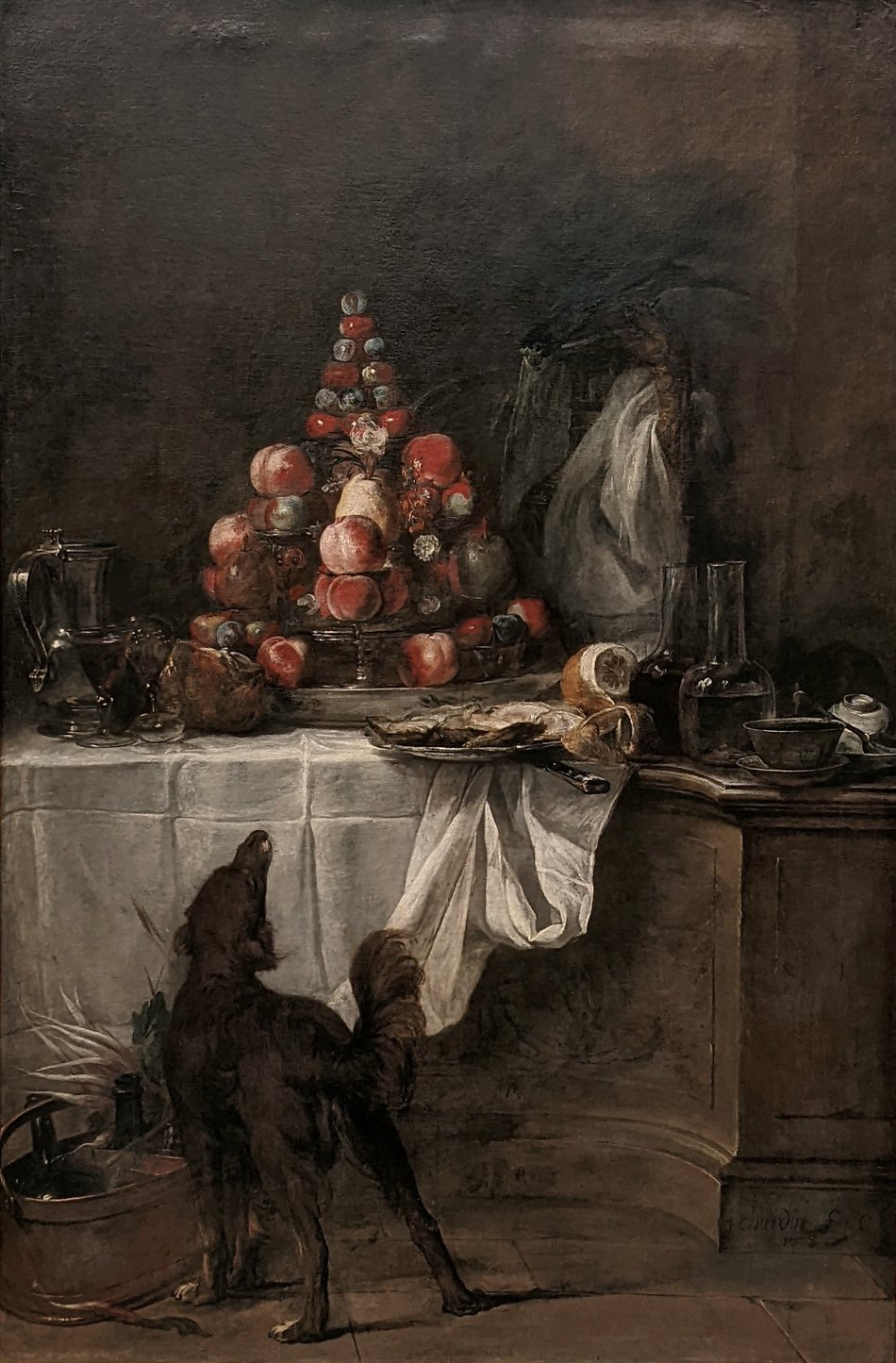
A dresser loaded with peaches, bottles, silver and a casket, a dog sniffing hopefully at the edge of the feast. Painted at twenty-nine as a reception piece alongside The Ray, it already contains his whole art: nothing arranged for effect, everything weighed, and the light doing the eloquence.
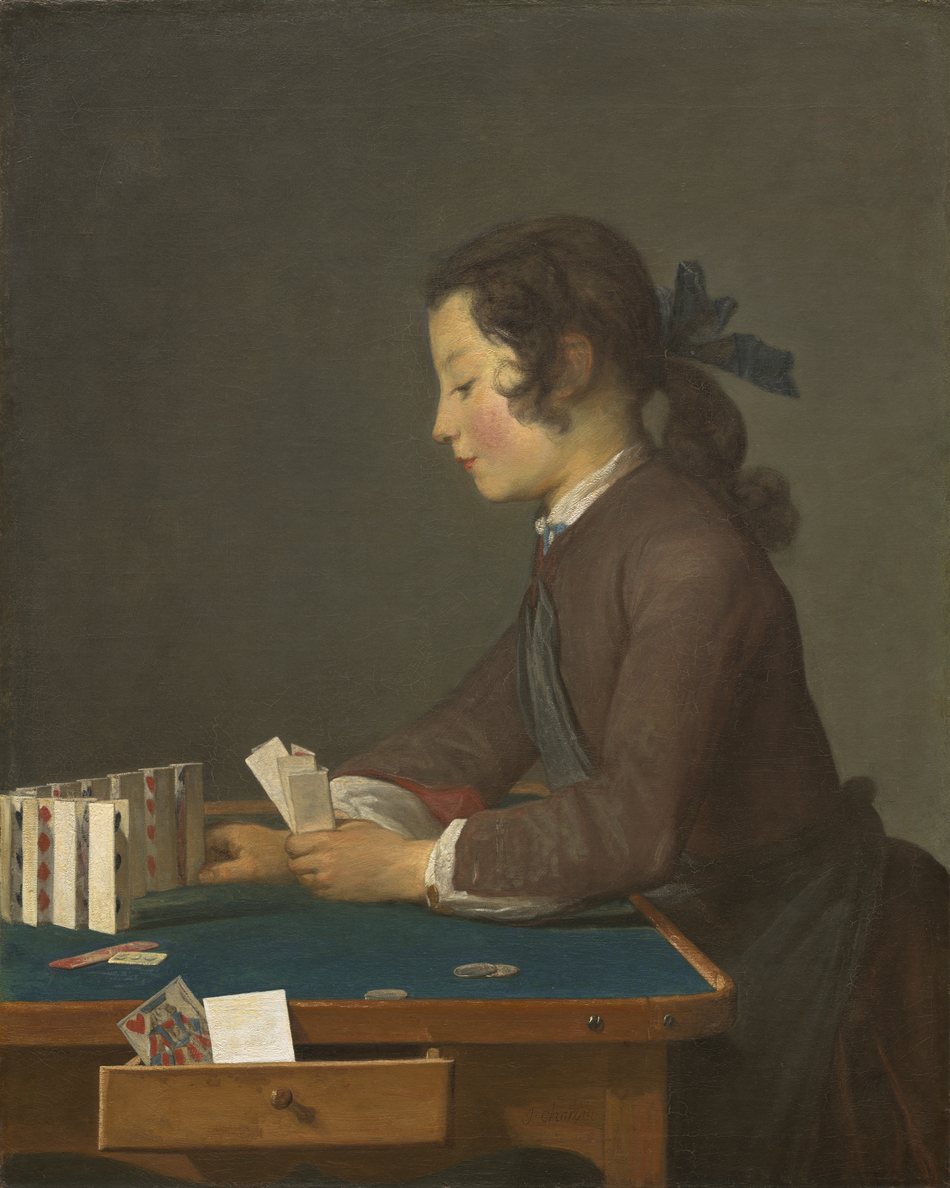
A boy in a brown jacket leans over a table, wholly absorbed in balancing one more card on his fragile construction; a drawer hangs open behind him, unnoticed. Painted in several versions, it is the emblem of Chardin's world: concentration as a subject, transience built out of cardboard, silence you can hear.
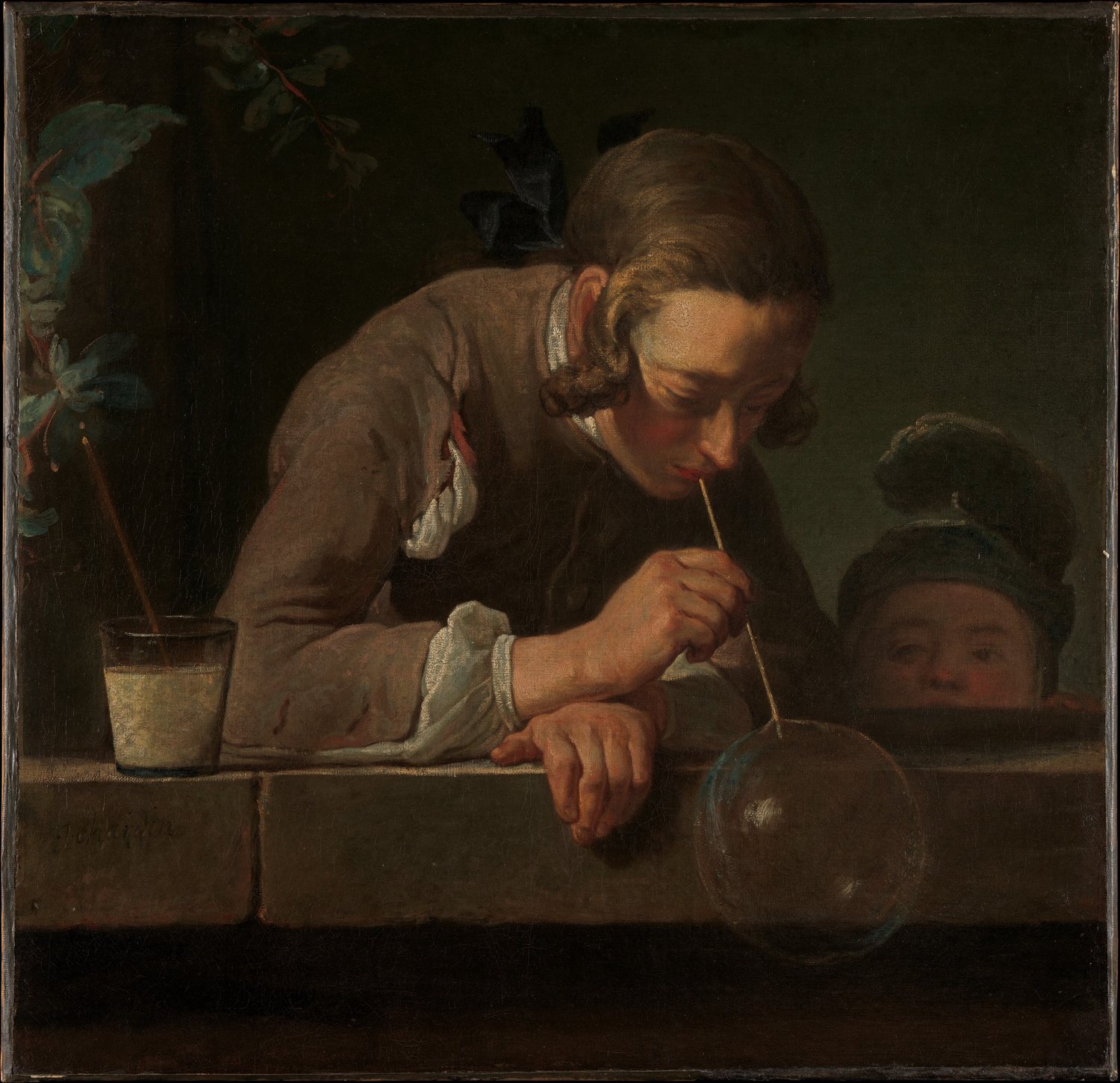
A young man leans from a stone window, blowing through a straw at a bubble that swells with rainbow light, while a small child peeks up beside him, desperate for his turn. An old vanitas emblem — life is a bubble — painted so gently that the moral dissolves into the moment itself.
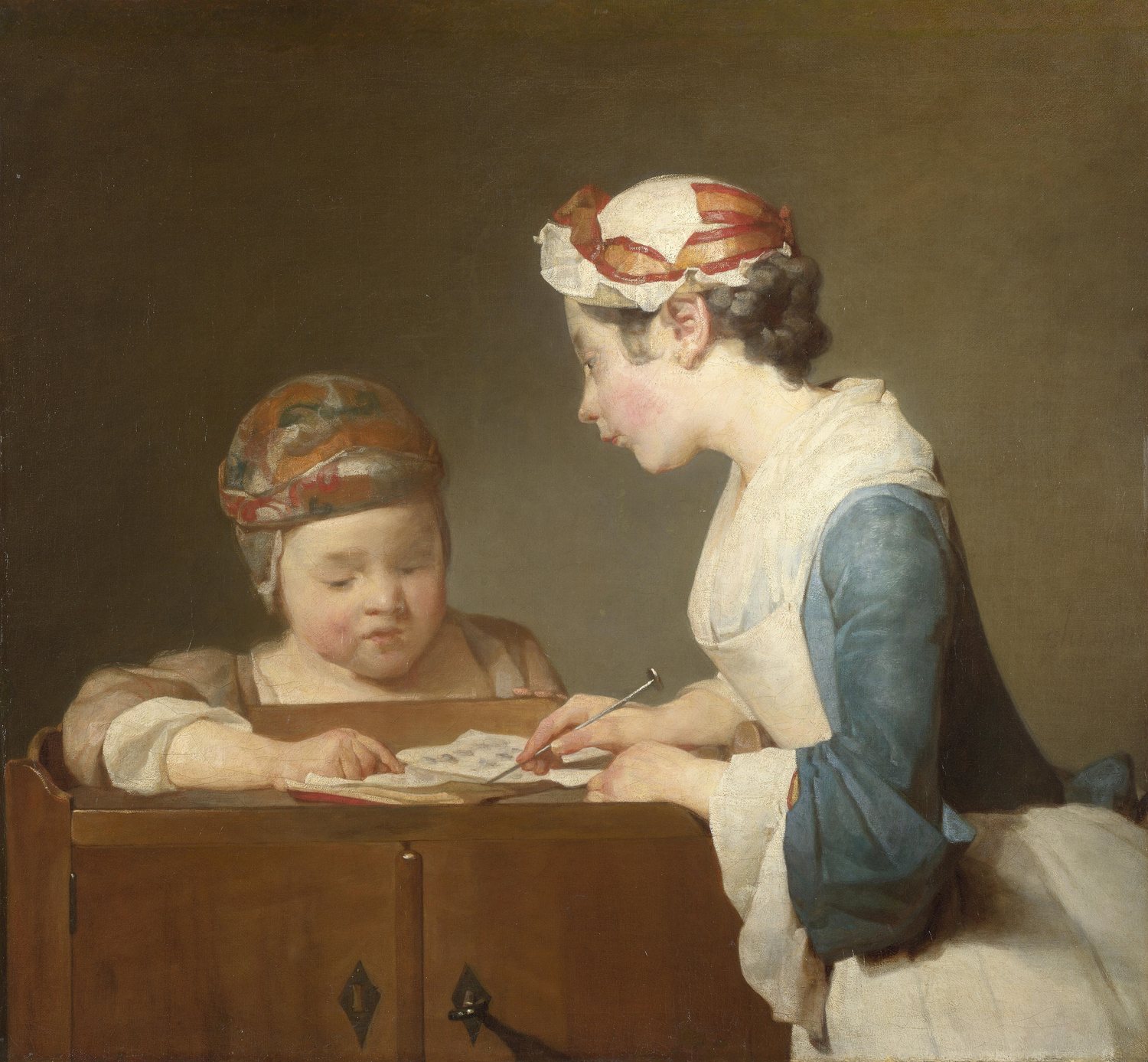
A young woman bends over a small child sounding out the alphabet from a book, her finger guiding, her whole body patient. There is no anecdote and no sentimentality — only attention, painted by the most attentive brush in Europe. Chardin returned to the composition in several versions, as he did to all his quiet successes.
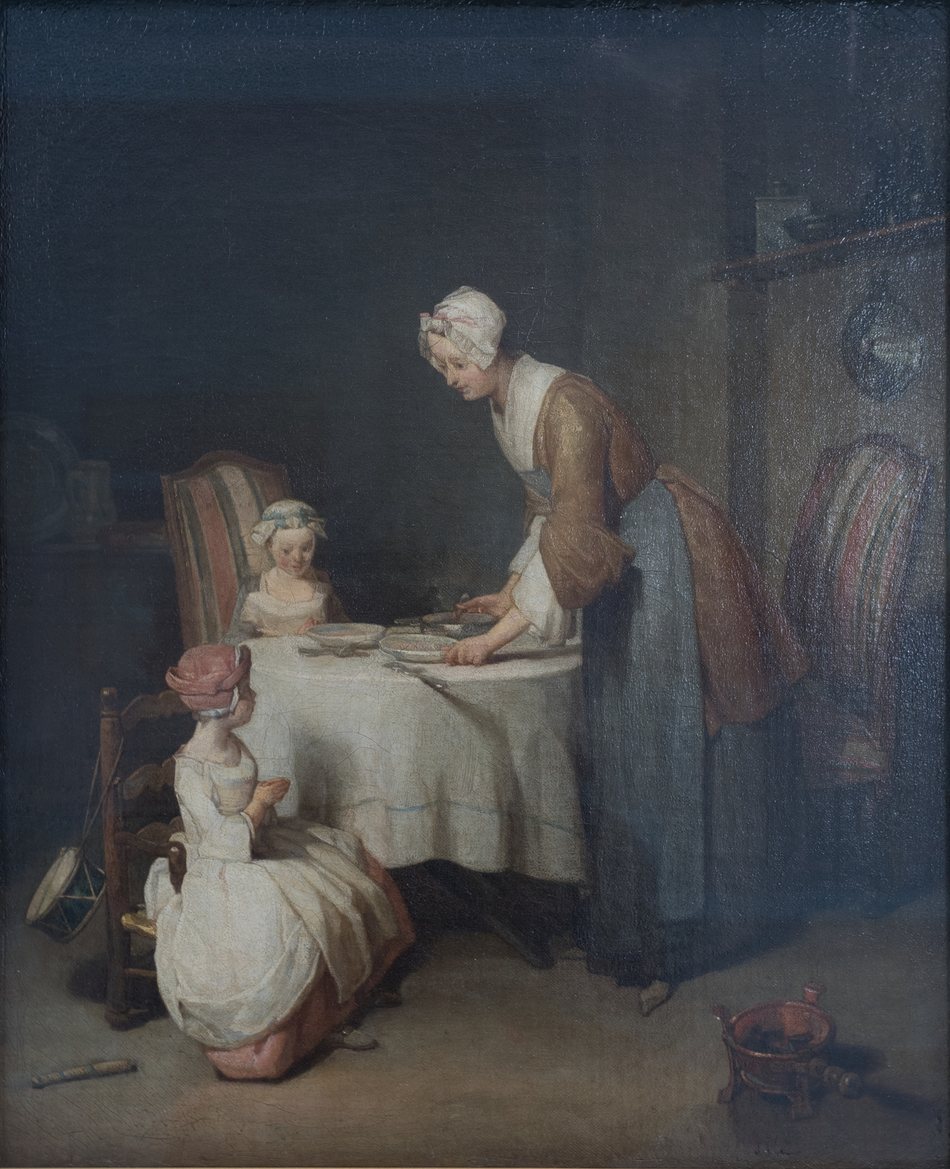
A mother has set the soup tureen on the table and folds her children's hands into the grace before the meal; the little girl's eyes are already on the food. Presented to Louis XV at Versailles in 1740, it is the most famous of Chardin's domestic scenes — piety and appetite in perfect, unforced balance.
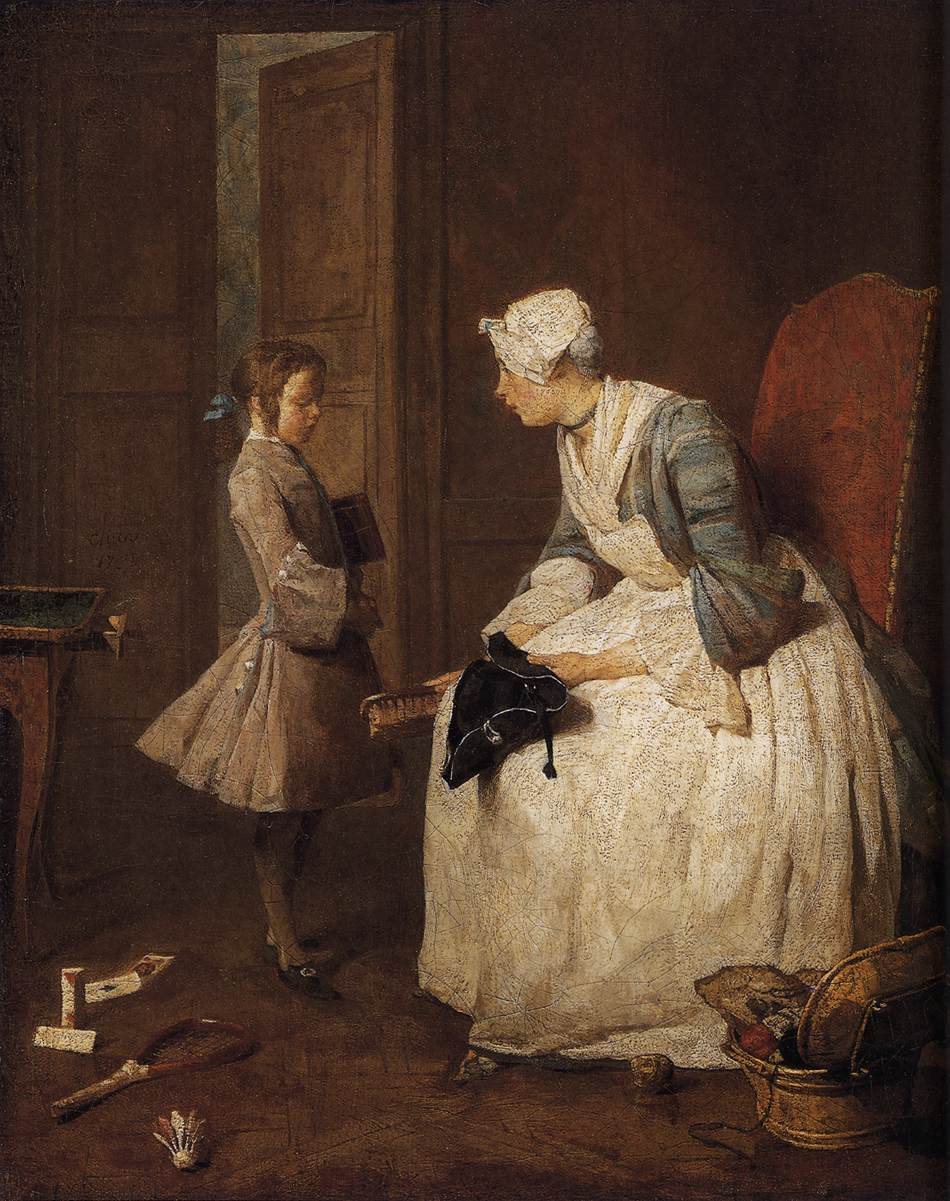
A governess speaks seriously to a small boy who stands before her with his hat and his lesson book, listening with the gravity of a man receiving a verdict. The room is bare, the light grey, the drama entirely moral — and entirely tender. An engraving after it carried the scene into homes across Europe.
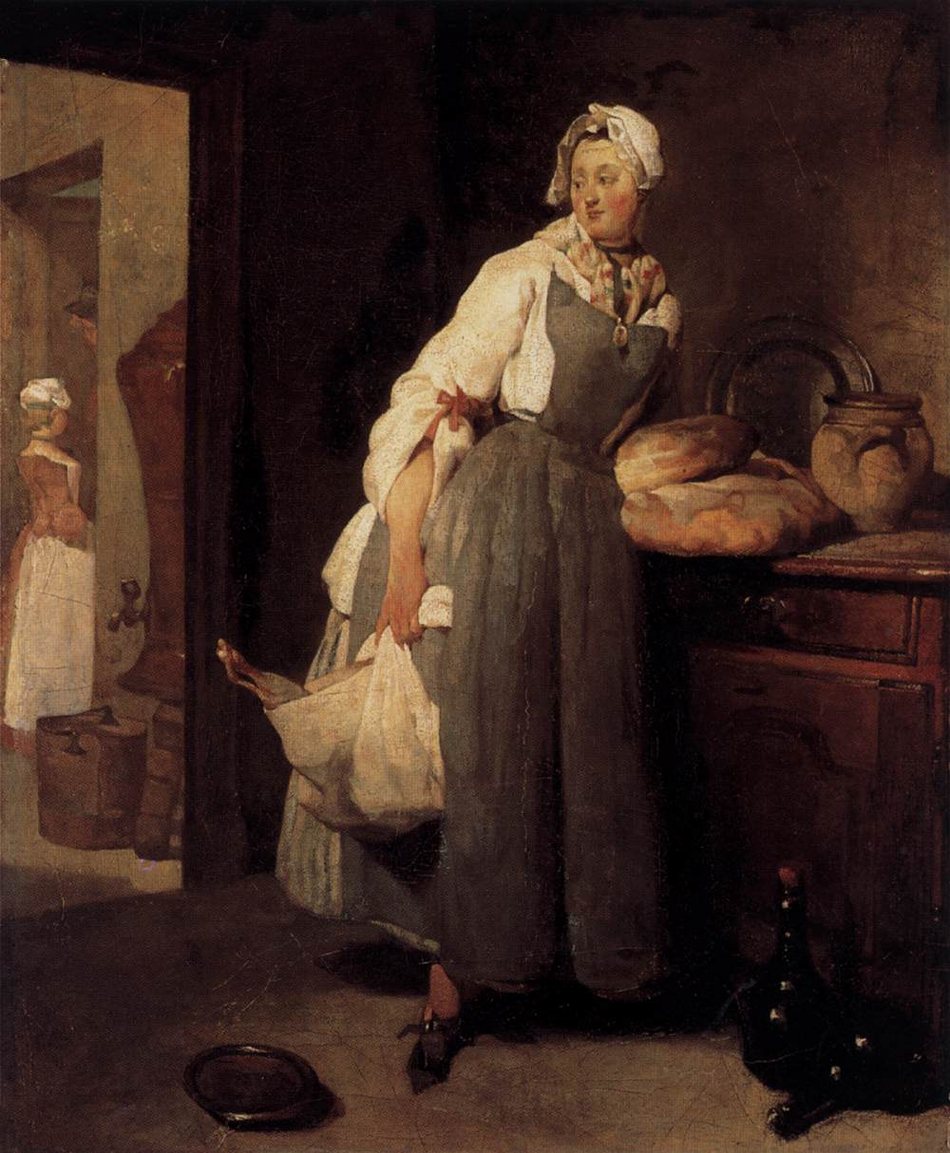
A young servant girl, back from marketing, pauses in the doorway with loaves under her arm and a copper vessel in her hand, caught between the errand and the household waiting inside. La Pourvoyeuse — the provider — is Chardin's homage to the labour that keeps a home alive, painted without a trace of condescension.
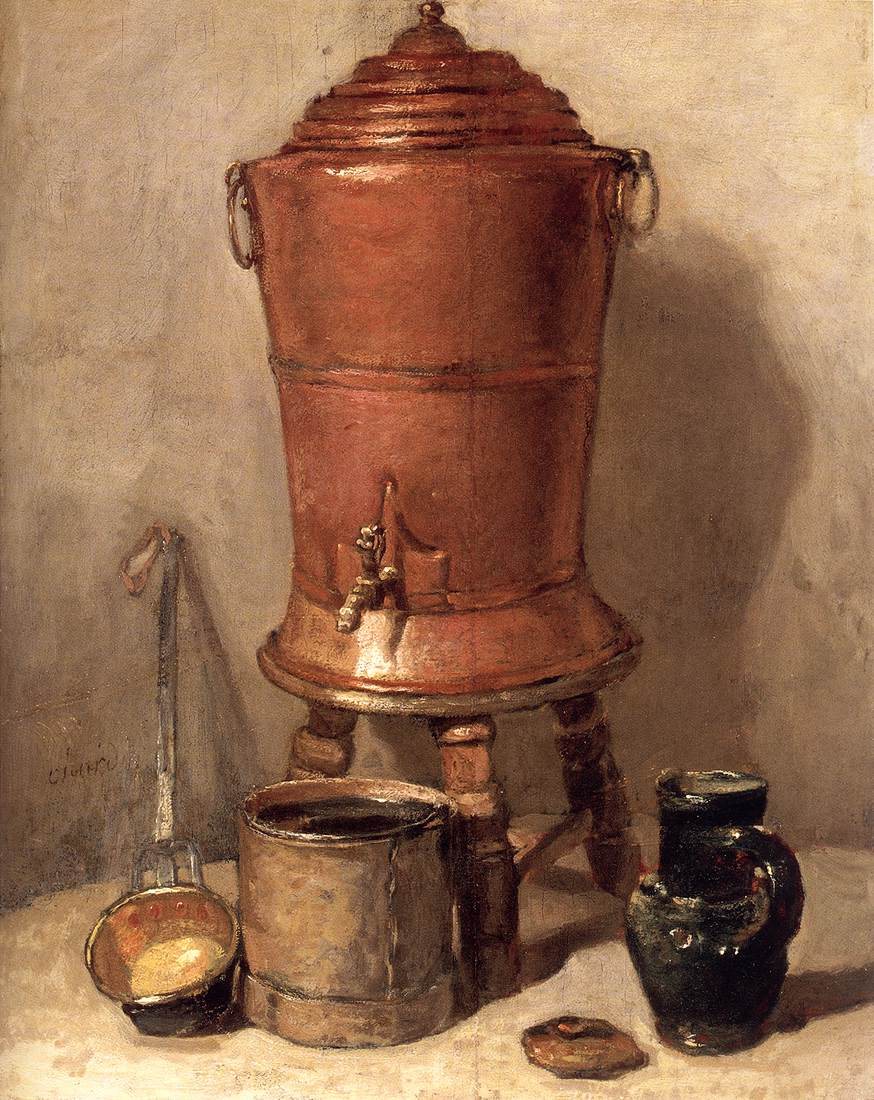
A great copper water cistern stands against a bare wall with a ladle, a jug and a small cup — the whole still life is five objects and a shaft of light. Chardin painted the cistern for forty years; here, early, it already has the monumentality he could give to the humblest vessel in the house.
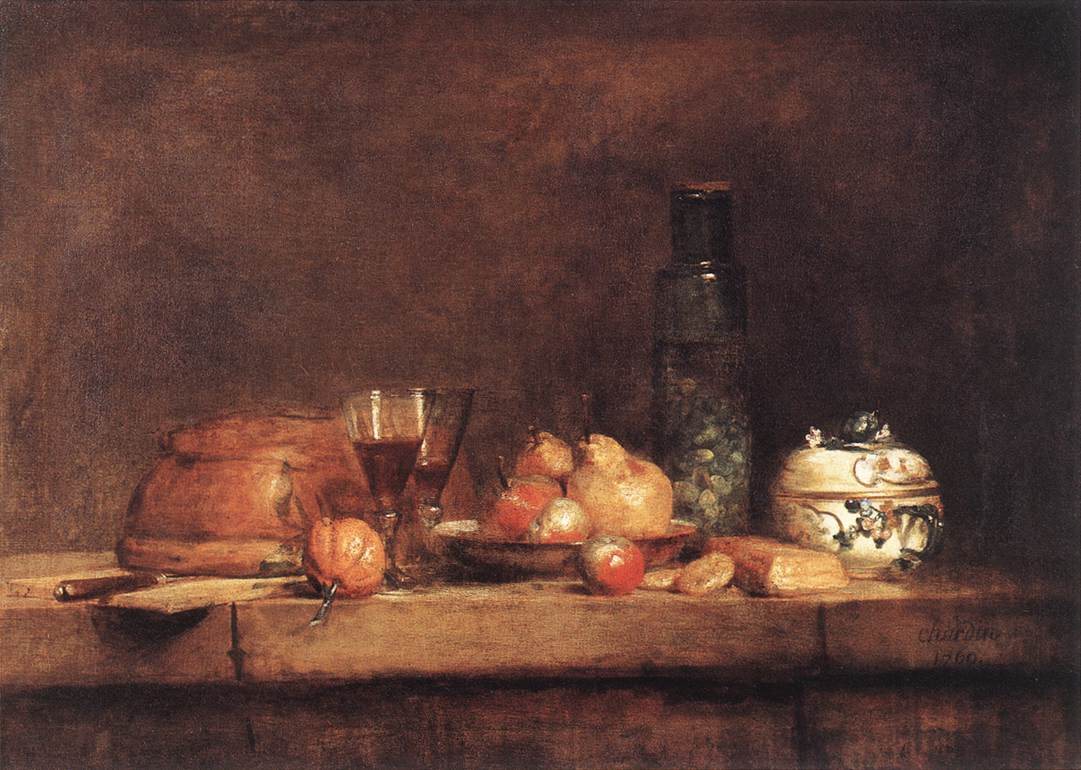
Signed and dated 1760: a jar of olives, a silver goblet, chestnuts, a knife and bread on a ledge, painted with the loaded, certain touch of his maturity. Everything earlier was practice for this — common things, exactly seen, in a light that makes them look remembered rather than observed.