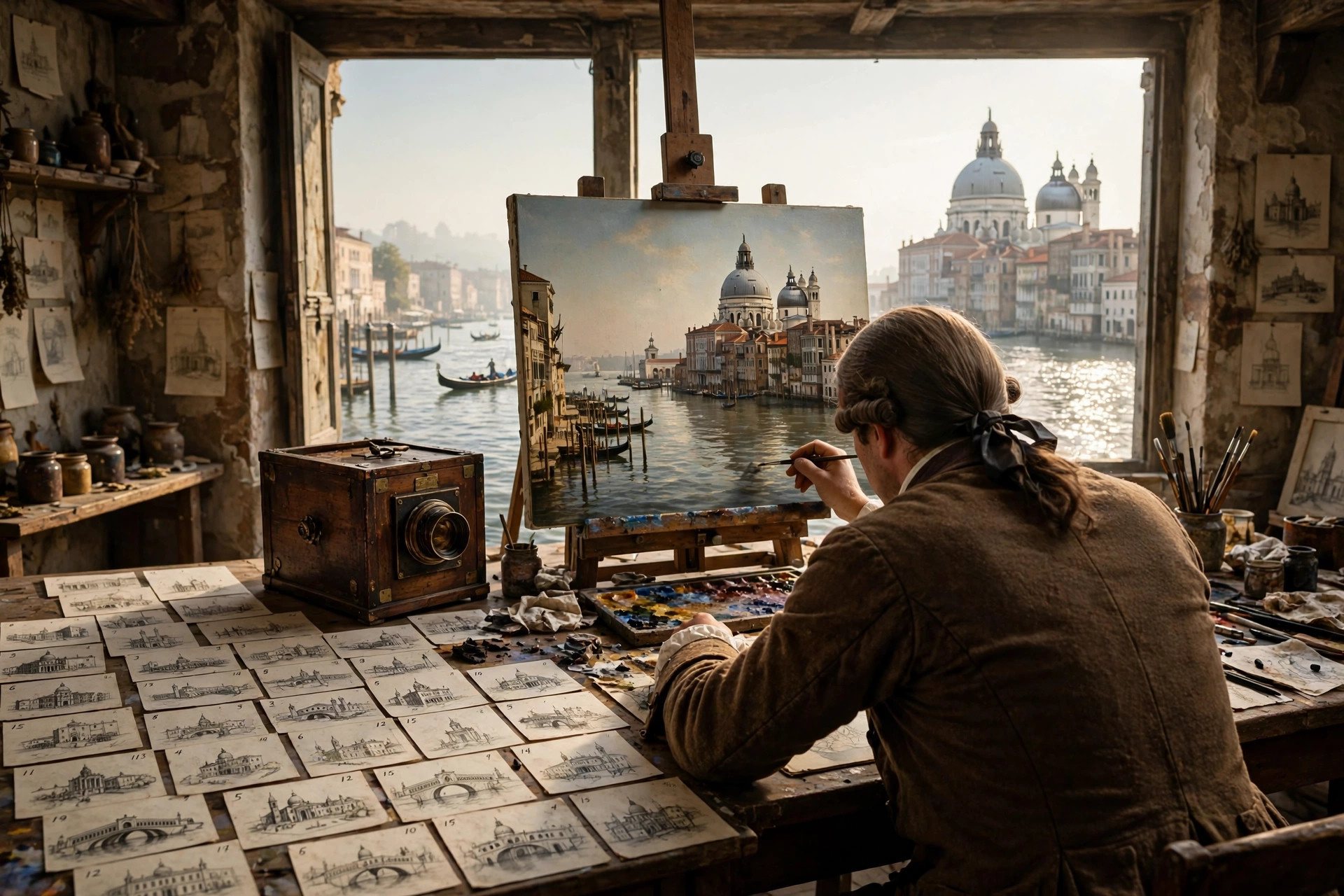
Giovanni Antonio Canal, called Canaletto, painted Venice so exactly that his canvases are still used as documents of the city — and yet every one is a composition, adjusted, improved, composed like music. He was the son of a stage designer, and he turned the whole of Venice into his stage: measured with a camera obscura, drawn by the hundred, and lit, always, by the clearest morning in Europe.
His father Bernardo Canal painted scenery for the opera stage, and the boy worked beside him in the theatres of Venice. Stagecraft taught him the trade's secrets: how to build a deep space on a flat surface, how to light it, how to make a backdrop convince. The veduta — the painted view — is theatre turned outward, from the invented set to the real city, with all the machinery of illusion kept.
Canaletto worked with a camera obscura — a box that projected the view, reversed, onto paper — to fix the architecture's proportions before painting. The instrument's fingerprints are on the canvases: the slightly wide-angle spread of the foreground, the exact recession of the palaces. But he was its master, not its clerk: buildings migrate, viewpoints float impossibly above rooftops, and no photograph has ever matched his Venice, because his is better arranged.
Every painting begins as drawings: rapid pen sketches made on the spot, squared-up studies, finished presentation sheets. Hundreds survive — the largest group at Windsor, sold to George III with his patron Consul Smith's whole collection. In the studio the drawings were combined like a card index of Venice: a canal from one sheet, a church from another, a sky from memory, a festival crowd from stock. The view is a montage wearing the mask of a snapshot.
His staffage — the hundreds of small figures that populate the views — are painted with two or three loaded strokes: a gondolier, a merchant in a red cap, a lady with a fan, a dog. They are types, not portraits, and they do the picture's social work, showing Venice at its trades and festivals. Look closely and each is a small calligraphic flourish; step back and the city is alive.
War shut the tourist market in 1740, and in 1746 he moved to London, where he painted the Thames as if it were a canal — white stone terraces, processions of boats, a new Westminster Bridge rising. The greyer English light fought him; rumours spread that he was an impostor, and he placed a newspaper advertisement inviting critics to his studio to watch him work. He stayed nine years. The Thames views are Venice remembered in another climate.
Alongside the measured views he painted capricci: invented scenes of ruins, triumphal arches and classical buildings that never stood together, sometimes real monuments transplanted to imaginary lagoons. He etched a famous series of them. The capriccio is the veduta's confession — that all his exactitude was always a form of fiction, Venice as she ought to be, composed by the man who knew her stones best.
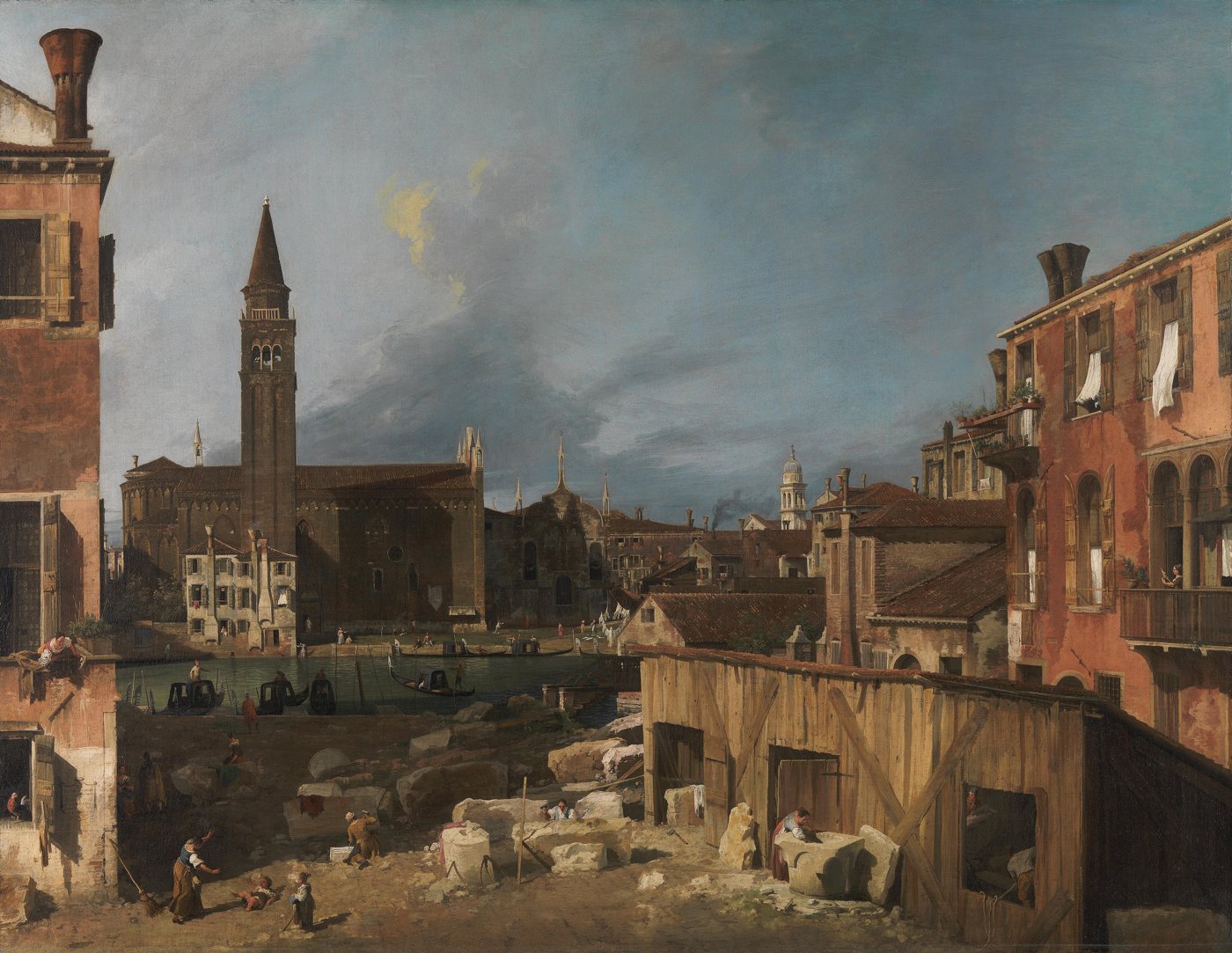
His most untypical masterpiece: not a famous view but a working yard on the Grand Canal — masons sawing stone under a makeshift awning, a woman spinning, a child playing, laundry overhead, and across the water the church of the Carità. Painted in his twenties with an almost Dutch attention to ordinary labour, it shows the city that built the views: Venice from the workshop floor, before the performance begins.
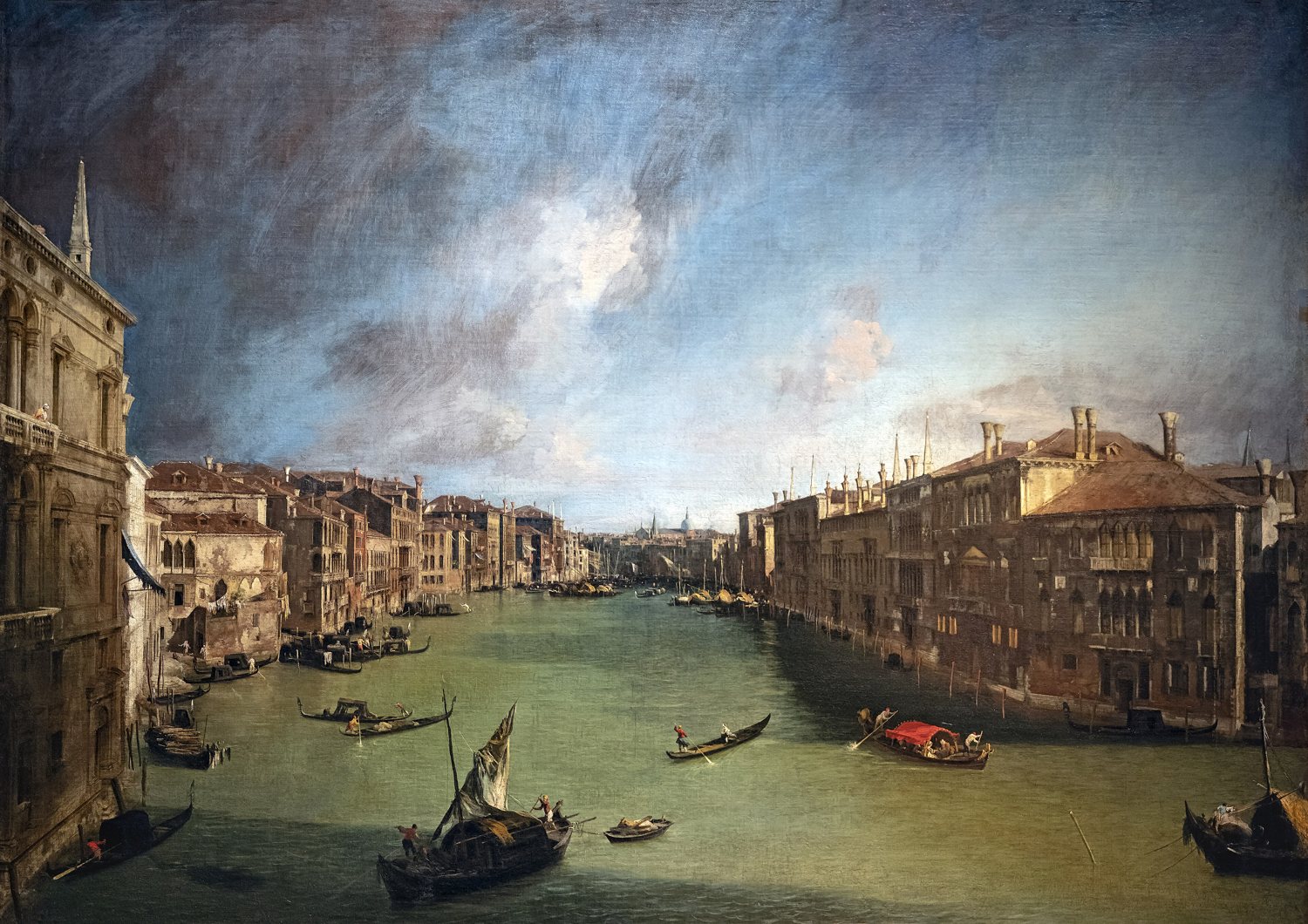
An early view under a dramatic, cloud-heavy sky — the young Canaletto still half a stage designer, the canal curving away between palace fronts toward the Rialto bridge, tiny gondolas stitching the water. Within a few years the skies would clear to his famous enamel blue; here the weather is still Baroque, and the city gleams the more strangely for it.
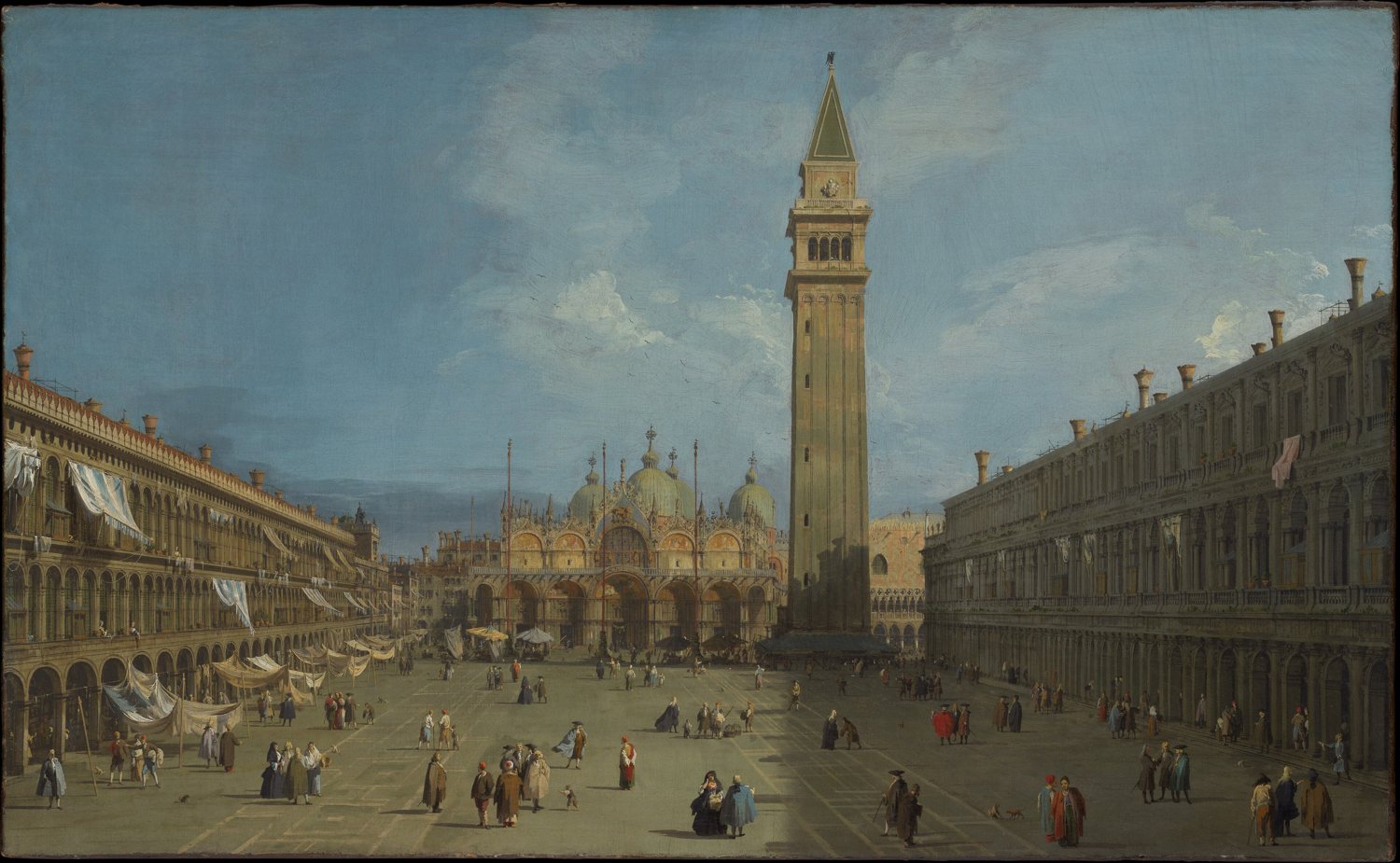
The drawing-room of Europe, measured to the last paving stone: the Basilica and campanile closing the east end, the Procuratie running down both sides like ruled lines, the crowd reduced to elegant punctuation. Every Venetian view-painter painted this square; Canaletto's is the standard by which the others are found wanting — architecture, light and ceremony in perfect equilibrium.
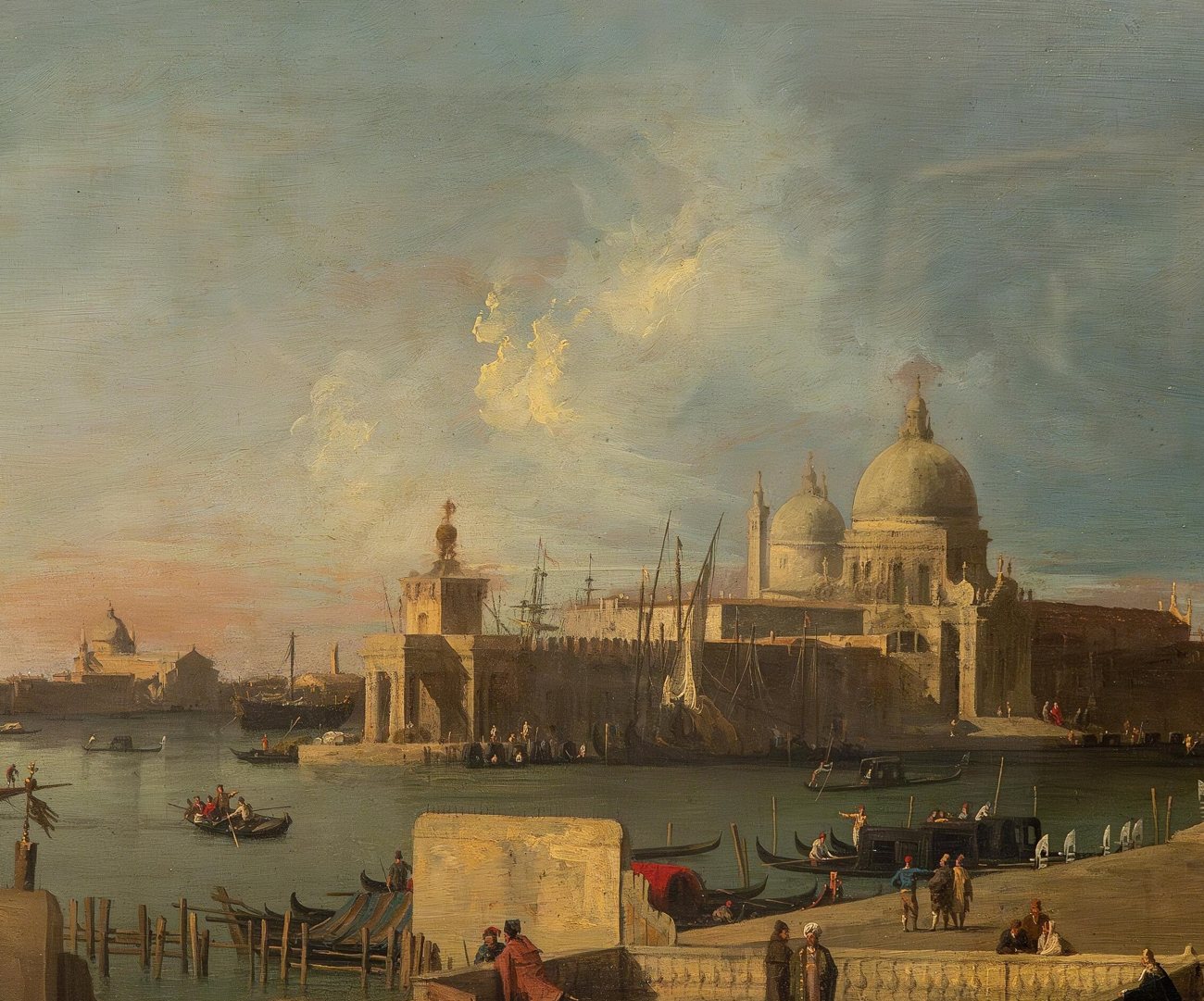
The entrance to the Grand Canal in the last light: the customs house point with its tower and golden ball, Longhena's great dome of the Salute behind, the water going rose and grey. Canaletto's mornings are famous, but his evenings are rarer and finer — the architecture cooling into silhouette, the figures on the steps reduced to a few dark notes, the whole city exhaling.
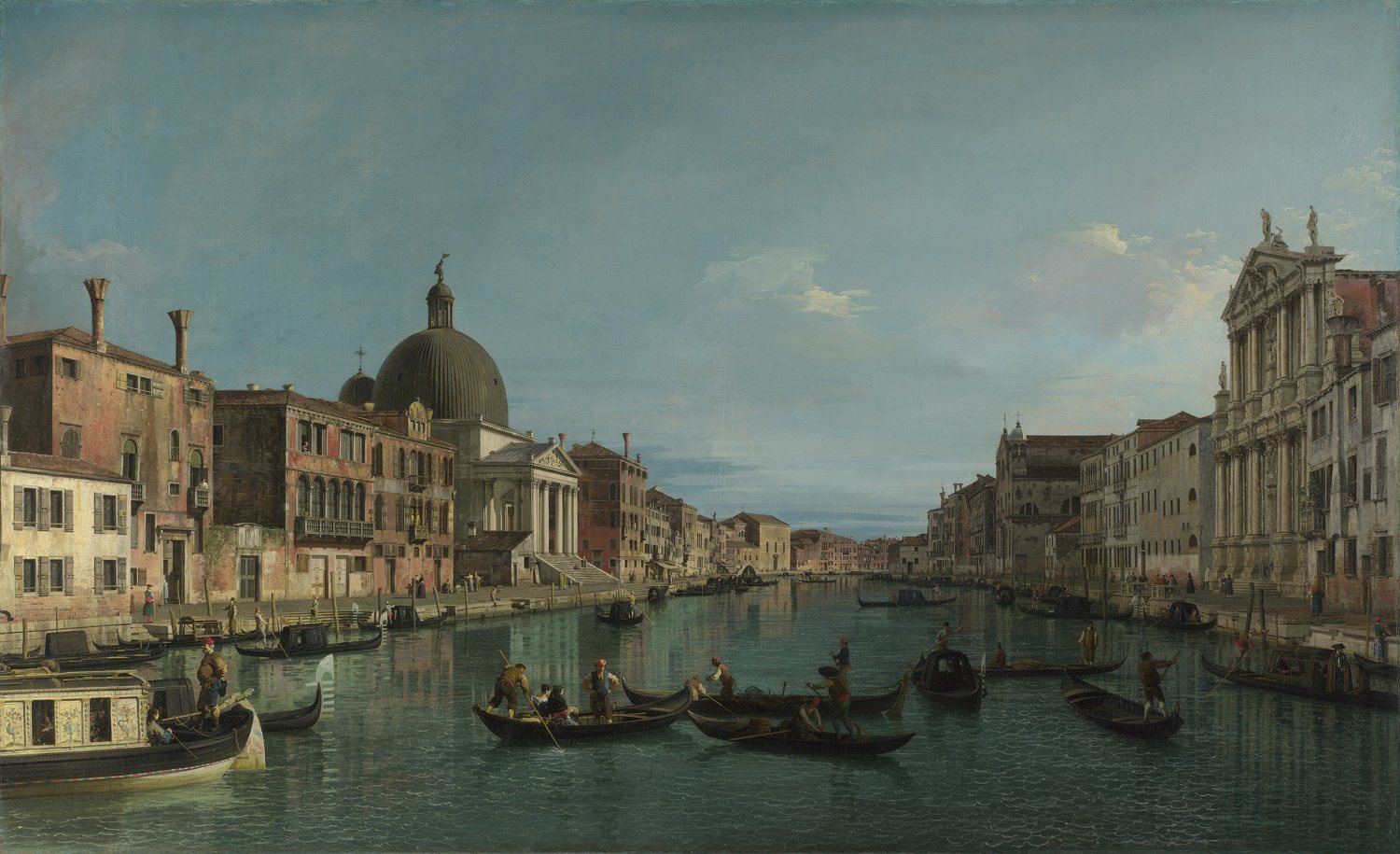
The upper reach of the canal under a high, bright sky: the green dome of San Simeone Piccolo on the left bank, the palaces running down both sides in measured recession, gondolas and barges keeping the water busy. It is the veduta at its most serene — nothing happens, and the nothing is composed like a fugue, every reflection placed.
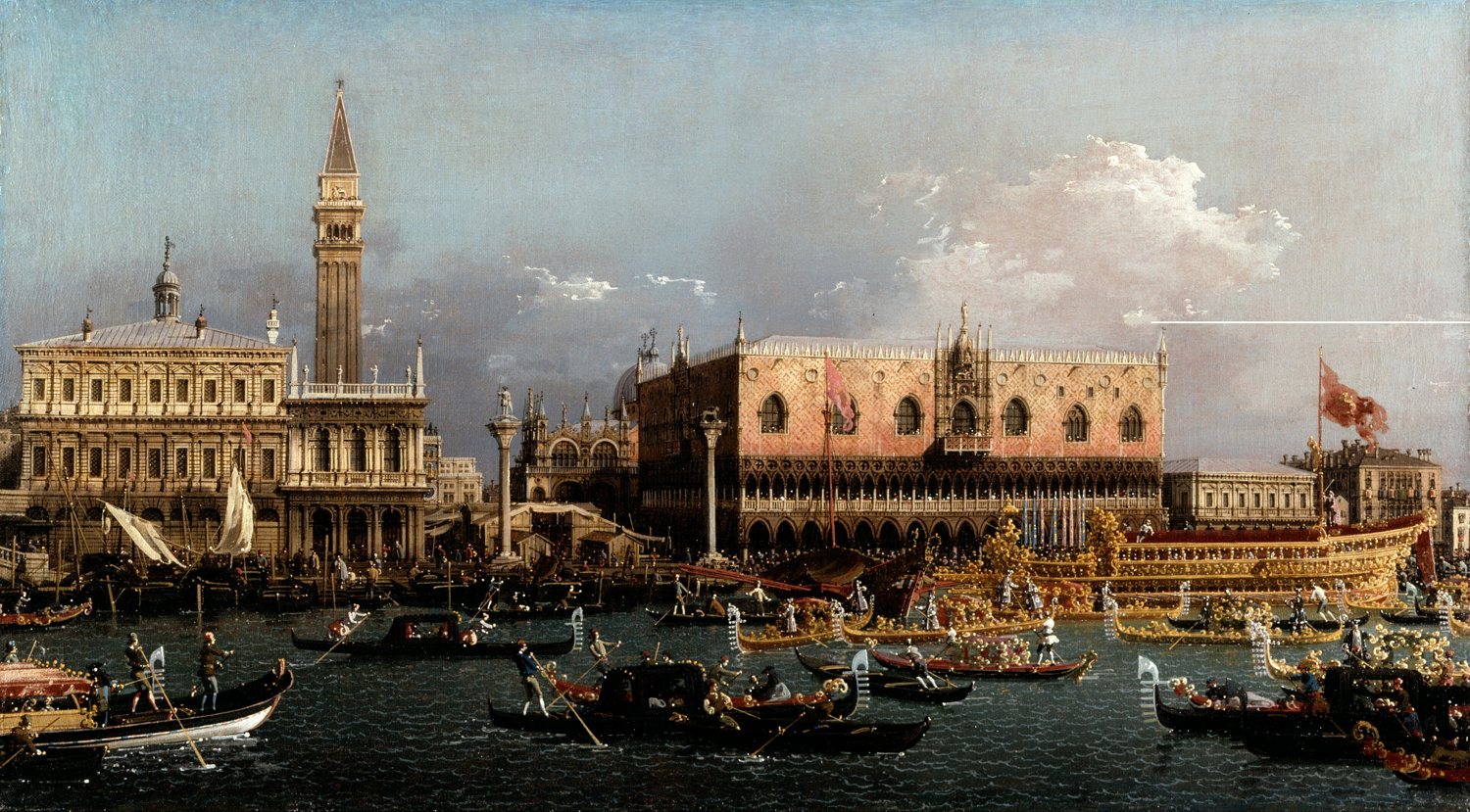
Venice's great state ceremony: the Doge's golden barge, the Bucintoro, returns to the Molo after the annual wedding of the city to the sea, the Doge's Palace and the campanile behind, the basin crowded with every boat in Venice. Canaletto paints the Republic's theatre of itself at full strength — a few years before the long decline made such pictures into souvenirs of a vanished world.
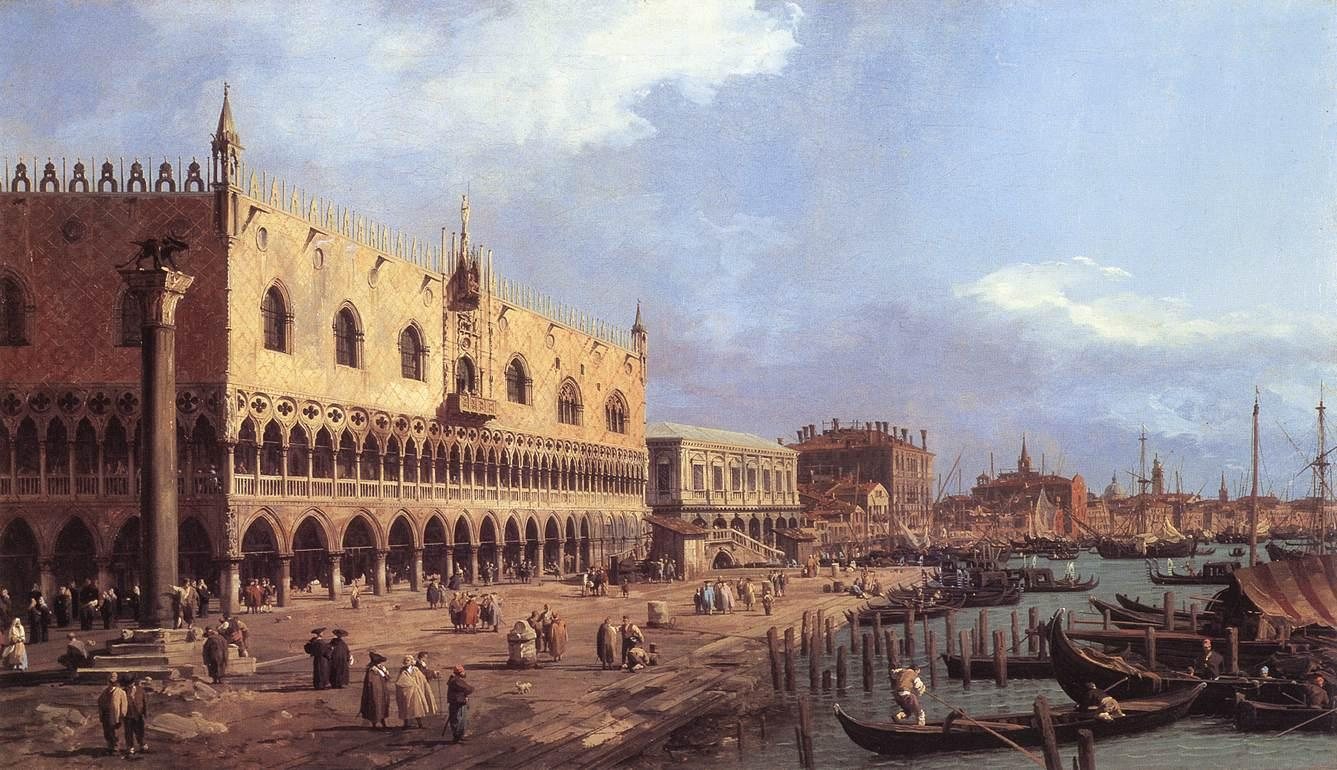
The palace from the water, its pink-and-white diamond brickwork catching the morning, the promenade of the Riva stretching east with its market stalls, boats and strollers. This was the postcard view of the eighteenth century, and Canaletto painted it more often and better than anyone — each version a slightly different hour, a different crowd, the same impossible clarity.
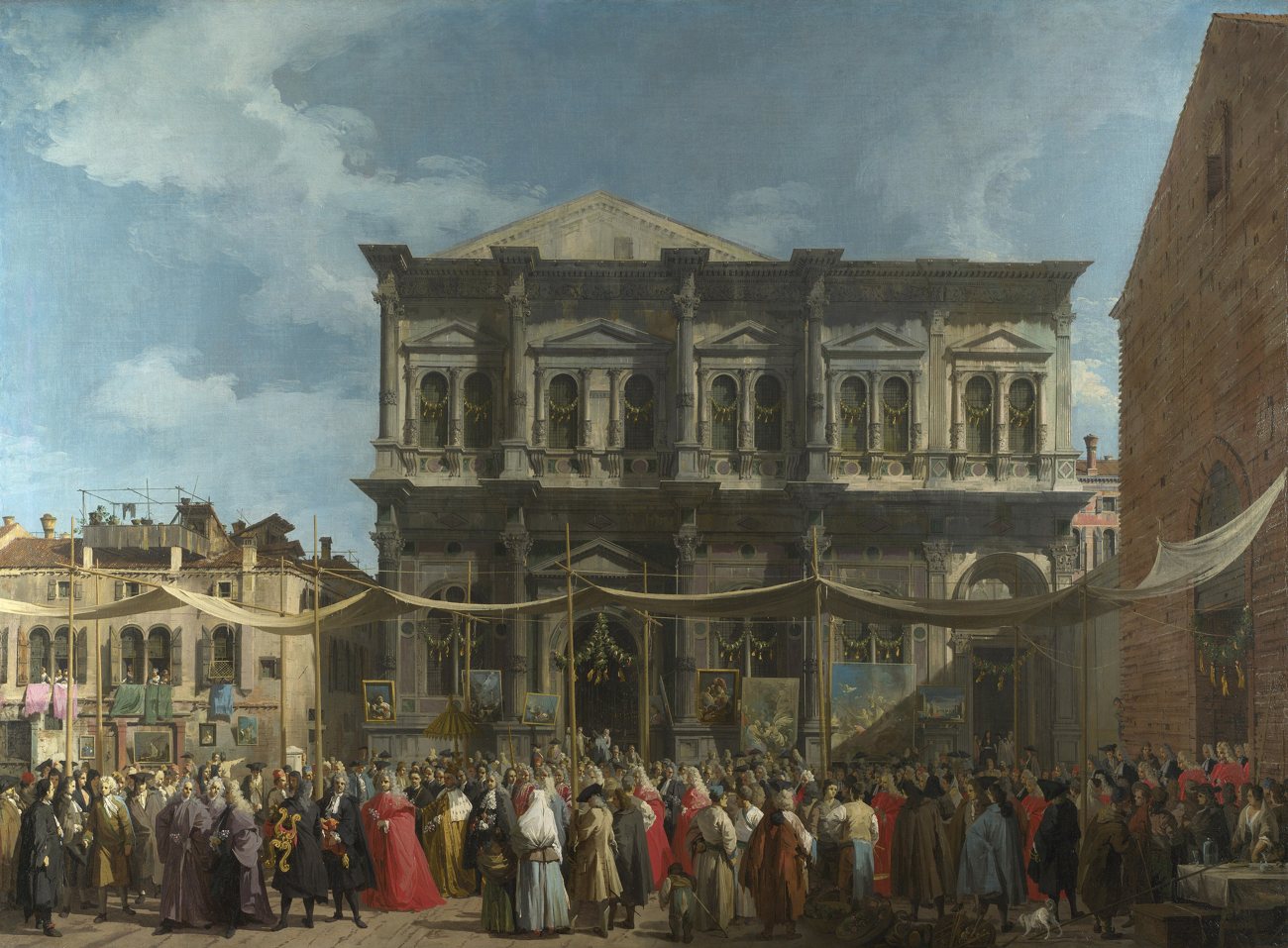
The Doge's annual visit to the church of San Rocco: garlands strung across the little square, a temporary canopy, and a crowd that fills the canvas edge to edge — senators, citizens, beggars, children on shoulders. Canaletto the crowd-painter at his best: two hundred figures, each a few strokes, together a whole city's holiday, preserved in clear morning light.
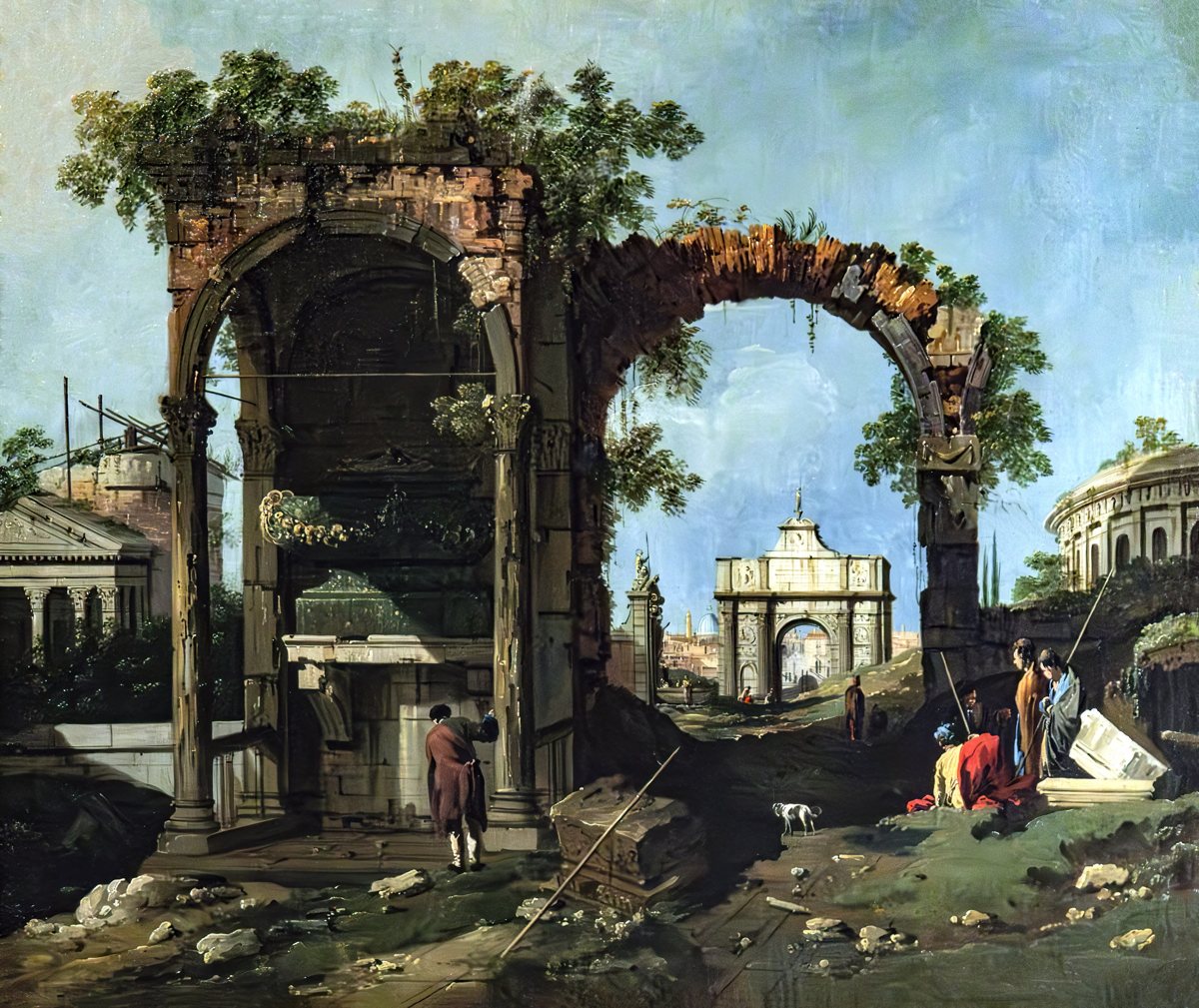
The invented view: a ruined triumphal arch overgrown with trees, classical fragments, country people among the stones — Rome as a dream, painted by a young man who had never been there. The capricci run through his whole career beside the exact views, the imagination's half of the veduta. Exactitude, it turns out, was a choice he made daily, not a cage.
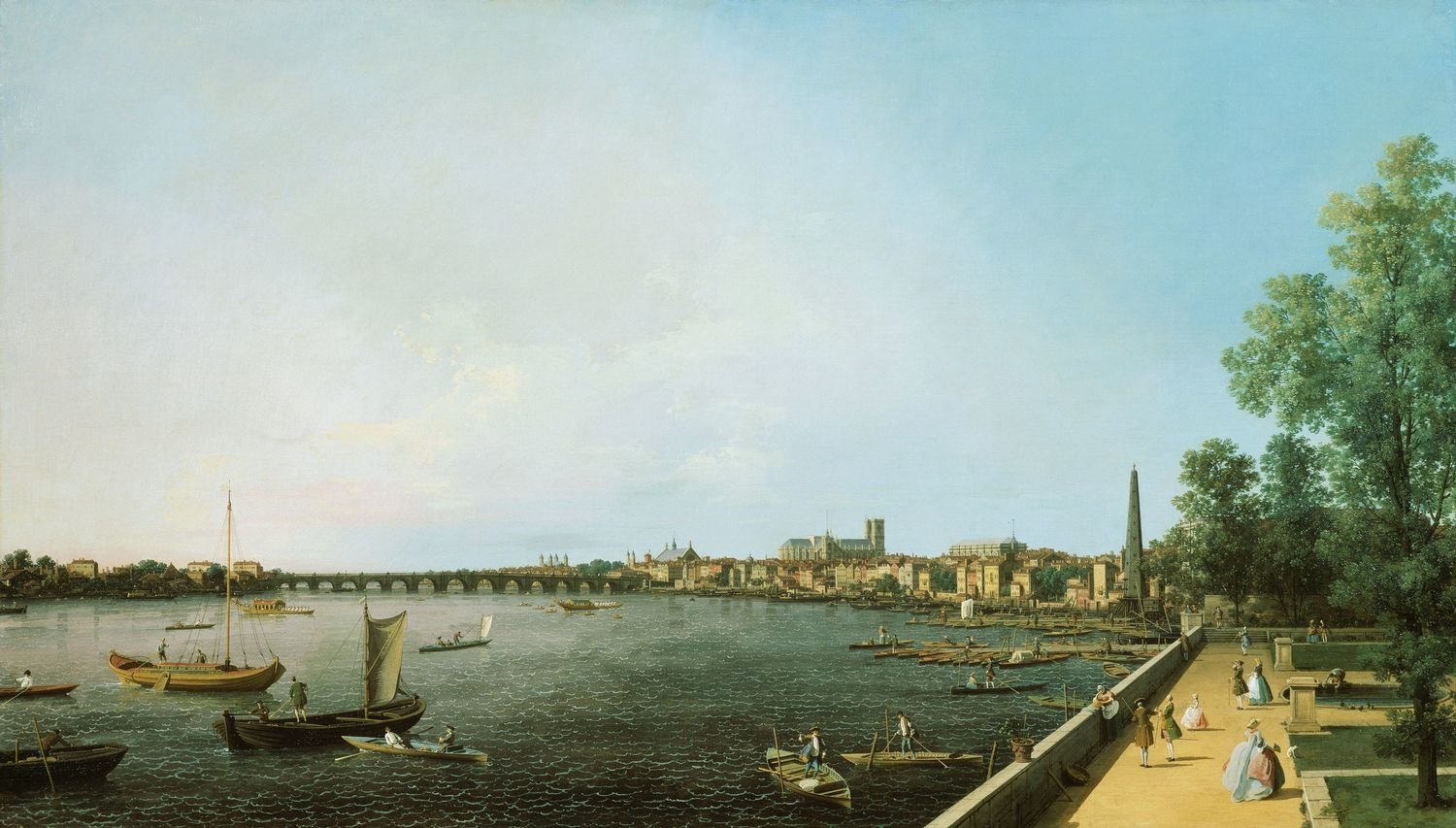
London painted as Venice: from the Somerset House terrace the Thames runs wide and ceremonial toward Westminster, its new bridge building, the banks lined with white stone, the river crowded with barges and wherries. The light is English — paler, greyer — and he bends it, gallantly, toward Venetian clarity. The English bought these views of their own capital from the Italian who saw it better than they did.