He crossed the Alps as a draughtsman for a print publisher and came home to invent a new kind of picture: the whole world at once — its weather, its work, its proverbs and its folly — seen from high above, as if from a church tower. They called him Peasant Bruegel, though he was a learned townsman who painted peasants the way an entomologist watches ants: with complete attention and not a trace of condescension.
Bruegel's career began on paper: he supplied drawings to Hieronymus Cock's print shop in Antwerp, the Four Winds — mountain landscapes from his Italian journey, the Large Landscapes, the Vices and Virtues — which engravers cut into copper and sold across Europe. The paintings came later, and they keep the printmaker's habits: everything legible, everything placed, a hundred episodes reading like lines of text.
His high horizon — the Weltlandschaft, the world-landscape — descends from Joachim Patinir and from his own Alpine drawings: a viewpoint no human can occupy, from which rivers, seasons, armies and harvests arrange themselves into one order. The device lets him put man's whole life inside nature's frame, and quietly shrink the man.
The Netherlandish Proverbs packs more than a hundred sayings into one village square — a man banging his head against a wall, another filling a well after the calf has drowned, a third casting roses before swine. It is painting as an encyclopedia of folk speech, each figure a caption waiting for its proverb, and half the fun is still the finding.
Two of his most fragile masterpieces — The Blind Leading the Blind and The Misanthrope — are painted not in oil but in glue tempera on linen, the cheap tüchlein technique: matte, dry, and heartbreakingly perishable. That they survive at all is an accident of careful centuries; their chalky stillness is part of their meaning, sermons painted in dust.
Bruegel hides his protagonists. Icarus is two legs disappearing into the sea at the edge of a landscape that does not notice him; the conversion of Paul is lost in a mountain crowd; the census at Bethlehem happens unregarded in a snowy village. It is a theology and a joke at once: the world goes on ploughing, skating and eating, whatever falls out of the sky.
He signed BRVEGEL, in Roman capitals; his sons Pieter and Jan inherited the name, the compositions and the market. Pieter the Younger spent a lifetime copying his father's panels — some forty versions of the Winter Landscape with a Bird Trap alone — which is why Bruegel is everywhere, and why telling the father's hand from the son's is a scholarly blood sport.
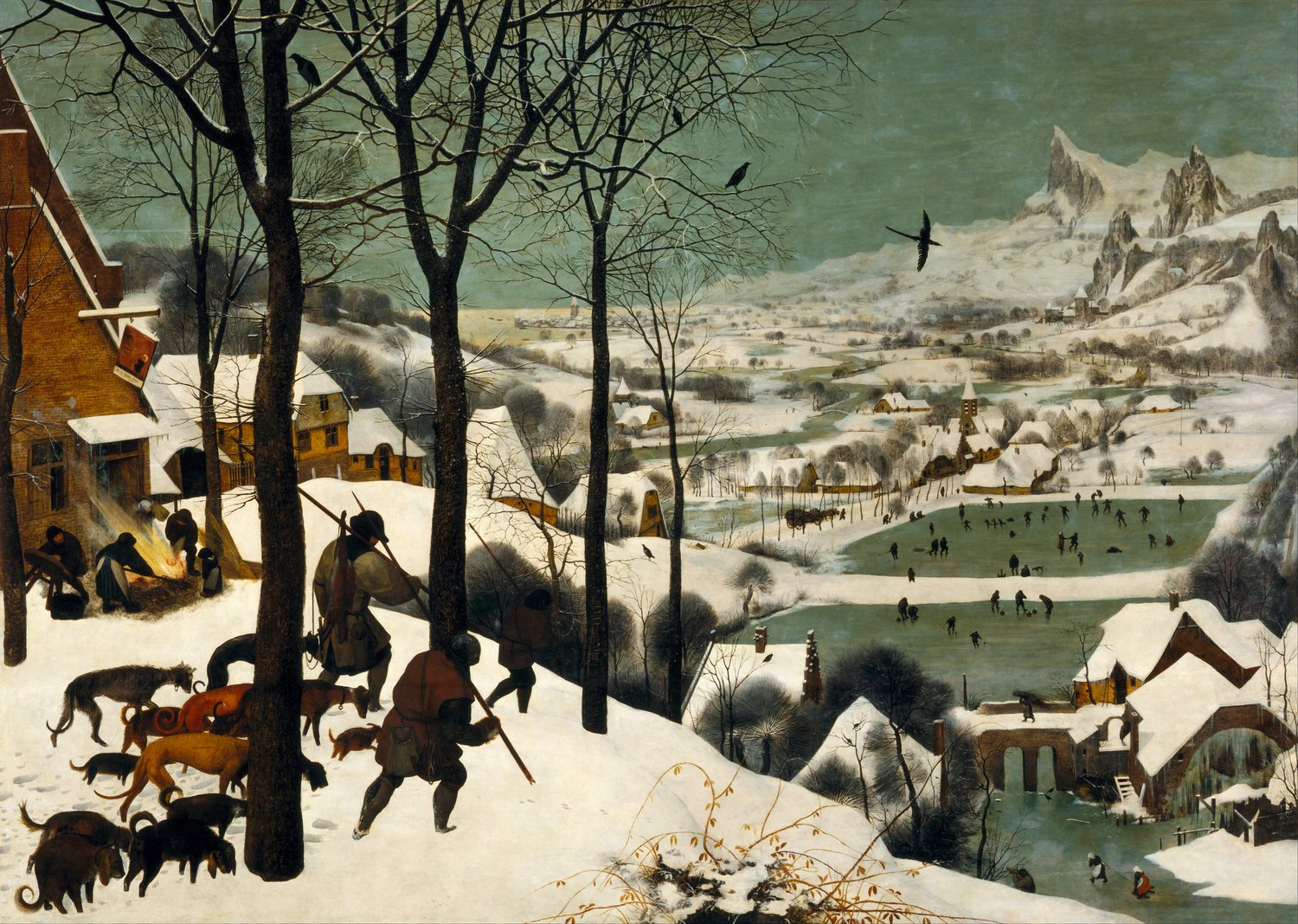
The most famous winter in art: hunters trudge home with one fox between them while the village below skates, eats and burns a pig as if winter were a festival. It was painted for a cycle of the Months for a Brussels banker's suburban villa — January, in the coldest decade of the Little Ice Age, and it shows.
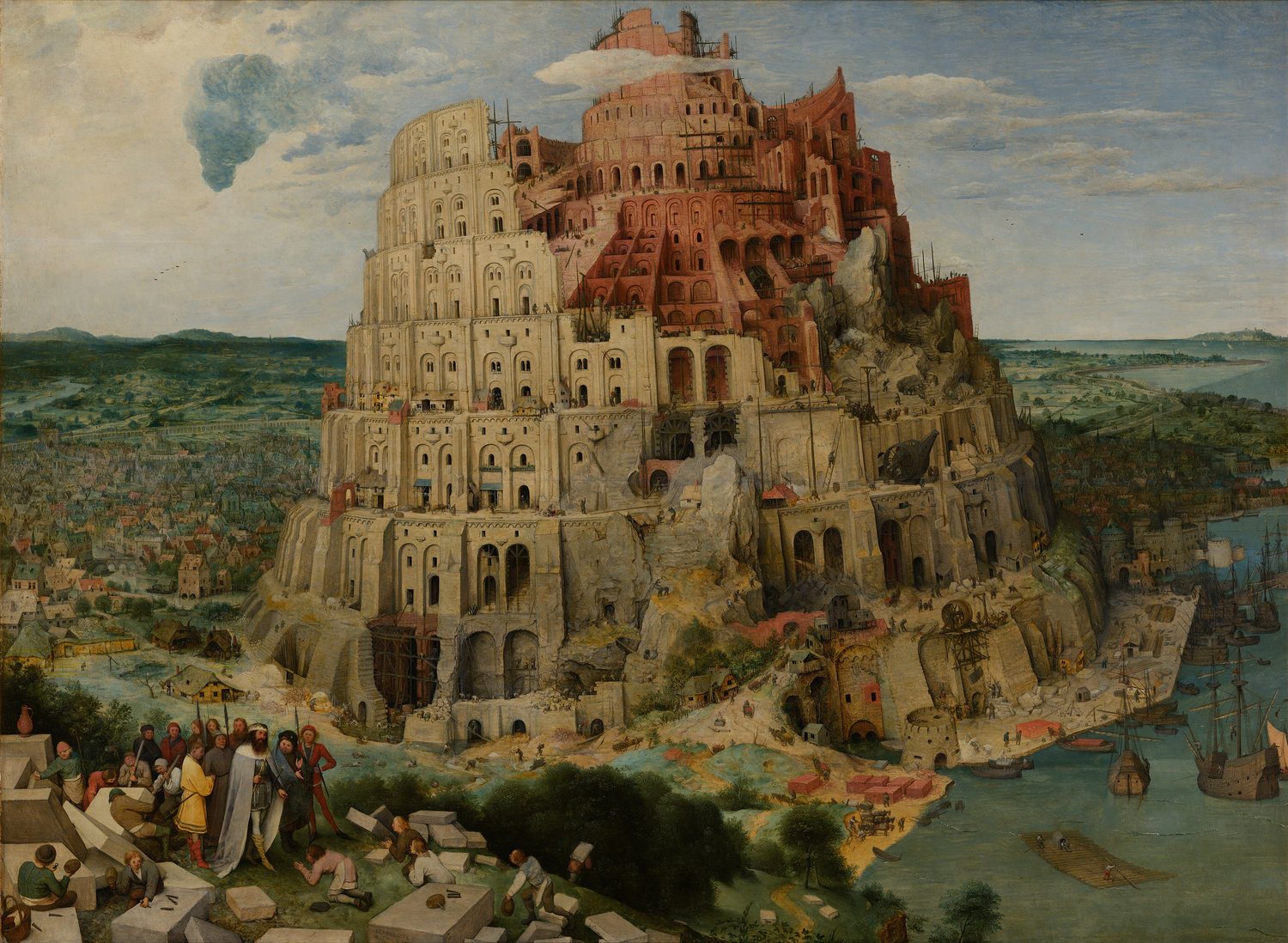
Bruegel builds Babel like a Roman Colosseum under construction in a Flemish port — thousands of tiny workers, cranes, barges, and a king inspecting the folly in the corner. He had seen Rome; he knew empires. The tower already leans and crumbles at the top while the bottom is still being built: the whole sermon in one building site.
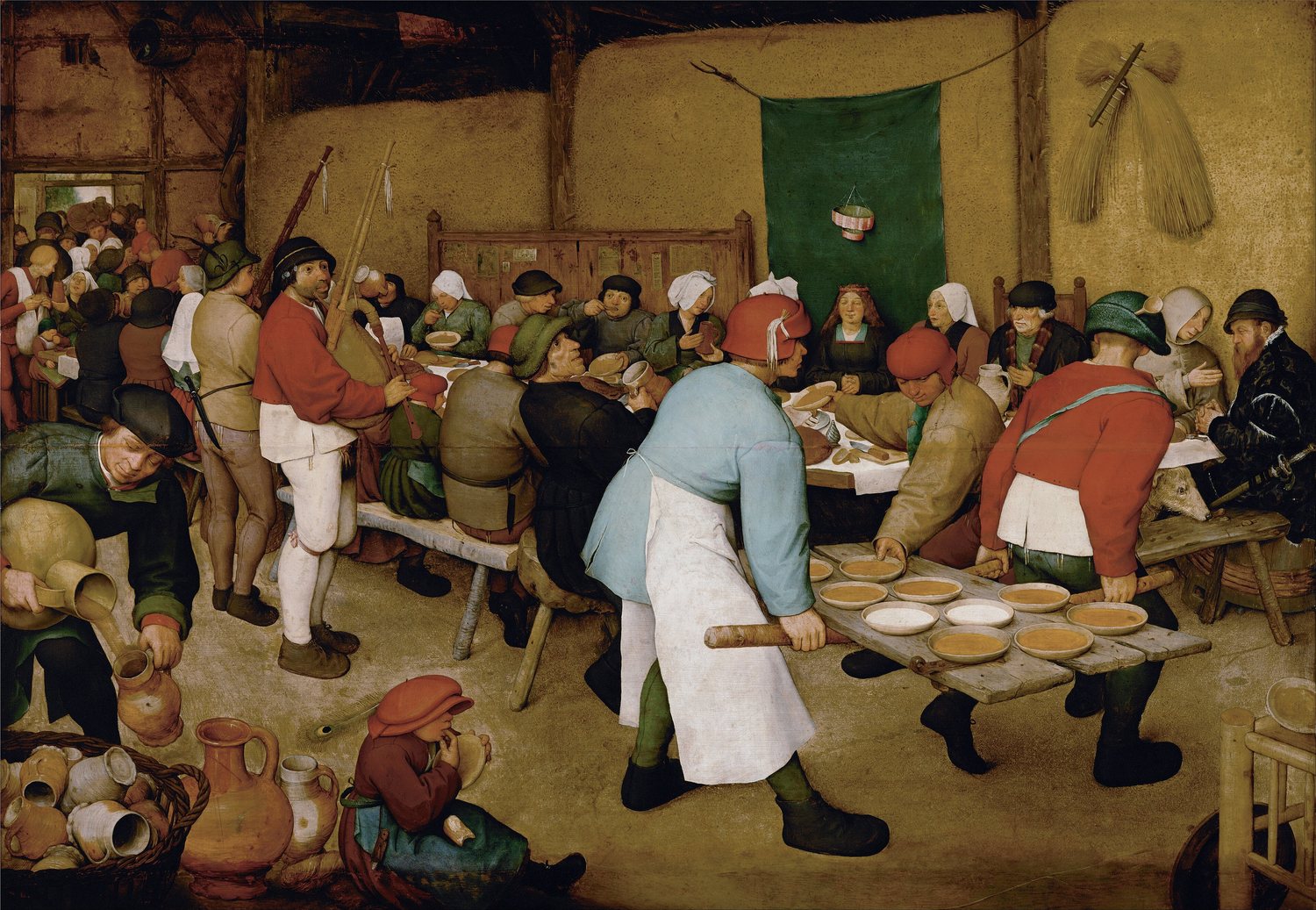
The bride sits demurely under her paper crown, not eating — custom forbade it — while the groom is nowhere certainly identifiable and the guests attack the porridge carried in on a door taken off its hinges. A feast painted by a man who, the story goes, disguised himself as a peasant to attend such weddings and watch.
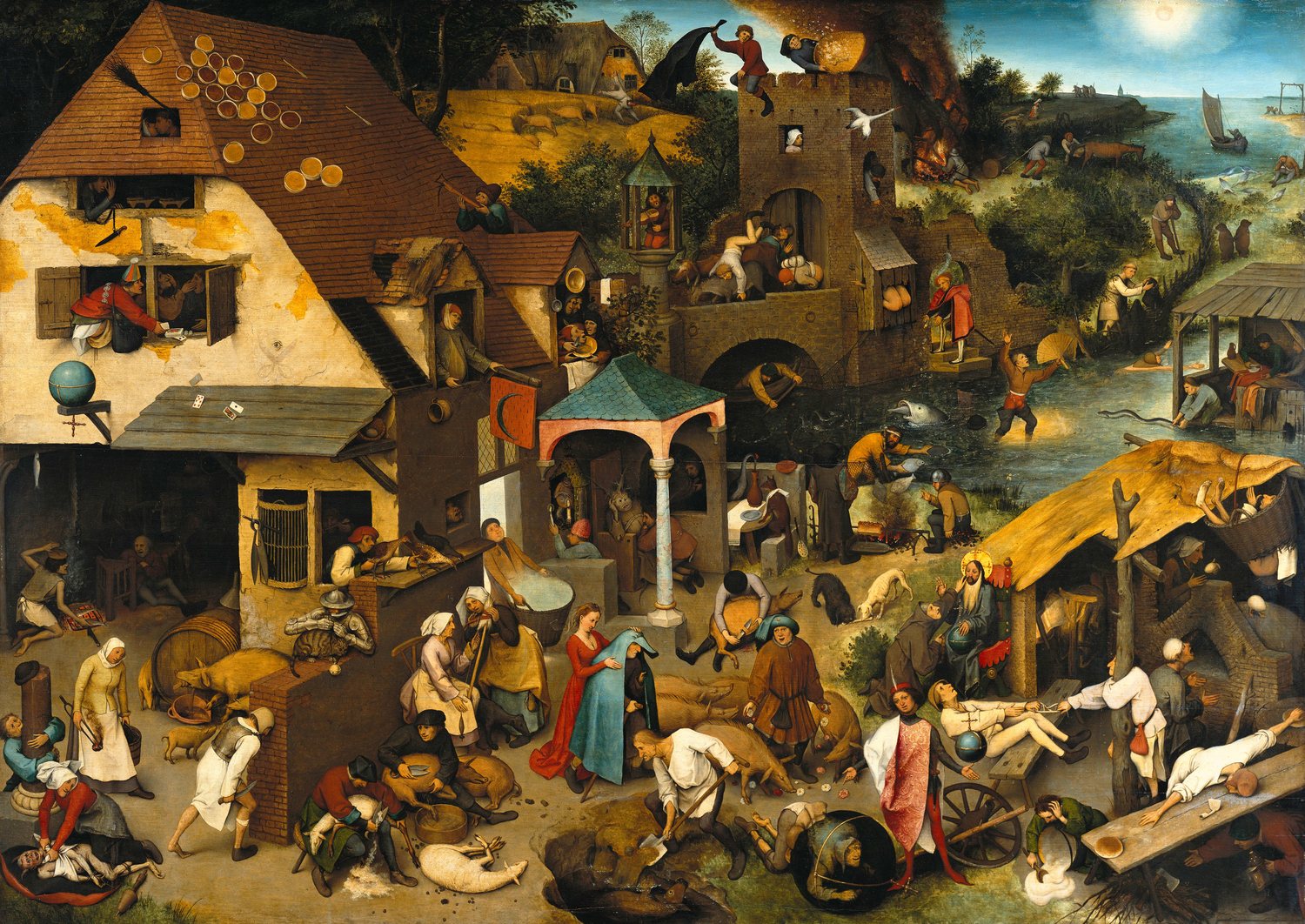
More than a hundred proverbs acted out in one village: folly as a census. The picture was famous in its own century and copied again and again — a painted dictionary of how people actually talked, preached and warned each other, four and a half centuries before anyone thought to record it.
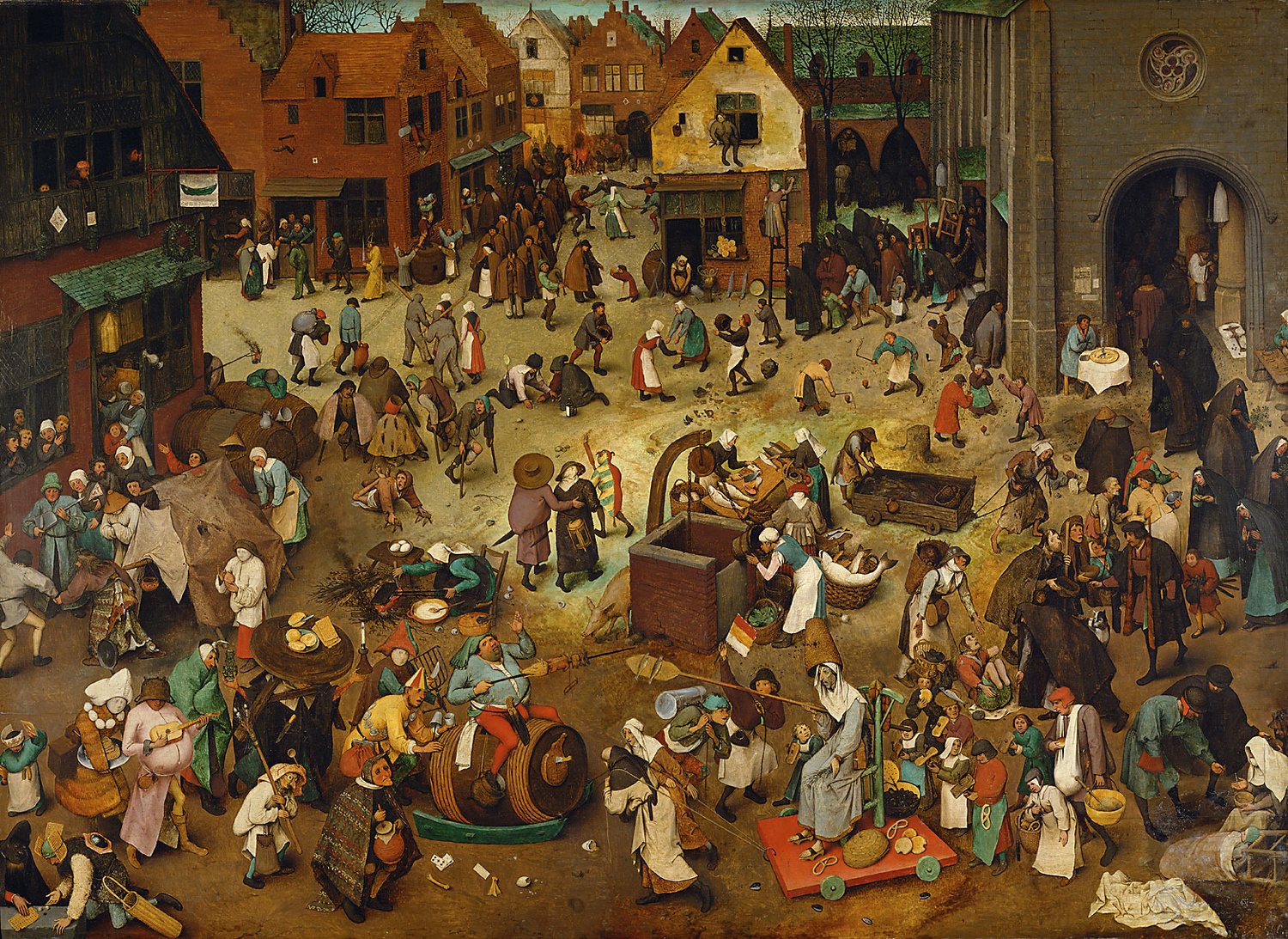
Fat Carnival, riding a barrel with a pie on his head, jousts with thin Lent and her beehive hat in a square split between the inn and the church — feasting on one side, fasting on the other, and the whole town flowing between them. Bruegel takes no side; he takes the whole square.
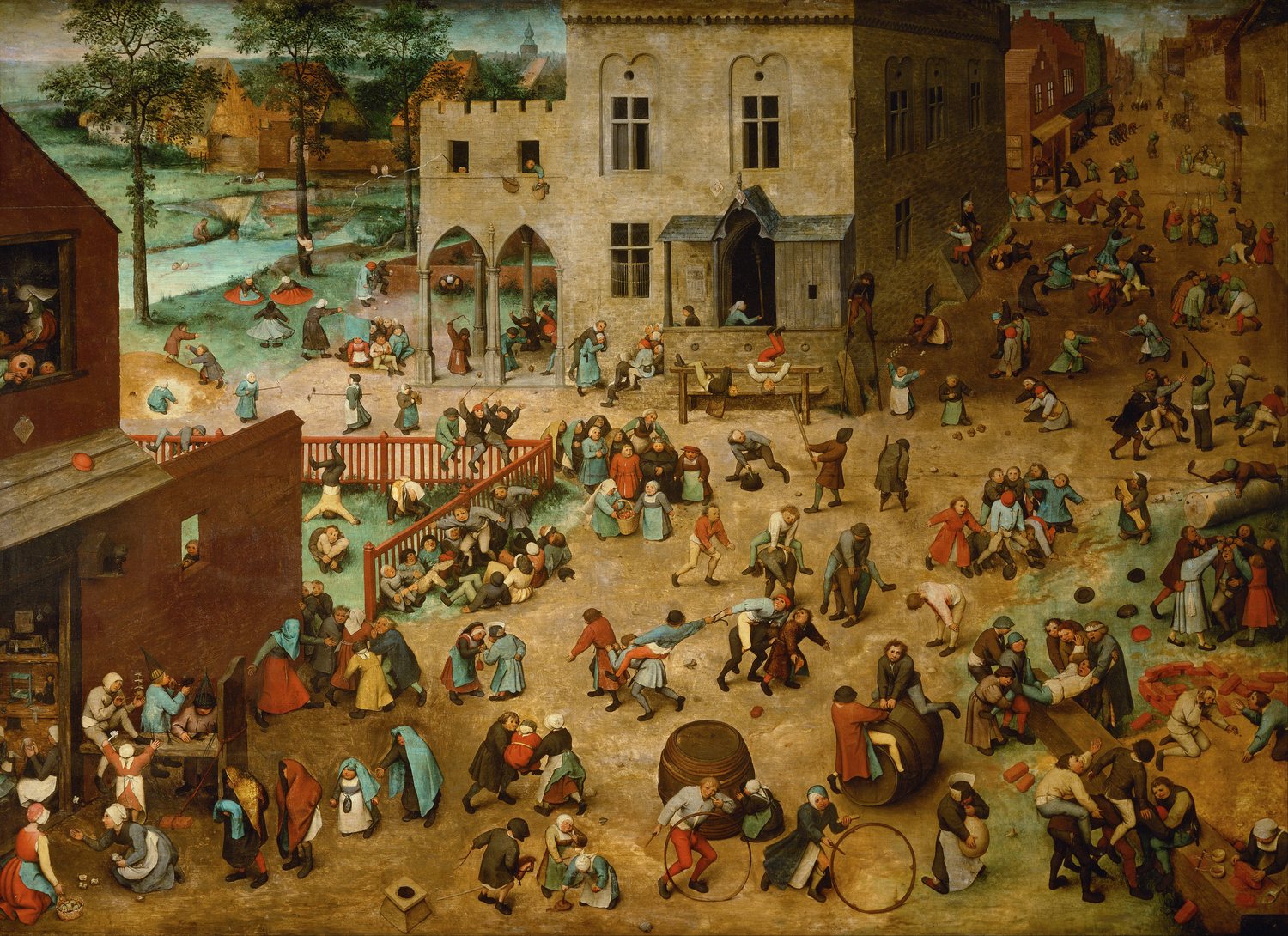
Some two hundred children play ninety-odd games — hoops, stilts, leapfrog, a mock wedding, a mock funeral — with the grave concentration of adults at work. Scholars count the games; everyone else recognises the point: the grown world, rehearsed in miniature, in a town square with no adult in charge.
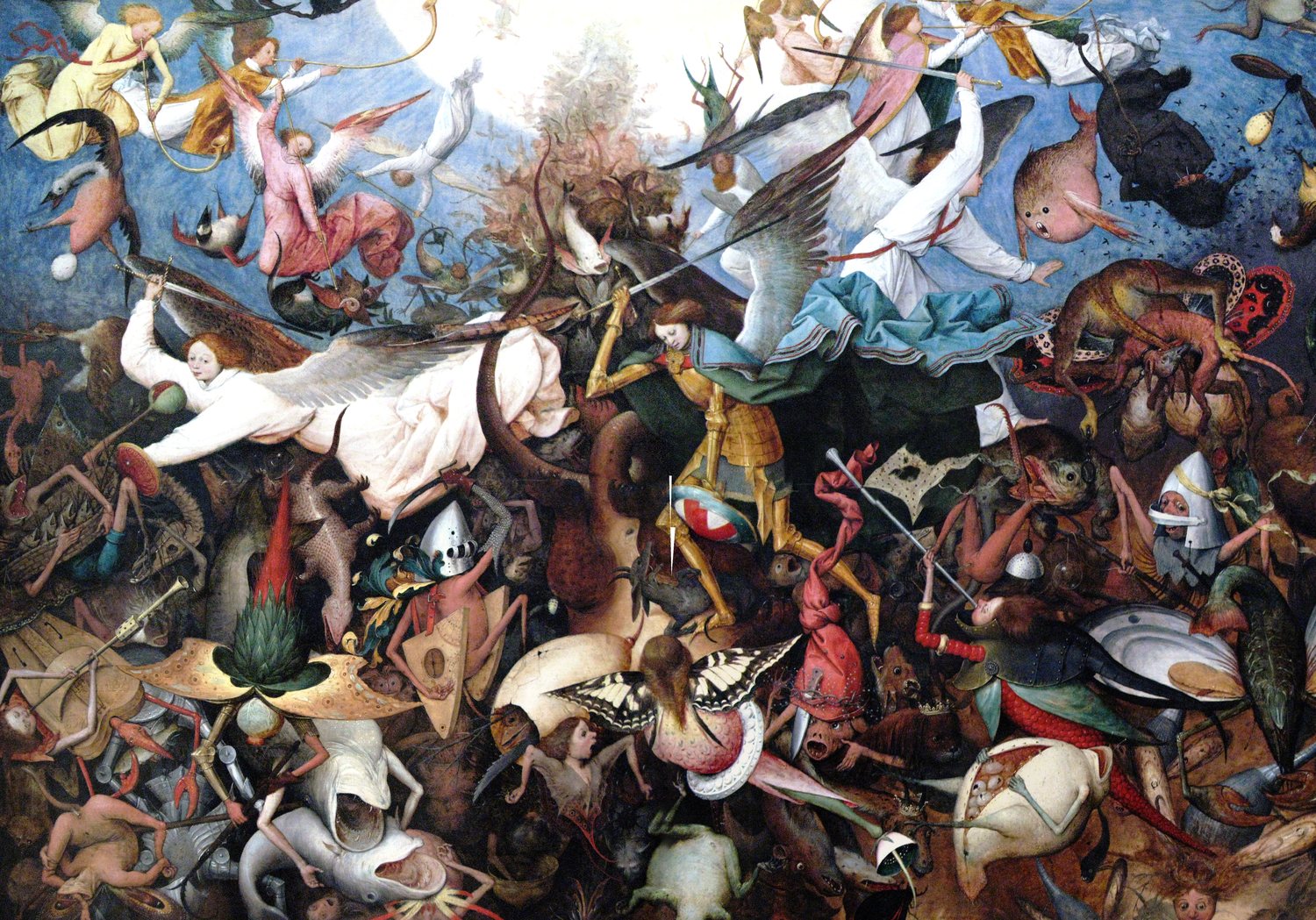
Archangel Michael drives a swarm of falling angels who turn, mid-air, into Bosch's whole bestiary — fish, frogs, insects, armoured fruit. It is Bruegel's most deliberate homage to the master he never met, painted the year before his move to Brussels, virtuosity as an act of ancestor worship.
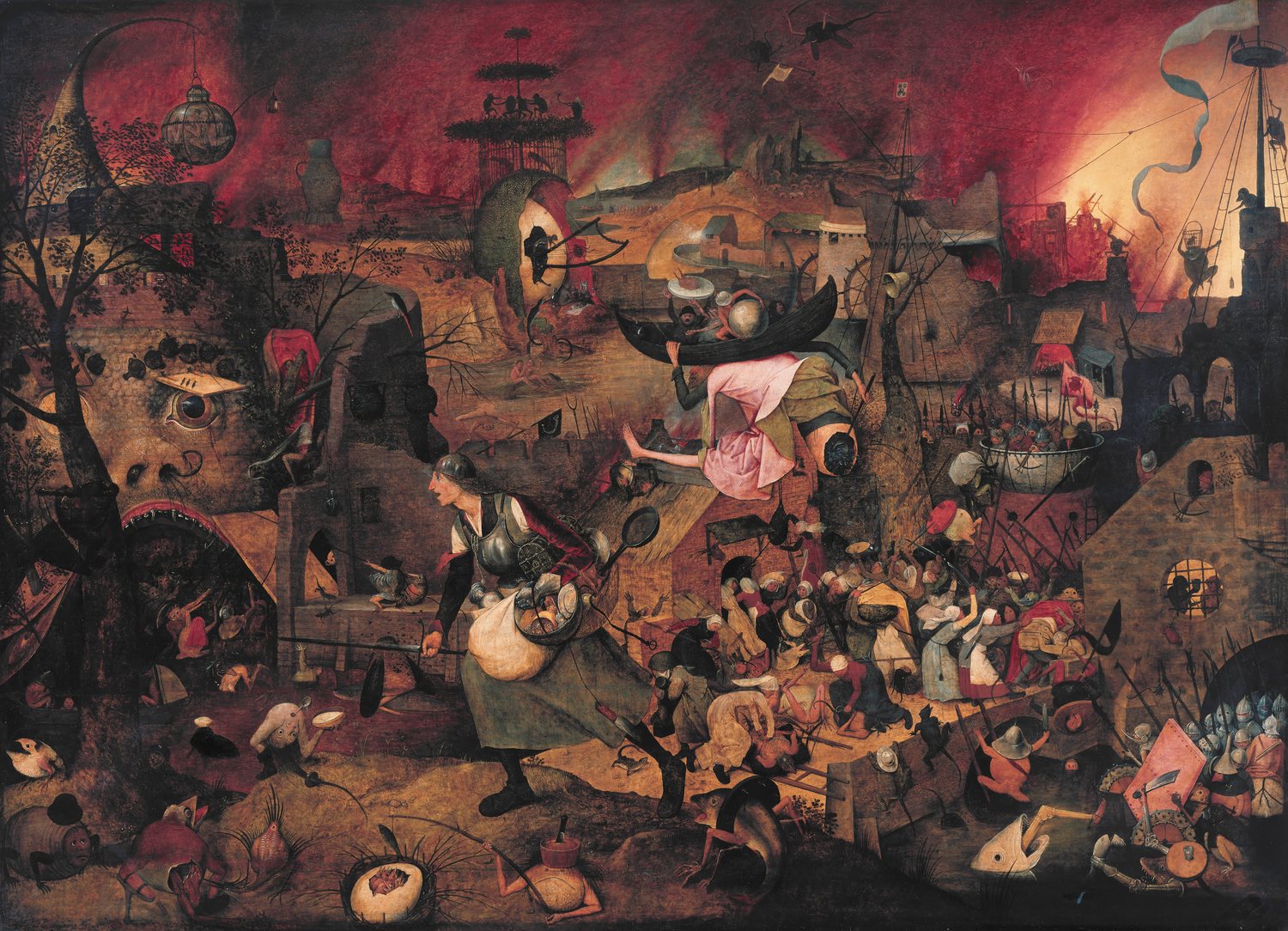
Mad Meg storms the mouth of Hell itself, apron full of loot, sword in hand, while demons pour out of a giant head and the sky burns red. Greed marching on Hell — or a woman braver than the apocalypse. Nobody has ever fully explained this picture, which is precisely its power.
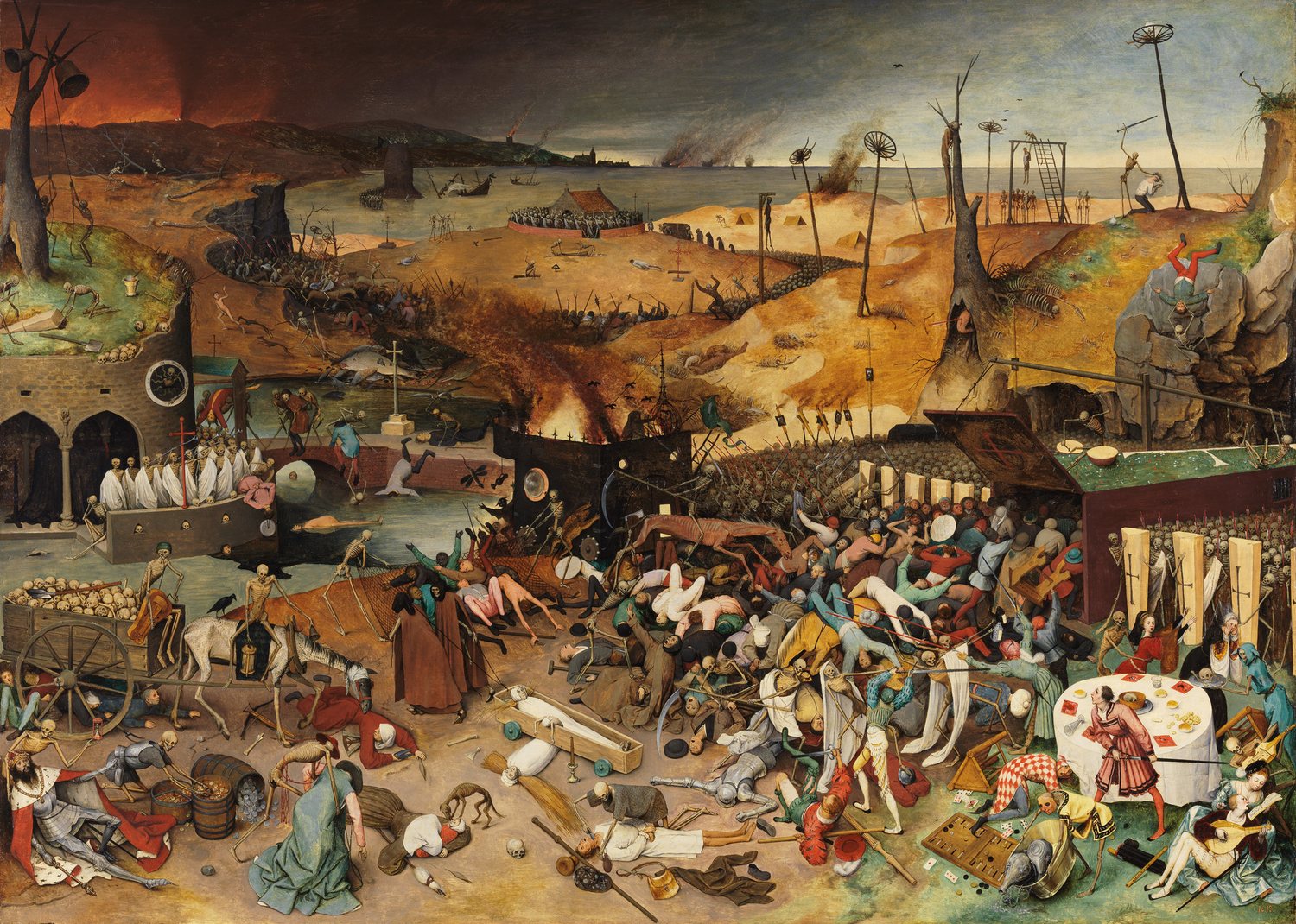
Armies of skeletons harvest the living — kings, cardinals, lovers, a whole world herded into a giant coffin — under a sky of burning ships. Painted in the years of plague, war and religious terror, it is the Dance of Death enlarged to the size of history, and the bleakest thing Bruegel ever made.
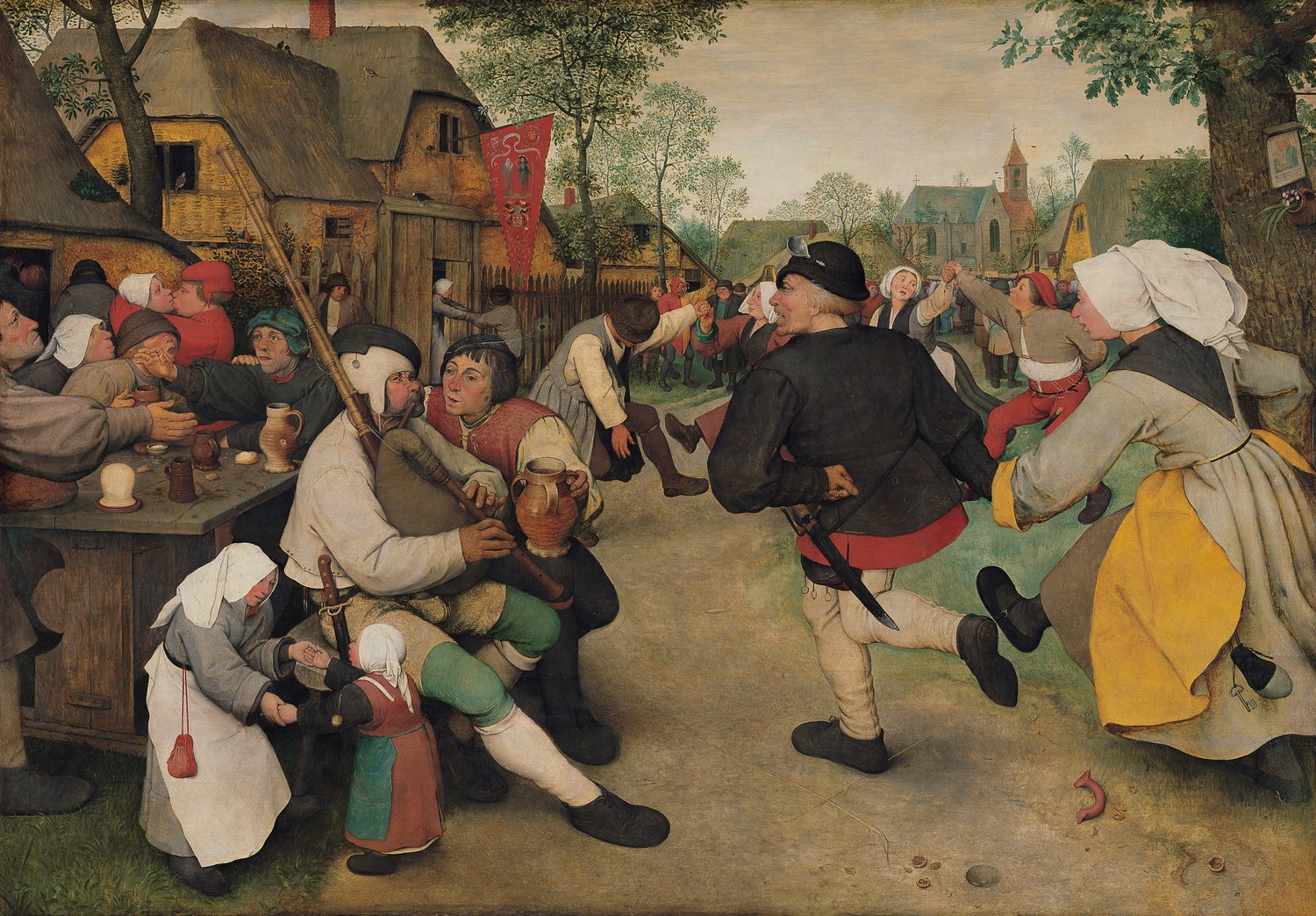
Late, large and loud: a village kermis at full swing, the dancers looming big in the foreground, a bagpiper, a flag, a couple hurrying in from the right as if afraid of missing a minute. Painted a year before his death, with nothing diminished — the energy of the young printmaker, at the scale of a history painting.
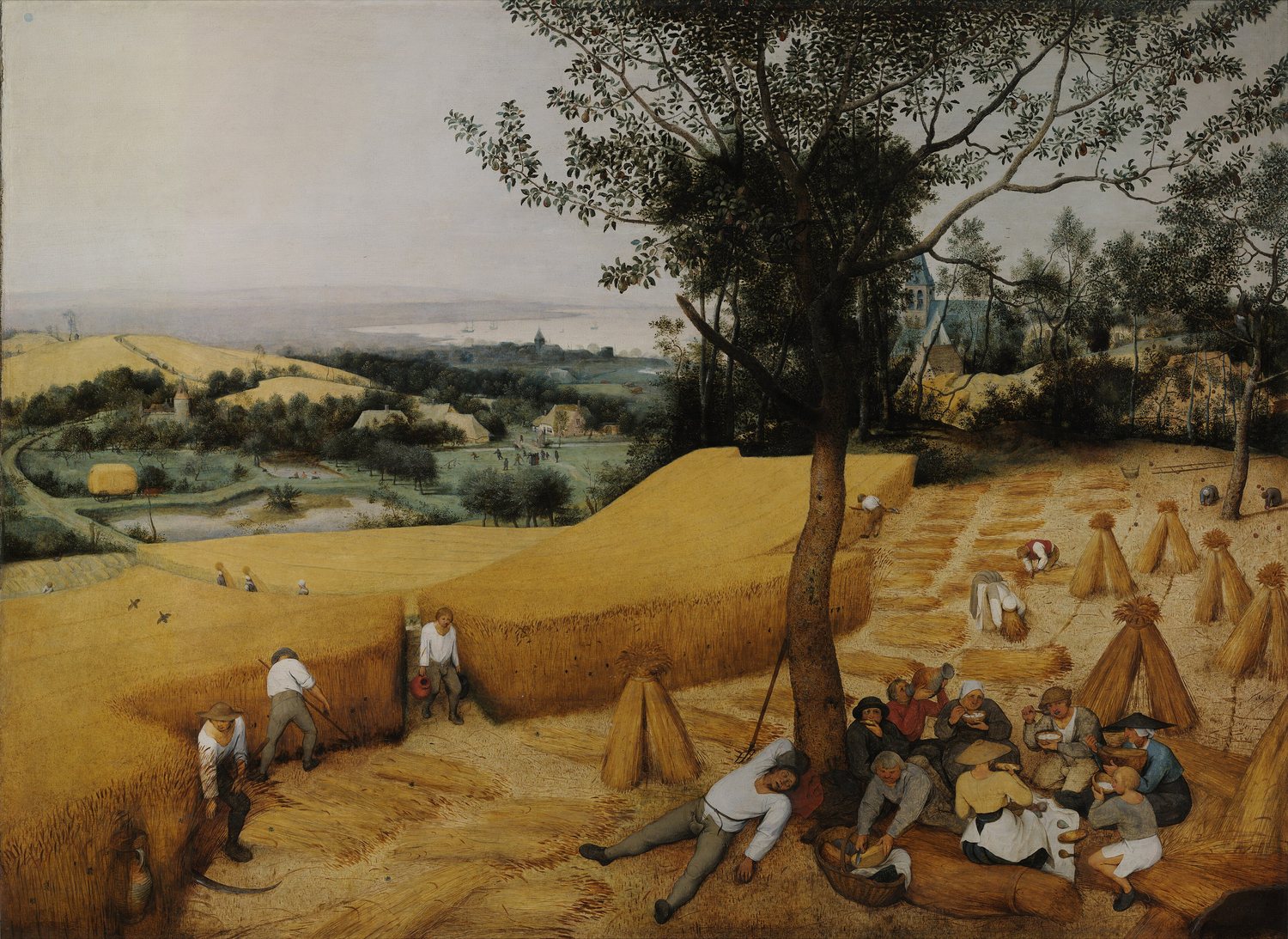
August, from the Months cycle: reapers in a wheat field that rolls down to a distant harbour, one worker flat asleep under the pear tree while the rest eat, drink and bind sheaves. Heat you can feel, painted in yellow on yellow — the summer counterpart to the Hunters' winter.
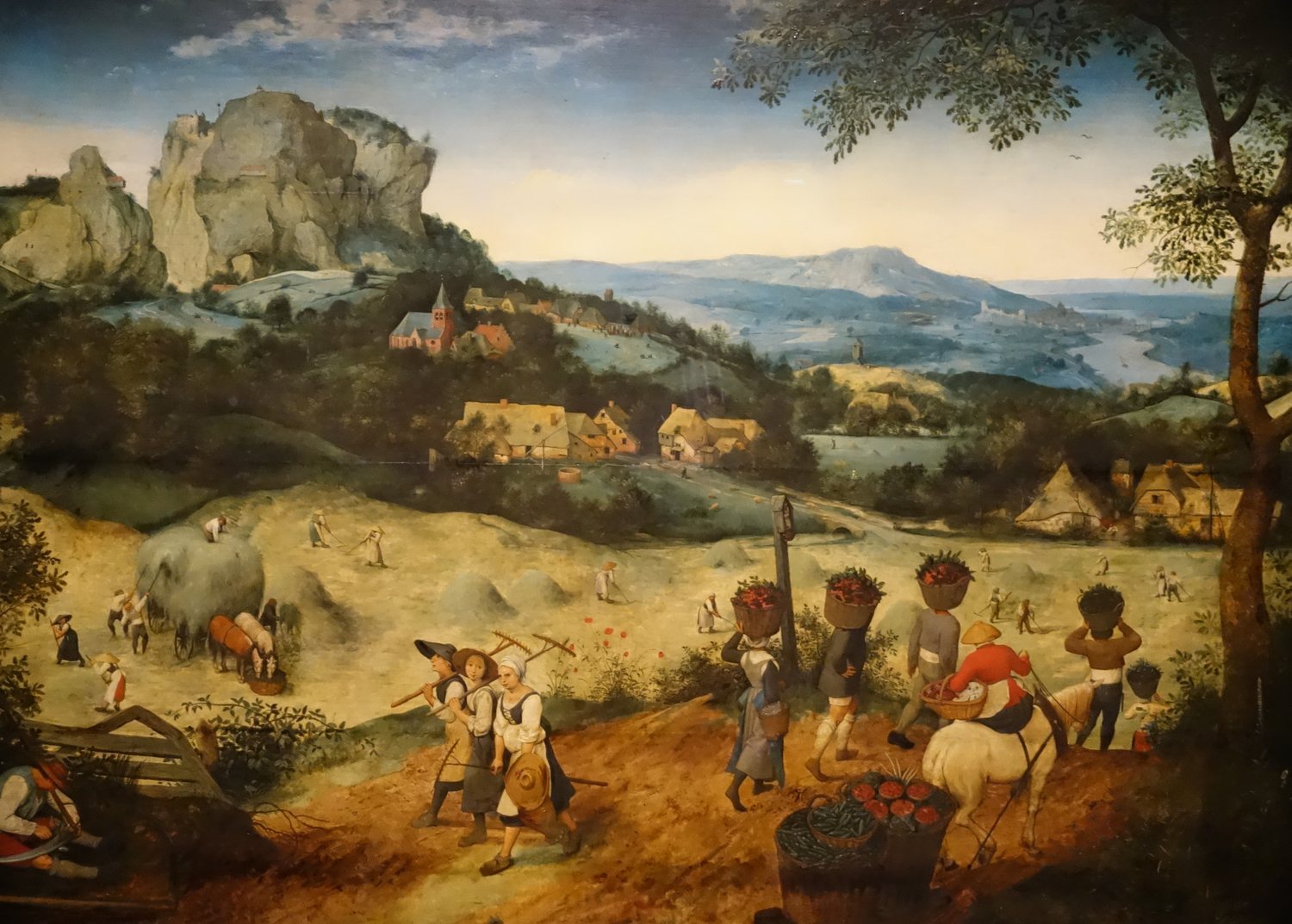
June and July from the Months: haymakers loading wagons under a high summer sky, the world green and gold and at peace. The cycle's six great panels are scattered today between Vienna, New York and Prague — this one hung for centuries in the Lobkowicz family's castles, a season kept like a title deed.
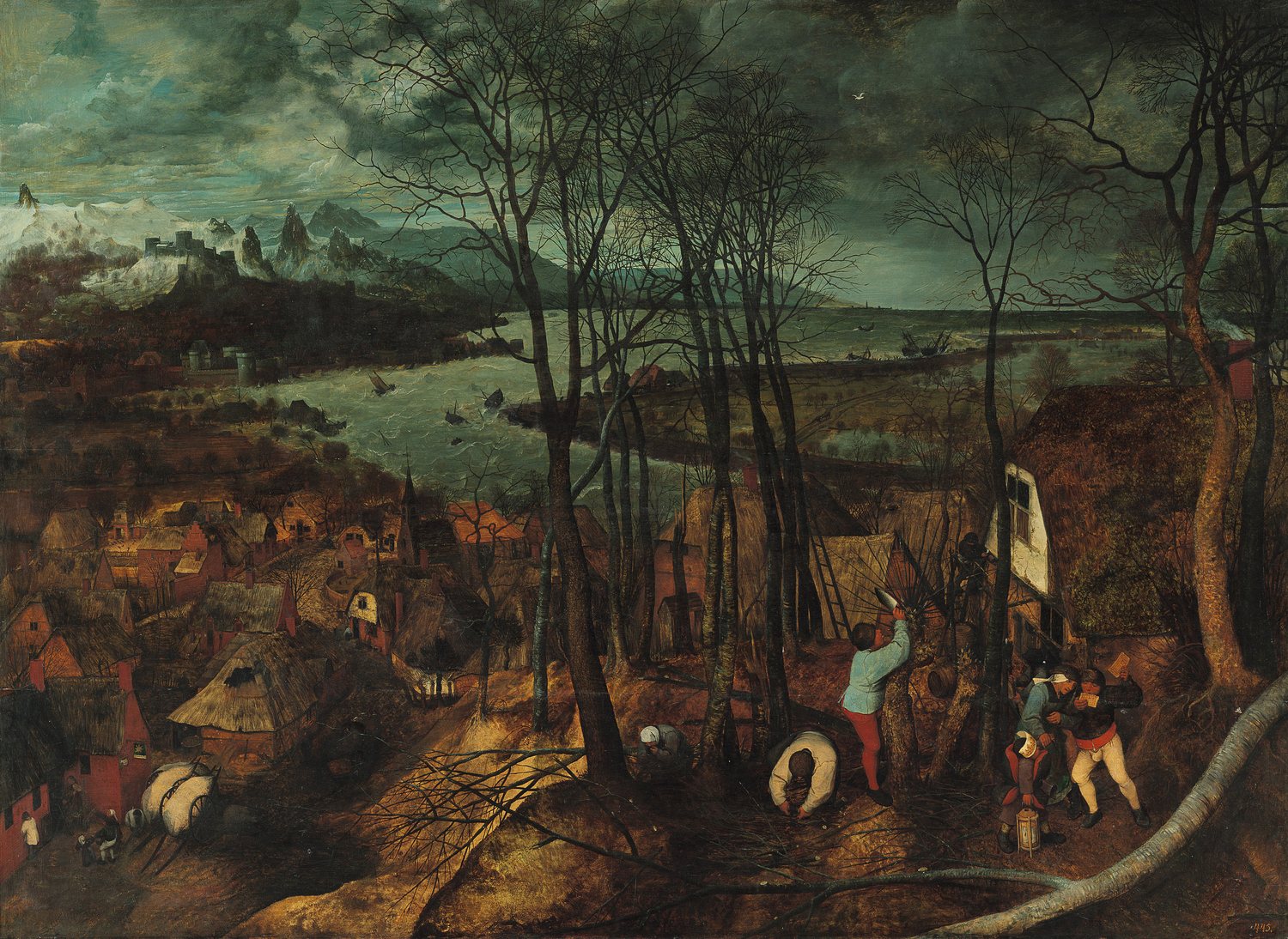
Early spring from the Months — February and March weather: men pruning willows under a sky the colour of wet slate, a child with a paper crown from carnival, ships in trouble on a grey sea in the distance. The least loved season, painted with the same attention as the glorious ones. That is the whole Bruegel creed in one panel.
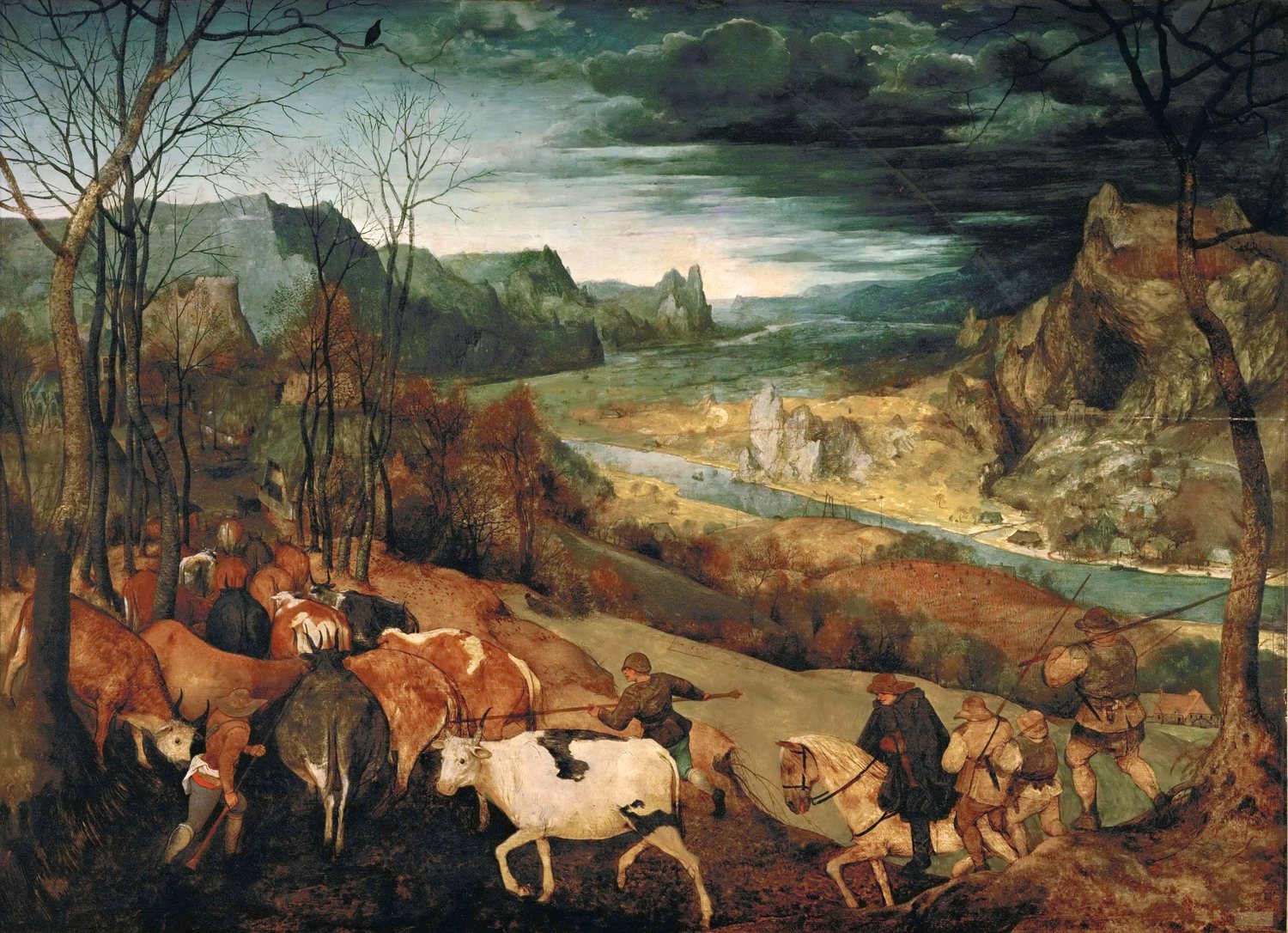
Autumn from the Months: cattle driven down from the high pastures through a river valley turning brown and gold, the herdsmen as monumental as any saints. Bruegel had crossed the Alps himself ten years earlier; the mountains in these panels are remembered, rebuilt and set down in Brabant like imported weather.
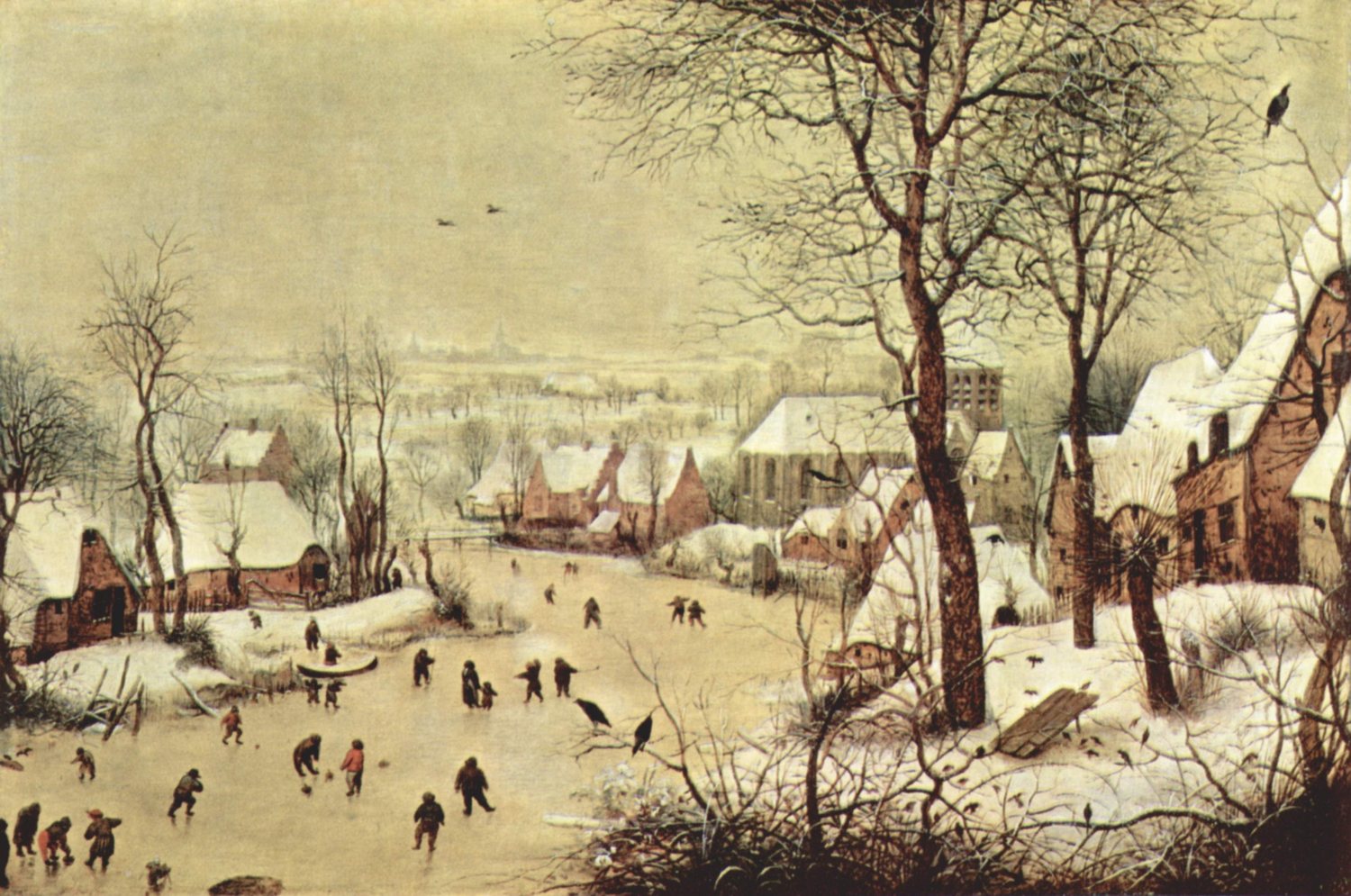
Skaters glide on the frozen river, unaware of the great trap propped on a stick in the foreground, waiting for the birds. The picture's charm and its menace are the same thing — which is why his son copied it some forty times, and why the moral reads itself: all of us skate over something.
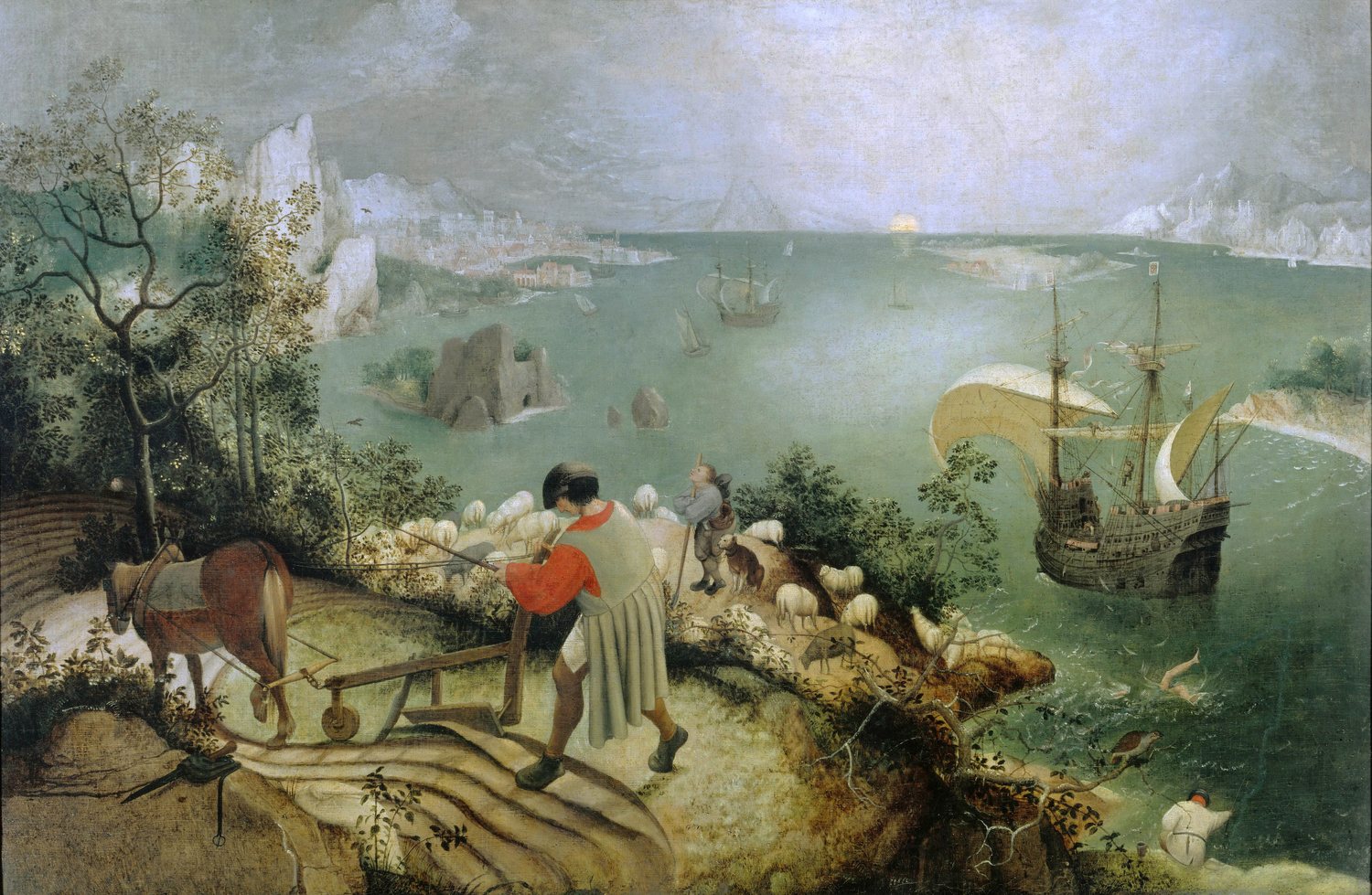
The most famous legs in art history splash into the sea, bottom right, while the ploughman ploughs, the shepherd daydreams and the ship sails on. The Brussels panel is now thought to be a fine early copy of a lost Bruegel original — the attribution is honestly doubtful, and the picture's idea, Auden's poem and all, is immortal anyway.
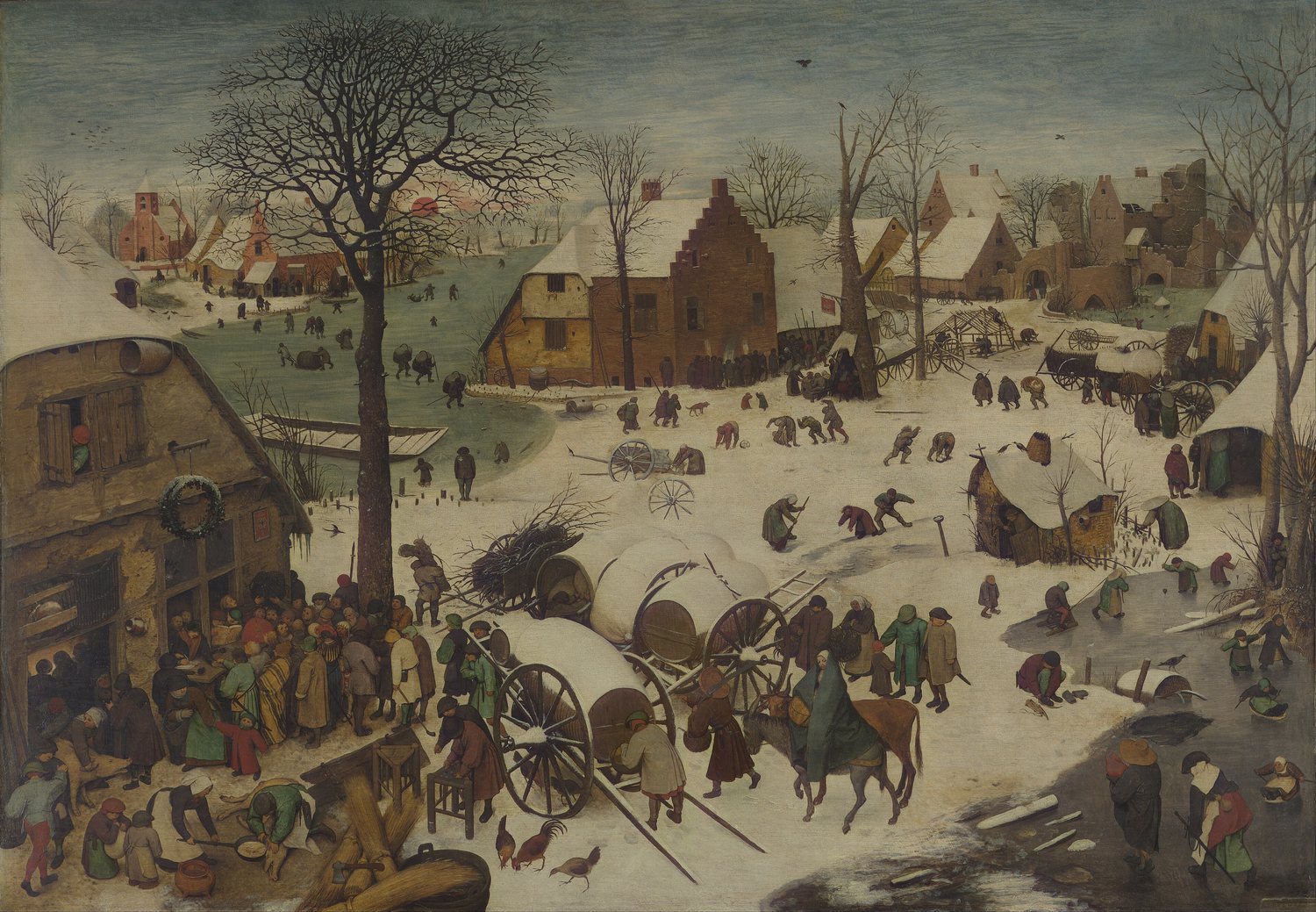
Bethlehem is a Flemish village in the snow, and the Holy Family is lost in the crowd queuing to register at the tax office — an inn window, lower left, easy to miss entirely. Under Spanish rule, everyone in Bruegel's audience understood a census, a tax queue and soldiers in the snow. The Bible, translated into taxation.
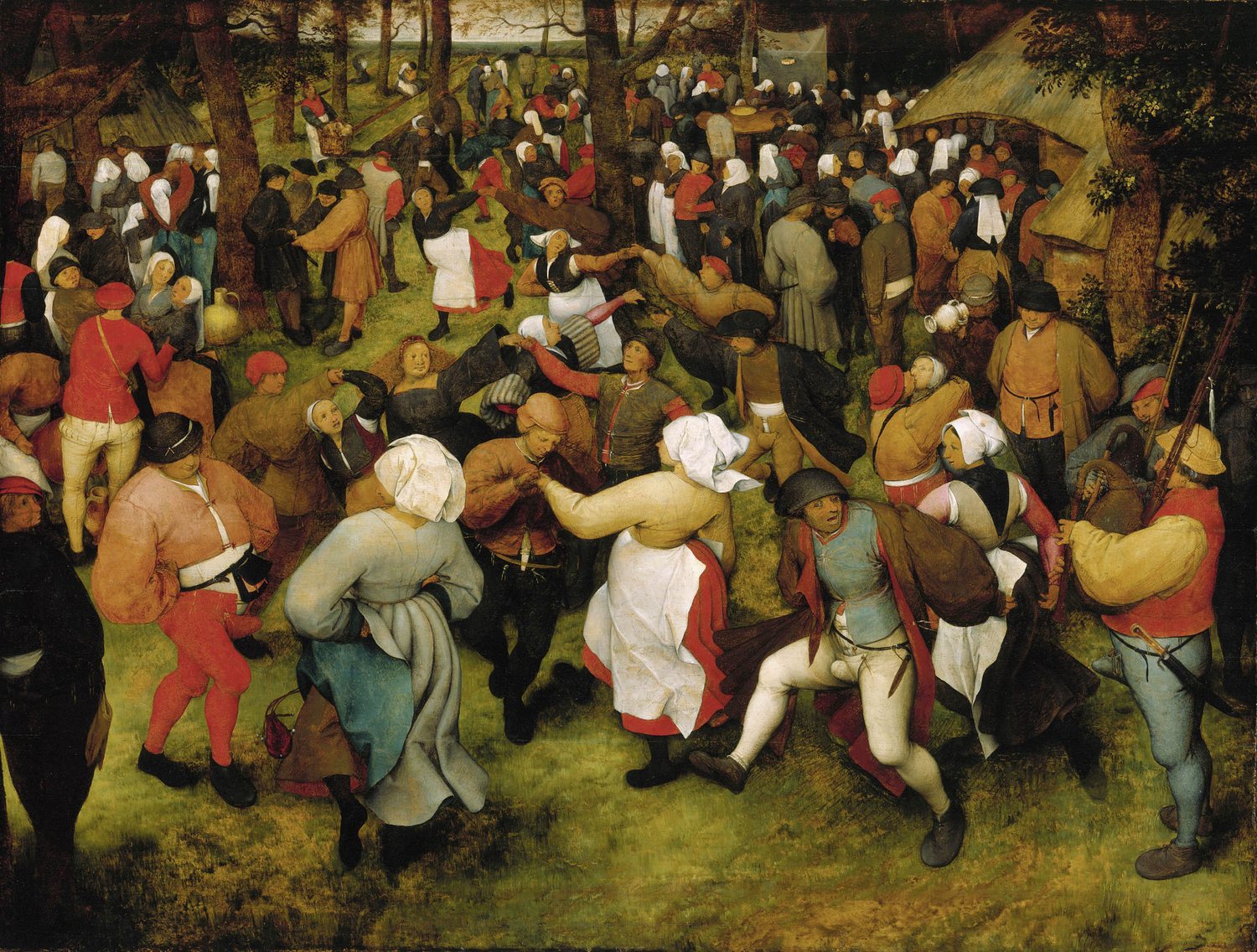
A hundred and twenty-five dancers whirl in the open air, the bride dancing with her hair down and her money-bag swinging — and generations of viewers have giggled at the codpieces, which Detroit's restorers in 1941 briefly covered with painted draperies, in a spasm of prudery later undone. The dance goes on regardless.
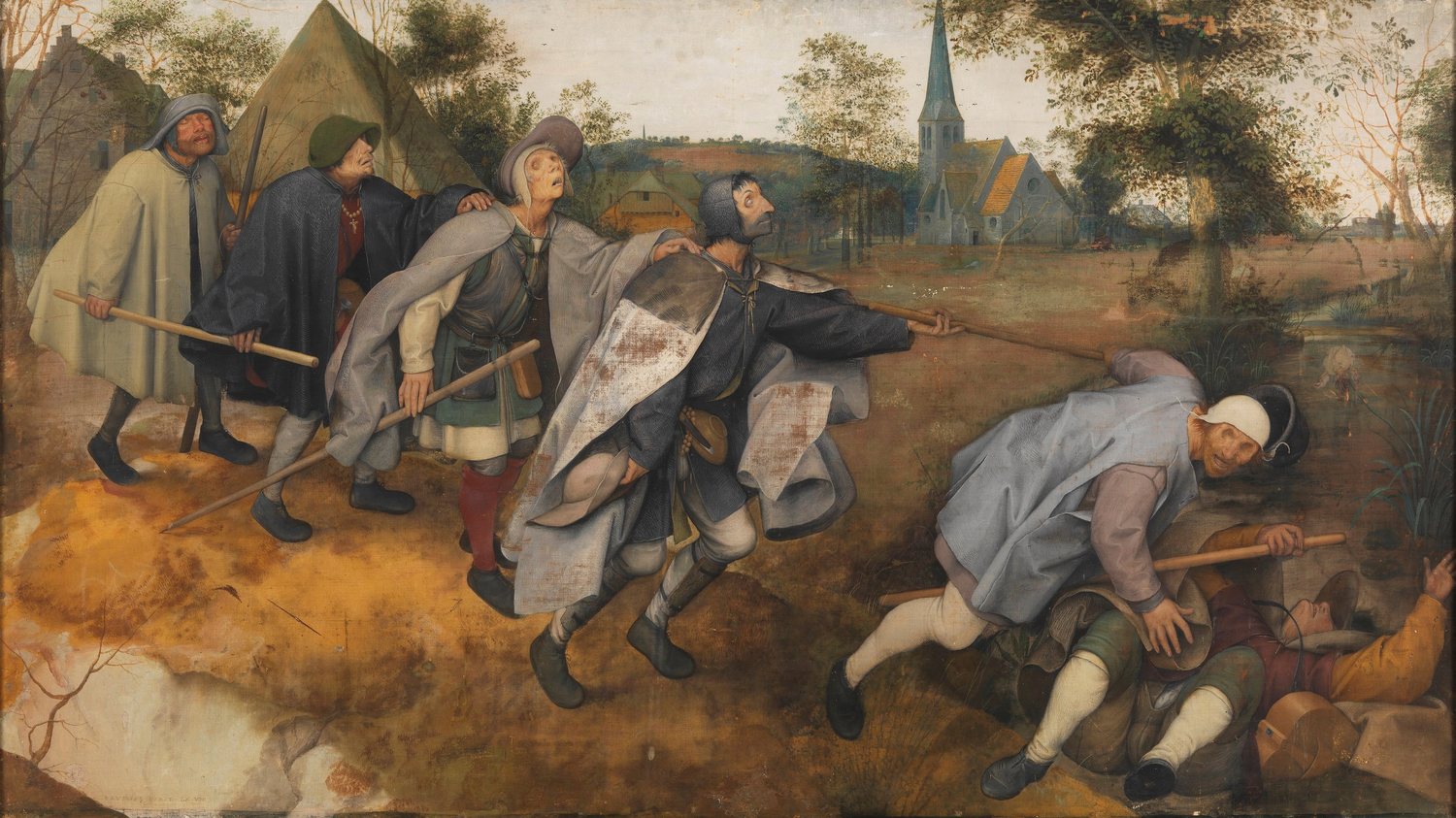
Six blind men, linked hand to shoulder, stumble one by one into the ditch — painted in fragile glue tempera on linen in the last year of his life, each face a different study of blindness, the church standing serene behind them. The parable made unbearable by precision. Nothing in it is exaggerated; that is the horror.
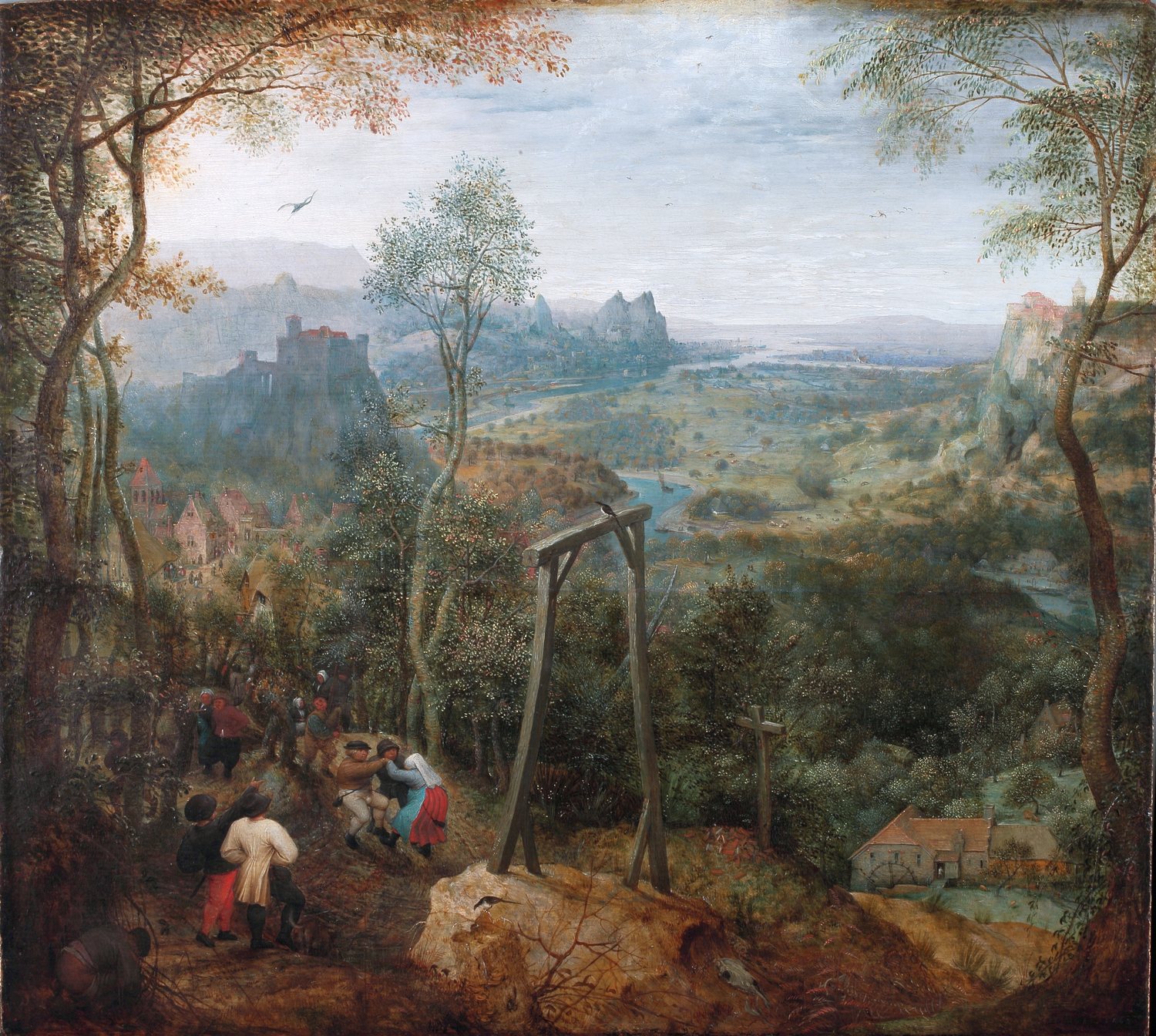
His last painting, left to his wife in his will with instructions that made it famous: a magpie — the gossip, the chatterer — perched on a gallows above dancing peasants and an immense, calm landscape. Painted under a regime of informers, it is usually read as his farewell warning: loose tongues lead to the gallows. The world below dances on, indifferent and beautiful.