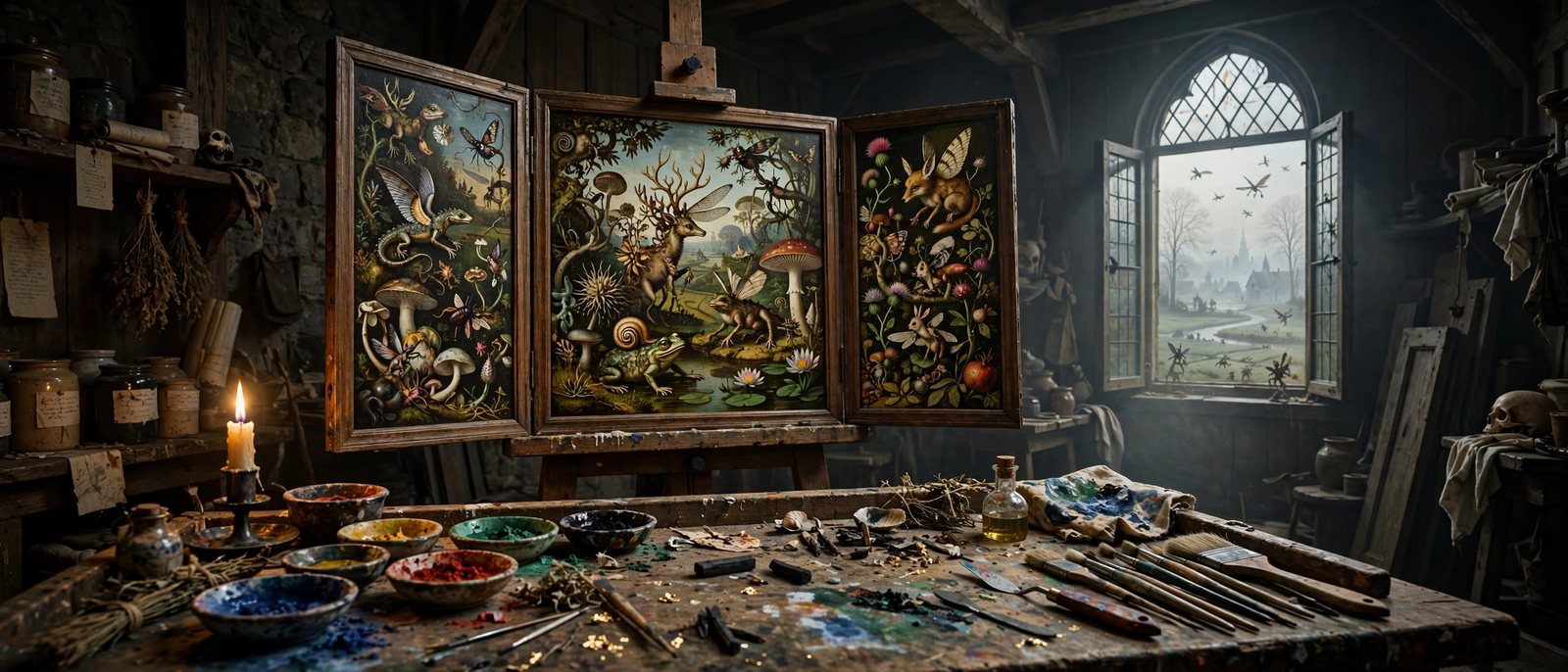
A painter of delightful terrors. Working in 's-Hertogenbosch in Brabant, Hieronymus Bosch filled oak panels with swarming inventions — angels and devils, fools and saints, hybrids of fish, bird and kitchenware — all of it laid down in oil paint so thin and quick that the drawing seems to think aloud. Five centuries on, nobody has matched the strangeness; nobody has needed to invent it twice.
Bosch painted on Baltic oak panels prepared with a chalk-and-glue ground, laying the oil paint in exceptionally thin, translucent layers. There is almost no impasto: forms are built from hatched strokes and glazes, so a huge triptych could be covered fast and still glow like enamel.
Infrared reflectography shows Bosch sketching the whole composition directly onto the ground with a brush, in loose liquid lines. He then painted over the sketch freely, shifting figures and inventing details in the paint itself — the many pentimenti prove the panel, not a cartoon, was where the image was decided.
His demons are assemblies: a fish's body, a bird's beak, insect wings, a funnel, a jug. Each part is observed from nature or from the workshop's stock of models and bestiaries, then joined with a draughtsman's logic — which is why the impossible creatures remain stubbornly believable.
Lead white, azurite, verdigris, red lakes, ochres and carbon black do nearly all the work. Distance is not drawn but tinted: landscapes cool into blue-green haze through thin scumbles of azurite and white, while the foreground stays warm, dry and needle-sharp.
Bosch painted wet-in-wet with loaded brushes, finishing faces and highlights in a few touches and leaving the underdrawing visible in the shadows. The sketchiness is deliberate: thousands of tiny actors could not be enamelled one by one, so each is a shorthand of two or three strokes that the eye completes.
He signed only a handful of works — 'Jheronimus bosch' lettered into the paint — and ran a workshop that produced versions and variants. Today dendrochronology, the dating of the oak by its tree rings, is the conservator's main tool for separating the master's own panels from the flood of followers and copies.
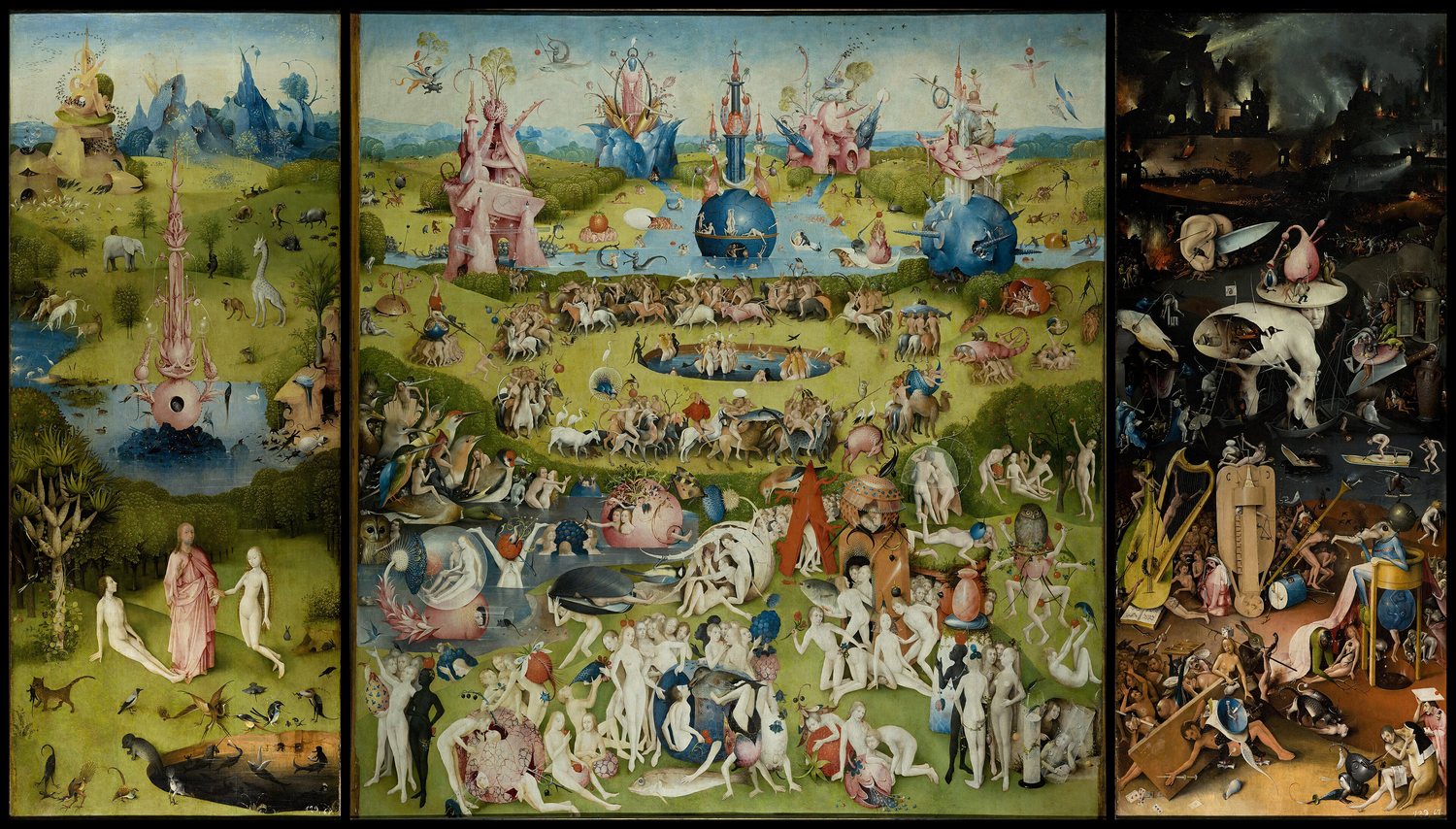
Bosch's masterpiece: Eden at left, a teeming garden of lovers, giant birds and glass bubbles in the centre, and a musical hell at right. The whole panorama is painted in oil films thin as breath.
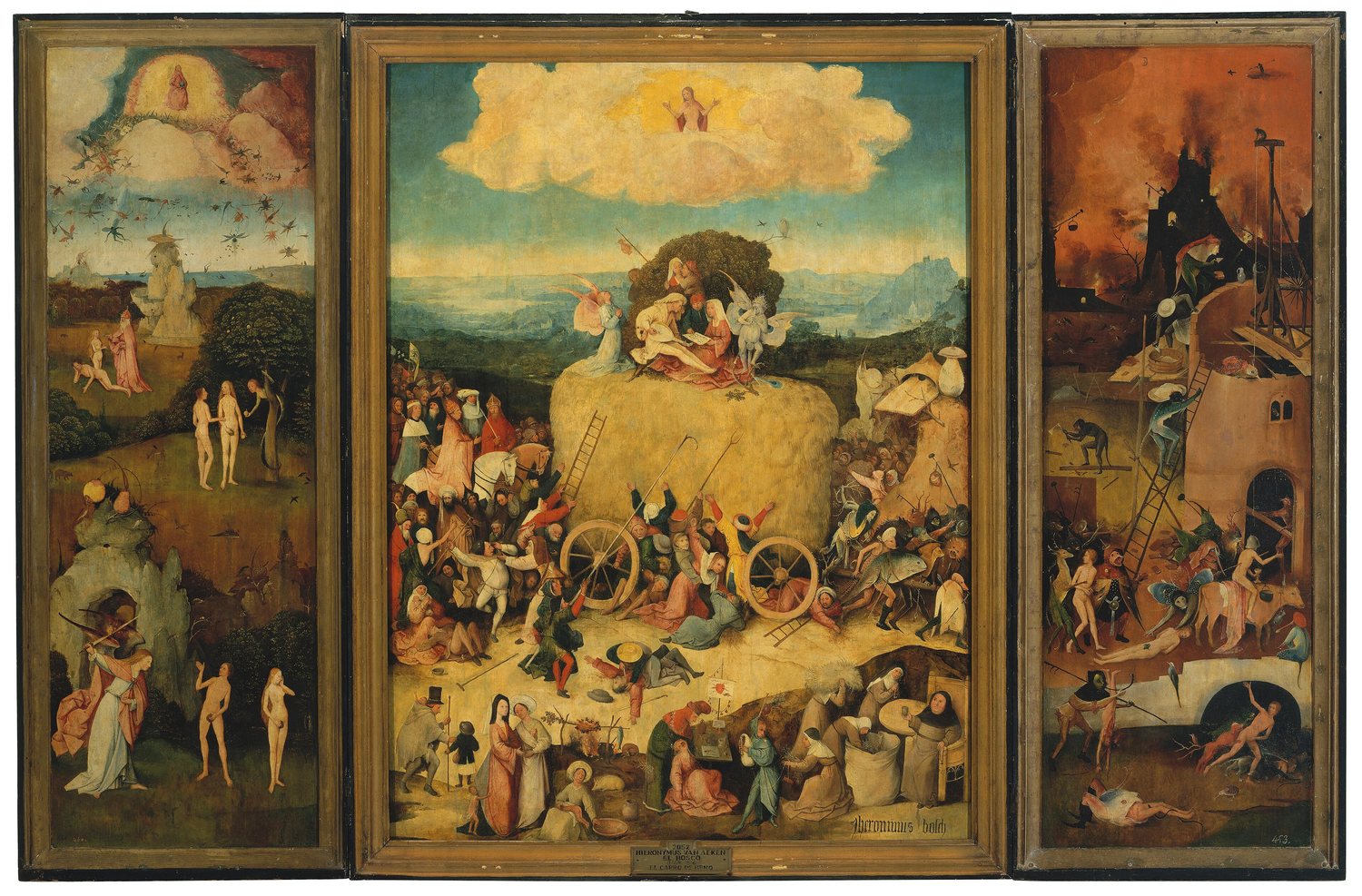
All the world fights over a cartload of hay — worthless grass dragged, in the right wing, straight into hell. Kings, pope and emperor pull at the wagon alongside peasants: folly respects no rank.
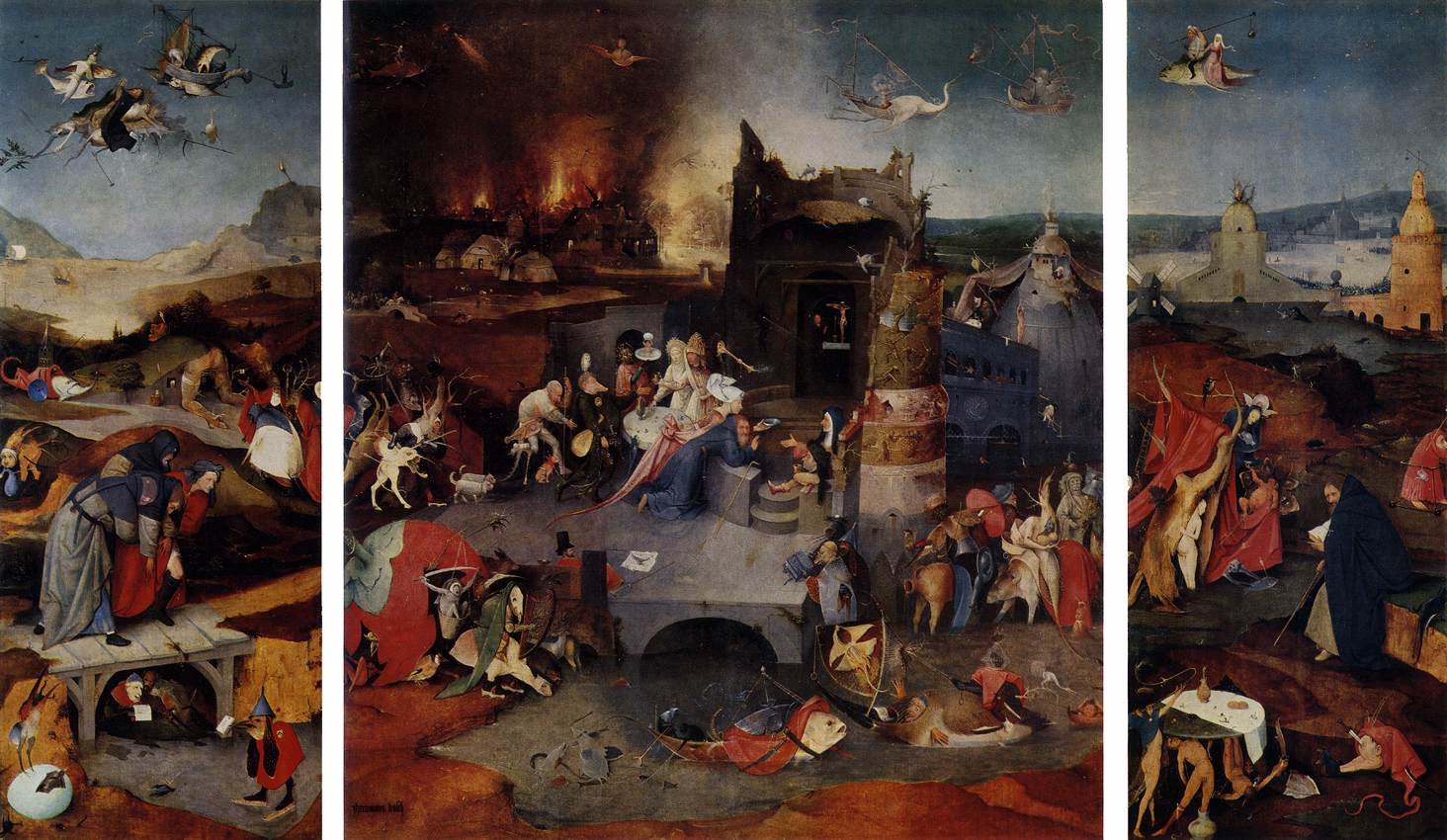
The hermit Anthony kneels at the centre of a demon carnival — flying fish, a funereal procession, a giant on stilts of branches. Through it all the saint's small, still figure holds the composition like a pin.
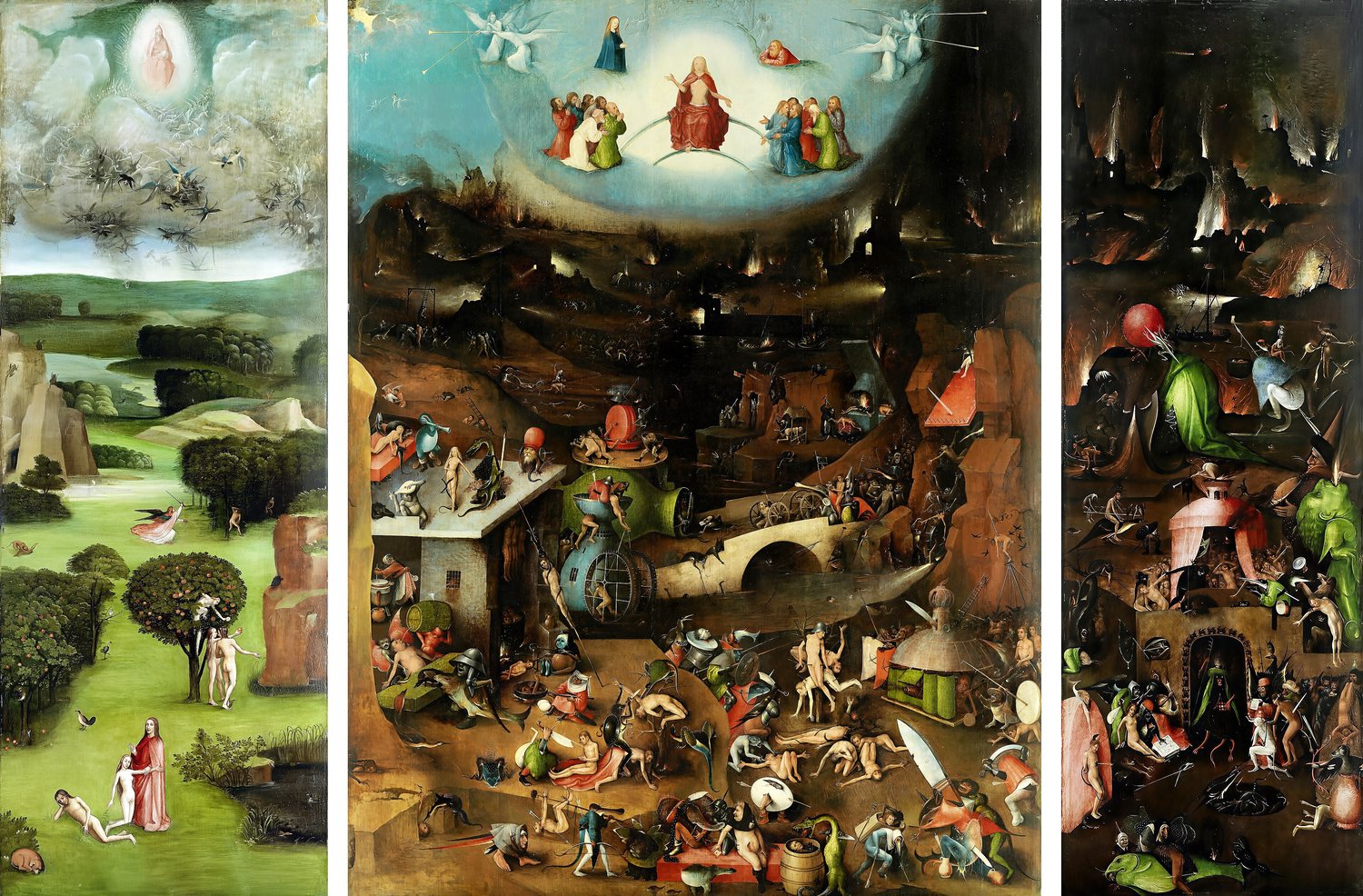
One of Bosch's earliest surviving triptychs: Christ judges above while the earth below dissolves into fire, flood and inventive torment, painted with a young master's already unmistakable shorthand.
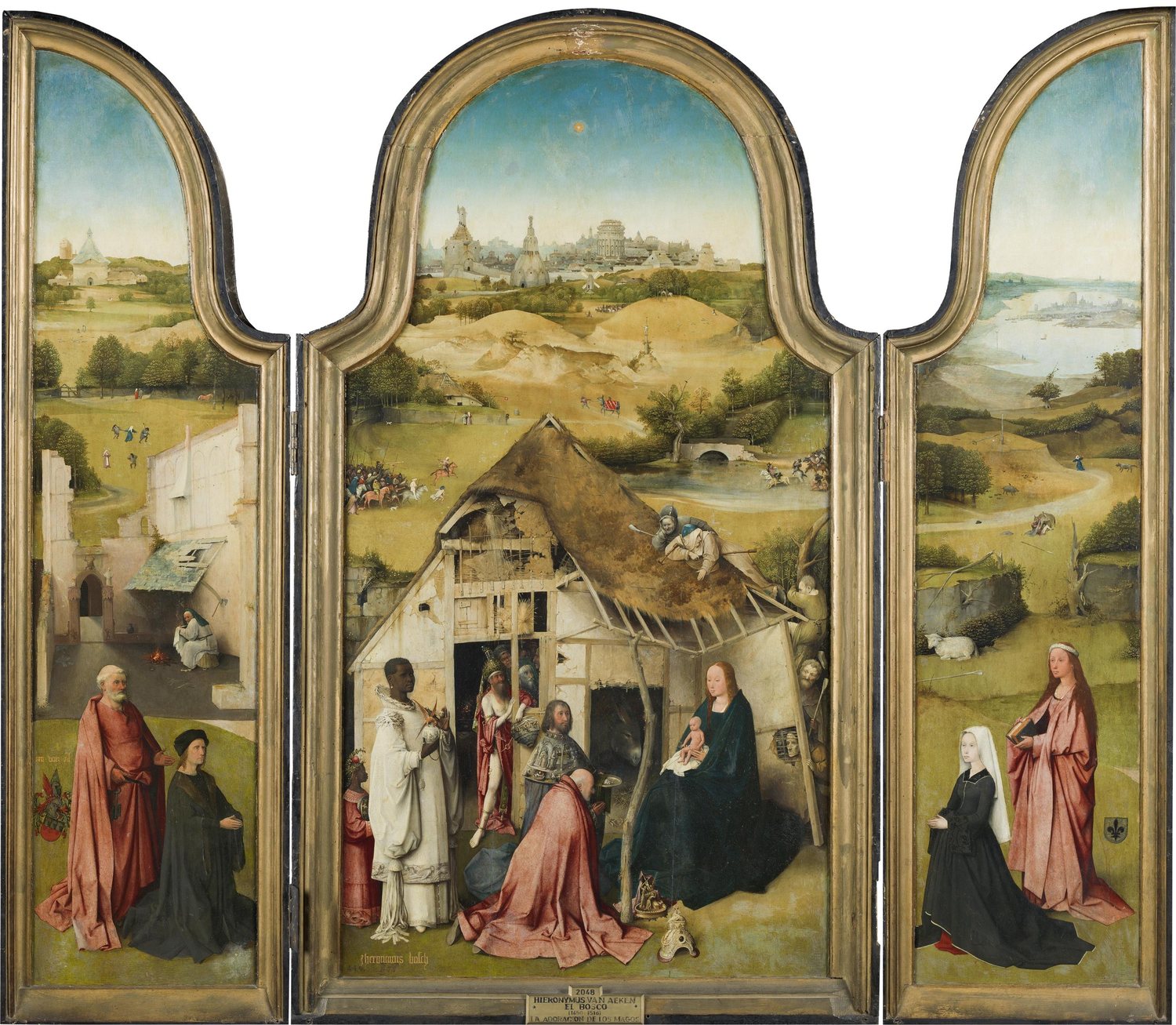
A serene, almost sculptural centre: the Magi offer their gifts before a ruined stable while, in the doorway behind, the sinister figure of the Antichrist watches — menace hidden inside devotion.
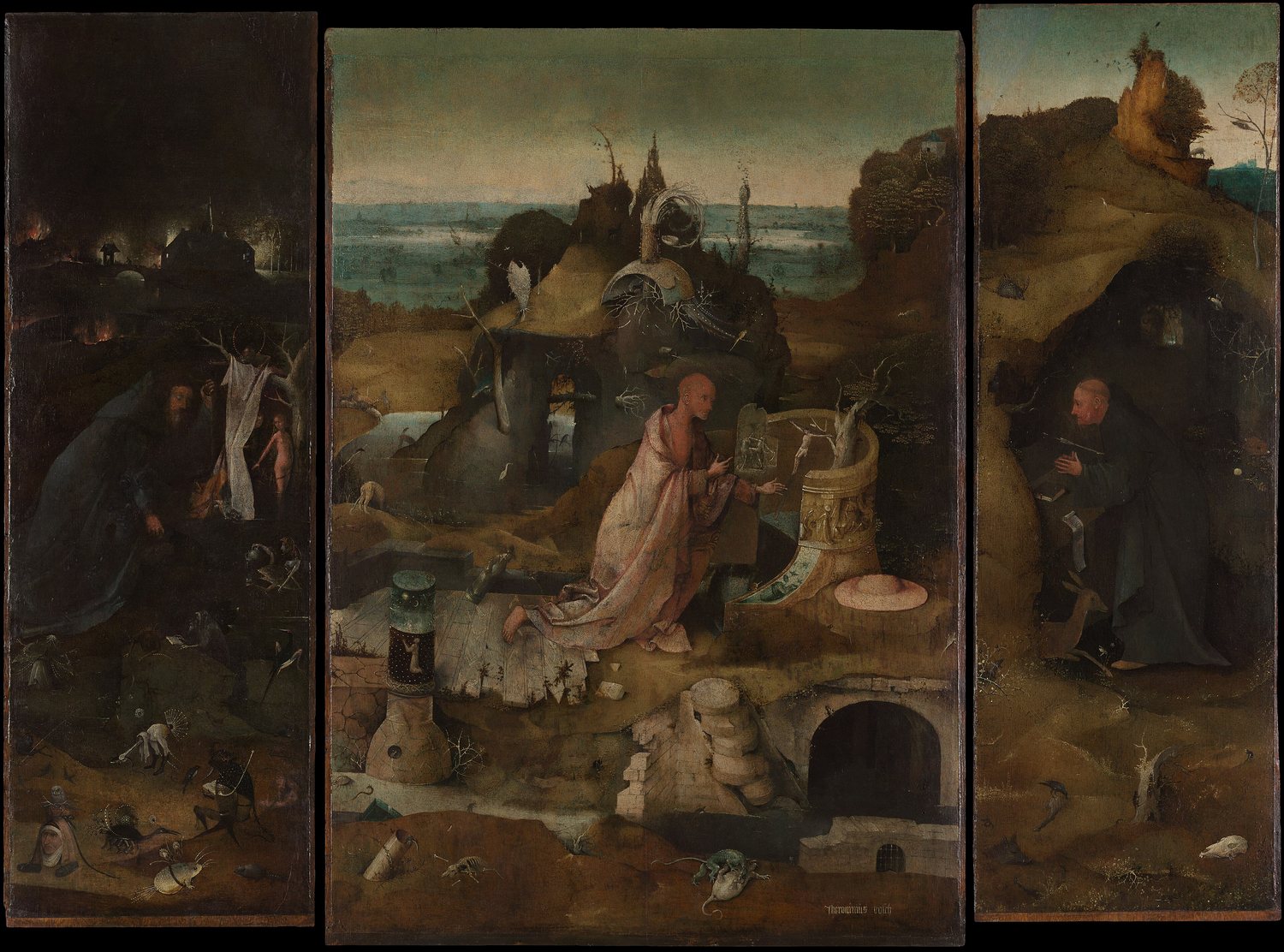
Anthony, Jerome and Giles alone in their wildernesses — Bosch at his most hushed, the demons reduced to whispers at the edges of three green, watery landscapes.
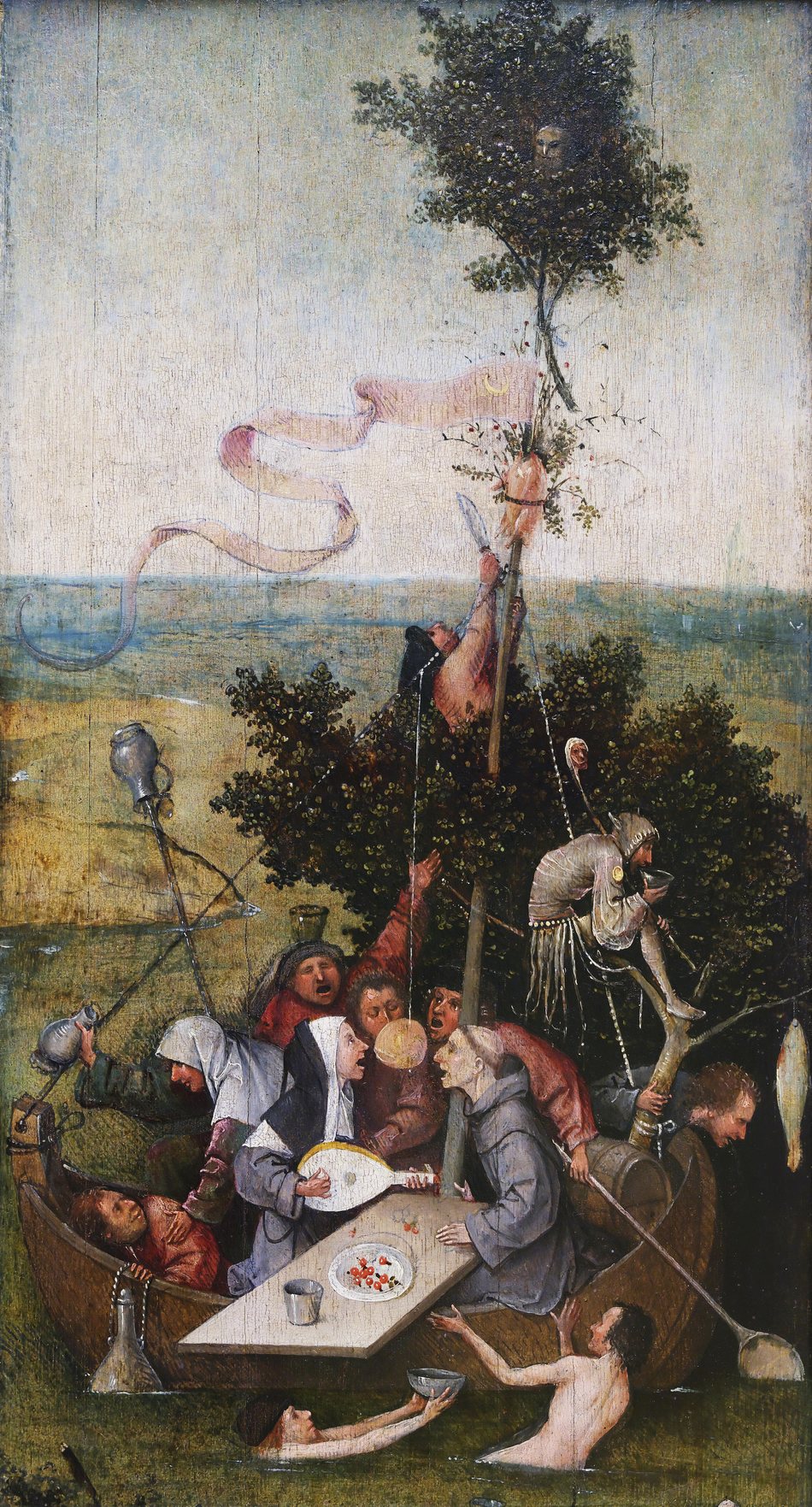
A fragment of a lost triptych: a monk and a nun sing and drink in a boat that goes nowhere, its mast a maypole tree. Gluttony and lust steer; nobody holds the rudder.
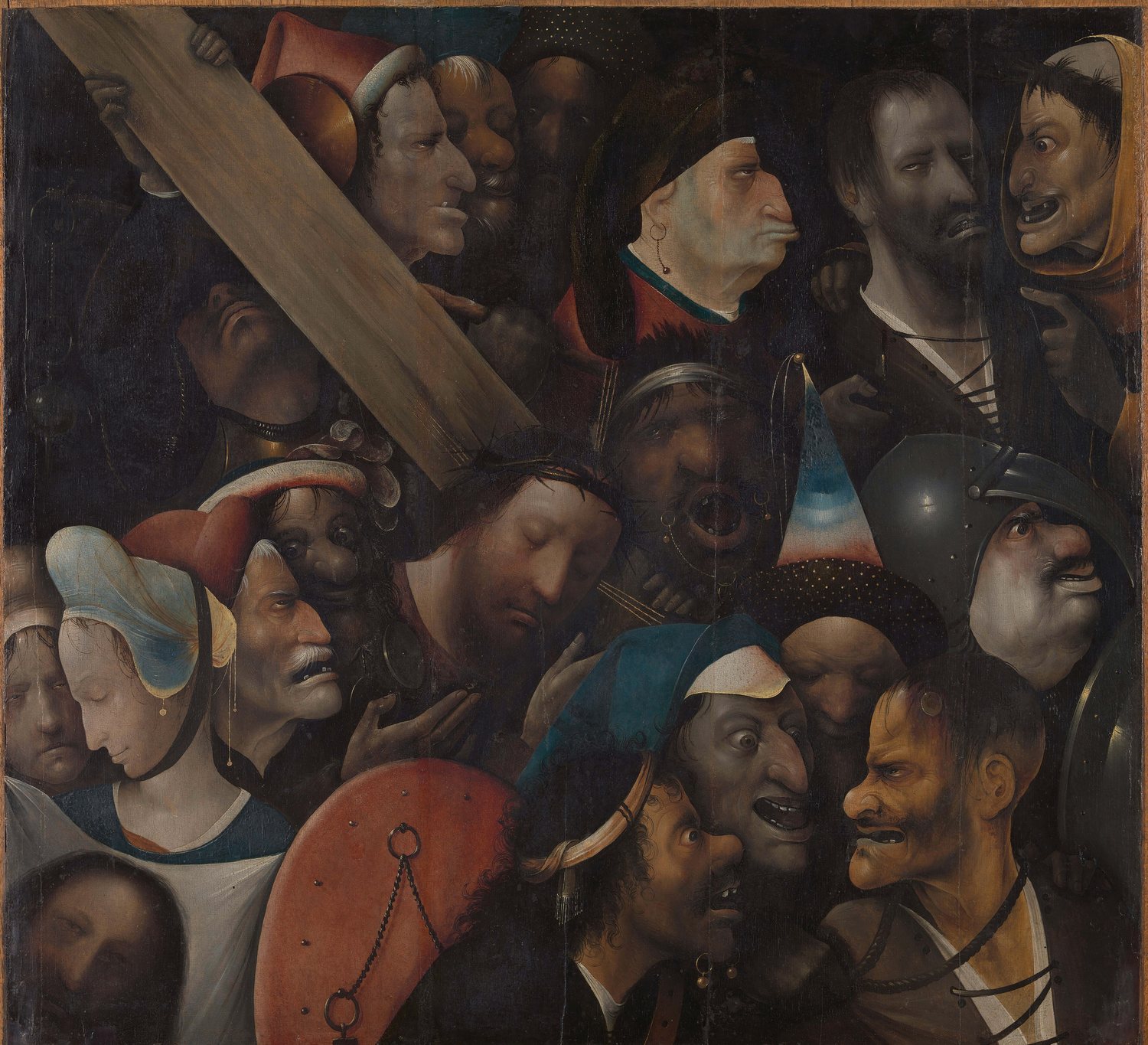
A late, terrifying panel: Christ's bowed face is lost in a solid wall of grimacing tormentors, painted head against head with almost no space to breathe — cruelty as pure pattern.
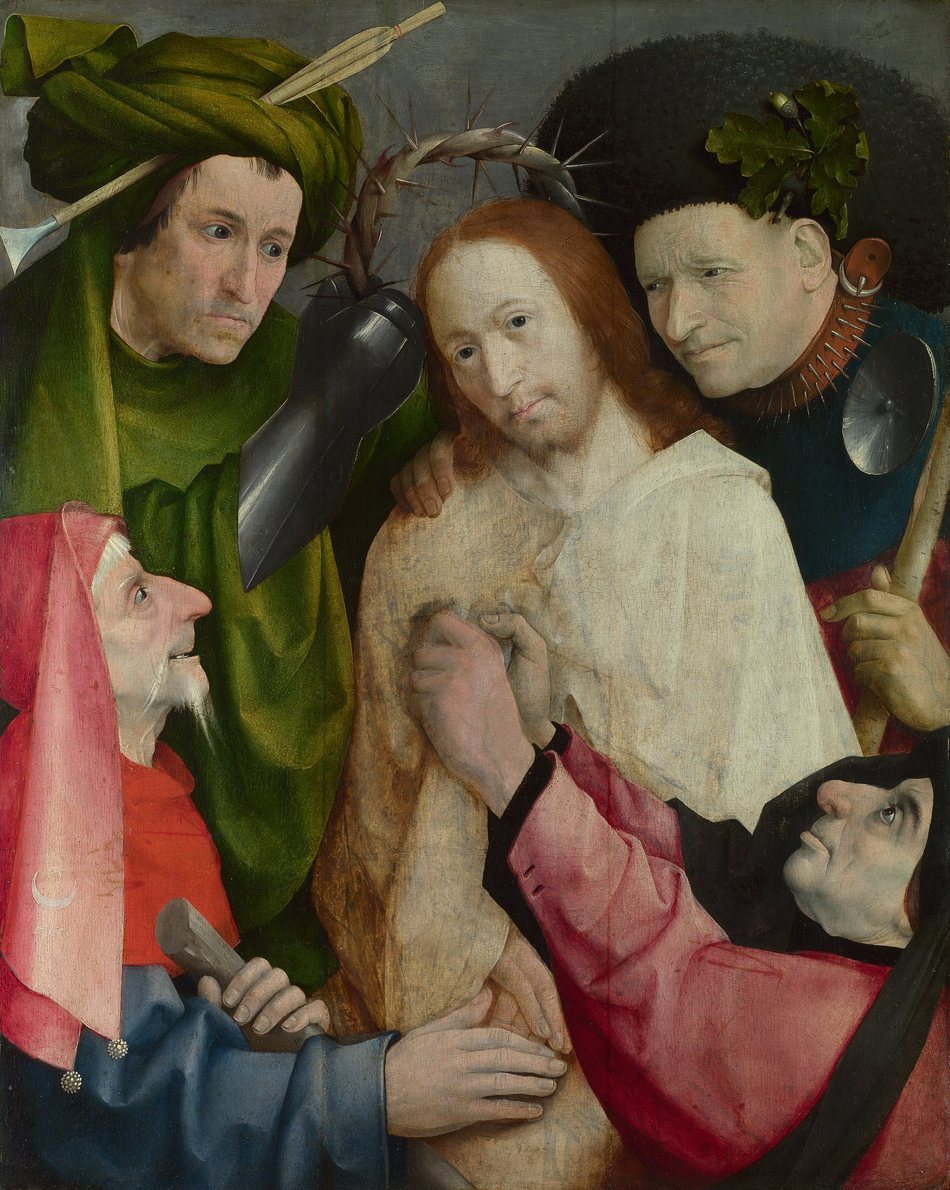
Four half-length tormentors close around Christ in a shallow, airless space. The painting's smooth, enamelled surface makes the quiet violence feel polished — and worse.
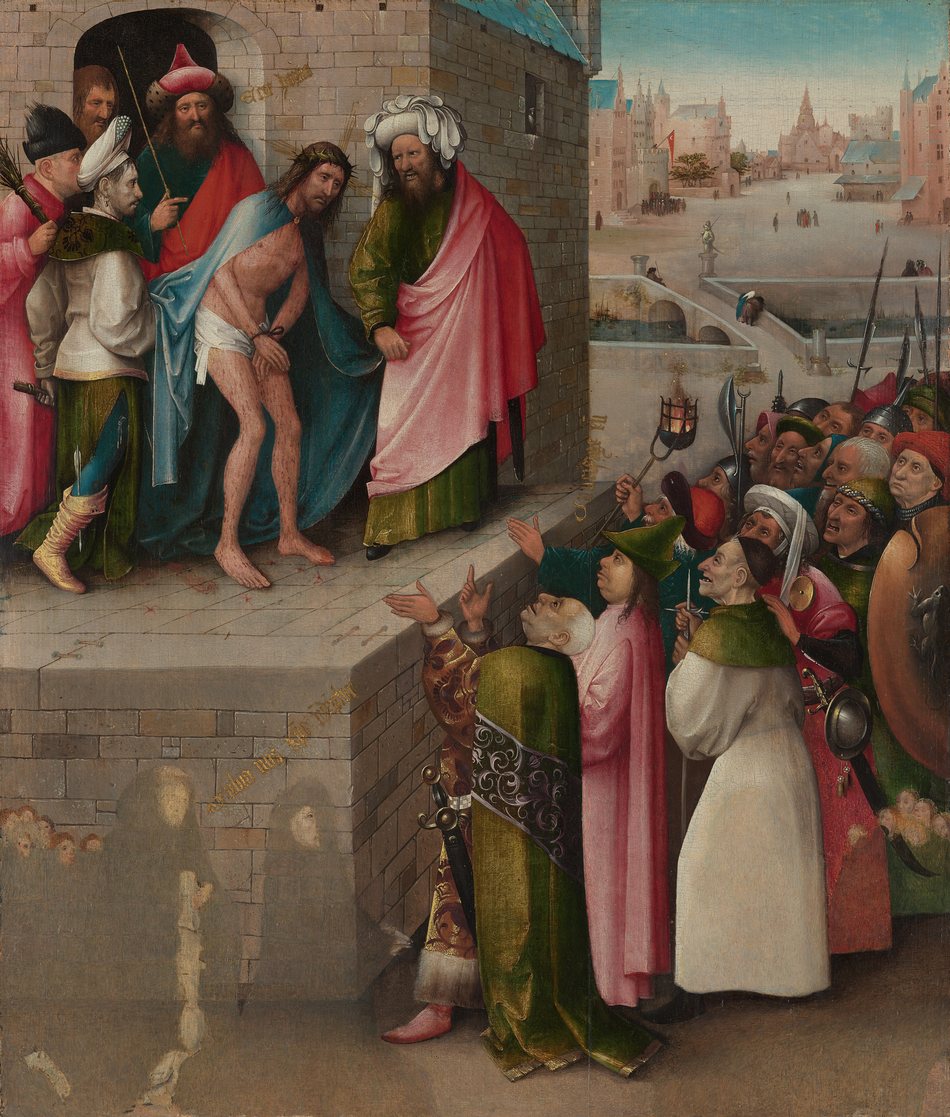
An early work: Christ is presented to a jeering crowd whose cries once issued from their mouths in painted scrolls. The gold sky and doll-like figures still belong to the world Bosch was about to reinvent.
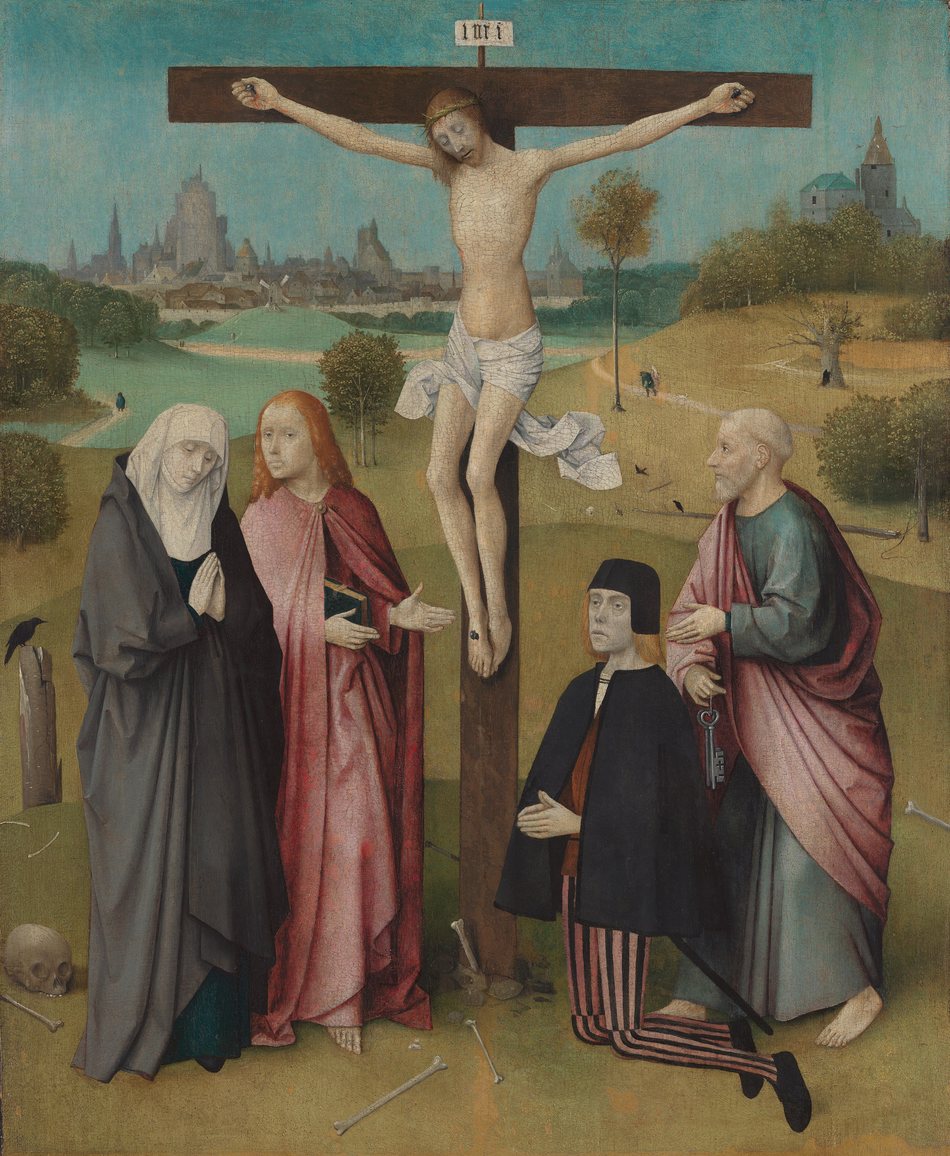
Bosch's most conventional early panel — a calm Crucifixion over a broad Brabantine landscape, the donor kneeling with his patron saint. The strangeness is still entirely in the distance.
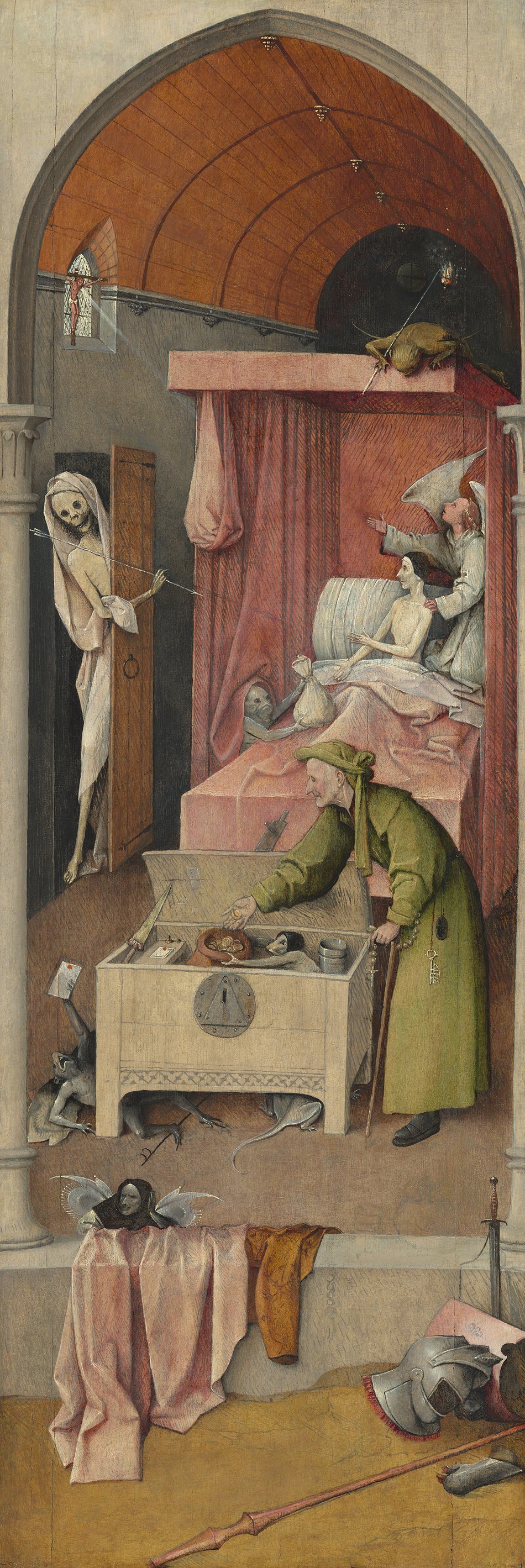
Death enters the bedchamber with an arrow while the dying man still reaches for a bag of gold a demon holds out. A tall, narrow panel — the wing of a lost triptych on the Four Last Things.
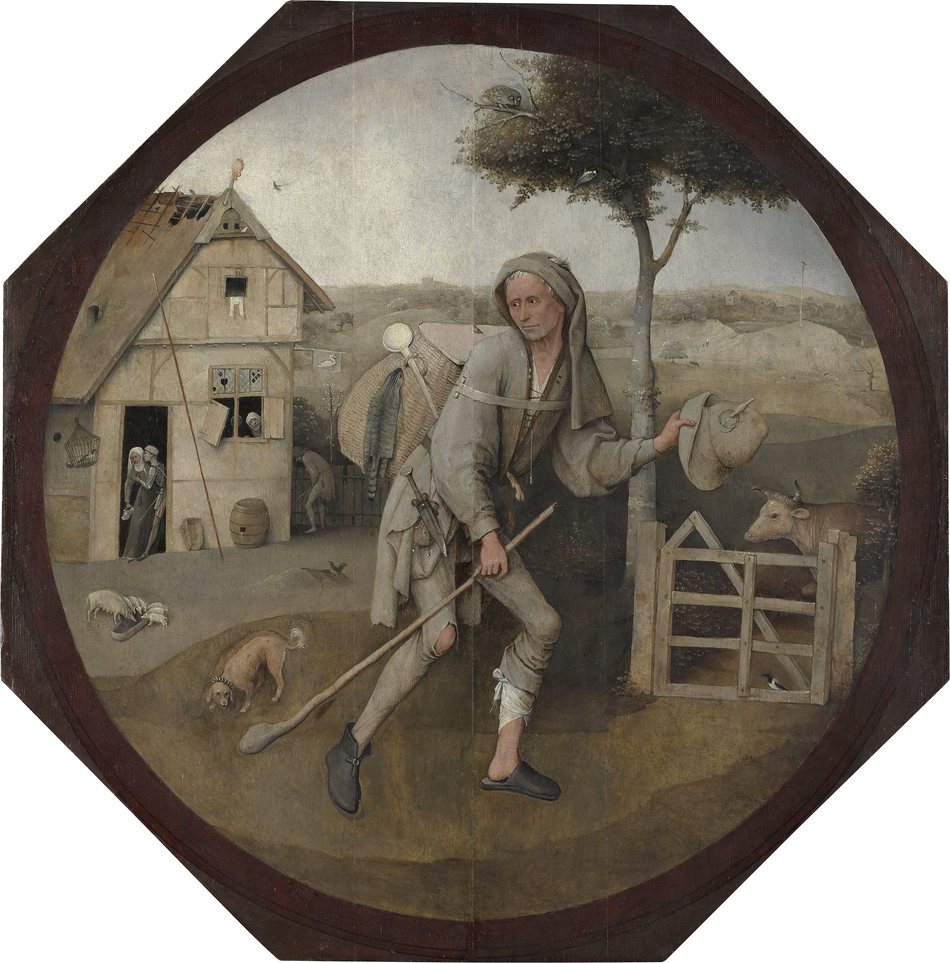
The ragged pedlar picks his way past a barking dog and a brothel door — the pilgrim of life on the outside of the Haywain's closed shutters, painted in near-monochrome greys and browns.
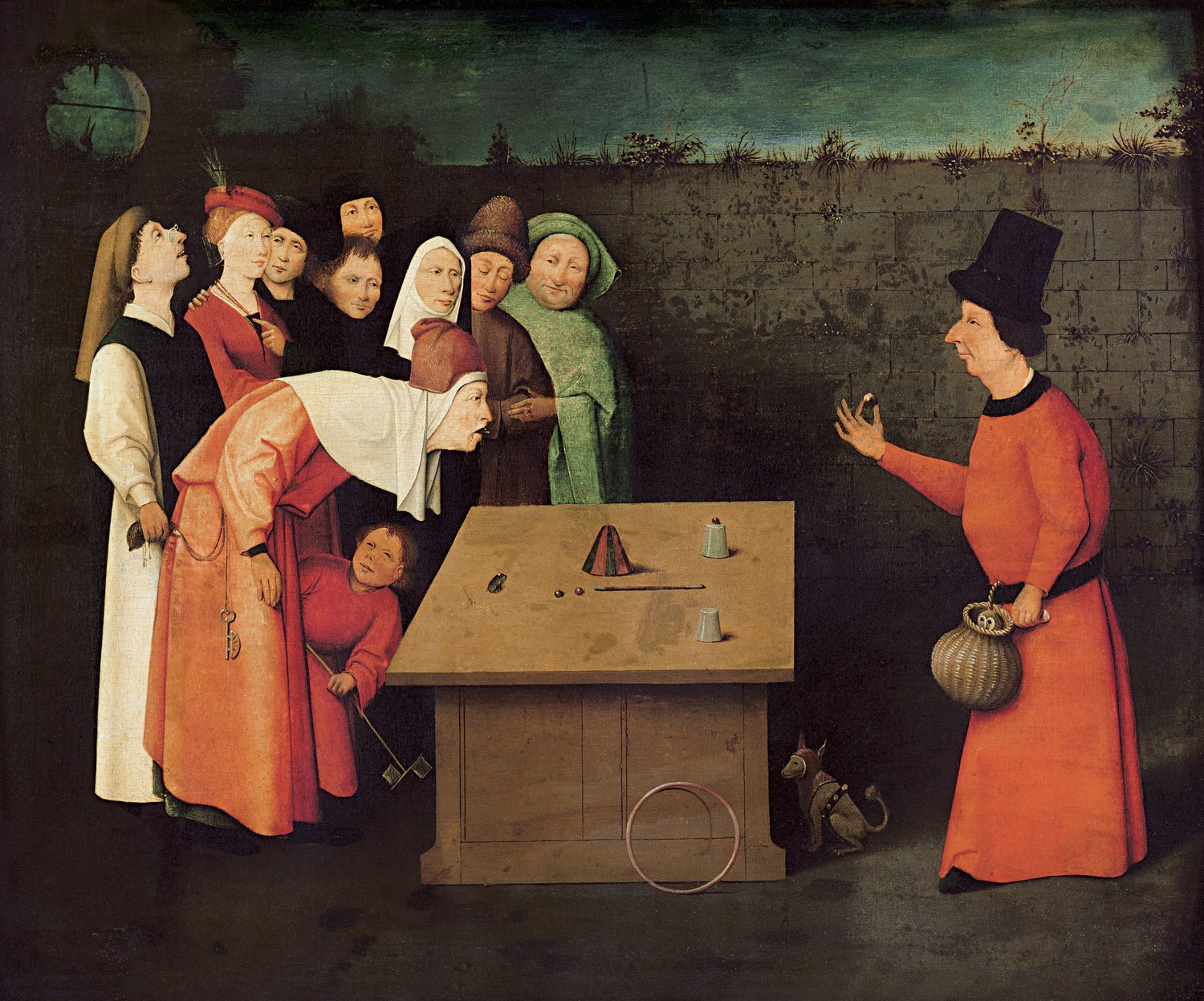
A street magician works his cups and balls while a pickpocket lifts the purse of a gaping spectator — the audience watches the trick and becomes it. The version in Saint-Germain-en-Laye is the finest surviving.
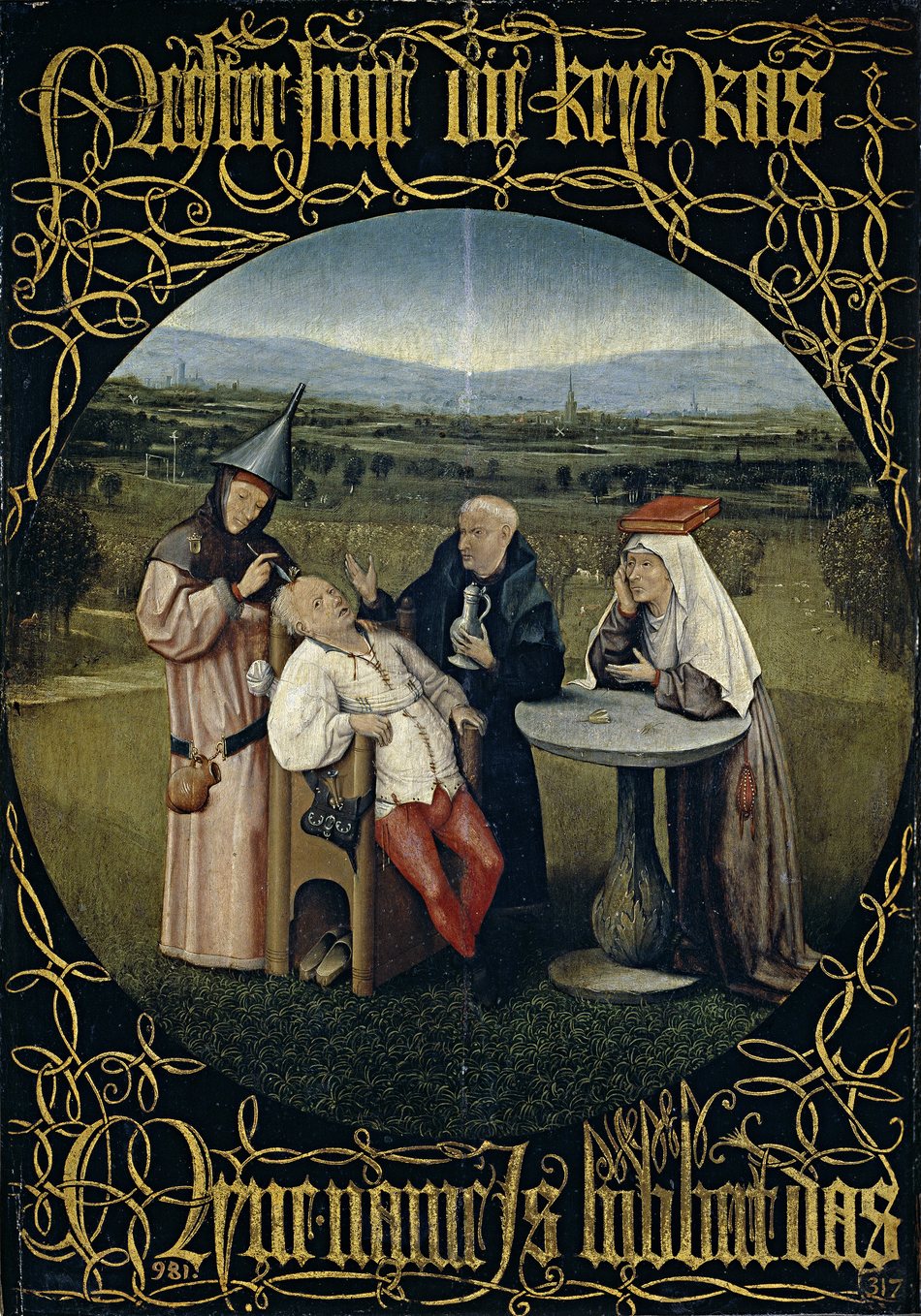
A quack with a funnel on his head cuts a flower — not a stone — from a patient's skull, while a monk and a nun look on. The circular panel's inscription, in gold Gothic letters, names the fool: Lubbert Das.
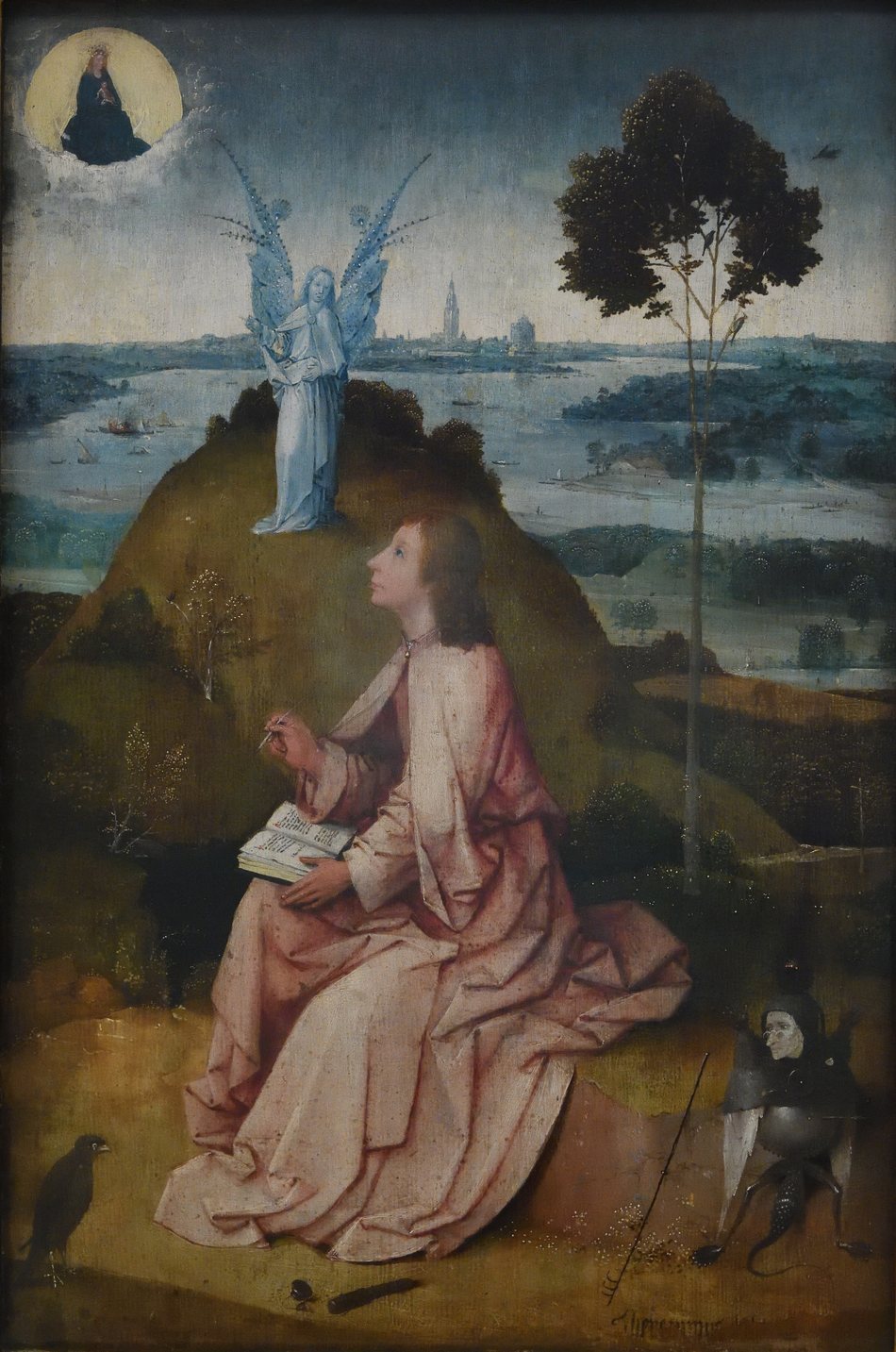
John writes his Revelation in a green, sunlit estuary while a scorpion-like demon creeps off with his inkpot at lower right — Bosch hiding a whole apocalypse in one sly detail.
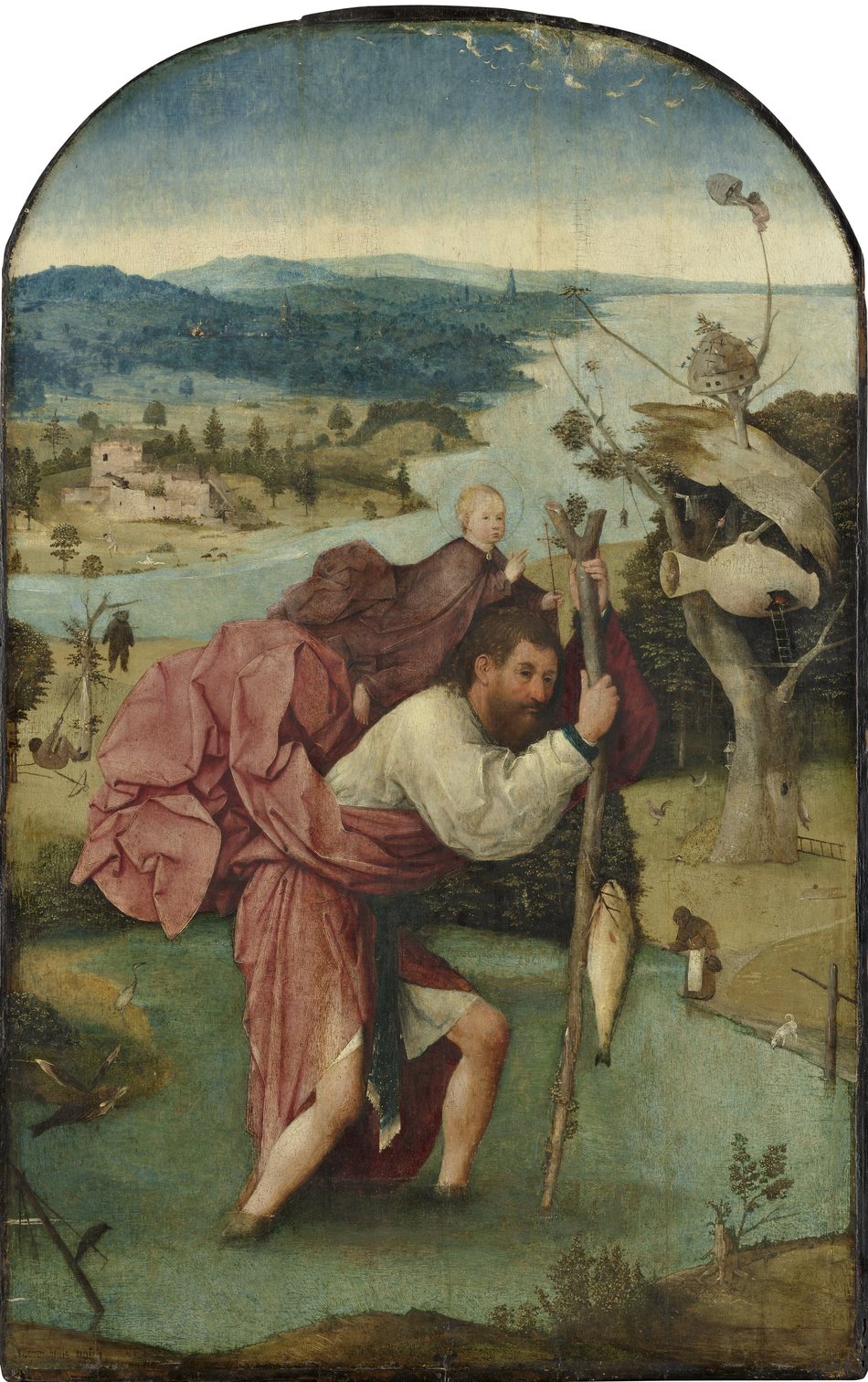
The giant saint wades through a river with the Christ Child on his shoulder; on the bank a dragon bursts from a ruin and a man hangs from a tree — the world's dangers sketched in miniature around a calm colossus.
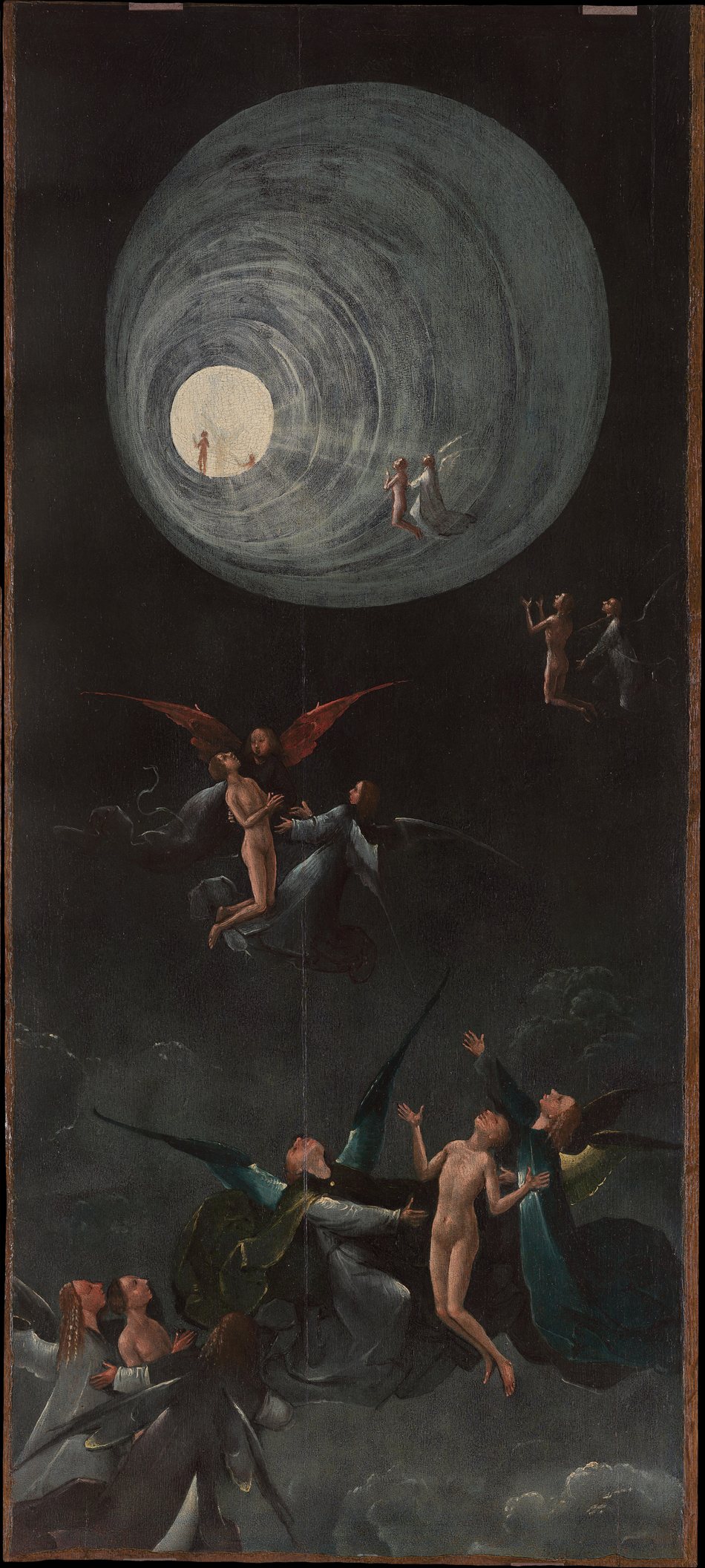
From the Visions of the Hereafter: angels carry the saved up a tunnel of light toward a radiance no pigment can hold — one of the most daring images of pure light in early painting.
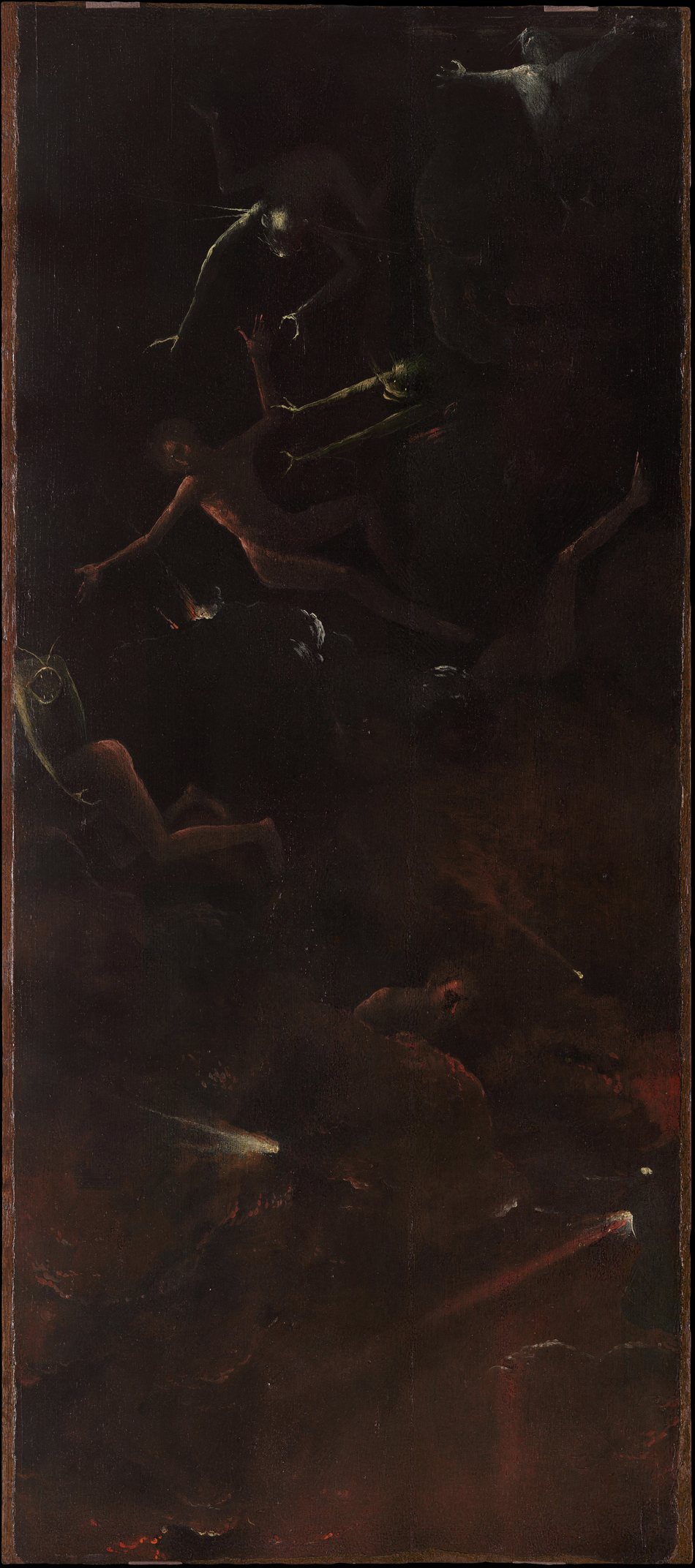
The companion panel to the Ascent: bodies tumble through blackness, snatched at by demons. Bosch paints the dark itself in layered glazes, so the falling figures surface and vanish like things seen by lightning.
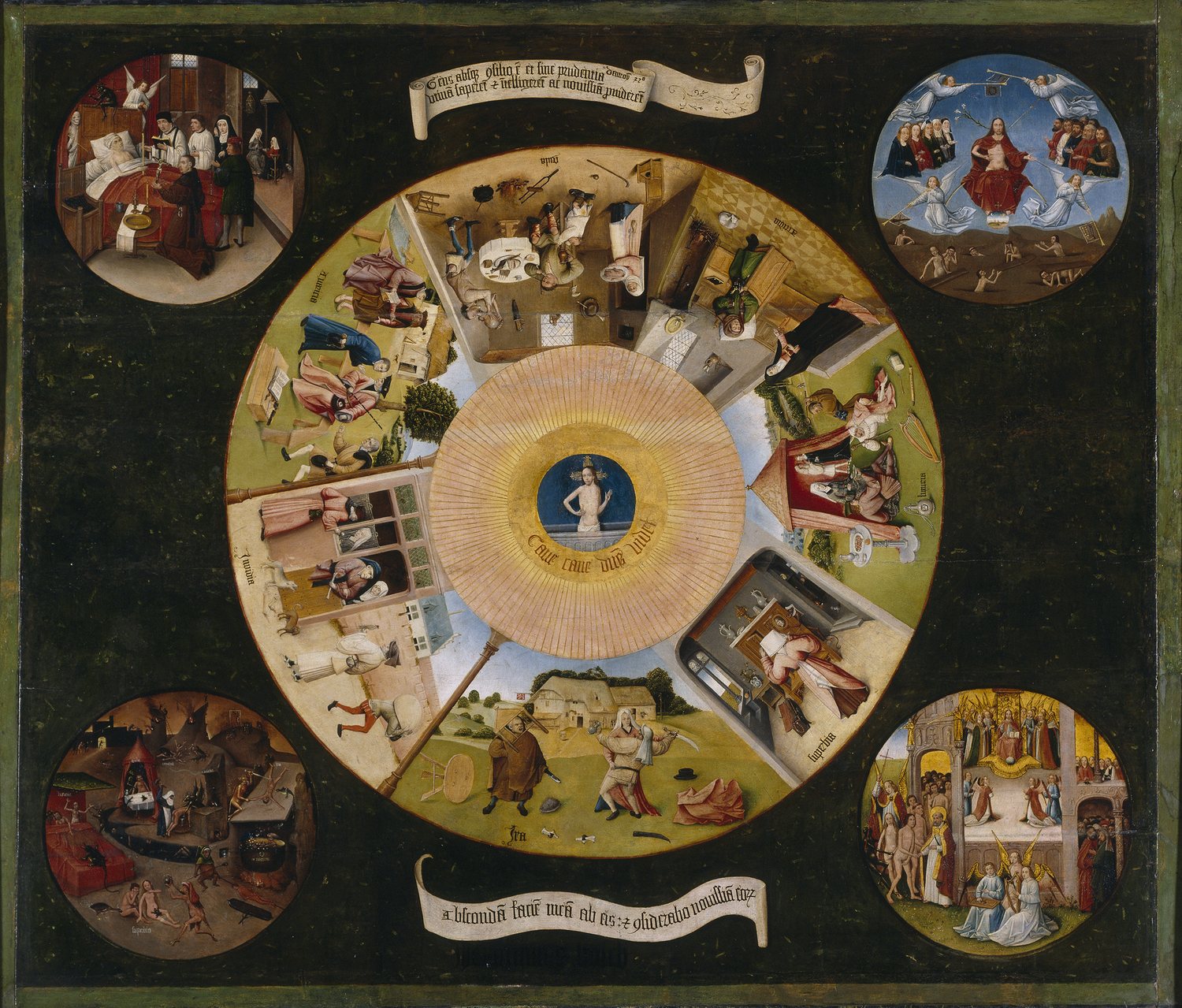
A painted tabletop: the seven sins circle the eye of God, whose pupil is Christ, with Death, Judgment, Heaven and Hell in the corners. Long given to Bosch himself, it is now credited to the master working with his shop.