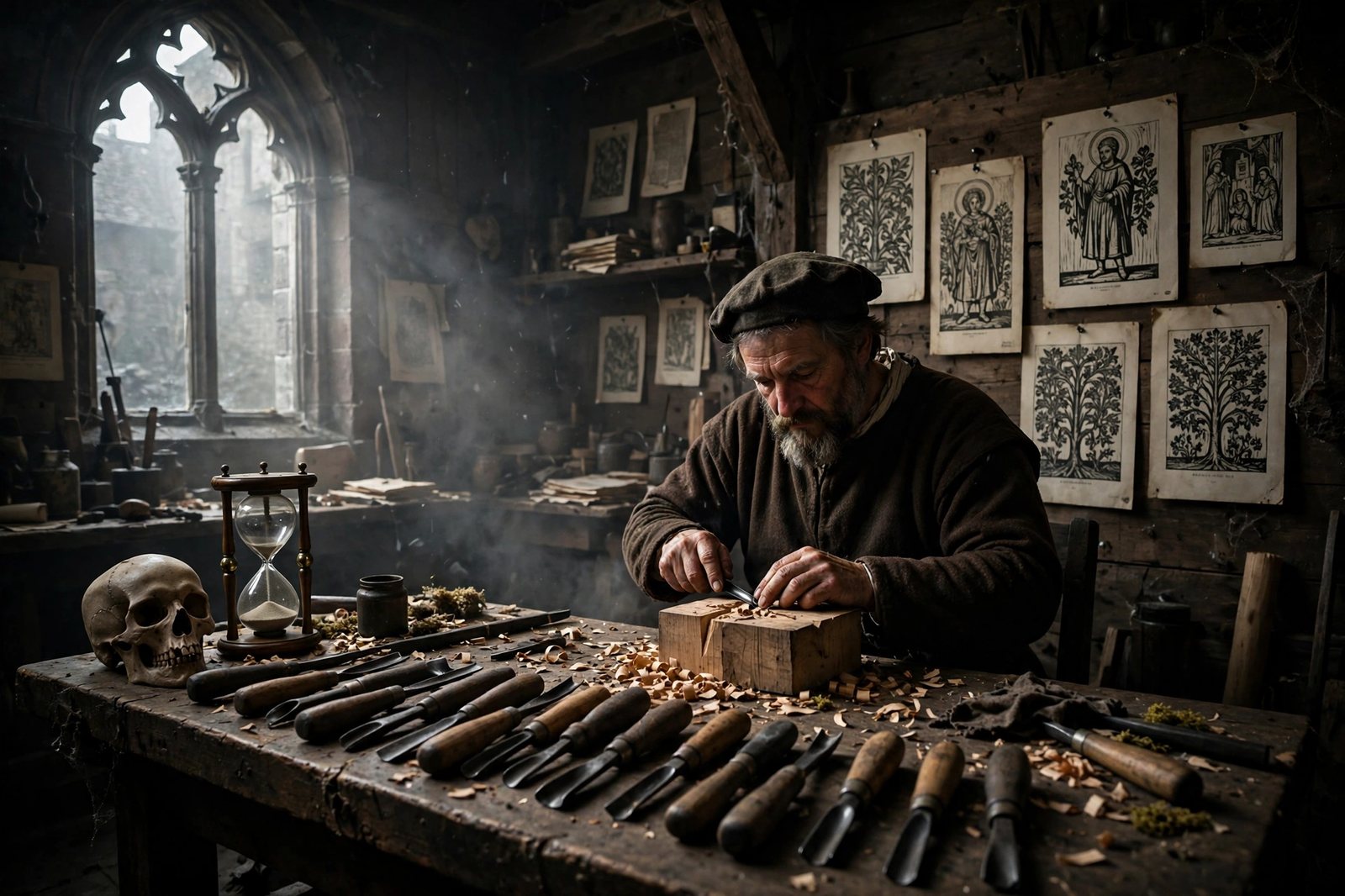
Dürer's most gifted pupil was also his most unsettling. Baldung — 'Grien', the Green — spent forty years in Strasbourg painting and cutting images in which beauty and rot share one body: Eve hand in hand with a skeleton, maidens kissed by Death, witches riding through sulphurous air. His line is Dürer's discipline with the nerves left in.
As a journeyman in Nuremberg (c. 1503–1507), Baldung worked in Dürer's shop while the master was in Italy, absorbing the whole system: precise underdrawing, swelling engraved line, nature studied leaf by leaf. Dürer valued him enough to take his drawings on the road and, tradition says, left him a lock of his hair. Everything Baldung later twisted, he had first learned straight.
His Witches of 1510 is printed from two blocks: a line block for the drawing and a tone block that lays in a whole middle tone of grey-brown, so the night scene is modelled before a single white is cut. Among the very first chiaroscuro woodcuts ever made, it turned the cheap woodcut into a medium that could do darkness itself — the perfect technology for his subjects.
The nickname — and the acid green that haunts his palette — set him apart in a workshop full of Hanses. His flesh is modelled with cold, greenish shadows and sulphurous highlights, so bodies look lit by something other than daylight. Whether the colour made the name or the name the colour, the effect is his signature: beauty with a faint chemical wrongness in it.
His studies were often drawn with the brush in black and grey on toned paper, heightened with white — heads, hands, horses, witches' bodies — a graphic rehearsal for both panels and prints. The horse studies behind the Bewitched Groom show the method at its most obsessive: anatomy worried over until the animal could carry a demon on its back.
From 1512 to 1516 he lived in Freiburg to paint the high altar of its minster — eleven panels, the largest commission of his life — working in a temporary workshop in the Franciscan monastery. The altarpiece craft is all there: limewood panels, exact underdrawing, gold handled sparingly, and crowded sacred scenes into which his strange private weather keeps leaking.
He designed more than 550 woodcuts, most of them illustrations for Strasbourg's publishers, but the single-leaf prints were his laboratory: there, freed from patrons and altarpiece decorum, he cut the witches, deaths and bewitched horses that panels could not have carried. The woodcut line he learned from engraving — swelling, tapering, nervous — is the true Baldung medium.
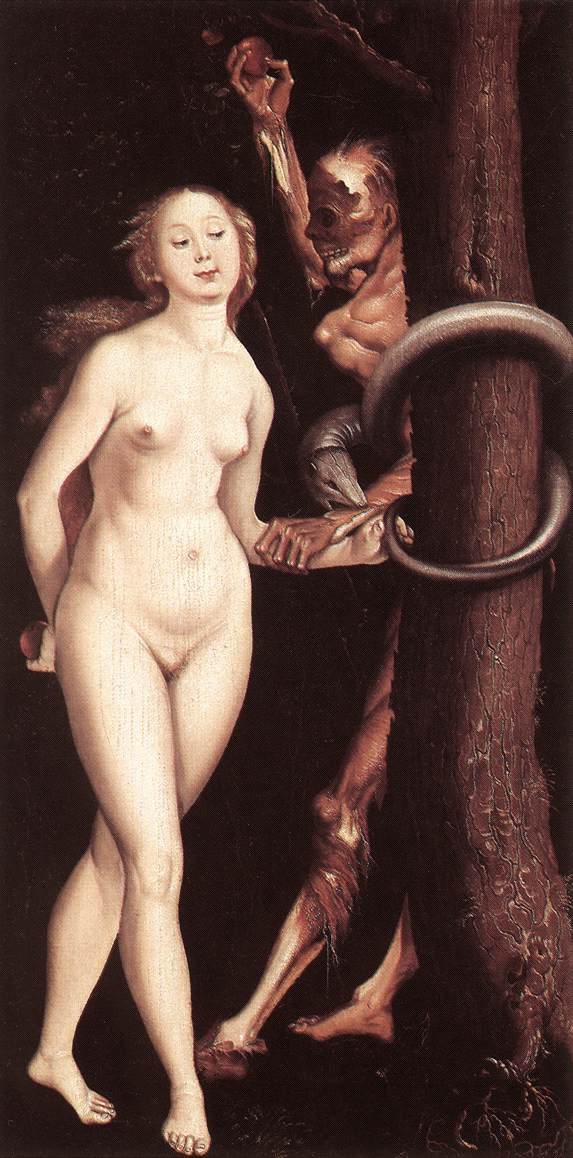
Eve offers the apple while the serpent, coiled in the tree, offers it back to her — and behind her, holding her arm with proprietary calm, stands Death himself, a rotting corpse with her own face's shadow in his. It is the Fall painted as a transaction already concluded: beauty, sin and decay in one handshake.
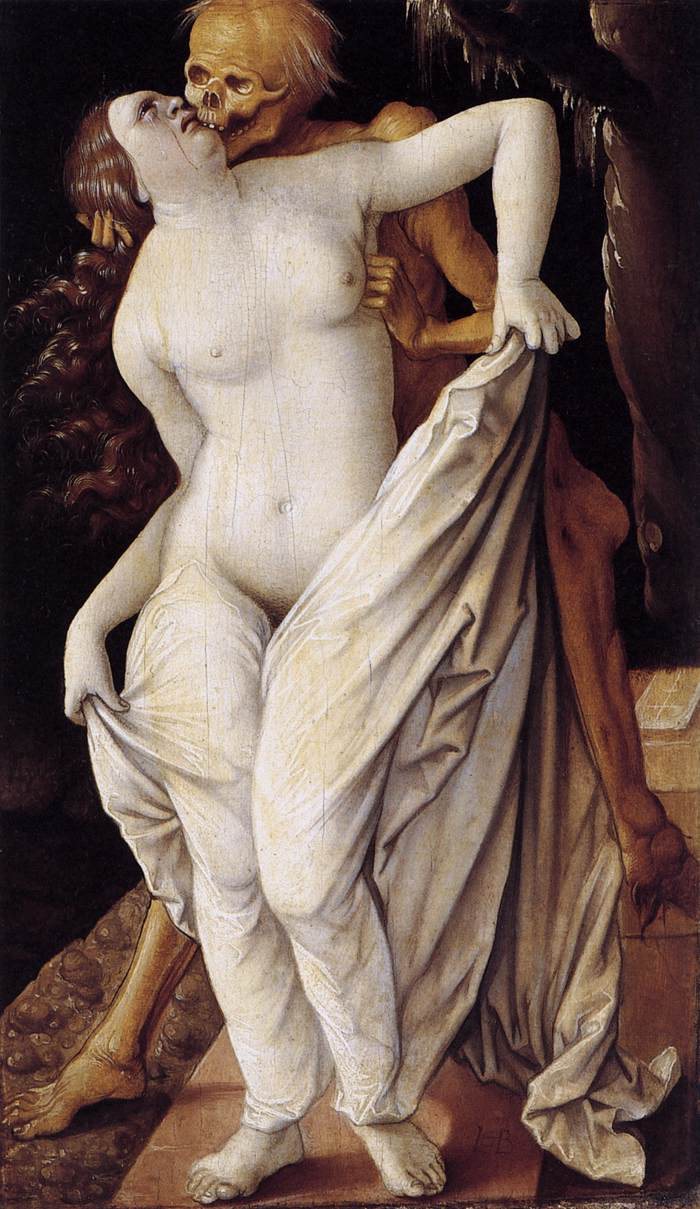
In a graveyard at night, Death — a desiccated corpse — seizes a young woman by the hair and bites a kiss into her cheek while she claws at his arm in vain. Painted about 1517, when Baldung was back in Strasbourg and the dance of death was in the air of every churchyard, it remains the most brutal of all his meetings of eros and rot.
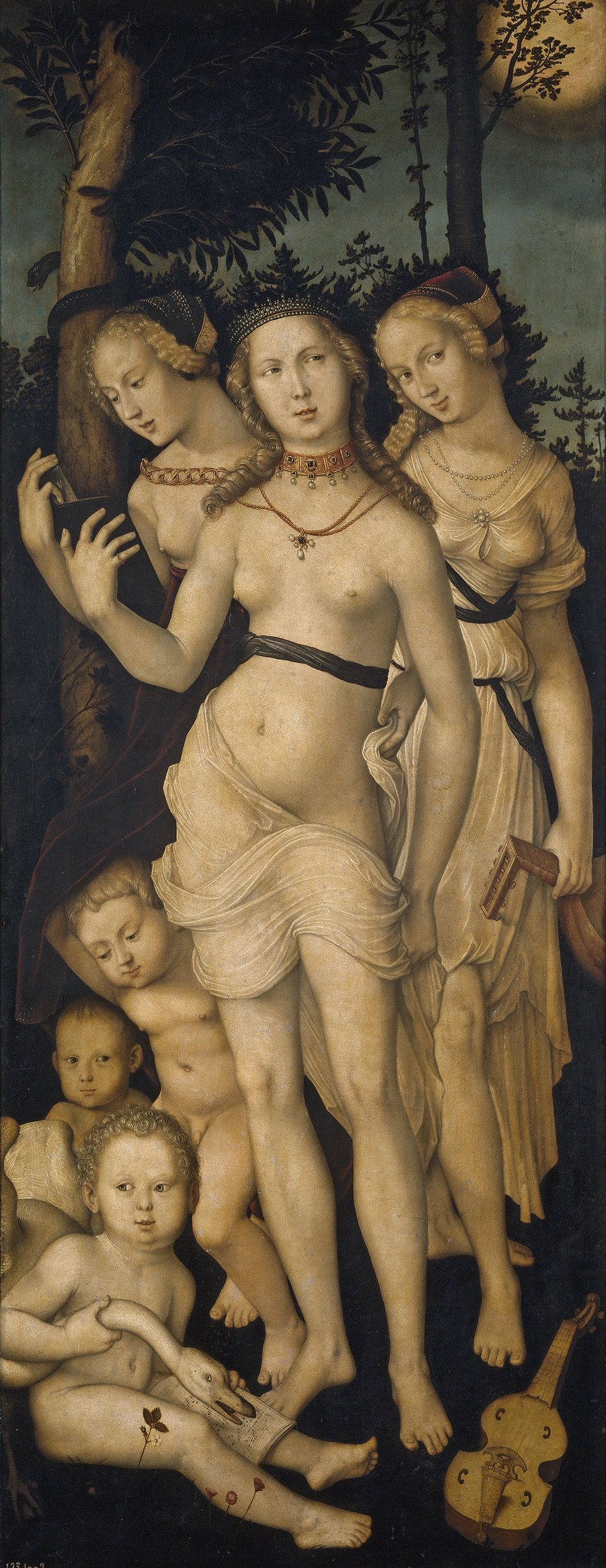
Three nude Graces stand in a dark landscape linked by a garland, an owl watching from the rocks and a putto below with a snake. Painted near the end of his life, the antique subject has gone Baldung-strange: the goddesses of charm stand in witch country, and the charm has an edge of unease no Italian Grace ever carried.
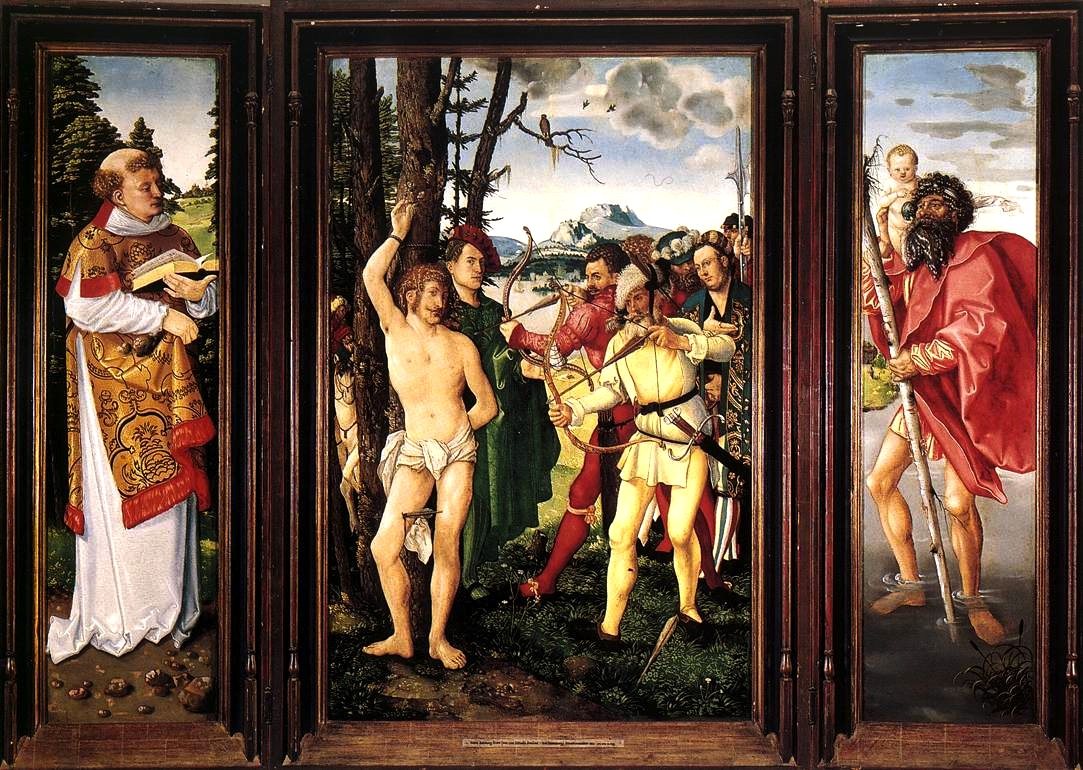
The Sebastian altarpiece, signed and dated 1507, is his earliest surviving major work: the saint tied to his tree in the centre, serene under the arrows, with saints and donors crowded on the wings. Painted fresh from Dürer's workshop, it already shows the cold green shadow and the unflinching body that would define him.
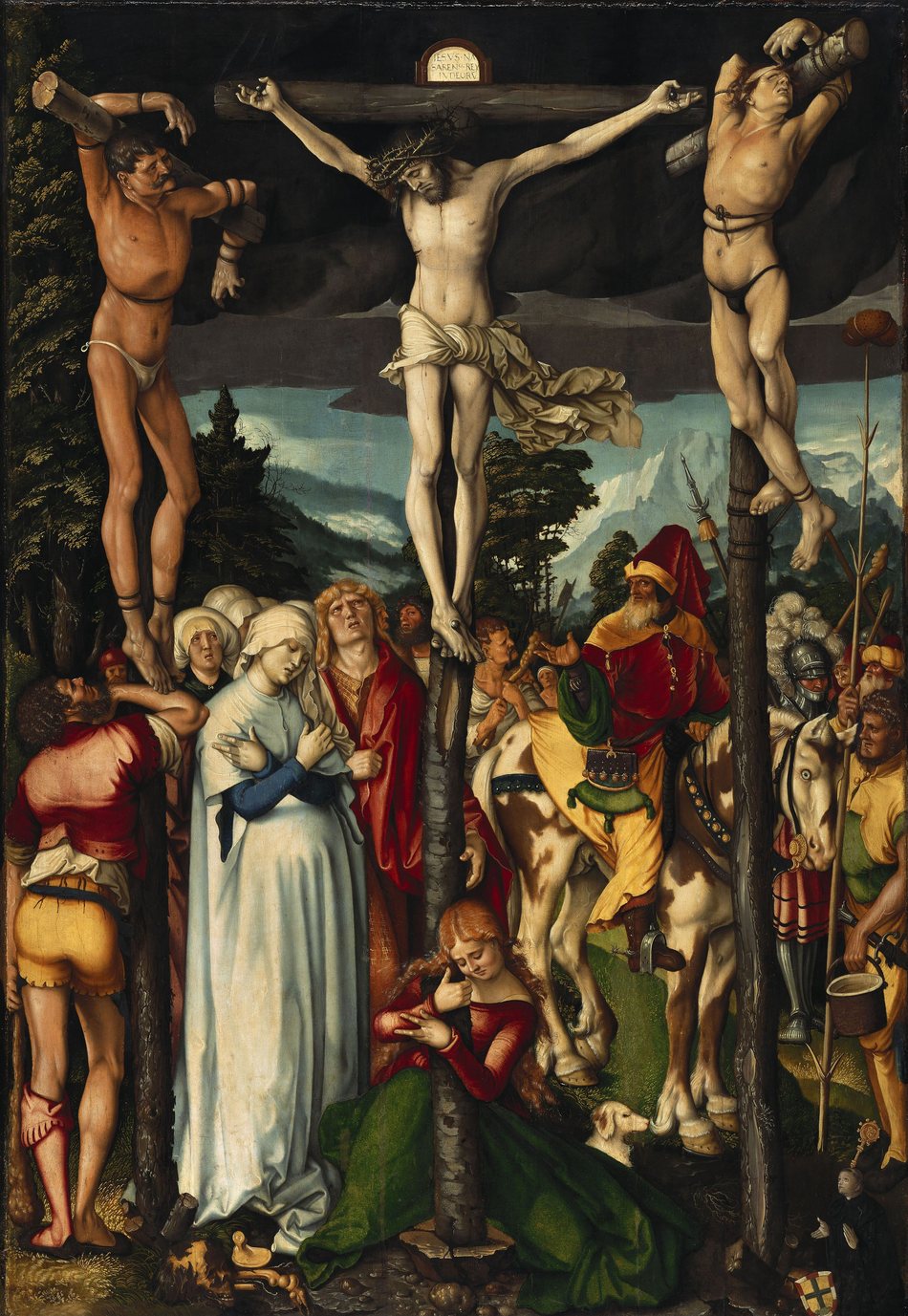
Christ hangs against a sky the colour of a bruise, the cross jammed into a rocky foreground, the mourners small and stiff with a grief that has no theatre in it. Painted the year he left for the Freiburg altar, it is Baldung at his most austere — the horror carried by colour and silence rather than by gesture.
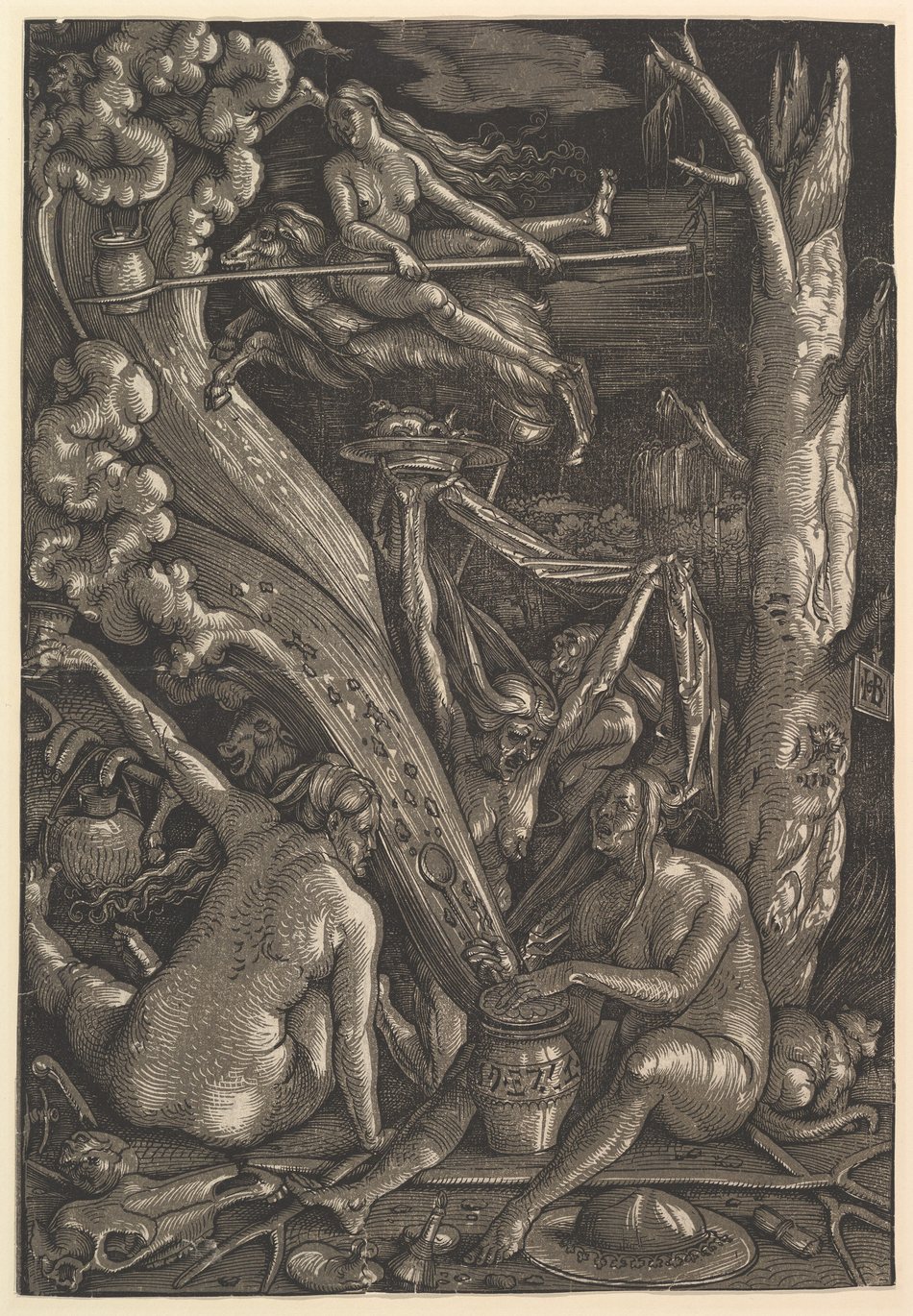
His most famous print: naked witches around a steaming pot in a night wood, one riding a goat backwards through the air, printed from two blocks — line and tone — among the first chiaroscuro woodcuts ever made. In 1510 the great witch persecutions were still to come; Baldung drew the fantasy with an insider's unnerving relish.
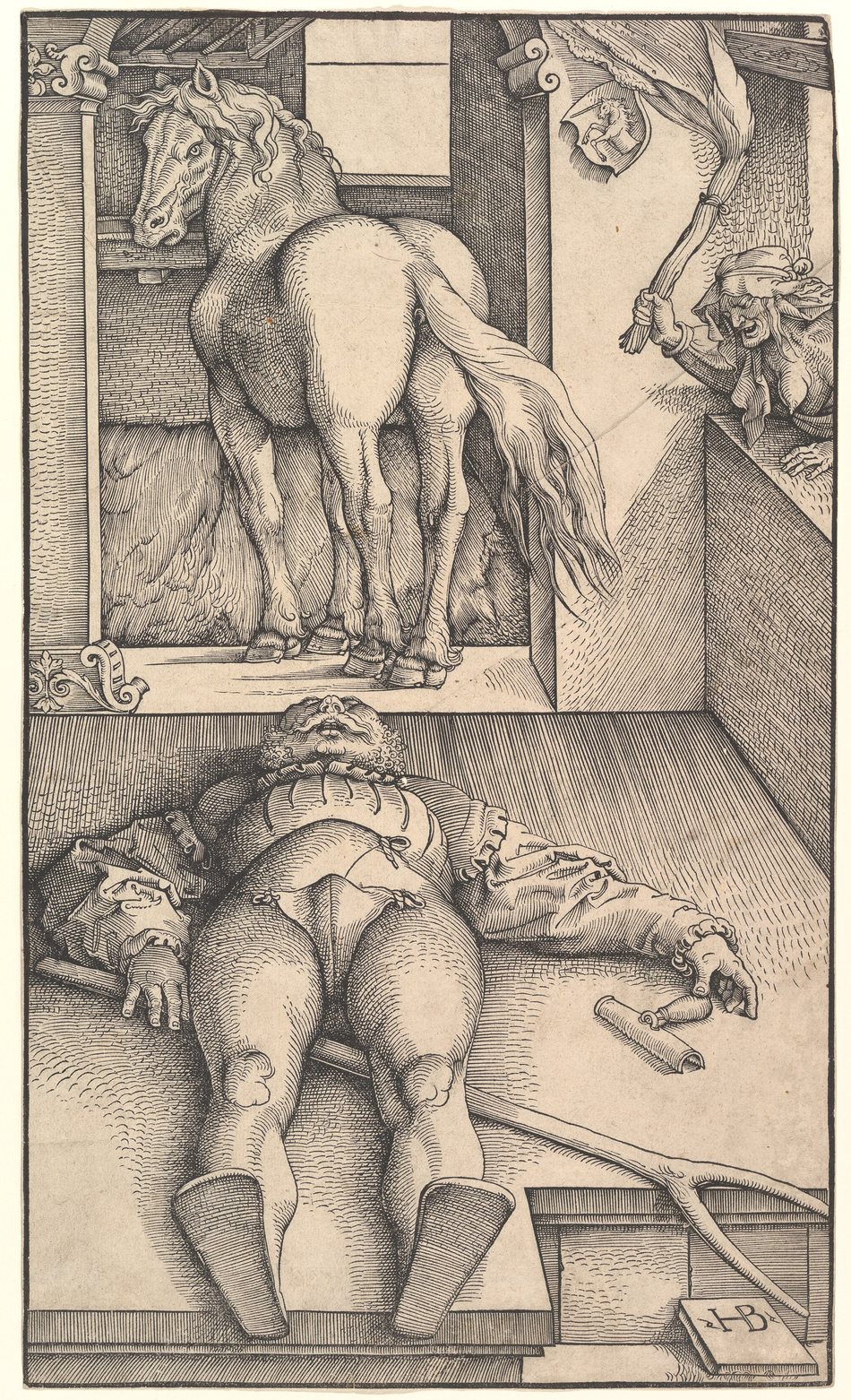
A groom lies sprawled in a stable as if struck down, a witch glowering through the hatch above, the horse turning to look at us — and on a tablet, Baldung's monogram beside a skull. His last woodcut, cut in the year before his death, it reads like a signature on his whole career: craft, menace and a joke nobody can quite explain.
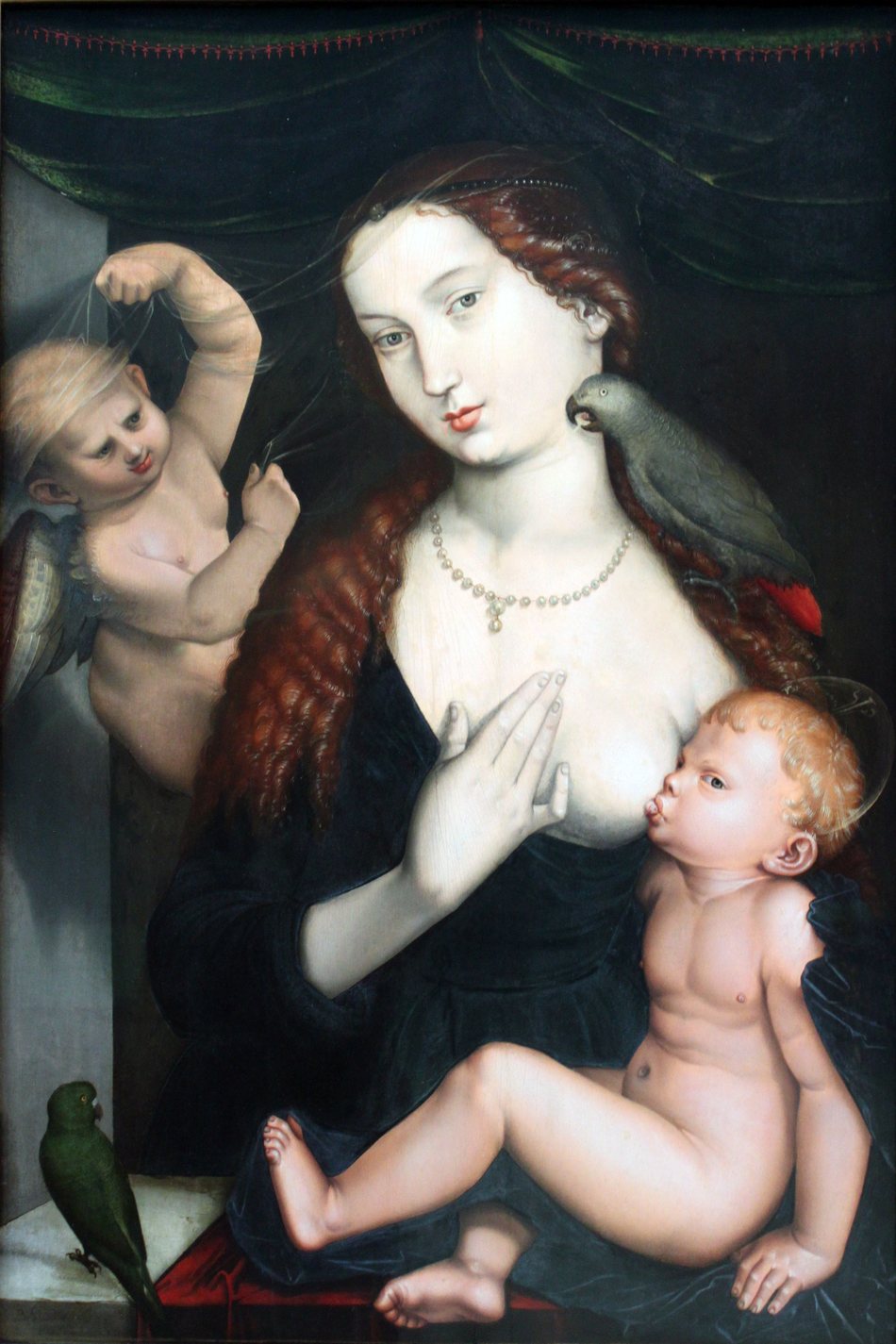
Mary bends over the Christ Child in a landscape opening, two parrots bright in the branches — an image of tenderness with exotic witnesses. Even here the Baldung weather gathers: the beauty is serene, but the light has that green, pre-storm quality that makes everything he painted feel one minute from changing.
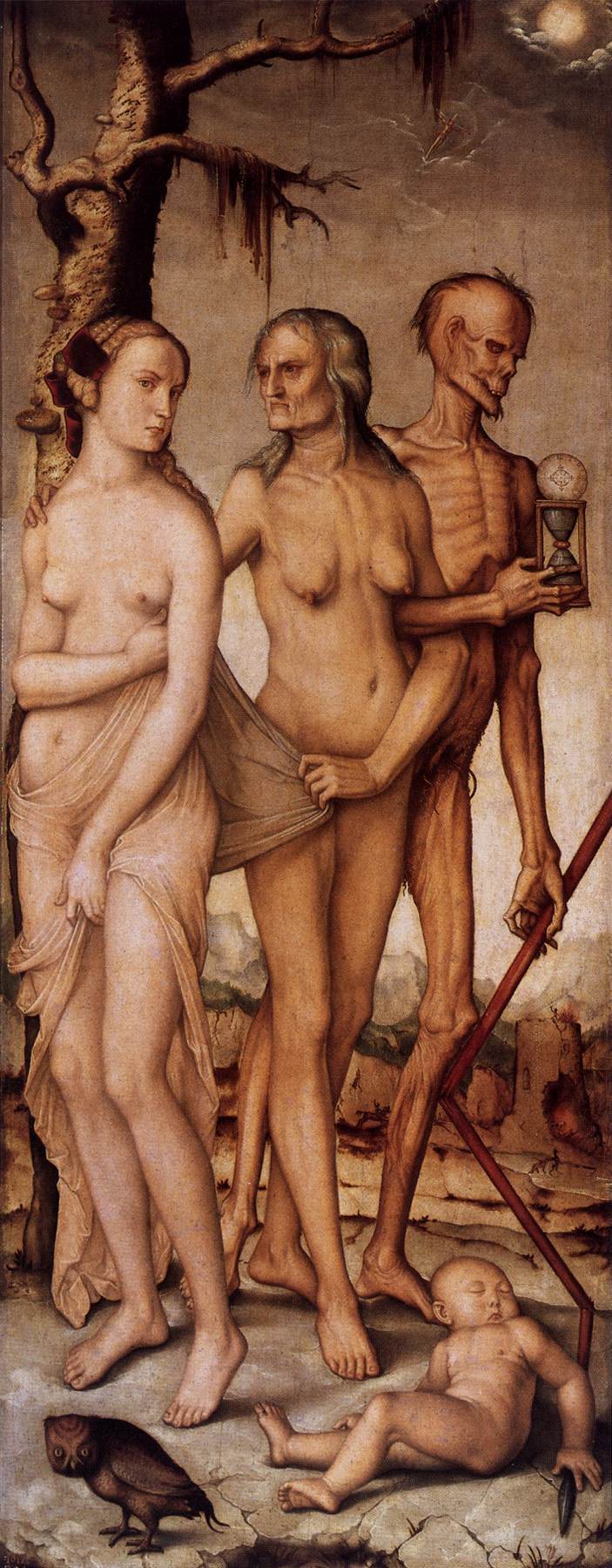
A child, a woman in her prime and an old woman stand in a row while Death, hourglass in hand, already has the eldest by the arm and gestures the middle one onward. Painted in his last years, it is the summation of his lifelong subject — not a sermon on vanity but an inventory, taken without blinking.
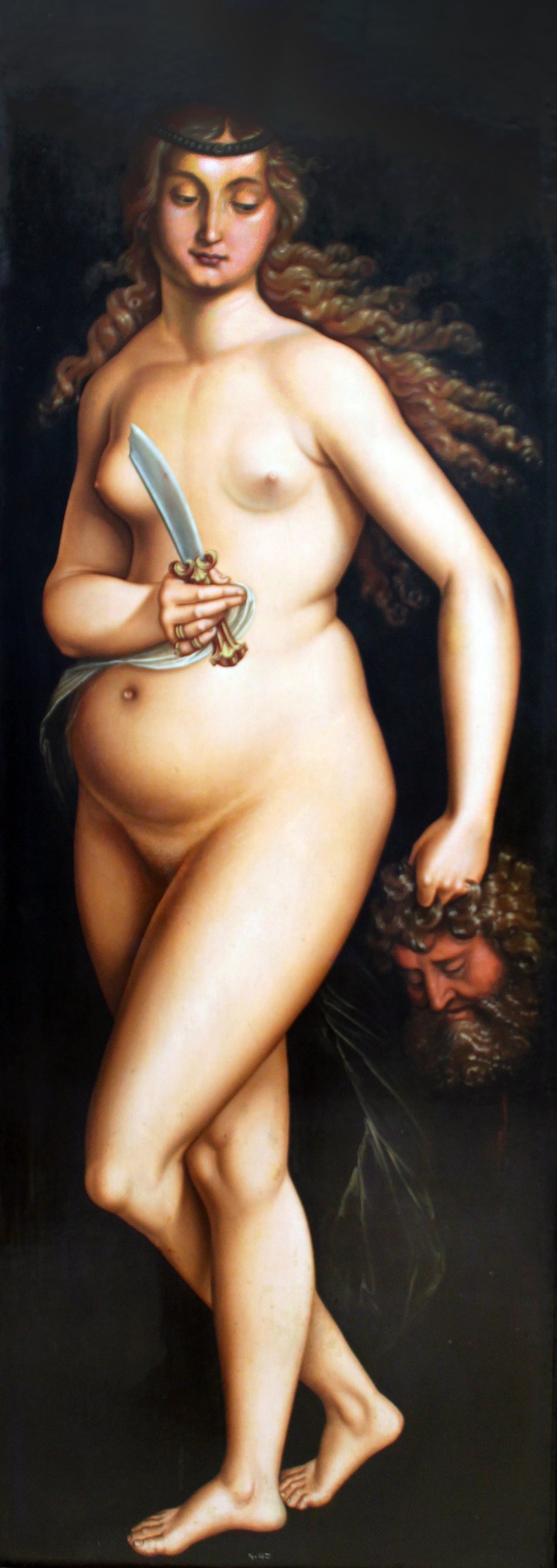
Judith stands in splendid contemporary dress, sword lowered, holding the head of Holofernes by the hair with the calm of a woman inspecting fruit. Baldung dresses the biblical heroine as a Strasbourg patrician of 1525 — and the modernity is the point: the danger in his pictures is never safely in the past.