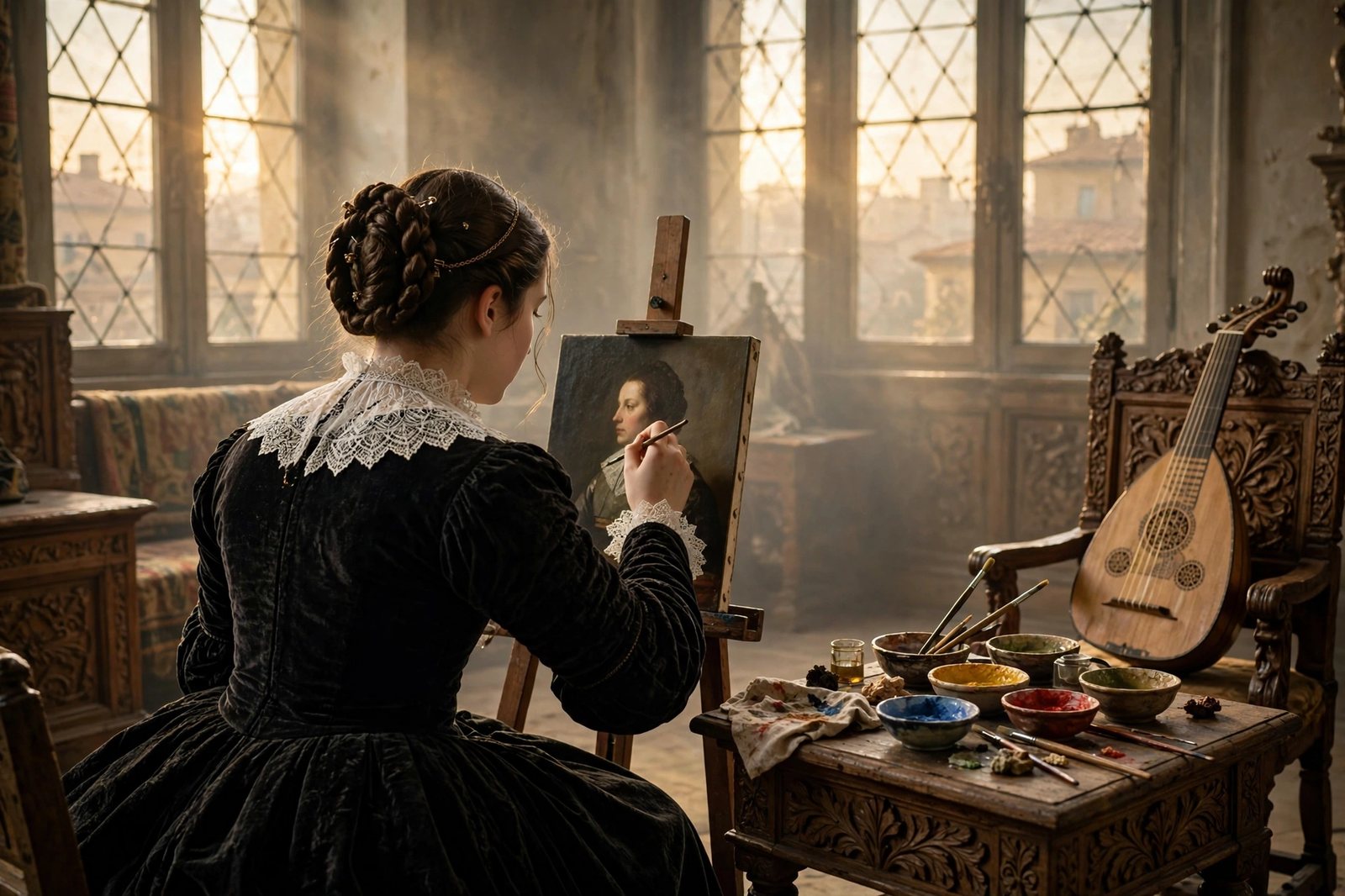
She was not supposed to exist: a noblewoman with a workshop training, famous across Europe while still in her twenties. Anguissola painted her own family from inside — sisters at a chessboard, a brother bitten by a crayfish, a mother in gold brocade — with an intimacy no court painter could buy, and then took that eye to the court of Spain.
Her father Amilcare, a minor Cremonese nobleman, did something unheard of: he apprenticed his daughters like sons. Sofonisba and her sister Elena were sent to live and train in the workshop of Bernardino Campi, then with Bernardino Gatti — full workshop discipline: drawing from casts and from life, grinding colour, copying, composing. The experiment produced the first woman painter of international fame in European history.
Before the portraits came chalk: she filled sheets with observed expressions — a girl laughing at an old woman's fumbling with the alphabet, her little brother howling over a bitten finger. Michelangelo, sent one drawing by her father, asked for a harder test: a crying face. She answered with the crayfish-bitten Asdrubale, tears and all, and the old master praised it. Expression, for her, was a studied craft, not an accident.
Her oil paint is laid thin and smooth in the Lombard manner learned from the Campi and, at a distance, from Correggio: flesh modelled in soft half-tones with almost no visible stroke, lace and brocade built stitch by stitch over the modelling. Nothing is sketched in paint; the surface stays enamel-calm while the psychology underneath it moves. It is technique as good manners — and it never misses.
Her sitters were in the house: five sisters, a brother, her parents. She staged them like a theatre director — around a chessboard, in a garden, mid-laugh, mid-quarrel — linked by glances and hands into conversations the viewer overhears. The group portrait as a slice of life, decades before the Dutch made it a genre, is her invention, worked out on the only models a noblewoman could freely use.
In Madrid (1559–1573) she served Queen Elizabeth of Valois as lady-in-waiting and painting teacher, portraying the royal family inside the strict code of Spanish court portraiture: dark grounds, restrained colour, identity carried by jewels, lace and bearing. Court painters did not sign; for centuries many of her canvases were given to Titian, Sánchez Coello or van Dyck. Recovering her hand from theirs is still detective work done with documents and brushwork.
She painted into her eighties, in Sicily and Genoa, as her sight failed. In 1624 the young Anthony van Dyck visited her in Palermo, drew her portrait and recorded her advice — on light, on patience, on not overworking a passage — noting that her memory and judgement were sharper than her eyes. The technique she defended to the end was the one Campi taught her: prepare completely, then paint once, cleanly.
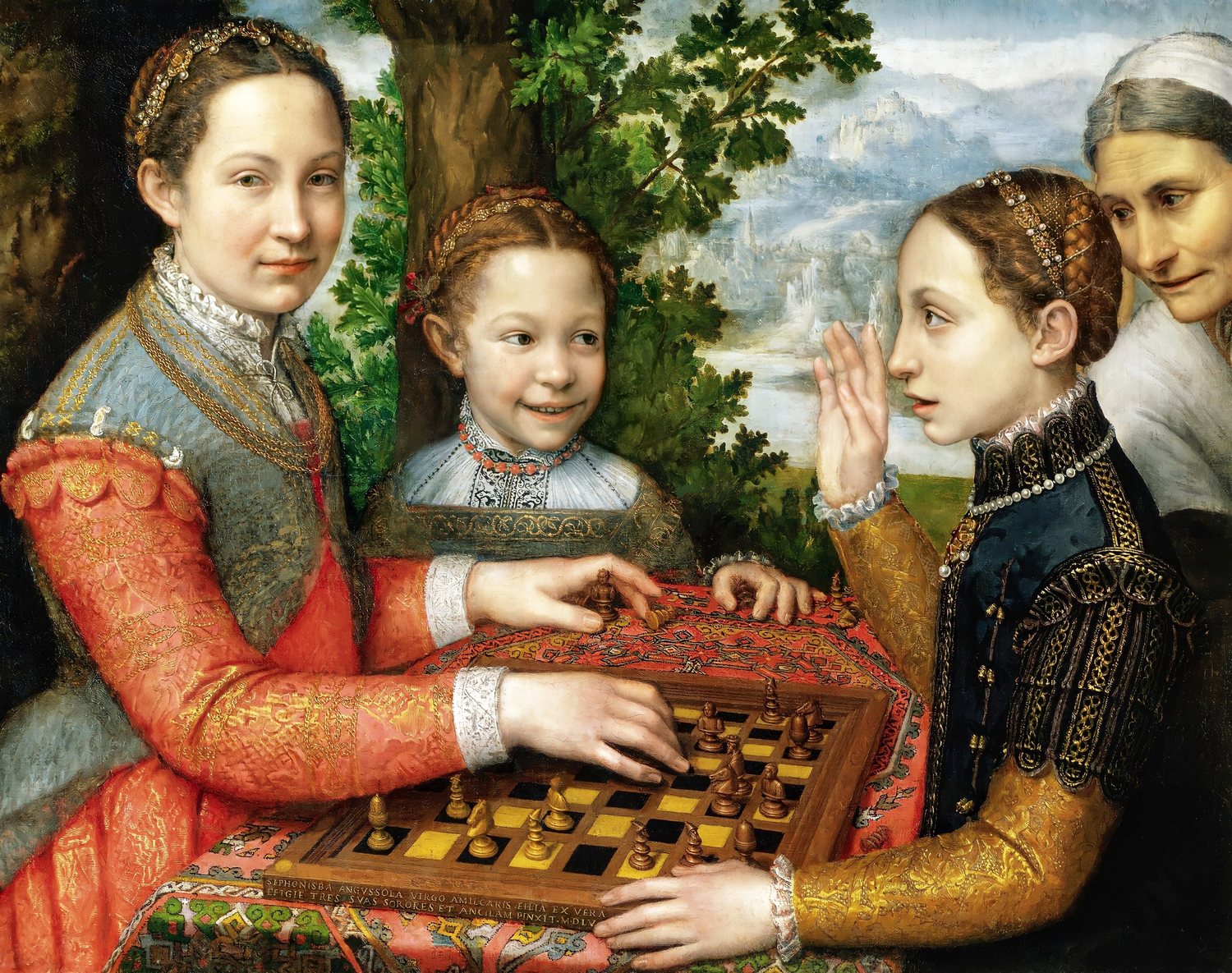
Her three younger sisters — Lucia, Minerva and Europa — play chess in a garden while a maidservant watches; Europa grins at us, delighted by the move just played. Signed and dated 1555, it is less a portrait than a captured minute of family life: four temperaments around one board, each face turned to a different thought.
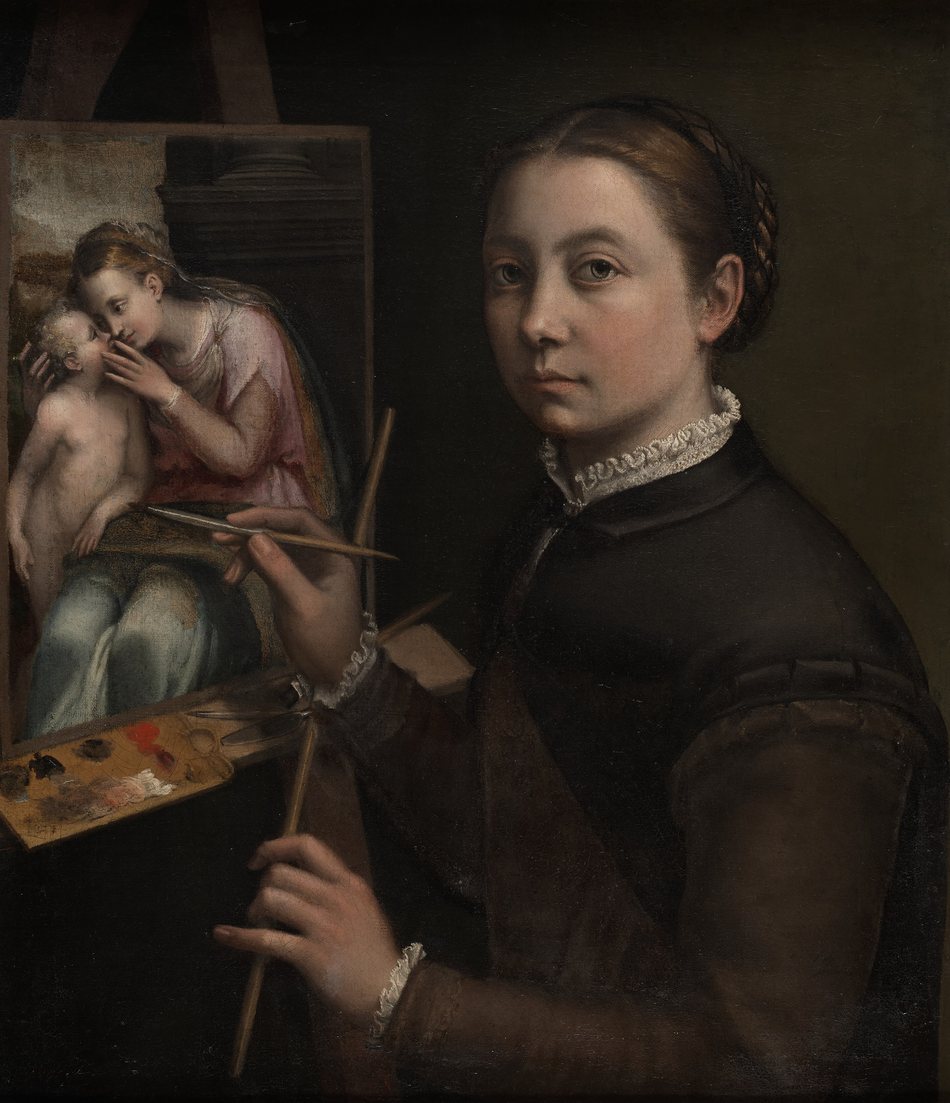
She shows herself at work, brush and palette in hand, painting a devotional panel of the Virgin and Child — the respectable subject a noblewoman could be seen painting. The picture is a quiet manifesto: the sitter, the painter and the author are one person, and she meets our gaze over her shoulder without apology.
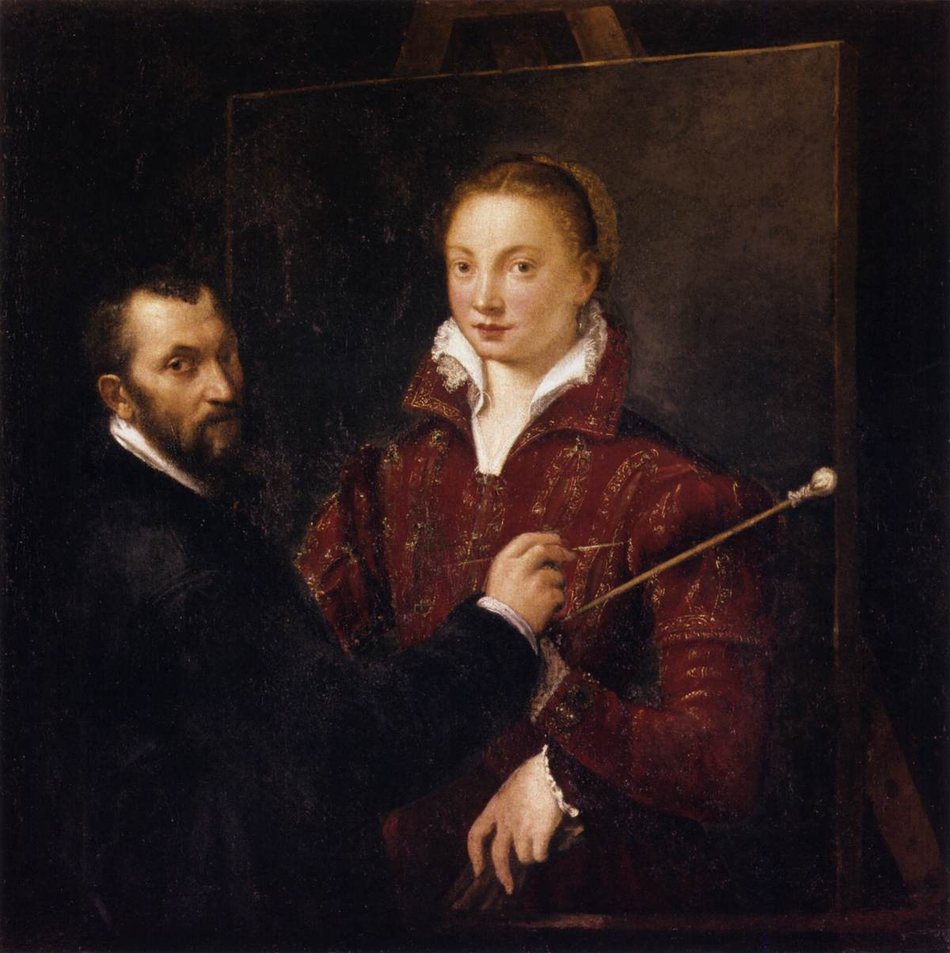
A double portrait folded into itself: her teacher Campi stands at an easel painting her portrait, while she — life-size on his canvas — holds the tools of the trade herself. Scholars still argue whether Campi painted it or Sofonisba painted them both; either way, the pupil is already the larger presence in the picture.
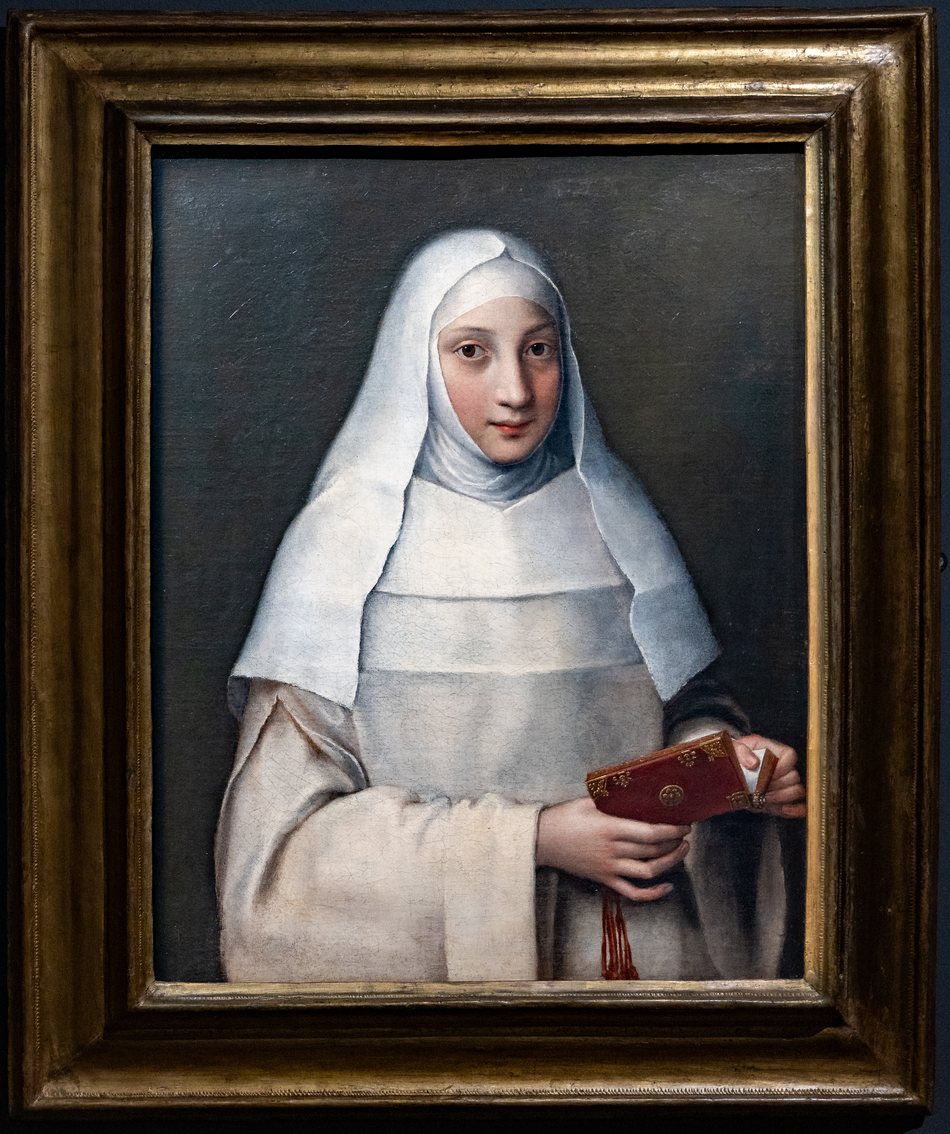
Her sister Elena, who had taken the veil as a Dominican nun, holds a breviary and looks out with unnerving calm. Painted when Sofonisba was about nineteen, it is her earliest signed and dated work — already complete: the white habit built from a dozen greys, the face from almost nothing at all.
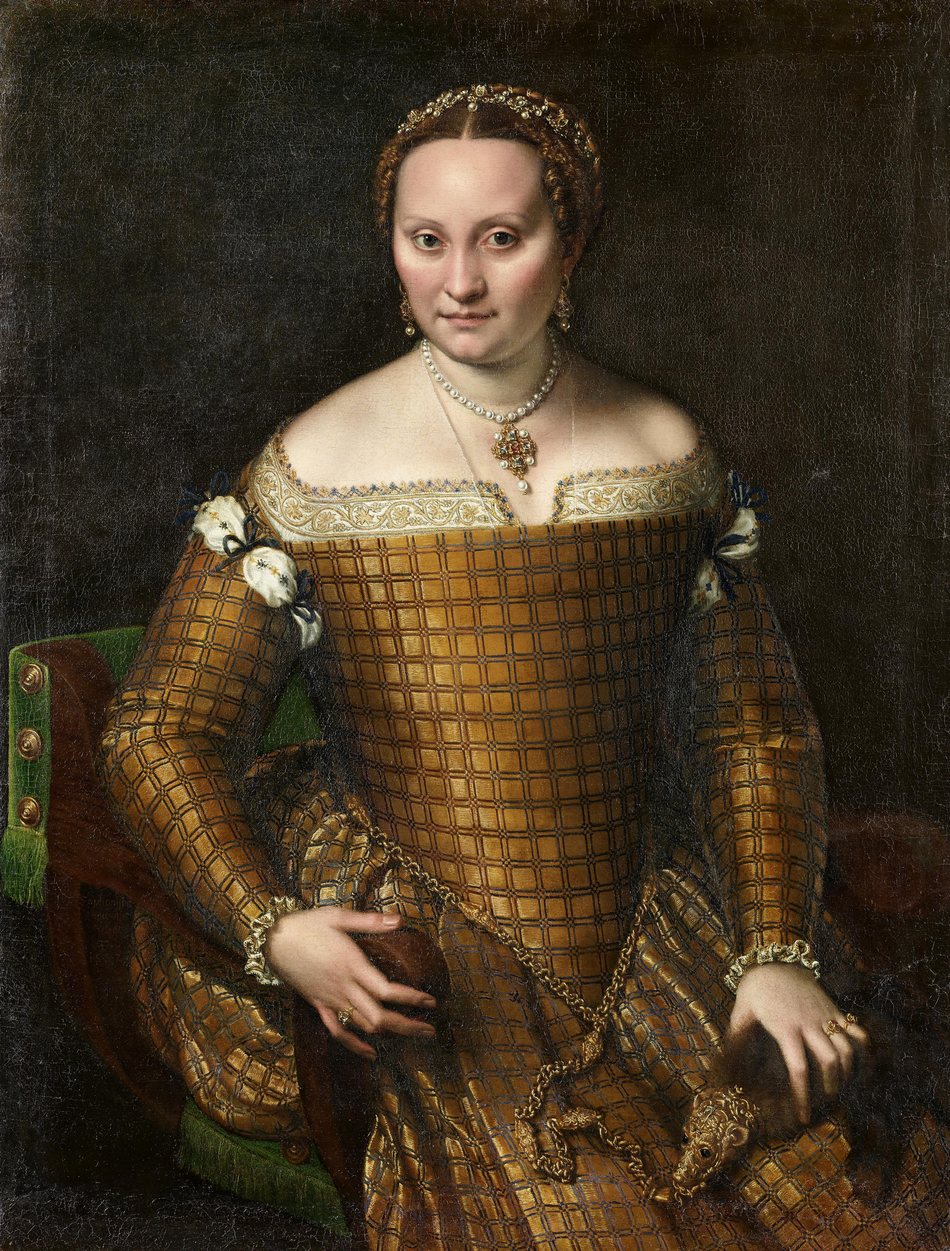
Her mother, seated in a gold lattice brocade with pearls and a jewelled pendant, one hand resting on the chair, the other holding a small dog's chain of gold. It is a state portrait in miniature — and a daughter's inventory of everything her mother's face did not say in public.
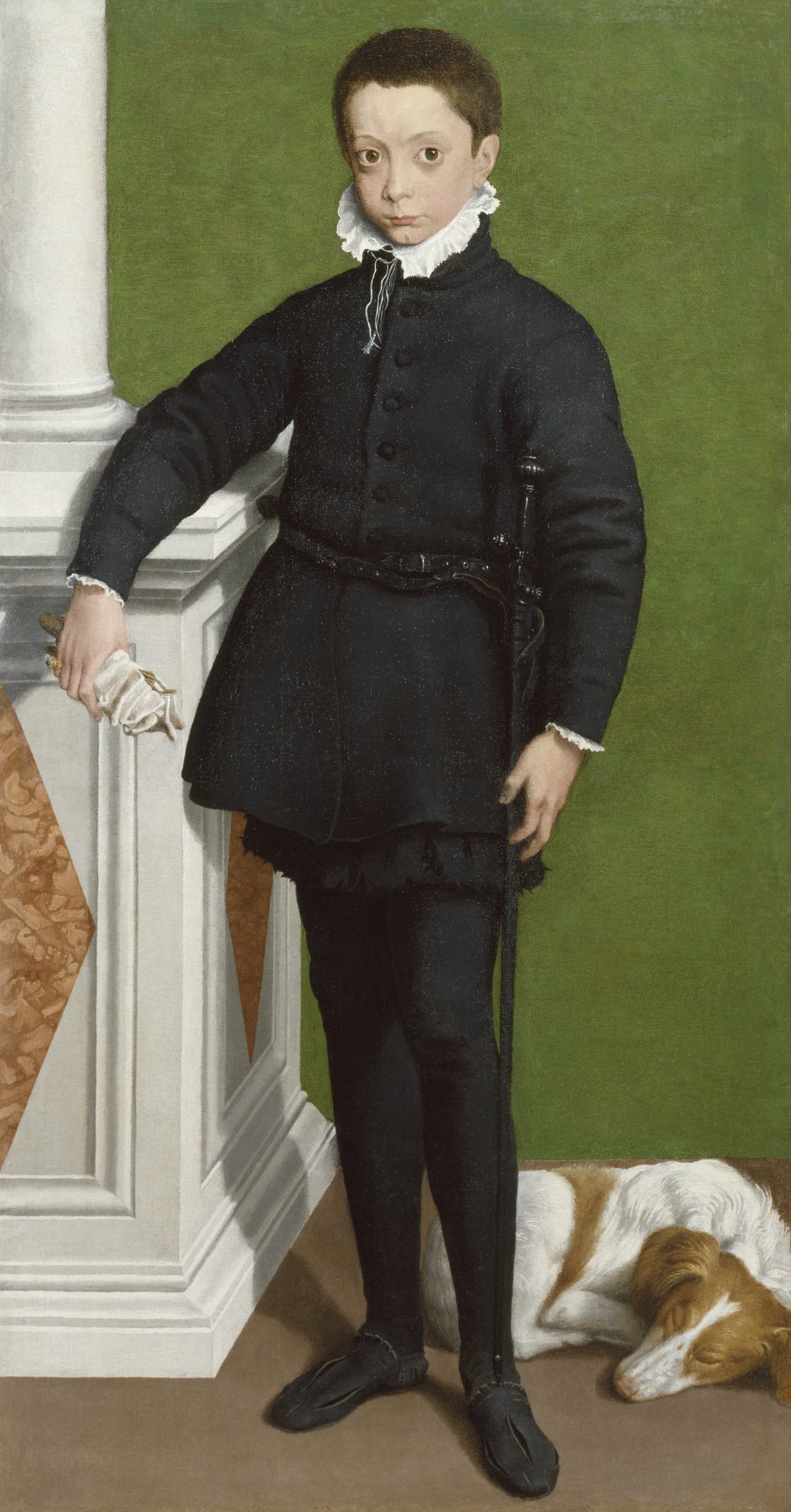
The nine-year-old heir of Soncino stands full-length in mourning black beside a column, a small dog at his feet, one gloved hand resting with adult composure. His father had just died; the portrait is an instrument of succession as much as a likeness — a child presented as already a marquis.
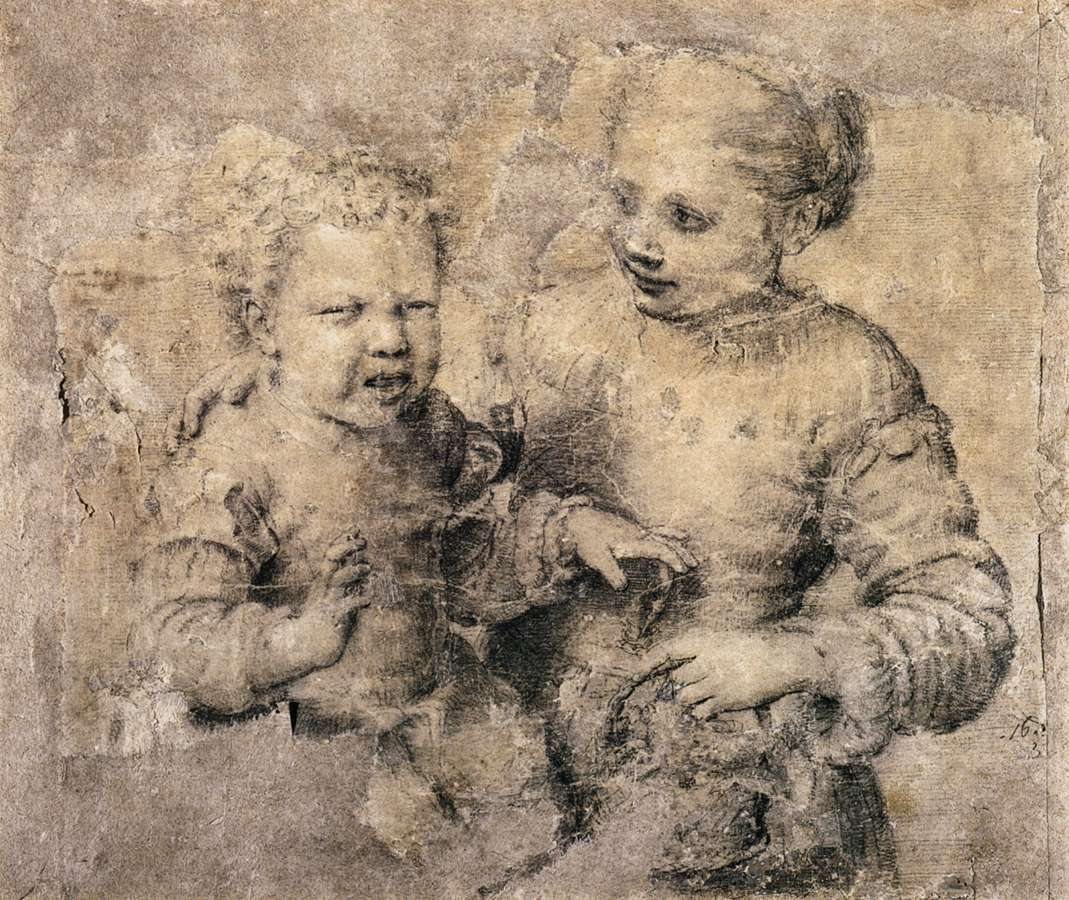
The most famous drawing of the century: her little brother Asdrubale, bitten on the finger by a crayfish, screws up his face to cry while his sister Europa laughs. Sent to Michelangelo as proof of the girl's talent, it drew his praise — and it still startles: real tears, caught at the exact second before they fall.
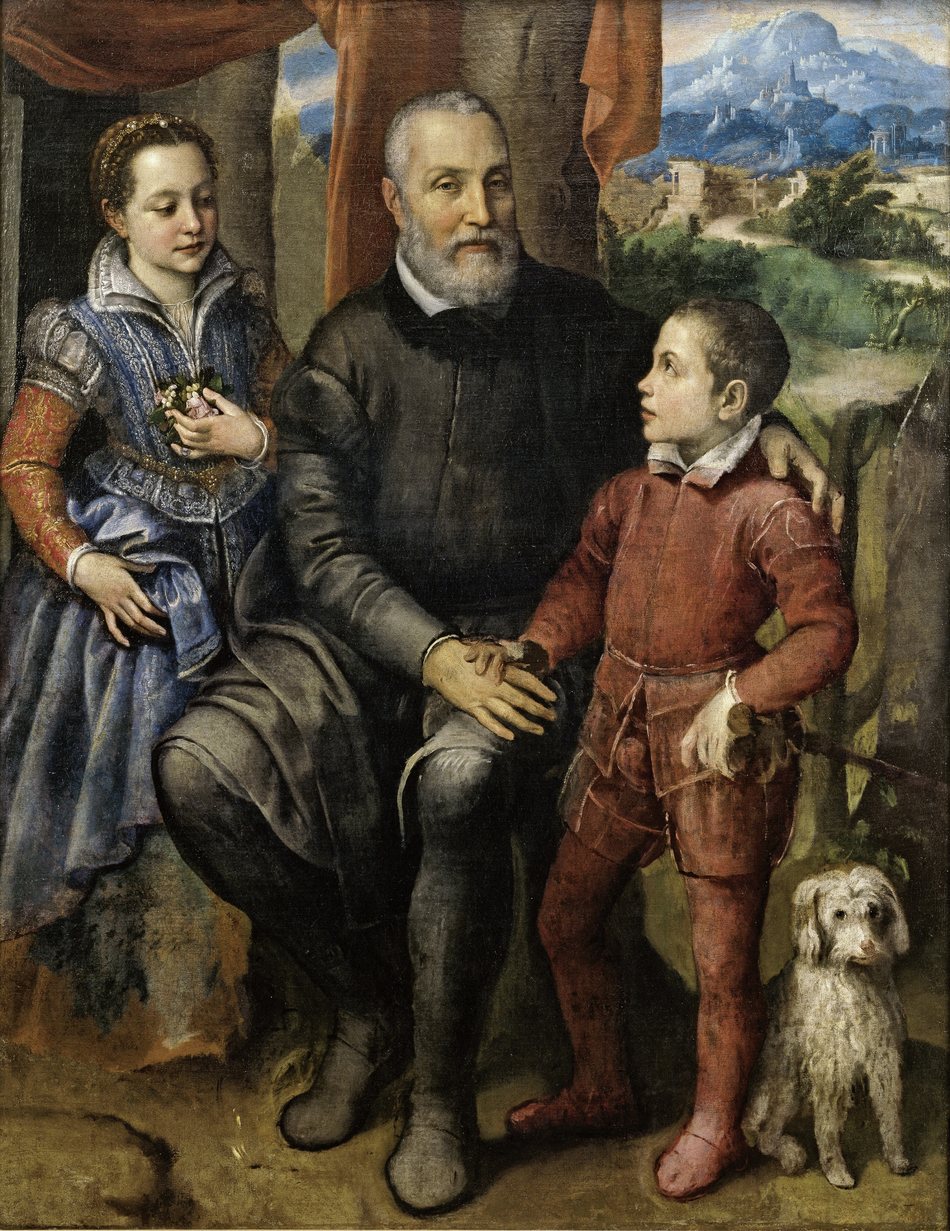
Amilcare sits between Minerva and young Asdrubale, a landscape opening behind them, the little dog in attendance. The canvas was left unfinished — passages of dress and background still open — which makes it a rare X-ray of her method: faces finished first, everything else negotiable.
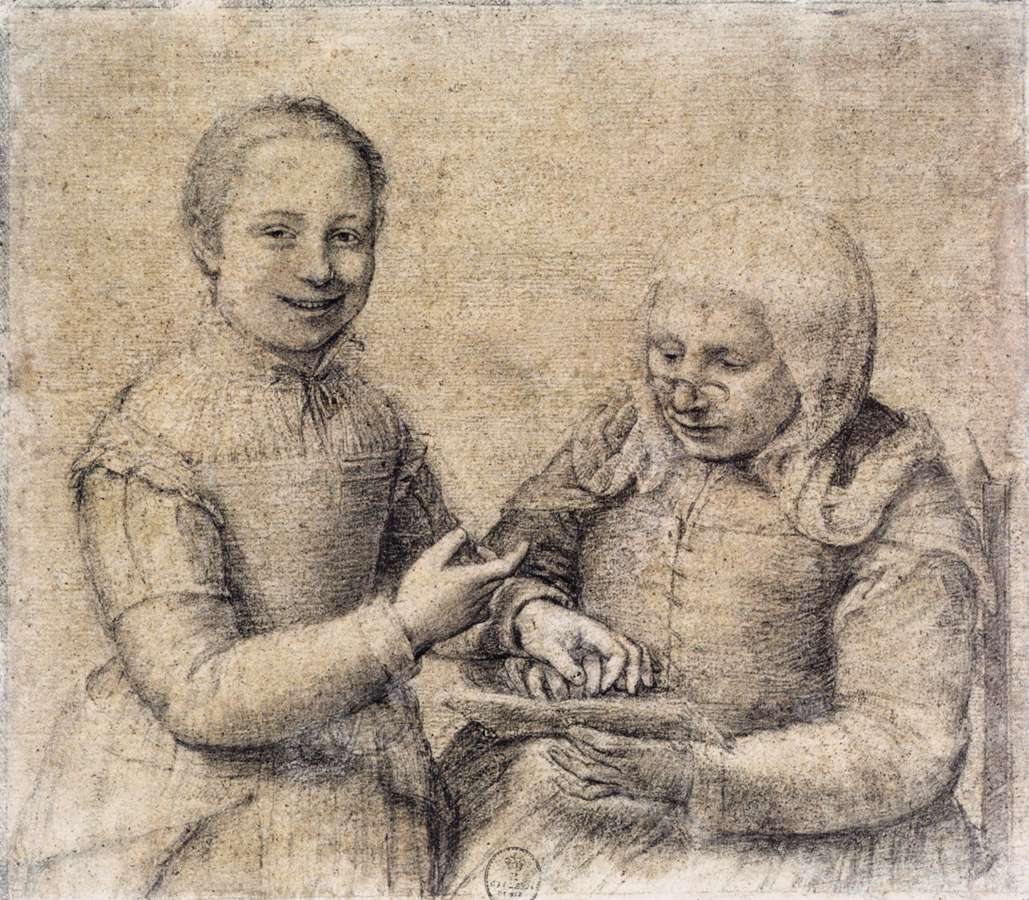
An old woman sounds out her letters from a primer while a young girl — the drawing's accomplice and ours — dissolves in laughter beside her. A chalk study in the Leonardo tradition of paired opposites: age against youth, effort against ease, drawn with an economy that lets two faces carry the whole joke.
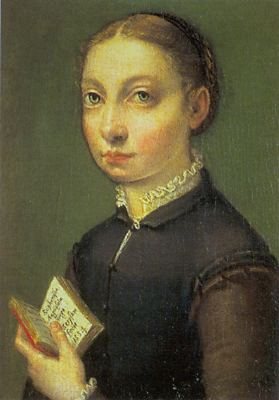
A small panel, a young woman in a dark dress with a lace collar, holding an open book. She was twenty-two and already signing herself, in the inscription, as a painter. The modesty is strategic: everything in the picture is restrained except the steadiness of the gaze, which is not modest at all.