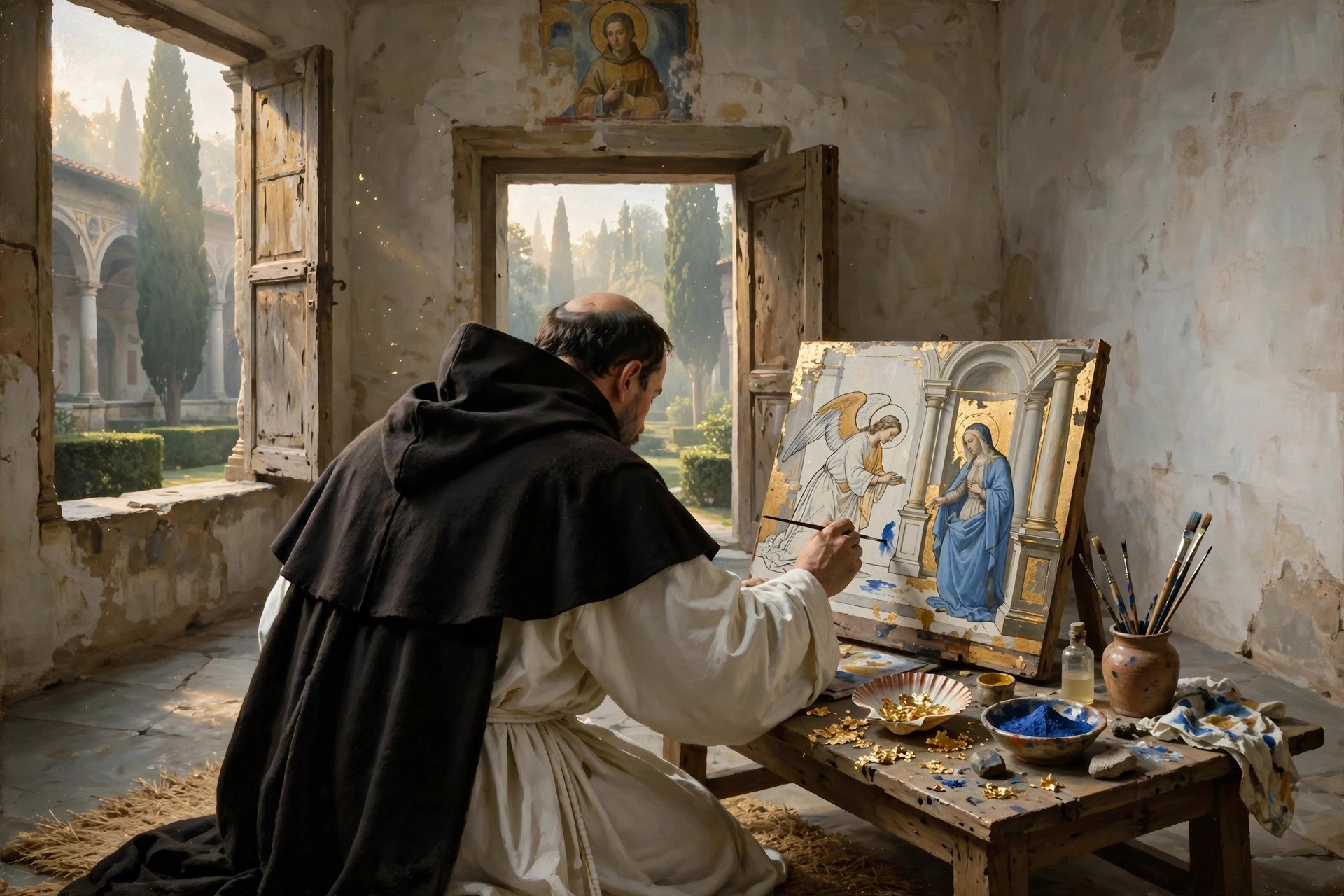
A friar who painted as other men pray. Fra Angelico — born Guido di Pietro, blessed by the Church and called 'the Angelic' by everyone since — covered the cells of his own convent with frescoes meant for an audience of one kneeling brother. No painter has ever made holiness look so simple, or simplicity so radiant.
Vasari reports that he never took up a brush without praying first, never painted a Crucifixion without tears running down his cheeks, and never retouched a finished passage — believing what had come through prayer should stand as given. The anecdotes may be polished by legend, but the pictures support them: there is no vanity, no display, no wasted stroke anywhere in his work.
In the convent of San Marco he and his assistants painted a fresco in every friar's cell — some forty rooms, each image a meditation instrument for the single brother who slept and prayed there. No public, no patron to please, no signature. The Mocking of Christ in Cell 7 reduces the scene to a blindfolded figure and floating hands: a picture designed to be prayed with, not looked at.
His frescoes are true buon fresco: pigment worked into wet plaster, one day's patch — a giornata — at a time, the joins planned along contours so the seams disappear. The method forbids hesitation: plaster waits for no one. That his San Marco walls look so effortless, so breathed-on rather than built, is the measure of a lifetime's discipline in the least forgiving medium in painting.
He mastered the new perspective — the Cortona and San Marco Annunciations are built in rigorous space — yet he kept the gold ground and the tooled, punched halo long after they were old-fashioned. For Angelico gold is not decoration: it is what heaven is made of, and his punchwork makes it shimmer like a surface of light. Modern space and medieval radiance, held in one hand.
His colours are the clearest of the century: rose, pale blue, spring green, white — laid in fresco's matte register or tempera's enamel, with ultramarine spent generously where lesser painters saved. Figures seem built of coloured light rather than flesh; even his damned, in the Last Judgment, are arranged with a tailor's tidiness. Hell, in Angelico, is the only disorderly place, and he clearly disliked painting it.
Called to Rome, he painted the Niccoline Chapel for Pope Nicholas V — the lives of Saints Stephen and Lawrence in fresco, architecture like stage sets of the new Rome rising around him. Lawrence, the deacon who gave the Church's treasure to the poor, is painted distributing alms with a bookkeeper's calm. The friar from Fiesole died in Rome in 1455 and lies in Santa Maria sopra Minerva, under a slab that calls him the glory of painting.
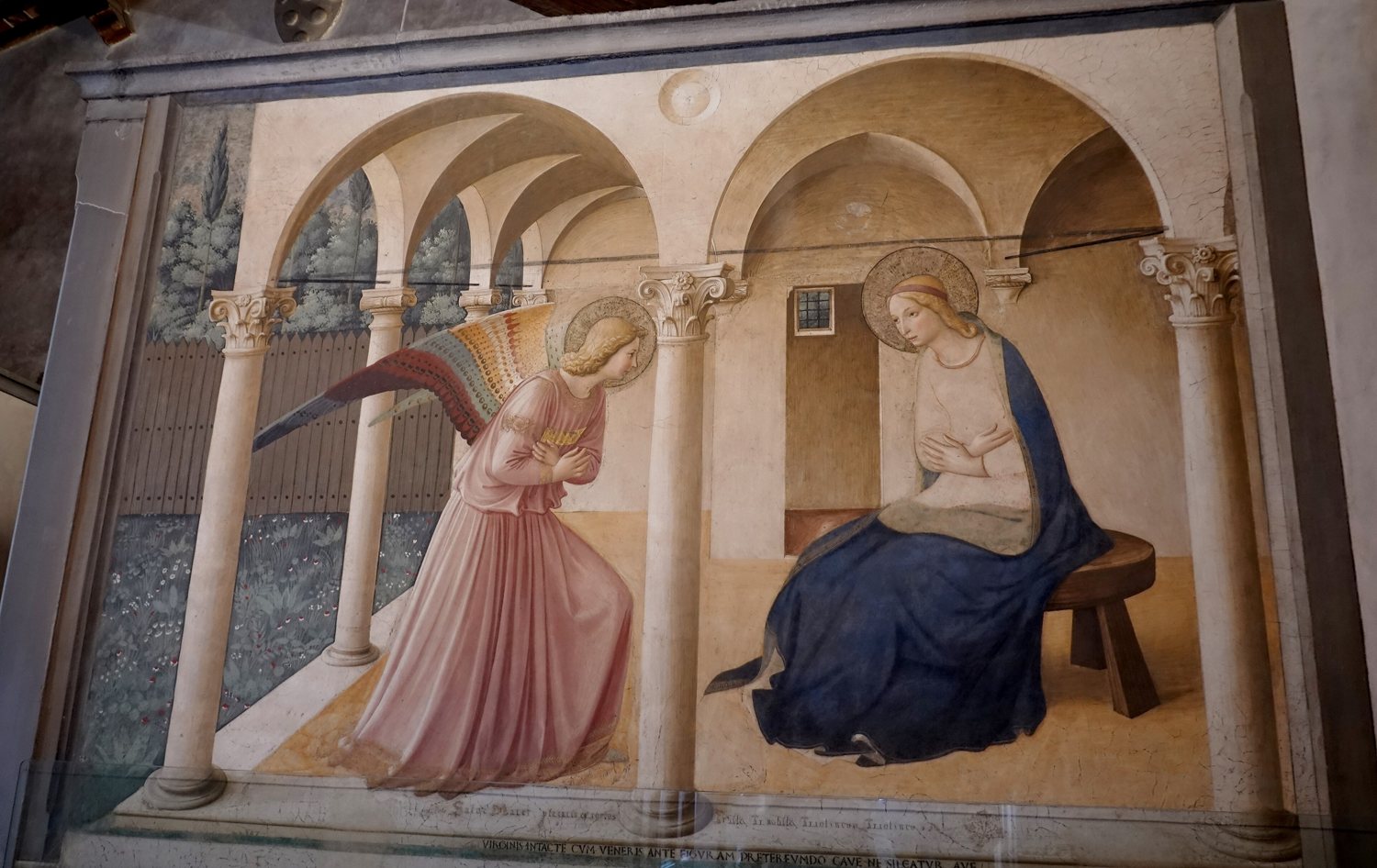
At the top of the dormitory stairs, the first thing a friar saw each morning: the angel bowing in a plain loggia, the Virgin bowing back, a fenced garden behind. Nothing in it shines, nothing performs. Painted not for the world but for the brothers passing on their way to prayer, it may be the most quietly perfect Annunciation ever made — two bows, and the history of the world changes.
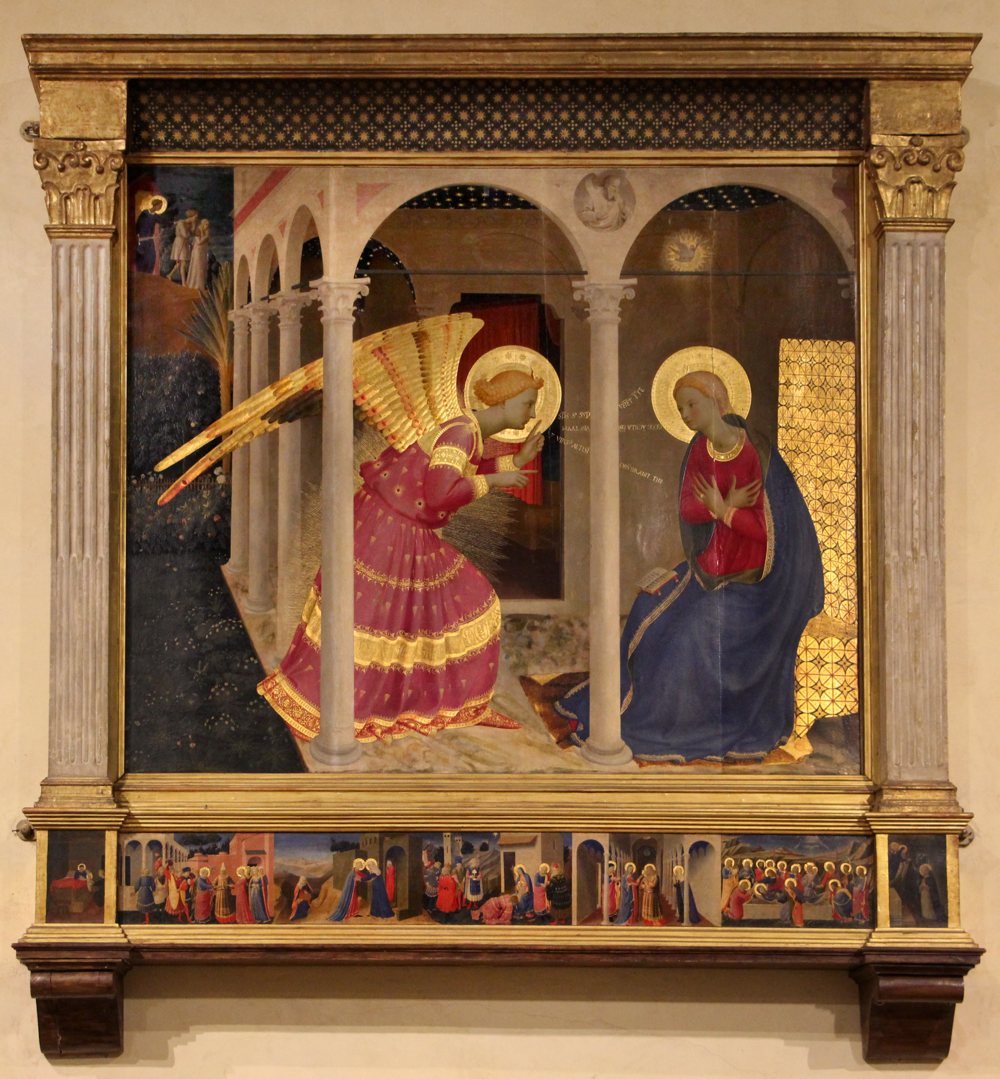
The angel lands in a rush of pink and gold on the left of a marble loggia, his speech written in gold letters streaming toward the Virgin — and her answer streams back, written upside down, as if heaven needed to read it. In the top corner, tiny and far, Adam and Eve are expelled from Paradise: the cause of it all, already being undone in the foreground.
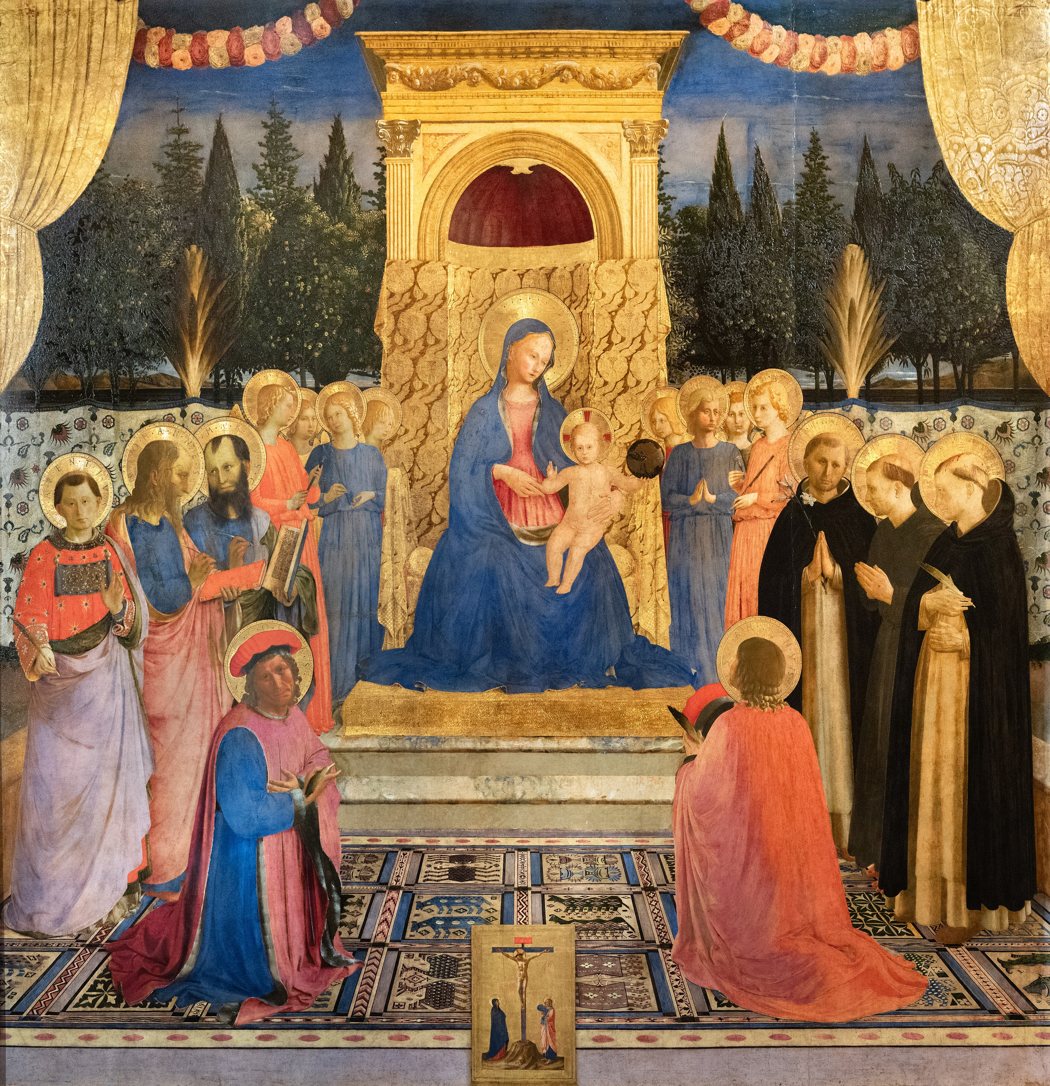
For the high altar of his own convent church: the Virgin enthroned on a carpet of Anatolian pattern, saints Cosmas and Damian kneeling in the front rank like two friars at prayer, a small Crucifixion planted at the centre of the carpet's pattern. Cosimo de' Medici paid; the friars prayed. The picture is a sacra conversazione conducted at the volume of a whisper.
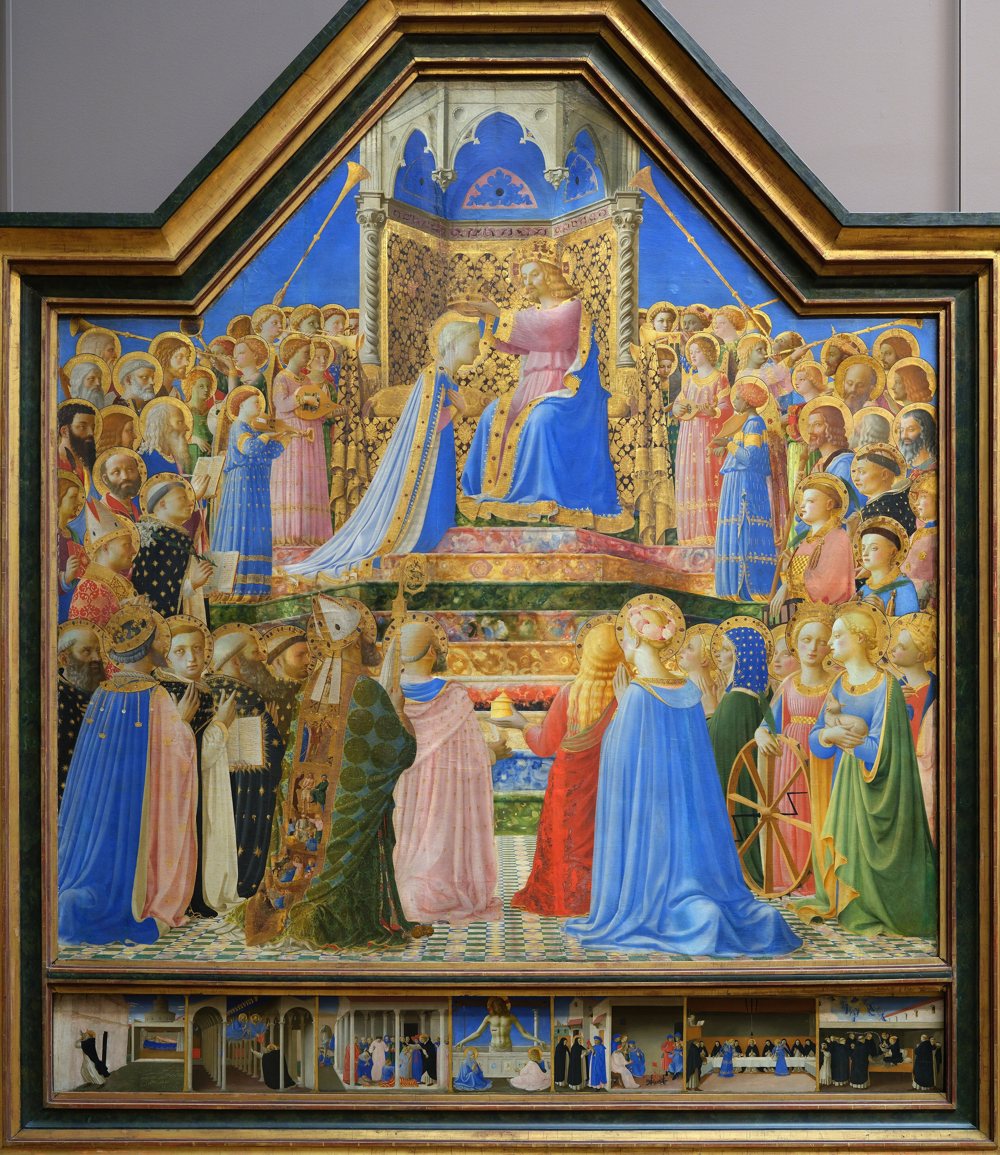
Christ crowns his mother on a marble throne at the top of nine steps, in a heaven crowded with saints ranked like a choir — bishops, virgins, friars, kings, each recognisable, each at rest. Below, in the predella, the miracles of Saint Dominic run like a strip of film. It is Angelico's most splendid panel: gold, ultramarine and rose spent without a single anxious stroke.
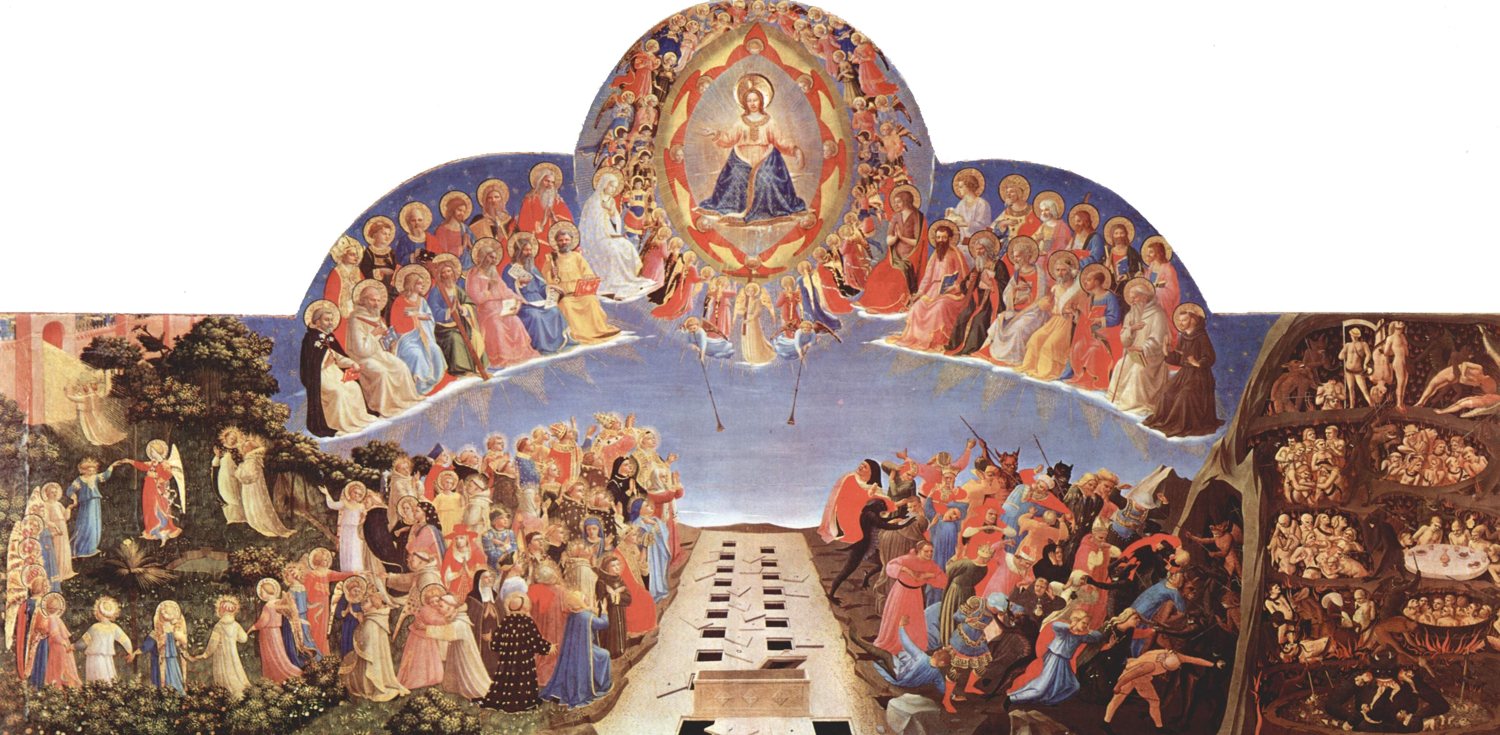
On the left, the blessed dance in a garden in rings of coloured light, led by angels toward a radiant gate; on the right, the damned are sorted into hell's neat compartments; between them a row of opened tombs divides the two eternities like a street. Even the end of the world, in Angelico, is orderly and full of light — the terror is there, but it is kept in its assigned place.
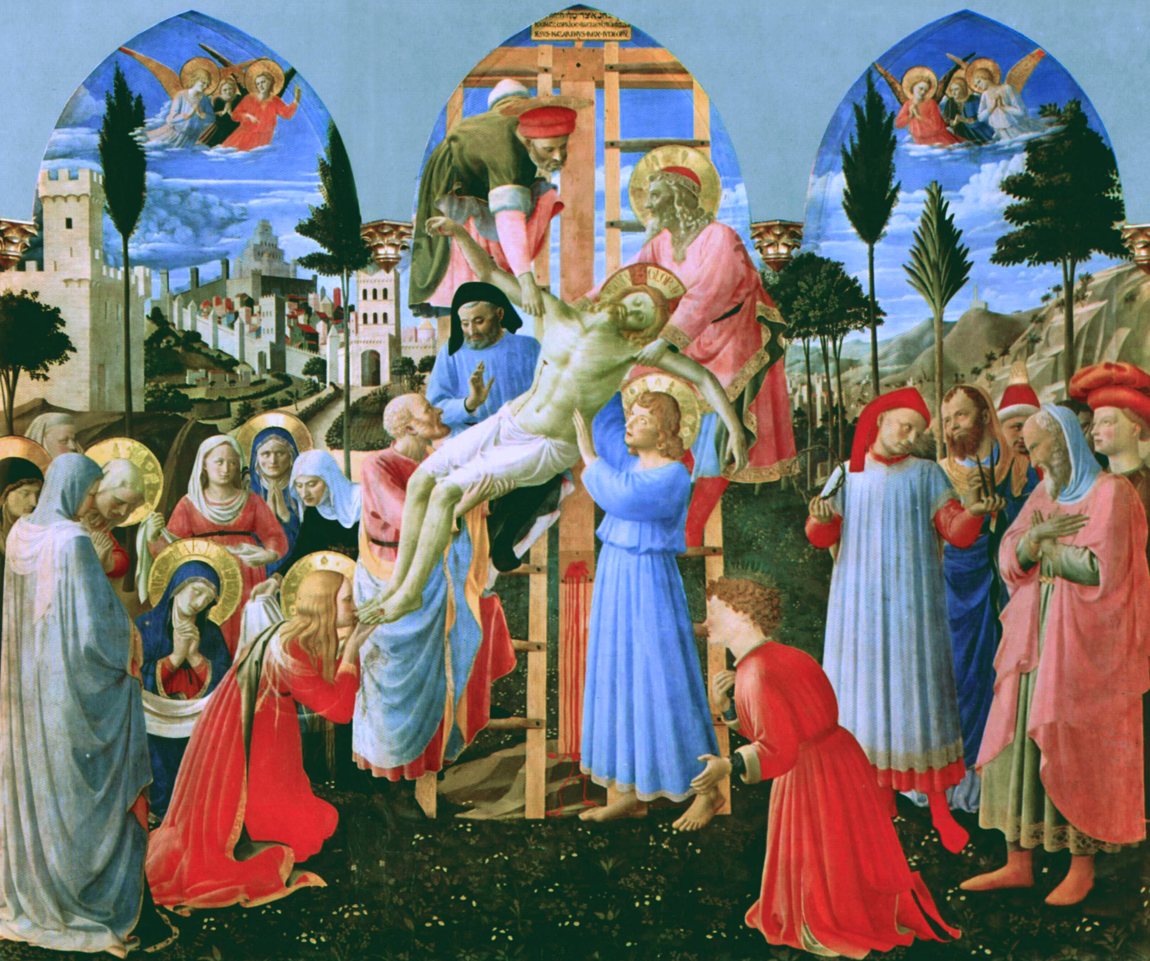
The body is lowered from the cross into a semicircle of saints and citizens, the holy women in front, the Florentine hills and a walled town behind. A man in red at the right edge holds the nails and the crown of thorns and looks out at us — traditionally a portrait of the donor, presenting the instruments of the Passion like evidence. Grief, here, is a ceremony performed in spring sunshine.
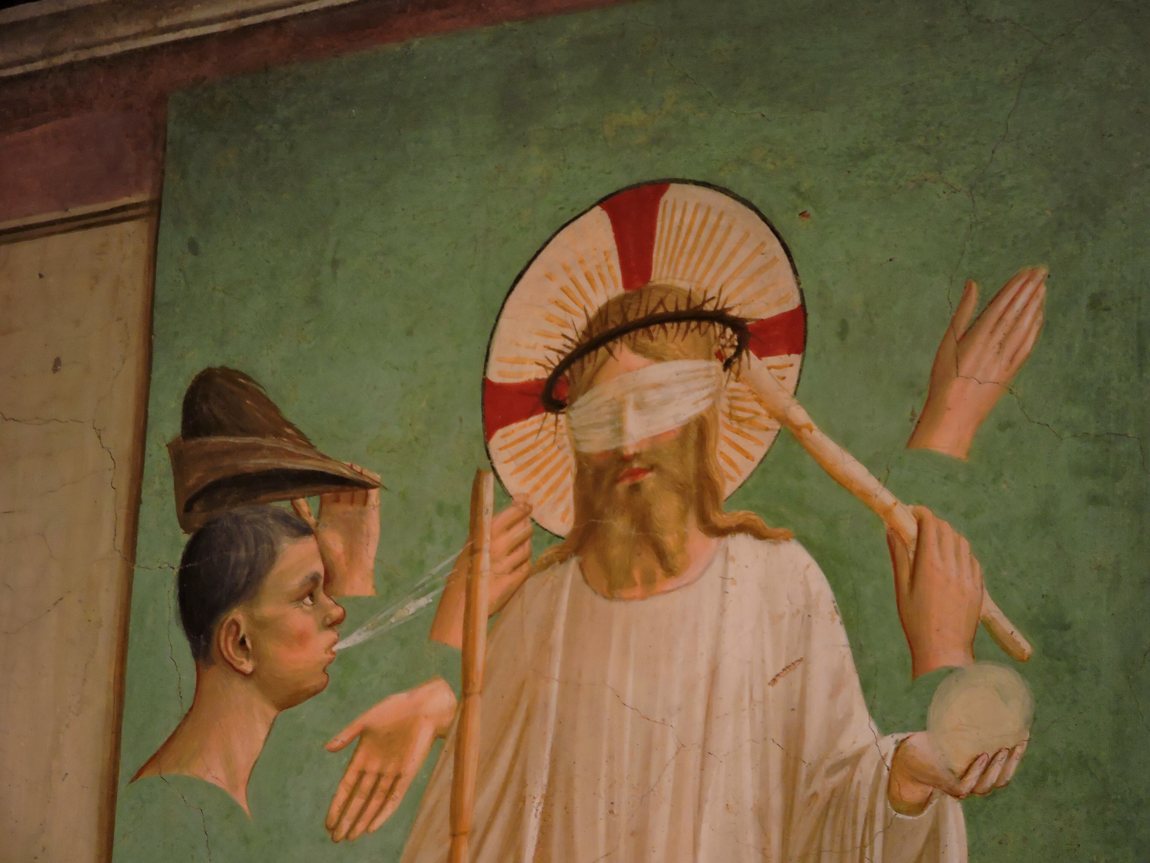
The strangest fresco in San Marco: Christ blindfolded and enthroned, struck by hands that float in the air without bodies, spat at by a head that floats likewise, while the Virgin and Saint Dominic sit below reading, undisturbed. It is not a scene but a meditation diagram — the insults abstracted into symbols so a friar could contemplate them one by one. Five centuries later it looks startlingly like surrealism.
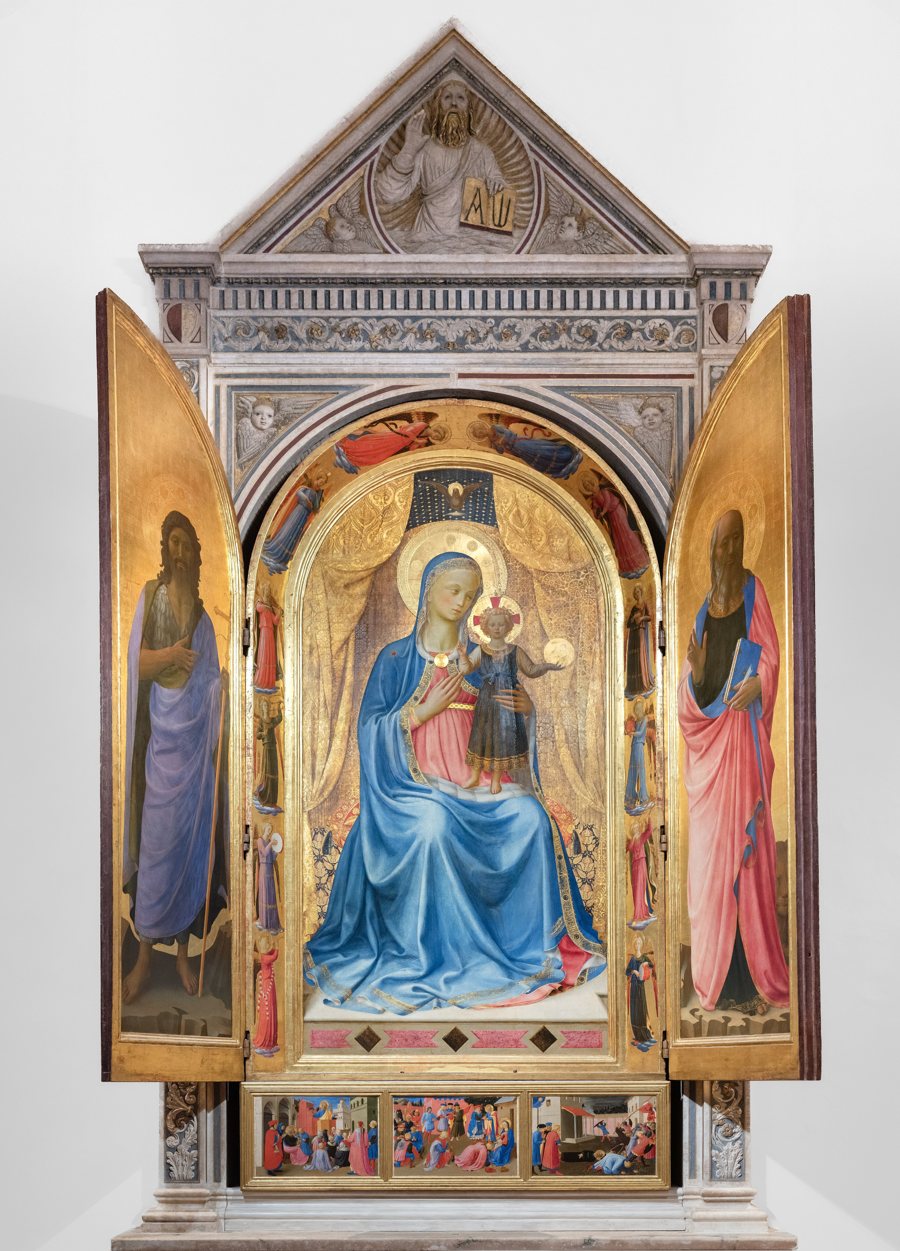
A folding tabernacle for the Florentine linen-weavers' guild: with its doors open, the Virgin sits in a glory of music-making angels, Saint John the Baptist and Saint Mark standing on the shutters as doorkeepers. Lorenzo Ghiberti designed the marble frame. Painted when Angelico was in his thirties, it is a guild's treasure and a young master's announcement that gold and grace could still fill a whole wall.
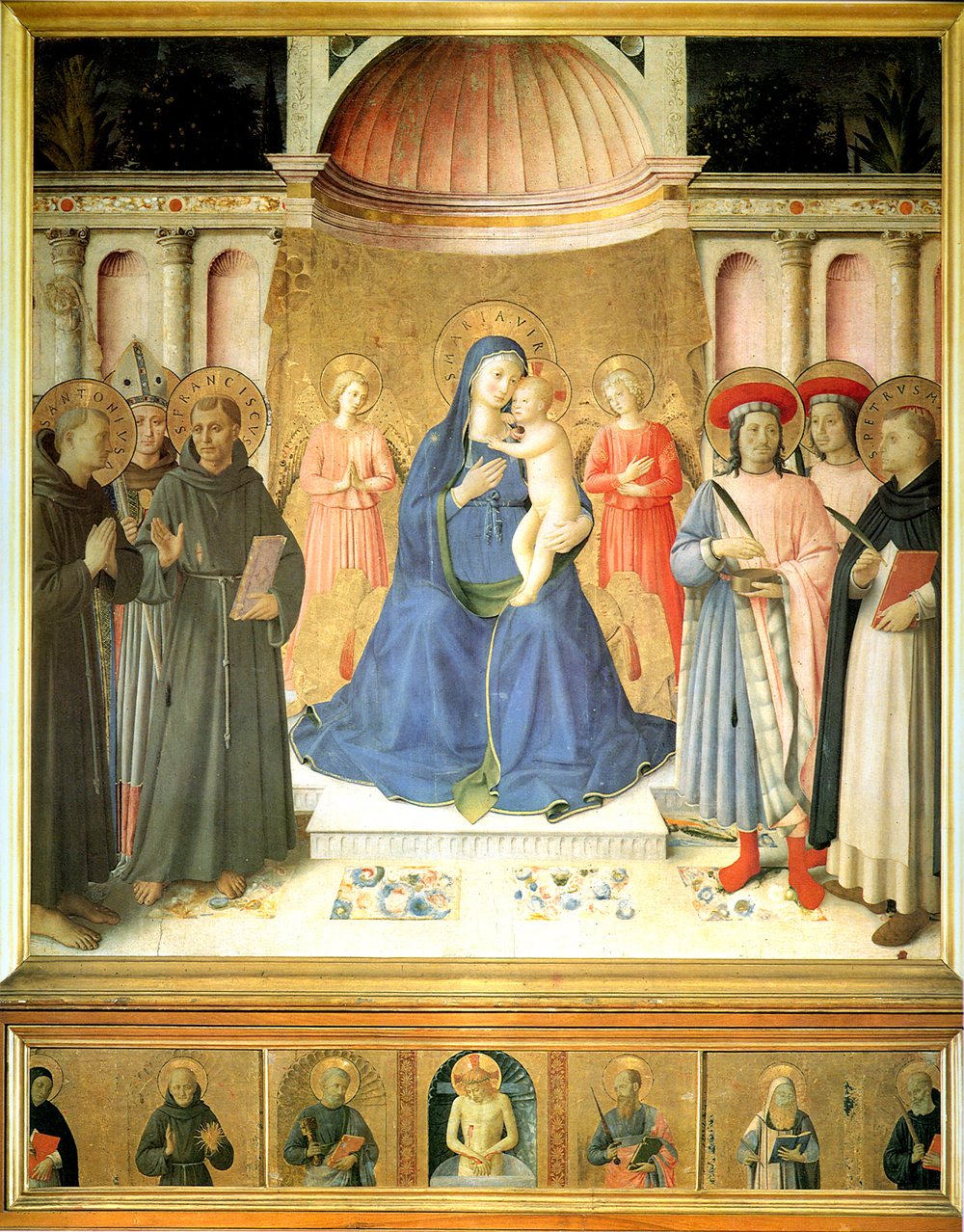
A late altarpiece for a Franciscan convent in the Mugello hills: the Virgin and Child between saints, Francis and Anthony of Padua among them, in the clear, pale light of his last manner. The gold is quieter now, the space deeper, the faces older and gentler. Below, the predella tells the saints' stories in small, bright scenes — a lifetime's craft, unhurried to the end.
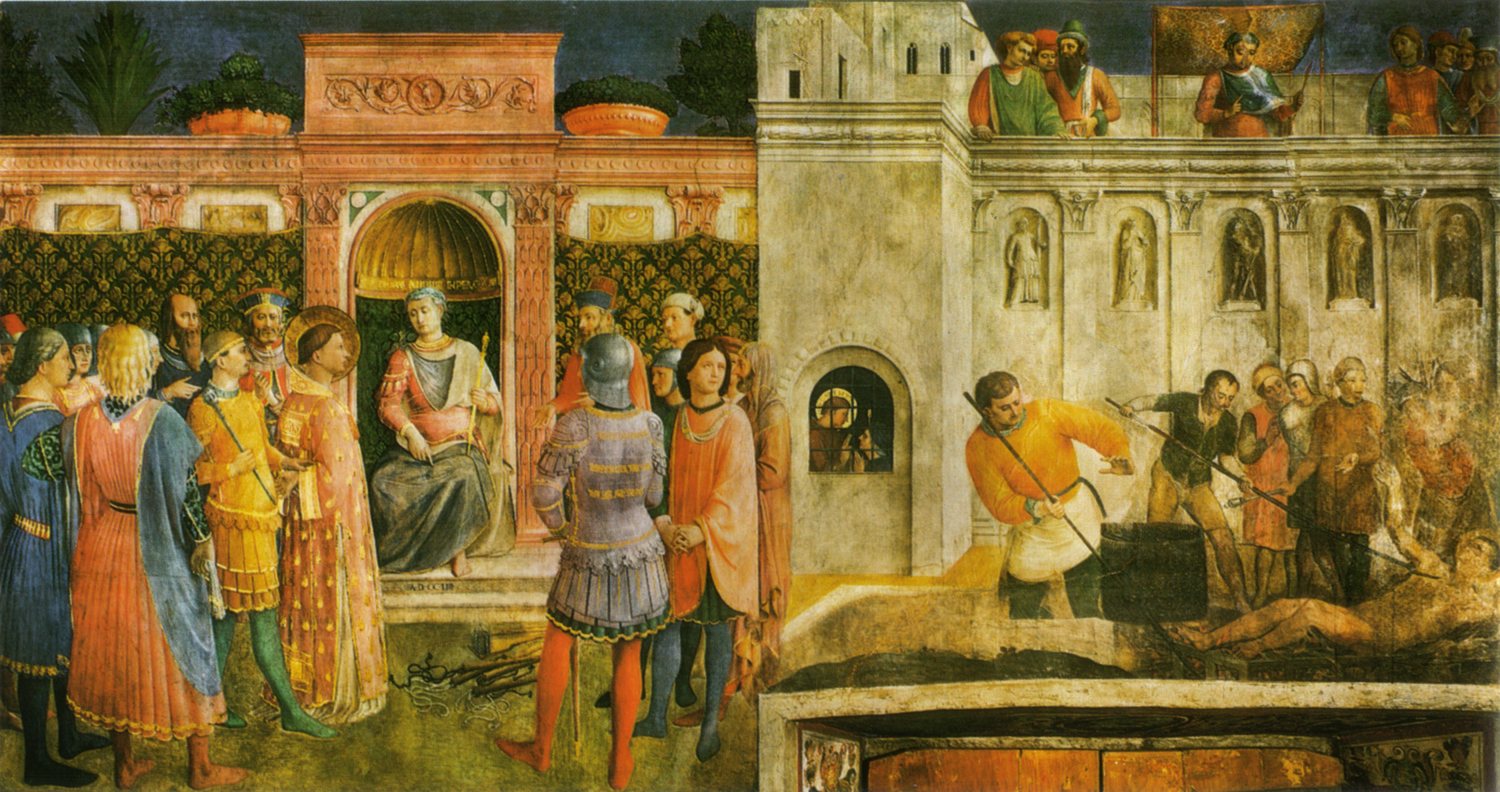
In the Pope's private chapel: on the left, the deacon Lawrence stands trial before the emperor Valerian, calm in a crowd of soldiers; on the right he dies on the gridiron, his executioners stoking the fire like workmen at a forge. Angelico paints martyrdom without a raised voice — the saint's composure is the argument, and Rome, in the architecture around him, is already becoming the city of the Renaissance.