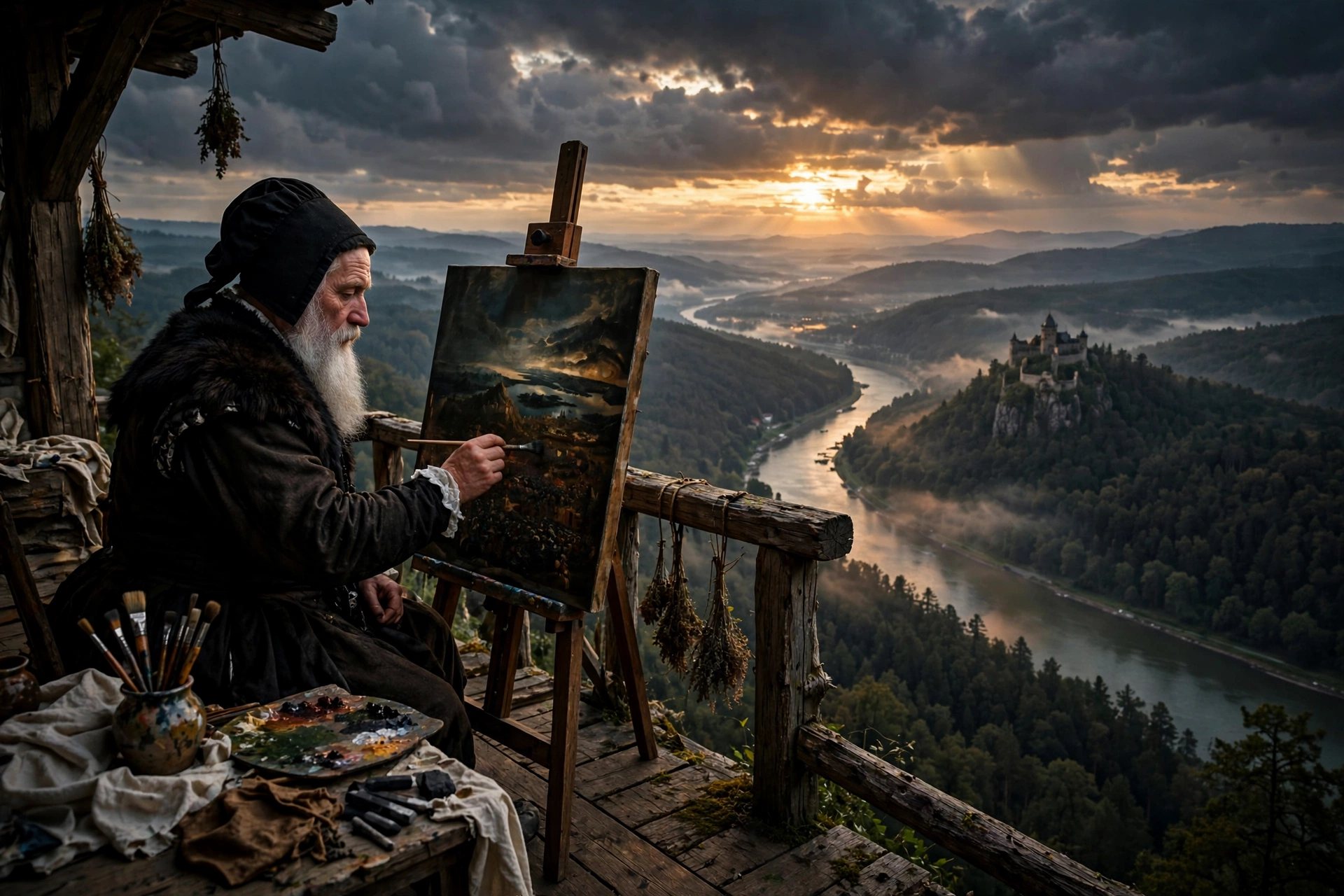
The city painter of Regensburg who invented landscape itself: Altdorfer was the first European to paint pictures in which nature is the subject and men are only guests in it. His forests close over saints like green cathedrals, his skies carry whole battles, and his Danube winds away into a blue infinity that painting had never attempted before.
Around 1522 Altdorfer painted a Danube valley with no saint, no story and no patron's arms — just river, forest, a castle and weather. It is among the first pure landscapes in European painting: nature promoted from backdrop to subject. The little parchment panel was not a study for something bigger; it was the finished thing, made to be looked at the way one looks out of a window.
His mature pictures take the viewpoint of a bird or a god: the eye starts at a foreground ledge and falls away over forests, rivers and towns to a horizon that curves with the sky. Scholars call it the Weltlandschaft, the world-landscape — a whole cosmos in one panel, with the human story, however sacred or bloody, kept small inside it.
In the Saint George of 1510 the trees are the building: trunks like columns, foliage like vaulting, and the saint and his dragon reduced to a small incident in the green nave. Altdorfer drew leaves and needles in tight, calligraphic clusters — a handwriting of vegetation that his whole Danube circle learned from him.
Altdorfer was also the first to etch landscapes: a handful of small iron plates from around 1518–1522, bitten with acid through a ground he scratched with a needle, all trees, water and sky. Printmaking had served figures and ornament; he pointed it at the weather. The etchings are as free as drawings — the line of a man sketching outdoors.
No painter of his generation loved artificial light more: the Resurrection explodes out of a night sky, Lot's daughters flee a burning city that lights the whole panel from behind, and the Battle of Alexander is fought under a sky split between sun and moon. His colour is thin, jewel-like and deliberately unearthly — landscape as the stage of wonders.
Altdorfer was no wandering courtier: he bought citizenship in Regensburg, sat on its council, served as the city's architect and grew prosperous and fat, as his one self-image in a woodcut suggests. The cosmic visions came out of a burgher's workshop on the Danube — painted between council meetings, for abbots, dukes and the Emperor's own family.
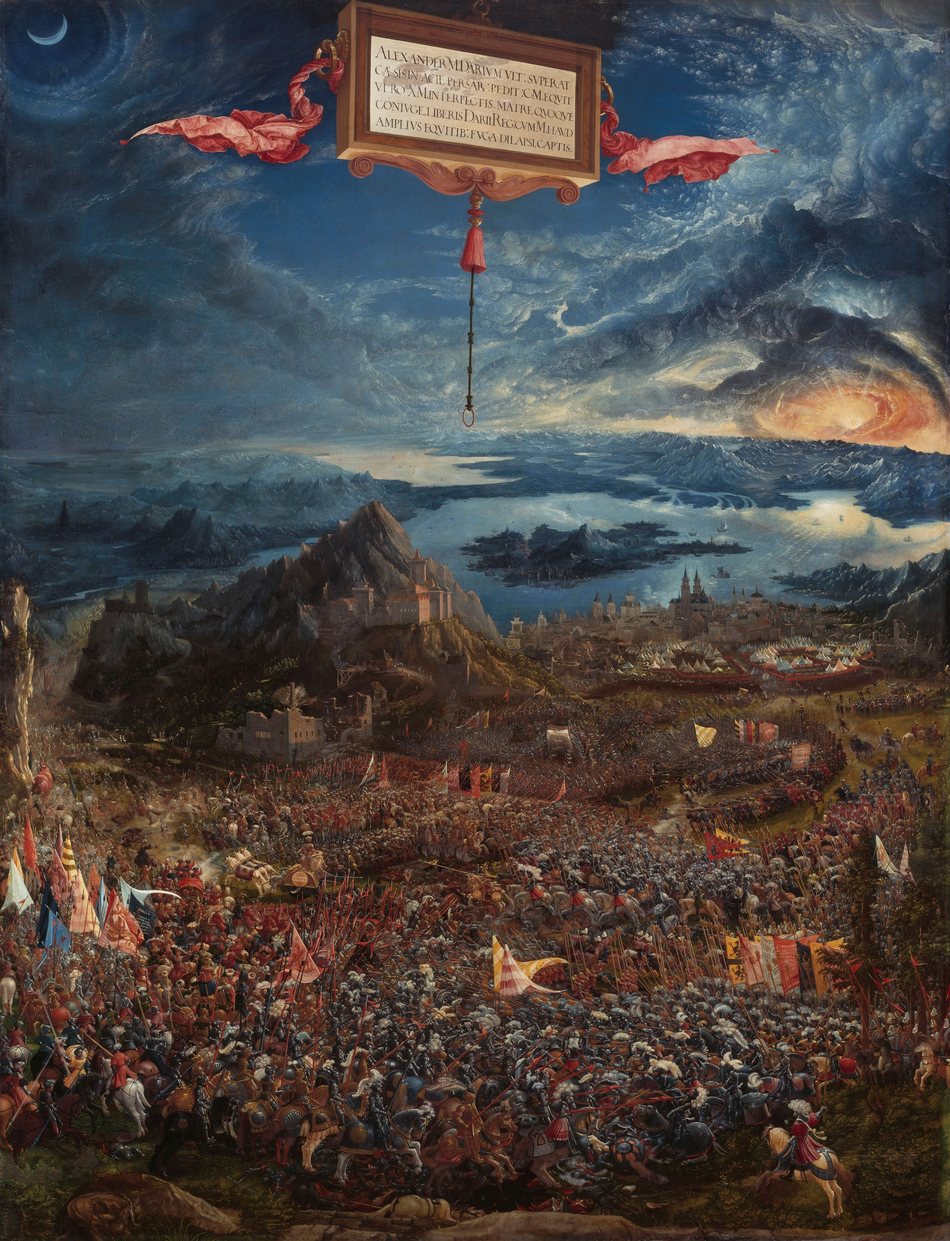
The most cosmic battle picture ever painted: thousands of tiny soldiers swirl in a valley while the sky above them — sun setting on one side, moon rising on the other, clouds like a torn curtain — dwarfs the whole event. A tablet hangs from heaven itself, naming the victory of Alexander over Darius, as if history needed a label hung on the cosmos.
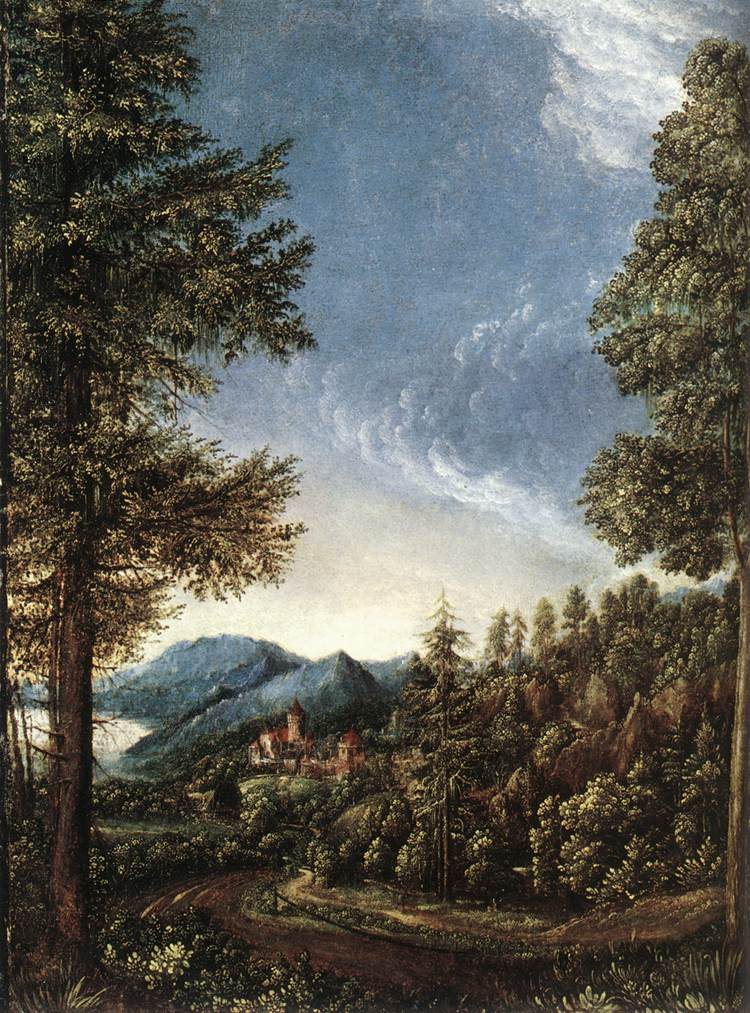
Two great trees frame a view down the Danube to Wörth Castle, and nothing else happens at all. Painted on parchment no bigger than a sheet of writing paper, it is one of the founding pictures of landscape art — the world offered simply as something worth looking at, with the painter's monogram carved, in the fiction of the picture, into a tree.
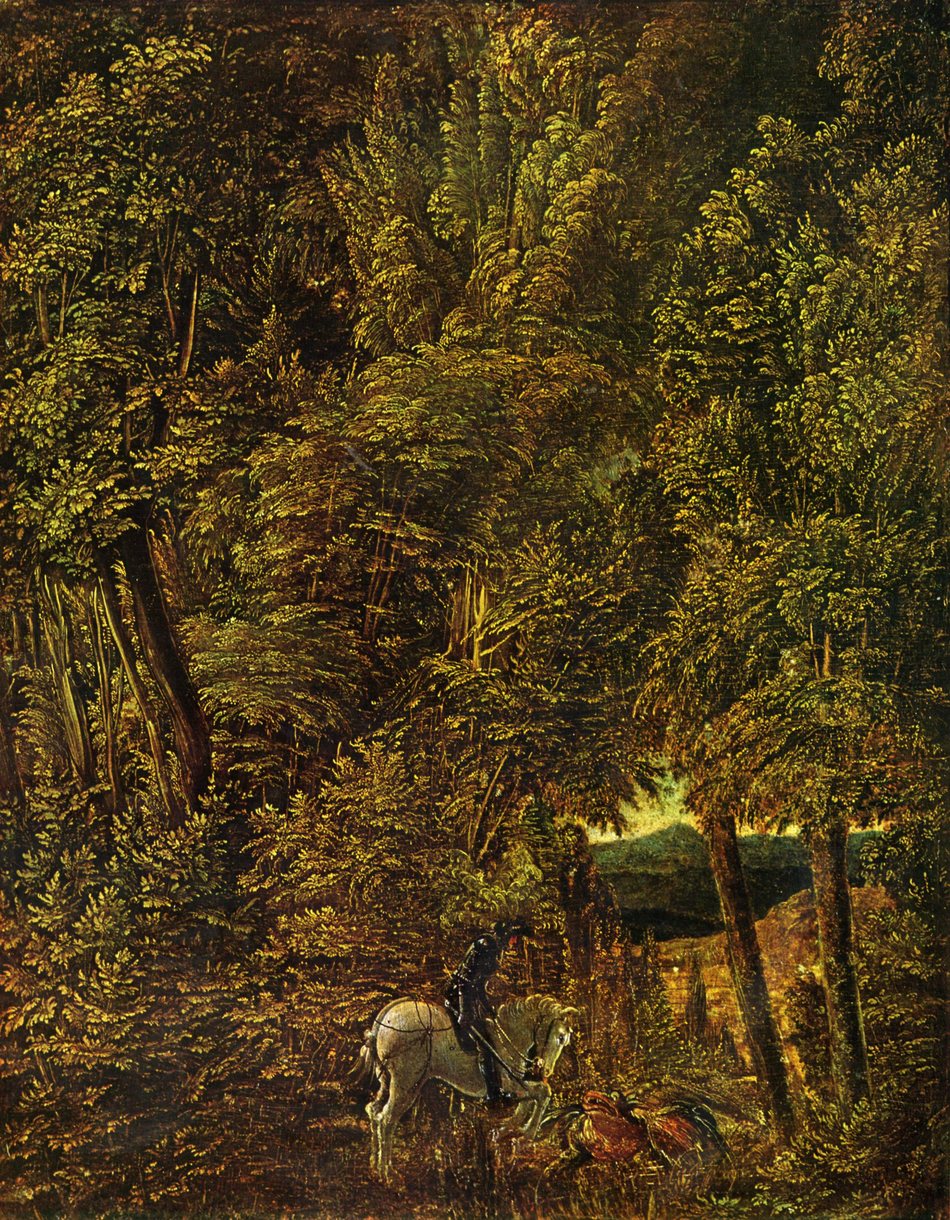
The dragon-slayer is almost lost in his own picture: a small armoured figure on a rearing horse, deep inside a forest painted leaf by leaf until the trees become a green cathedral around him. It is the manifesto of the Danube style — the saint as a guest in nature's house, not its master.
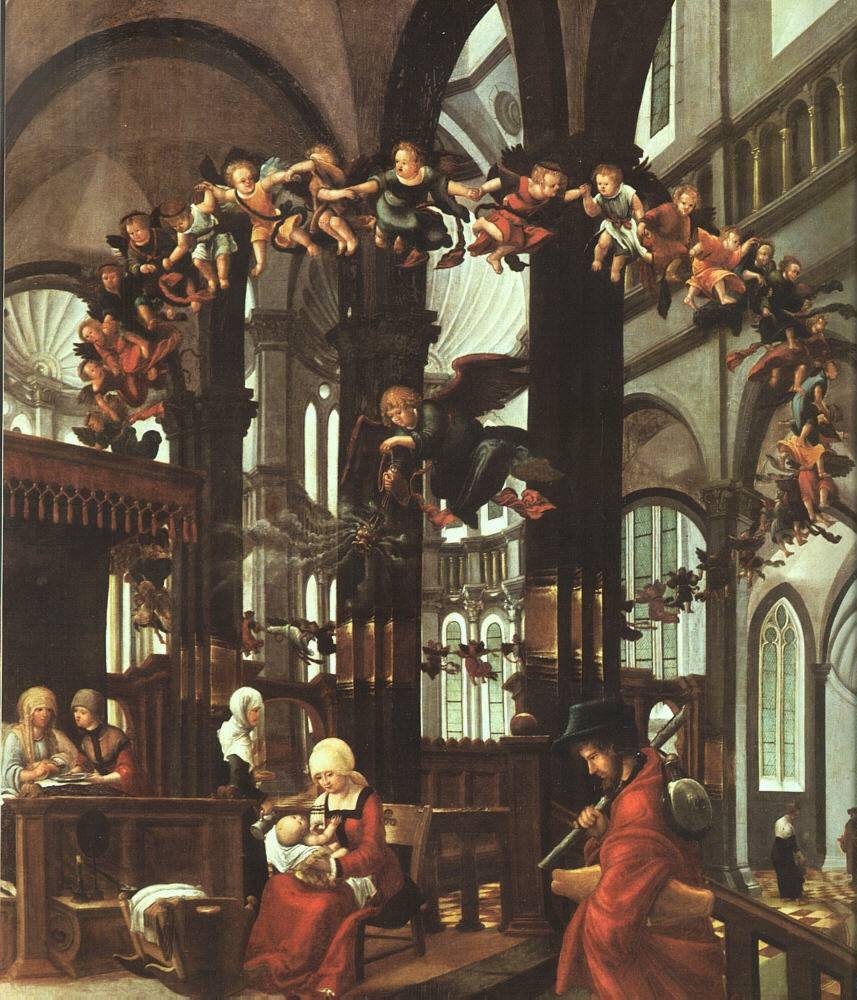
The sacred event is pushed to the edges: Saint Anne in bed at the lower left, Joachim arriving below, while the middle of the picture belongs to a soaring church interior and a ring of angels dancing in the air like a garland. Architecture and atmosphere take the leading roles; the holy family makes a quiet entrance at the side.
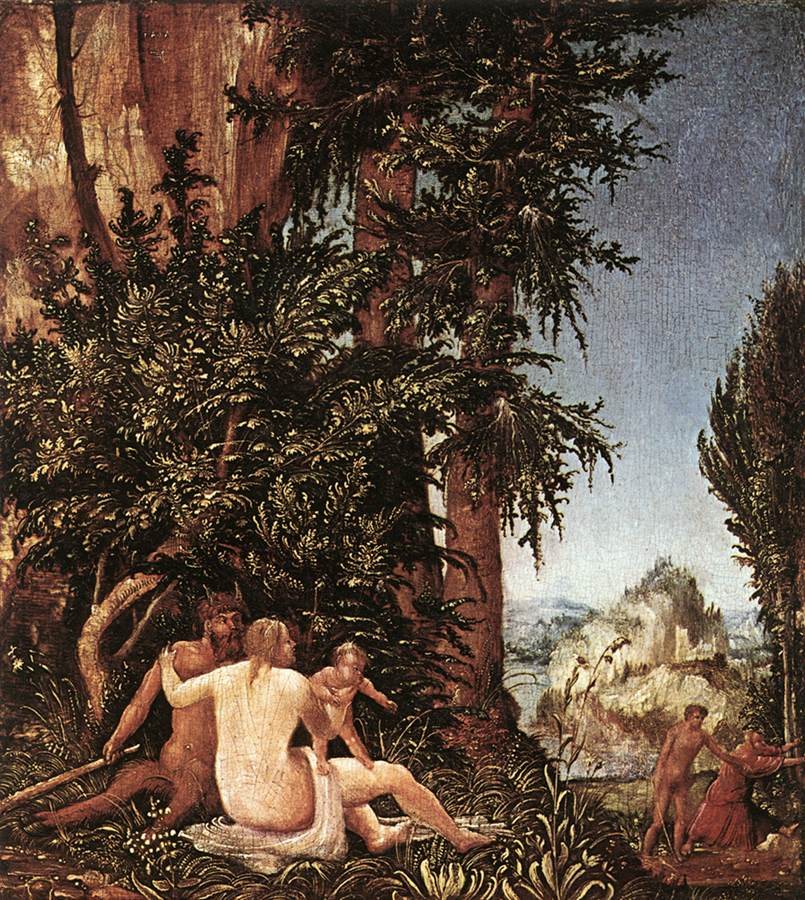
One of his earliest panels, and already the whole programme: a wild family resting at the edge of a dense forest, a lake and pale crags opening behind them, two more figures wrestling at the water's edge. Mythology is the excuse; the forest, painted with a miniaturist's patience, is the subject.
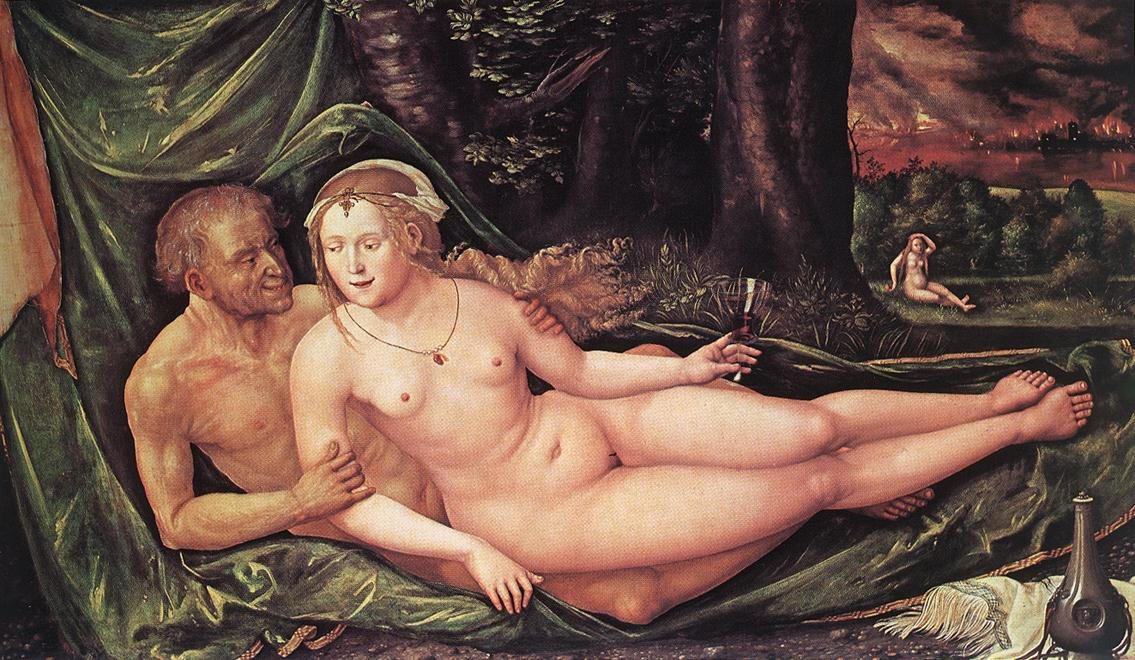
In the foreground, an intimate, unsettling idyll on a green drape; far behind, small as a thumbnail, Sodom burns and lights the edge of the world. Altdorfer paints the Bible's most uncomfortable story as a landscape with a secret in it — the catastrophe kept at the distance of a memory.
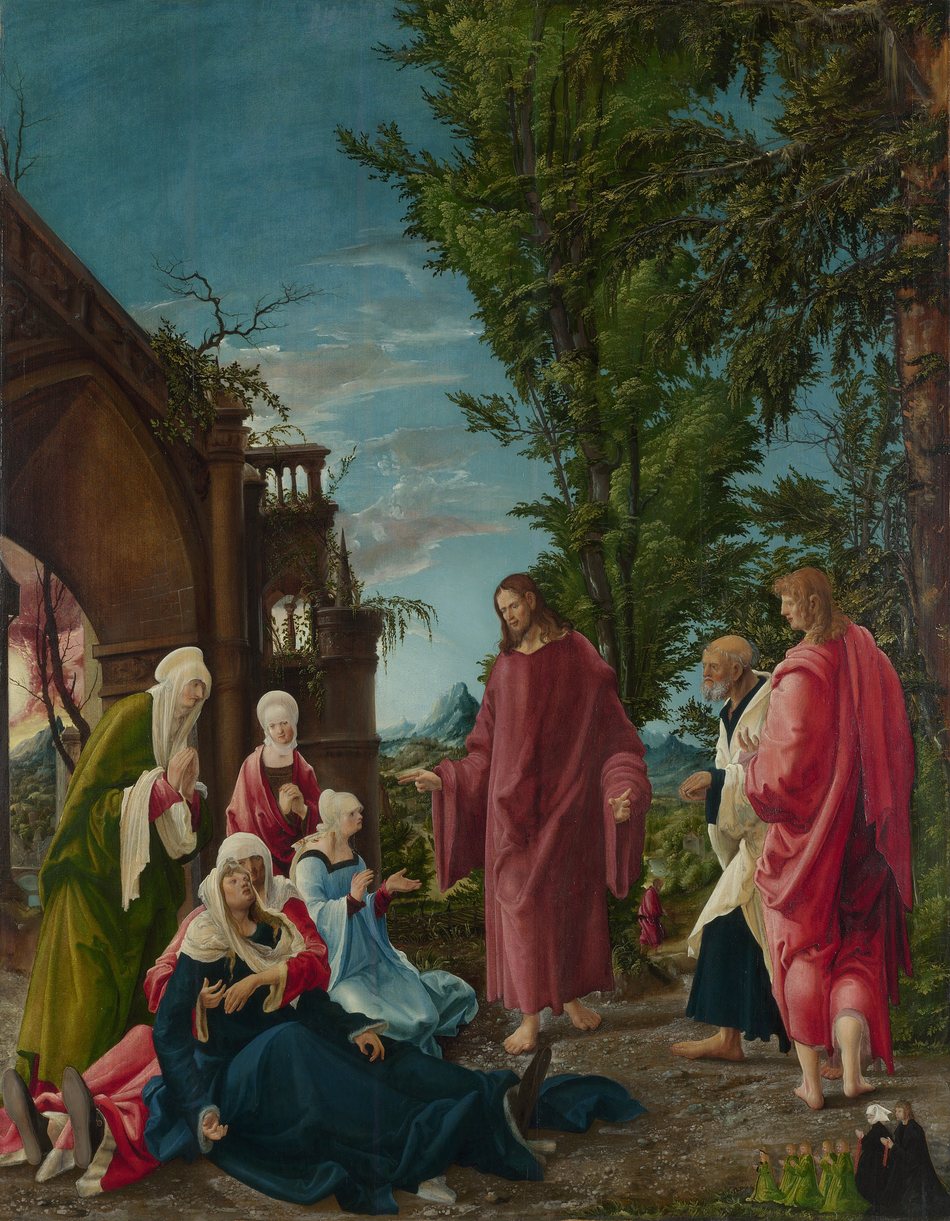
A farewell staged in a ruined Gothic hall open to a vast evening landscape: Christ raises his hand in blessing, the Virgin sinks with folded hands, and the donors kneel small at the bottom edge with their coats of arms. Grief, in Altdorfer, is always measured against the size of the world.
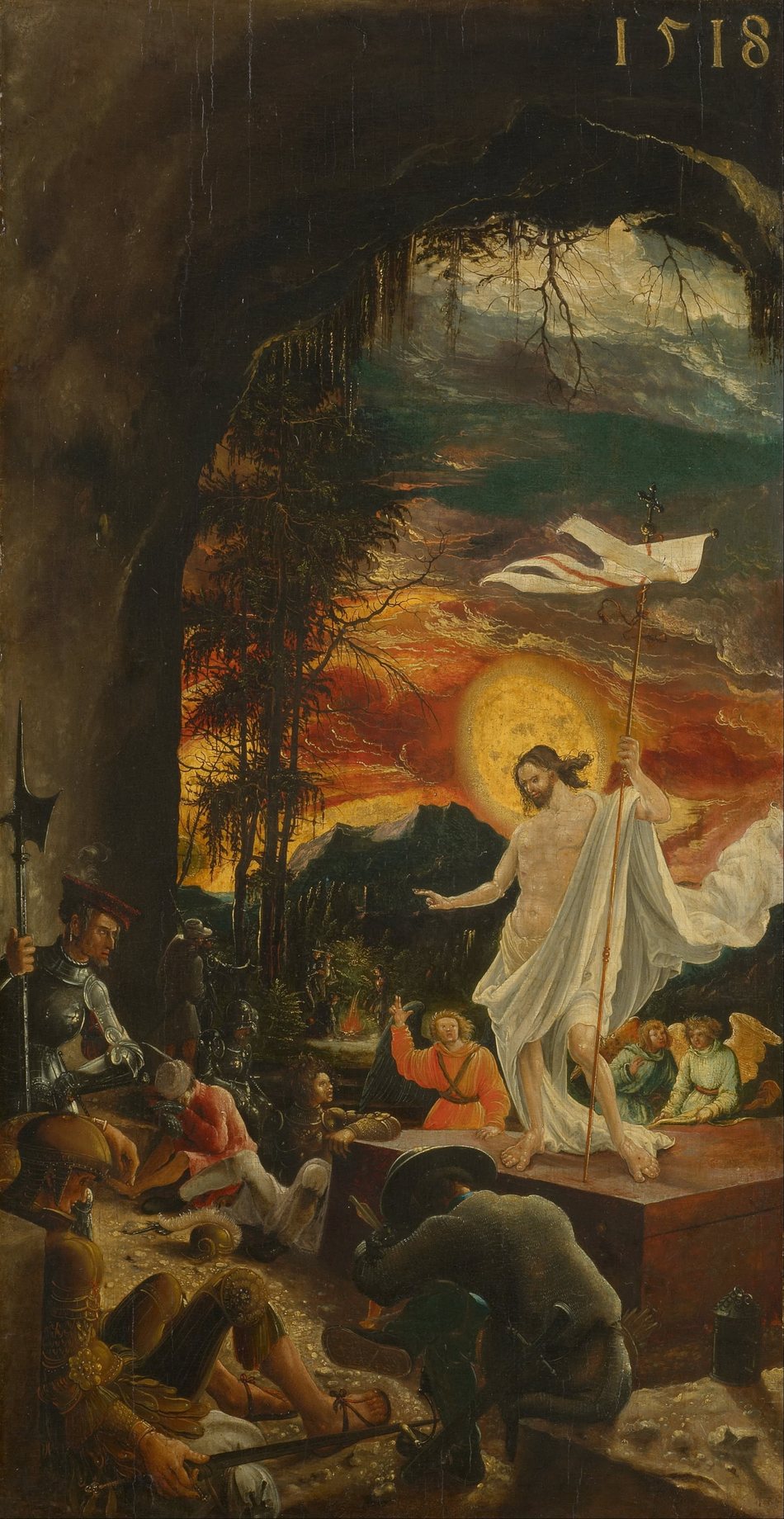
Christ bursts upward out of the tomb in a blaze of orange light, trailing clouds, while the soldiers tumble in the dark below and the whole night sky wheels around him. It is less an illustration than an explosion — the panel is tall and narrow, and the energy of the rising figure fills every inch of it.
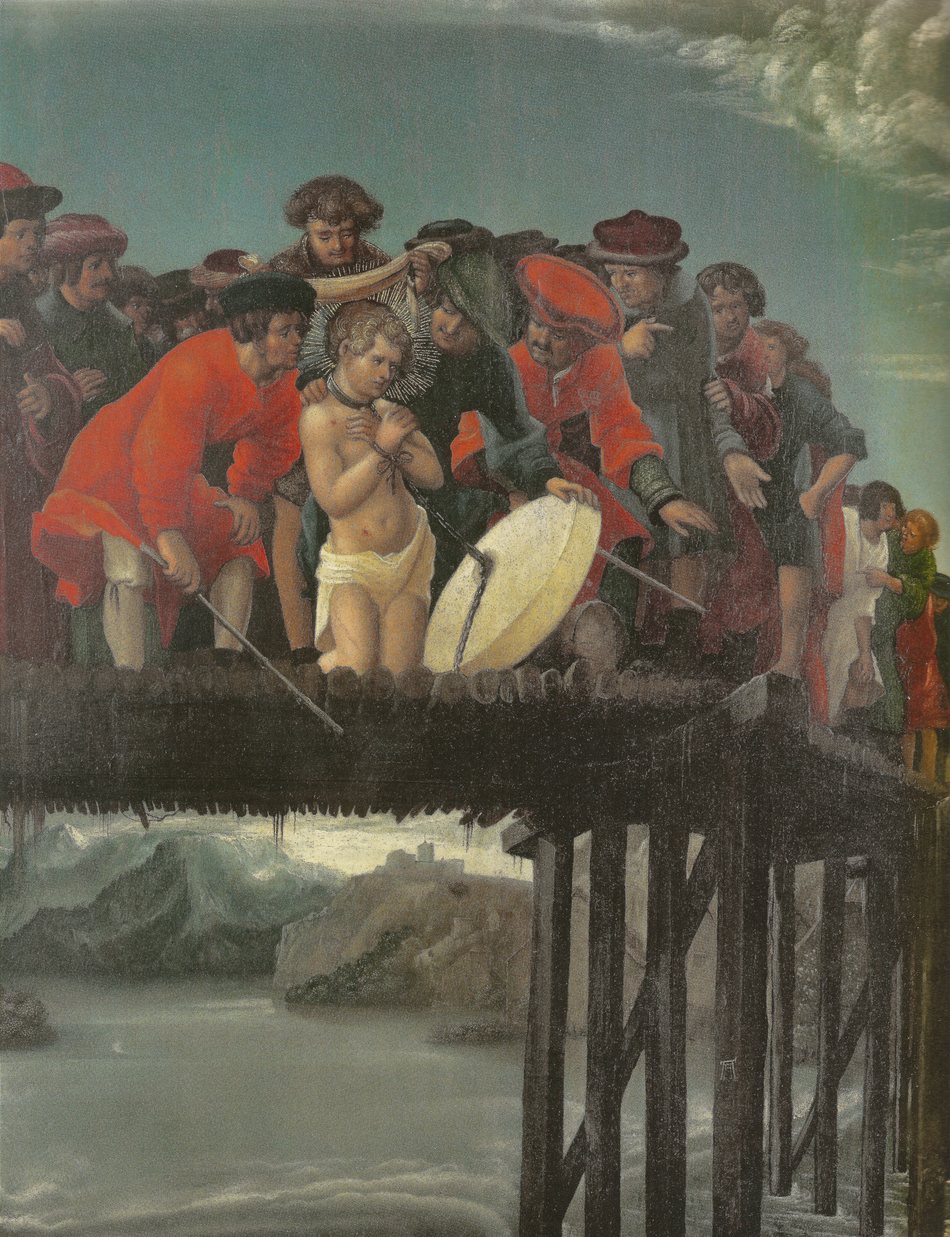
The saint, stripped and bound on the bridge, is surrounded by a crowd of tormentors in bright contemporary dress, while below the parapet the river and a calm, indifferent landscape wait to receive him. The panel belonged to a cycle of Florian's passion painted for the abbey that bore his name.
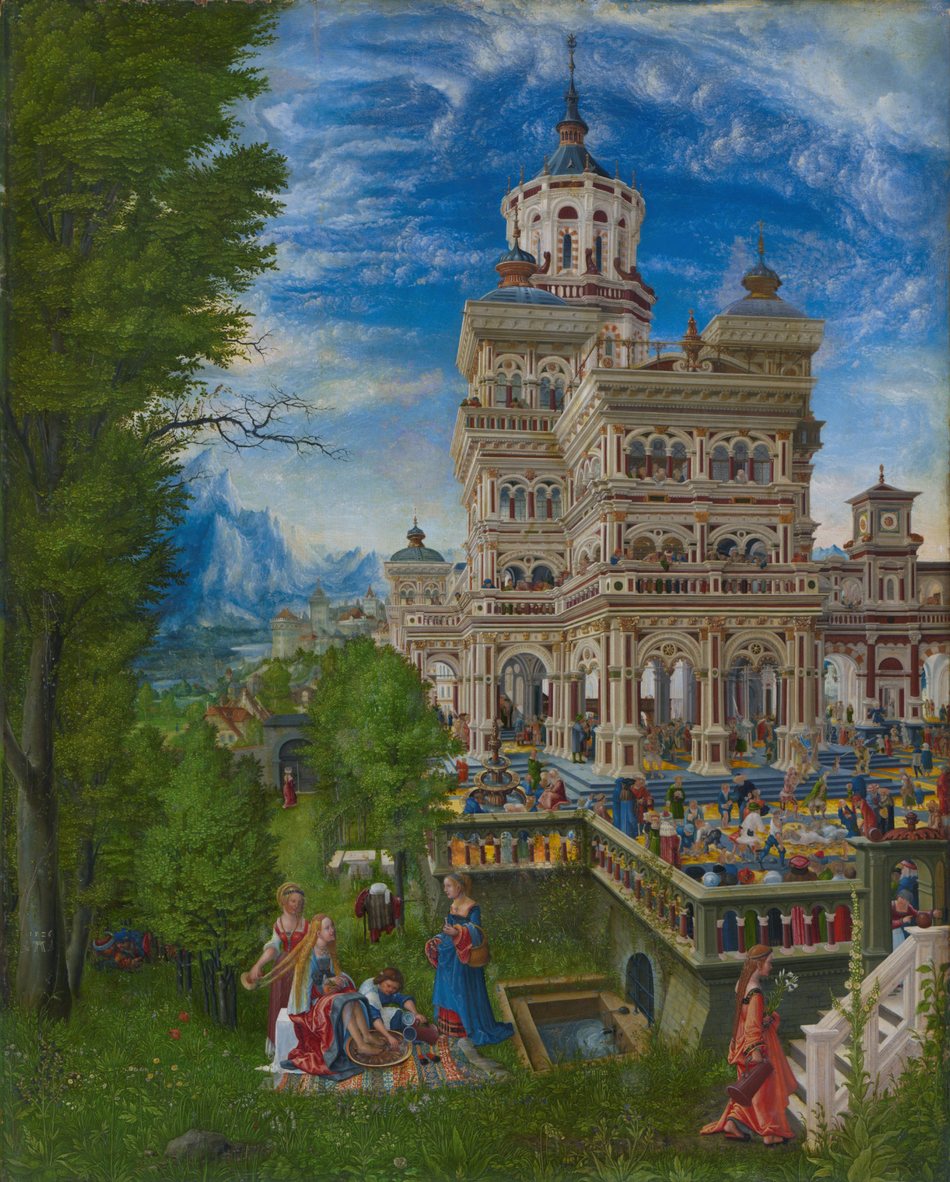
Susanna at her bath is a small episode in the lower left; the picture belongs to the fabulous palace behind her — tier upon tier of Renaissance loggias, bridges and gardens, crowded with hundreds of tiny courtiers. Altdorfer the city architect signs his real profession here: the building is the protagonist, and the Bible story is its housewarming.