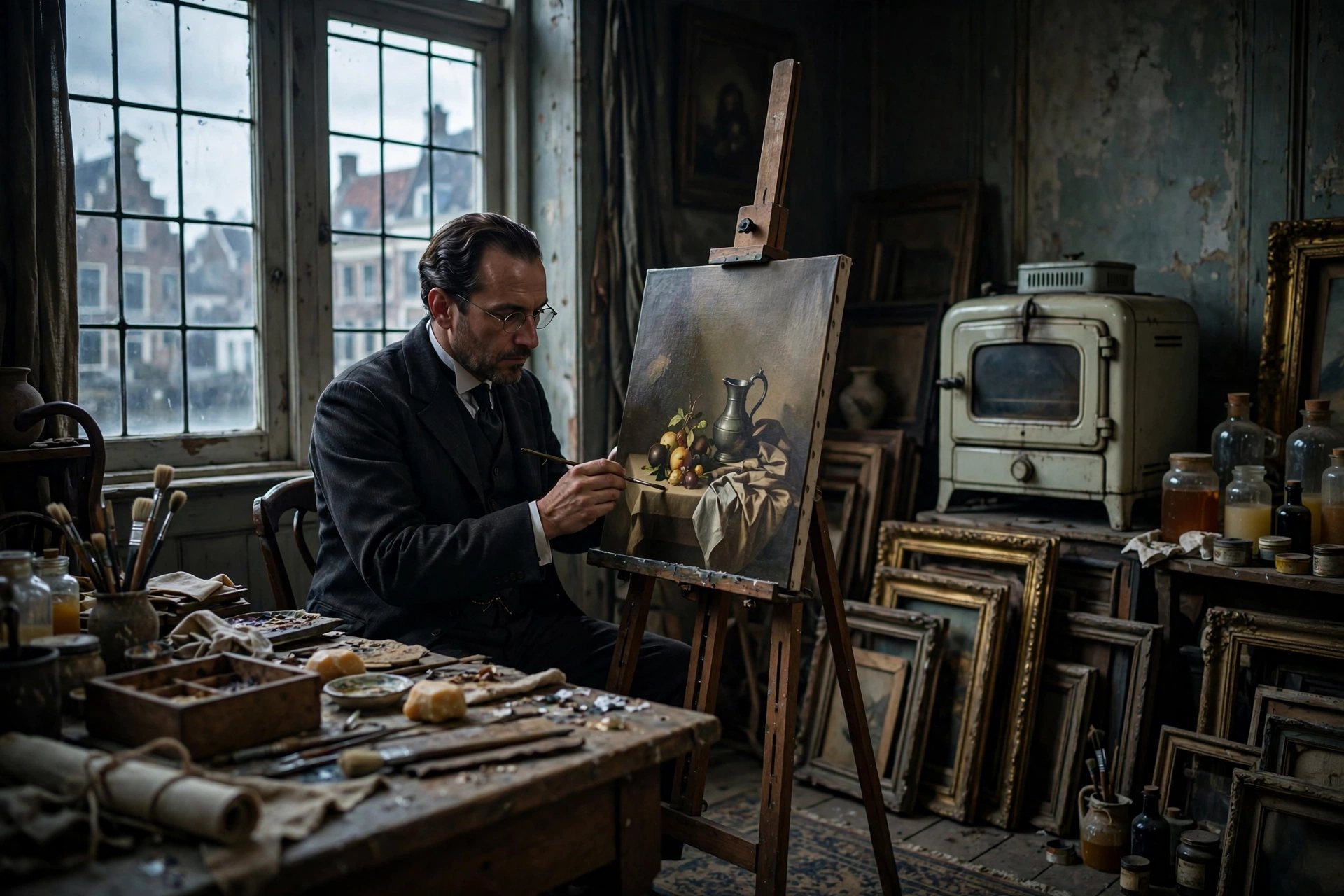
He did not copy Vermeer. He did something far more dangerous: he painted the Vermeers that scholarship had predicted — the early, religious, Caravaggesque works the real Vermeer never left behind — and the greatest expert of the age embraced them as the master's finest paintings. This is the room of Han van Meegeren, the most successful forger who ever lived: his revenge on the critics who had dismissed his own work, executed in period pigments, baked in an oven, and sold, at the climax, to Hermann Göring.
Vermeer's known work begins, fully formed, in the mid-1650s. Scholars reasoned that a young Vermeer must first have painted large religious scenes in the Italian manner — and none existed. Van Meegeren, a trained painter whose own modern work the critics had savaged, saw the vacancy precisely: the market and the academy were not waiting for a painting, they were waiting for a chapter. He spent years learning to supply it.
His masterstroke, Christ at Emmaus, surfaced in 1937 with a discreet story and no documents. Abraham Bredius, the eighty-two-year-old dean of Vermeer studies, examined it and wrote in The Burlington Magazine that it was 'the masterpiece of Johannes Vermeer' — every inch a Vermeer. The Boymans Museum in Rotterdam bought it for a fortune and hung it as the jewel of the collection. The forger had not fooled a fool; he had fooled the best eye alive, by giving it exactly what it had prophesied.
The craft was serious. He scraped down genuine seventeenth-century canvases and painted on them; ground period pigments, avoiding anything Vermeer could not have used; and solved the forger's hardest problem — old paint is hard and insoluble, new paint dissolves in alcohol — by mixing his oils with phenol-formaldehyde resin, a bakelite cousin, then baking the finished canvas until the surface hardened like two-hundred-year-old paint. Craquelure he induced and rubbed with ink, so the cracks held convincing dirt.
During the occupation he sold a 'Vermeer', Christ with the Adulteress, through intermediaries to Hermann Göring, for the modern equivalent of millions. After the liberation, Allied investigators traced the painting from Göring's collection back to Van Meegeren — and arrested him not for fraud but for treason: selling the nation's patrimony to the enemy. The charge carried the death penalty. The forger faced a surreal choice: confess to the lesser crime that would destroy his name, or hang as a patriot's thief.
He confessed — and was not believed. The experts who had certified his Vermeers could not accept that this mediocre painter had made them. So in 1947, under guard, in a room provided by the court, Van Meegeren painted one more 'Vermeer', Jesus Among the Doctors, while officials watched. It was the strangest demonstration in art history: a man proving his guilt of forgery to escape a charge of treason. He was convicted of fraud, sentenced to one year, and died of a heart attack weeks later, a folk hero to a public that enjoyed the experts' humiliation.
The commission that finally dismantled the fakes found the chemistry wanting — the resin medium, traces of cobalt in the ultramarine — but the deeper failure was not chemical. It was desire: scholars wanted the missing chapter, museums wanted the masterpiece, and a nation wanted a hero-painter's relics. Van Meegeren's pictures are now exhibited under his own name and fetch real prices. The uncomfortable question his room asks every other room in this gallery is simple: how much of what we call an eye is knowledge — and how much is wanting?
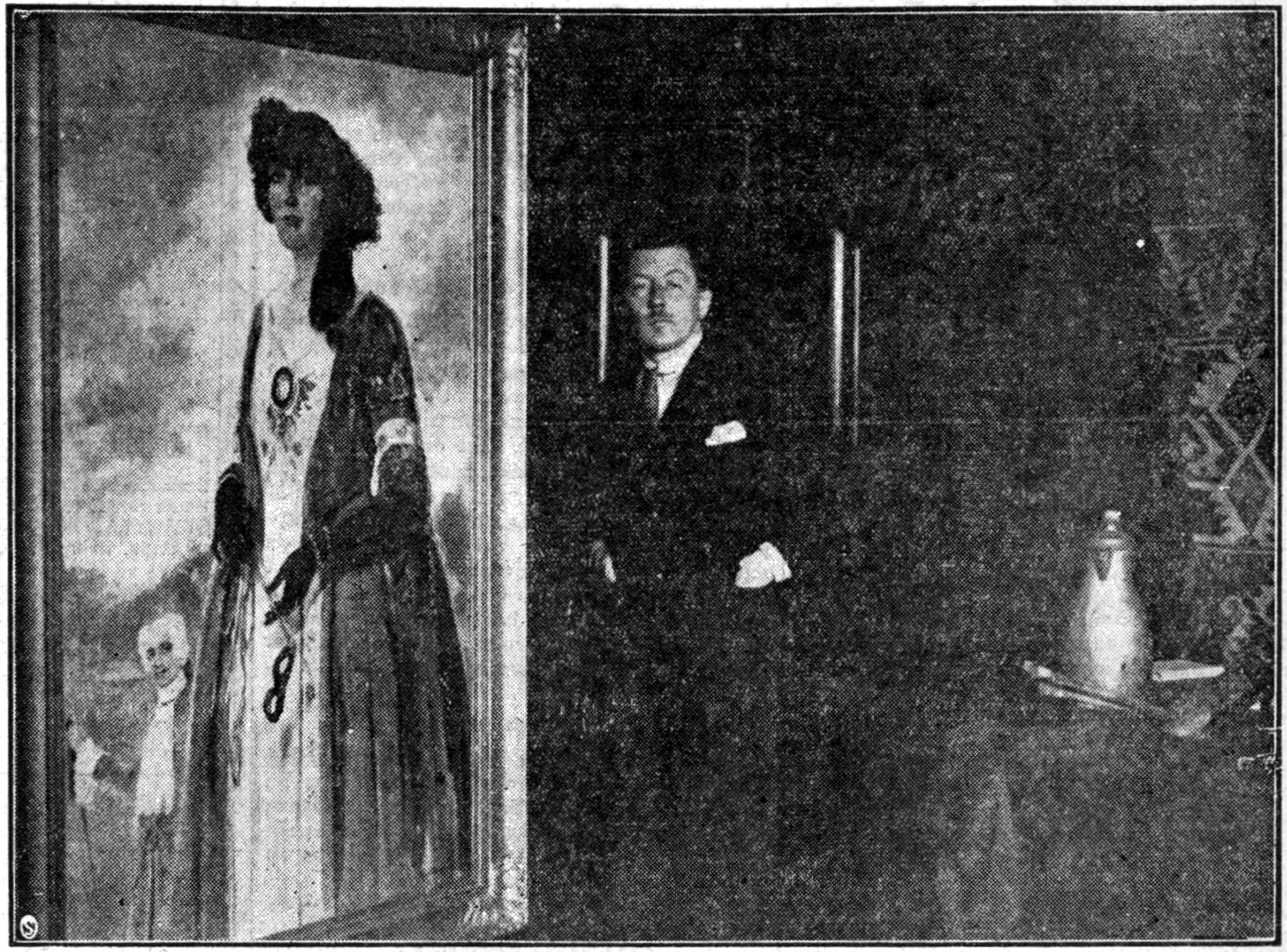
Nine years before the Emmaus, he is a respectable Hague painter in a good suit, sitting for a photograph among his own unremarkable pictures. Nothing in the portrait predicts the crime of the century — except, perhaps, the patience. The technique that would fool Bredius was assembled in rooms like this one, out of genuine skill, genuine learning, and a grievance he nursed for decades.
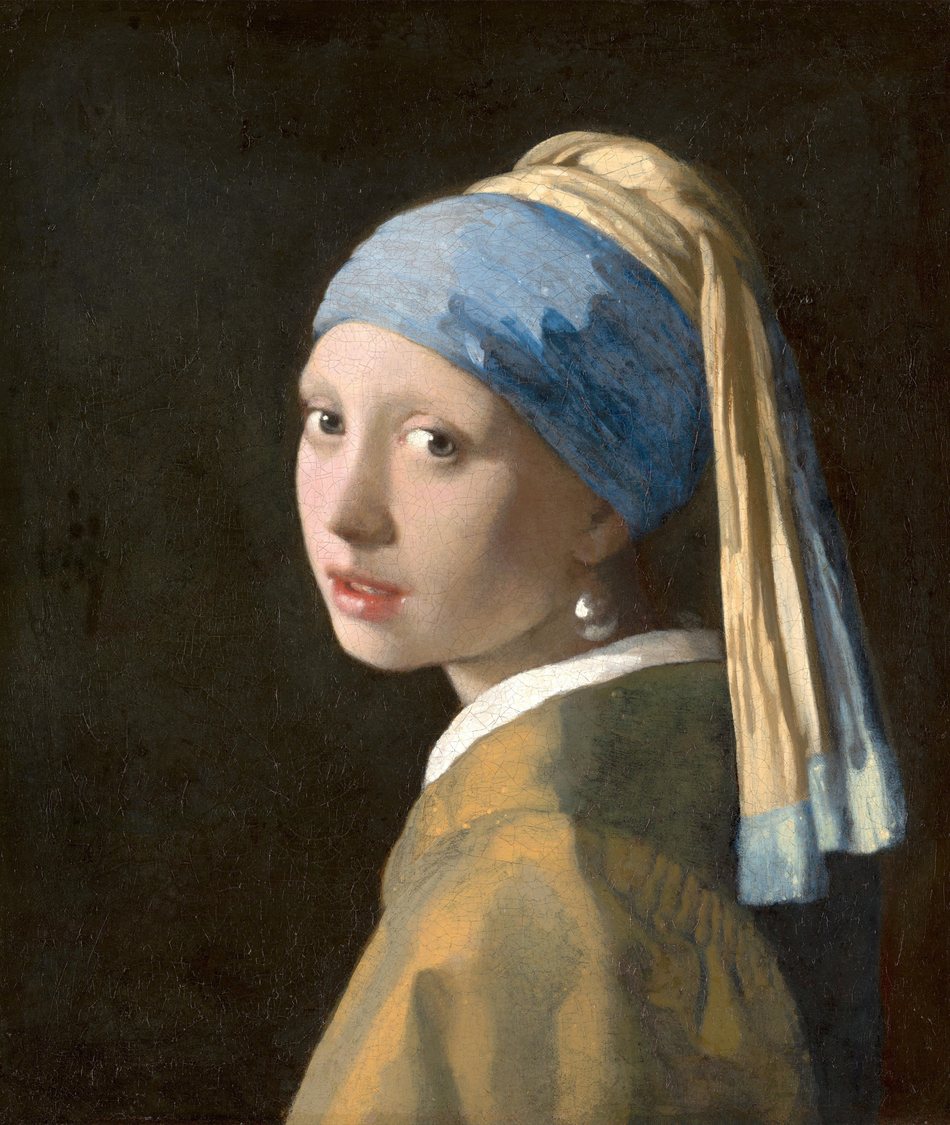
This is the standard the forgeries had to meet — and the reason they aimed lower and earlier. Van Meegeren never attempted a mature Vermeer interior like the ones in this room; their light was inimitable and their provenance documented. He painted the Vermeers that did not exist, where no comparison could convict him, and let the experts' own theories do the authenticating.
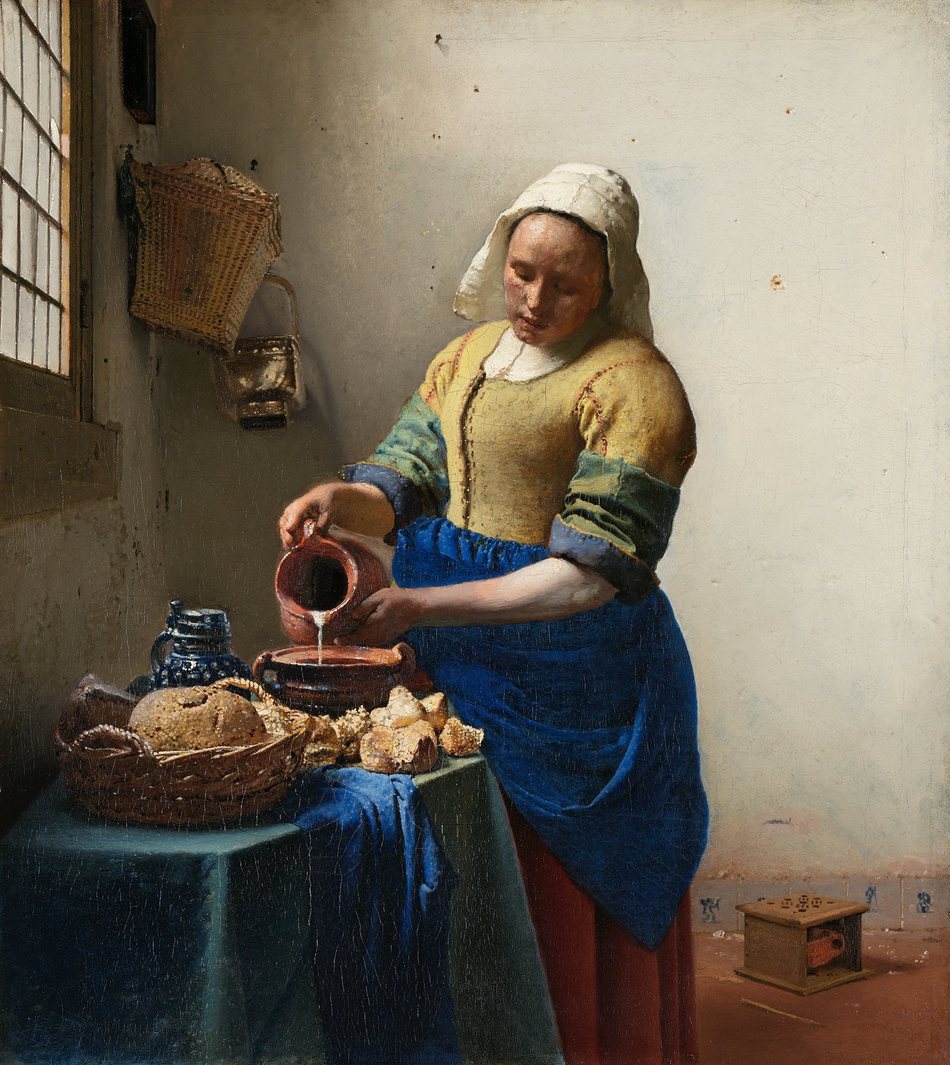
The Milkmaid's blue is the real ultramarine, ground from Afghan lapis at ruinous expense — the Painter's Table room in this gallery tells its story. Van Meegeren had to match that blue with period materials and mostly did; what finally betrayed his chemistry was subtler: twentieth-century traces in the medium itself, the bakelite resin that no seventeenth-century painter could have baked into his paint.
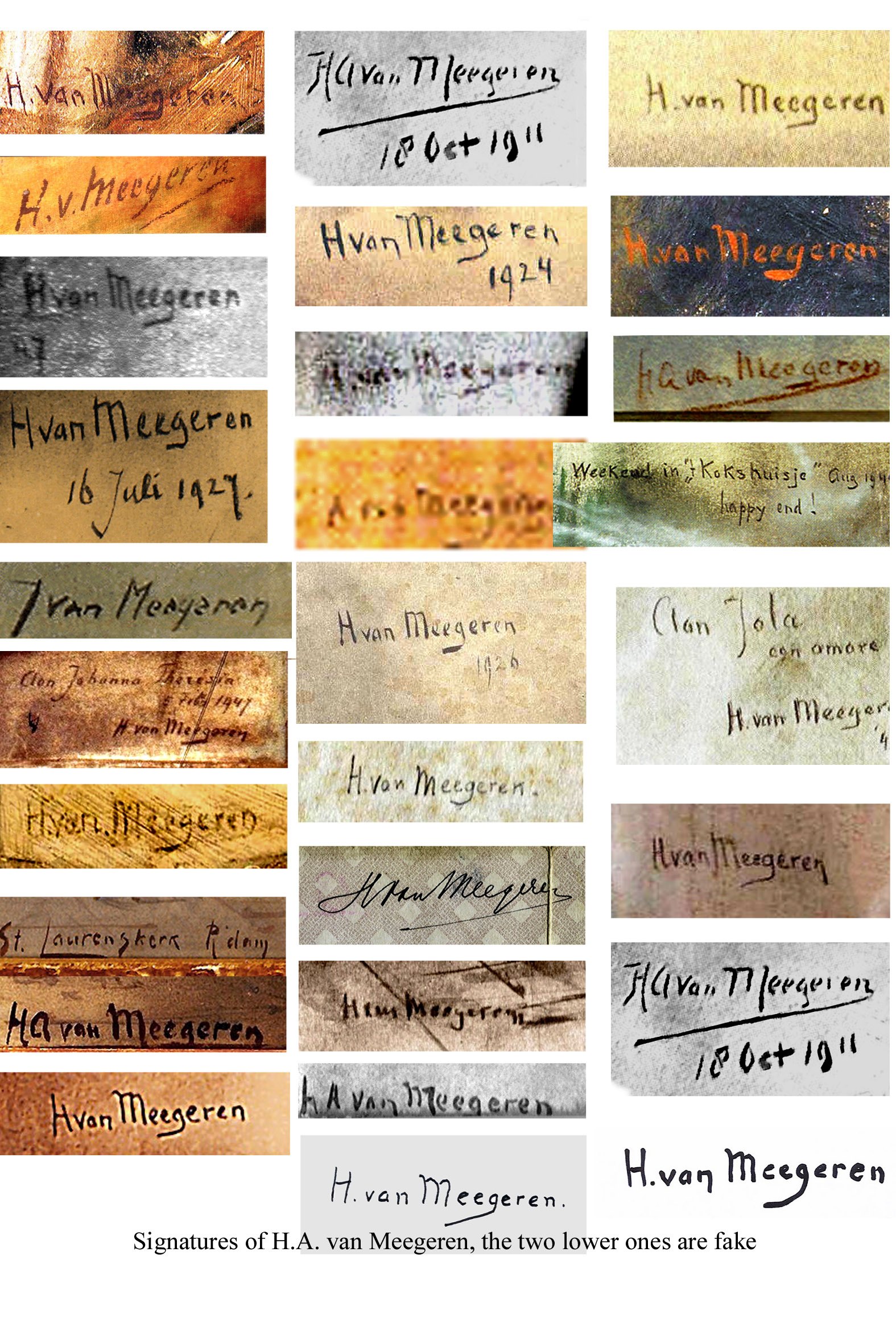
Vermeer signed rarely, small and unobtrusively — the monogram woven into a shadow or a map's edge. The forgeries carry his name with a confidence the real painter seldom showed, and this comparison sheet, assembled during the investigation, lines the imitations up like suspects. It is the forger's eternal problem: the signature must be present enough to sell the picture, and absent enough to be Vermeer.
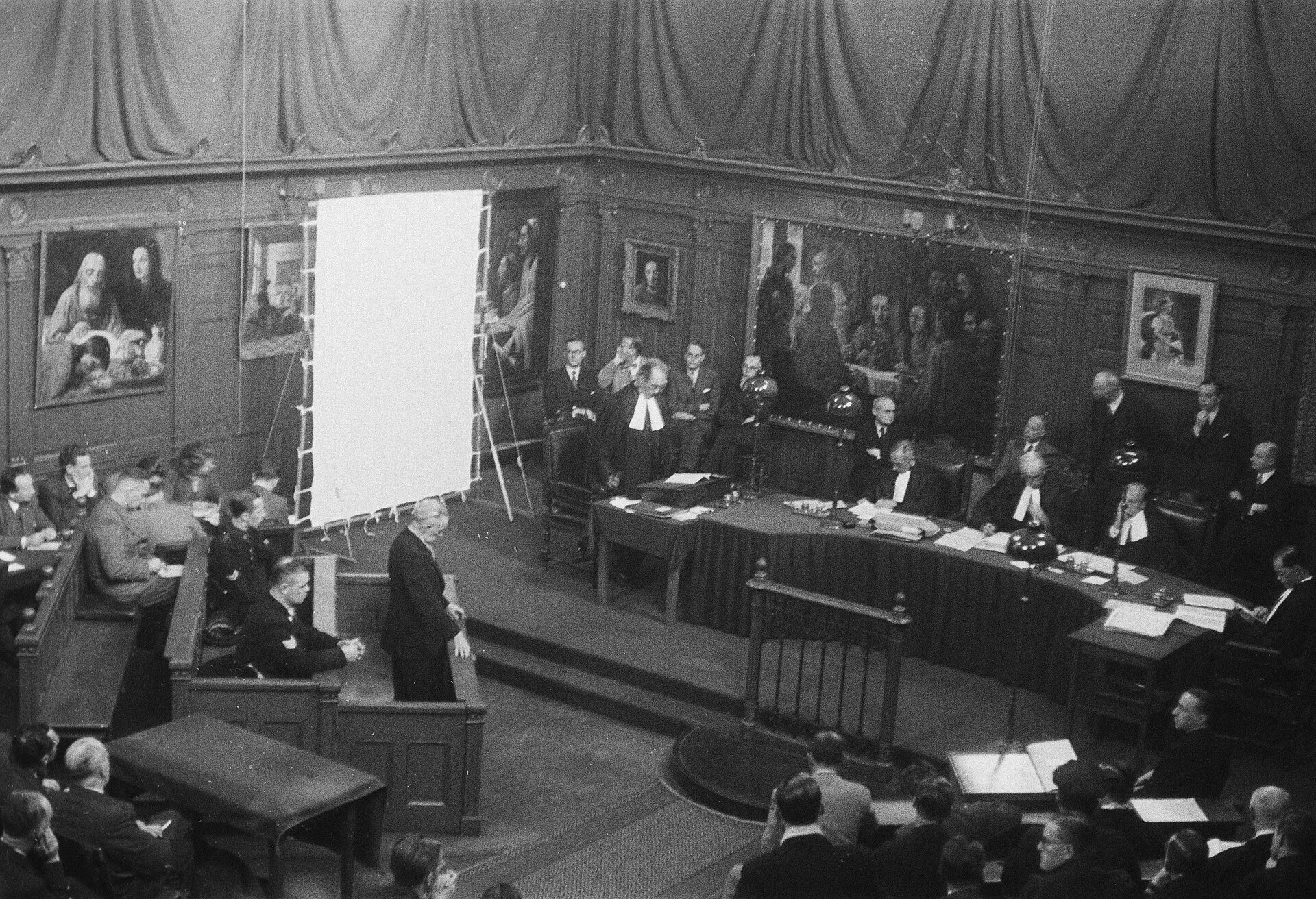
The courtroom, 1947: the state prosecutes a man for paintings it had celebrated, in a trial where the defendant's whole defence is that he is guilty of something else. Spectators queue for seats. Within weeks of the verdict Van Meegeren is dead, and the 'Vermeers' begin their second career — as Van Meegerens, exhibited, studied, and sold under the name of the man who painted them to prove the experts wrong.