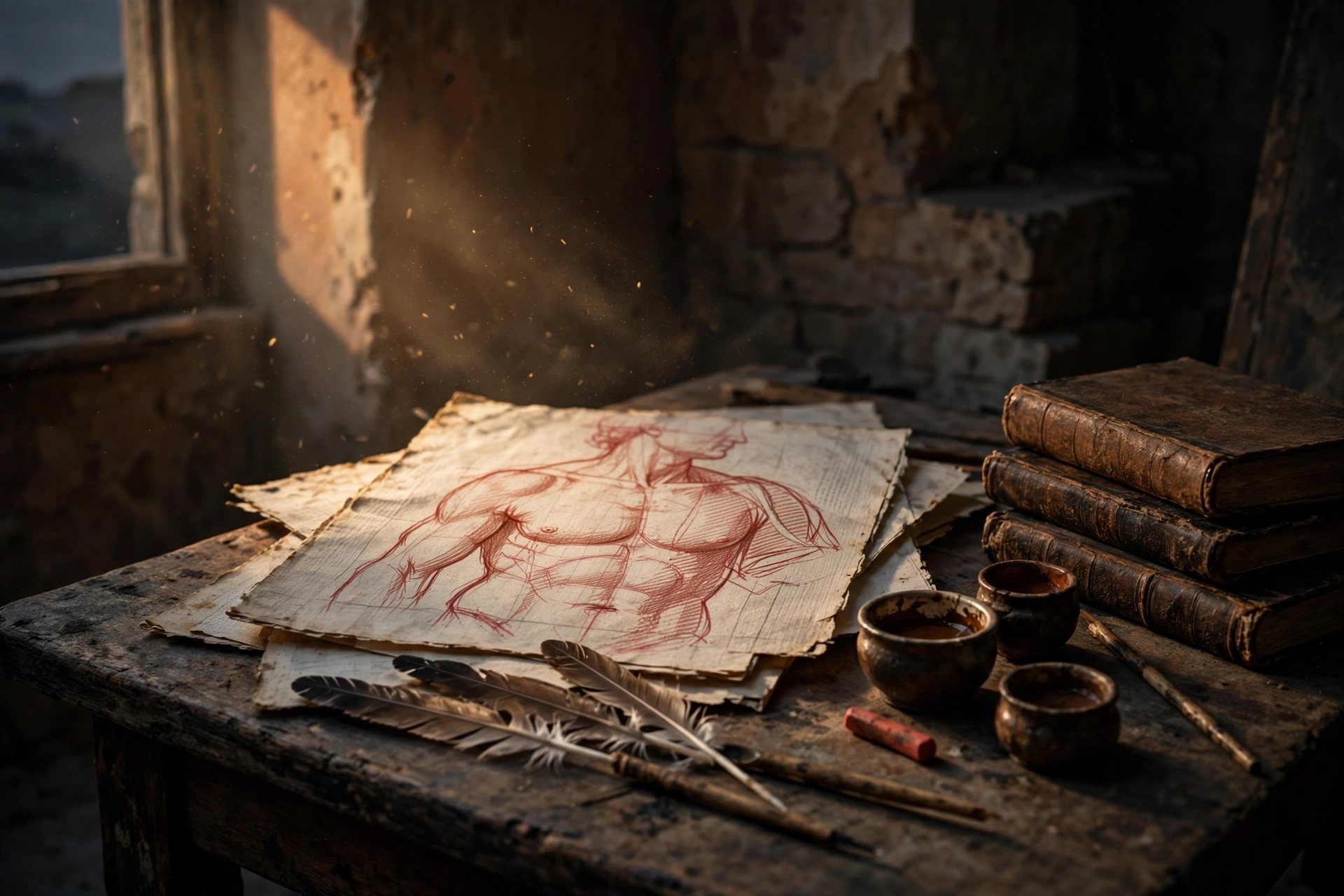
Of all the forgers in this wing, Eric Hebborn chose the quietest weapon: not the canvas but the sheet of paper. A drawing has no craquelure to fake and no weave to match — it is judged almost purely by the eye — and Hebborn, a Rome Prize draughtsman of real brilliance, could draw like Bruegel, like Van Dyck, like Rubens, on paper that was genuinely old, in inks made from period recipes. His inventions passed through London's greatest drawing dealers into the world's museums. This is his room: the forger as scholar, who confessed everything in a bestselling autobiography — and whose death in a Roman street remains unexplained.
Hebborn was no amateur with a grievance; he was the real thing — trained at Chelsea and the Royal Academy Schools, winner of the Rome Prize in 1959, a draughtsman whose line scholars still admire. In Italy he restored old drawings, and restoration taught him the trade from inside: the papers, the inks, the way a master's hand actually moves. When his own work failed to sell, the conclusion he drew was not that he lacked talent, but that the market lacked eyes.
The choice of medium was the masterstroke. An oil painting carries centuries of physical evidence — ground, weave, craquelure, chemistry. A drawing is ink on paper, and both could be genuine antiques: Hebborn drew on the blank leaves of period books and made his inks from historical recipes, iron gall that bites and browns exactly as it should. What remained was the one test he wanted: the connoisseur's eye, looking at the line alone. He trusted his hand against their eyes, and for twenty years he won.
From the mid-1960s his drawings flowed into the market through respectable channels, above all Colnaghi of London, the most venerable drawings dealer in the world, and on into the Metropolitan Museum and other great collections — as Bruegel, Van Dyck, Rubens, Piranesi, Corot. He lived in Italy with his partner Graham David Smith, drawing quietly, while the attributions multiplied. Each sale certified the next: once a museum owns your 'Bruegel', the following sheet arrives pre-believed.
Suspicion gathered slowly — too many fine 'discoveries', too similar in flavour, from too narrow a source. In the late 1970s and early 1980s the wall cracked: Colnaghi acknowledged that drawings it had sold were fakes, and Hebborn, rather than hiding, stepped forward with something close to pride. In his 1991 autobiography Drawn to Trouble he confessed in detail and named works hanging in famous museums as his own. Some claims were accepted; others the museums disputed — and dispute, of course, was exactly his point about the eye.
His strangest legacy is a textbook. The Art Forger's Handbook, published after his death, is a serious technical manual — papers and watermarks, pens, chalks, inks, the ageing of a sheet — written with a craftsman's love and no remorse. His doctrine ran through it: if a drawing is indistinguishable from a master's, the fraud is in the label and the price, not in the drawing; blame the market that worships names and cannot see lines. It is a self-serving argument. It is not an empty one.
In January 1996 Hebborn was found in a street in Trastevere, Rome, with a severe head injury, and died in hospital without regaining consciousness. No one was ever charged. Theories multiplied — the mafia, a vengeful art world, a robbery gone wrong — and none was proved; the file stays open in everything but name. He left behind a question no museum enjoys: how many of the drawings he claimed, in collections around the world, are still hanging under other men's names — because no one can finally prove they are his?
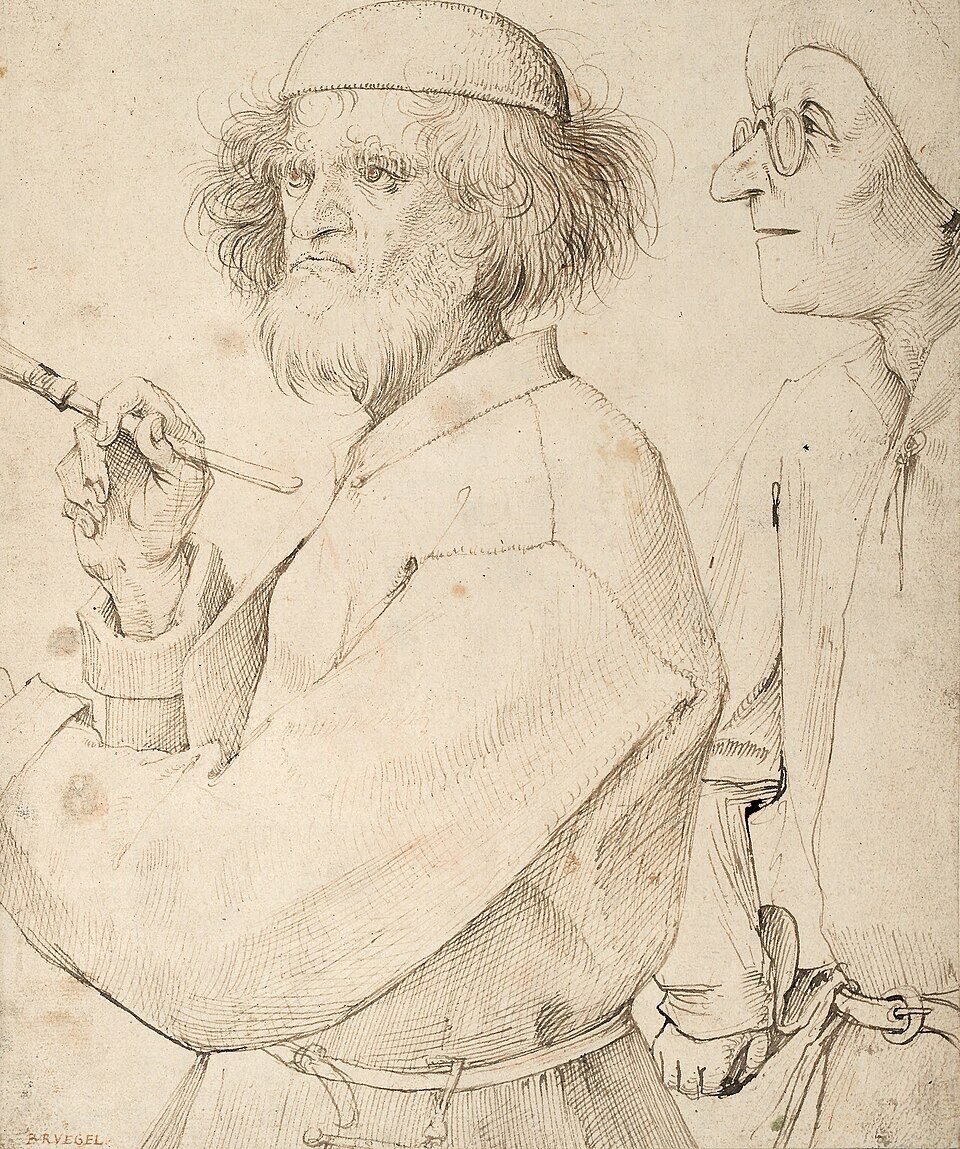
This is a genuine Bruegel — and the very species of sheet Hebborn forged best. The subject could be his emblem: the painter at work while the buyer, purse ready, leans in with the confidence of a man who trusts his eye. Bruegel's drawings are rare, mostly pen landscapes and figure studies of disarming economy; Hebborn studied that economy until his own hand could produce 'new' Bruegels that the trade received with gratitude.
This gallery rebuilds his workplace: red chalk on laid paper, quills and reed pens, iron-gall ink in earthen pots, and the blank leaves of old books waiting for their second life. Nothing here is modern except the intention. That was Hebborn's whole method — no chemistry to catch, no anachronism to trip on; only a hand trained to move as dead men's hands had moved, and paper old enough to make the lie physical.
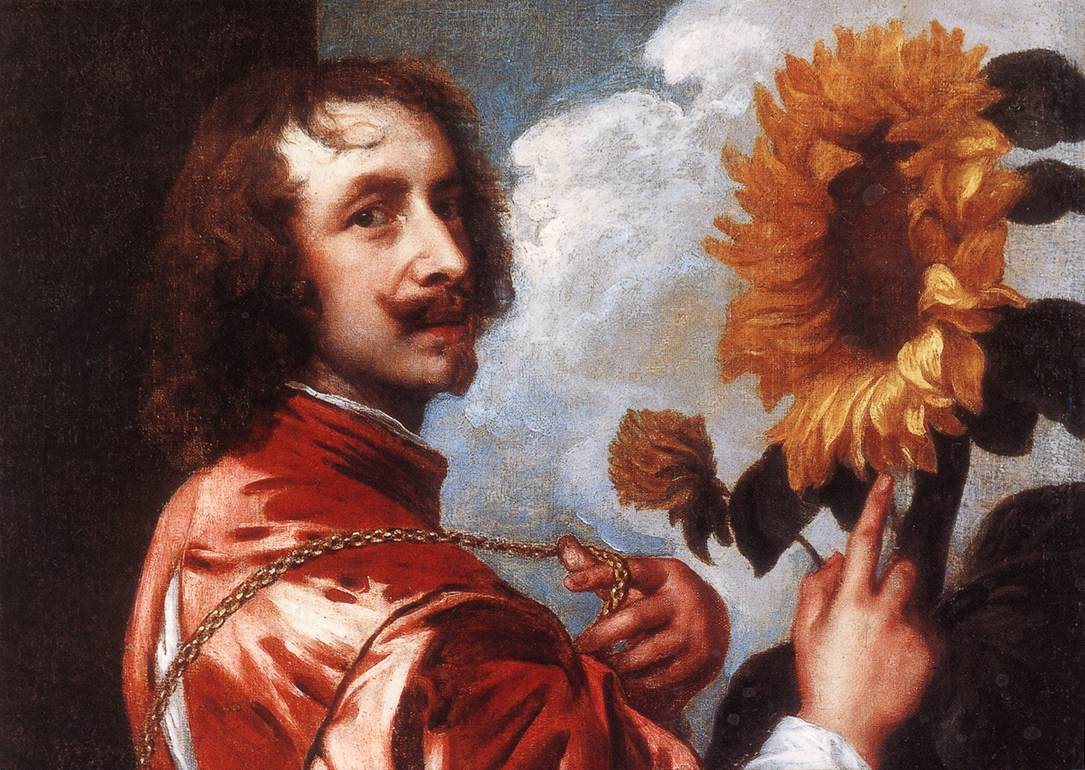
Van Dyck was another of Hebborn's masks — the fluent chalk studies and portrait drawings of the most elegant hand of the seventeenth century. The Self-portrait with a Sunflower in Van Dyck's own room of this gallery shows the genuine article's poise; the forgeries traded on exactly that poise, offering the market Van Dyck's grace in sheets it had somehow never catalogued.