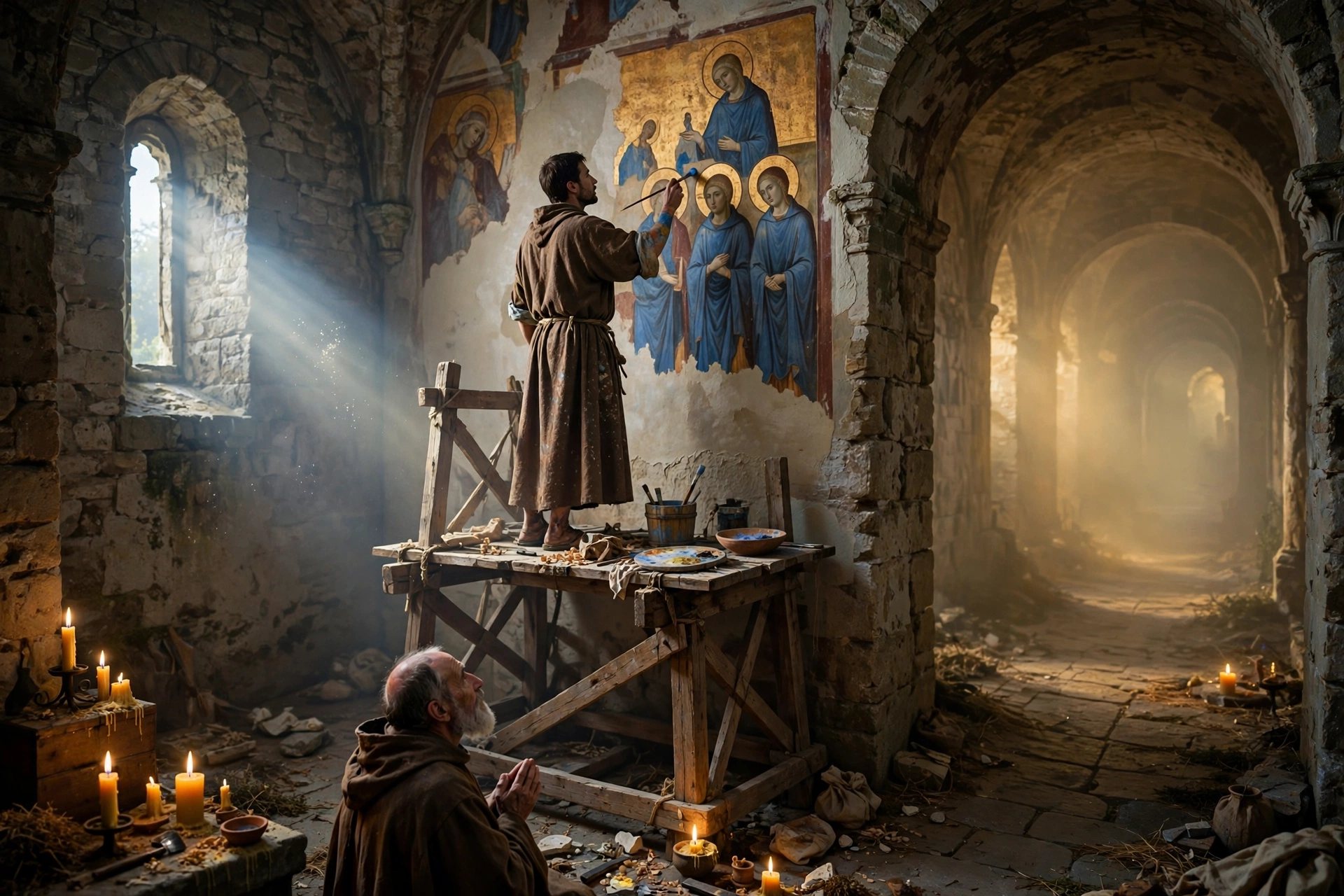
Between 1300 and 1450 painting changes its nature. In Italy, Giotto gives the flat golden image a body, a grief and a ground to stand on; a century later, in Flanders, Jan van Eyck gives it a new skin — oil paint laid in glazes until light itself seems to live in the surface. This room holds the dawn of everything this gallery shows: the moment pictures stopped being signs and became worlds.
Before Giotto, sacred figures float on gold: weightless, timeless, signs rather than people. In the Arena Chapel in Padua (c. 1305) his figures stand on real ground, turn real backs to us, weep with swollen faces. Nothing in the technique is new — the revolution is in the looking: bodies that occupy space and feel weather, grief and time.
Fresco is painted into wet lime plaster, a section at a time — the giornata, one day's work, its edges still visible if you look closely. The pigment is locked into the wall as the plaster carbonates, which is why these colours survive seven centuries; but the painter cannot correct, cannot blend at leisure, and must know the whole picture before the wall dries.
The panel painter began with poplar boards, sized and coated with gesso — chalk and glue — sanded to ivory smoothness. Gold leaf was laid on red clay bole, burnished with a dog-tooth stone and punched with patterned tools so halos catch candlelight. The gold is not background decoration: it is uncreated light, heaven rendered as metal.
Ultramarine came from a single valley in Afghanistan, carried over the sea — oltremare — and ground from lapis lazuli at a price above gold. Contracts specified exactly how much would be used and on whom: the Virgin's mantle received the true blue; lesser figures got azurite, which darkens. When you see that deep, unchanging blue in this room, you are looking at the picture's budget, spent on purpose.
Vasari claimed Jan van Eyck invented oil painting; he did not — but he perfected what oil could do. Thin translucent glazes over a bright underpainting let light enter the paint film and bounce back, so jewels, fur, glass and skin glow from within. The North found a different road from Italy's: not perspective and anatomy, but surface, light and the patient accumulation of the visible world.
Dante put Giotto's fame into the Divine Comedy while the painter still lived; Boccaccio told stories about him as about a prince of wit. Jan van Eyck signed his panels — Johannes de Eyck fuit hic, Jan van Eyck was here — and painted his own watchful face into mirrors and reflections. The anonymous craftsman of the gold ground is becoming the named master: the first light falls on the artist, too.
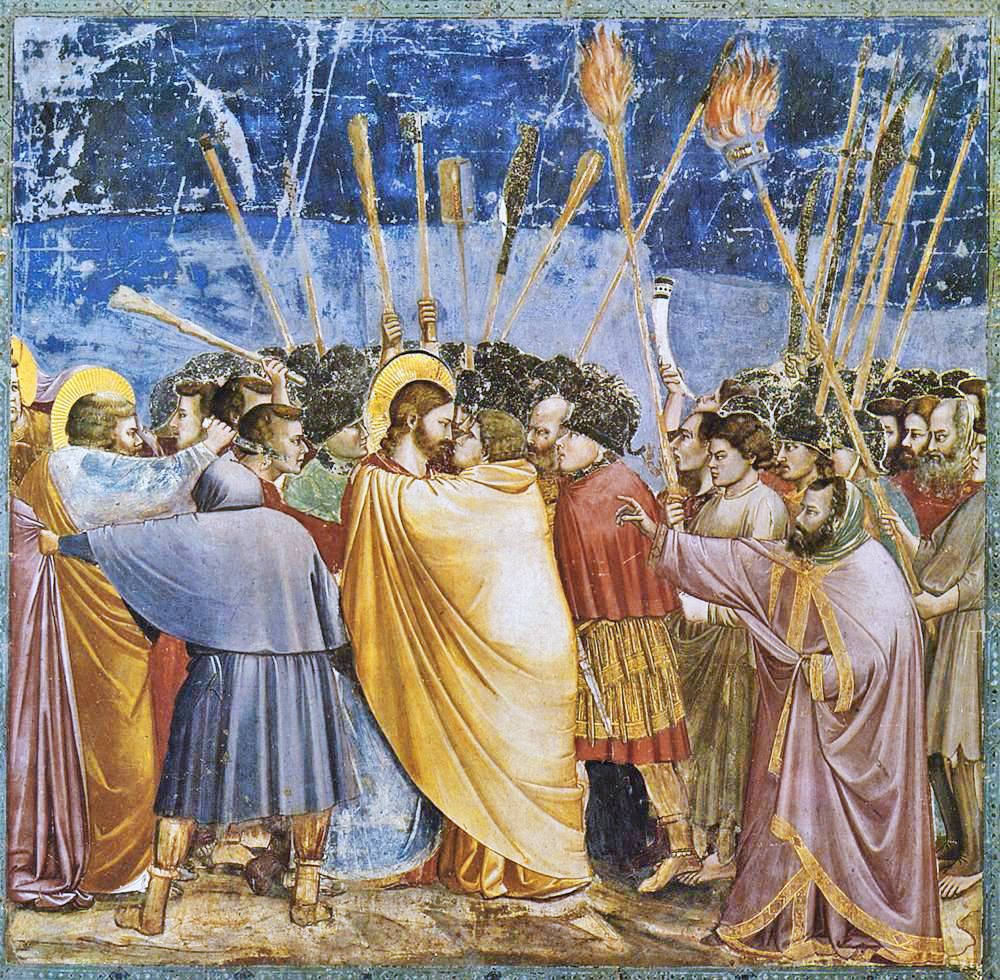
Judas's yellow cloak swallows Christ whole in an embrace that is an arrest; around them a thicket of spears, clubs and torches presses against the blue night. The two faces, profile to profile, are inches apart — the traitor calm, Christ looking past him at everything that follows.
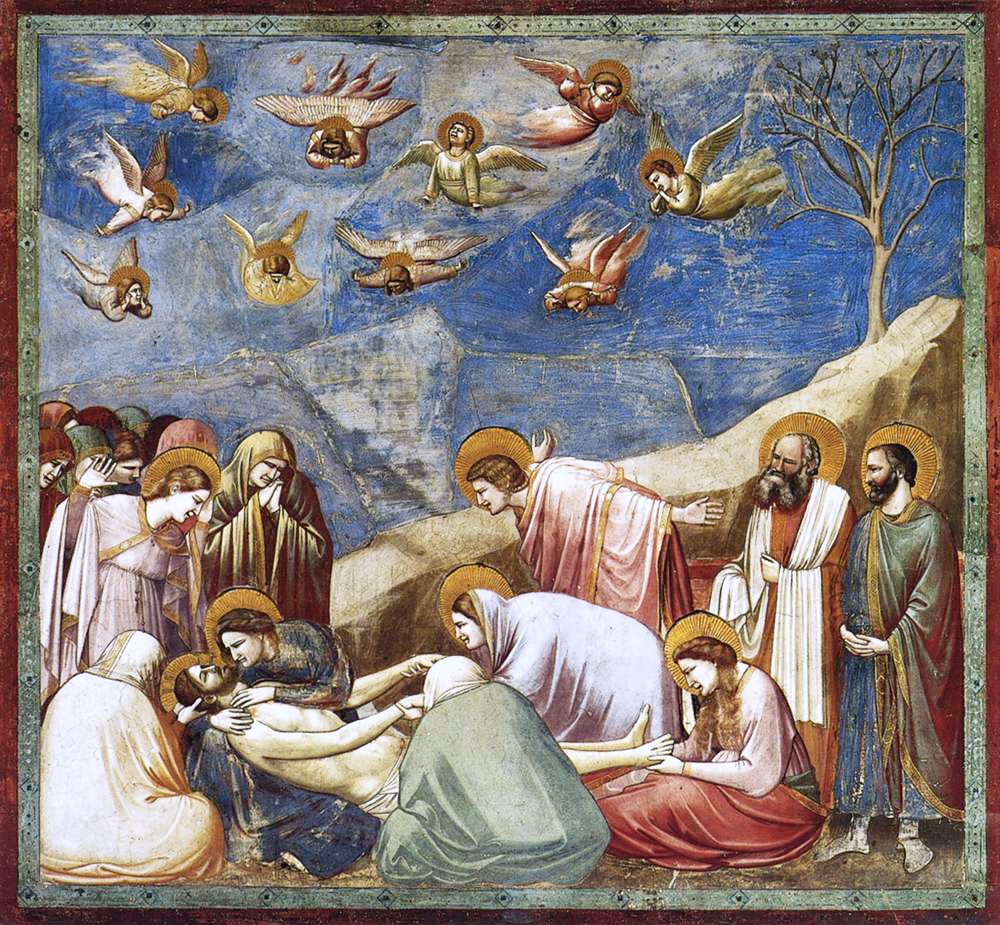
The most famous grief in Western painting: a bare diagonal of rock drives the eye down to the dead Christ's face, held by his mother face-to-face; behind, John flings his arms wide in a gesture nobody had painted before, and the little angels in the sky tear at themselves like birds in a storm.
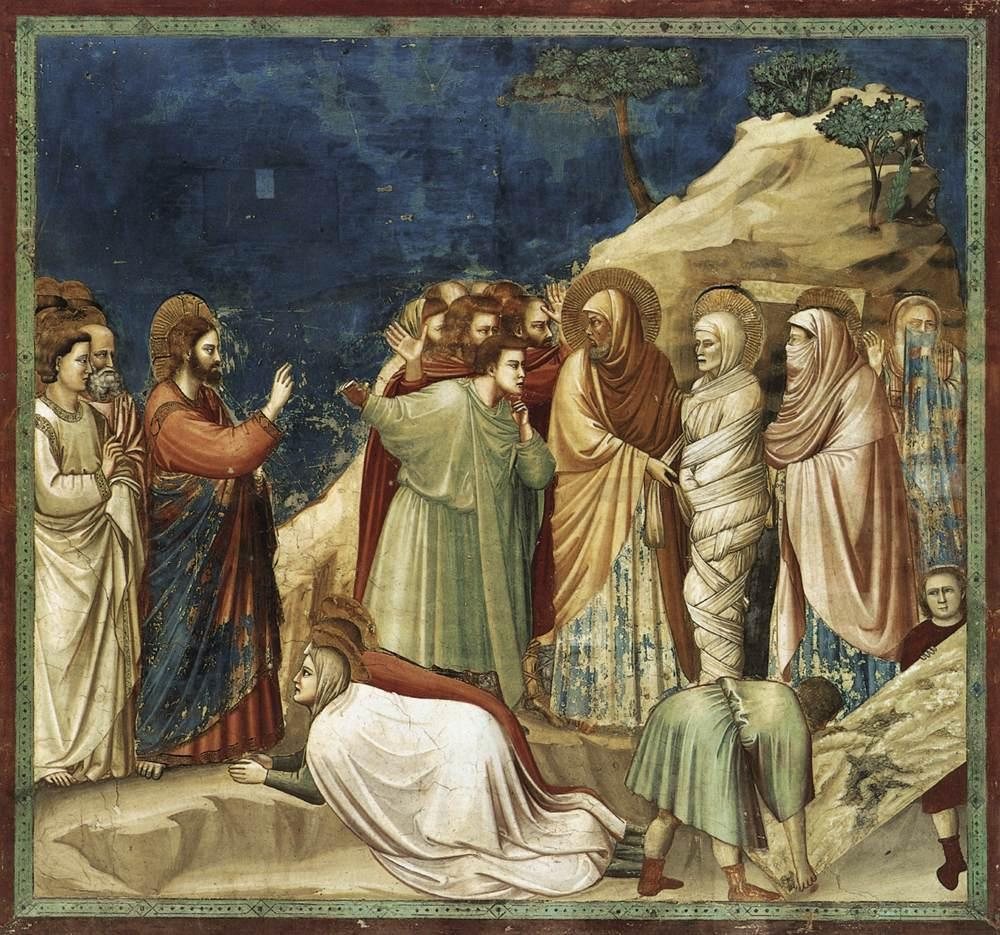
Lazarus stands upright in his grave-clothes like a parcel, the stone rolled away, Christ commanding — and at the edges the bystanders cover their noses against the smell of a four-days-dead man. A miracle with the stench left in: that is Giotto's realism in a single detail.
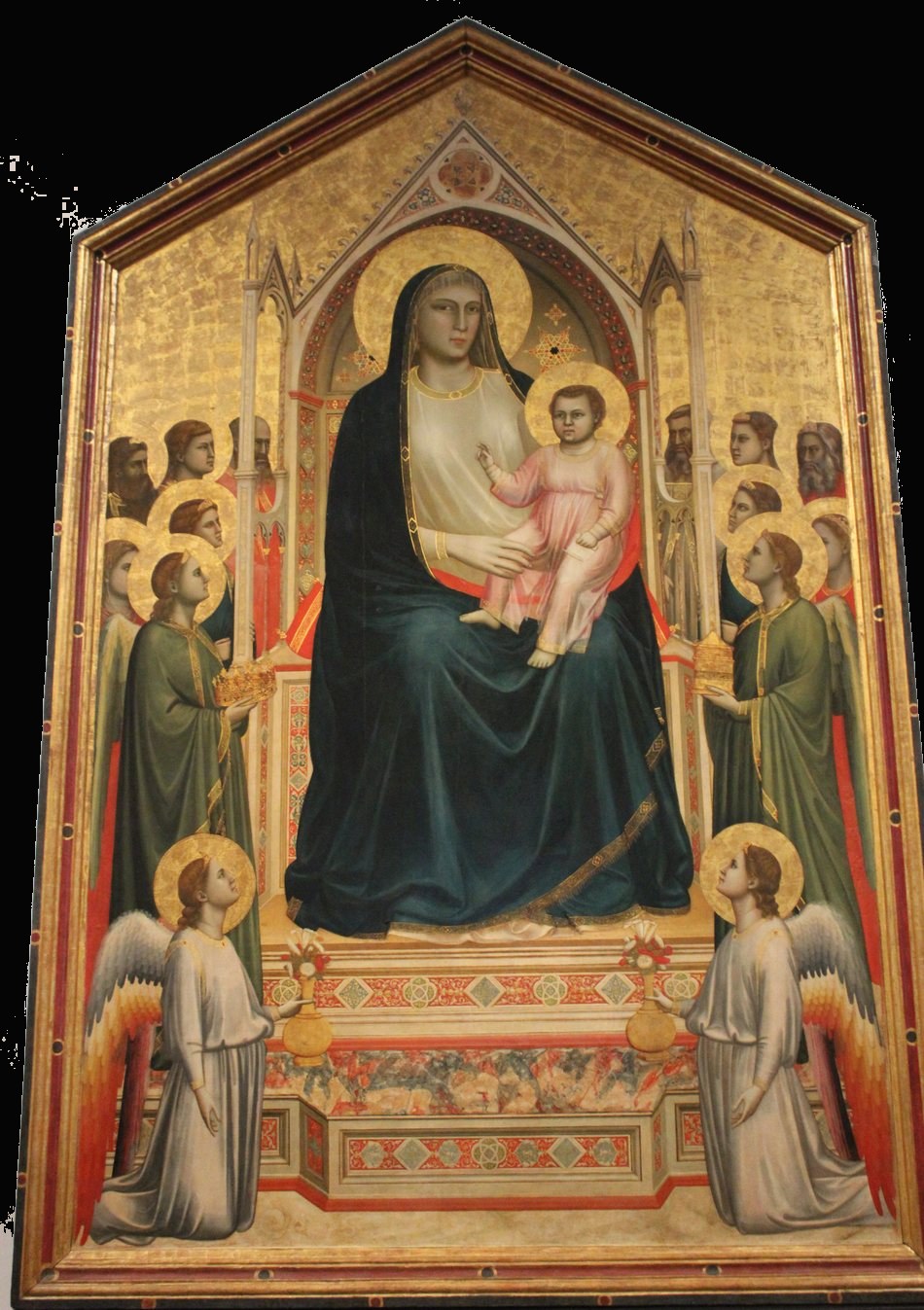
A Madonna you could climb steps to: the Virgin sits on a real throne, in a real space, with the Child's weight on her knee, angels and saints ranked beside her like courtiers measured for depth. Hung in the Uffizi between Cimabue's and Duccio's Madonnas, it shows in one glance what Giotto changed — the figures have come down off the gold and into the room.
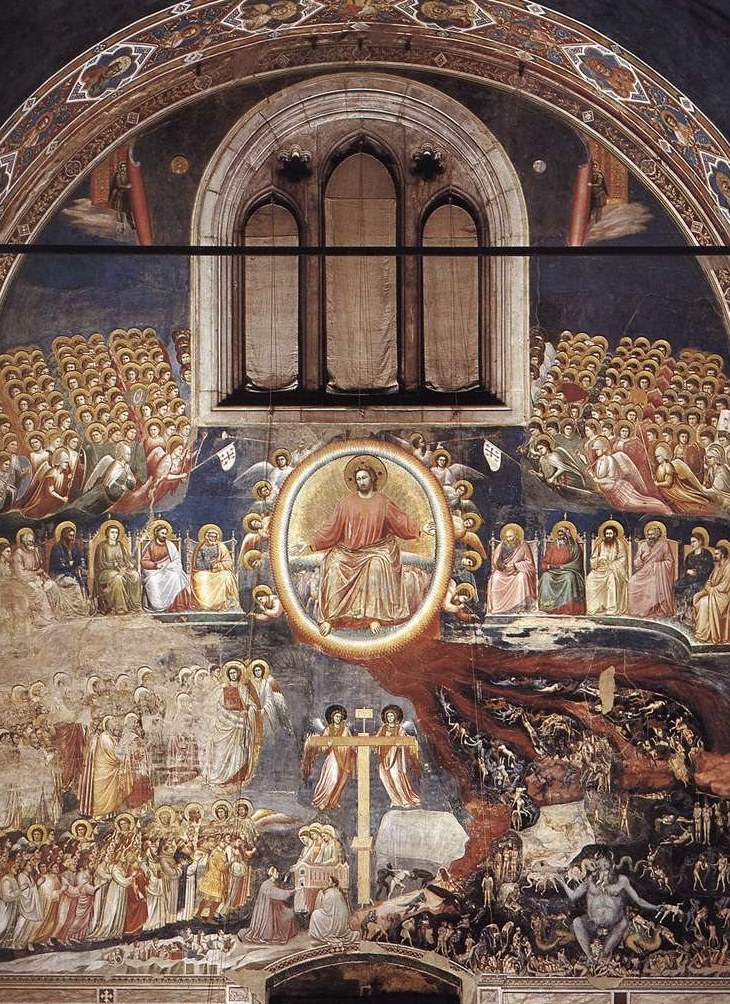
The whole west wall of the chapel is one vision: Christ in a mandorla of rainbow, the blessed processing to paradise, hell boiling at the lower right — and at the foot of the cross, in the saved, kneels Enrico Scrovegni himself, presenting a model of this very chapel to the Virgin. The banker who built the chapel as penance for usury painted himself into the front row of heaven.
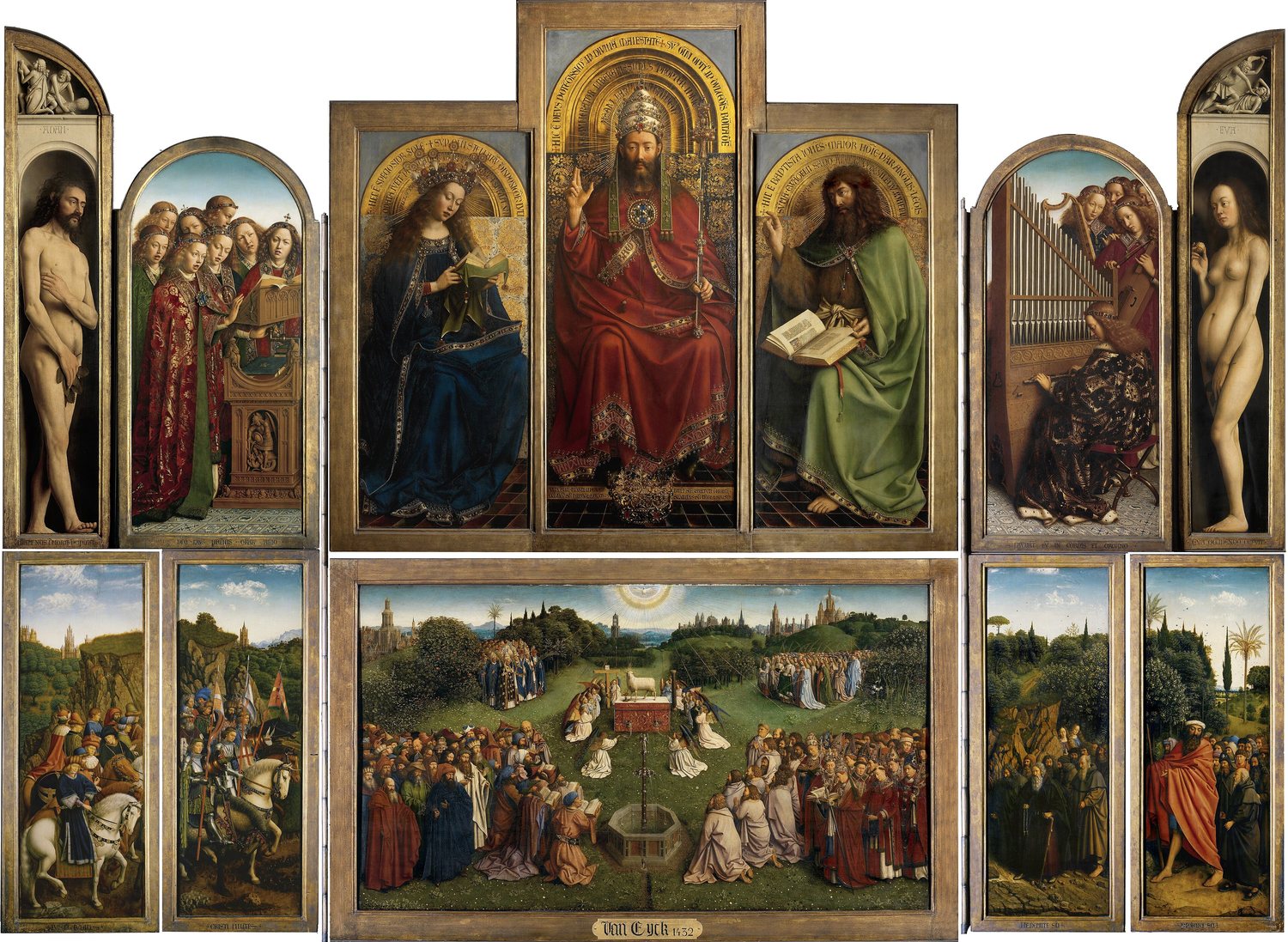
The open altarpiece, shown here in full: singing and music-making angels around the enthroned Deity above, and below, the Lamb on the altar while prophets, martyrs and knights stream across a spring landscape to adore it. Begun by Hubert van Eyck and finished by Jan, it has been stolen so often that it is called the most stolen artwork in history.
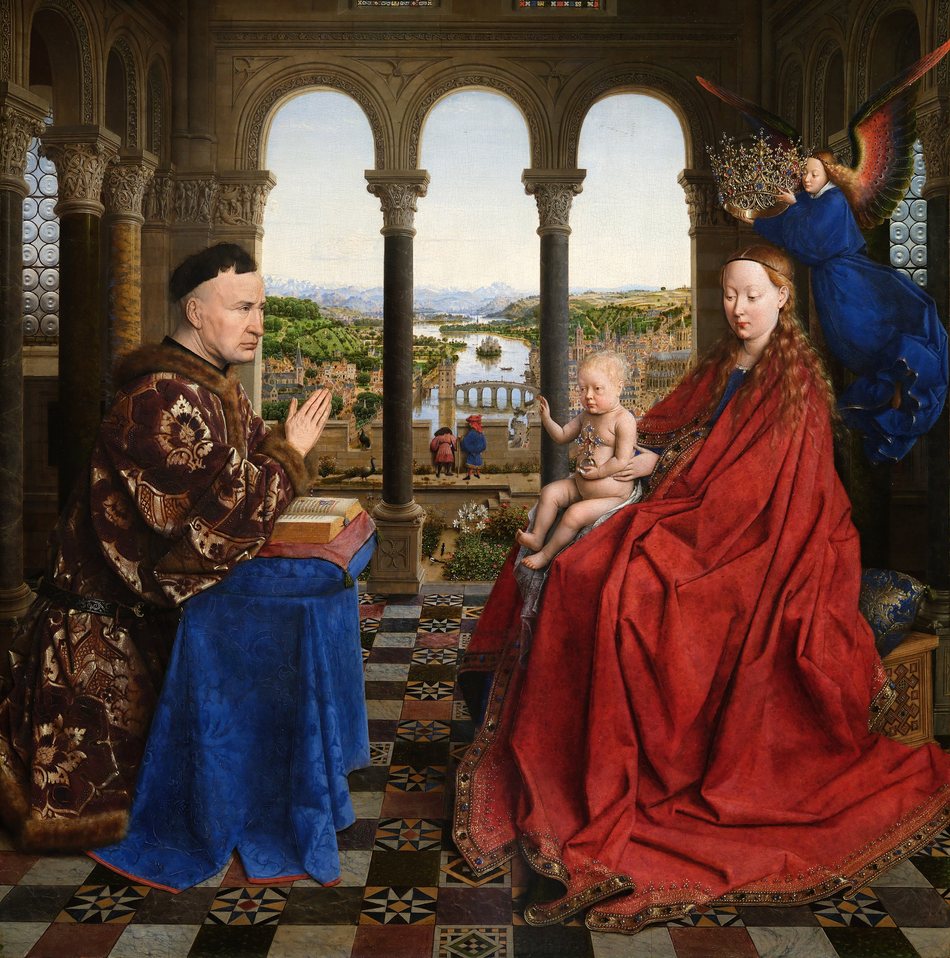
The most powerful layman in Burgundy kneels at his prayers as close to the Virgin as paint allows, while an angel descends with her crown. Through the triple arch behind them lies a whole river city — hundreds of tiny figures on a bridge, gardens, churches, and hills dissolving into blue distance.
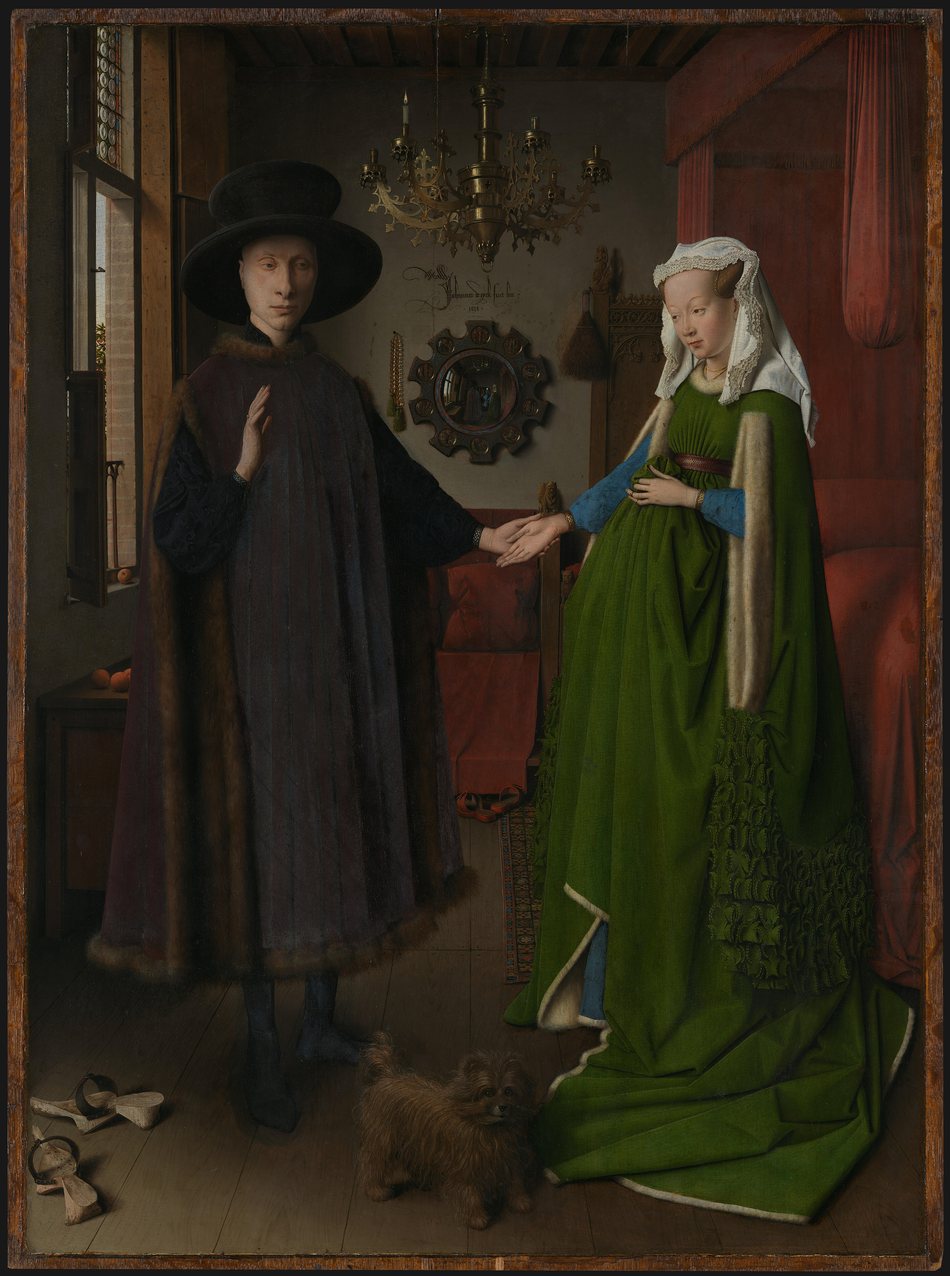
A Florentine merchant and his wife in a Bruges bedroom, every object — the little dog, the oranges, the discarded clogs, the beads by the mirror — painted with a jeweller's patience. In the convex mirror two men enter the room, and above it Van Eyck signs like a witness to a contract: Jan van Eyck was here, 1434.