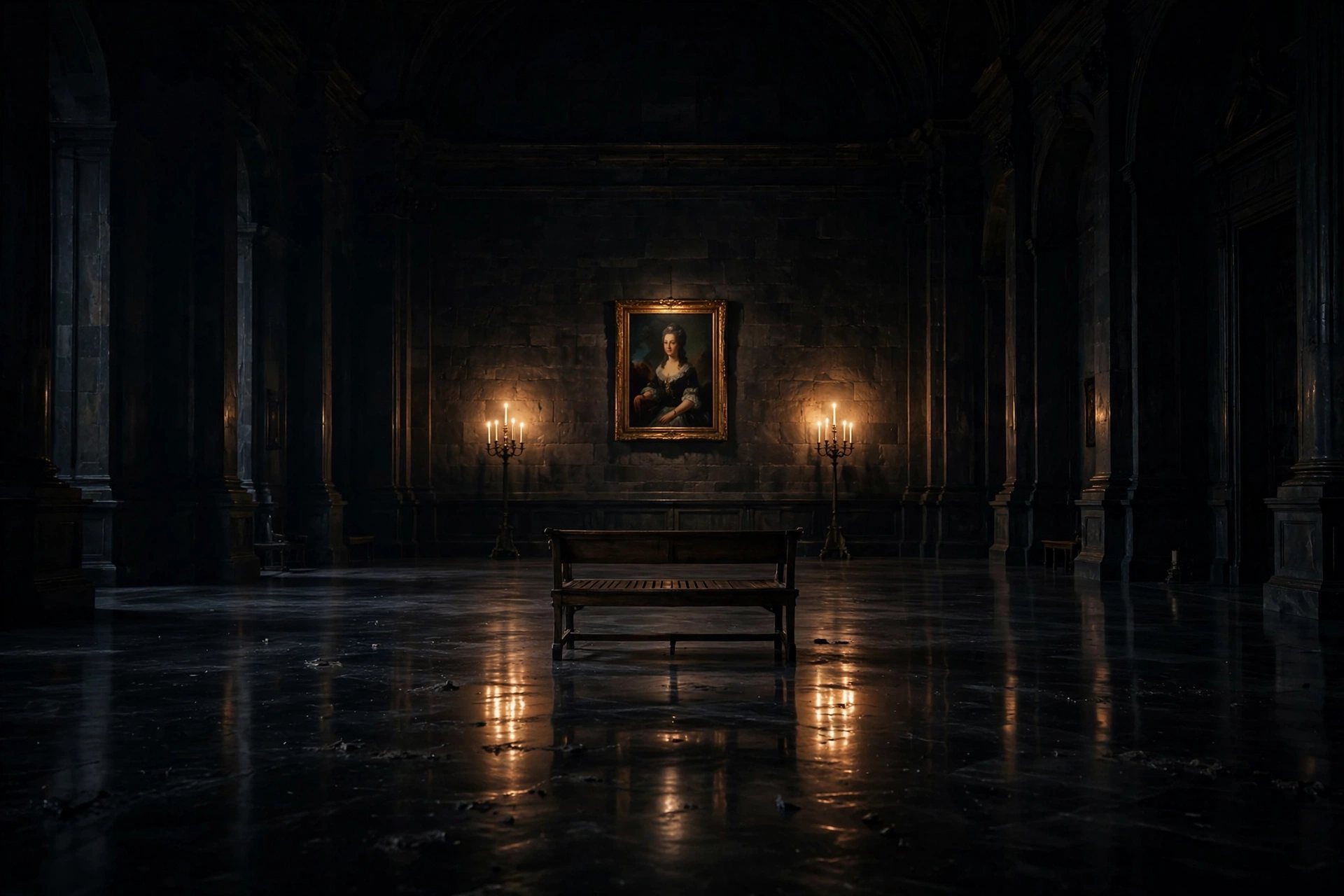
Every other room in this gallery crowds your eye. This one empties it. A single painting hangs alone in the dark, and the room asks for the rarest thing a gallery can ask: not your attention in passing, but your evening. Tonight's picture is the most candlelit canvas ever painted — Georges de La Tour's Magdalene, alone with a flame and a skull. Sit down. The chapters below are paced for a slow hour.
Everything in the picture is organised by one small flame, hidden behind the Magdalene's hand and revealed only by its light. La Tour paints no window, no moon, no second source — a single candle's worth of light against a whole world of dark. Begin your evening here: notice how the flame is almost the smallest thing in the painting, and entirely in command of it.
On her knees rests a skull, and her fingers touch it the way other hands in this gallery touch books, letters, lutes. It is the vanitas emblem — remember you must die — but La Tour refuses horror. The skull is furniture of her thought, worn smooth by contemplation. In the candlelit rooms of the seventeenth century, this was not morbidity; it was a way of keeping the evening honest.
Her profile is cut by the light into a lit half and a lost half, and La Tour simplifies everything he touches: the hair is a smooth helmet, the sleeve a single architecture of cloth, the body almost a piece of geometry. Stand close and the painting approaches abstraction; step back and it is a woman thinking. The whole of La Tour lives in that oscillation, and an evening is long enough to feel it slow down.
Nine-tenths of this canvas is darkness, and it is not empty: La Tour modulates it in browns and blacks the way other painters modulate colour. He painted the night the way Vermeer painted the morning — as a medium you live inside. The dark is why the picture cannot be hurried. Your eyes need minutes to adjust, exactly as they would in the room it depicts.
She is Mary Magdalene, the penitent — but La Tour strips away her story until only a state remains: wakefulness, at night, with death in her lap and light in her hand. No ointment jar, no grotto, no ecstasy. In his Lorraine, far from Rome's theatrical baroque, devotion looked like this: provincial, silent, interior. The painting's refusal to perform is what makes modern viewers trust it.
The room's only rule is on the way out: carry one thing. Not the whole picture — the angle of a hand, the exact orange of the flame's heart, the patience of the dark. Slow looking is not a technique for paintings; it is a way of returning to the rest of life with adjusted eyes. The bench is empty again. The candle, in the picture, is still burning. It has been burning for nearly four hundred years.
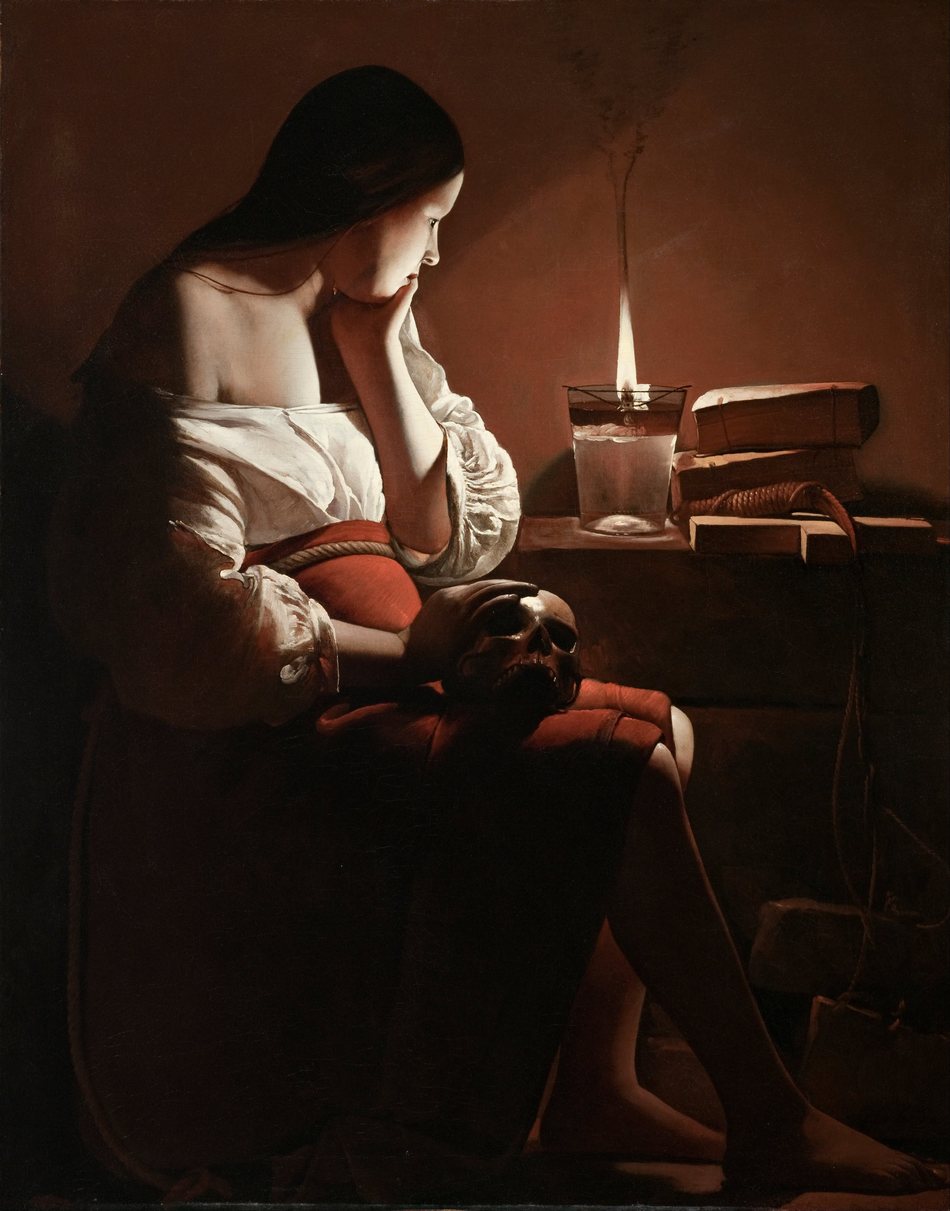
She sits in profile in a darkness so complete that the world has been reduced to three things: her face, a flame, and the skull resting on her knees. Georges de La Tour painted several Magdalenes by candlelight in the 1630s and 1640s; this, the version in Los Angeles, is the one with the smoking flame — the wick still curling its thin thread of smoke upward, as if the candle had just been lit, or is just about to matter. Nothing happens in this picture, and it happens completely.